What To Do When You're Stopped By Police - The ACLU & Elon James White
What To Do When You're Stopped By Police - The ACLU & Elon James White
Know Anyone Who Thinks Racial Profiling Is Exaggerated? Watch This, And Tell Me When Your Jaw Drops.
This video clearly demonstrates how racist America is as a country and how far we have to go to become a country that is civilized and actually values equal justice. We must not rest until this goal is achieved. I do not want my great grandchildren to live in a country like we have today. I wish for them to live in a country where differences of race and culture are not ignored but valued as a part of what makes America great.
Friday, June 05, 2026
‘They are disturbing the dead’: reconstructing the site of the forgotten first genocide of the 20th century
(As usual European colonialists minimize the numbers of people they murder in their colonization of indigenous populations.
What is Genocide?
One of five hundred children’s drawings collected by Waging Peace showing killings, bombing and looting committed by government troops. In November 2007, the drawings were accepted by the International Criminal Court as contextual evidence of the crimes committed in Darfur.
Courtesy of The Wiener Holocaust Library Collections.
Genocide is defined as an act committed with intent to destroy, in whole or in part, a national, ethnic, racial or religious group. The term ‘genocide’ was coined in 1944 by the Polish-Jewish lawyer Raphael Lemkin in his book Axis Rule in Occupied Europe. In creating the term ‘genocide’, Lemkin intended to more clearly define the crime of mass murder of groups of people and to raise awareness of it.
Genocide became a crime in itself following the adoption of the ‘Convention for the Prevention and Punishment of the Crime of Genocide’ by the United Nations General Assembly on 9 December 1948, as result of the events of the Holocaust. The Convention came into force on 12 January 1951.
Various different acts are defined in the convention as acts of genocide, including:
Killing members of a group.
Causing serious bodily or mental harm to members of the group.
Deliberately inflicting on the group conditions of life calculated to bring about its physical destruction in whole or in part.
Imposing measures intended to prevent births within the group.
Forcibly transferring children of the group to another group.
The Stages of Genocide
In 1987, Gregory Stanton, a professor of law, published a paper which explored how genocides develop and unfold.
In his original work, Stanton identified eight key stages which resulted in acts of genocide. According to Stanton’s model, some of these stages can happen at the same time or in a different order. In 2012, Stanton expanded on these ideas, and added two further stages (Discrimination and Persecution) to make ten. According to Stanton’s current model, therefore, the stages of genocide are as follows:
Classification – Dividing people into ‘them’ and ‘us’.
Symbolisation – Forcing groups to wear or be associated with symbols which identify them as different.
Discrimination – Excluding groups from participating in civil society, such as by excluding them from voting or certain places. In Nazi Germany, for example, Jews were not allowed to sit on certain park benches.
Dehumanisation – To deny the humanity of one group, and associate them with animals or diseases in order to belittle them.
Organisation – Training police or army units and providing them with weapons and knowledge in order to persecute a group in future.
Polarisation – Using propaganda to polarise society, create distance and exclude a group further.
Preparation – Planning of mass murder and identifying specific victims.
Persecution – Incarcerating groups in ghettos or concentration camps , forcibly displacing groups, expropriating property, belongings or wealth.
Extermination – Committing mass murder.
Denial – Denial of any crimes. This does not necessarily mean denying that the acts of murder happened, but denying that these acts were a crime, and were in fact justified.
Stanton hoped that by identifying these stages it would be easier to recognise genocide before it took place and thus stop it from happening.
The Herero and Namaqua Genocide
A photograph showing German forces gathered in GSWA to join in the conflict against the Herero people in 1904.
Courtesy of Wikimedia Commons [Public Domain].
The Herero and Namaqua Genocide was the massacre of approximately 50,000 – 65,000 Herero and 10,000 Nama between 1904 and 1907 by German military forces in German South West Africa (GSWA) – modern-day Namibia .
—————————————————————————————————-
‘They are disturbing the dead’: reconstructing the site of the forgotten first genocide of the 20th century
Summary
The exhibition “Fractured Lifeworlds” in Berlin, created by Forensic Architecture and Forensis, uses digital technology to investigate the legacy of the Herero and Nama genocide in Namibia. The exhibition examines how colonial violence is inscribed into the Namibian landscape, focusing on sites like Shark Island, where a concentration camp operated from 1905 to 1907. The exhibition also highlights the ongoing impact of colonialism, including the Hyphen project, a green hydrogen initiative that threatens to disturb ancestral lands and burial grounds.
At least 3,000 Herero and Nama people died in a German concentration camp at Shark Island, Namibia. A new forensic exhibition in Berlin is using digital technology to unearth how colonisers scarred a landscape, and a community
Hanno Hauenstein
A black and white photograph of 1897 Namibian grassland showing a large tree, hills, and mountains
‘A digital shield against historical denial’ … an 1897 photograph from Hatsamas, Namibia, matched with a 3D digital reconstruction. Photograph: Forensic Architecture/Forensis, 2025
Visiting the Namibian port town of Lüderitz in late 2024, I came across a small museum run by descendants of German settlers. Alongside imperial German flags and memorabilia, it displayed artefacts of the Herero tribe that had been recovered from nearby Shark Island. What went unmentioned is that, from 1905 to 1907, Shark Island was the site of a concentration camp where Herero and Nama prisoners were subjected to forced labour, starvation and systematic abuse. At least 3,000 people are estimated to have died there.
Shark Island was used as a tourist campsite when I visited. Monuments on the island honoured Adolf Lüderitz and Heinrich Vogelsang, the German merchants who helped establish the colony known as German South West Africa. Today, it is widely reported that Namibia’s white minority – less than 2% of the population – owns roughly 70% of commercial farmland.
Fractured Lifeworlds, a new exhibition opening in Berlin this week, is built around questions of memory, geography and accountability. The show presents four years of research by Forensic Architecture, a multidisciplinary research agency that uses visual reconstructions to investigate human rights abuses from Syria and Palestine to Greece and Germany.
Produced jointly with its Berlin-based sister organisation Forensis and developed in collaboration with Namibian researchers, the exhibition traces the legacy of what has been described as the first genocide of the 20th century. Originally presented at Namibia’s National Art Gallery in Windhoek last year, it now arrives at Spore Initiative in the form of three seasonal chapters, Bush, Wind and Sand, each examining how colonial violence became inscribed into Namibia’s arid landscape.
The show’s centrepiece is a series of films that combine oral testimony from descendants of genocide victims with meticulous geological research. An eerie 30-minute film on Shark Island reconstructs the concentration camp, showing how German authorities weaponised the island’s harsh environment against prisoners – and shipped their skulls back to Germany for pseudoscientific research. The investigation also identifies sand mounts nearby, believed to be unmarked mass graves for prisoners killed on Shark Island.
Underneath Shark Island, the Lüderitz port is set to expand as part of Hyphen, a multibillion-euro British-German green hydrogen project developed in Namibia. The project would use Namibia’s rich wind and solar resources to produce green hydrogen and ammonia for export. For Germany, it promises clean energy and greater independence from foreign fossil fuels.
For many Nama and Herero descendants, it recalls familiar patterns of extraction. Much of the project’s infrastructure is being developed across a 4,000 sq km area of ancestral land that belongs to Nama communities. According to human rights groups, they have been excluded from any meaningfully participation in the project.
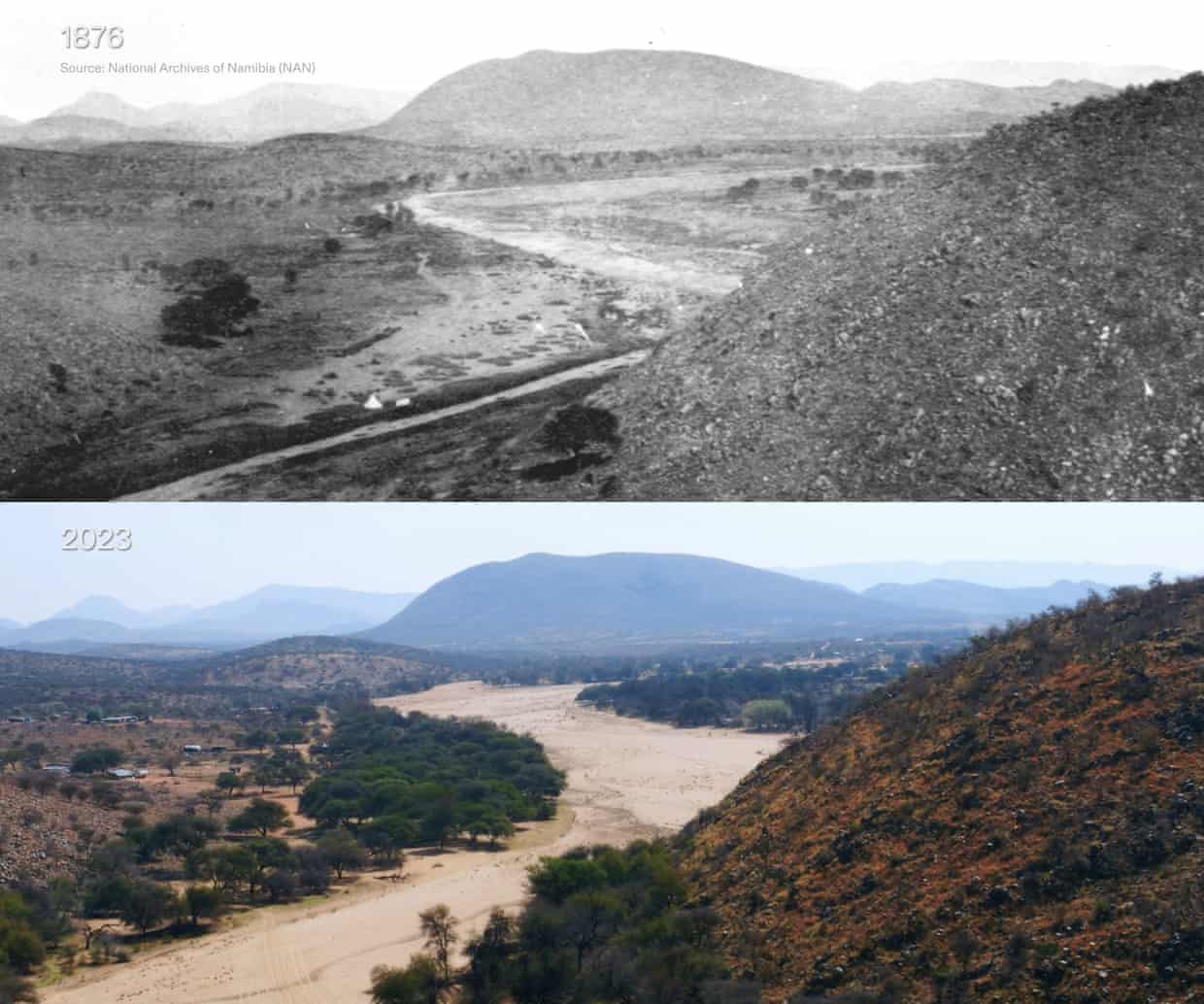
Before and after images of Hatsamas, Namibia.
Before and after images of Hatsamas, Namibia. Photograph: Forensic Architecture/Forensis
Many descendants also fear that the Hyphen project could undermine efforts to preserve Namibia’s sites of the genocide as places of remembrance. Sima Luipert, adviser to the Nama Traditional Leaders Association (NTLA) and a collaborator on the exhibition, fears the port expansion could disturb burial grounds. “When they dredge, they don’t seem to realise that they are not simply moving dirt. They are disturbing the dead,” she says. “The water is the burial site.”
Germany refuses to pay reparations to Herero and Nama descendants, offering instead development aid payments negotiated with the Namibian government. When Germany formally recognised the atrocities in 2021, it described them as a genocide “from today’s perspective” – a formulation critics say avoids the legal and political implications of recognition. By that logic, no act committed before the 1948 genocide convention could fully qualify as such.
To Luipert, the agreement reflects a glaring double standard. “Germany can swiftly compensate victims of the Holocaust while invoking strict legal technicalities to deny reparations to Africans,” she says. To her, the show is a way to provide evidence – “a digital shield against historical denial”.
In recent years, Forensic Architecture’s work has divided opinion. Critics see its work as persuasive visualisations built on evidence that can be ambiguous; supporters argue the collective has pioneered new ways of exposing structures of violence that might otherwise remain hidden or obscured.
In the works presented in Berlin, transparency about methodology is central. This is perhaps most convincing in a film on the Hornkranz massacre of 1893, when German colonial troops under Curt von François attacked the settlement of Nama leader Hendrik Witbooi, killing dozens of civilians. Drawing on oral histories, photographs and in-depth analysis of changes in the landscape, the film reconstructs an atrocity largely absent from German collective memory.
The film’s process of reconstruction is visible throughout the exhibition space. Historical drawings, maps and a letter by Von François are displayed alongside digital models that imagine how the village might have looked before the massacre.
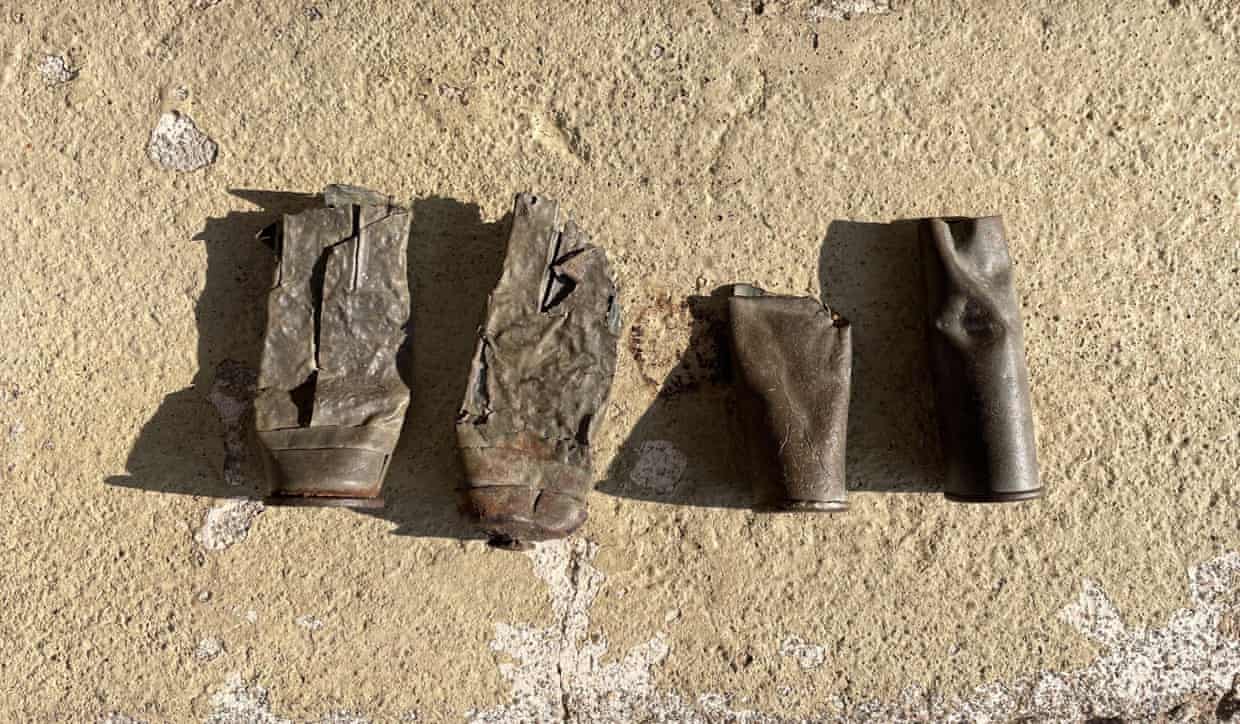
Evidence of a massacre: spent cartridges at Horncranz, dating back to 1893
Evidence of a massacre: spent cartridges at Horncranz, dating back to 1893. Photograph: Forensic Architecture/Forensis
Mark Mushiba, the lead curator of Fractured Lifeworlds and a researcher at Forensis, explains that historians have largely relied on colonial documents. Forensic Architecture and Forensis instead sought to “read the landscape”. In Hornkranz – which is now used as a private farm – that meant locating old bullet cartridges, identifying former homesteads through distinctive vegetation patterns and treating plants as historical evidence. “We were absolutely shocked by the lack of physical investigation that was done here,” Mushiba says.
Forensic Architecture founder Eyal Weizman describes their approach in Namibia as a form of “forensic botany”. With Forensis, the research agency analysed shades of grey in colonial photographs to infer patterns of grass density, and combined these findings with other sources to reconstruct the erasure of local communities. The aim is to recover a record inscribed in the landscape. In Weizman’s words, the show is about finding ways to “send a satellite back in time”.
This approach is mirrored in a work titled Satellite Images of Hatsamas, consisting of three digital prints in flashy red and green tones. Combining local knowledge, historical photographs and modern satellite data, the prints aim to visualise changes in vegetation over 150 years. The result will show how colonial settlement has shaped the land, leading to bush encroachment and desertification.
Contemporary artworks add a further layer to the show. Tuli Mekondjo contributes an embroidered Herero uniform titled Schutztruppe. Originally worn by German colonial soldiers, the garment was adopted by Herero communities as an act of resistance and commemoration. By stitching a human skeleton on to the fabric, Mekondjo transforms it into a wearable memorial for prisoners who died on Shark Island.
In speaking about the exhibition, Weizman repeatedly returns to the relationship between genocide and the desert: from the forced marches of Armenians into the Syrian desert to Gaza, where widespread destruction has transformed much of the territory into flattened terrain. Fractured Lifeworlds shows how colonial violence leaves traces in the land. As Germany continues to debate the meaning and scope of its memory culture, this exhibition is a timely reminder that the past remains part of the present.
Fractured Lifeworlds is at Spore Initiative, Berlin, from 7 June to 30 April”
“The exhibition “Fractured Lifeworlds” in Berlin, created by Forensic Architecture and Forensis, uses digital technology to investigate the legacy of the Herero and Nama genocide in Namibia. The exhibition examines how colonial violence is inscribed into the Namibian landscape, focusing on sites like Shark Island, where a concentration camp operated from 1905 to 1907. The exhibition also highlights the ongoing impact of colonialism, including the Hyphen project, a green hydrogen initiative that threatens to disturb ancestral lands and burial grounds.
At least 3,000 Herero and Nama people died in a German concentration camp at Shark Island, Namibia. A new forensic exhibition in Berlin is using digital technology to unearth how colonisers scarred a landscape, and a community
‘A digital shield against historical denial’ … an 1897 photograph from Hatsamas, Namibia, matched with a 3D digital reconstruction. Photograph: Forensic Architecture/Forensis, 2025
Visiting the Namibian port town of Lüderitz in late 2024, I came across a small museum run by descendants of German settlers. Alongside imperial German flags and memorabilia, it displayed artefacts of the Herero tribe that had been recovered from nearby Shark Island. What went unmentioned is that, from 1905 to 1907, Shark Island was the site of a concentration camp where Herero and Nama prisoners were subjected to forced labour, starvation and systematic abuse. At least 3,000 people are estimated to have died there.
Shark Island was used as a tourist campsite when I visited. Monuments on the island honoured Adolf Lüderitz and Heinrich Vogelsang, the German merchants who helped establish the colony known as German South West Africa. Today, it is widely reported that Namibia’s white minority – less than 2% of the population – owns roughly 70% of commercial farmland.
Fractured Lifeworlds, a new exhibition opening in Berlin this week, is built around questions of memory, geography and accountability. The show presents four years of research by Forensic Architecture, a multidisciplinary research agency that uses visual reconstructions to investigate human rights abuses from Syria and Palestine to Greece and Germany.
Produced jointly with its Berlin-based sister organisation Forensis and developed in collaboration with Namibian researchers, the exhibition traces the legacy of what has been described as the first genocide of the 20th century. Originally presented at Namibia’s National Art Gallery in Windhoek last year, it now arrives at Spore Initiative in the form of three seasonal chapters, Bush, Wind and Sand, each examining how colonial violence became inscribed into Namibia’s arid landscape.
The show’s centrepiece is a series of films that combine oral testimony from descendants of genocide victims with meticulous geological research. An eerie 30-minute film on Shark Island reconstructs the concentration camp, showing how German authorities weaponised the island’s harsh environment against prisoners – and shipped their skulls back to Germany for pseudoscientific research. The investigation also identifies sand mounts nearby, believed to be unmarked mass graves for prisoners killed on Shark Island.
Underneath Shark Island, the Lüderitz port is set to expand as part of Hyphen, a multibillion-euro British-German green hydrogen project developed in Namibia. The project would use Namibia’s rich wind and solar resources to produce green hydrogen and ammonia for export. For Germany, it promises clean energy and greater independence from foreign fossil fuels.
For many Nama and Herero descendants, it recalls familiar patterns of extraction. Much of the project’s infrastructure is being developed across a 4,000 sq km area of ancestral land that belongs to Nama communities. According to human rights groups, they have been excluded from any meaningfully participation in the project.
Before and after images of Hatsamas, Namibia. Photograph: Forensic Architecture/Forensis
Many descendants also fear that the Hyphen project could undermine efforts to preserve Namibia’s sites of the genocide as places of remembrance. Sima Luipert, adviser to the Nama Traditional Leaders Association (NTLA) and a collaborator on the exhibition, fears the port expansion could disturb burial grounds. “When they dredge, they don’t seem to realise that they are not simply moving dirt. They are disturbing the dead,” she says. “The water is the burial site.”
Germany refuses to pay reparations to Herero and Nama descendants, offering instead development aid payments negotiated with the Namibian government. When Germany formally recognised the atrocities in 2021, it described them as a genocide “from today’s perspective” – a formulation critics say avoids the legal and political implications of recognition. By that logic, no act committed before the 1948 genocide convention could fully qualify as such.
To Luipert, the agreement reflects a glaring double standard. “Germany can swiftly compensate victims of the Holocaust while invoking strict legal technicalities to deny reparations to Africans,” she says. To her, the show is a way to provide evidence – “a digital shield against historical denial”.
In recent years, Forensic Architecture’s work has divided opinion. Critics see its work as persuasive visualisations built on evidence that can be ambiguous; supporters argue the collective has pioneered new ways of exposing structures of violence that might otherwise remain hidden or obscured.
In the works presented in Berlin, transparency about methodology is central. This is perhaps most convincing in a film on the Hornkranz massacre of 1893, when German colonial troops under Curt von François attacked the settlement of Nama leader Hendrik Witbooi, killing dozens of civilians. Drawing on oral histories, photographs and in-depth analysis of changes in the landscape, the film reconstructs an atrocity largely absent from German collective memory.
The film’s process of reconstruction is visible throughout the exhibition space. Historical drawings, maps and a letter by Von François are displayed alongside digital models that imagine how the village might have looked before the massacre.
Evidence of a massacre: spent cartridges at Horncranz, dating back to 1893. Photograph: Forensic Architecture/Forensis
Mark Mushiba, the lead curator of Fractured Lifeworlds and a researcher at Forensis, explains that historians have largely relied on colonial documents. Forensic Architecture and Forensis instead sought to “read the landscape”. In Hornkranz – which is now used as a private farm – that meant locating old bullet cartridges, identifying former homesteads through distinctive vegetation patterns and treating plants as historical evidence. “We were absolutely shocked by the lack of physical investigation that was done here,” Mushiba says.
Forensic Architecture founder Eyal Weizman describes their approach in Namibia as a form of “forensic botany”. With Forensis, the research agency analysed shades of grey in colonial photographs to infer patterns of grass density, and combined these findings with other sources to reconstruct the erasure of local communities. The aim is to recover a record inscribed in the landscape. In Weizman’s words, the show is about finding ways to “send a satellite back in time”.
This approach is mirrored in a work titled Satellite Images of Hatsamas, consisting of three digital prints in flashy red and green tones. Combining local knowledge, historical photographs and modern satellite data, the prints aim to visualise changes in vegetation over 150 years. The result will show how colonial settlement has shaped the land, leading to bush encroachment and desertification.
Contemporary artworks add a further layer to the show. Tuli Mekondjo contributes an embroidered Herero uniform titled Schutztruppe. Originally worn by German colonial soldiers, the garment was adopted by Herero communities as an act of resistance and commemoration. By stitching a human skeleton on to the fabric, Mekondjo transforms it into a wearable memorial for prisoners who died on Shark Island.
In speaking about the exhibition, Weizman repeatedly returns to the relationship between genocide and the desert: from the forced marches of Armenians into the Syrian desert to Gaza, where widespread destruction has transformed much of the territory into flattened terrain. Fractured Lifeworlds shows how colonial violence leaves traces in the land. As Germany continues to debate the meaning and scope of its memory culture, this exhibition is a timely reminder that the past remains part of the present.



No comments:
Post a Comment