Wednesday, December 31, 2025


Israeli ban on aid agencies in Gaza will have ‘catastrophic’ consequences, experts say | Gaza | The Guardian
Israeli ban on aid agencies in Gaza will have ‘catastrophic’ consequences, experts say
"Thirty-seven NGOs told they have to cease operations, putting Palestinian lives ‘at imminent risk’

Israel’s new ban on dozens of aid organisations working in Gaza will have “catastrophic” consequences for the delivery of vital services in the devastated territory and will put Palestinian lives “at imminent risk”, diplomats, humanitarian workers and experts say.
Thirty-seven NGOs active in Gaza were told by Israel’s ministry of diaspora affairs on Tuesday that they would have to cease all operations in the territory within 60 days unless they fulfilled stringent new regulations, which include the disclosure of personal details of their staff.
In a statement, the ministry said the measures were intended to prevent NGOs employing staff with links to extremist organisations and were necessary to ensure that Hamas did not exploit international aid.
Israel has repeatedly claimed that Hamas has systematically diverted aid supplies for military or political purposes and infiltrated aid organisations but has provided limited evidence to support the allegations.
Aid organisations said they had been engaging with Israeli officials for many months.
“We have made strenuous efforts to comply even if these demands are made nowhere else. We do extensive vetting ourselves. It would be disastrous for us to have any armed combatants or people linked to armed groups among our staff,” said Athena Rayburn, executive director of the Association of International Development Agencies, which represents more than 100 NGOs operating in Gaza and the occupied West Bank.
“We have such strong measures in place already and have proposed alternatives to the Israeli authorities that would meet this requirement, and they have refused.”
Israeli officials said that the NGOs hit by the ban only supplied 15% of the desperately needed assistance in Gaza, which is suffering an acute humanitarian crisis after two years of devastating war.
Aid officials said this calculation was misleading because most of the NGOs affected by the ban did not deliver their own services but were contracted by the UN to run basic health clinics, malnutrition screening, hygiene and shelter support and much else.
One senior UN official said the ban would “cripple” relief operations. Israeli laws banning Unrwa, the main UN agency dealing with Palestinians, from Gaza had already had a significant impact, they added.
Rayburn said the ban would bring about a “catastrophic collapse of humanitarian services”, and that Israel authorities had been made “fully aware” of potential consequences.
Under the 20-point agreement that allowed a fragile ceasefire to come into effect in October, Israel is obliged to allow “full aid” to be “immediately sent into Gaza”.
The ceasefire ended two years of relentless conflict, but further progress towards a lasting peace deal has stalled, with Israel saying it will not withdraw from the 53% of Gaza territory that is still under its control until Hamas disarms and returns the remains of the last hostage it is holding. The Islamist militant organisation has so far refused to commit to full disarmament.
Speaking on Monday, Donald Trump said he hoped “reconstruction” could begin soon in the Palestinian territory, reduced to ruins by Israeli offensives in response to Hamas’s 7 October 2023 attacks, but gave no details.
Some aid officials said they would be able to find “workarounds” to mitigate the worst effects of the ban but that urgent assistance was needed in Gaza, where recent storms have destroyed tents that were the only shelter for an estimated 500,000 people, food is expensive and clean water, scarce.
On Wednesday, Volker Türk, the UN human rights chief, said in a statement that Israel’s move was “outrageous”, warning that “such arbitrary suspensions make an already intolerable situation even worse for the people of Gaza”.
The EU warned on Wednesday that the new NGO registration law that had led to the ban “cannot be implemented in its current form”.
But Israeli officials insisted the law was necessary. “They [the NGOs] refuse to provide lists of their Palestinian employees because they know, just as we know, that some of them are involved in terrorism or linked to Hamas,” Gilad Zwick, spokesperson for the ministry of diaspora affairs and combating antisemitism, told AFP.
Médecins Sans Frontières (MSF), the main medical aid organisation, is among those facing a ban.
Israeli officials claim individuals affiliated with MSF have links to Hamas and Palestinian Islamic Jihad. MSF rejects the accusations as unsubstantiated, adding it would never knowingly employ anyone engaged in military activity.
Shaina Low, a spokesperson for the Norwegian Refugee Council, which has extensive operations in Gaza, said it would be impossible to fulfil the new Israeli requirements.
“It is a security concern and a legal concern … and it’s all a distraction from actually getting aid to the people who need it,” she said.
In May, aid agency Oxfam said the requirement to share staff details raised protection concerns, after attacks on humanitarian workers in Gaza.
Several aid officials reported that during the war in Gaza they had been asked by Israeli military officials to supply details of the whereabouts of their international staff there. Suspecting that the information would be used to allow Israeli strikes on offices where there were only Palestinian staff, the NGO refused.
After targeting Unrwa last year, Israel and the US backed the Gaza Humanitarian Fund, a private company that distributed aid from a small number of hubs in southern Gaza amid chaotic conditions that led to the death from Israeli fire of more than 1,000 people.
Cogat, the Israeli agency charged with administration of Gaza, said 4,200 aid trucks would continue to enter every week via the UN, donor countries, the private sector, and more than 20 international organisations that have been reregistered.
The Hamas raid that triggered the war in Gaza killed 1,200 people, mostly civilians, and led to the abduction of 250. The ensuing Israeli offensive killed about 70,000, mostly civilians, with hundreds more killed since the ceasefire."
Israeli ban on aid agencies in Gaza will have ‘catastrophic’ consequences, experts say | Gaza | The GuardianOpinion | Trump Spent the Past Year Trying to Crush Dissent - The New York Times
I Counted Trump’s Censorship Attempts. Here’s What I Found.

By Nora Benavidez
"Ms. Benavidez is the senior counsel for the media policy organization Free Press.
“We took the freedom of speech away.”
That was part of President Trump’s explanation in October of his executive order that purports to criminalize burning the American flag. Though his words fail as a constitutional rationale, they inadvertently distill many of his efforts at smothering dissent during the past 11 months.
Since returning to office, Mr. Trump and his administration have tried to undermine the First Amendment, suppress information that he and his supporters don’t like and hamstring parts of the academic, legal and private sectors through lawsuits and coercion — to flood the zone, as his ally, Steve Bannon, might say.
Some examples are well known, such as when ABC briefly took Jimmy Kimmel off the air after Brendan Carr, the chairman of the Federal Communications Commission, objected to a reference in one of Mr. Kimmel’s monologues about the killing of Charlie Kirk. Other examples received less attention, but by my count, this year there were about 200 instances of administration attempts at censorship, nearly all of which I outline in a new report.
Mr. Trump’s playbook isn’t random. It employs several recurring modes of attack.
The president has tried to cow the press. His administration banned Associated Press reporters from certain parts of the White House and Air Force One because the outlet uses “Gulf of Mexico” rather than the term Mr. Trump prefers, “Gulf of America.” It tried and failed to force some of the nation’s biggest news organizations to agree to restrictions on coverage of the Pentagon. He has said critical coverage of his initiatives is “really illegal.”
A journalist from El Salvador, Mario Guevara, was arrested while reporting on a No Kings protest in Georgia; he was detained for more than three months, then deported. At an Oval Office meeting between Mr. Trump and Crown Prince Mohammed bin Salman of Saudi Arabia, an ABC News correspondent, Mary Bruce, asked about the killing of the Saudi journalist Jamal Khashoggi and about the Jeffrey Epstein files. Mr. Trump replied by berating her at length, at one point describing one of her questions as “insubordinate” — a characterization that upends the entire notion of a free press.
Sign up for the Opinion Today newsletter Get expert analysis of the news and a guide to the big ideas shaping the world every weekday morning.
The administration has used immigration status to try to suppress political speech. In March, Mahmoud Khalil, a green card holder and a leader of pro-Palestinian demonstrations on the Columbia campus, was arrested and detained by immigration officials for several months. That month, Rumeysa Ozturk, a student visa holder, was arrested by immigration officials and detained for several weeks, apparently because she was an author of an opinion essay criticizing Tufts University for its response to the Israel-Hamas war.
It seems almost no one is beyond the scope of administration efforts to muzzle views or decisions that conflict with Mr. Trump’s agenda: After Federal District Court Judge James Boasberg ruled against the administration in a case involving the deportation of Venezuelans to El Salvador, Mr. Trump called for the judge to be impeached. A trainee was dismissed from the F.B.I.’s academy, apparently for having displayed an L.G.B.T.Q. Pride flag. The F.B.I. also appears to have fired agents for kneeling during George Floyd protests.
At a news conference in Tampa, Fla., Kristi Noem, the secretary of homeland security, asserted that filming Immigration and Customs Enforcement officers while they are in the field is tantamount to violence. In Los Angeles, Senator Alex Padilla, Democrat of California, was forced to the ground and handcuffed after interjecting at a news conference held by Ms. Noem.
In just the past few days, the administration has banned a former member of the European Commission and four European researchers from the United States, claiming that their efforts to fight disinformation and hate speech online amount to censorship of Americans.
The president federalized and deployed the National Guard in Los Angeles; a federal appeals court found that his administration had illegally prolonged the deployment. He similarly sent the National Guard to the Chicago area — an action that the Supreme Court, for now, has blocked.
As part of the administration’s war on so-called wokeness, it has identified hundreds of words, with the intent of curtailing their use. Mr. Trump issued an executive orderdirecting staff members at national parks and museums to get rid of content that, he says, portrays America “in a negative light.” Just two days after Inauguration Day, the Justice Department’s chief of staff sent a memo calling for a “litigation freeze” in the department’s civil rights division.
Two of Mr. Trump’s perceived political adversaries — James Comey, a former F.B.I. director, and Letitia James, the New York attorney general — were criminally charged (in cases now both dismissed) that were difficult to see as anything other than revenge prosecutions. A few days into his term, the president fired more than a dozen inspectors general from various federal government agencies.
Some of the nation’s biggest law firms — including Paul, Weiss and Kirkland & Ellis — have caved under presidential pressure and signed deals agreeing to contribute pro bono work for causes dictated by the administration. Several prestigious universities submitted to agreements in which they committed to change certain policies and, in some cases, pay what amounts to millions of dollars in fines.
Mr. Trump has sued social media platforms for their content moderation policies — free-speech decisions, in other words — leading to Meta, X and YouTube capitulating through settlements totaling around $60 million.
These examples are just a sampling from the administration’s relentless campaign to stifle dissent. What is important to recognize is that these efforts work in concert in their frequency and their volume: Even the most egregious cases seem to quickly fade from public consciousness, and in that way, they’re clearly meant to overwhelm us and make us think twice about exercising our rights.
Over the past year, individual and communal acts of resistance have blunted the potency of Mr. Trump’s censorship campaign and contributed to his declining approval ratings. Unquestionably, more and more Americans are rejecting his overreach.
But constitutional rights and democratic norms don’t disappear all at once; they erode slowly. The next three years will require a vigilant defense of free speech and open debate."
These Inmates Died After Beatings by New York Prison Guards. No One Raised an Alarm. - The New York Times
They, Too, Died After Beatings by Guards. No One Raised an Alarm.
Two brutal killings, less than three months apart, in New York State’s prison system raised troubling questions: Had other inmates met similar fates?


By Jan Ransom
Jan Ransom has been covering the turmoil in the New York State prison system. This article is based on dozens of interviews and a review of thousands of pages of court filings and inmate death records.
When an inmate named Ladale Kennedy stopped breathing one night in a New York State prison cell, no one paid it much mind.
No one opened a broad inquiry into the death of Mr. Kennedy, the 1,055th to be recorded in the prison system since 2014.
The local medical examiner classified the incident, in July 2022, as something of an official mystery: cause and manner “undetermined.”
In fact, just before he died, Mr. Kennedy, 41 and mentally ill, had been pepper sprayed by guards, beaten, handcuffed, held face-first under running water and fitted with a “spit hood” — a mesh restraint that is sometimes used to prevent inmates from biting or spitting on officers.
All because he had failed to return some food trays and cups that had been handed to him in his cell.
He had said, “I’m sorry” at least eight times as they pulled him from his cell, video shows. He had told the officers he could not breathe at least 20 times during the entire encounter.
Over the past year, the prison system that held Mr. Kennedy has come under enormous scrutiny. Twenty guards were charged in the fatal beatings of two inmates, Robert L. Brooks and Messiah Nantwi. Lawmakers proposed a sweeping measure to strengthen prison oversight, and the governor signed it into law.
But Mr. Kennedy’s case, which passed by largely unnoticed, is a reminder that other men have died after beatings like Mr. Brooks and Mr. Nantwi did — and that the public still has not received a full accounting of those deaths.
The New York Times, after conducting dozens of interviews and reviewing thousands of pages of medical records, court filings and inmate death records, identified three other cases of inmates who died after beatings in the past three years, including Mr. Kennedy.
These new cases bear similarities to the high-profile deaths of Mr. Brooks and Mr. Nantwi. But where those cases stirred outrage, these have gone almost completely unnoticed.
Mr. Kennedy died at Upstate Correctional Facility.
Another inmate, Clement Lowe, 62, told his daughter that guards at Green Haven Correctional Facility had stomped on him and lashed his head with batons before he deteriorated and died of a massive brain bleed in November 2023.
The third occurred in October 2024, when Ameek Nixson, 39, began fighting with another inmate at Fishkill Correctional Facility and was beaten by officers until he went limp, according to records and interviews.
Mr. Nixson’s was the only one of the three deaths that was ruled a homicide, although investigators have yet to determine whether it was caused by the inmate he was fighting or the guards who intervened.
None of the deaths have resulted in criminal charges.
Only Mr. Kennedy’s beating was captured on video, but many of the recorded actions are obscured by poor angles or guards’ bodies.
The New York State attorney general’s office, which is required by law to conduct an inquiry into every in-custody death, took the rare step of hiring an independent reviewer in April to scrutinize the medical examiner’s ruling in the case.
That reviewer, Dr. Christopher Milroy, said he was not able to determine what caused Mr. Kennedy’s death.
One expert who reviewed the case at the request of The Times called the findings into question.
“They put a spit hood on, that you can see,” said the expert, Dr. Michael Baden. “He starts at that point saying he can’t breathe.”
Dr. Baden, a former New York City chief medical examiner and longtime consulting pathologist who spent decades on a state board reviewing in-custody deaths, said: “In my opinion, this was a death from asphyxia caused by the spit mask.”
In a statement, a spokeswoman for the New York State Department of Corrections and Community Supervision said that evidence had shown that the prison staff members had not caused the deaths of any of the three inmates.
The rate of deaths per year in the correctional facilities has been on the rise even though the number of people being held in the prisons has declined, the records show. Last year the death count hit 144 — the highest number in the past seven years.
State law requires each of those deaths to be investigated, but the results of those inquiries are often not made public. That makes it difficult to know what surfaced during the investigations and how thoroughly the cases were reviewed.
Current and former inmates, advocates for the incarcerated and state watchdog officials said they have long suspected that many more of those deaths followed violent encounters with guards than has been publicly known.
“There is no accountability,” said Jose Saldana, a former New York prison inmate who runs a nonprofit that lobbies for the release of older prisoners. “If Robert Brooks’s brutal murder wasn’t inadvertently captured on a camera, they would have gotten away with it.”
‘I can’t breathe’
After the killing of George Floyd by Minneapolis police officers in 2020, the New York State legislature passed a law requiring all in-custody deaths to be thoroughly investigated.
It assigned the task of reviewing the cases to a newly created unit within the attorney general’s office, which would be empowered to supersede local law enforcers, gather evidence and issue public reports.
Over the years, the law was refined to add more protections for the incarcerated, in particular, including a requirement that the corrections department post information about prisoner deaths online within 48 hours of notifying the prisoner’s next of kin.
But the case of Mr. Kennedy shows that even a system that was designed to be robust has its limitations.
Mr. Kennedy was still a teenager when, according to his mother, he fell in with the wrong crowd. At 17, he was accused of killing a man in the Bronx in a gang-related shooting, convicted of second-degree murder and sentenced to 25 years to life.
Inside the prison system, he began showing signs of mental illness — including fits of paranoia and hallucinations — and was often at odds with guards and other inmates.
In summer 2022, he had been accused of fighting another prisoner and ordered held in solitary confinement despite his often fragile mental state, prompting him to write to state officials that the guards at Upstate prison were torturing him and that he needed to be transferred “before an officer murders me.”
Not long after, on July 30, guards dressed in riot gear assembled outside Mr. Kennedy’s cell for a “cell extraction” over concerns that he had kept items from the mess hall.
Their actions were captured on a hand-held video camera in accordance with department policy.
Although the camera’s view is often obscured by the guards, the video shows the officers blasting Mr. Kennedy’s cell with pepper spray and storming inside. They appear to strike him as he calls out apologies and begs the officers not to kill him.
Soon, they walk him, handcuffed, down a corridor to a shower cell, where they turn on the water, and he can be heard gurgling as they hold his face in the stream, ostensibly to wash away the pepper spray.
One of the guards accuses Mr. Kennedy of spitting, and he is taken to another room, where they pull a mesh spit hood over his face.
A nurse enters the room and he tells her: “I can’t breathe, ma’am.”
“All right, well stop spitting,” she replies, and then leaves the room.
They ignore his repeated protests that he cannot breathe — and signs that his legs were giving way — and carry him back to his cell, where they leave him alone for the next several hours.
When prison guards finally opened the cell to check on him, they found he had stopped breathing.
A local pathologist, Dr. Laura Schned, conducted an autopsy for the Franklin County Coroner’s Office, in which she noted lacerations to Mr. Kennedy’s head and body and fractured ribs — possibly caused by emergency efforts to revive him. He was found to have no toxic substances in his body.
Ultimately, Dr. Schned concluded that it was impossible to say what had led to his death. She marked down its cause and manner as “undetermined,” and Mr. Kennedy became one of 121 inmates over the past decade whose deaths were initially attributed to “unknown causes” — a number that included Mr. Brooks, records show, before his case was reclassified as a homicide.
Dr. Schned did not respond to requests for comment.
At that point, the New York State Police opened an investigation into Mr. Kennedy’s death and the attorney general’s office began a preliminary review, but months passed with seemingly no developments.
Earlier this year, unsure of Dr. Schned’s finding in the case, the attorney general’s office hired an independent expert, Dr. Milroy, a renowned forensic pathologist at the Ottawa Hospital in Ontario, Canada, to review her conclusions.
Dr. Milroy concluded that it appeared the guards had not caused his death.
In an interview he said he considered the spit hood as causing the death but added that, in his opinion, too much time had elapsed between when Mr. Kennedy was put in the hood and when he stopped breathing.
“The specific cause of death could not be determined, and I would stand by that,” he said. “People don’t typically die of delayed asphyxiation.”
The Times filed a freedom of information request for the report laying out the basis for his findings, but the attorney general’s office did not provide it before this article was published.
On Dec. 22, the office sent a letter to the local district attorney informing her that Mr. Kennedy’s death did not meet the criteria for further scrutiny from the in-custody death unit.
Nicole March, a corrections department spokeswoman, said that video showed that the force used during the cell extraction was consistent with agency policies and procedures and that Mr. Kennedy had been assessed by a nurse.
She said that his death had been thoroughly investigated by multiple agencies and that evidence supports that he was alive for 10 hours before he was found unresponsive in his cell.
Mr. Kennedy’s mother, Dorothy Charley, remains at a loss.
“Somebody killed him,” said Ms. Charley, who filed a still-pending lawsuit over her son’s death. “It seems like they can do all of this — and get away with it.”
Pleading for help
About a year after Mr. Kennedy died, Mr. Lowe was showing signs of medical distress in the same prison.
He had been incarcerated since 2000 and was serving up to 49 years for attempted murder, kidnapping and other crimes. For days, Mr. Lowe had been slurring his words, vomiting constantly and unable to hold eye contact with other people — all signs of a possible brain injury. But the prison officials in charge of his care failed to get him outside help until it was too late.
He died in a hospital in Albany on Nov. 7, 2023. After an autopsy, a forensic pathologist, Dr. Bernard T. Ng of Schenectady Pathology Associates, ruled his death to be of natural causes.
Mr. Lowe’s case underscores how inmate deaths can receive that classification even after the prisoner was involved in a violent encounter with guards.
He was 62 and had a history of stroke and diabetes. But on Oct. 7, 2023, weeks before he died, guards at Green Haven Correctional Facility had struck him with batons in the head, stomach and ribs, Mr. Lowe told his daughter.
The guards were upset over an assault they said another inmate had committed on a correction officer and had set out to teach the other prisoners a lesson, according to an inmate who witnessed the beatings and complaints received by a state watchdog panel.
After the beating, he was driven by bus some 300 miles to Upstate prison, where he began to deteriorate.
It was not a subtle process, said his daughter, Jessica Lawman, who recalled her desperate efforts to get him medical care. She said he was complaining of splitting headaches. Then that he could not hold a pen or feed himself. Then vomiting, slurring and an unsteady gait.
She went to visit him, and a guard pushed him out in a wheelchair, Ms. Lawman said. He was emaciated and drooling, she said.
Still, despite pleas from Mr. Lowe and Ms. Lawman, the prison medical staff offered him no additional care, Ms. Lawman said. They did not even ensure that he was getting his medication for diabetes and other ailments, she said.
“His death could have been avoided if he had gotten the care he needed and if he was never beaten,” said Ms. Lawman, who filed a lawsuit that is still pending in state court.
After the autopsy, Dr. Ng concluded that Mr. Lowe had died of a massive intracerebral hemorrhage.
In an interview, Dr. Ng said that he had not been aware of the beating Mr. Lowe received when he did the autopsy but that he found no signs of trauma on his body.
“Does severe head trauma in the past increase the likelihood of a stroke? Yes, that is possible, but also hypertension and diabetes can as well,” he said. “He had a number of things against him that can lead to the final clinical presentation.”
Dr. Baden, the pathologist consulted by The Times, said the ruling of death by natural causes seemed not to take into account Mr. Lowe’s complaints of being beaten before he fell ill — and the failure of the prison medical staff to care for him.
“There is evidence the person is getting worse,” Dr. Baden said. “It takes weeks for this to get this bad.”
Ms. March, the corrections department spokeswoman, said, “There was no evidence of trauma identified, which refutes the claim that an earlier beating of Lowe caused his death.”
She said that department investigators did, however, find evidence to show that certain Green Haven staff had engaged in an unnecessary use of force, and they were disciplined. One was arrested and prosecuted, she said.
Mr. Lowe was one of 978 people over the past decade whose deaths were attributed to natural causes while in the custody of the state prison system, records show.
Gray areas
More so than the cases of Mr. Kennedy and Mr. Lowe, the death of Mr. Nixson shows the gray areas that in-custody deaths can inhabit.
Mr. Nixson was 12 months into a five-year sentence for drug selling when he arrived at Fishkill Correctional Facility in fall 2024. He had been transferred there after an inmate at another prison had slashed his face, his mother, Laurie Willis, said in an interview.
Weeks later, for reasons that remain unclear, Mr. Nixson approached a prisoner with whom he had been friendly and took a swing at him in a housing area, according to that inmate and other prisoners who witnessed the incident.
The two men tussled briefly on the floor before guards intervened, the inmates said. One jumped on top of Mr. Nixson, landing with his knee on Mr. Nixson’s head, and others piled on, the inmates said.
After Mr. Nixson and the other man were handcuffed and separated, the guards began to beat them, according to the inmates and witness statements obtained by The Times.
They slammed Mr. Nixson onto a stove top, said one of the inmates, Jeffrey Wynn, in an interview at the prison.
Another witness, David Josaphat, 47, said the guards were punching Mr. Nixson in the head.
“They were bending their arms as far as they could,” said Mr. Josaphat, who was released from prison in March.
Other inmates shouted for the guards to stop, the inmates said, and the officers dragged the men into a hallway.
Accounts differ as to what happened next, but the man whom Mr. Nixson punched told The Times that after they were out of view of the other inmates, the guards kicked and punched them in the head, stomach and groin.
When the man looked over at Mr. Nixson, he said, Mr. Nixson’s eyes were fixed, his head lolled and it appeared he could not stand. The man spoke to The Times on condition of anonymity because he feared reprisals for Mr. Nixson’s death, which he said he did not cause.
Soon after, a nurse reported that Mr. Nixson was cold and clammy and had no pulse, according to the witness statements in a State Police investigative report obtained by The Times.
Mr. Nixson’s autopsy was conducted by a Dr. Jennifer L. Roman, a forensic pathologist in nearby Orange County.
Dr. Roman discovered that Mr. Nixson had severe heart disease that contributed to his death. But the manner, she concluded, was homicide.
Still, the case presented a challenge for investigators. It was not clear whether it was the fight with the inmate or the response by the guards that had caused his death.
The officers involved were wearing cameras, as required by policy, but none were activated during the incident, and no security cameras were installed in the housing area at the time, records show.
Four of the guards involved declined to speak with investigators without a union representative present.
The State Police opened an investigation but closed it months later. The attorney general’s office is still reviewing the case.
Ms. March, the correction department spokeswoman, said the agency’s investigators reached the same conclusion as the local pathologist.
“Staff did not cause the death of Ameek Nixson,” she said. “Nixson’s minor abrasions to his face and knee and small cut to his thumb were consistent with the fight he had engaged in with the other incarcerated individual and responding staff using force to break up the fight.”
She added, however, that staff members had been found to have violated department policy by failing to activate their body-worn cameras during the incident, and they were retrained on the policies.
Despite the murky circumstances, Mr. Nixson’s mother, Ms. Willis, remains convinced that the guards were responsible.
She has filed a lawsuit in the hopes that the civil courts can bring her the clarity that the criminal justice system has so far failed to provide.
“I know my son is in heaven right now saying, ‘My mom never gave up,’” she said, and then added: “I’m living a nightmare.”
Bianca Pallaro contributed reporting and Arijeta Lajka contributed reporting and video production. Amogh Vaz also contributed video production.
Jan Ransom is an investigative reporter for The Times focusing on the criminal justice system, law enforcement and incarceration in New York."
Unsealed: Abrego Garcia
 |


“The sealed order in the Abrego Garcia case that I wrote about in Sunday night’s “The Week Ahead” column was unsealed today. This is in the government’s hastily manufactured criminal case against him, which seemed, at the time, to be some sort of face-saving gesture after they were forced to return him to the U.S. from El Salvador, where he was incarcerated in CECOT prison.
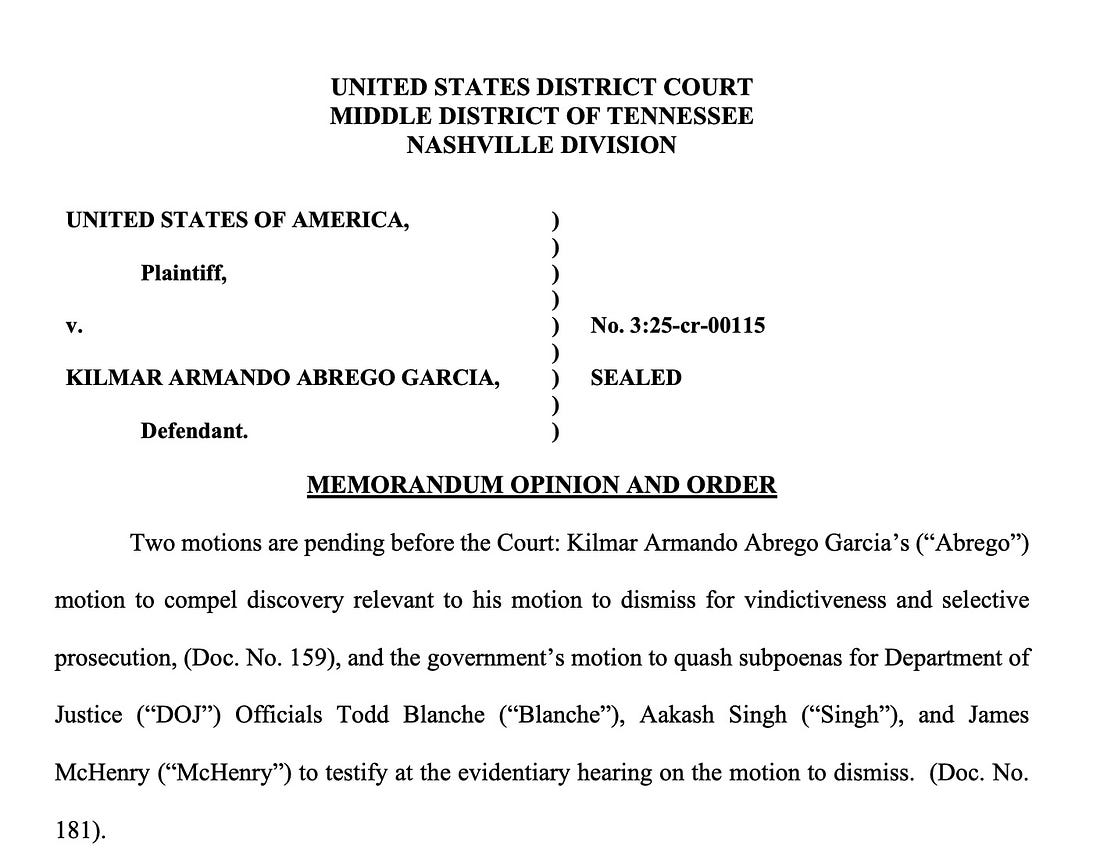 |
The case is before Federal District Judge Waverly D. Crenshaw, Jr. in the Middle District of Tennessee. It turned out that my conjecture that the sealed motion might have something to do with Abrego Garcia’s motions to dismiss the prosecution because it’s vindictive was on target. As we know from our discussion of this type of motion in the context of the Virginia prosecution of Jim Comey, it’s difficult for a defendant to prove, and cases are only rarely dismissed on this basis. But the timeline here has always seemed to suggest it could be a serious possibility in this one.
In the newly unsealed motion, the Judge goes straight to the heart of the government’s contention that the local U.S. Attorney made the decision to indict, so it was not influenced by any alleged vindictiveness on the part of higher-ups in Washington, writing, “The central question after Abrego established a prima facie case of vindictiveness is what information in the government’s control sheds light on its new decision to prosecute Abrego, after removing him from the United States without criminal charges. These documents show that McGuire [the local U.S. Attorney] did not act alone and to the extent McGuire had input on the decision to prosecute, he shared it with Singh [a Lawyer in Deputy Attorney General Todd Blanche’s office] and others. … Specifically, the government’s documents may contradict its prior representations that the decision to prosecute was made locally and that there were no outside influences.”
This, needless to say, is not good news for the government. To understand just how bad it is, let’s review a bit of the case’s history:
In October, Judge Crenshaw found that Abrego Garcia had come forward with evidence to suggest that a reasonable person might believe the indictment was motivated by vindictiveness on the part of the government. When that happens, the government has to offer evidence that the prosecution was undertaken for legitimate reasons, for instance, that newly discovered evidence made a case previously rejected as weak strong enough to be indicted.
Judge Crenshaw granted Abrego Garcia’s request to conduct discovery on the issue and have an evidentiary hearing. But he noted that it was entirely possible that “no fire will be discovered under all the smoke.”
The indictment stems from a 2022 traffic stop that did not result in Abrego Garcia’s arrest, or even a traffic ticket. The case file at Homeland Security Investigations remained open, but no action was ever taken on it, and the case was closed shortly after he was deported.
The timeline of the criminal prosecution gave rise to the presumption of vindictiveness in the Judge’s view:
Abrego Garcia was deported on March 15, 2025 (despite the existence of an order that prohibited it).
Abrego Garcia’s lawyers sued on March 24, 2025, and in less than two weeks, a district judge ordered his return to the U.S.
Both the Fourth Circuit and the U.S. Supreme Court sided with Abrego Garcia, holding the government responsible for “facilitating” his return. The Supreme Court ruled on April 10.
Just days after the Supreme Court’s decision, the investigation into the traffic stop was reopened by Homeland Security Investigations (HSI) under DHS Secretary Kristi Noem’s direction.
Ten days after that, an HSI agent reached out to the acting U.S. Attorney in Nashville.
The case was indicted on May 21, 2025, only 58 days after Abrego Garcia filed suit in Maryland seeking his return to the U.S.
As Judge Crenshaw noted back in October, “All of this stands in stark contrast to the 832 days the HSI investigation into Abrego remained pending, without referral to the U.S. Attorney’s Office in the Middle District of Tennessee for prosecution.” In other words, the case wasn’t even deemed significant enough to ask a prosecutor to take a look at it. It was only after Abrego Garcia’s lawsuit challenging the legality of his deportation—and the Supreme Court confirmation that he should be returned—that HSI seemed to take the case seriously. In the absence of any explanation from the government, the Judge correctly found these facts gave rise to a presumption of vindictiveness.
Sometimes, though, where there’s smoke, there is, in fact, fire.
The newly unsealed order relates to two motions filed by Abrego Garcia’s lawyers in the course of trying to obtain the discovery the court had ordered they were entitled to: one to compel the government to comply with some of the requests and one to obtain testimony from Deputy Attorney General Todd Blanche and some of the key people in his office. The government had submitted “over 3,000 documents” to the Judge for him to review privately, because the government maintained it wasn’t obligated to turn them over.
Judge Crenshaw has now ordered the government to “disclose to Abrego a sub-set of the over 3,000 documents that are relevant to the narrow issue of whether the government’s new decision to prosecute Abrego, after deciding not to do so, ‘was tainted by improper motivation’ arising from Abrego’s success in the Maryland civil case.” The government doesn’t have to turn over the remainder of the 3,000+ documents. The Judge asked for additional briefing on the government’s motion to prevent Blanche and his subordinates from testifying.
At the time the motion was filed, the government argued that the decision to prosecute was made by Acting U.S. Attorney Robert McGuire in Nashville, so it could not have been vindictiveness of the part of higher-ups in Washington. But as the Judge points out at length in this order, “at the time of Abrego’s arrest, Blanche linked Abrego’s criminal charges to his successful civil lawsuit in Maryland.” Blanche had “volunteered” in a television appearance that the government’s criminal investigation had started up after the judge in the civil case in Maryland accused the government of misconduct when it deported Abrego Garcia. So, Judge Crenshaw orders the government to provide the defendant with documents that “support Abrego’s argument. Specifically, some of the documents suggest not only that McGuire was not a solitary decision-maker, but he in fact reported to others in DOJ and the decision to prosecute Abrego may have been a joint decision, with others who may or may not have acted with an improper motivation.” If Abrego Garcia can use the discovery to successfully wipe out the government’s contention that the decision to indict wasn’t made in D.C., he may be on the road to getting his case dismissed.
Some of the documents the government must now turn over for the defense to use include:
An email from one of Blanche’s subordinates to the local U.S. Attorney that “made clear that Abrego’s criminal prosecution was a ‘top priority’ for the Deputy Attorney General’s office (Blanche).”
An email from the U.S. Attorney to his staff, advising them that “DAG (Blanche) and PDAG would like Garcia charged sooner rather than later.”
There is also an email from the Blanche subordinate to the local U.S. Attorney advising him that they should “‘close[ly] hold’ the draft indictment until the group ‘g[o]t clearance,’ to file.” The Judge comments that “The implication is that ‘clearance’ would come from the Office of the Deputy Attorney General, not just McGuire.”
These developments are all phrased in the polite language used in courts by judges and lawyers, but they are jaw dropping. The government represented to the court that the decision to prosecute Abrego Garcia was made locally, disconnected from his effort to enforce his constitutional rights and challenge his deportation. Their own emails appear to contradict that assertion. The government will still have the opportunity to come forward and explain away the presumption of vindictiveness. I’ve seen a number of cases during my 25 years at DOJ where a defendant argued vindictiveness. In every case, the government explained why the prosecution was legitimate, and in every case, it prevailed. I’ve never seen a case where the government made representations to a judge that were refuted by its own internal communications. It’s exceptionally unusual for prosecutors to have to take the witness stand to defend their own conduct. But Abrego Garcia’s case, which has been highly irregular from the start, may well be the one where that happens.
This is all about due process. Back in April, as Abrego Garcia’s situation was coming to light, Press Secretary Karoline Leavitt claimed that there was “a lot of evidence” Abrego Garcia was a convicted member of the gang MS-13, saying that “I saw it this morning.” We were supposed to take her word for it and leave Abrego Garcia to his fate of torture in a Salvadoran prison. That’s why the rule of law and due process matter. If it’s up to Trump, anyone can be swept up and swept away and have no recourse. Our ability to go to court to protect ourselves when the government gets it wrong is more and more important.
During his monumental filibuster earlier this year, New Jersey Senator Cory Booker saidthat this was our moral moment and that inaction was not enough. He asked: “Where does the Constitution live? On paper, or in our hearts?” Here at Civil Discourse, it lives in our hearts and stays on our minds.
Thank you for being here with me. I know you have lots of choices about where to get your news and analysis. I appreciate that you’re spending some of it with me. Your paid subscriptions make it possible for me to devote the time and resources it takes to write the newsletter. I’m proud that we’ve built a community together that’s dedicated to keeping the Republic.
We’re in this together,
Joyce