Contact Me By Email


What To Do When You're Stopped By Police - The ACLU & Elon James White

What To Do When You're Stopped By Police - The ACLU & Elon James White

Know Anyone Who Thinks Racial Profiling Is Exaggerated? Watch This, And Tell Me When Your Jaw Drops.


This video clearly demonstrates how racist America is as a country and how far we have to go to become a country that is civilized and actually values equal justice. We must not rest until this goal is achieved. I do not want my great grandchildren to live in a country like we have today. I wish for them to live in a country where differences of race and culture are not ignored but valued as a part of what makes America great.

Saturday, July 20, 2019

Opinion | The Joy of Hatred


"By Jamelle BouieJuly 18, 2019


The chanting was disturbing and the anger was frightening, but what I noticed most about the president’s rally in Greenville, N.C., on Wednesday night was the pleasure of the crowd.


His voters and supporters were having fun. The “Send her back” chant directed at Representative Ilhan Omar of Minnesota was hateful but also exuberant, an expression of racist contempt and a celebration of shared values.


This dynamic wasn’t unique to the event. It’s been a part of Trump’s rallies since 2015. Both he and his crowds work from a template. He rants and spins hate-filled tirades; they revel in the transgressive atmosphere. The chants are their mutual release. Sometimes he basks in them.


To watch raucous crowds of (mostly) white Americans unite in frenzied hatred of a black woman — to watch them cast her as a cancer on the body politic and a threat to a racialized social order — is to see the worst of our past play out in modern form.


Join Jamelle Bouie as he shines a light on overlooked writing, culture and ideas from around the internet.


To be clear, the Trump rally was not a lynch mob. But watching the interplay between leader and crowd, my mind immediately went to the mass spectacles of the lynching era. There’s simply no way to understand the energy of the event — its hatred and its pleasures — without looking to our history of communal racial violence and the ways in which Americans have used racial others, whether native-born or new arrivals, as scapegoats for their lost power, low status or nonexistent prosperity. And in that period, one event stands out: an 1893 lynching in Paris, Tex., where Henry Smith, a mentally disabled black teenager, was burned alive.


The 17-year-old Smith, “generally considered a harmless, weak-minded fellow,” according to Ida B. Wells-Barnett in “The Red Record: Tabulated Statistics and Alleged Causes of Lynchings in the United States,” had been accused of the rape and murder of 3-year-old Myrtle Vance, the daughter of the local sheriff. The white community of Paris believed the murder was retaliation for an earlier arrest by the sheriff, and the accusation of rape was added, in Wells-Barnett’s words, “to inflame the public mind so that nothing less than immediate and violent death would satisfy the populace.”


On the day of the lynching, an estimated 10,000 people crowded along Paris’s main street to witness the killing. Smith was bound to a float and paraded across town in a theatrical performance meant to emphasize his guilt. The audience jeered and chanted, cursed and gave the rebel yell. “Fathers, men of social and business standing, took their children to teach them how to dispose of Negro criminals,” a witness to the event said. “Mothers were there, too, even women whose culture entitles them to be among the social and intellectual leaders of the town.” Around noon, Smith was tortured, doused with kerosene and lit ablaze, immolated for the crowd’s enjoyment.


It was part carnival, part spectacle and part ritual. Smith was accused of something greater than a mere crime. He was accused of violating a sacred moral order — of defiling the white home and white society. “In the minds of many white southerners,” the historian Amy Louise Wood writes in “Lynching and Spectacle: Witnessing Racial Violence in America, 1890—1940,” “black men came to personify the moral corruption that they believed to be the root cause of social disorder.” Lynching, then, “acted as more than a form of political terror that restored white dominance against the threat of black equality.” It also became a “divinely sanctioned retribution for black ‘sin’ that threatened not only white authority but white purity and virtue.”


In a 1933 essay, “Marxism and the Negro Problem,” W.E.B Du Bois tried, as the title suggests, to adapt the theories and analysis of Karl Marx for the American experience. “While Negro labor in America suffers because of the fundamental inequities of the whole capitalistic system,” he argued, “the lowest and most fatal degree of its suffering comes not from the capitalists but from fellow white laborers.” It is white labor, he continued, that “deprives the Negro of his right to vote, denies him education, denies him affiliation with trade unions, expels him from decent houses and neighborhoods, and heaps upon him the public insults of open color discrimination.”


Later, in his 1935 book, “Black Reconstruction in America,” Du Bois would expand on this idea, rooting white racism in a collective bargain of sorts. “It must be remembered that the white group of laborers, while they received a low wage, were compensated in part by a sort of public and psychological wage,” he wrote, outlining the ways in which this “public and psychological” wage strengthened ordinary white Americans’ attachment to a system that ultimately exploited them too:


They were admitted freely with all classes of white people to public functions, public parks, and the best schools. The police were drawn from their ranks, and the courts, dependent upon their votes, treated them with such leniency as to encourage lawlessness. Their vote selected public officials, and while this had small effect upon the economic situation, it had great effect upon their personal treatment and the deference shown them. White schoolhouses were the best in the community, and conspicuously placed, and they cost anywhere from twice to ten times as much per capita as the colored schools. The newspapers specialized on news that flattered the poor whites and almost utterly ignored the Negro except in crime and ridicule.


When this wage was threatened — by black social mobility and economic success, by black political action, by interracial contact that challenged the boundaries of caste — the response was violence. Not just as punishment but, as the lynching of Henry Smith demonstrates, as a communal defense of the existing social order. This ability to engage in state-sanctioned extrajudicial violence was both a kind of wage and a means to collect it, which tied white communities together in a shared experience of rage, righteous anger and joy.


It is important to take history on its own terms. We shouldn’t conflate the past with the present, but we should also be aware of ideas and experiences that persist through time. A political rally centered on the denunciation of a prominent black person demands reference to our history of communal, celebratory racism. It’s critical for placing the event in context, and it can help us understand the dynamic between the president and his base.


If Trump has an unbreakable bond with his supporters, it’s because he gives them permission to express their sense of siege. His rhetoric frees them from the mores and norms that keep their grievance in check. His rallies — his political carnivals — provide an opportunity to affirm their feelings in a community of like-minded individuals.


“He gets us. He’s not a politician, and he’s got a backbone,” a woman who attended a recent “Women for Trump” kickoff event in Pennsylvania told The Philadelphia Inquirer. “He’s not afraid to say what he thinks. And what he says is what the rest of us are thinking.”


Opinion | The Joy of Hatred

Pelosi Proves Triangulation Is Really Self-Strangulation

Nancy_Pelosi_hands_img


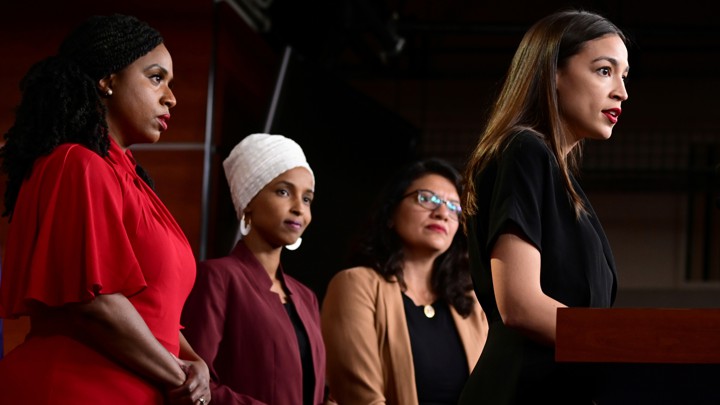
"Since regaining her position as speaker of the House earlier this year, Nancy Pelosi has been fighting a two-front war: Her lackadaisical sparring with Donald Trump has left the speaker with plenty of time and energy to take up arms against her other nemesis, the left wing of her own party. The two struggles are inseparable. Trump’s infamous go-back-to-where-you-came-from tweets targeting four Democratic congresswomen was likely provoked by a Fox & Friends segment about Democratic divisions created by the Squad (consisting of Alexandria Ocasio-Cortez, Ilhan Omar, Rashida Tlaib, and Ayanna Pressley). Trump probably saw a chance to stir up Democratic infighting with his provocative tweets.


Trump’s plan partly backfired, when Democrats united in revulsion against his racism by passing a resolution condemning his words. Yet, even in the face of Trump’s bigotry, the internecine Democratic war continued. On Thursday, the very day Trump supporters chanted “Send her back!” at a rally when the president denounced Omar, a group of moderate Democrats anonymously smeared the Squad in interviews with CNN’s Jake Tapper.


“Other House Democrats are conflicted about having to defend the Squad given things they’ve said and done,” Jake Tapper tweeted. “House Dems cited: talk of supporting challengers to incumbent Dems in primaries, AOC’s use of the term ‘concentration camps,’ anti-Semitic comments by Tlaib & Omar.” The claim that Tlaib and Omar are anti-Semites was a straight-out smear. At worst, they are guilty of inelegant phrasing when discussing the touchy issue of Israel. In making this underhanded and off-the-record accusation, moderate Democrats were giving ammunition to Trump and other right-wing bigots.

To judge by Tapper’s quotes, these moderate Democrats thought that Trump’s attack on the Squad was a smart political play. “What the president has done is politically brilliant,” one of the them said. “Pelosi was trying to marginalize these folks and the president has now identified the entire party with them.”

The moderate Democrats are right to think that Pelosi is on their side in the battle against the Squad. While the moderate Dems merely whisper in Tapper’s ears, Pelosi has made herself the public face of anti-left politics in the Democratic Party. A feud that had been simmering for months became public when members of the Squad broke rank and voted against the immigration bill Pelosi rallied Democrats to accept and which she called “our bill” (which gave the president new funding on the promise of slightly more humane treatment of detained migrants). “All these people have their public whatever and their Twitter world,” Pelosi complained to Maureen Dowd of The New York Times. “But they didn’t have any following. They’re four people and that’s how many votes they got.”


A week later, Axios published a story leaked by House Democrats that was clearly designed to damage Ocasio-Cortez. “Top Democrats are circulating a poll showing that one of the House’s most progressive members—Rep. Alexandria Ocasio-Cortez—has become a definitional face for the party with a crucial group of swing voters,” the news site reported. “These Democrats are sounding the alarm that swing voters know and dislike socialism, warning it could cost them the House and the presidency.”

The entire Axios report was nonsensical agitprop. The poll was conducted only among non-college-educated whites, a cohort that overwhelmingly voted against the Democratic Party in recent elections, even in the wave election of 2018. It’s hardly surprising that Ocasio-Cortez was unpopular among the group that is the base of the Republican Party. Axios didn’t give the name of the pollster, any information about the cross tabs or indicate if Ocasio-Cortez had been tested against other Democratic politicians like Nancy Pelosi. The article was a pure smear job, one orchestrated by Ocasio-Cortez’s enemies within the Democratic Party.

Current Issue


The war between Nancy Pelosi and the Squad boils down to one-word: triangulation. In the tradition of Bill Clinton, Pelosi and moderate Democrats are positioning themselves as the vital center between the radical right (Donald Trump) and the radical left (the Squad). Triangulation explains not just Democratic infighting but also Pelosi’s decision to dampen down impeachment fervor and to slow-walk (and sometimes stall) investigations into Trump and his administration.

Why has Pelosi tied herself so tightly to moderate Democrats? Greg Sargent of The Washington Post suggests that there are structural explanations. The Democratic midterm victory rested on 43 seats that lean Republican. According to Cook Partisan Voter Index (PVI), these seats are an average of 2 percent more Republican than the rest of the country. By contrast, the remaining 192 Democratic seats are on average 16 points more Democratic.


Pelosi has decided to make it a top priority to preserve the newly won Democratic seats, which means pushing her party to be much more conservative than its average voter. This has created a situation where the Squad can become national celebrities (possibly even influencing the presidential primaries) by bucking Pelosi. At the Netroots conference earlier this month, Pelosi was booed by Democratic Party activists, a crowd that cheered on the Squad.

But structural factors aren’t the only force driving the feud. Ocasio-Cortez became a star by her unexpected victory over the political machine that controls Democratic politics in New York State. Future progressive victories by left-wing candidates are likely to occur in similar circumstances, with upstarts challenging incumbents who are more conservative than their districts. The prospect of a rising left scares old-school Democrats.


Writing in HuffPost, Zach Carter suggests that machine politics is exacting revenge on Ocasio-Cortez and the Squad. “Ocasio-Cortez represents a greater threat to this machine than Trump, which is why the Democratic leadership in Congress is now diverting time, attention and resources to defend the machine’s turf, instead of focusing on the president,” Carter contends.


Regardless of her motives, Pelosi’s triangulation policy has been a disaster. Whatever merits, dubious or real, triangulation might have had in the 1990s, the policy makes little sense when Democrats confront an extremist like Trump, who needs to be fought by a united party. With triangulation, Pelosi often ends up making unnecessary concessions. As The Intercept reports, even House minority leader Chuck Schumer, hardly famous for his fighting spirit, was surprised by how much ground Pelosi ceded on the immigration bill. Moreover, the idea that moderate Democrats are somehow closer to average voters doesn’t bear scrutiny. As Eric Levitz points out in New York magazine, the Blue Dog brigade has worked to slow down or sabotage policy goals that have overwhelming popular appeal: notably, the minimum wage increase and lower prices for prescription drugs.


Pelosi often acts as if Trump were merely annoying (and perhaps a useful foil), while the Squad are the true enemies. Unless she ends her feud with the congressional left, Democrats will be marching into battle with a commander who is only halfheartedly challenging the most dangerous president in modern American history."


Pelosi Proves Triangulation Is Really Self-Strangulation

Friday, July 19, 2019

Ocasio-Cortez Just Broke Down During an Emotional Powerful Congressional...

Am I an American?


"... House Speaker Nancy Pelosi has told Representatives Ilhan Omar of Minnesota, Ayanna S. Pressley of Massachusetts, Rashida Tlaib of Michigan, and Alexandria Ocasio-Cortez of New York to get in line to be a Democrat, in the way I’m told by moderates away from Capitol Hill to get in line to be an American. I hear the moderate message of compliance, of assimilation, of being happy just dining. And I hear the message from the man with the blood-red hat defending the moderate and giving me an ultimatum.


“So interesting to see ‘Progressive’ Democrat Congresswomen, who originally came from countries whose governments are a complete and total catastrophe, the worst, most corrupt and inept anywhere in the world (if they even have a functioning government at all), now loudly and viciously telling the people of the United States, the greatest and most powerful Nation on earth, how our government is to be run,” Donald Trump tweeted Sunday. “Why don’t they go back and help fix the totally broken and crime infested places from which they came. Then come back and show us how it is done. These places need your help badly, you can’t leave fast enough.”


But Pelosi and her moderate lieutenants do not desire this type of defense, this white-nationalist brand of American exceptionalism. They quickly and rightly stood up for the Americanness of these four women. “When @realDonaldTrump tells four American Congresswomen to go back to their countries,” Pelosi tweeted, “he affirms his plan to ‘Make America Great Again’ has always been about making America white again.” They quickly and rightly classified Trump’s MAGA attack as “a racist tweet from a racist president,” as the assistant speaker of the House, Ben Ray Luján, tweeted.


But their defenses and affirmations of my Americanness—that my black, Puerto Rican, Somalian, and Palestinian sisters are indeed Americans—did little to quiet the question screaming in my soul for an answer. And I suspect in the souls of millions more.


I can’t stop the screams. Am I an American? It is a question I have never been able to answer.


I can’t stop the shouts: “Go back to your country!” It is a statement I have never been able to answer.


Is this my country? Am I an American?


Ocasio-Cortez—like Trump, like me—was born in New York City. Tlaib was born in Detroit, and Pressley in Cincinnati. Omar’s family immigrated to the U.S. from Somalia when she was a child. They are all U.S. citizens, like me.


“WE are what democracy looks like,” Pressley tweeted. “And we’re not going anywhere.”


But they are not white like the Slovene-born Melania Trump. Is an American essentially white? I do not know. I do not know if I’m still three-fifths of an American, as my ancestors were written into the U.S. Constitution. Or fully American. Or not American at all.


What I do know is that historically, people like me have only truly been all-American—if all-American is not constantly being told to “go back to your country” or “act like an American”—when we did not resist enslavement on a plantation, or in poverty, or in a prison with or without bars shackling our human potential and cultural flowering. Perhaps we were Americans when we did not resist our bodies being traded, our wombs being assaulted, and our bent backs and our hands being bloodied picking and cleaning and manufacturing white America’s wealth.


Perhaps we were Americans when we did not resist how the self-identified white allies were trying to civilize us, telling us to slow down, telling us our anti-racist demands were impractical or impossible, instructing us how to get free. We were rarely told to go back to our country when we did kneel, when we did not kneel, when we did as told by the slaveholder and the abolitionist, by the segregator and racial reformer, by the American mentor telling us to pull up or pull down our pants.


Am I an American only when I act like a slave?


What Trump told those four congresswomen is hardly unorthodox for a U.S. president if we extend recent memory backwards. In 1787, the year the U.S. Constitution was drafted, was also the year that Thomas Jefferson published his influential Notes on the State of Virginia. Enslaved Africans should be emancipated, civilized, and “colonized to such place as the circumstances of the time should render most proper,” he wrote.


Colonization emerged as the most popular solvent of the race problem before the Civil War, advocated by nearly every president from Jefferson to Abraham Lincoln. Slaveholders increasingly desired to rid the nation of the emancipated Negro. And moderate Americans increasingly advocated gradual emancipation and colonization, telling the anti-racists that immediate emancipation was impractical and impossible in the way that anti-racists are told immediate equality is impractical and impossible today.


At the founding of the American Colonization Society in 1816, Representative Henry Clay of Kentucky, the future presidential candidate and “Great Compromiser,” gave voice to what we now call Trumpism, the savaging of people of color and the countries of people of color to hold up white Americanness.


“Can there be a nobler cause that that which, whilst it proposes to rid our country of a useless and pernicious, if not dangerous portion of its population, contemplates the spreading of the arts of civilized life, and the possible redemption from ignorance and barbarism of a benighted quarter of the globe!”


The moderate strategized then, as the moderate still do now, based on what was required to soothe white sensibilities. As the clergyman Robert Finley wrote in Thoughts on the Colonization of Free Blacks in 1816, through colonization, “the evil of slavery will be diminished and in a way so gradual as to prepare the whites for the happy and progressive change.”


Some black people advocated back-to-Africa campaigns or relocated there, convinced American racism was permanent, convinced they could create a better life for themselves alongside their African kin. But many, perhaps most, black people resisted colonization schemes from their beginning. This is “the land of our nativity,” thousands of black Philadelphians resolved in 1817. Still colonization recycled through time, on the basis that the black race could never “be placed on an equality with the white race,” as Lincoln lectured a delegation of black men on August 14, 1862. The abolitionist William Lloyd Garrison corrected Lincoln: “It is not their color, but their being free, that makes their presence here intolerable.”


President Andrew Johnson did everything he could to keep us slaves. His successor, Ulysses S. Grant, tired of alienating racist Americans from the Republican Party every time he sent federal troops to defend our right to live, vote, thrive, and hold political office from Ku Klux Klansmen led by men such as Nathan Bedford Forrest, whom Tennessee honored with his own day on Saturday.


In the so-called Compromise of 1877, northerners retained the White House in exchange for allowing racist southerners to treat us like anything but Americans over the next century. Or were we Americans all along, despite what the lynchings and pogroms did to our bodies, and what Jim Crow did to our political economy? Or did we become Americans through court rulings and congressional acts in the 1940s, 1950s, and 1960s? Or were we still not Americans in 1968, when the Kerner Commission’s study of America’s racial landscape concluded, “Our nation is moving towards two societies, one black, one white—separate and unequal.”


Were the two societies—instead of black and white—the American society of legal patriots and the un-American society of illegal aliens? Did the Latinx, Muslim, Asian, and black immigrants who arrived in the United States since the 1960s join the people of color and anti-racist whites in the un-American society? Have people of color been allowed to enter American society and become Americans when they submitted to racist power and policy and inequality and injustice—when they became “my African American”? Have rebellious “un-Americans” of color been demonized as criminals and deported back to our countries or to more and more prisons like Angola in Louisiana?


Am I an American?


Blood-red-hatted segregationists say no, never, unless we submit to slavery. Assimilationists say we can be Americans if we stop speaking Spanish, stop wearing hijabs, cut our long hair, stop acting out against them—if we follow their gradual lead.


Anti-racist blacks have divided over this question as fiercely as segregationists and assimilationists. I am an American, and because I’m an American, I deserve to be free. I am not an American, because if I were an American, I’d be free.


“I, too, am America,” Langston Hughes wrote in perhaps his most famous poem, first published in 1926.


“I’m not a Republican, nor a Democrat, nor an American—and got sense enough to know it,” Malcolm X orated at a Detroit church on April 12, 1964.


Both ring true to me. I do not know whether I’m an American. But I do know it is up to me to answer this question based on how I define American, based on how I am treated by America. I don’t care whether or not anyone thinks I am an American. I am not about persuading anyone to see how American I am. I do not write stories that show white people all the ways people of color contributed to America. I will not battle with anyone over who is an American. There is a greater battle for America.


Maybe that is the point. Maybe I had the question wrong all along. Maybe I should not live in envy; I should live in struggle. Maybe I should have been asking, “Who controls America?” instead of “Am I an American?” Because who controls America determines who is an American."


Am I an American?

Ilhan Omar Greeted With Cheers, Trump Flip Flops On 'Send Her Back' | Th...

Trump Distances Himself From The Racist Chant He Inspired

Thursday, July 18, 2019

John Kerry: Trump can’t hold a candle to Ayanna Pressley - The Boston Globe


BOSTONGLOBE.COM


Ayanna Pressley’s “story identifies as more ‘American’ than any mantle this president could ever claim.”


"Of course President Trump’s comments about Representative Ayanna Pressley are racist. But even more revolting is his defense: pretending he’s not attacking her race, but rather her lack of patriotism. Pressley’s entire life has been a story of patriotism: loving her country so much that she wanted to help America live up to its ideals.


A strong woman raised in public housing by a fearless mother who sacrificed to keep her safe? An activist who found in Boston a life of public service and a determination to speak up for people who were underrepresented? That story identifies as more “American” than any mantle this president could ever claim. No wonder Donald Trump is afraid of her."


John Kerry: Trump can’t hold a candle to Ayanna Pressley - The Boston Globe

Trump’s Racist Attack on the Squad & A Raid on Area 51 | The Daily Show

Ethiopian city braces for protests as activists promise to declare new region - Reuters


"HAWASSA, Ethiopia (Reuters) - Activists in Ethiopia were set to declare a new region for their Sidama ethnic group on Thursday in defiance of the central government, with some residents of the southern city of Hawassa worried that it could lead to violence.


The declaration will be a litmus test of whether Prime Minister Abiy Ahmed’s federal government can maintain its commitment to peaceful political reforms in the face of increasing demands from competing ethno-nationalist groups.


“Red berets, regional special police force are patrolling with grim faces and guns pointed. Special forces can be seen in all corners and small streets,” one resident in Hawassa told Reuters.


Some of his friends were so concerned that violence would erupt on Thursday that they sent their wives and children to the national capital Addis Ababa, he added.


The federal system in Africa’s second most populous nation is designed to allow larger ethnic groups a degree of autonomy.


But smaller groups such as the Sidama, who make up about 5% of Ethiopia’s 105 million people, say they have been sidelined. In addition to the Sidama, at least eight more ethnic groups are campaigning for their own regions.


Hawassa city is the capital of the multi-ethnic southern nations region, but some Sidama - who make up the largest group within the region - claim it as the capital of their own new region.


Fasika Qedele, another Hawassa resident, said it was time for the Sidama people to achieve self-rule.


“The Sidama people have lived under repression for years and years. Now we are super excited as we are on the eve of declaration of our self administration,” he said, adding the people had the capacity and the educated workforce to do this.


On Wednesday, the streets of Hawassa were unusually quiet apart from patrols of truckloads of federal police.


Outside the airport, freshly painted signs announced “Welcome to Sidama National Regional State”.


A planning meeting between elders and activists trying to decide on a course of action for Thursday turned heated. Reuters journalists were asked to leave the meeting for what some activists said was their own safety.


Some activists said the government would lose legitimacy if it responded to the declaration with violence.


“I don’t think the government would opt to dismantle itself by resolving to the use of force,” said Tariku Lema, a youth activist. “If the government pursues this track, the people would accelerate their struggle.”


REFERENDUM REQUEST

On Tuesday, the National Election Board tried to defuse the situation at the last minute by promising the Sidama they could hold a referendum on having their own region within five months.


But some activists said they had already requested a referendum a year ago with no response. The constitution guarantees the right to a referendum within a year, but does not say what should happen if it is not held.


Tariku, the Sidama activist, said minorities would be protected in the new region like all other Ethiopians.


“As citizens, they would be entitled to all social and democratic rights in the constitution,” he told Reuters.


Ethiopia has seen an explosion of violence since Abiy began his reforms, which have included ending bans on political parties, releasing political prisoners and welcoming home rebel groups.


More than 2.4 million Ethiopians have fled their homes due to drought or violence, the U.N. says, making it the country with the highest number of displaced people in the world."


Ethiopian city braces for protests as activists promise to declare new region - Reuters

Republicans Pretend They Haven’t Seen Trump’s Racist Tweets: A Closer Look

Wednesday, July 17, 2019

Are you OK with a racist president, Republicans?


"By the Editorial Board July 15, 2019 10:14 AM,


On July 15, 2019, President Donald Trump defended his tweet calling on four Democratic congresswomen of color, who are American citizens and three of which were born in the U.S., to go back to their "broken and crime infested" countries. By

We’re not big believers in public officials being responsible for all the bad things other public officials say or do. It’s become a too-common political weapon to ask lawmakers to condemn members of their own party, even for behavior that’s not representative of anything more than one person’s poor decision. But sometimes that behavior is so troubling that our leaders need to stand up and say something.


So it was Sunday when President Donald Trump tweeted a bigoted attack on four Democratic Congresswomen of color, telling Alexandria Ocasio-Cortez of New York, Ilhan Omar of Minnesota, Ayanna Pressley of Massachusetts and Rashida Tlaib of Michigan to “go back and help fix the totally broken and crime infested places from which they came.” This despite three of the four women being born in the United States, and the other, Omar, being a U.S. citizen.


“Go back where you came from” is among the worst of racist tropes. It divides us by ethnicity and skin color. It says that even if someone is a citizen or legal immigrant, they are not part of the rest of us. That runs contrary to who we should be as Americans, and if Donald Trump didn’t know it when he typed the words, he surely did later when people responded with appropriate outrage. But the same president who referred to Haiti and African nations as “shithole countries” and said African visitors would never “go back to their huts” once again doubled down on his racism.


It’s dangerous, destructive behavior, and at the least every Republican lawmaker in Congress should declare as much about their president’s outburst. That includes North Carolina’s most senior leaders, Sens. Richard Burr and Thom Tillis. We know this isn’t easy politically, especially for Tillis, who is running for reelection and faces a Republican primary challenger in a race to see who can embrace the president more fully. Tillis, of course, has a history of comically wavering on Trump — standing up then backing down on issues that include the Mueller investigation and the president’s declaration of a national emergency at the southern border.


North Carolina’s lawmakers, however, are far from the only Republicans to struggle with Trump’s troubling tendencies. A handful have dared to step forward and criticize the president, only to equivocate when everyone else takes a step back. Most have instead decided that any criticism of Trump — be it for policy or problematic behavior — is not worth the heat that follows.


The result is that the Republican Party is firmly Donald Trump’s party now. It’s the party where insults and other ugliness are just being “rough around the edges.” It’s the party where locking legal migrants in crowded, unhealthy cages is acceptable immigration policy. It’s the party where it’s OK to say racist things so long as the next jobs report is encouraging.


If you don’t believe it, listen to the meekness today from Republicans, including those who represent our state. Instead of standing up for who we should be, they’re bowing to the worst of who we are."


Are you OK with a racist president, Republicans?

Congresswomen Issue Scathing Rebuke To ‘Blatantly Racist’ Trump Attack |...

Opinion | Why Hasn’t the Officer Who Killed Eric Garner Been Fired Yet?


"Reason enough to hate America. America is a racist nation. There is no justice for people of color and after 400 years it is obvious there never will be in this evil land. This happened less than five miles from where I grew up.

"By The Editorial Board
On Tuesday, just one day before the statute of limitations would have run out, the Justice Department said it wouldn’t bring federal civil rights charges against the New York City police officer who put Eric Garner in a chokehold that caused a fatal asthma attack in 2014 as Mr. Garner cried, “I can’t breathe.”
A state grand jury declined to indict that officer, Daniel Pantaleo, five years ago, and as departmental disciplinary action has been delayed, he not only remains on modified duty but also received an increase in overtime pay. So far, nobody has been held accountable for Mr. Garner’s death.
After meeting with federal prosecutors, the Garner family stood outside a courthouse in Lower Manhattan, convulsing with pain.
“Y’all watched him kill my father,” Mr. Garner’s daughter Emerald Garner shouted as she stood before the cameras, her voice heavy with anger. “Fire him.”
Mayor Bill de Blasio and the Police Department delayed disciplinary action against Officer Pantaleo because the Justice Department asked them to wait while it considered whether to prosecute him. On Tuesday, the mayor said waiting so long for the Justice Department to bring charges was a mistake.
The Police Department finally began a disciplinary hearing in May, after the Civilian Complaint Review Board brought charges. An administrative judge has yet to decide whether Officer Pantaleo is guilty of departmental charges that he recklessly used a chokehold, in violation of departmental policy, and intentionally restricted Mr. Garner’s breathing.
Standing in the hot sun outside City Hall on Tuesday, Mr. Garner’s mother, Gwen Carr, implored Mr. de Blasio to fire Officer Pantaleo.
“Do your job,” she said. “Come forward and show yourself as the mayor you were elected to be.” As she spoke, Mr. de Blasio, who won election largely because of support from black New Yorkers while promising to hold the police accountable, was at Gracie Mansion, miles away.
City law seems to preclude the city from firing Officer Pantaleo until the conclusion of the hearing.
Given the facts of the case, it’s hard to see his continued employment by the Police Department as anything but an insult to the people of New York.
Mr. Garner, who was unarmed and supposedly selling loose cigarettes, which is illegal, died because Officer Pantaleo used a chokehold. The Police Department banned the use of chokeholds in 1993 amid a rise in deaths linked to the maneuver.
In searing testimony at the departmental trial this year, the medical examiner said the chokehold triggered an asthma attack that led to Mr. Garner’s death, which he ruled a homicide.
A police internal affairs investigator also testified that he recommended disciplinary charges against Officer Pantaleo in 2015. None came until last year.
While the judge will decide if Officer Pantaleo’s actions violated departmental rules, they clearly violated good sense and demonstrated the kind of overly aggressive policing that has led to many controversial deaths. He chose to escalate an encounter, involving several officers, with an unarmed man over a minor violation, then used a dangerous and banned maneuver. Video of the episode, viewed by millions, shows the officer with his arm across Mr. Garner’s throat.
Even before Mr. Garner’s death, the Civilian Complaint Review Board had substantiated four allegations of abuse against him in previous cases.
Why should an officer like Officer Pantaleo remain on the force, diminishing the trust of New Yorkers?
The Justice Department’s delay is inexcusable.
The city’s deference to federal prosecutors, and lack of urgency, are offensive.
That Officer Pantaleo could remain on the force, after everything, seems unimaginable.
Mr. Garner’s family and supporters held a press conference at City Hall on Tuesday condemning the Justice Department’s decision not to file civil rights charges in his death.Bryan Anselm for The New York Times"


Opinion | Why Hasn’t the Officer Who Killed Eric Garner Been Fired Yet?

House Condemns Trump’s Attack on Four Congresswomen as Racist - The New York Times

Speaker Nancy Pelosi on Tuesday before a vote condemning President Trump’s tweets.


House Condemns Trump’s Attack on Four Congresswomen as Racist - The New York Times

Chris Cuomo ENDED Trump's CAREER in CONTEMPT after House Votes to Condem...