Contact Me By Email


What To Do When You're Stopped By Police - The ACLU & Elon James White

What To Do When You're Stopped By Police - The ACLU & Elon James White

Know Anyone Who Thinks Racial Profiling Is Exaggerated? Watch This, And Tell Me When Your Jaw Drops.


This video clearly demonstrates how racist America is as a country and how far we have to go to become a country that is civilized and actually values equal justice. We must not rest until this goal is achieved. I do not want my great grandchildren to live in a country like we have today. I wish for them to live in a country where differences of race and culture are not ignored but valued as a part of what makes America great.

Saturday, July 06, 2019

Powerful Democrat seeks probe of CBP leaders after secret Facebook groups revealed


"2nd secret CBP Facebook group shows mocking images 01:18

(CNN)The chairman of the House Homeland Security Committee is calling for the Department of Homeland Security's inspector general to investigate Customs and Border Protection leadership after Facebook groups associated with the agency were found to contain vulgar and offensive posts.


Rep. Bennie Thompson, a Mississippi Democrat, sent a letter Friday to the Homeland Security Department's acting inspector general requesting an investigation into whether Customs and Border Protection and Department of Homeland Security leadership -- specifically acting Homeland Security Secretary Kevin McAleenan, acting Customs and Border Protection Commissioner Mark Morgan and Border Patrol Chief Carla Provost -- knew about or addressed allegations that Customs and Border Protection agents had "posted violent, racist, misogynistic comments and pictures" in the groups.

"Such vile and threatening behavior from agents of the United States Government is entirely unacceptable, should be grounds for immediate dismissal from service, and is the subject of an investigation by CBP's Office of Professional Responsibility," Thompson said.

Thompson's request comes on the heels of Customs and Border Protection officials announcing an investigation into "disturbing social media activity" after a published report of a closed Facebook group for current and former Border Patrol agents called "I'm 10-15." The group reportedly featured jokes about migrant deaths and derogatory comments about Latina lawmakers.

CNN reported on Friday the existence of at least one other such group called "The Real CBP Nation," which has around 1,000 members and featured images mocking the separations of migrant families, disrespecting New York's Democratic Rep. Alexandria Ocasio-Cortez, and deriding Asians and African Americans.

Thompson pointed to media reports that Morgan had been aware of the group since 2016, when he was Border Patrol chief, and that high-ranking Customs and Border Protection officials knew of the group and used it to gain information.


"If accurate, this report calls into question Mr. Morgan's fitness to hold any office in the United States Government," Thompson wrote.


Customs and Border Protection has been aware of troubling social media activity for more than a year. In February 2018, a senior Customs and Border Protection official warned all agency employees of potential discipline after having been informed of a private Facebook group with inappropriate and offensive posts, according to a memo obtained by CNN."


Powerful Democrat seeks probe of CBP leaders after secret Facebook groups revealed

Japanese-American Internment Survivors Protest Plan to Jail Migrant Kids...

Thursday, July 04, 2019

Opinion | It’s the Cruelty, Stupid

"By Charles M. BlowJuly 3, 2019

There are tanks in the nation’s capital and concentration camps on its border. The slide of this nation into a nearly unrecognizable state continues unabated. Donald Trump is recreating America in his own image: an abominable one.


He brags about trading valentines with the ruthless North Korean dictator Kim Jong-un, saying at a political rally in September:


“I was really being tough. And so was he. And we’d go back and forth. And then we fell in love, O.K.? No, really. He wrote me beautiful letters. And they’re great letters. We fell in love. But you know what? Now they’ll say: ‘Donald Trump said they fell in love. How horrible. How horrible is that? So unpresidential.’”


According to Human Rights Watch, North Korea under Kim not only “restricts all civil and political liberties, including freedom of expression, assembly, association and religion,” it systematically extracts “forced, unpaid labor from its citizens,” and “women in North Korea suffer a range of sexual and gender-based abuses” that include “rape and other sexual violence and torture in detention facilities, sexual exploitation, or forced marriage of North Korean women in China, and sexual and gender-based violence and discrimination.”


And this says nothing of the hundreds of people Kim is thought to have had executed since coming to power in 2011.


And this is the man that the president of the United States brags about being in love with.


Last month Trump joked with Russia’s Vladimir Putin about getting “rid of journalists.”


According to the Committee to Protect Journalists, 28 journalists have been killed in Russia since Putin took office in 2000.


Last week in Osaka, Japan, Trump said of the Saudi crown prince: “It’s an honor to be with the crown prince of Saudi Arabia, a friend of mine, a man who has really done things in the last five years in terms of opening up Saudi Arabia.”


Let’s be clear: That friend is believed to have ordered the murder of Washington Post columnist Jamal Khashoggi. And, murder may in fact be too antiseptic a word. Turkish officials claim that after Khashoggi was killed, his body was hacked up with a bone saw, then disposed of.


Not only has Trump never delivered a full-throated condemnation of the Saudi leader, he plans to reward the kingdom with more arms sales unless Congress is able to stop him.


Why does the American president have such an affinity, a fetish even, for the world’s dictators while at the same time spurning many of America’s traditional allies? And how does this turn to the darkness reposition this country in the annals of history?


I believe that it speaks to a blindness, or more precisely, an indifference to cruelty. This also crops up in domestic policy, where the indifference is particularly acute when those who suffer are somehow other: black or brown, female or trans, Muslim or migrant.


How else could this administration have executed for so long its zero-tolerance approach to family separation of immigrants and asylum seekers? I don’t believe in open borders, but I do believe in humane borders. I do not believe that a parent seeking asylum — which is still legal in this country, it bears repeating — should have a child ripped from his or her arms. I don’t believe that people — including children — should be caged like animals and deprived of basic human necessities and basic human dignity.


What is happening at our border is unconscionable, a violation of basic human rights, a complete moral violation. And yet the president on Thursday will make a mockery of the country’s freedom celebration by turning it into a muscle-flexing political pep rally.


Trump will likely spend millions on his vanity spectacle just weeks after his administration argued in court that immigrant children didn’t need to be provided soap and toothbrushes.


Stop thinking that this is only about partisanship or polarization. It’s the cruelty, stupid. It has always been about cruelty: racial cruelty, gender cruelty, religious cruelty. It has always been about bending the rest of America, the rest of reality, really, into subordination to the white supremacist patriarchy.


If the emerging culture of the world has to be put under boot for the established culture to maintain power, so be it. This is the white supremacist mantra; this is the Trump message.


Trump cares nothing about the suffering of racial minorities here — other than to increase the pain — nor does he care about the suffering of nonwhite people abroad.


There is a through line in Trump behavior, and it runs directly through his perception of white cultural dominance.


There, I said it. And I’m going to continue to say it.


I know that this may read as redundant. I worry about as much every time I begin to write. But I also know that history is sitting in judgment, that when this dark era draws to a close, an accounting must be made, a record made. None of us will be immune.


The questions will come without room for equivocation or adjustment: Where were you when the bodies floated in the Rio Grande? What did you say when this president bragged about assaulting women and defended men accused of doing the same? What was your reaction when he saw very good people among the Nazis? Where was your outrage when thousands died in Puerto Rico?


What did you do? What did you say? And for others in my profession, what did you write?


I plan to say, or have my work say, that I never faltered, that it never became normal to me, that my heart bled as well as my pen.


What will you say?"


Opinion | It’s the Cruelty, Stupid

Wednesday, July 03, 2019

'Happy hunting!' Immigration agents swapped cheery messages about raids, records reveal | US news | The Guardian

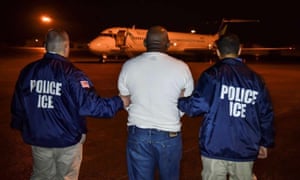
Ice agents in 2017. The messages were exchanged as officials planned raids that year.


"US immigration officials planning countrywide raids targeting thousands of undocumented immigrants wrote cheerful messages about the potential arrests, wishing one another “Happy hunting!”, jokingly calling the initiative “Operation Super Epic Mega”, and saying the work was “fun”, records show.


Immigration and Customs Enforcement (Ice) documents released Wednesday show how officials at the agency prepared for a set of coordinated raids in 2017 that aimed to detain more than 8,000 people for deportation. The agency officially called it “Operation Mega” and officials boasted in the documents that it would be the “largest operation of its kind in the history of ICE, targeting all aliens who are present in the United States in violation of the [law]”. Some documents also suggested field offices might have had specific arrest quotas.


The records, obtained by the immigrant rights groups Mijente and Detention Watch Network, were released the same week that the not-for-profit news organization ProPublica uncovered a secret Facebook group where Customs and Border Protection (CBP) officers posted racist, misogynistic and violent content about immigrants and Democratic members of Congress.


And their release comes as Donald Trump renewed his threat of fresh Ice raids, after calling off a coordinated action targeting undocumented immigrants across the country in late June.


The 2017 raid was ultimately canceled, after plans were leaked to the media. But the email records provide a detailed look at the broad and aggressive way Ice targets communities. The documents also offer insight into the culture of the agency, where some officers seem to talk about deportations in a celebratory, joking and excited manner.


The documents reveal:


The raids planned for September went after 8,400 “targets”. But Ice directed agents to cast a wide net, saying “all aliens amenable to removal are to be considered for arrest” and “all collaterals are on the table”, meaning people who were not the initial targets of the raids could also be arrested.


One August 2017 email appeared to show that some field offices determined arrest quotas. One official said Salt Lake City was “required to have 240 targets”, adding, “Boise can provide 50 targets, leaving 190 additional needed”. In Austin, a supervisory detention and deportation officer said the target list should include “30 total”, adding that it could be difficult to find that many targets. “To fill out to the number we are looking for”, the Austin official said, agents could expand the geographical area.


Ice made its list of targets using a “myriad of sources”, including private companies that collect personal information like license plates.


Ice agents reported successfully apprehending “collateral” people in past operations, in some cases detaining more non-targets than targets. The Philadelphia field office reported that it arrested 156 people who were not initially targeted in March 2017.


In one so-called “Operation Safe City” effort, Ice also arrested 181 people it classified as “non-criminal”, meaning while they may have lacked documentation, they had not committed any crimes.


“The way that the lists are being created is really terrifying,” Jacinta Gonzalez, a Mijente organizer, told the Guardian. “The documents show just how politically motivated these raids are … It also just shows that the emphasis is on numbers and not on safety in any way, shape or form.”


Matthew Bourke, an Ice spokesman, said the agency did not have “arrest quotas” and that operations were “not based on competition or meeting a specific threshold”.


‘It’s gonna be EPIC!’

The emails also included a range of controversial language. In one email, an Ice official said his office was “responsible for 240 targets, which is due on September 12th”, signing off with, “Happy hunting and target building!”


An assistant field office director in San Bernardino, California, who was confused about whether the operation was called “Epic” or “Mega”, wrote: “I propose we call it Operation Super Epic Mega sonic.” Someone responded that “they … changed the name to Epic!! It was Trumppped!!” Another email labeled “Fugitive Operations” celebrated the name change, saying, “It’s gonna be EPIC!”


One email exchange mocked a news article in the York Daily Record, a local Pennsylvania paper, about educating immigrants on their rights. “I’m sure the 4 people that read ydr.com, never even got to that story!” an Ice official wrote.


Another Ice official seemed enthused about the coming raids, writing in an email, “Here we go!!!!” In a July exchange about the operation and targets, a deputy field office director in Texas told one group, “You guys are crushing it,” and the recipient responded, “Thanks, guys are having fun.”


In Austin, an Ice official was enthusiastic about detentions, saying, “We had more apprehensions today than any other day during this operation. Awesome job!!”


In one August planning email, an official asked another person if they would like to be on an “arrest team” and the person responded: “YOU KNOW IT!!!!!!”


Combined with the recent report on the offensive CBP Facebook group, the new Ice records suggested systemic problems among the different agencies involved in immigration enforcement, said Gonzalez: “They have a department-wide problem … They frequently say inhumane and offensive things that are meant to dehumanize.”


Bourke, the Ice spokesman, said in an email that the agency “does not condone the use of offensive or politically-charged language in reference to agency enforcement operations”, adding that “any employee found to have acted in a manner that negatively portrays the agency … or embarrasses the agency … will be held accountable and may be subject to disciplinary measures”.


He said officers were “expected to conduct enforcement humanely, respectfully and with professionalism”, adding: “ICE operations are driven by the agency’s mission to enforce the nation’s immigration laws and to uphold national security, border security and public safety.”


The records also included an Ice presentation about immigrants’ constitutional rights, which Gonzalez said was a good reminder that communities should be informed about the laws that protect them and that people should keep pressure on the agency.


“We must continue to be organized, and we must continue to defend our rights,” she said."


'Happy hunting!' Immigration agents swapped cheery messages about raids, records reveal | US news | The Guardian

Tuesday, July 02, 2019

‘Nothing Prepares You for the Inhumanity of It’


"At a visit to Border Patrol facilities this week, the freshman congresswoman Madeleine Dean of Pennsylvania met weeping women and exchanged notes with detained children.


Several United States lawmakers have used the word to describe what they saw during a visit to two Border Patrol processing centers in Texas yesterday, where they say they communicated with detained children through thick glass walls and met sobbing women who lacked access to running water.


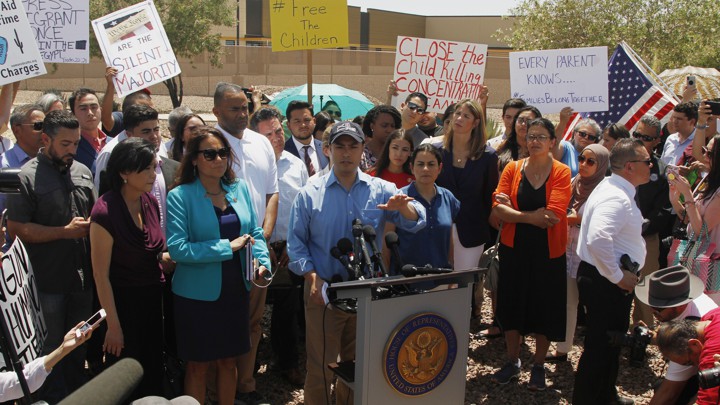
“Nothing prepares you for the inhumanity of it,” Representative Madeleine Dean of Pennsylvania told me by phone today. Dean, a freshman Democrat and a former lawyer and professor from the Philadelphia area, was part of a crew of 14 Democratic lawmakers who visited the facilities in El Paso and Clint. The trip was organized by the Congressional Hispanic Caucus following media reports that 250 infants and children were being held in poor conditions in the latter facility, without access to enough food and water, or adequate sanitation.


The visit coincided with the release of a ProPublica story exposing a secret Facebook group for current and former Border Patrol agents, in which members joked about the deaths of migrants, posted vulgar comments and images related to Representative Alexandria Ocasio-Cortez of New York, and referred to several female members of the congressional delegation as “hoes” and “scum buckets.”


In response to the report, Carla Provost, the chief of the Border Patrol, called the posts “completely inappropriate and contrary to the honor and integrity I see—and expect—from our agents day in and day out.” But members of Congress, among others, argue that the Facebook group not only illustrates systemic problems within the agency, but also helps complete the picture of a growing humanitarian crisis at the U.S.-Mexico border.


I spoke with Dean about what she witnessed in the two Border Patrol facilities, the treatment of the immigrant detainees by agents, and what she sees as Congress’s role in addressing the situation. Our conversation has been lightly edited for length and clarity.


Elaine Godfrey: You’re not a member of the Congressional Hispanic Caucus, nor do you represent a border district. What made you want to join this delegation and tour these facilities?


Madeleine Dean: I’ve been looking for a way to get my eyes on it, to be close to it, to actually see for myself what our government is doing. I wanted to be close up to it so I could speak with some authority about the granular truth on the ground. These are human beings simply trying to find a better life, and they have been caged like either animals or very bad criminals.


I’m stunned that we have done this to children, because the lingering effects of this will be lifelong. The harm that this will do to the psyche of children in terms of trust and bonding, and just simple kindness and humanity. It’s haunting to think about. Our government has done this—not Democrats, not this majority in this Congress. This administration.


Godfrey: Can you walk me through what it was like getting into these detention facilities?


Dean: In El Paso, we were met by a tremendous number of Border Patrol [officers] and our cohort sat down at a meeting area.


Right away they said, Please leave your phones behind or give them to staff. No electronic devices in the facility. In the interest of time, no communication with the detainees at all. With that, [Representative Joaquin] Castro [of Texas] literally stood up and said, We’re members of Congress here to investigate. We expect to be able to speak to folks here.


Very quickly it came up—the grotesque reporting of the Facebook group. I told [the officers] I was quite disappointed that they would not have started [their remarks] with that. They said, That was not reflective of us—we know that it was none of the management. Of course, I don’t know how they could know that, because they claimed not to know [in the first place] about a Facebook group of 9,500 members and former employees. They said they will do an internal investigation. We assured them Congress will do its own investigation.


Godfrey: What happened next?


Dean: We walked into the facility, outside this meeting room. Picture sort of a glassed-in area where the Border Patrol folks work at stations and desks. They can look out through the glass onto the floor and into the cells where people were being held. The guards never wanted us to speak to the women [in the cells but] we went down onto the floor area, and eventually into a cell of 15 women.


They were lying on the floor in blue sleeping bags. We learned that they had been moved in there only yesterday morning. I measured the cell by way of cinder blocks: It’s 10 [blocks] by 13, an irregular shape. A concrete floor. The guards told us that they got [the sleeping bags recently] as a donation from the Forest Service. These women had been living there for 56 days, and they were mostly from Cuba. One woman pulled out of her belongings one of those [emergency blankets] which she gave me. She said, Recently, we were out in the elements in tents with just these silver blankets, no mats.


They said that prior to the last four days, they were allowed to shower [roughly] every nine to 15 days. Very recently, they were allowed to shower daily. They were moved into this room, which they called “the refrigerator.” It’s very much a prison cell.


There was a prison-style toilet, stainless steel, no seat. We tried the sink above it, and there was no running water. [The women] said, Oh, yes, they told us you can drink out of the toilet—that water is clean. And they said that in their 56 days, they had been drinking out of toilets.


When we talked about the women not having water, [the guards] said, Oh, no, they can come out here and wander around and get water all they want. And the women said, No, no, no, that’s not true.


Godfrey: Wow.


Dean: The women were worried about their own health. Two of the women have epilepsy. We talked about toothbrushes. One said, As a result of the medication I take for epilepsy, my teeth are harmed and I have very little access to toothbrushes. She revealed her teeth in terrible condition.


Another woman said, Feel my back, and on the upper portion of her back was a large lump. [The guards] said, Yeah, that’s something that needs a biopsy, but we can’t take care of that here.


Everybody was crying. One woman, 58 years old, clearly the eldest in this grouping, kept sobbing and sobbing, saying, I don’t know where my daughter is; she’s 23 years old; we were separated. Another woman seated next to her said, Two days ago, my 18-year-old daughter and I were separated from the tents; I don’t know where my daughter is. I asked the guard if they could guarantee me that they would find out exactly where these daughters are and if they would facilitate communication. He said, I know exactly where they are; I already told her—just that kind of flippant information.


I said to the women, You’re being detained here like criminals; what is your crime? The one who could speak the best English said, The crime is, I crossed the damn river. I wanted to come to America. I’m fleeing Cuba and political problems there. My family is not sure where I am. That’s the crime for which they’ve been detained 56 days.


The other thing they were worried about was retribution. They whispered to those [lawmakers] who could speak Spanish and said, We’re worried they’ll take this out on us, since we’ve spoken to you and told you about these conditions.


Godfrey: What did the women look like? What state were they in?


Dean: They were teary-eyed, if not actively crying. Many of them had cracked lips from the arid conditions and, I would assume, inadequate water. They had an affect of resignation of sitting on the floor, lying on the floor. One woman wailed; she said: We don’t mind so much being called “bitches,” but to be treated as dogs … [Our] food is sometimes spoiled or frozen—it’s not edible. She said, We are treated as animals.


Godfrey: You and several other lawmakers said on social media that the guards had treated you with hostility. What did you mean?


Dean: There was just an immediate resistance, a skepticism about why Congress was here. It was also fueled by the fact that they had a lot of explaining to do with that Facebook group and the grotesque posts, whether about people of Congress or dead children in their custody.


They didn’t want us seeing certain things. I tried to put my camera up outside at the Clint facility. They tried to block my camera.


Godfrey: When you went to the Clint facility, did you interact with the children there?


Dean: We could not open the glass doors [of the cells]. One room had six children of varying heights standing around. We were communicating through the glass. I put up a drawing—I just wrote on a paper: We heart you, we love you. [Dean began to cry.] The guard came up to me and said, What are you doing? I said, I’m just trying to express something to these children.


He said, You shouldn’t be communicating with them, and I showed him what I’d written. He said, Oh, okay.


Then one of the kids slipped a note under the door, beautifully printed. It was interpreted for me. The children wrote, How can we help you? I did sort of a fake air hug for each of the children. A guard tried to stop me from doing even something as human as that.


There was another room that appeared to be 12-, 13-, 14-year-old boys sleeping in cots. All sleeping, the lights were all on. We asked about the lighting, and [the guards] said, Well, for their safety and ours, we have to keep the lights up.


It was haunting to think, how were these children treated when we weren’t there? The lack of humanity that they wouldn’t want us to talk to the children; they wouldn’t want us to express some human compassion. What must they be like when we’re not there?


Godfrey: What happens now? What are you personally going to do now, and what do you see as Congress’s role here?


Dean: I’m going to Homestead [in Florida] today, visiting the Homestead detention facility, which, as you know, is a for-profit detention facility. I want to see the conditions there.


I want to shine such a spotlight on the inhumanity of this, whether it’s the children or the adults. [The goal is] that, No. 1, this administration says, We will never do this to children again. The family separation needs to end. These children need to be reunited immediately.


Then I want greater oversight. I want resources to go to these children. I want them to be shown love, compassion, care. They don’t have people there to do any of that. Mostly, I want the children reunited and the people seeking asylum to be processed in a humane, quick fashion.


Imagine. We’re coming up on the Fourth of July, and this is what is going on every single day at our border."


‘Nothing Prepares You for the Inhumanity of It’

Reports show poor migrant conditions are widespread, worse than Trump administration says. And no movement towards impeachment.


Reports show poor migrant conditions are widespread, worse than Trump administration says

Opinion | The Immigration Crisis Is Corrupting the Nation


"By The Editorial BoardJuly 1, 2019

Border agents who demeaned migrants on Facebook have exacerbated a grim situation.


A protest in Miami last week against the government’s immigrant family separation and detention policies.Damon Winter/The New York Times

Last year, as part of an effort to carry out President Trump’s promise of “extreme vetting” of visitors to the United States, the Department of Homeland Security began collecting social media account information from millions of people seeking to cross the border.


After all, a radical online could be a radical offline.


That’s why the stream of posts ricocheting around a 9,500-member Facebook group, comprising current and former Border Patrol agents as well as some people with no apparent connection to the Border Patrol, is so troubling. Members of the group, as documented by ProPublica this week, “joked about the deaths of migrants, discussed throwing burritos at Latino members of Congress visiting a detention facility in Texas on Monday and posted a vulgar illustration depicting Rep. Alexandria Ocasio-Cortez engaged in oral sex with a detained migrant, according to screenshots of their postings.”


Of a 16-year-old migrant from Guatemala who died while in Border Patrol custody in May, a member of the group wrote, “If he dies, he dies.”


Customs and Border Protection said on Monday that it had informed the Department of Homeland Security’s inspector general about the posts and had started its own investigation. The National Border Patrol union decried the posts as “inappropriate and unprofessional.”


A reckoning from their superiors is due for any border agents who dishonored their uniform by spreading vileness on social media. In June, when the Plain View Project, a nonprofit research effort, released documentation on dozens of police officers from eight departments across the country posting racist, misogynist and Islamophobic material, 72 police officers in Philadelphia were pulled off the streets and the top prosecutor in St. Louis said she would no longer accept cases from 22 officers.


In a larger sense, the Border Patrol Facebook posts reveal a worrying mind-set among some of those charged with administering the harshest crackdown on migrants and asylum-seekers in decades. “These are clearly agents who are desensitized to the point of being dangerous to migrants and their co-workers,” Representative Joaquin Castro, who heads the Congressional Hispanic Caucus, told ProPublica.


The realities of that crackdown have created conditions that Americans would condemn if they were in another country.


While lawmakers refuse to compromise on emergency aid for the humanitarian needs at the border, “children are held for weeks in deplorable conditions, without access to soap, clean water, showers, clean clothing, toilets, toothbrushes, adequate nutrition or adequate sleep,” groups supporting the children wrote in a recent court filing. A judge on Friday ordered Customs and Border Protection to allow health workers into facilities where children are being held to ensure that conditions are “safe and sanitary.”


On Monday, Ms. Ocasio-Cortez toured facilities where migrants and asylum-seekers are being held. “Officers were keeping women in cells w/ no water & had told them to drink out of the toilets,” she tweeted.


As the congressional delegation arrived at one detention facility, they were heckled and cursed at by demonstrators, including one man wearing a Make America Great Again hat. (Another heckler hurled ethnic slurs at Representative Rashida Tlaib.)


Only a callous person could find mirth in the misery at the border. And only a desensitized nation could continue to permit the separation of children from their parents — and detaining all of them in atrocious conditions — as a morally acceptable form of deterrence."


Opinion | The Immigration Crisis Is Corrupting the Nation

Monday, July 01, 2019

Ocasio-Cortez visits border facility: 'I was not safe'

Inside the Secret Border Patrol Facebook Group Where Agents Joke About Migrant Deaths and Post Sexist Memes — ProPublica . America The Fascist State


"The three-year-old group, which has roughly 9,500 members, shared derogatory comments about Latina lawmakers who plan to visit a controversial Texas detention facility on Monday, calling them “scum buckets” and “hoes.”


ProPublica is a nonprofit newsroom that investigates abuses of power. Sign up for ProPublica’s Big Story newsletter to receive stories like this one in your inbox as soon as they are published.


Members of a secret Facebook group for current and former Border Patrol agents joked about the deaths of migrants, discussed throwing burritos at Latino members of Congress visiting a detention facility in Texas on Monday and posted a vulgar illustration depicting Rep. Alexandria Ocasio-Cortez engaged in oral sex with a detained migrant, according to screenshots of their postings.


In one exchange, group members responded with indifference and wisecracks to the post of a news story about a 16-year-old Guatemalan migrant who died in May while in custody at a Border Patrol station in Weslaco, Texas. One member posted a GIF of Elmo with the quote, “Oh well.” Another responded with an image and the words “If he dies, he dies.”


Created in August 2016, the Facebook group is called “I’m 10-15” and boasts roughly 9,500 members from across the country. (10-15 is Border Patrol code for “aliens in custody.”) The group described itself, in an online introduction, as a forum for “funny” and “serious” discussion about work with the patrol. “Remember you are never alone in this family,” the introduction said.


A screenshot from the Facebook group, run with this text: “That's right bitches. The masses have spoken and today democracy won. I have returned. To everyone who knows the real me and had my back I say thank you. To everyone else? This is what I have to say.....”

Responsible for policing the nation’s southern and northern boundaries, the Border Patrol has come under intense scrutiny as the Trump administration takes new, more aggressive measures to halt the influx of undocumented migrants across the United States-Mexico border. The patrol’s approximately 20,000 agents serve under the broader U.S. Customs and Border Protection agency, which has been faulted for allegedly mistreating children and adults in its custody. The agency’s leadership has been in turmoil, with its most recent acting chief, John Sanders, resigning last week.


ProPublica received images of several recent discussions in the 10-15 Facebook group and was able to link the participants in those online conversations to apparently legitimate Facebook profiles belonging to Border Patrol agents, including a supervisor based in El Paso, Texas, and an agent in Eagle Pass, Texas. ProPublica has so far been unable to reach the group members who made the postings.


ProPublica contacted three spokespeople for CBP in regard to the Facebook group and provided the names of three agents who appear to have participated in the online chats. CBP hasn’t yet responded.


“These comments and memes are extremely troubling,” said Daniel Martinez, a sociologist at the University of Arizona in Tucson who studies the border. “They’re clearly xenophobic and sexist.”


The postings, in his view, reflect what “seems to be a pervasive culture of cruelty aimed at immigrants within CBP. This isn’t just a few rogue agents or ‘bad apples.’”


The Border Patrol Facebook group is the most recent example of some law enforcement personnel behaving badly in public and private digital spaces. An investigation by Reveal uncovered hundreds of active-duty and retired law enforcement officers who moved in extremist Facebook circles, including white supremacist and anti-government groups. A team of researchers calling themselves the Plain View Project recently released a hefty database of offensive Facebook posts made by current and ex-law enforcement officers.


And in early 2018, federal investigators found a raft of disturbing and racist text messages sent by Border Patrol agents in southern Arizona after searching the phone of Matthew Bowen, an agent charged with running down a Guatemalan migrant with a Ford F-150 pickup truck. The texts, which were revealed in a court filing in federal court in Tucson, described migrants as “guats,” “wild ass shitbags,” “beaners” and “subhuman.” The messages included repeated discussions about burning the migrants up.


Several of the postings reviewed by ProPublica refer to the planned visit by members of the Congressional Hispanic Caucus, including Ocasio-Cortez and Rep. Veronica Escobar, to a troubled Border Patrol facility outside of El Paso. Agents at the compound in Clint, Texas, have been accused of holding children in neglectful, inhumane conditions.


Members of the Border Patrol Facebook group were not enthused about the tour, noting that Ocasio-Cortez, a Democrat from Queens, had compared Border Patrol facilities to Nazi concentration camps. Escobar is a freshman Democrat representing El Paso.


One member encouraged Border Patrol agents to hurl a “burrito at these bitches.” Another, apparently a patrol supervisor, wrote, “Fuck the hoes.” “There should be no photo ops for these scum buckets,” posted a third member.


Perhaps the most disturbing posts target Ocasio-Cortez. One includes a photo illustration of her engaged in oral sex at an immigrant detention center. Text accompanying the image reads, “Lucky Illegal Immigrant Glory Hole Special Starring AOC.”


Another is a photo illustration of a smiling President Donald Trump forcing Ocasio-Cortez’s head toward his crotch. The agent who posted the image commented: “That’s right bitches. The masses have spoken and today democracy won.”


The posts about Escobar and Ocasio-Cortez are “vile and sexist,” said a staffer for Escobar. “Furthermore, the comments made by Border Patrol agents towards immigrants, especially those that have lost their lives, are disgusting and show a complete disregard for human life and dignity.”


The head of the Congressional Hispanic Caucus, Joaquin Castro, reviewed the Facebook discussions and was incensed. “It confirms some of the worst criticisms of Customs and Border Protection,” said Castro, a Democrat who represents San Antonio. “These are clearly agents who are desensitized to the point of being dangerous to migrants and their co-workers.” He added that the agents who made the vulgar comments “don’t deserve to wear any uniform representing the United States of America.”


Vicki Gaubeca, director of the Southern Border Communities Coalition, said the postings are more evidence of the sexism and misogyny that has long plagued the Border Patrol. “That’s why they’re the worst at recruiting women,” said Gaubeca, whose group works to reform the agency. “They have the lowest percentage of female agents or officers of any federal law enforcement agency.”


In another thread, a group member posted a photo of father and his 23-month-old daughter lying face down in the Rio Grande. The pair drowned while trying to ford the river and cross into the U.S.; pictures of the two have circulated widely online in recent days, generating an outcry.


The member asked if the photo could have been faked because the bodies were so “clean.” (The picture was taken by an Associated Press photographer, and there is no indication that it was staged or manipulated.) “I HAVE NEVER SEEN FLOATERS LIKE THIS,” the person wrote, adding, “could this be another edited photo. We’ve all seen the dems and liberal parties do some pretty sick things…”


Investigative Journalism and News in the Public Interest — ProPublica

The Battle for School Busing | Retro Report | The New York Times

Florida jury convicts cop in on-duty shooting for first time in 30 years

A Police Shooting Gives the Lie to Buttigieg’s Campaign Narrative. "Black voters are wary of Mayor Pete, for good reasons.

APTOPIX Election 2020 Buttigieg


"Black voters are wary of Mayor Pete, for good reasons.


Living and working as a lawyer in the Israeli-occupied West Bank, I have followed the changes that Israel has been making to the laws in force there since the late 1970s. Over the course of the first 24 years of its occupation, Israel imposed laws affecting every aspect of Palestinian life—from land and water use to mobility and zoning—that have enabled the establishment of Israeli settlements and redefined the lives of Palestinians on their own land. And yet, during most of these years, there was seemingly little or no interest shown by the Palestine Liberation Organization and the Palestinian political leadership based outside the Occupied Territories in these legal maneuvers, leaving it up to human-rights organizations like Al Haq, an affiliate of the International Commission of Jurists, and the Palestine Human Rights Information Center to document these changes and show how they violated international law.


When negotiations started in 1991 between Israel and the Palestinians, who were represented by a joint Palestinian-Jordanian delegation in Washington, I thought this situation might change, so I joined the delegation in order to ensure that any agreement signed by the PLO would not have the effect of consolidating Israel’s violations of international law. The West Bank delegation that I advised knew exactly what I was talking about, and yet we found little interest among the PLO’s Tunis leadership.


Throughout my time in Washington, I wondered why this was so. Did the PLO have an alternative plan to address Israeli and international law or a separate channel for negotiations? After the first year, I gave up and left the talks. Two years later, I read the 1993 Oslo Accords Declaration of Principles and saw my worst fears confirmed: The PLO had fallen into every trap that the Israeli delegation prepared. Just as I warned, Israel succeeded in consolidating the laws it implemented that restrict Palestinian life in Gaza and the West Bank and that enable the expansion of its settlements.


After the Palestinian Authority was consolidated in 1995, its leadership continued to ignore the legal dimensions of the occupation. In the absence of such pressure, Israel continued to implement all of its plans in the Occupied Territories, even when they were in violation of the accords.


Why did the PLO, the Palestinian Authority, and other representatives repeatedly fail to use the law to the Palestinian people’s advantage? How did their view of the law differ so significantly from the Israeli government’s? And how did Israel succeed in creating alternative legal regimes for regulating Palestinian lives that fell outside the purview of international laws relating to war and occupation? All of these questions have haunted the history of the region for the past half century, and they now find some compelling answers in Noura Erakat’s Justice for Some: Law and the Question of Palestine.


Israel’s legal maneuvers go back to 1951, when it won concessions in the United Nations’ Convention Relating to the Status of Refugees that allowed it not to recognize as refugees those Palestinians forced out of what became Israel in 1948, as long as they received assistance from the United Nations Relief and Works Agency. It is an exclusion that is in effect to this day.


Since that exception, Israel has done everything in its power to continue to manipulate and avoid adhering to those conventions under international law governing refugees. In the 1950s and ’60s, Israel kept the estimated 160,000 Palestinians who had not fled or been expelled during the 1948 war under what amounted to a martial-law regime through a declaration that the country was still in a state of emergency and the adoption of what came to be known as the Defense Emergency Regulations. By doing so, Erakat observes, Israel racialized martial law in order “to dispossess, displace, and above all, contain its native population.”


Even before the 1951 exception, Israel deployed legal measures to achieve this aim. In June 1948, orders were given to prevent the return of Palestinian refugees “by every means,” and an estimated 3,000 to 5,000 Palestinians attempting to return were killed by Israeli troops along the 1949 armistice lines. In 1950, Israel passed the Absentees’ Property Law, which effectively dispossessed approximately 750,000 Palestinian refugees denied the right of reentry to claim their lands. Many of the Palestinians who remained in Israel were declared “present-absentees” and had their lands confiscated as well.


After the 1967 war, Israel found itself facing a new set of conventions that it had to outmaneuver—those international laws applying to war and occupation. With the seizure of Gaza and the West Bank (including East Jerusalem), Israeli leaders had to develop a full-scale approach toward legalizing their occupation of Palestinian land, which was in violation of international law governing states that have seized territory during a war.


After annexing East Jerusalem outright 20 days after its army entered the city, Israel hesitated when it came to the rest of the West Bank. The Israeli army issued a military order that affirmed the principles of the Fourth Geneva Convention, thus acknowledging that Gaza and the West Bank were now occupied. But this lasted only a short time: Four months later, the order was rescinded, and Prime Minister Levi Eshkol began discussing with Theodor Meron, the Foreign Ministry’s legal adviser, whether Israel could build settlements in the Occupied Territories.


When Meron confirmed that it would violate the Fourth Geneva Convention, the Israeli government supplanted his recommendations with a legal argument put forth by Yehuda Zvi Blum, a Hebrew University law professor, who asserted that since Jordan was not a rightful sovereign over the West Bank, the territory that Israel now controlled was not occupied as a matter of law. Without any legal parallels for this situation, the territory was sui generis; therefore, Israel was allowed to exercise its authority there, as Erakat notes, “without either preserving the sovereign rights of its inhabitants or absorbing them under [Israel’s] civil jurisdiction.”


From 1967 on, this argument concerning the exceptional status of the Occupied Territories became central to Israel’s domination of them. Not only did Israel argue that it was still fighting a war like no other and that the Palestinians were not a juridical people—that is, a people with collective political and legal rights. Israel now also claimed that since the territories seized were not controlled rightfully by another state, there were no international laws to inform how Israel might govern such a territory. As Erakat notes, the invocation of “exception, like necessity and martial law,” afforded “Israel room for maneuvering” and allowed it to deploy “the sui generis framework as a sovereign act compelled by a unique circumstance.” As a result, Israel insisted that it was “within the bounds of law” when it came to establishing settlements. “A sui generis framework,” she adds, maintained “the veneer of legality while producing a violence that ‘sheds every relation to law.’ ”


In the long history of Israel’s colonization project, there are many other examples of such legal maneuvers. While declaring Palestinian lands “closed areas” became central to the post-1967 regime, arbitrary edicts under the emergency powers of the state were used to prevent Palestinians from cultivating their lands before that year’s war. Erakat writes that “from 1948 to 1953…350 (out of a total of 370) new Jewish settlements were built on land owned by Palestinians.” The ability to designate Palestinian land closed areas “bolstered the legal framework reifying Palestinian displacement” early on, creating a legal and political context in which Israeli settlement in the West Bank and Gaza was normalized.


The sovereign-exception framework became the core legal argument after 1967, serving to justify why Israeli settlers living in the occupied West Bank could be subject to different laws from those that applied to the rest of the population in the same area. It was also used to justify the extensive use of force against civilians in Gaza, where, as Erakat writes, “in effect Israel usurped the right of Palestinians to defend themselves because they did not belong to an embryonic sovereign, relinquished its obligations as an occupying power, and expanded its right to unleash military force, thus rendering Palestinians in the Gaza Strip triply vulnerable.” The sovereign-exception framework, she concludes, “has since become the bedrock of Israel’s military campaigns against the coastal enclave.”


As a human-rights activist in the 1980s, I took every opportunity in Palestine and abroad to warn against the devastation that the sovereign exception wreaked on everyday Palestinian lives in the Occupied Territories. I also pointed out the danger that it posed to any peaceful resolution to the Israel-Palestine conflict by enabling the establishment of Israeli settlements in the Occupied Territories, thereby making it prohibitively difficult to create a Palestinian state.


When I spoke to audiences in the United States, the usual response was that these settlements were necessary for Israel’s security and that as long as Israel had a Supreme Court to which the Palestinians could appeal, the situation could not be all that bad. In time, the justification that the settlements bolstered Israel’s security proved to have little standing, while the Supreme Court—when presented with an opportunity to rule on the legality of civilian settlements in the Occupied Territories—concluded that this was not a legal matter but a political one outside the purview of the court.


Instead of protecting legal norms, Israel’s Supreme Court excelled in making fine distinctions, such as that the occupation could be indefinite but not permanent. Had the court ruled on the illegality of the settlements, it could have saved the region from what now constitutes one of the biggest obstacles to making peace between Israelis and Palestinians.


The Supreme Court went further: It provided arguments for the Israeli government to continue the settlement enterprise, and in innumerable cases challenging the Israeli army’s practices, it used the argument of military necessity to justify the harshest and most egregious violations of Palestinians’ human rights.


Even as Israel consolidated its expansionist project through the law, the PLO directed its attention more to politics and diplomacy. After the 1968 Battle of Karameh, in which a large Israeli invading force was repelled by Palestinian and Jordanian fighters, the PLO unified the most active Palestinian movements and parties. In 1974, it made some notable diplomatic gains as well when its chairman, Yasir Arafat, was invited to address the UN General Assembly and make the case for the body to recognize Palestinians as a juridical people. Introduced as “the General Commander of the Palestinian Revolution,” Arafat cited the UN Charter’s commitment to freedom and the right of self-determination and insisted that these principles had to be extended to the Palestinians, as they were to many other peoples. The speech helped thwart an American and Israeli attempt to delegitimize the PLO and label its use of nonstate force as criminal and terroristic. It also helped win UN recognition of the Palestinians as a people with their own legal and political rights, in particular, the right to self-determination. As a result, Erakat writes, the Palestinian question was transformed “from a humanitarian crisis, punctuated by the overwhelming presence of an exiled refugee population across the Arab world, into a political crisis marked by the failure of current and former colonial powers to deliver sovereignty and independence to a colonized people.”


However, she points to the ambiguity in what was then hailed by many as a victory for the PLO: “By articulating its demands for peoplehood in the framework of international law and pursuing this goal at the United Nations, the PLO drew upon the same legal and institutional norms that legitimated Israel’s establishment, naturalized its existence, and protected its territorial and political sovereignty.” This turn to international law as a result “catalyzed a schism within the PLO between a ‘pragmatic’ camp that sought a state as an interim, or even final, step to full liberation and the ‘Rejection Front,’ led by the PFLP [Popular Front for the Liberation of Palestine], that insisted upon revolution in order to upend Zionist settler sovereignty.”


This question about how to relate to Israel and to international laws legitimizing its existence has continued to plague Palestinians’ politics and divide their different factions: Was the Palestinian liberation movement dedicated to creating a Palestinian state alongside Israel or in place of Israel? Also at issue was whether to engage in a diplomatic process with Israel in order to find a resolution to the conflict or to pursue liberation through every possible means.


The split continued into the 1980s and was one impediment in the talks that began in the early 1990s, as it was reflected in the divergent positions taken by the various Palestinian factions to the Oslo Accords. Even after the accords were concluded, this rift continued to divide Palestinian politics into two camps, with the vehement rejection of the accords by Hamas and the PFLP weakening the Palestinian Authority, which emerged as a result of the agreement.


Palestinian leadership would also be forced to reckon with another aspect of international law that serves as a critical area for inquiry in Erakat’s book and one of the key lessons she takes away from her analysis: that “the law is only as meaningful as the political will underpinning its enforcement.” In the case of Palestine, this was evident at many points throughout Palestinians’ long years of struggle, but never more so than at the time of the Oslo negotiations.


Having followed closely over many years the changes in the law and administration of the Occupied Territories, when I joined the Palestinian delegation, I lobbied the PLO to adopt a legal as well as a political strategy to counter Israel’s attempt to consolidate and enshrine its legal maneuvers in any agreement with the Palestinians. The PLO, however, was reluctant to do so, even in the secret negotiations that took place in Oslo in 1992 and ‘93. As Erakat notes, the PLO “leadership’s lack of appreciation for the law, and particularly for the law’s strategic malleability,” and “its single-minded goal of obtaining de jure recognition for the liberation movement” ended up blinding it “to the deleterious terms of the agreement it was drafting.”


While Palestinian negotiators at first sought a promise from Israel to cease all settlement activity, they ended up accepting something far less: Israel’s offer to recognize the PLO as the representatives of the Palestinian people. As Abu Ala, the chief Palestinian negotiator at Oslo, later explained the reasoning, “Israeli recognition of the PLO as the representative of the Palestinian people would also mean Israeli acceptance of the PLO’s political agenda, including the right of the Palestinian people to self-determination, and their right to establish an independent Palestinian state.”


As time has shown, Abu Ala could not have been more wrong. “As part of the Faustian bargain that is the Oslo framework,” Erakat explains, “the Palestinian Authority has internalized the colonial logic that its compliance and good behavior will be rewarded with independence.” Thus, by signing such an agreement, the PLO not only undermined the Palestinians’ larger legal claims; it also “severely altered the post-1965 Palestinian national movement and transformed it into a critical part of Israel’s settler-colonial machinery, rather than being the primary impediment to that apparatus.”


In the final portions of her book, Erakat describes the various legal campaigns that the PLO and then the Palestinian Authority have embarked on since the Oslo Accords, including a resort to the International Court of Justice in 2004 and an attempt to upgrade the Palestinian territories’ status at the United Nations from a nonstate observer entity to a member state.


Erakat concludes that in each instance, “the Palestinian leadership pursued a legal campaign aimed at, in the crudest and most rudimentary terms, holding Israel to account through international law.” At the same time, bent on winning US favor, the Palestinians’ strategy has not included any attempt to challenge the United States’ unequivocal aid to Israel, thus dooming it to failure.


A common thread running throughout these failings is the inability of the Palestinian leadership—both in the PLO and the Palestinian Authority—to appreciate that nations will not adhere to international law unless they are forced to. As Erakat shows, the opposite has often proved to be the case: Political will tends to undermine legal norms. Without the United States’ aggressive intervention on behalf of Israel, Israel’s legal arguments would not have succeeded. “Over the decades,” Erakat writes,


the United States has shielded Israel from diplomatic censure and ensured its military prowess in the region while tacitly endorsing Israel’s sui generis occupation framework that alters the territorial status quo by appropriating Palestinian lands but not the Palestinians on them. Consequently, U.S. Mideast policy has enabled Israel to expand its settlement enterprise without serious consequences.


With the Trump administration granting Israel even more impunity, this continues to be the case. When Prime Minister Benjamin Netanyahu promised to annex the Israeli settlements in the West Bank during his recent reelection campaign, the United States did not raise questions about its legality—in fact, the Trump administration had just recognized the Israeli annexation of the Syrian Golan Heights.


Trump has shown a willingness to go even further. On April 12, 2019, following a complaint by Palestinians calling on the International Criminal Court at The Hague to investigate Israel’s house demolitions and building of illegal settlements in the West Bank, Trump promised that “any attempt to target American, Israeli, or allied personnel for prosecution will be met with a swift and vigorous response.”


Concluding her book, Erakat argues that “Palestinians’ primary claim is not to control; it is to belong. The unbending refusal to center Palestinian claims and invert the equation of Jewish sovereignty equaling Palestinian oppression is preventing us from turning to more fruitful possibilities.” The law will be one mechanism for achieving this right to belong, but she notes that there is political work to be done, too. She quotes Gabriel Ash, an Israeli-American analyst, who points out that the Israeli citizenry suffers “from a congenital inability to belong to the land it claims as its homeland,” when what is necessary is “an Israeliness that is at home in the Middle East” by recognizing the rights of Palestinians who also live there. Erakat agrees but also recognizes this may not be possible in the current moment, with Israel’s decisive turn to the right and a government controlled by the country’s settler contingent.


While Erakat is correct in arguing that international law has failed to regulate or restrain Israel’s colonial project, what is absent from her book is any consideration of whether Israel has been perhaps too clever for its own good. Its success in avoiding the application of international law and in deceiving the Palestinian leadership into submission has worked against its own interests as well, foreclosing the possibility of peace. However limited Arafat’s leadership was, he was ready for compromise with his adversaries. By rejecting his willingness to compromise, Israel has perpetuated the conflict.


There also might still be some promise inherent in international law, even if it is currently neglected. The law, in Erakat’s narrative, has been cynically misused by Israel. Yet there still may come a day when international law can again serve as an arbiter in resolving conflicts. One hopes this is the case, because of its effect not only on the Middle East but on the rest of the world as well."


A Police Shooting Gives the Lie to Buttigieg’s Campaign Narrative

Warehouses: Last Week Tonight with John Oliver (HBO)

'I Know Law Bro ...': Man Chased Away Cop Who Had Illegally Detained A Y...

Alabamians Defend Arrest of Woman Whose Fetus Died in Shooting


"PLEASANT GROVE, Ala. — In the days since police officers arrested Marshae Jones, saying she had started a fight that resulted in her unborn baby getting fatally shot, the hate mail has poured in.

“I will encourage all U.S. business owners to boycott your town,” a woman from San Diego wrote on the Facebook page of the Pleasant Grove Police Department.
“Misogynist trash,” wrote another.

“Fire the chief and arresting officers,” wrote a third.
But Robert Knight, the police chief, said his officers had little choice in the matter.
“If the laws are there, we are sworn to enforce them,” he said. “That’s what we’re going to do.”

Around the country, the case of Ms. Jones — who was indicted by a grand jury for manslaughter — has served as a stark illustration of how pregnant women can be judged and punished when a fetus is treated as a person by the justice system.
Activists have also cited it as a demonstration of the dangers of the “personhood” movement, which pushes for the rights of fetuses to be recognized as equal to — or even more important than — the rights of the mothers who carry them. And many are now watching as the movement gains momentum in Alabama, which already has some of the most restrictive reproductive rights laws in the country.

But in Pleasant Grove, a city of 10,000 people on the western outskirts of Birmingham, the case appears to have caused little controversy. Gun rights are popular here. Reproductive rights are not. Many conversations in the city focused on how harshly Ms. Jones should be punished, not whether she was culpable.

Outside Hill’s Foodland, the city’s only grocery store, two mothers raising money for the Pleasant Grove middle school cheerleading squad said that both Ms. Jones, 28, and the woman who shot her should face some consequences — perhaps anger management classes — for the death of a fetus.

“In the state of Alabama, an unborn baby has the same rights as a living child,” said Sharonda Hall, 38, who just earned her bachelor’s degree in criminal justice and is hoping to attend law school. “Most people agree with it.”

Others said prison time would be appropriate. Inside a local restaurant, the Olipita Mediterranean & American Grill, Forrest Brown, 64, a retired musician, said that from what he had heard so far about the case, he believed the indictment was fair.
“You have to go by the law,” he said.

The notion that the law should treat a fetus like a person is widely held in Alabama. Lawmakers passed the most restrictive anti-abortion bill in the country in May, banning abortions at any stage of pregnancy, even in cases of rape or incest. A protest against the measure in Birmingham drew only about 2,000 people, in a metropolitan area that is home to more than one million.

Last November, Alabama voters approved a ballot measure that amended the state’s constitution to recognize the “sanctity of unborn life and the rights of unborn children.”
In the wake of that vote, a Madison County judge ruled that a 19-year-old man could pursue a wrongful-death lawsuit against a clinic and a pharmaceutical company that provided an abortion pill to his girlfriend.

It is that case — not the case of Ms. Jones — that pushes the envelope of “personhood” for many in Alabama.

Brent Helms, the attorney who filed the wrongful-death suit on a contingency basis, said that case law had already established personhood for fetuses who perish at the hands of reckless people, such as drunken drivers or domestic abusers. His is the first case, he said, to “establish personhood for even an unborn aborted child.”
He acknowledged that conferring “personhood” so early in a pregnancy had the potential to affect everything from fertility treatment — which discards fertilized eggs that aren’t used — to the freedom of women who play risky sports or drink wine.
“At this stage, we don’t know all of the ramifications,” he said. “Every time I speak to someone, they come up with something new.”

Years of legal precedent in Alabama have set the stage for this debate.
“Under Alabama law, life begins at conception,” said Bryan Fair, professor of Constitutional Law at the University of Alabama School of Law. “The question is whether that is consistent with federal constitutional law.”

He said that in a case like Ms. Jones’s, the federal courts could be asked to decide whether the state law that defines a fetus as a person is trumped by the constitutionally protected rights to due process and equal protection, an uncertain prospect under the current conservative majority on the Supreme Court.

Hundreds of women have been prosecuted in the state for exposing their fetuses to controlled substances under a 2006 “chemical endangerment” law, according to an investigation by ProPublica and Al.com. In Pleasant Grove, three women who were addicted to drugs have been prosecuted for chemical endangerment in recent years.
Ms. Jones was five months pregnant when she got involved in an altercation in the parking lot of a Dollar General store in Pleasant Grove, Ala. Lynsey Weatherspoon for The New York Times."
Lynsey Weatherspoon for The New York Times
Last year, Jessica Lindsey, 29, was sentenced to 10 years in prison after pleading guilty to chemical endangerment for using heroin while pregnant. Raven West, a heroin addict who gave birth to a stillborn baby, received a five-year suspended sentence last year. And Alexandra Laird, who gave birth to two children who tested positive for heroin, received two suspended 10-year sentences and access to a treatment program, according to court records.
The cases have sometimes put police at odds with doctors who argued that prosecuting pregnant addicts discourages them from seeking treatment they need. But in each of those cases, Lt. Danny Reid of the Pleasant Grove Police, who serves as a spokesman of the 16-officer department, gave passionate public statements about the need to protect the rights of the unborn.
A similar approach can be seen in the case of Ms. Jones. Shortly after the shooting, which took place in December, Lieutenant Reid told reporters that the mother’s culpability will be presented to a grand jury.
“The investigation showed that the only true victim in this was the unborn baby,” he said then. “It was the mother of the child who initiated and continued the fight.”
Ms. Jones was five months pregnant and working at a company in Pleasant Grove that sells fuel for fires, when she got involved in an altercation in the parking lot of the Dollar General store.
The fight stemmed from a long-simmering feud with a female co-worker, Ebony Jemison, 23, over a man who worked at the same company. Ms. Jones spotted Ms. Jemison in the parking lot and started a fight with her, according to a law enforcement officer with direct knowledge of the investigation who did not want to be identified. By the officer’s account, Ms. Jones was winning the fight and had Ms. Jemison pinned in her car.
After taking repeated blows, the officer said, Ms. Jemison reached for a gun, and fired point blank into Ms. Jones’s stomach. Ms. Jones was driven to a hospital in a car that apparently broke down on the way. Paramedics eventually arrived and took her to a hospital, but her fetus — struck by a bullet — died.
This account of the fight differs from others that have been offered in recent days, which have suggested that Ms. Jemison fired a warning shot at the ground and the bullet bounced up and hit Ms. Jones in the belly.
Pleasant Grove officers initially arrested Ms. Jemison. But the grand jury declined to indict her, concluding that she had acted in self-defense. It then took the unusual step of indicting Ms. Jones, for “initiating a fight knowing she was five months pregnant.” The police were surprised by the decision, according to the law enforcement officer, but agreed with its logic.
Reached by phone on Friday night, the forewoman of the grand jury, Mischelle Cagle, said she was unaware of the national furor. She declined to discuss the details of the case, but said that it was one of hundreds of cases the jury had heard over the course of a few days. She said the jurors did their best to probe for the truth and follow Alabama law.
“You think certain things, but then when you look at the law, it’s different,” she said.
Since the furor erupted, prosecutors have distanced themselves from the charges.
A statement from the office of Lynneice Washington, the district attorney for part of Jefferson County, emphasized that no decision had yet been made about whether to go to trial, file lesser charges against Ms. Jones or dismiss the case altogether. A decision is expected within the week.
“Foremost, it should be stated that this is a truly tragic case,” the statement said. “We feel sympathy for the families involved, including Ms. Jones, who lost her unborn child.”
Ms. Washington, a Democrat, became Alabama’s first black female district attorney when she was elected in 2016 by a slim margin of about 300 votes. The case is being closely watched by liberal reproductive rights advocates in Birmingham, as well as conservative voters in her district.
Ms. Jones was taken into custody on Wednesday, and posted bail the following day with the help of her family and the Yellowhammer Fund, an organization that supports abortion rights. Her attorney Mark White, whose law firm has taken on the case, said Ms. Jones was resting in an undisclosed location.
“She’s devastated,” he said.
After being shot, Ms. Jones lost her unborn baby, her job and her house, which burned down in an unrelated incident, Mr. White said. Now she is facing criminal prosecution in a case that could land her in prison for years, depriving her 6-year-old daughter of a mother.
“If you look at the five top stress factors that humans can experience, she may be the only person we’ve encountered that got all five simultaneously,” Mr. White said.
Mr. White said many lawyers in Birmingham were outraged about how his client had been treated, and urged his law firm to take her case. His legal team spent the weekend poring over case law and investigating the facts.
“By Monday morning, we will file a motion to dismiss that will show this indictment to be illegal, inappropriate and unprecedented,” he said. “The motion will also give examples of the additional dangers this type of prosecution presents for the rule of law.”
Ms. Jones’s lawyers have not decided whether to challenge the notion of conferring “personhood” on a fetus, which is enshrined in Alabama law.
Indeed, even Ms. Jones views the fetus that died in the shooting as a baby. She gave it a name — Marlaysia Jones. She had it cremated and the ashes placed in an urn.
Alain Delaquérière contributed research.


Alabamians Defend Arrest of Woman Whose Fetus Died in Shooting

Biden Is Lying About His Opposition To Busing