Contact Me By Email


What To Do When You're Stopped By Police - The ACLU & Elon James White

What To Do When You're Stopped By Police - The ACLU & Elon James White

Know Anyone Who Thinks Racial Profiling Is Exaggerated? Watch This, And Tell Me When Your Jaw Drops.


This video clearly demonstrates how racist America is as a country and how far we have to go to become a country that is civilized and actually values equal justice. We must not rest until this goal is achieved. I do not want my great grandchildren to live in a country like we have today. I wish for them to live in a country where differences of race and culture are not ignored but valued as a part of what makes America great.

Thursday, July 11, 2019

Tensions Between Pelosi and Progressive Democrats of ‘the Squad’ Burst Into Flame - The New York Times


“They’re four people, and that’s how many votes they got,” Speaker Nancy Pelosi said of a group of freshman Democrats that have challenged her.Tom Brenner for The New York Times

“They’re four people, and that’s how many votes they got,” Speaker Nancy Pelosi said of a group of freshman Democrats that have challenged her.
“They’re four people, and that’s how many votes they got,” Speaker Nancy Pelosi said of a group of freshman Democrats that have challenged her.Tom Brenner for The New York Times
WASHINGTON — Speaker Nancy Pelosi said they have no following in Congress. Representative Alexandria Ocasio-Cortez of New York shot back that she and three of her fellow liberal freshmen, darlings of the left known collectively as “the squad,” are wielding the real power in the party.

Six months into the new House Democratic majority, long-simmering tensions between the speaker and the squad — Representatives Ocasio-Cortez, Ilhan Omar of Minnesota, Rashida Tlaib of Michigan and Ayanna S. Pressley of Massachusetts — have boiled over in the most public of ways, setting off a flurry of criticism of Ms. Pelosi among liberal activists and reinvigorating a debate within the party about how best to stand up to President Trump.

The fire was lit by a $4.6 billion border aid package passed by Congress that the quartet argued had empowered Mr. Trump’s immigration crackdown. But the forest already was a tinder box, dried by the monthslong debate over impeachment, earlier dust-ups with Ms. Omar and Ms. Tlaib and over Ms. Ocasio-Cortez’s Green New Deal, and looming debates over a $15-an-hour minimum wage bill and funding for Immigration and Customs Enforcement.

The squabble is all the more notable because it pits Ms. Pelosi, the liberal San Francisco congresswoman who is the most powerful elected woman in American history, against a group of progressive Democratic women of color who have broken barriers of their own as part of the most diverse class ever to serve in the House.

“This is an inevitable tension between a few progressives with one priority, which is their ideology, and a speaker with many priorities, including preserving the majority in the House, electing a Democratic president against Trump, and responding to the consensus of her caucus,” said Steve Israel, a Democrat and former representative of New York. “To the extent that it distracts from Donald Trump and becomes a circular firing squad among Democrats, it can be lethal.”

Others see an old guard defending itself against powerful young voices demanding change.

“Those freshman members are breaking through, and they’re building a movement, and the more power that movement gains, the more persuasive they will be to Pelosi,” said Brian Fallon, a former spokesman for Senator Chuck Schumer and Hillary Clinton.

The contretemps began when Maureen Dowd, the New York Times columnist, asked Ms. Pelosi about the squad’s fury over the border aid package. The speaker noted that the group had failed to persuade any other Democrats to join them last month in voting against the House’s version of the bill, which placed restrictions on how the administration could spend the money and demanded standards of care at migrant detention centers.

“All these people have their public whatever and their Twitter world,” Ms. Pelosi told Ms. Dowd in an interview published over the weekend by The Times. “But they didn’t have any following. They’re four people, and that’s how many votes they got.”

Ms. Ocasio-Cortez, the Queens congresswoman who upset a 20-year Democratic incumbent in a primary and who has carved out a reputation as an outspoken and social-media-savvy firebrand in the halls of Congress, responded tartly in a string of Twitter posts — a public show of defiance to the leader of her party 50 years her senior.

“That public ‘whatever’ is called public sentiment,” she wrote to her more than 4.7 million followers in a message that was recirculated more than 10,000 times and “liked” by more than 65,000 accounts. “And wielding the power to shift it is how we actually achieve meaningful change in this country.”

Ms. Omar chimed in with a tweet of solidarity. “Patetico!” she wrote on her personal Twitter account, with more than one million followers. “You know they’re just salty about WHO is wielding the power to shift ‘public sentiment’ these days, sis. Sorry not sorry.”

Ms. Ocasio-Cortez’s chief of staff, Saikat Chakrabarti, went much further, arguing in a series of tweets that his boss and her first-term colleagues were better at leading than Ms. Pelosi was, that Democratic leaders were not willing to fight for their principles, and that the speaker had failed to deliver any Democratic victories while shrinking from impeachment proceedings against Mr. Trump.

“Pelosi claims we can’t focus on impeachment because it’s a distraction from kitchen table issues,” Mr. Chakrabarti wrote. “But I’d challenge you to find voters that can name a single thing House Democrats have done for their kitchen table this year. What is this legislative mastermind doing?”

From left, Representatives Alexandria Ocasio-Cortez, Ayanna Pressley, and Rashida Tlaib, all Democrats, as well as Ilhan Omar, are the four members of “the squad.”T.J. Kirkpatrick for The New York Times

From left, Representatives Alexandria Ocasio-Cortez, Ayanna Pressley, and Rashida Tlaib, all Democrats, as well as Ilhan Omar, are the four members of “the squad.”
From left, Representatives Alexandria Ocasio-Cortez, Ayanna Pressley, and Rashida Tlaib, all Democrats, as well as Ilhan Omar, are the four members of “the squad.”T.J. Kirkpatrick for The New York Times
The back and forth has less to do with ideological differences between Ms. Pelosi and the young crop of progressives than their divergent styles and agendas.

Ms. Pelosi, whose legislative triumphs include muscling the Affordable Care Act through the House in 2010, has focused on using the House Democrats’ power to challenge Mr. Trump by advancing legislation that appeals to the broadest possible swath of Democrats, including the more than two dozen moderate lawmakers elected in districts carried by the president in 2016. She has kept the fractious caucus united on measures addressing health care, gun safety, election reforms and immigration, even as divisions persist over whether to impeach Mr. Trump, a step she has so far refused to endorse.

“Look, we wouldn’t have an A.C.A., we wouldn’t have all of the progressive policies that we have if it weren’t for her, and she has molded a caucus that, especially in these last several months, made unbelievable strides in terms of public policy,” said Representative Rosa DeLauro, Democrat of Connecticut, a close ally of the speaker. “We have these young women who have new and great energy and ideas, and I welcome all of that, but the idea that there is some outcry against the speaker of the House? They speak for themselves, but the caucus is squarely behind Nancy Pelosi.”

The speaker is also giving voice to an undercurrent of resentment among Democratic lawmakers toward Ms. Ocasio-Cortez and her group, whom they see as using their megaphones to sow intraparty divisions and burnish their own brands without achieving any results for Democrats. On Tuesday, some senior Democrats were working behind the scenes to try to smooth over those raw feelings, according to one lawmaker involved in the effort, recognizing that Ms. Pelosi’s dismissive comments about the squad’s political celebrity could do lasting damage.

But Ms. Pelosi insists she was not trying to take anything away from the group.

“It wasn’t dismissive; it was a statement of fact,” Ms. Pelosi told a reporter in San Francisco on Monday, saying while most House Democrats had “voted to protect the children” by supporting the House’s humanitarian aid bill, the squad had chosen not to. “They were four who argued against the bill, and they were the only four who voted against the bill. All I said was nobody followed their lead.”

“They have a following in the public,” Ms. Pelosi added. “I’m just talking about in the Congress.”

The foursome has helped to redefine their party’s message, pushing multi-trillion-dollar ideas like the Green New Deal, Medicare for all, and tuition-free college that have drawn broad rhetorical support, including from Democratic presidential candidates. But they have yet to translate their vision into concrete legislative achievement.

The squad and its allies argue that they are tapping into the real energy in the Democratic base with their uncompromising and unapologetic stances.

“Representing the movement that actually helped to put everyone in Congress into office and give Pelosi her gavel is a critical role, and they’ve been at the forefront of pushing the boundaries of what is possible in Congress,” said Leah Greenberg, the executive director of Indivisible, a progressive advocacy group.

Liberal activists tried to use the speaker’s comments to stoke outrage — and to raise money to mount primaries against incumbent Democrats they deem insufficiently liberal.

“AOC and The Squad have changed the entire national debate,” said an email rehashing the spat from the Progressive Change Campaign Committee, which offered a colorful “I STAND WITH AOC” sticker to anyone who donated to their work “electing more AOC’s to Congress.”

Mr. Fallon, now the executive director of the grass-roots progressive group Demand Justice, said Ms. Ocasio-Cortez has demonstrated a unique ability to grab the public spotlight for liberal candidates and causes, as she did last week when she visited a migrant detention center in Texas. But Ms. Pelosi has an entirely different mandate, he argued, one that her recent comments may have been designed to subtly convey.

“I think more than anything it’s a challenge to this ascending wing of the party, that if they actually want to move beyond being the protest wing and have leadership follow their strategy, that they need to grow their base of support and leave her with no option,” he said.

On Tuesday, Ms. Ocasio-Cortez said she was baffled by Ms. Pelosi’s decision to take issue with her and her three young colleagues, adding that the speaker had repeatedly singled them out for criticism.

“I would understand why you’d want to put an arm’s distance between more progressive members of the caucus and more moderate members of the caucus — I think that’s fine — but it’s explicitly the four of us,” she said.

“I was elected here to do a job,” Ms. Ocasio-Cortez added. “But I also respect the fact that she has to do hers.”


Tensions Between Pelosi and Progressive Democrats of ‘the Squad’ Burst Into Flame - The New York Times

Trump issues executive order to collect citizenship data

AOC calls for dismantling Homeland Security. Will other Democrats follow? John Armwood Just now · YouTube · AOC calls out Pelosi for her calling out of four freshmen congresswomen of color. Watch this video, especially if you think Pelosi is on the side of people of color.

Wednesday, July 10, 2019

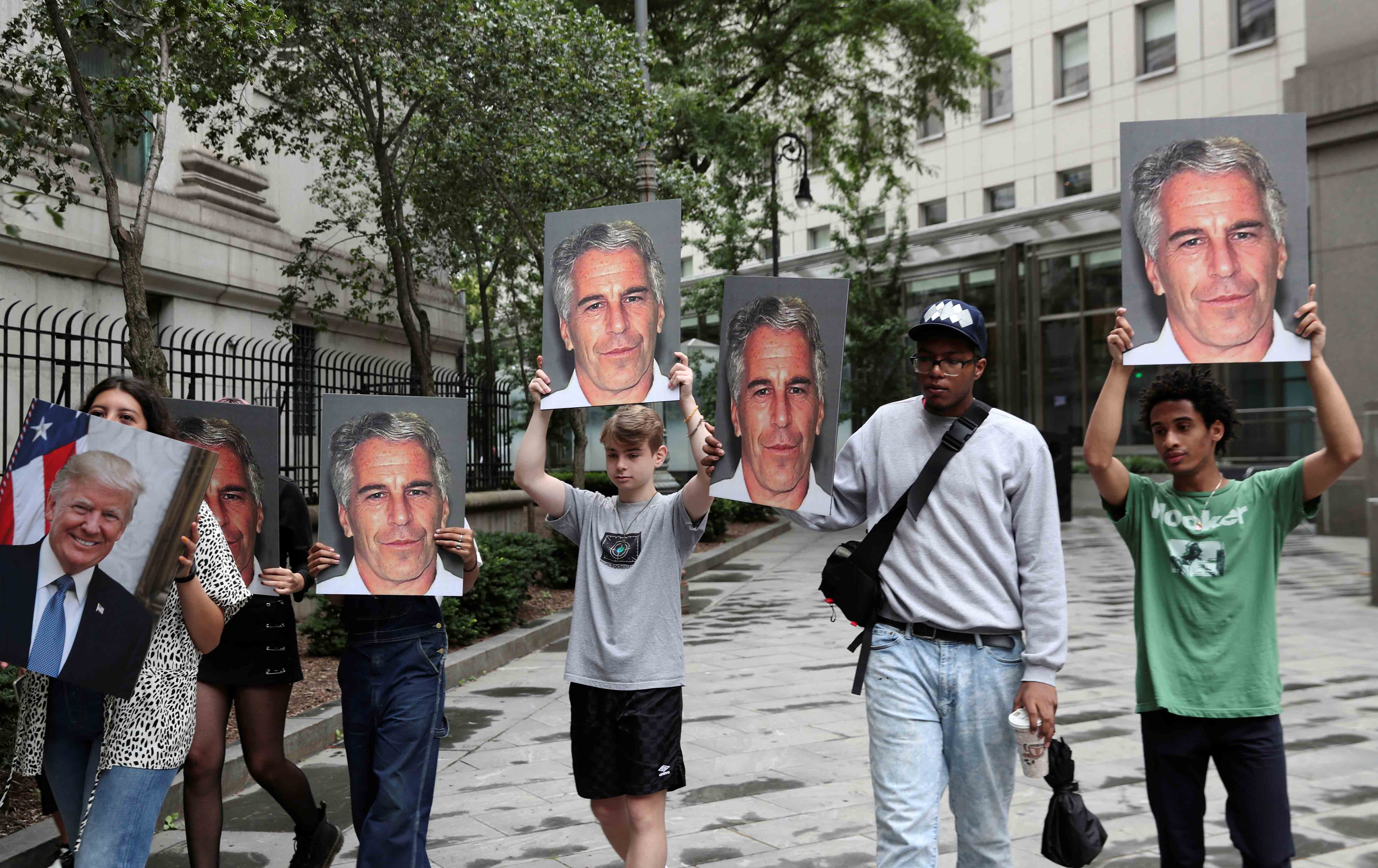
Jeffrey Epstein Embodies Elite Impunity


"The sheer scale of the crimes Jeffrey Epstein has allegedly committed staggers the imagination. Yet Epstein, who was arrested in New York on Sunday on charges of sexual trafficking of minors, was not an individual miscreant, a lone Humbert Humbert who transgressed against widely shared social norms. As someone who has enjoyed the friendship of the rich and powerful all his adult life, Epstein is emblematic of a much wider problem: a system of elite impunity that extends to even the worst crimes.

The Miami Herald reports that in 2005 when police in Palm Beach, Florida, first started interviewing Michelle Licata, a teen who said she’d been sexually abused by the multimillionaire hedge fund investor, they designated her “Jane Doe” to protect her identity since she was then a minor. The newspaper added, “There would be many Jane Does to follow: Jane Doe No. 3, Jane Doe No. 4, Jane Does 5, 6, 7, 8—and as the years went by—Jane Does 102 and 103.”

Behind the protective anonymity of the Jane Doe appellation, each of those girls had a real name, a family, and a story. In the totality of their testimonies, the girls offered strikingly consistent accounts about being lured while they were underage into Epstein’s mansion with the promise of easy money for giving a massage. After the massage, many of these girls claimed, they were sexually assaulted.

Despite these often horrifying accounts, Epstein was given a sweetheart deal in 2008 by federal prosecutor Alexander Acosta, who now serves as secretary of labor in the Trump administration. Under the non-prosecution agreement reached by Acosta and Epstein’s high-powered attorneys (a team that included Alan Dershowitz and Ken Starr), the FBI probe into Epstein was effectively closed, and Epstein received a 13-month sentence, served in the Palm Beach County Jail, where he stayed in a private wing. During this jail sentence, he received a permit to go to his office for up to 12 hours a day.

Few convicted sex offenders enjoy such a cushy confinement. In fact, the Palm Beach sheriff’s department has rules that forbid granting sex offenders the privileges Epstein received.

After serving the sentence, Epstein continued to benefit from the solicitude of the criminal justice system. In New York State in 2011, the office of District Attorney Cy Vance tried to downgrade Epstein from being a Level 3 sex offender (the highest risk) to a Level 1. Shooting down this motion, New York State Supreme Court Judge Ruth Pickholz said, “I have to tell you, I’m a little overwhelmed because I have never seen a prosecutor’s office do anything like this. I have done so many [sex offender registration hearings] much less troubling than this one where the [prosecutor] would never make a downward argument like this.’’

Acosta is a Republican, Vance a Democrat. The Epstein scandal is a bipartisan affair, one that implicates both political parties. Like many of the wealthy, Epstein sought out political friends who were both Republicans and Democrats. Bill Clinton flew on Epstein’s private jet on at least four occasions, but says he knew nothing of Epstein’s crimes. “I’ve known Jeff for fifteen years,” Donald Trump told New York magazine in 2002. “Terrific guy. He’s a lot of fun to be with. It is even said that he likes beautiful women as much as I do, and many of them are on the younger side.”

Current Issue

But the fact that leading figures in the American duopoly palled around with Epstein doesn’t mean that the scandal has no political salience. Quite the reverse; it shows that plutocratic corruption infects the entire system.

As Time magazine editor Anand Giridharadas notes, “Everything that made Epstein’s life possible remains in place after his arrest: the Caribbean tax havens, the hidden real-estate deals, the buying of politicians, the nonprofits that sell reputational glow, the editors who cover for people of their class. Epstein isn’t a self-contained tumor. He is a biopsy of an entire system.”

The strength of this system is on display as the six Senate Democrats who voted to confirm Acosta as labor secretary continue to stick with their man, despite Epstein’s arrest and the damning reporting of the Miami Herald. Indeed, New Jersey Senator Bob Menendez claimed he didn’t even know there was any issue involving Acosta’s making a plea deal with Epstein—despite the fact the matter was brought up in the confirmation hearings. Menendez told Politico that he didn’t “have any thoughts about it.”

Menendez and the other Democrats who support Acosta style themselves as moderates. Yet are we really to believe that there is a constituency of middle-of-the-road voters who are eager to keep a labor secretary who went easy on a wealthy sexual predator? As so often, what is called centrism is really just a mask for plutocracy and elite self-protection.

The politics of the Epstein case cut across party lines, but they open up an opportunity for a genuine populist critique. It’s easy to imagine a candidate untarnished by ties to Epstein—perhaps Elizabeth Warren, perhaps Bernie Sanders—holding up the sex offender as an example of a rigged system where the wealthy are unconstrained by law.

Such a gambit could be risky, since it would mean picking a fight with those Democrats who were part of Epstein’s circle. It would mean going after Bill Clinton for his sometimes sleazy associations and Cy Vance for his habit of avoiding prosecuting the wealthy (a kindness that Vance also extended to Harvey Weinstein and the Trump family). And it would mean lambasting Senate Democrats who continue to provide cover for Acosta.

This sort of intramural fight would make many enemies within the Democratic Party. But for any populist revolution to succeed, it has to combat the enablers of plutocracy whatever their partisan affiliation. The Epstein case offers a golden opportunity for any candidate who wants to take on that fight."

Jeffrey Epstein Embodies Elite Impunity

Migrant Children Describe Sex Assault, Retaliation By Border Agents | Ra...

Monday, July 08, 2019

Chris Cuomo SHOCKED By Bill Maher Drops A BIGB00M To END Trump's Career

James Monroe Enslaved Hundreds. Their Descendants Still Live Next Door. - The New York Times


"CHARLOTTESVILLE, Va. — So many Monroes in rural Albemarle County remember the moment they asked a parent or grandparent if they were somehow connected to the nation’s fifth president, James Monroe.

The telltale entrance sign to Monroe’s plantation estate, now a museum, had been a fixture of their childhoods, part of the landscape on the route back and forth between Charlottesville and the small, predominantly African-American community they called Monroetown.

Ada Monroe Saylor, 79, was riding in her father’s green Chevrolet on the way to the grocery store in the early 1950s when he confirmed her suspicions.

Sign Up for On Politics With Lisa Lerer

A spotlight on the people reshaping our politics. A conversation with voters across the country. And a guiding hand through the endless news cycle, telling you what you really need to know.

George Monroe Jr., a cousin of Ms. Saylor’s, spent much of his childhood at the homestead built by his great-great grandfather, Edward Monroe, known as Ned, whose parents were believed to be enslaved by the president and were among the first known to carry his name. For slaves whose African heritage had long been stolen or lost, this was not uncommon.

Mr. Monroe, 45, was about 8 years old when he posed the question to his father, after driving by the plantation, known as Highland.

“I had been seeing that entrance sign all my life,” Mr. Monroe said. “We were riding, and I asked my dad if we were the same Monroes, and he said yes, but he wouldn’t say much more. We didn’t talk about it.

“It was just understood that we were connected to the president, not by blood but by slavery.”

For seven generations, members of the Monroetown descendant community have lived less than 10 miles away from Highland, yet until three years ago there had never been a conversation between them and the museum. Now, they are working together to change the way slavery is presented at the former presidential plantation.

George Monroe Jr. grew up in a homestead built by his great-great-grandfather, Ned Monroe.
Ada Monroe Saylor is one of the eldest Monroetown descendants.
The president lived at Highland from 1799 to 1823. The property, which he purchased in 1793, was his family home while he served as a governor of Virginia and president. It is now owned by his alma mater, William & Mary.

As president, Monroe supported abolition, but he enslaved up to 250 people in his lifetime. Daily tours and the Highland website note the contradiction.

Visitors are now told about the nearby descendant community. They are also told about two enslaved men by name — Peter Mallory and George — who built Monroe’s guesthouse. A space under the porch of the guesthouse is being refashioned to reflect its former use as slave quarters. Biographies of the enslaved will soon be presented, and William & Mary will begin recording the oral histories of the descendants.

A more layered and complete narrative about the lives of the men, women and children enslaved by Monroe was built upon one family’s quest to trace its roots, the discoveries made by two independent researchers and the museum’s desire to accurately reflect the role slavery played on the plantation of a founding father. The intersection of those related paths, unfolding as part of a larger cultural reckoning, is an American story.

When George Monroe Jr. eventually made his way to Highland in 2016, he came searching for clues as to “who I come from and what makes me, me.” Entering the visitor center, he wanted to know more about his family. Highland wanted to know more about him.

‘We are all Monroes!’

Highland rises against the Southwest Mountains. It was once a 3,500-acre estate, filled with grain crops. Now it is a tourist attraction, about two miles from Thomas Jefferson’s Monticello.

After emancipation, some of the enslaved carried the Monroe name and settled nearby, informally calling their new free community Monroetown. This is where the Monroe descendants’ first chapter begins. The family estimates that fewer than 100 Monroes still live in that area.

On a summer Sunday afternoon in 2017, Martin Violette, a part-time researcher and guide at Highland, went to Middle Oak Baptist, a tiny white church in Monroetown. Mr. Violette — and Miranda Burnett, also a Highland guide — had set out on their own to find out what happened to the enslaved men, women and children sold by Monroe to a Florida plantation owner nearly 200 years ago.

What Mr. Violette found instead: an entire community of Monroe descendants right on Highland’s doorstep.

In the parking lot of Middle Oak Baptist after a service, Mr. Violette approached a group of African-American women, all in their 70s, members who had worshiped in the church since they were children. He inquired about Monroes.

“You have come to the right place,” one of the women exclaimed. “We are all Monroes!”

It turned out that more than half of the church members were part of a large Monroe family tracing back to Highland.

Rocks mark the location of the original house foundation at Highland.
A reenactment of slave quarters at Highland.
For seven generations, the Monroetown descendant community has lived less than 10 miles from Highland.
As president, Monroe supported abolition, but enslaved up to 250 people in his lifetime.
“Up until that point, we had no idea this community was right here,” said Sara Bon-Harper, Highland’s executive director. “It’s a very big thing for an institution like ours to forge these relationships absolutely from scratch, and we had this responsibility to get it right.

“But the question is, what is right?” she added. “Having this connection with the descendant community is the spark for us to tell a more inclusive, authentic history.”

By the time Mr. Violette found his way to Middle Oak, following clues left behind by Monroe’s records, Mr. Monroe had already visited Highland. He and a cousin, Francis Scott, the family historian, were already chasing their history back to the plantation and learning more about the connections between the president and their community, but no formal conversations had been initiated with the museum.

“We are talking about the pain of slavery and the ties that bind and the start of our story in America,” said Jennifer Saylor Stacy, 56, Ms. Saylor’s daughter and a lifelong member of Middle Oak. “We want to know more about our ancestors and help to give them back a sense of humanity.”

A small group of Monroe descendants gathered at Highland in March 2018 to begin the first of several discussions on how best to incorporate its family history. The meetings have also become a space to talk about the legacy of slavery, racial inequities and reparations, now a part of the national dialogue.

“It’s hard to put into words what it feels like to grow up this close to the plantation where your roots are,” Ms. Saylor said. “Once I knew we came from there, I often wondered what became of our people.”

Separated by centuries and hundreds of miles

Last year, Brent Leggs, executive director of the African-American Cultural Heritage Action Fund, an initiative led by the National Trust for Historic Preservation, and a group of historians, preservationists, descendants and site directors, gathered for the first National Summit on Teaching Slavery at James Madison’s Montpelier to talk about engaging descendant communities. Both George Monroe Jr. and Ms. Bon-Harper attended. That same year, Monticello opened its first exhibition of the living quarters of Sally Hemings.

“Most of the narrative about the black experience is about a painful past, but we have an opportunity today to uncover the hidden stories of activism and resistance and black agency rooted in slavery,” Mr. Leggs said. “This is about expanding beyond the typical stories of brutality and injustice to stories of black life and black love and how our community overcame the most difficult chapter in American history.”

At Highland, visitors learn about Monroe’s vision for a federal government and his opposition to European colonialism in the Americas, known as the Monroe Doctrine. In 1828, Monroe sold up to two dozen enslaved people for $5,000 to Joseph Mills White, the owner of Casa Bianca, a cane and cotton plantation just outside Monticello, Fla., to pay off mounting debt after his presidency.
"
Mr. Violette, a ninth-generation Virginian and Ms. Burnett, a reference librarian, started their research of the sale by asking basic questions: How many of the enslaved were sold? Did they leave Florida after emancipation? Then, after visiting Middle Oak, they wondered: Could they be related by blood to the Monroe descendants in Virginia?

The researchers pored over archival records documenting shipping manifests, property inventories, bills of sale, death certificates. In a letter to James Madison, Monroe said he had arranged to have the enslaved taken in families. At least three couples — Dudley and Eve, Toby and Betsy, Jim and Calypso — along with their children, were sent to Florida, yanking apart the larger Highland enslaved community.

“The more we were able to find, the more we knew how important it was to try to help reunite these two communities,” Mr. Violette said.

Fifteen months after Mr. Violette visited Middle Oak, he and Ms. Burnett visited another small church, this time in Florida. It was founded, in part, by children once enslaved at Highland. The researchers met about a dozen people in Monticello, including a woman whose grandfather was a descendant of Dudley and Eve, one on the enslaved couples sold to Florida, and the first direct link between the two descendant communities in Florida and Virginia.

Ms. Burnett cried as she described piecing together the life of Garrett Sanders, a son of Toby and Betsy, who was about 18 when he was sold with his parents and sent to Casa Bianca. After emancipation, he appeared in the 1870 census with his occupation listed as a blacksmith. He registered to vote in 1867, and cast a ballot in the 1876 presidential election.

“It means he made it. He made it to freedom,” Ms. Burnett said. “It is an incredible discovery to find the evidence that an enslaved person was finally able to live free.”

The Middle Oak Baptist Church.
A list of enslaved people from Casa Bianca, a cane and cotton plantation just outside Monticello, Fla.

Ms. Burnett and Mr. Violette hope to identify more Highland descendants in both states, and this August, the two communities — connected by slavery but separated by centuries and hundreds of miles — could be brought together for the first time.

Once Ms. Burnett and Mr. Violette shared what they had learned in Florida with those in Virginia, Waltine Eubanks, a Monroe descendant in Virginia, suggested inviting the Florida descendants to attend the annual Monroe homegoing celebration in Virginia next month.

“I want the treasure hunt to go on so that we find even more connections between these two communities,” Ms. Eubanks said. “We have the same roots, and we might even have the same bloodline. We might be cousins.”
James Monroe Enslaved Hundreds. Their Descendants Still Live Next Door. - The New York Times

Opinion | The Bro-iness of Joe Biden - The New York Times

By Charles M. Blow


Joe Biden has a 1960s T.V. dad quality that can sometimes be charming and nostalgia-provoking but is just as often problematic and cringe-inducing.

He is a man of a particular time whose evolution seems to be slowing. I don’t believe he’s a bad person, or a racist, or a segregationist. That’s ridiculous. I just believe that he is a man late in life who believes that he has always behaved admirably over that life. Hindsight sometimes renders a different judgment.

This is not a situation singular to Biden. Many of us, as we age, survey our lives, measure our behaviors against modern mores, and regret some actions.
But there is something about Biden that on occasion wants to resist this growth and acknowledgment. His first impulse is to get his back up and fight, rather than be empathizing and accepting. It is that thing in him, his own certitude that his motives are honorable and pure, that allows him to casually diminish or dismiss the pain people say he caused them.

In his mind, he is one of the good guys who shelved much of his privilege to fight for the oppressed. To some degree, that is true. But you can’t hold your own halo. You have to be able to see that you can still do harm when you mean well. That’s Biden’s blind spot.
He seems to have emerged from a kind of vintage bro culture in which self-righteousness and assumed altruism produces its own form of machismo — tough and touchy — that feels just a tad discordant with modern liberalism and a tad entitled.

This was on full display last week when Biden sat for an interview with CNN’s Chris Cuomo.
In some ways it was subtle, like the way he kept saying to Cuomo, “Come on, man,” to punctuate his sentences, a rhetorical device that men often use among themselves, in locker rooms and barbershops, to recognize, register and reinforce masculinity.
But in other ways it was blunt, like Biden saying of Donald Trump: “You walk behind me in a debate, come here, man.” Biden continued, “He’s the bully that used to make fun when I was a kid that I stutter, and I’d smack him in the mouth.”

This is not the first time Biden has talked about Trump in this way. Last year, at a rally hosted by a sexual assault awareness group no less, Biden said of Trump, “If we were in high school, I’d take him behind the gym and beat the hell out of him.”

This is not an admirable feature, but Biden can’t seem to see that. His worldview seems to be that self-righteousness gives license to a kind of ruffianism. That very same license has been abused throughout history.

This tough guy, “guy’s guy” sense of himself is what has caused Biden many of his problems. It informed his thinking on the disastrous 1994 crime bill he helped write and the way he discussed the bill the year before on the Senate floor, saying that “we have predators on our streets.” He said of violent criminals during that speech: “It doesn’t matter whether or not they are the victims of society.”

Biden had defended the crime bill for years, even bragging about it, but on Saturday in South Carolina, a state he’ll need to win and where the majority of Democratic primary voters are black, he again offered a partial apology, saying, “It worked, it worked in some areas. But it failed in others.”

But his first instinct is always to fight criticism rather than accept it. The dust-up over his comments about working with segregationists would have been only a flash in the pan if he’d apologized when people asked him to.
It speaks to how he handles accusations by women who said he had touched them in ways that made them uncomfortable. Rather than apologize, he issued a video in which he said “social norms are beginning to change” and “I get it, I get it.” But apparently, he doesn’t get it, because since then he has joked about inappropriately touching women more than once.

It informs the rough, unfair treatment of Anita Hill during the Clarence Thomas confirmation hearing before the Judiciary Committee that Biden chaired. But only this year when the campaign is gearing up, did he reach out to Hill to express his “regret,” and he told “Good Morning America”: “She did not get a fair hearing. She did not get treated well. That’s my responsibility.”
Biden still leads in the polls, and if he can maintain his lead he may well win the nomination. Biden, like the rest of the Democratic field, is better than Trump any day. Biden, like much of the Democratic field, could beat Trump.

But, none of that negates that fact that Biden has a tone and temperament issue that it would behoove him to adjust. We don’t need to replace a septuagenarian brute with a septuagenarian bro.
During the CNN interview with Cuomo, Biden bragged: “I’ve never been accused of being — not being able to spar. I’ve been accused of being too aggressive.”
Come on, man."


Opinion | The Bro-iness of Joe Biden - The New York Times

Saturday, July 06, 2019

Roland Martin Deconstructs Joe Biden's Problem With Segregation, 'Bussin...

Why I love a country that once betrayed me | George Takei

Powerful Democrat seeks probe of CBP leaders after secret Facebook groups revealed


"2nd secret CBP Facebook group shows mocking images 01:18

(CNN)The chairman of the House Homeland Security Committee is calling for the Department of Homeland Security's inspector general to investigate Customs and Border Protection leadership after Facebook groups associated with the agency were found to contain vulgar and offensive posts.


Rep. Bennie Thompson, a Mississippi Democrat, sent a letter Friday to the Homeland Security Department's acting inspector general requesting an investigation into whether Customs and Border Protection and Department of Homeland Security leadership -- specifically acting Homeland Security Secretary Kevin McAleenan, acting Customs and Border Protection Commissioner Mark Morgan and Border Patrol Chief Carla Provost -- knew about or addressed allegations that Customs and Border Protection agents had "posted violent, racist, misogynistic comments and pictures" in the groups.

"Such vile and threatening behavior from agents of the United States Government is entirely unacceptable, should be grounds for immediate dismissal from service, and is the subject of an investigation by CBP's Office of Professional Responsibility," Thompson said.

Thompson's request comes on the heels of Customs and Border Protection officials announcing an investigation into "disturbing social media activity" after a published report of a closed Facebook group for current and former Border Patrol agents called "I'm 10-15." The group reportedly featured jokes about migrant deaths and derogatory comments about Latina lawmakers.

CNN reported on Friday the existence of at least one other such group called "The Real CBP Nation," which has around 1,000 members and featured images mocking the separations of migrant families, disrespecting New York's Democratic Rep. Alexandria Ocasio-Cortez, and deriding Asians and African Americans.

Thompson pointed to media reports that Morgan had been aware of the group since 2016, when he was Border Patrol chief, and that high-ranking Customs and Border Protection officials knew of the group and used it to gain information.


"If accurate, this report calls into question Mr. Morgan's fitness to hold any office in the United States Government," Thompson wrote.


Customs and Border Protection has been aware of troubling social media activity for more than a year. In February 2018, a senior Customs and Border Protection official warned all agency employees of potential discipline after having been informed of a private Facebook group with inappropriate and offensive posts, according to a memo obtained by CNN."


Powerful Democrat seeks probe of CBP leaders after secret Facebook groups revealed

Japanese-American Internment Survivors Protest Plan to Jail Migrant Kids...