Thursday, July 25, 2019


Wednesday, July 24, 2019
Opinion | Robert Mueller Said All He Needed to Say

"As devastating as Robert Mueller’s report was for the president, his testimony on Wednesday — coming after months of the president’s efforts to deny the report’s realities and shut down all attempts at oversight or accountability — is worse.
From the outset, Mr. Mueller, the former special counsel, was predictably cautious and restrained, and he said very little that went beyond what was in his report. But his plain-spoken answers illuminated for Congress — and millions of Americans watching at home — the case against the president.
Several episodes stand out, all of which Democrats highlighted in their questions to Mr. Mueller at the morning hearing before the House Judiciary Committee.
First, there was President Trump’s June 2017 direction to the White House counsel, Don McGahn, to fire the special counsel in the wake of news reports that he was investigating the president for obstruction of justice — and Mr. Trump’s later insistence that Mr. McGahn create a false internal memorandum that would contradict reporting about this order.
Then there was President Trump’s instructions, in summer 2017, to his former campaign manager Corey Lewandowski, who was then a private citizen, to direct Attorney General Jeff Sessions to limit Mr. Mueller’s investigation with the intent to, as stated in the report, “prevent further investigative scrutiny of the president and his campaign’s conduct.”
More from Opinion on the Mueller Testimony
Democrats also noted Mr. Trump’s repeated instructions that Mr. Sessions “unrecuse” himself from running the investigation, which Mr. Mueller said in the report lead to a “reasonable inference” that the president wanted his attorney general to act as a shield from the investigation.
And finally, Mr. Mueller described how Mr. Trump sought, in part through his private attorneys, to influence the cooperation and testimony of several possible witnesses, including his former campaign manager Paul Manafort and his former lawyer Michael Cohen, by making public and private threats, and by floating the possibility of pardons.
These facts, starkly affirmed on Wednesday by Mr. Mueller after months of mischaracterization of his report by the president and others, are catastrophic.
Despite Mr. Mueller’s unwillingness to speculate on hypotheticals, and his adherence to the Justice Department policy against indicting a sitting president, these facts, which he also outlined in depth in his report, make clear that were Mr. Trump an ordinary person, he would have been indicted on multiple counts of obstruction of justice, as more than a thousand former federal prosecutors, free of those limitations, have observed.
Republicans did their best, during their own questions, to muddy these facts by attacking Mr. Mueller’s credibility. And of course from the beginning, Mr. Mueller was limited by a finding by the Office of Legal Counsel that a sitting president could not be indicted. And yet there is no doubt, after Wednesday, that Mr. Mueller found substantial evidence of serious and repeated criminal activity by the president. Inaction is not an option. So what next?
Wednesday’s hearings are significant because they mark the point where Congress will take up where Mr. Mueller left off; they were, effectively, the beginning of an inquiry into whether these and other abuses of power are the “high crimes and misdemeanors” that the Constitution says would merit President Trump’s impeachment and removal from office. Congress needs to continue that effort and make it official.
To call for a formal impeachment inquiry to begin is not to prejudge its outcome. It is to acknowledge that the preconditions for Congress for initiating that process have undoubtedly been met. It is also an acknowledgment that as a nation we have exhausted other avenues for accountability.
Since his inauguration, Mr. Trump has made clear that he will not abide by the normal standards of ethical and responsible government. Since Democrats took control of Congress in January, he and his administration have asserted baseless privileges and immunities to undermine ordinary forms of legislative oversight of the executive branch, attacked all attempts at review or accountability, and ignored recommendations to discipline top officials for repeatedly violating the law.
President Trump has threatened to dismantle the proposition that no person is above the law. But given what we have all now heard from Mr. Mueller, it is clear that Congress must assert itself as a constitutional protector of the rule of law.
In opening an impeachment inquiry, Congress must confront other questions that Mr. Mueller was not asked to answer — the most important of which is whether President Trump has engaged in other constitutionally repugnant abuses of power. In addition to obstruction of justice, there are at least two more, independent bases for impeachment that Congress should assess.
Just last week, newly released documents reinforced just how personally involved Mr. Trump was in an apparent criminal scheme to defraud enforcement of federal campaign finance laws related to hush money payments to women who claimed that they had affairs with him.
And from the start of his presidency, Mr. Trump has accepted profits, gains and advantages from foreign and domestic governments at properties he still owns, conduct so worrisome to the founders that they prohibited it in the Constitution’s two emoluments clauses. Their fear — that domestic and foreign governments might try to curry favor with the executive — has been realized.
The American people deserve a process that will facilitate a thorough assessment of the evidence presented and the gravity of the president’s misconduct. Far from being a distraction from Congress’s other responsibilities, checking abuses of executive powers is one of its core functions.
Mr. Trump has spent his entire presidency trying to foreclose the possibility of accountability for his misdeeds. Mr. Mueller, in his testimony on Wednesday, made clear that such a path is unacceptable. Congress must take it from here.
Noah Bookbinder (@NoahBookbinder) is the executive director of Citizens for Responsibility and Ethics in Washington."
Opinion | Robert Mueller Said All He Needed to Say


Tuesday, July 23, 2019
Monday, July 22, 2019
Behind the Scenes of the House Democrats’ Twitter War
"Behind the Scenes of the House Democrats’ Twitter War
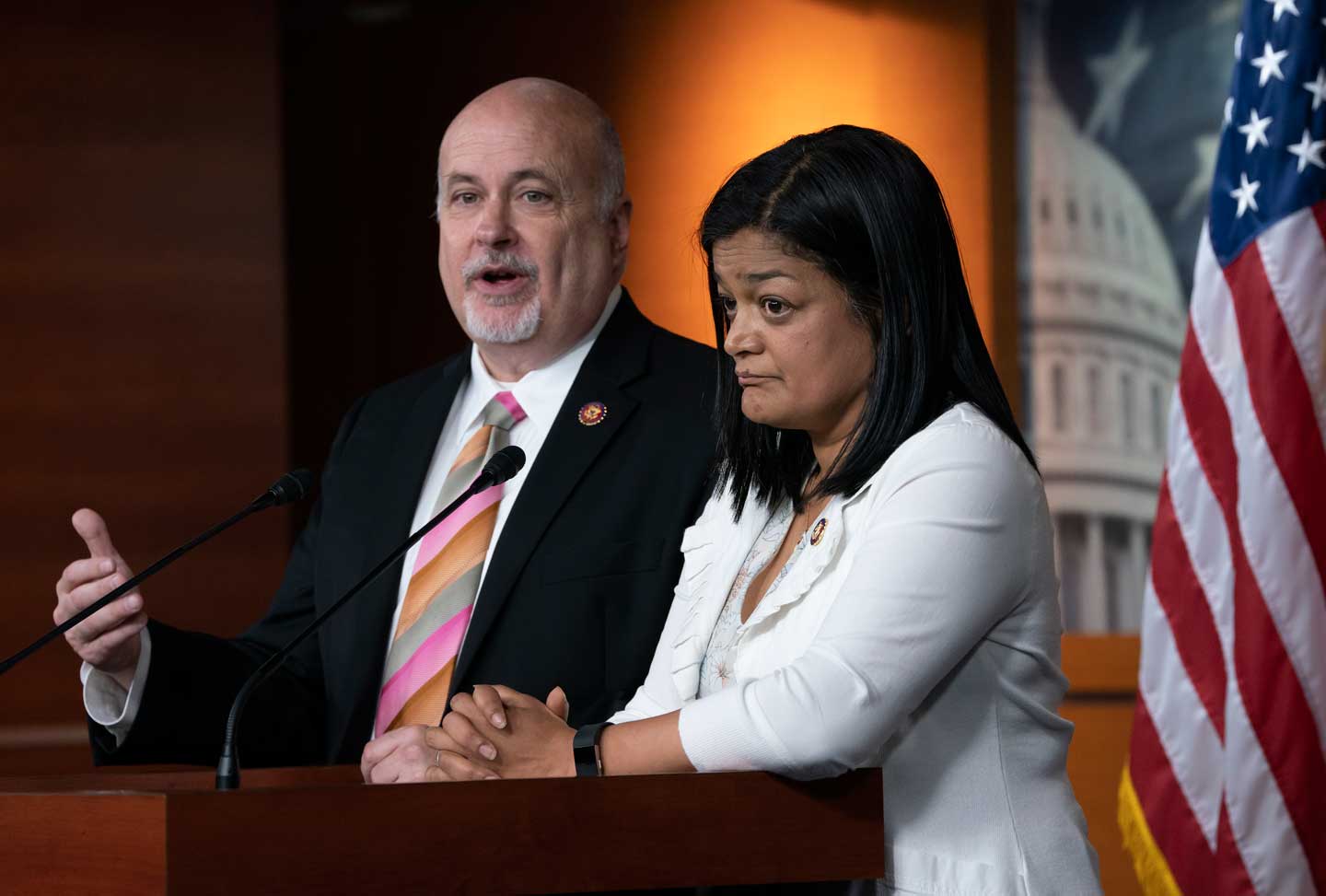
In an exclusive interview, Progressive Caucus co-chair Pramila Jayapal explains how she helped broker a truce among the warring factions of the party.
By Joan WalshTwitter
Donald Trump’s racist attacks on four left-leaning, first-term congresswoman over the last week had one salutary side-effect: They seemed to bring feuding House Democratic Caucus members together behind their besieged sisters and in renewed opposition to the repellent president.
But even though Trump’s attacks on the young Democratic leaders—telling them to “go back” to where they came from, though three of the four brown-skinned women were born here, and the fourth became a citizen as a child—appeared to end open warfare among Democrats, the ideological rifts revealed by the clash remain, as does confusion about how a truce was reached. The fragile peace seems to have many fathers and mothers—but the individuals who negotiated the calming of tensions say some folks are taking bows they haven’t earned. I reached out to Progressive Caucus co-chair Pramila Jayapal, who’s credited with doing some of the heavy lifting to unite the House Democratic Caucus. She wanted to set the record straight about what set off the infighting—and what put a stop to it, at least for now.
Although the brightest flashpoints came on Twitter, the original clash, between Representatives Alexandria Ocasio-Cortez, Ayanna Pressley, Rashida Tlaib and Ilhan Omar, and moderate Democratic leaders, came into the open after the four voted against a supplemental border-funding bill earlier this month. It was a bill Jayapal and her Progressive Caucus co-chair Mark Pocan worked hard to improve, adding language to require contractors to provide detainees with basic standards of care (food, water, hygiene supplies and medical care), to strip contracts from vendors that didn’t meet those standards, and to keep the government from detaining children for more than 90 days. The four first-term women, all members of the Progressive Caucus, had campaigned promising not to give added money to ICE, so they voted against it. The bill still passed easily, with only their four “nay” votes.
The Senate then rejected it and passed its own bill, with the unexpected support of 33 of 45 Senate Democrats, expanding funding for ICE and border security and leaving out the protective language of the House bill. When it came back to the House, a bloc of 23 conservative Democrats denied Rules Committee chairman Jim McGovern a maneuver that would have added back some of the protections before it went to the floor for a final vote. “It’s really unheard of for Democrats to do that,” Jayapal said, still seething. So the House adopted the Senate bill, but the majority of yeses came from Republicans; only 129 Democrats backed the final bill. Jaypal and Pocan voted with the four women of the so-called “squad” against the Senate bill.
“It passed with 176 Republican votes and only 129 Democratic votes, which simply should not happen when we have the majority, and certainly not without a full caucus discussion about what to do,” Jayapal said, still troubled three weeks later.
That’s the backdrop to this long, hot summer of Democratic infighting (which is technically less than half over). The so-called “squad” went its own way, even though Pelosi worked with progressives to add restrictions to the funding. (That didn’t bother Jayapal; “I knew they were never gonna vote for it; they said so. But we delivered everyone besides them.”) Pelosi was less sanguine, irritated that she’d worked with progressives to improve the bill, only to have the four women with wide progressive reach walk away.
That led to the dis heard ’round the world: when she told poison-penned New York Times columnist Maureen Dowd “they’re four people and that’s how many votes they got,” seeming to downplay their enormous popularity in the broad progressive movement. Ocasio-Cortez shot back, saying Pelosi’s comments “got to a point where it was just outright disrespectful.… the explicit singling out of newly elected women of color.” She seemed to suggest race was playing a role, although she immediately denied that was her intent.
Then staffers to the feuding parties took the beef to Twitter, which (take it from me) is never a good idea.
In a series of tweets, Ocasio-Cortez’s chief of staff Saikat Chakrabarti compared moderate Democrats who voted for the border bill to Southern segregationists, and suggested that Representative Sharice Davids (D-KS), one of the first two Native American women ever elected to Congress, just last year, had voted to “enable a racist system” by supporting the bill. Chakrabarti and Ocasio-Cortez came under fire for the personal attacks.
By several accounts, Chakrabarti was in the process of deleting the offensive tweets when the official Twitter account of the House Democratic Caucus, technically controlled by Caucus chair Hakeem Jeffries, went after him. “Who is this guy and why is he explicitly singling out a Native American woman of color? … She is a phenomenal new member who flipped a red seat blue,” the tweet said. “Keep Her Name Out Of Your Mouth.” Jeffries refused to condemn the escalation, telling reporters=, “The tweet speaks for itself.”
Behind the scenes, tensions were rapidly escalating over the Twitter war, and Jayapal was trying to play peacemaker. “I was very frustrated with the House caucus tweet about Saikat,” she said, since she knew Ocasio-Cortez was already working with her staffer to take the offensive material down—in fact, Chakrabarti had deleted the main offending tweet comparing conservative Democrats to last century’s segregationists, but had not deleted the thread that included the tweet about Davids. “I think it’s important for the House Democratic Caucus twitter account to be about lifting up members, not getting engaged in personality wars, and certainly not pulling out a tweet that was two weeks old,” Jayapal told me. “I was particularly concerned because I was also hearing discomfort from my colleagues—that account is supposed to represent all of us in the caucus, and seemed to just be fueling the fire.”
For the record, Jayapal says she was troubled by Chakrabarti’s tweets too and raised her concerns directly with Ocasio-Cortez. “Those tweets were not helpful, at all, and should not have happened. It’s just not his role, he’s not elected, he’s chief of staff, he represents Alex.” Jayapal had texted Ocasio-Cortez the day before the Trump tweet that ultimately helped unify Democrats, “to say, ‘Can we talk about everything that is happening?’ I wanted to strategize with her about how to move beyond where we were.” When they did meet, last Sunday evening, she discovered that only Representative Karen Bass had actually reached out to the first-term congresswoman directly. Jayapal promised Ocasio-Cortez she would work with others to get the House caucus tweet slamming Chakrabarti taken down.
Jeffries had, multiple times, told reporters he stood by the tweet, when questioned about it. Jayapal and Pocan had a previously scheduled meeting with Jeffries to discuss Progressive Caucus issues, and Jayapal raised the controversial tweet with him. Others had already done so. Jeffries listened, seemed to understand the concerns, and was open to finding a way forward. They discussed a plan that involved deleting both the House Caucus tweet and Chakrabarti’s tweets. Jayapal spoke with Ocasio-Cortez, who immediately agreed, and Chakrabarti’s tweets were deleted. Eventually, the House Caucus tweet came down as well, and peace was restored.
Then Jeffries suggested to Jayapal and Pocan that the leaders of the various Democratic caucuses use the opportunity to come together and release a statement, declaring a unified front. Although the other caucus leaders hadn’t directly been a part of these negotiations, Jayapal and Pocan respected his desire to use this as an opportunity to reset the table. On behalf of the Progressive Caucus, she and Pocan joined Jeffries and New Democrats chair Rep. Derek Kilmer (D-WA) and Blue Dog chair Rep. Stephanie Murphy (D-FL) to release a statement calling Democrats a “diverse, robust and passionate family…dedicated to making life better for everyday Americans.”
“At times, there may be different perspectives on the way forward. That is a hallmark of the legislative process,” the statement read. “We will remain clear-eyed with respect to our unity of purpose. Every single voice within the House Democratic Caucus is an important one. We have a shared mission. Onward and upward.”
All’s well that ends well, right?
Well, mostly.
Though Jeffries told the signees they should let the statement speak for itself, immediately some of the parties began to spin. In a Politico article about the settlement, a photo of Jeffries was captioned: “House Democratic Caucus Chairman Hakeem Jeffries initiated the olive branch among his colleagues.” But the article itself contradicts that, as does other reporting; Jeffries at first refused to take the House caucus tweet down or to condemn it, though he was repeatedly asked to, and Politico credits Jayapal “as ‘instrumental’ to securing the détente.”
What most irked Jayapal was that an earlier inflammatory tweet by Pocan was depicted as part of the deal; in fact, Pocan had on his own decided to remove the tweet, which he posted after conservative Democrats blocked the House vote to add restrictions to the Senate border-funding bill. (It asked sarcastically, “Since when did the Problem Solvers Caucus become the Child Abuse Caucus?”) “Mark’s tweet never came up in the meetings! It was like I threw Mark under the bus.” For his part, Pocan knows she did not.
It was also surprising, to me, to see conservative Problem Solvers caucus chair Josh Gottheimer of New Jersey take a victory lap at the end of the Politico piece. Described as “a moderate who has also been part of efforts to unify the caucus”—narrator’s voice here; I have never heard anything like that—Gottheimer was quoted saying, “I think there’s a real recognition that even when we have differences, there’s a constructive way to have those conversations.”
Given that Gottheimer took the lead in squashing the attempt to at least amend the Senate bill with some progressive-backed restrictions on funding, enraging some constituents sufficiently that they began talking—even to Politico, by the way—about a primary challenge to the monied moderate, that seemed a stretch. Jayapal confirmed that Gottheimer had nothing to do with the Democrats’ truce.
Still, some good came out of all the infighting. After Jayapal trained her fire on Senate Democrats for passing the border bill without protections for detainees, she got a phone call from minority leader Chuck Schumer. “We need to have more consultation with the Senate Dems and the CPC,” she told him. “We actually used to have a big group of Senate Dems who met with us—but they’re all running for president!” she jokes, and indeed that week many of them were away at the first debates. “Jeff Merkley was there and of course he pushed back, but we didn’t have Elizabeth, Bernie, Kamala, Cory! That was very difficult.” (That’s Warren, Sanders, Harris, and Booker, for those who aren’t on a first-name basis with some top-tier Democrats.) But last Wednesday, Schumer met personally with the House Progressive Caucus “and promised a closer connection between the CPC and the Senate.”
That’s good, because issues of border funding will return to Congress this fall, and Jayapal told me Democrats “need to seize the narrative” and say this has never been about money. “They have the money for toothpaste. They have the money for food.” To Jayapal it’s about “a badly managed agency, and a complete lack of accountability from the administration.” Two data points—you might call them atrocities—stand out to her. One is the Border Patrol Facebook group riddled with racism that has 10,000 members, roughly half the force. And the fact that former Homeland Security secretary John Kelly now sits on the board a for-profit company running child-detention centers, including one in Homestead, Florida, which bills $750 a night but can’t guarantee its young charges adequate food, water, or hygiene. “You can stay at the Ritz for that,” she notes. And you would definitely get toothpaste.
That’s why Jayapal says border issues aren’t mainly about money. It’s clear the Democrats will be battling over these issues again come fall. But let’s hope they debate openly, and fight cleanly, and leave Twitter insults to others. “I hope that we take what happened as important lessons learned, and move on with the recognition that people need to talk to one another more directly when there are problems,” she says. “Which there certainly will be, because we are a caucus that values diversity!”
Behind the Scenes of the House Democrats’ Twitter War
Behind the Scenes of the House Democrats’ Twitter War
"Behind the Scenes of the House Democrats’ Twitter War
In an exclusive interview, Progressive Caucus co-chair Pramila Jayapal explains how she helped broker a truce among the warring factions of the party.
By Joan WalshTwitter
Donald Trump’s racist attacks on four left-leaning, first-term congresswoman over the last week had one salutary side-effect: They seemed to bring feuding House Democratic Caucus members together behind their besieged sisters and in renewed opposition to the repellent president.
But even though Trump’s attacks on the young Democratic leaders—telling them to “go back” to where they came from, though three of the four brown-skinned women were born here, and the fourth became a citizen as a child—appeared to end open warfare among Democrats, the ideological rifts revealed by the clash remain, as does confusion about how a truce was reached. The fragile peace seems to have many fathers and mothers—but the individuals who negotiated the calming of tensions say some folks are taking bows they haven’t earned. I reached out to Progressive Caucus co-chair Pramila Jayapal, who’s credited with doing some of the heavy lifting to unite the House Democratic Caucus. She wanted to set the record straight about what set off the infighting—and what put a stop to it, at least for now.
Although the brightest flashpoints came on Twitter, the original clash, between Representatives Alexandria Ocasio-Cortez, Ayanna Pressley, Rashida Tlaib and Ilhan Omar, and moderate Democratic leaders, came into the open after the four voted against a supplemental border-funding bill earlier this month. It was a bill Jayapal and her Progressive Caucus co-chair Mark Pocan worked hard to improve, adding language to require contractors to provide detainees with basic standards of care (food, water, hygiene supplies and medical care), to strip contracts from vendors that didn’t meet those standards, and to keep the government from detaining children for more than 90 days. The four first-term women, all members of the Progressive Caucus, had campaigned promising not to give added money to ICE, so they voted against it. The bill still passed easily, with only their four “nay” votes.
The Senate then rejected it and passed its own bill, with the unexpected support of 33 of 45 Senate Democrats, expanding funding for ICE and border security and leaving out the protective language of the House bill. When it came back to the House, a bloc of 23 conservative Democrats denied Rules Committee chairman Jim McGovern a maneuver that would have added back some of the protections before it went to the floor for a final vote. “It’s really unheard of for Democrats to do that,” Jayapal said, still seething. So the House adopted the Senate bill, but the majority of yeses came from Republicans; only 129 Democrats backed the final bill. Jaypal and Pocan voted with the four women of the so-called “squad” against the Senate bill.
“It passed with 176 Republican votes and only 129 Democratic votes, which simply should not happen when we have the majority, and certainly not without a full caucus discussion about what to do,” Jayapal said, still troubled three weeks later.
That’s the backdrop to this long, hot summer of Democratic infighting (which is technically less than half over). The so-called “squad” went its own way, even though Pelosi worked with progressives to add restrictions to the funding. (That didn’t bother Jayapal; “I knew they were never gonna vote for it; they said so. But we delivered everyone besides them.”) Pelosi was less sanguine, irritated that she’d worked with progressives to improve the bill, only to have the four women with wide progressive reach walk away.
That led to the dis heard ’round the world: when she told poison-penned New York Times columnist Maureen Dowd “they’re four people and that’s how many votes they got,” seeming to downplay their enormous popularity in the broad progressive movement. Ocasio-Cortez shot back, saying Pelosi’s comments “got to a point where it was just outright disrespectful.… the explicit singling out of newly elected women of color.” She seemed to suggest race was playing a role, although she immediately denied that was her intent.
Then staffers to the feuding parties took the beef to Twitter, which (take it from me) is never a good idea.
In a series of tweets, Ocasio-Cortez’s chief of staff Saikat Chakrabarti compared moderate Democrats who voted for the border bill to Southern segregationists, and suggested that Representative Sharice Davids (D-KS), one of the first two Native American women ever elected to Congress, just last year, had voted to “enable a racist system” by supporting the bill. Chakrabarti and Ocasio-Cortez came under fire for the personal attacks.
By several accounts, Chakrabarti was in the process of deleting the offensive tweets when the official Twitter account of the House Democratic Caucus, technically controlled by Caucus chair Hakeem Jeffries, went after him. “Who is this guy and why is he explicitly singling out a Native American woman of color? … She is a phenomenal new member who flipped a red seat blue,” the tweet said. “Keep Her Name Out Of Your Mouth.” Jeffries refused to condemn the escalation, telling reporters=, “The tweet speaks for itself.”
Behind the scenes, tensions were rapidly escalating over the Twitter war, and Jayapal was trying to play peacemaker. “I was very frustrated with the House caucus tweet about Saikat,” she said, since she knew Ocasio-Cortez was already working with her staffer to take the offensive material down—in fact, Chakrabarti had deleted the main offending tweet comparing conservative Democrats to last century’s segregationists, but had not deleted the thread that included the tweet about Davids. “I think it’s important for the House Democratic Caucus twitter account to be about lifting up members, not getting engaged in personality wars, and certainly not pulling out a tweet that was two weeks old,” Jayapal told me. “I was particularly concerned because I was also hearing discomfort from my colleagues—that account is supposed to represent all of us in the caucus, and seemed to just be fueling the fire.”
For the record, Jayapal says she was troubled by Chakrabarti’s tweets too and raised her concerns directly with Ocasio-Cortez. “Those tweets were not helpful, at all, and should not have happened. It’s just not his role, he’s not elected, he’s chief of staff, he represents Alex.” Jayapal had texted Ocasio-Cortez the day before the Trump tweet that ultimately helped unify Democrats, “to say, ‘Can we talk about everything that is happening?’ I wanted to strategize with her about how to move beyond where we were.” When they did meet, last Sunday evening, she discovered that only Representative Karen Bass had actually reached out to the first-term congresswoman directly. Jayapal promised Ocasio-Cortez she would work with others to get the House caucus tweet slamming Chakrabarti taken down.
Jeffries had, multiple times, told reporters he stood by the tweet, when questioned about it. Jayapal and Pocan had a previously scheduled meeting with Jeffries to discuss Progressive Caucus issues, and Jayapal raised the controversial tweet with him. Others had already done so. Jeffries listened, seemed to understand the concerns, and was open to finding a way forward. They discussed a plan that involved deleting both the House Caucus tweet and Chakrabarti’s tweets. Jayapal spoke with Ocasio-Cortez, who immediately agreed, and Chakrabarti’s tweets were deleted. Eventually, the House Caucus tweet came down as well, and peace was restored.
Then Jeffries suggested to Jayapal and Pocan that the leaders of the various Democratic caucuses use the opportunity to come together and release a statement, declaring a unified front. Although the other caucus leaders hadn’t directly been a part of these negotiations, Jayapal and Pocan respected his desire to use this as an opportunity to reset the table. On behalf of the Progressive Caucus, she and Pocan joined Jeffries and New Democrats chair Rep. Derek Kilmer (D-WA) and Blue Dog chair Rep. Stephanie Murphy (D-FL) to release a statement calling Democrats a “diverse, robust and passionate family…dedicated to making life better for everyday Americans.”
“At times, there may be different perspectives on the way forward. That is a hallmark of the legislative process,” the statement read. “We will remain clear-eyed with respect to our unity of purpose. Every single voice within the House Democratic Caucus is an important one. We have a shared mission. Onward and upward.”
All’s well that ends well, right?
Well, mostly.
Though Jeffries told the signees they should let the statement speak for itself, immediately some of the parties began to spin. In a Politico article about the settlement, a photo of Jeffries was captioned: “House Democratic Caucus Chairman Hakeem Jeffries initiated the olive branch among his colleagues.” But the article itself contradicts that, as does other reporting; Jeffries at first refused to take the House caucus tweet down or to condemn it, though he was repeatedly asked to, and Politico credits Jayapal “as ‘instrumental’ to securing the détente.”
What most irked Jayapal was that an earlier inflammatory tweet by Pocan was depicted as part of the deal; in fact, Pocan had on his own decided to remove the tweet, which he posted after conservative Democrats blocked the House vote to add restrictions to the Senate border-funding bill. (It asked sarcastically, “Since when did the Problem Solvers Caucus become the Child Abuse Caucus?”) “Mark’s tweet never came up in the meetings! It was like I threw Mark under the bus.” For his part, Pocan knows she did not.
It was also surprising, to me, to see conservative Problem Solvers caucus chair Josh Gottheimer of New Jersey take a victory lap at the end of the Politico piece. Described as “a moderate who has also been part of efforts to unify the caucus”—narrator’s voice here; I have never heard anything like that—Gottheimer was quoted saying, “I think there’s a real recognition that even when we have differences, there’s a constructive way to have those conversations.”
Given that Gottheimer took the lead in squashing the attempt to at least amend the Senate bill with some progressive-backed restrictions on funding, enraging some constituents sufficiently that they began talking—even to Politico, by the way—about a primary challenge to the monied moderate, that seemed a stretch. Jayapal confirmed that Gottheimer had nothing to do with the Democrats’ truce.
Still, some good came out of all the infighting. After Jayapal trained her fire on Senate Democrats for passing the border bill without protections for detainees, she got a phone call from minority leader Chuck Schumer. “We need to have more consultation with the Senate Dems and the CPC,” she told him. “We actually used to have a big group of Senate Dems who met with us—but they’re all running for president!” she jokes, and indeed that week many of them were away at the first debates. “Jeff Merkley was there and of course he pushed back, but we didn’t have Elizabeth, Bernie, Kamala, Cory! That was very difficult.” (That’s Warren, Sanders, Harris, and Booker, for those who aren’t on a first-name basis with some top-tier Democrats.) But last Wednesday, Schumer met personally with the House Progressive Caucus “and promised a closer connection between the CPC and the Senate.”
That’s good, because issues of border funding will return to Congress this fall, and Jayapal told me Democrats “need to seize the narrative” and say this has never been about money. “They have the money for toothpaste. They have the money for food.” To Jayapal it’s about “a badly managed agency, and a complete lack of accountability from the administration.” Two data points—you might call them atrocities—stand out to her. One is the Border Patrol Facebook group riddled with racism that has 10,000 members, roughly half the force. And the fact that former Homeland Security secretary John Kelly now sits on the board a for-profit company running child-detention centers, including one in Homestead, Florida, which bills $750 a night but can’t guarantee its young charges adequate food, water, or hygiene. “You can stay at the Ritz for that,” she notes. And you would definitely get toothpaste.
That’s why Jayapal says border issues aren’t mainly about money. It’s clear the Democrats will be battling over these issues again come fall. But let’s hope they debate openly, and fight cleanly, and leave Twitter insults to others. “I hope that we take what happened as important lessons learned, and move on with the recognition that people need to talk to one another more directly when there are problems,” she says. “Which there certainly will be, because we are a caucus that values diversity!”
Behind the Scenes of the House Democrats’ Twitter War
Opinion | Denying Racism Supports It

"By Charles M. Blow July 21, 2019
When did we arrive at the point where applying the words racist and racism were more radioactive than actually doing and saying racist things and demonstrating oneself to be a racist?
How is it that America insists on knowledge of the unknowable — what lurks in the heart — in order to assign the appellation?
Why are so many Americans insisting that racism requires conscious, malicious intent in order for the title to be earned?"
Last week, much of America wrestled with whether to label the president racist after he published racist tweets about four congresswomen of color, demonstrating once again in the most overt terms that he is indeed a racist.
And yet many, including those in the media, struggled with whether or not to label his tweet, and by extension Donald Trump himself, as racist.
As the Columbia Journalism Review put it, some outlets did label the tweets as racist, but “On the whole, however, the news desks of mainstream news organizations did not call the tweets racist, or at least did not do so consistently across their output.”
In many cases it was up to critics, pundits and columnists to be the loudest voices in the chorus willing to call a thing a thing. And many of those voices were people of color who have been properly labeling Trump what he is from the beginning.
But, this raises a very serious question, particularly for our white colleagues in journalism and our fellow white citizens: What took you so long? Were these tweets really your racial Rubicon? Or, were they simply your last straw? Did nothing else in his decades-long track record earn him the designation? Or, do you simply reset the racism dial every few months?
It seems to me that white journalists in particular — and white citizens, in general — have done a tremendous injury to truth and honesty by providing the dangerous illusion that racism was hard to define and racists were hard to designate.
This newspaper is not exempt from that critique.
And specifically, by leaving people of color out on a limb as the primary voices of truth on these racial issues, you have created the impression that the use of these terms are born of personal grievance rather than professional assessment.
By refusing to add your white voices you gave the defining of racism a black face. You allowed people to believe that the telling of truth and bearing of witness by some, we black and brown few, has the appearance of being corrupted and compromised by ignoble motive.
A USA Today/Ipsos poll published on July 17 found that more than twice as many Americans believe that people who call others racist do so “in bad faith,” compared with those who do not believe it."
This all contributes to whittling away at the reality of racism itself, that it even exists in nearly the proportions which social scientists have documented. This refusal to properly and consistently call racism racism allows the pro-racists and the racism deniers to proclaim nearly unopposed that labeling something or someone racist has simply become a weapon, and that the words themselves have lost meaning by overuse.
In truth, the opposite is true: Racism is actually under-identified and labeled in America.
And, I believe that too many of our white neighbors are choosing to be intentionally blind to the enormous breadth and scope of racism in this country, because to acknowledge it would be to condemn self, family, friends and community. It would be to recognize that much of their existence is privileged, and conversely blackness is oppressed.
Shirley Chisholm, the first African-American woman elected to Congress and the first to seek a major party nomination for president, once put it: “Racism is so universal in this country, so widespread and deep-seated, that it is invisible because it is so normal.”
There is racial bias embedded in nearly every aspect of America life: financial, medical, judicial, political, nutritional, environmental, educational, you name it.
Racism in America is like air — all around us, being constantly inhaled and exhaled, and if you are white, proving very beneficial to your health and survival.
It is precisely for that reason that many white people are incredulous when they see a person of color heaving, gasping for breath, complaining that the air is poisoned.
How is it that this invisible thing that sustains me simultaneously causes you grievous injury?
And so begins the mental gymnastics to assign another cause, to accuse the asphyxiated of histrionics.
Make no mistake: Denying racism or refusing to call it out is also racist. You cannot claim to be egalitarian and anti-racism and choose to be closeted among family and friends or even in your community for fear of rejection and ostracism, or as is often used as an excuse, to keep the peace.
There is no peace for the targets of racism, so your choosing of personal comfort and the comfort of racists supports the commission of racial injury.
If you are just coming to call Trump’s behavior racist — or, worse yet, if you still can’t bring yourself to do so — you are part of the problem. You are supporting that architecture of white racism."
Opinion | Denying Racism Supports It
Subscribe to:
Posts (Atom)