Contact Me By Email


What To Do When You're Stopped By Police - The ACLU & Elon James White

What To Do When You're Stopped By Police - The ACLU & Elon James White

Know Anyone Who Thinks Racial Profiling Is Exaggerated? Watch This, And Tell Me When Your Jaw Drops.


This video clearly demonstrates how racist America is as a country and how far we have to go to become a country that is civilized and actually values equal justice. We must not rest until this goal is achieved. I do not want my great grandchildren to live in a country like we have today. I wish for them to live in a country where differences of race and culture are not ignored but valued as a part of what makes America great.

Wednesday, July 04, 2018

Protester climbs Statue of Liberty, there were a total of 8 protesting ICE

James Forman Jr. on “Locking Up Our Own: Crime and Punishment in Black A...

Opinion | How to Protest the Fourth of July - The New York Times

NewImage


""William Lloyd Garrison, the 19th-century abolitionist, had a different idea for how to observe the holiday. Every flag should be either taken down or flown at half-staff, he wrote in his newspaper, The Liberator, and “all signs of exultation, parade and boasting should be studiously suppressed.” The usual rounds of celebratory music, marching and fireworks must be abandoned until “the millions of our oppressed countrymen are emancipated.” In the meantime, the Fourth of July “should be made THE DAY OF DAYS for the overthrow of slavery.”

In our time, July 4 has become detached from the politics of protest. But the history of the United States suggests that this need not — indeed, ought not — be the case.

Garrison borrowed the July 4 protest tradition from a group of black activists in Albany. When slavery was legally abolished in New York on July 4, 1827, they resolved not to celebrate. Instead, they mourned all those who remained in bondage and came out the following day for public reflection on the nation that allowed it. This became a tradition that continued until the Civil War.The most famous abolitionist July 4 protest took place in 1854, when Garrison mounted a platform adorned with an upside-down, black-bordered American flag and burned a copy of the Constitution. From the same stage that day, Henry David Thoreau declared that the moral failure of the United States affected even his ability to enjoy the outdoors, noting that “the remembrance of my country spoils my walk.”

For the better part of the 19th century, many groups in addition to abolitionists, including Native Americans, utopian socialists, women’s suffragists and industrial workers, chose to use the Fourth of July as an occasion for social-justice agitation.

The tradition of July 4 protest faded in the 20th century, but it re-emerged in moments of political urgency. Peace activists during the Vietnam War, for example, seized the day for fasts and demonstrations. In 1970, a committee of African-American churchmen urged the black community across the country not to participate in any festivities on July 4. Their “Black Declaration of Independence” listed 15 grievances, including “being lynched, burned, tortured, harried, harassed and imprisoned without Just Cause” and “being gunned down in the streets by Policemen and Troops who are protected from punishment.”

In the weeks leading up to July 4, 1981, a group of military veterans, in a spirit of outraged patriotism, staged a hunger strike to demand an independent review of Veterans Administration hospitals, further study of the effects of Agent Orange and greater support for veterans’ mental health. In 1986, when the Supreme Court upheld laws that criminalized sodomy between consenting adults in private, gay activists held a rally in Greenwich Village in New York, promising to “disrupt traffic, snarl subways and show our rage” during the city’s July 4 celebrations.

The tradition of July 4 protest has been largely dormant for a generation now — although the rallies and “die-ins” staged during the July 4 Senate recess last year, protesting efforts to repeal the Affordable Care Act, hinted at a revival. These days, many Americans seem to disapprove of protests in general, and for them, demonstrations on the Fourth of July might seem particularly offensive, even worse than taking a knee during the national anthem."

Opinion | How to Protest the Fourth of July - The New York Times: ""

Trump running a base-only strategy - but will it work?

"

(Via.) Trump running a base-only strategy - but will it work?: "

Federal judge deals setback to Trump asylum detentions

"

(Via.) Federal judge deals setback to Trump asylum detentions

Tuesday, July 03, 2018

Susan Collins, Roe v. Wade: She could save reproductive rights in the U.S. She won’t.

"Progressives worried about losing Supreme Court protections for voting rights, reproductive rights, LGBTQ equality, affirmative action, and a whole lot more are now turning hopeful eyes to Susan Collins. The Republican senator from Maine, who represents the best hope of crossing party lines to vote with Democrats to block a Donald Trump nominee eager to overturn Roe v. Wade, spent some time on Sunday positioning herself as a potential savior for the right to choose. Mathematically speaking, she is correct: Her one vote can save reproductive freedom for the foreseeable future. The question is whether she understands the scope of that power. All available evidence suggests she does not."


Susan Collins, Roe v. Wade: She could save reproductive rights in the U.S. She won’t.

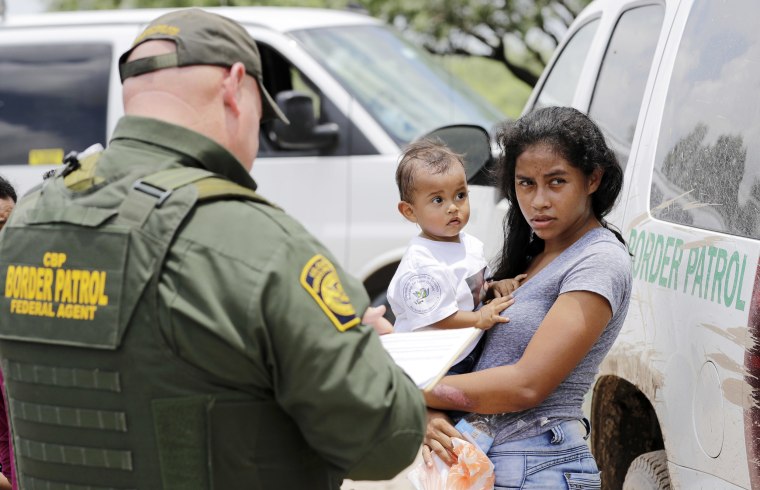
New Trump admin order for separated parents: Leave U.S. with kids or without them. Rights advocates say the new directive prevents migrant parents who were separated from their kids under zero tolerance from asking for asylum in the U.S.

Image: A mother holds her 1-year-old child as they surrender to Border Patrol


New Trump admin order for separated parents: Leave U.S. with kids or without them

Trump Administration Reverses Obama on Affirmative Action - The New York Times


"WASHINGTON — The Trump administration will encourage the nation’s school superintendents and college presidents to adopt race-blind admissions standards, abandoning an Obama administration policy that called on universities to consider race as a factor in diversifying their campuses, Trump administration officials said.


The reversal would restore the policy set during President George W. Bush’s administration, when officials told schools that it “strongly encourages the use of race-neutral methods” for admitting students to college or assigning them to elementary and secondary schools.


Last November, Attorney General Jeff Sessions asked the Justice Department to re-evaluate past policies that he believed pushed the department to act beyond what the law, the Constitution and the Supreme Court had required, Devin M. O’Malley, a Justice Department spokesman said. As part of that process, the Justice Department rescinded seven policy guidances from the Education Department’s civil rights division on Tuesday.


“The executive branch cannot circumvent Congress or the courts by creating guidance that goes beyond the law and — in some instances — stays on the books for decades,” said Devin M. O’Malley, a spokesman for the Justice Department."


Trump Administration Reverses Obama on Affirmative Action - The New York Times

James Earl Jones Reads Frederick Douglass's famous 4th of July Speech

Airport Worker “Heartbroken” Witnessing Waves of Migrant Children Silent...

HHS refusing to say how many separated kids still in custody

Monday, July 02, 2018

Supreme Court Labor Decision Wasn’t Just a Loss for Unions - The New York Times


"The Supreme Court decision striking down mandatory union fees for government workers was not only a blow to unions. It will also hit hard at a vast network of groups dedicated to advancing liberal policies and candidates.


Some of these groups work for immigrants and civil rights; others produce economic research; still others turn out voters or run ads in Democratic campaigns. Together, they have benefited from tens of millions of dollars a year from public-sector unions — funding now in jeopardy because of the prospective decline in union revenue.


Liberal activists argue that closing that pipeline was a crucial goal of the conservative groups that helped bring the case, known as Janus v. American Federation of State, County and Municipal Employees.


“If the progressive movement is a navy, they’re trying to take out our aircraft carriers,” said Ben Wikler, Washington director of the liberal activist group MoveOn.org.


Conservatives have acknowledged as much. In a fund-raising solicitation in December, John Tillman, the chief executive of the free-market group that found the plaintiff in the case, cited the objective of depriving unions of revenue by helping workers abandon them. “The union bosses would use that money to advance their big-government agenda,” Mr. Tillman wrote.


Even President Trump took notice of the justices’ ruling, declaring on Twitter that it was a “big loss for the coffers of the Democrats!”


In the 5-to-4 decision on Wednesday, the court’s majority ruled that requiring nonmembers to make union payments violated their First Amendment rights, since much of what unions do could be considered political activity at odds with their beliefs.


The unions’ ability to spend on progressive causes and candidates was already diminishing.


As conservative groups escalated their campaign to rein in labor over the past decade or two, unions have had to divert more and more of their budgets to defensive battles, leaving less to spend elsewhere. But the multipronged effort that culminated in the Janus decision — whose likely effect will be a loss of at least hundreds of thousands of members and tens of millions in revenue — has forced many public unions, among the most powerful in the labor movement, to fundamentally rethink their spending.


Mary Kay Henry, the president of the Service Employees International Union, said that her union had cut its budget by about 30 percent in anticipation of the decision, and that the service employees had been talking with leaders of liberal groups for two years about how to offset the loss. She said the union, with about two million members, would provide a range of nonmonetary support, from in-kind staff assistance to help with fund-raising.


Brad Woodhouse, a former communications director for the Democratic National Committee, until recently ran a group called Americans United for Change, whose budget was heavily dependent on contributions from public-sector unions when it campaigned for health care reform and the Obama stimulus plan a decade ago. Mr. Woodhouse said unions gave less in 2015 and 2016, when the Supreme Court considered a predecessor to the Janus case. (The court deadlocked in that case after Justice Antonin Scalia died.) Partly as a result, the group shut down after the 2016 election.


The Economic Policy Institute, a Washington-based think tank producing research on worker rights, wages and employment, has relied on the four biggest public-sector unions for about 10 to 15 percent of its roughly $6 million in annual revenue in recent years.


“We aren’t seeing it as an existential threat,” said Thea Lee, the institute’s president, “but we have been trying to be conservative in what projects we pursue.”


A group called Mi Familia Vota, which advocates on behalf of Latino voters and immigrants, had received about $1 million a year directly from the Service Employees International Union since 2012 — a significant portion of its annual revenue, which has ranged from about $1.5 million to $5 million during that time.


Last year, the union gave just $25,000.


“We’ve been adjusting,” said Ben Monterroso, director of Mi Familia Vota, which focuses on issues including education, health care, workers’ rights and voting rights. “Some of the programs we’ve needed to scale back. Demonstrations, activities, actions, we’ve scaled back.”


Mark Janus, center, the plaintiff in the case challenging the collection of mandatory union fees from nonmembers, entering the Supreme Court building before the ruling. “They’re trying to take out our aircraft carriers,” a liberal activist said of conservative groups that backed the litigation.

Photo by: Carolyn Kaster/Associated Press

Mr. Monterroso said the group was now focused primarily on elections and elected officials. “We do that by growing the electorate — helping people become citizens when eligible, and helping those eligible be registered,” he said.


Other groups that register and mobilize voters may be vulnerable, too. America Votes, a group with a permanent staff in more than 20 states that turns out voters on Election Day and rallies them around causes like reproductive rights and the environment, received more than one-fifth of its nearly $10 million budget from the four biggest public-sector unions in 2016.


The major public-sector unions are also major backers of ballot-measure campaigns, having spent more than $7 million on such efforts in 2015 and 2016. Some of the measures involved increasing taxes to fund services like education and health care, and raising the minimum wage. Unions funded opposition to a measure allowing an expansion of charter schools in Massachusetts.


(Some unions said it was too early to know what spending they would cut. The American Federation of Teachers was adamant that it would continue funding certain groups, like America Votes.)


In some arenas, the loss of union money will almost certainly be offset by other liberal donors — both the wealthy and ordinary citizens. Few party operatives worry, for example, that the Democrats will lack resources for their next presidential nominee, or candidates in high-profile Senate and House races.


A newly formed political action committee called End Citizens United, named for the Supreme Court decision that opened the door to more corporate money in elections, raised about $25 million, largely from small donors, during the 2016 campaign, and is on pace to exceed that amount this election cycle. Most of its spending supports House and Senate Democratic candidates favoring campaign-finance reform.


In other cases, the loss of union money may be offset by grass-roots activism.


In 2016, the four major public-sector unions gave nearly 15 percent of the $17 million raised by the Democratic Legislative Campaign Committee, which funds state legislative races nationwide. But the group is optimistic that any loss of union revenue can be offset by what it calls the “people power” of union members and other voters.


Jessica Post, the committee’s executive director, cited these efforts in flipping 44 state legislative seats from Republican to Democratic control since Mr. Trump’s inauguration: “Retired teachers, Afscme members, union members — they were out knocking on doors, flooding campaign offices with support.”


Activists and party operatives said union cash would be more difficult to replace in other areas. Mr. Wikler said MoveOn’s monthly donor base had quadrupled since Mr. Trump was elected, allowing it to increase support for groups working on immigrants’ rights, workers’ rights and racial-justice causes.


“But the scale of what we can kick in to efforts like that are dwarfed by what the public-sector unions can muster,” he said.


Mr. Woodhouse said labor money could be especially critical to groups that must form quickly for a specific policy fight. He cited the example of Americans United, founded in 2005 to block President George W. Bush’s attempt to partly privatize Social Security.


“It was a lot easier to go to labor to do that than it is to kind of try to do this through other means — low-dollar or individual donors,” he said. “Speed was essential, and we were caught a little flat-footed.” (Labor has funded some of these efforts through super PACs in recent years.)


In the end, the loss of union money may be less detrimental to Democrats and progressive causes than the loss of union members.


In the 2000 presidential election, noted Steve Rosenthal, a former political director of the A.F.L.-C.I.O., 43 percent of the votes cast in Michigan came from union households, which tend to vote Democratic by a large margin. In the 2016 presidential election, the first after the state passed a “right to work” law ending mandatory union fees, only 28 percent of votes came from union households. That drop-off accounts for Hillary Clinton’s margin of defeat in the state many times over.


The key to unions’ importance, said John D. Podesta, who was chairman of Mrs. Clinton’s campaign and is a founder of liberal advocacy and research groups, is “their ability to change outcomes through educational efforts of their own members.”


“They do a very good job of communicating with their own members and getting them out to vote,” he said."


Supreme Court Labor Decision Wasn’t Just a Loss for Unions - The New York Times

Sunday, July 01, 2018

Belgium Honors Congolese Leader It Helped Overthrow


The full horror of what occurred during the period of Belgian rule, particularly when Congo was personally held by King Leopold II, may never be known. Most historians estimate that up to 5 million lives were lost in that time, roughly a third of the population, though official registers did not exist. Some caution that the number may be over 10 million. Congolese mineral wealth filled Belgium’s coffers....”

Belgium Honors Congolese Leader It Helped Overthrow

Compassion for immigrant children can help. But it isn’t enough. - The Washington Post


"...Yet for all its power to galvanize, the impulse to save children can have ambiguous consequences. Focusing on humanitarian aid for migrant children all too often comes at the expense of appreciating the full context of their lives. Make no mistake; the wailing children in the audiotape were the result, most immediately, of the new “zero tolerance” policy that Attorney General Jeff Sessions announced for unauthorized migrants. But they were also the product of broader and deeper developments that made “zero tolerance” possible in the first place. These include long-standing violence and human rights violations at the U.S.-Mexico border, which have been denounced by activists for years. They include the political impulse, radically intensified in recent years, to demonize immigrants as criminals or even as sub-humans. This impulse is, of course, this administration’s hallmark.


Even more insidiously, the imperative to protect children is frequently used as a rationale for penalizing their parents. Some conservatives have attempted to conceptually cleave away the poor, suffering children from their lawbreaking parents. As one Texas lawmaker wrote in an open letter asking Gov. Greg Abbott (R) to halt the separations, “These children did not make the decision to violate our laws to be in this country nor have they committed any crimes. Their parents did.” If the parents are responsible for their children’s suffering, the child’s vulnerability itself is a reason to disparage the parents.


Meanwhile, humanitarianism is a powerful foil used to justify the violation of rights. Amid their many shifting explanations for the policy before President Trump abandoned it last week, administration officials suggested that family separation is itself a humanitarian measure. Secretary of Homeland Security Kirstjen Nielsen characterized forcibly removing children from their parents as “protect[ing] alien children from human smuggling, trafficking and other criminal actions.” Their parents are, in this framework, the smugglers the children need protection from. Her predecessor, John Kelly, now the White House chief of staff, argued that family separation would protect children by discouraging their parents from bringing them north in the first place. Child saving, in short, is a powerful but perniciously elastic idea that can justify even policies of willful harm.


This is not a call to abandon altruism — or the outrage that helped force Trump to reverse himself. By all means, ordinary citizens should indulge their compassion in circumstances like this. Donating clothing and diapers to attend to the immediate needs of children whom our government has recklessly separated from their parents is not an empty gesture. At a moment when former Trump campaign manager Corey Lewandowski ridicules a girl with Down syndrome and right-wing provocateur Ann Coulter dismisses distraught children as “actors,” basic empathy clearly cannot be taken for granted.


But compassion is a poor substitute for justice. Framing our response in terms of charity threatens to depoliticize this crisis, downplaying the fact that migrant children’s suffering is not just the unfortunate product of happenstance but is itself a deliberate political strategy.


Thanks to public outrage the separations have been suspended and approximately 500 of the more than 2,500 children forcibly appropriated by the U.S. government in recent weeks have been reunited with their parents. But the issue doesn’t end here. The children taken from their families are a small subset of a much larger population of children whose well-being has been harmed by immigration policies in recent years. These include the tens of thousands of migrant children who have been jailed in family detention centers since 2014, the estimated 1 million undocumented children resident in this country and the 4.5 million young citizens who have an undocumented parent. It’s not just separated migrant children who are suffering: Studies suggest that punitive immigration policies are associated with rising rates of severe psychological distress among children in immigrant families resident in the United States.


Nor should the focus on suffering children cause us to ignore their parents and other adults. The unrelenting criminalization of immigrants and refugees has as its necessary and inevitable outcome the brutalization of migrant children. We cannot hope to succor the latter without also addressing the former."


Compassion for immigrant children can help. But it isn’t enough. - The Washington Post

The Court Defers to a Racist Era - The New York Times

May 17th of 2000 the NY Times wrote an editorial describing how the current Supreme Court was ruling back Civil Rights now as in the 1880s.  This Sisyphean cycle is nothing new in American History.  Donald Trump's appointment of another right wing will push us further back to the 1880s.


"The Supreme Court's ruling this week striking down portions of the Violence Against Women Act is the unfortunate consequence of a series of political decisions harking back to Reconstruction. These decisions have created a Catch-22 for modern federal civil rights legislation.


Federal civil rights laws are generally passed under either Congress's power to regulate interstate commerce or its power to enforce the 14th Amendment.


The 14th Amendment is the natural home of civil rights legislation. It guarantees equal citizenship, and it gives Congress power to enforce equality rights. But in the 1880's, the Supreme Court greatly narrowed the scope of this enforcement power, for overtly racist reasons. The court held that Congress couldn't protect blacks from private discrimination because that would make them ''the special favorite of the laws,'' as Justice Joseph P. Bradley wrote in the Civil Rights Cases of 1883.


Years later the Supreme Court would overturn many other racist decisions of that era, including Plessy v. Ferguson, which gave blessing to Jim Crow laws. But it never overturned the Civil Rights Cases.


That led the Kennedy and Johnson administrations to seek another way of enacting civil rights legislation. They didn't try to overturn the precedent established in the 1880's. Instead, they drafted laws that used the commerce clause as their foundation, arguing that racial discrimination interfered with interstate commerce. By doing so, the 1960's civil rights laws created a genuine incongruity: They used the power to regulate the economy to guarantee civil equality.


Continue reading the main story

In his majority opinion overturning the Violence Against Women Act, Chief Justice William Rehnquist used this history to create a Catch-22. He ruled that the act, adopted by Congress in 1994 to protect women's civil rights, could not be a regulation of interstate commerce because violence against women was not ''economic'' -- even if the violence had real and palpable economic effects.


Nor, he wrote, is the law constitutional under Congress's power to enforce the 14th Amendment, because that power extends only to regulating conduct by the state. Without a hint of embarrassment, Justice Rehnquist argued that the decision in the Civil Rights Cases was hallowed by time and could not be disturbed.


The same Catch-22 arose earlier this term when the Supreme Court ruled that Congress lacked the authority to bind state governments to the federal law that bars age discrimination in the workplace.


The court ruled that states can be sued for damages only if they violate laws created under Congress's power to enforce the 14th Amendment. But, the court also ruled, states cannot be sued for damages if Congress passed the laws under the commerce clause.


Since many federal civil rights laws passed after the 1960's are based on Congress's commerce power, that decision means states can now violate many civil rights with impunity.


The Supreme Court has taken a wrong turn in these cases. It's striking down the work of a democratically elected legislature. But it's not too late to end this constitutional Catch-22.


We should get rid of the racist precedents of the 1880's. We should recognize what the framers of the 14th Amendment intended: Congress has an independent power and obligation to promote and protect equal citizenship and civil rights. If Congress believes that a law is necessary and proper to promote equal citizenship, it should have the power to pass it without using the fiction that inequality affects interstate commerce."


The Court Defers to a Racist Era - The New York Times

How Conservatives Weaponized the First Amendment - The New York Times



"WASHINGTON — On the final day of the Supreme Court term last week, Justice Elena Kagan sounded an alarm.


The court’s five conservative members, citing the First Amendment, had just dealt public unions a devastating blow. The day before, the same majority had used the First Amendment to reject a California law requiring religiously oriented “crisis pregnancy centers” to provide women with information about abortion.


Conservatives, said Justice Kagan, who is part of the court’s four-member liberal wing, were “weaponizing the First Amendment.”


The two decisions were the latest in a stunning run of victories for a conservative agenda that has increasingly been built on the foundation of free speech. Conservative groups, borrowing and building on arguments developed by liberals, have used the First Amendment to justify unlimited campaign spending, discrimination against gay couples and attacks on the regulation of tobacco, pharmaceuticals and guns.


“The right, which had for years been hostile to and very nervous about a strong First Amendment, has rediscovered it,” said Burt Neuborne, a law professor at New York University.


The Citizens United campaign finance case, for instance, was decided on free-speech grounds, with the five-justice conservative majority ruling that the First Amendment protects unlimited campaign spending by corporations. The government, the majority said, has no business regulating political speech.


The dissenters responded that the First Amendment did not require allowing corporate money to flood the political marketplace and corrupt democracy.


“The libertarian position has become dominant on the right on First Amendment issues,” said Ilya Shapiro, a lawyer with the Cato Institute. “It simply means that we should be skeptical of government attempts to regulate speech. That used to be an uncontroversial and nonideological point. What’s now being called the libertarian position on speech was in the 1960s the liberal position on speech.”


How the Koch Brothers Are Killing U.S. Public Transit Projects


Corruption Gutted South Africa’s Tax Agency. Now the Nation Is Paying the Price.


Climate Change Brought a Lobster Boom. Now It Could Cause a Bust.

Advertisement


And an increasingly conservative judiciary has been more than a little receptive to this argument. A new analysis prepared for The New York Times found that the Supreme Court under Chief Justice John G. Roberts Jr. has been far more likely to embrace free-speech arguments concerning conservative speech than liberal speech. That is a sharp break from earlier eras.


As a result, liberals who once championed expansive First Amendment rights are now uneasy about them.


“The left was once not just on board but leading in supporting the broadest First Amendment protections,” said Floyd Abrams, a prominent First Amendment lawyer and a supporter of broad free-speech rights. “Now the progressive community is at least skeptical and sometimes distraught at the level of First Amendment protection which is being afforded in cases brought by litigants on the right.”


Many on the left have traded an absolutist commitment to free speech for one sensitive to the harms it can inflict.


Take pornography and street protests. Liberals were once largely united in fighting to protect sexually explicit materials from government censorship. Now many on the left see pornography as an assault on women’s rights.


In 1977, many liberals supported the right of the American Nazi Party to march among Holocaust survivors in Skokie, Ill. Far fewer supported the free-speech rights of the white nationalists who marched last year in Charlottesville, Va.


There was a certain naïveté in how liberals used to approach free speech, said Frederick Schauer, a law professor at the University of Virginia.


“Because so many free-speech claims of the 1950s and 1960s involved anti-obscenity claims, or civil rights and anti-Vietnam War protests, it was easy for the left to sympathize with the speakers or believe that speech in general was harmless,” he said. “But the claim that speech was harmless or causally inert was never true, even if it has taken recent events to convince the left of that. The question, then, is why the left ever believed otherwise.”


Some liberals now say that free speech disproportionately protects the powerful and the status quo.


“When I was younger, I had more of the standard liberal view of civil liberties,” said Louis Michael Seidman, a law professor at Georgetown. “And I’ve gradually changed my mind about it. What I have come to see is that it’s a mistake to think of free speech as an effective means to accomplish a more just society.”


To the contrary, free speech reinforces and amplifies injustice, Catharine A. MacKinnon, a law professor at the University of Michigan, wrote in “The Free Speech Century,” a collection of essays to be published this year.


“Once a defense of the powerless, the First Amendment over the last hundred years has mainly become a weapon of the powerful,” she wrote. “Legally, what was, toward the beginning of the 20th century, a shield for radicals, artists and activists, socialists and pacifists, the excluded and the dispossessed, has become a sword for authoritarians, racists and misogynists, Nazis and Klansmen, pornographers and corporations buying elections.”


Judge Robert H. Bork in 1987. “Constitutional protection should be accorded only to speech that is explicitly political,” he wrote in 1971 in a law-review article. “There is no basis for judicial intervention to protect any other form of expression, be it scientific, literary or that variety of expression we call obscene or pornographic.”CreditJose R. Lopez/The New York Times

Changing Interpretations

In the great First Amendment cases in the middle of the 20th century, few conservatives spoke up for the protection of political dissenters, including communists and civil rights leaders, comedians using vulgar language on the airwaves or artists exploring sexuality in novels and on film.


In 1971, Robert H. Bork, then a prominent conservative law professor and later a federal judge and Supreme Court nominee, wrote that the First Amendment should be interpreted narrowly in a law-review article that remains one of the most-cited of all time.


“Constitutional protection should be accorded only to speech that is explicitly political,” he wrote. “There is no basis for judicial intervention to protect any other form of expression, be it scientific, literary or that variety of expression we call obscene or pornographic.”


But a transformative ruling by the Supreme Court five years later began to change that thinking. The case, a challenge to a state law that banned advertising the prices of prescription drugs, was filed by Public Citizen, a consumer rights group founded by Ralph Nader. The group argued that the law hurt consumers, and helped persuade the court, in Virginia State Board of Pharmacy v. Virginia Citizens Consumer Council, to protect advertising and other commercial speech.


The only dissent in the decision came from Justice William H. Rehnquist, the court’s most conservative member.


Kathleen M. Sullivan, a former dean of Stanford Law School, wrote that it did not take long for corporations to see the opportunities presented by the decision.


Conservatives in Charge, the Supreme Court Moved Right

Justice Anthony M. Kennedy’s last Supreme Court term contained hints of his retirement and foreshadowed a lasting rightward shift.


June 28, 2018

“While the case was litigated by consumer protection advocates,” she wrote in the Harvard Law Review, “corporate speakers soon became the principal beneficiaries of subsequent rulings that, for example, struck down restrictions on including alcohol content on beer can labels, limitations on outdoor tobacco advertising near schools and rules governing how compounded drugs may be advertised.”


That trend has continued, with businesses mounting First Amendment challenges to gun control laws, securities regulations, country-of-origin labels, graphic cigarette warnings and limits on off-label drug marketing.


“I was a bit queasy about it because I had the sense that we were unleashing something, but nowhere near what happened,” Mr. Nader said. “It was one of the biggest boomerangs in judicial cases ever.”


“I couldn’t be Merlin,” he added. “We never thought the judiciary would be as conservative or corporate. This was an expansion that was not preordained by doctrine. It was preordained by the political philosophies of judges.”


Not all of the liberal scholars and lawyers who helped create modern First Amendment law are disappointed. Martin Redish, a law professor at Northwestern University, who wrote a seminal 1971 article proposing First Amendment protection for commercial speech, said he was pleased with the Roberts court’s decisions.


“Its most important contributions are in the commercial speech and corporate speech areas,” he said. “It’s a workmanlike, common sense approach.”


Liberals also played a key role in creating modern campaign finance law in Buckley v. Valeo, the 1976 decision that struck down limits on political spending by individuals and was the basis for Citizens United, the 2010 decision that did away with similar limits for corporations and unions.


One plaintiff was Senator Eugene J. McCarthy, Democrat of Minnesota, who had challenged President Lyndon B. Johnson in the 1968 presidential primaries — from the left. Another was the American Civil Liberties Union’s New York affiliate.


Professor Neuborne, a former A.C.L.U. lawyer, said he now regrets the role he played in winning the case. “I signed the brief in Buckley,” he said. “I’m going to spend long amounts of time in purgatory.”


To Professor Seidman, cases like these were part of what he describes as a right-wing takeover of the First Amendment since the liberal victories in the years Chief Justice Earl Warren led the Supreme Court.


“With the receding of Warren court liberalism, free-speech law took a sharp right turn,” Professor Seidman wrote in a new article to be published in the Columbia Law Review. “Instead of providing a shield for the powerless, the First Amendment became a sword used by people at the apex of the American hierarchy of power. Among its victims: proponents of campaign finance reform, opponents of cigarette addiction, the L.B.G.T.Q. community, labor unions, animal rights advocates, environmentalists, targets of hate speech and abortion providers.”


The title of the article asked, “Can Free Speech Be Progressive?”


“The answer,” the article said, “is no.”


Shifting Right

The right turn has been even more pronounced under Chief Justice Roberts.


The Supreme Court has agreed to hear a larger share of First Amendment cases concerning conservative speech than earlier courts had, according to the study prepared for The Times. And it has ruled in favor of conservative speech at a higher rate than liberal speech as compared to earlier courts.


The court’s docket reflects something new and distinctive about the Roberts court, according to the study, which was conducted by Lee Epstein, a law professor and political scientist at Washington University in St. Louis; Andrew D. Martin, a political scientist at the University of Michigan and the dean of its College of Literature, Science and the Arts; and Kevin Quinn, a political scientist at the University of Michigan.


“The Roberts court — more than any modern court — has trained its sights on speech promoting conservative values,” the study found. “Only the current court has resolved a higher fraction of disputes challenging the suppression of conservative rather than liberal expression.”


The court led by Chief Justice Earl Warren from 1953 to 1969 was almost exclusively concerned with cases concerning liberal speech. Of its 60 free-expression cases, only five, or about 8 percent, challenged the suppression of conservative speech.


The proportion of challenges to restrictions on conservative speech has steadily increased. It rose to 22 percent in the court led by Chief Justice Warren E. Burger from 1969 to 1986; to 42 percent in the court led by Chief Justice William H. Rehnquist from 1986 to 2005; and to 65 percent in the Roberts court.


The Roberts court does more than hear a larger proportion of cases concerning conservative expression. It is also far more likely than earlier courts to rule for conservative speech than for liberal speech. The result, the study found, has been “a fundamental transformation of the court’s free-expression agenda.”


In past decades, broad coalitions of justices have often been receptive to First Amendment arguments. The court has protected videos of animal cruelty, hateful protests at military funerals, violent video games and lies about military awards, often by lopsided margins.


But last week’s two First Amendment blockbusters were decided by 5-to-4 votes, with the conservatives in the majority ruling in favor of conservative plaintiffs.


On Tuesday, Justice Clarence Thomas wrote for the majority that requiring health clinics opposed to abortion to tell women how to obtain the procedure violated the clinics’ free-speech rights. In dissent, Justice Stephen G. Breyer said that was a misuse of First Amendment principles.


“Using the First Amendment to strike down economic and social laws that legislatures long would have thought themselves free to enact will, for the American public, obscure, not clarify, the true value of protecting freedom of speech,” Justice Breyer wrote.


On Wednesday, in announcing the decision on public unions, Justice Samuel A. Alito Jr. said the court was applying settled and neutral First Amendment principles to protect workers from being forced to say things at odds with their beliefs. He suggested that the decision on public unions should have been unanimous.


“Compelling individuals to mouth support for views they find objectionable violates that cardinal constitutional command, and in most contexts, any such effort would be universally condemned,” he wrote. “Suppose, for example, that the State of Illinois required all residents to sign a document expressing support for a particular set of positions on controversial public issues — say, the platform of one of the major political parties. No one, we trust, would seriously argue that the First Amendment permits this.”


In response, Justice Kagan said the court’s conservatives had found a dangerous tool, “turning the First Amendment into a sword.” The United States, she said, should brace itself.


“Speech is everywhere — a part of every human activity (employment, health care, securities trading, you name it),” she wrote. “For that reason, almost all economic and regulatory policy affects or touches speech. So the majority’s road runs long. And at every stop are black-robed rulers overriding citizens’ choices.”


How Conservatives Weaponized the First Amendment - The New York Times