What To Do When You're Stopped By Police - The ACLU & Elon James White
What To Do When You're Stopped By Police - The ACLU & Elon James White
Know Anyone Who Thinks Racial Profiling Is Exaggerated? Watch This, And Tell Me When Your Jaw Drops.
This video clearly demonstrates how racist America is as a country and how far we have to go to become a country that is civilized and actually values equal justice. We must not rest until this goal is achieved. I do not want my great grandchildren to live in a country like we have today. I wish for them to live in a country where differences of race and culture are not ignored but valued as a part of what makes America great.
“The article describes Democratic Senator Kirsten Gillibrand's Islamophobic rant against New York City mayoral candidate Zohran Mamdani. Gillibrand falsely accused Mamdani of supporting violence and hate speech, despite Mamdani's repeated denouncements of such actions. The article also highlights the hypocrisy of Gillibrand's stance, given her previous support for the Israeli military and her silence on other instances of Islamophobia.
The Democrat’s rant has sparked calls for her to resign over her bigoted language.
Sen. Kirsten Gillibrand speaks during a hearing on Capitol Hill on January 14, 2025, in Washington, D.C. Andrew Harnik / Getty Images
Honest, paywall-free news is rare. Please support our boldly independent journalism with a donation of any size.
Democratic Sen. Kirsten Gillibrand (New York) went on an Islamophobic rant against New York City Democratic mayoral candidate Zohran Mamdani in a radio interview on Thursday, spewing lies about Mamdani and suggesting that he would represent a threat to public safety if elected.
In an appearance onWYNC’s “Brian Lehrer Show,” the senator repeated numerous lies about Mamdani, echoing oft-repeated bigoted statements made about Palestinians and the pro-Palestine movement.
During the segment, kicked off by a call-in question by a listener, Gillibrand said that Mamdani, who is Muslim, is dangerous and supports violence, citing his refusal to condemn the phrase “globalize the intifada” and equating the words “intifada” and “jihad” to fear monger about them.
Her statements were completely removed from reality, and clearly informed by some of the worst hatred spread against Arabs, Muslims, and Palestinians in particular over the past decades. For instance, Gillibrand said that just the phrase “global intifada” — with “intifada” meaning “uprising” or “rebellion” in Arabic — is “violent and destructive.”
“It doesn’t matter what meaning you have in your brain, it is now how the word is received. When you use a word like intifada, to many Jewish Americans and Jewish New Yorkers, that means you are permissive for violence against Jews,” Gillibrand said. Her statements ignored the many times that Mamdani has denounced antisemitic violence — instead suggesting that Mamdani made an explicit call for violence when he did not.
“I would be very specific in these words, and I would say you may not use them again if you expect to represent everyone, ever again, because they are received as hateful and divisive,” she said, discounting the many Arabic speakers for whom the word simply means “uprising.”
Gillibrand was referring to recent comments made by Mamdani after he was asked to denounce the phrase “globalize the intifada.” Mamdani, who has been active in the movement for Palestinian rights, said that the phrase speaks to Palestinians’ desire for equal rights. He pointed out that the word has been politicized to incite violence against Palestinians, even though the word “intifada” was used by the Holocaust Museum in its Arabic translation for the Warsaw Uprising.
Gillibrand steamrolled over Lehrer’s attempts to correct her and rein her rant back in — even as she admitted that Mamdani has assured her that he will work to protect all New Yorkers, including Jewish people.
“I just feel compelled to say, we can find no evidence that he has supported Hamas or has supported violent jihad, as the caller was asserting,” Lehrer said. Later, he also chimed in, saying, “I think we also clarify, or he was clarifying that he never said ‘globalize the intifada.’ He was asked in an interview if he would denounce the phrase.”
But Gillibrand refused to back down. “He should denounce it. And that’s it. Period. And you can’t celebrate it, you can’t value it, you can’t lift it up,” she said, going on to reference the Hamas-led October 7, 2023, attack.
“When you hear things like intifada, when you hear things like jihad, when you hear ‘from the river to the sea,’ it is received as ‘slaughter the Jews and destroy Israel,’ period,” she said, suggesting that the mere use of two Arabic words is violent.
Never once did she acknowledge the Muslim and Arab communities that she represents as senator of New York, who may feel alarmed by her blatant Islamophobia and anti-Palestinian bigotry. Directly following her comments, the conversation shifted to President Donald Trump’s strikes on Iran, which Gillibrand criticized for being unauthorized by Congress but praised for their supposed strength.
Many commentators noted the shocking nature of Gillibrand’s bigotry, with some calling for her to resign.
“I think she should resign for falsely smearing [Zohran Mamdani] as a terrorist,” saidZeteo Editor-in-Chief Mehdi Hasan. “He has never invoked a ‘global jihad’. This is a nasty, Islamophobic racist smear from a sitting Dem senator.”
After a recording of the interview spread widely on X, Gillibrand’s communications director claimed in a post that the senator “misspoke.” “She also highlighted that Mr. Mamdani assured her that, if elected, he would protect Jews and all residents of NYC,” her spokesperson said.
But Gillibrand delivered her rant with confidence, without stuttering or hesitation, and went on for nearly six minutes. While she did offer scant acknowledgement of Mamdani’s commitment to equal rights for all, those comments were nestled in between other parts of her rant.
Gillibrand joins a large chorus of those on the right who spewed Islamophobiaafter Mamdani’s landmark win on Tuesday, inciting violence against the Muslim politician.
This bigotry has been taken to an extreme by some Republicans, with one, Rep. Andy Ogles (R-Tennessee), calling Mamdani a bigoted nickname while calling on him to be denaturalized and deported on Wednesday. Ogles, in a letter to the Trump administration, also fear mongers about the phrase “globalize the intifada,” similarly likening it to a call for “terrorism.”
“The Trump administration’s use of the Alien Enemies Act to deport Venezuelan immigrants is being challenged in court. The ACLU argues the law, intended for wartime, doesn’t apply to mass migration. The case, likely to reach the Supreme Court, centers on the definition of “invasion” and the extent of presidential authority in immigration matters.
The case before one of the most conservative courts in the country is likely to be the first to reach the Supreme Court.
In April, the Trump administration sought to use the Alien Enemies Act to deport a group of Venezuelans held at the Bluebonnet Detention Facility in Anson, Texas.Paul Ratje/Reuters
It is one of President Trump’s most contentious assertions of executive authority: a proclamation, issued in March, calling on the powers of an 18th-century law to round up and deport scores of immigrants who he claimed were members of a Venezuelan street gang.
That law, the Alien Enemies Act, had been used only three times before in U.S. history, all during periods of war. And the way Mr. Trump invoked it raised significant questions about whether he was complying with the statute’s text.
For more than three months, courts across the country have been struggling to answer those questions and decide whether the president had stretched the limits of the law in pursuing one of his central policy goals: the mass deportation of immigrants.
On Monday, a federal appeals court in New Orleans will consider those questions, as well, in what is likely to be the decisive legal battle over Mr. Trump’s use of the Alien Enemies Act.
The hearing, before the U.S. Court of Appeals for the Fifth Circuit, will almost certainly reprise legal arguments that the Trump administration and lawyers for the Venezuelan men have made repeatedly in lower courts. But the Fifth Circuit’s case is likely to be the first to reach the Supreme Court, where it will get a fullhearing on the substantive question of whether Mr. Trump has used the act unlawfully.
Passed in 1798 as the nascent United States was threatened by war with France, the Alien Enemies Act gives the president expansive powers to detain and expel members of a hostile foreign nation. But the act grants those powers only in times of declared war or during what it describes as an invasion or a “predatory incursion.”
From the start, the administration has sought to use the law in an unusual way, turning it against scores of Venezuelan men accused of belonging to the street gang Tren de Aragua, which Mr. Trump has designated as a foreign terrorist organization.
The president and his aides have repeatedly maintained that the men were not mere criminals but were working hand in glove with the Venezuelan government. Moreover, they have argued that their presence on U.S. soil was tantamount to an invasion by a hostile foreign country.
The American Civil Liberties Union, which has been representing the men, has scoffed at those claims in case after case, saying that they have no connection to reality. Lawyers for the A.C.L.U. have pointed out that mass migration, regardless of its scale, is not the same as an invasion. They have also argued that there is no conclusive evidence that their clients, many of whom have no criminal record, are working for anyone, let alone for the Venezuelan government.
So far, a majority of federal courts have agreed with the A.C.L.U., deciding that Mr. Trump invoked the act unlawfully and that his vision of the Venezuelans posing a military threat to the United States did not line up with the facts. Two courts, however, have sided with the administration, essentially arguing that the White House should be granted wide latitude in conducting foreign affairs, especially when they concern a gang that has been deemed a terrorist organization.
The A.C.L.U. could face an uphill battle in its effort to win over the Fifth Circuit, which has a reputation as one of the most conservative appeals courts in the country. But no matter who prevails in the oral arguments set for Monday, the case is likely to move on to the Supreme Court.
The case took an unusual path in reaching the Fifth Circuit.
In mid-April, the A.C.L.U. filed an emergency lawsuit in Federal District Court in Abilene, Texas, after suddenly getting news that the Trump administration was preparing to use the Alien Enemies Act to deport a group of Venezuelans being held at the Bluebonnet Detention Facility in nearby Anson.
A prison in Tecoluca, El Salvador, where an earlier group of Venezuelan immigrants were sent in March.Fred Ramos for The New York Times
The move to expel the men, the A.C.L.U. maintained, appeared to be an opportunistic effort to bypass orders barring similar removals from courts in New York, Colorado and another part of Texas, which covered only those local jurisdictions.
After the district court judge in Abilene failed to act quickly, the A.C.L.U. filed a flurry of follow-up petitions, asking the Fifth Circuit and then the Supreme Court to help the men at Bluebonnet. The lawyers argued that the men were in imminent danger of being shipped off to El Salvador, where an earlier group of Venezuelan immigrants were sent in March and remain today.
In an unusual ruling issued well after midnight, the Supreme Court ultimately put the deportations from Bluebonnet temporarily on hold. The justices declined to weigh in on the larger question of whether Mr. Trump’s invocation of the Alien Enemies Act was lawful, saying only that the government had skirted due process by failing to give the Venezuelan men enough time and opportunity to contest their removal.
Last month, the Supreme Court issued another decision in the case, maintaining the freeze on the deportations and sending the matter back to the Fifth Circuit, with marching orders on how to proceed in the upcoming hearing.
The appellate judges were instructed to consider two issues: the substantive question of whether Mr. Trump’s use of the act was legal in the first place and a narrower one about how much — and what sort of — warning immigrants should be given before being expelled under the law.
Alan Feuer covers extremism and political violence for The Times, focusing on the criminal cases involving the Jan. 6 attack on the Capitol and against former President Donald J. Trump.“
“The Supreme Court’s decision in Trump v. CASA, limiting nationwide injunctions, is seen as a partisan move to empower a Republican president. Justice Ketanji Brown Jackson’s dissent argues this ruling allows arbitrary power, disproportionately impacting the poor and unrepresented. The author suggests this decision, coupled with other actions like masked ICE officers, reflects a growing trend towards unchecked executive power.
Will Matsuda for The New York Times
The heart of Justice Ketanji Brown Jackson’s dissent in Trump v. CASA is that the Constitution does not permit the exercise of arbitrary power and is certainly not a document that gives to any single individual the authority to rewrite the law.
This may seem to be a strange dissent to issue in a case that deals narrowly with the legality of nationwide injunctions, the practice by which federal courts block the application of laws and executive orders for the entire nation as a way of issuing temporary relief pending further appeal. But this particular case regarding nationwide injunctions had to do with the Trump administration’s order overturning birthright citizenship, a right established in Section 1 of the 14th Amendment and reaffirmed in subsequent legislation and jurisprudence.
In 1898, the Supreme Court held that birthright citizenship applies to every person born in the United States. The only exceptions are those people who do not fall under the jurisdiction — which is to say, the laws — of the United States. In 1868, at the time the amendment was ratified, that meant foreign diplomats and members of Native tribes.
The children of everyone else are citizens if they are born on American soil. Driven by his nativist vision for the United States, President Trump sought to subvert this, with an executive order limiting birthright citizenship to only those with at least one parent who is a citizen or lawful permanent resident. The order, issued on the president’s first day back in office, was set to take effect on Feb. 19.
This was an outright attack on the Constitution. However much Donald Trump and Stephen Miller might want it to be otherwise, undocumented immigrants are subject to the jurisdiction of the United States — they can be arrested and tried in criminal courts, for instance — and thus their children, who are also subject to that jurisdiction, are American citizens if born on American soil.
The blatant illegality of the president’s executive order meant immediate legal backlash. Several states and parties filed lawsuits and a federal court quickly held that the executive order was plainly unconstitutional, freezing it nationwide.
Now, even skeptics of the nationwide injunction — such as myself! — would have to admit that this is a case where, given the stakes and the circumstances, it would be wise to prevent the president’s order from taking effect pending further litigation and review. Not so the Supreme Court.
In a decision written by Justice Amy Coney Barrett, a six-justice majority held that a nationwide injunction was not an appropriate method of relief, and that those affected by the executive order would have to either file suit themselves or join a class action. The court issued a 30-day hold for the president’s executive order, so that plaintiffs would have time to file in court. In her opinion, she also affirmed that courts can grant “complete relief” that affects third parties. It is possible, then, that plaintiffs can achieve the results of a nationwide injunction without use of the practice itself.
And yet, it still should be said here that this is a strange vehicle for the conservative majority to tackle the question of nationwide injunctions. There were ample opportunities under President Biden to do so, and the Biden White House even asked the court to consider the issue. It said no.
As far as I can tell from the outside, none of the nationwide injunctions issued under Biden seemed to test the court’s patience. The conservative majority seemed content to allow district courts to operate as normal. It is only now, under President Trump, that the conservatives have had a change of mind. And they’ve done so in the context of an executive order that exemplifies this president’s lawlessness and open contempt for the Constitution.
It is generally not polite, in writing about the court, to note thepartisan affiliations of the justices. But here I think it’s appropriate, since for as much as there are real merits to ending nationwide injunctions, it is also difficult to escape the conclusion that a Republican-appointed majority with an expansive view of executive power is working, again, to give as much freedom of action to a Republican president, in this case, the Republican president who secured their supermajority.
To return to Justice Jackson’s dissent, she notes that by ending the practice of nationwide injunctions in this particular circumstance, the majority has empowered a lawless president to violate the rights of American citizens, who then have no particular relief other than what they can get in a slow-moving judicial process. The majority, Jackson argues, is missing the forest for the trees. The nature of the Constitution, from the original document to its amendments, is that it is a brief against the exercise of arbitrary power. And here is the Supreme Court blessing a president’s exercise of arbitrary power as if the executive were the sovereign lord of the nation and not a mere servant of the Constitution.
It’s worth quoting at length from Jackson’s dissent:
The majority’s ruling thus not only diverges from first principles, it is also profoundly dangerous, since it gives the executive the go-ahead to sometimes wield the kind of unchecked, arbitrary power the Founders crafted our Constitution to eradicate.
“The Founders of the United States of America,” she continues, “squarely rejected a governing system in which the King ruled all and all others, including the courts, were his subordinates. In our Constitution-centered system, the People are the rulers and we have rule of law.”
The majority, Jackson argues, has created a law-free zone of arbitrary power which is “unlikely to impact the public in a randomly distributed manner.”
“Those in the good graces of the Executive,” she writes,
have nothing to fear; the new prerogative that the Executive has to act unlawfully will not be exercised with respect to them. Those who accede to the Executive’s demands, too, will be in the clear. The wealthy and the well connected will have little difficulty securing legal representation, going to court, and obtaining injunctive relief in their own name if the Executive violates their rights. Consequently, the zone of lawlessness the majority has now authorized will disproportionately impact the poor, the uneducated, and the unpopular — i.e., those who may not have the wherewithal to lawyer up, and will all too often find themselves beholden to the Executive’s whims.
It is hard to know for certain whether the Republican majority understands the legal world it’s building and the power it has given to the president. My view, like Jackson’s, is that it is laying the groundwork for the exercise of arbitrary power, unaccountable save for the next election — an American-style presidential dictatorship.
What I Wrote
I wrote my column this week on masked ICE officers and how their assertion of the right to anonymity is an extension of the president’s belief in his own impunity:
As a federal agent, an ICE officer is a public servant whose ultimate responsibility lies with the people. And the people have the right to know who is operating in their government. If an ICE officer does not want to risk identification — if he does not want the public he serves to hold him accountable for his actions — then he can choose another line of work.
In the latest episode of my podcast with John Ganz, we discussed the 1997 political thriller “The Assignment.” And I joined my colleagues David French and Carlos Lozada to discuss President Trump’s foreign policy on The Opinions
We Know Exactly Where the Supreme Court’s Change of Heart Has Come From
The Supreme Court’s decision in Trump v. CASA, limiting nationwide injunctions, is seen as a partisan move to empower a Republican president. Justice Ketanji Brown Jackson’s dissent argues this ruling allows arbitrary power, disproportionately impacting the poor and unrepresented. The author suggests this decision, coupled with other actions like masked ICE officers, reflects a growing trend towards unchecked executive power.
Will Matsuda for The New York Times
The heart of Justice Ketanji Brown Jackson’s dissent in Trump v. CASA is that the Constitution does not permit the exercise of arbitrary power and is certainly not a document that gives to any single individual the authority to rewrite the law.
This may seem to be a strange dissent to issue in a case that deals narrowly with the legality of nationwide injunctions, the practice by which federal courts block the application of laws and executive orders for the entire nation as a way of issuing temporary relief pending further appeal. But this particular case regarding nationwide injunctions had to do with the Trump administration’s order overturning birthright citizenship, a right established in Section 1 of the 14th Amendment and reaffirmed in subsequent legislation and jurisprudence.
In 1898, the Supreme Court held that birthright citizenship applies to every person born in the United States. The only exceptions are those people who do not fall under the jurisdiction — which is to say, the laws — of the United States. In 1868, at the time the amendment was ratified, that meant foreign diplomats and members of Native tribes.
The children of everyone else are citizens if they are born on American soil. Driven by his nativist vision for the United States, President Trump sought to subvert this, with an executive order limiting birthright citizenship to only those with at least one parent who is a citizen or lawful permanent resident. The order, issued on the president’s first day back in office, was set to take effect on Feb. 19.
This was an outright attack on the Constitution. However much Donald Trump and Stephen Miller might want it to be otherwise, undocumented immigrants are subject to the jurisdiction of the United States — they can be arrested and tried in criminal courts, for instance — and thus their children, who are also subject to that jurisdiction, are American citizens if born on American soil.
The blatant illegality of the president’s executive order meant immediate legal backlash. Several states and parties filed lawsuits and a federal court quickly held that the executive order was plainly unconstitutional, freezing it nationwide.
Now, even skeptics of the nationwide injunction — such as myself! — would have to admit that this is a case where, given the stakes and the circumstances, it would be wise to prevent the president’s order from taking effect pending further litigation and review. Not so the Supreme Court.
In a decision written by Justice Amy Coney Barrett, a six-justice majority held that a nationwide injunction was not an appropriate method of relief, and that those affected by the executive order would have to either file suit themselves or join a class action. The court issued a 30-day hold for the president’s executive order, so that plaintiffs would have time to file in court. In her opinion, she also affirmed that courts can grant “complete relief” that affects third parties. It is possible, then, that plaintiffs can achieve the results of a nationwide injunction without use of the practice itself.
And yet, it still should be said here that this is a strange vehicle for the conservative majority to tackle the question of nationwide injunctions. There were ample opportunities under President Biden to do so, and the Biden White House even asked the court to consider the issue. It said no.
As far as I can tell from the outside, none of the nationwide injunctions issued under Biden seemed to test the court’s patience. The conservative majority seemed content to allow district courts to operate as normal. It is only now, under President Trump, that the conservatives have had a change of mind. And they’ve done so in the context of an executive order that exemplifies this president’s lawlessness and open contempt for the Constitution.
It is generally not polite, in writing about the court, to note thepartisan affiliations of the justices. But here I think it’s appropriate, since for as much as there are real merits to ending nationwide injunctions, it is also difficult to escape the conclusion that a Republican-appointed majority with an expansive view of executive power is working, again, to give as much freedom of action to a Republican president, in this case, the Republican president who secured their supermajority.
To return to Justice Jackson’s dissent, she notes that by ending the practice of nationwide injunctions in this particular circumstance, the majority has empowered a lawless president to violate the rights of American citizens, who then have no particular relief other than what they can get in a slow-moving judicial process. The majority, Jackson argues, is missing the forest for the trees. The nature of the Constitution, from the original document to its amendments, is that it is a brief against the exercise of arbitrary power. And here is the Supreme Court blessing a president’s exercise of arbitrary power as if the executive were the sovereign lord of the nation and not a mere servant of the Constitution.
It’s worth quoting at length from Jackson’s dissent:
The majority’s ruling thus not only diverges from first principles, it is also profoundly dangerous, since it gives the executive the go-ahead to sometimes wield the kind of unchecked, arbitrary power the Founders crafted our Constitution to eradicate.
“The Founders of the United States of America,” she continues, “squarely rejected a governing system in which the King ruled all and all others, including the courts, were his subordinates. In our Constitution-centered system, the People are the rulers and we have rule of law.”
The majority, Jackson argues, has created a law-free zone of arbitrary power which is “unlikely to impact the public in a randomly distributed manner.”
“Those in the good graces of the Executive,” she writes,
have nothing to fear; the new prerogative that the Executive has to act unlawfully will not be exercised with respect to them. Those who accede to the Executive’s demands, too, will be in the clear. The wealthy and the well connected will have little difficulty securing legal representation, going to court, and obtaining injunctive relief in their own name if the Executive violates their rights. Consequently, the zone of lawlessness the majority has now authorized will disproportionately impact the poor, the uneducated, and the unpopular — i.e., those who may not have the wherewithal to lawyer up, and will all too often find themselves beholden to the Executive’s whims.
It is hard to know for certain whether the Republican majority understands the legal world it’s building and the power it has given to the president. My view, like Jackson’s, is that it is laying the groundwork for the exercise of arbitrary power, unaccountable save for the next election — an American-style presidential dictatorship.
What I Wrote
I wrote my column this week on masked ICE officers and how their assertion of the right to anonymity is an extension of the president’s belief in his own impunity:
As a federal agent, an ICE officer is a public servant whose ultimate responsibility lies with the people. And the people have the right to know who is operating in their government. If an ICE officer does not want to risk identification — if he does not want the public he serves to hold him accountable for his actions — then he can choose another line of work.
In the latest episode of my podcast with John Ganz, we discussed the 1997 political thriller “The Assignment.” And I joined my colleagues David French and Carlos Lozada to discuss President Trump’s foreign policy on The Opinions“
At least 34 people killed in Israeli strikes in Gaza - health staff
At least 34 people were killed across Gaza by Israeli strikes, health staff say.
The strikes began late Friday and continued into Saturday morning, among others killing 12 people at the Palestine Stadium in Gaza City, which was sheltering displaced people, and eight more living in apartments, according to staff at Shifa hospital where the bodies were brought.
Six others were killed in southern Gaza when a strike hit their tent in Muwasi, according to the hospital.
At least 34 people were killed across Gaza by Israeli strikes, health staff say. The strikes began late Friday and continued into Saturday morning, among others killing 12 people at the Palestine Stadium in Gaza City, which was sheltering displaced people, and eight more living in apartments, according to staff at Shifa hospital where the bodies were brought.
Qatar’s foreign ministry spokesman says mediators see a “window of opportunity” for a truce in the Gaza Strip.
Donald Trump has said he would “absolutely” consider bombing Iranagain. At a White House briefing, he said he would “without question” attack the country if Tehran is enriching uranium to concerning levels.
Iran has been holding a state funeral service on Saturday for around 60 people, including its military commanders, killed in its war with Israel.
Johnnie Moore, head of the controversialUS- and Israeli-backed aid group, Gaza Humanitarian Foundation (GHF), has defended its work after repeated killings of Palestinians at aid hubs.
Iran’s foreign minister, Abbas Araghchi, said on Saturday that Iranians had given their “blood” during a 12-day war with Israel but “not honour”, AFP reports.
Yemen’s Iran-backed Huthi rebels said they fired a ballistic missile towards Israel on Saturday, in response to Israel’s conduct towards Palestinians during the Gaza war. The Israeli army confirmed the launch and said the “missile was most likely successfully intercepted”, AFP reports.
Emirates extended its cancellation of flights to and from Iran’s capital Tehran until July 5 due to the “regional situation“, it said in a statement on Saturday, Reuters reports. The Dubai-based airline said it will recommence operations to Baghdad on 1 July and Basra on 2 July.
Emirates extended its cancellation of flights to and from Iran’s capital Tehranuntil July 5 due to the “regional situation“, it said in a statement on Saturday, Reuters reports.
The Dubai-based airline said it will recommence operations to Baghdad on 1 July and Basra on 2 July.
When Benjamin Netanyahu described the opportunities for peace that Israel’s successes in its brief war with Iran might bring, supporters took him at his word.
“This victory presents an opportunity for a dramatic widening of peace agreements. We are working on this with enthusiasm,” Israel’s longest-serving prime minister said on Thursday in a pre-recorded statement.
Critics of the 75-year-old leader saw something else.
“Whatever he does, he tries to turn everything to his advantage … This is a guy who never takes responsibility but only credit … Everything is opportunistic and everything is transactional,” said Prof Yossi Mekelberg at Chatham House in London.
Quite how long Netanyahu will stay in power is now a burning question in Israel, as the country recovers from the rollercoaster of fear and elation of the last weeks.
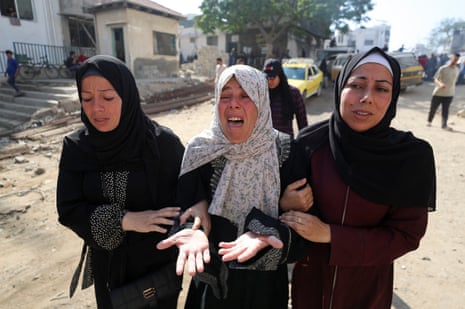
Women mourn during the funeral of Palestinians killed on Friday in Israeli airstrikes, according to Gaza’s health ministry, at Al-Shifa Hospital, in Gaza City, 28 June 2025. Photograph: Mahmoud Issa/Reuters
Palestinians gather at the site of a tent camp that was struck by an Israeli airstrike on Friday, in Gaza City. Photograph: Mahmoud Issa/Reuters
Palestinians gather at the site of a tent camp that was struck by an Israeli airstrike on Friday, in Gaza City, June 28, 2025. Photograph: Mahmoud Issa/Reuters
Mourners during the funeral of Palestinians killed on Friday in Israeli airstrikes. Photograph: Mahmoud Issa/Reuters
Minister says Iranians gave 'blood' not 'honour' in Israel war
Iran’s foreign minister Abbas Araghchi said on Saturday that Iranians had given their “blood” during a 12-day war with Israel but “not honour”, AFP reports.
“Iranians gave blood, not land; gave their loved ones, not honour; they withstood a thousand-ton rain of bombs, but did not surrender,” Abbas Araghchi said on his Instagram account, adding that Iran does not recognise the word “surrender”.
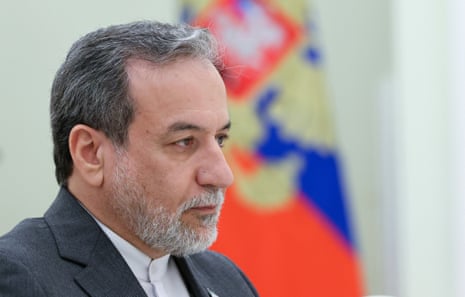
Iranian foreign minister Abbas Araghchi photographed in Moscow on 23 June 2025. Photograph: Sergey Karpukhin/SPUTNIK/KREMLIN POOL/EPA
Yemen’s Huthi rebels say they fired missile at Israel
Yemen’s Iran-backed Huthi rebels said they fired a ballistic missile towards Israel on Saturday, in response to Israel’s conduct towards Palestinians during the Gaza war.
The Israeli army confirmed the launch and said the “missile was most likely successfully intercepted”, AFP reports.
In a statement, rebel military spokesman Yahya Saree said the Huthis had fired at a “sensitive Israeli enemy target in the occupied area of Beersheba using a Dhu al-Fiqar ballistic missile.”
Mediator Qatar sees 'window of opportunity' for Gaza truce - foreign ministry
Qatar’s foreign ministry spokesman says mediators are engaging with Israeland Hamas to build on momentum from this week’s ceasefire with Iran and work towards a truce in the Gaza Strip.
Majed al-Ansari said in an interview with AFP on Friday:
If we don’t utilise this window of opportunity and this momentum, it’s an opportunity lost amongst many in the near past.
We don’t want to see that again.
At least 34 people killed in Israeli strikes in Gaza - health staff
At least 34 people were killed across Gaza by Israeli strikes, health staff say.
The strikes began late Friday and continued into Saturday morning, among others killing 12 people at the Palestine Stadium in Gaza City, which was sheltering displaced people, and eight more living in apartments, according to staff at Shifa hospital where the bodies were brought.
Six others were killed in southern Gaza when a strike hit their tent in Muwasi, according to the hospital.
Here is more detail on comments made by the head of the controversial US- and Israeli-backed aid group Gaza Humanitarian Foundation (GHF), who has defended its work after repeated killings of Palestinians at aid hubs.
Johnnie Moore told the BBC World Service’s Newshour that he did not deny there were deaths near the aid sites, but he added that “100% of those casualties are being attributed to close proximity to GHF” and that was “not true”.
“Moore also accused the UN and other international organisations of spreading information they could not verify,” the BBC added.
Moore also told Sky News there is a “disinformation campaign” fuelled by “some figures” coming out every day.
The UN said at least 410 Palestinians have been killed seeking food since Israel lifted an 11-week aid blockade on 19 May. The Hamas-run Gaza health ministry said at least 549 people have been killed.
On Friday, the UN secretary general, Antonio Guterres, called the GHF aid system “inherently unsafe”.
He said: “Any operation that channels desperate civilians into militarised zones is inherently unsafe. The search for food must never be a death sentence.”
Iran holds state funeral for top brass slain in war with Israel
We have more on the state funeral being held in Tehran for around 60 people, including its military commanders and nuclear scientists.
The proceedings started at 8.00am local time (04.30 GMT) in the capital as government offices and many businesses were closed on Saturday for the occasion, AFP reports.
State TV showed footage of thousands of people wearing black clothes, waving Iranian flags and holding pictures of the slain military commanders.
Iranian President Masoud Pezeshkian, along with other senior government officials and military commanders - including Esmail Qaani, head of the Quds Force, the foreign operations arm of the Revolutionary Guards - also attended the event.
The march began near Enghelab (Revolution) Square in central Tehran.
A patriotic eulogy blared from loudspeakers as the procession set out across the sprawling metropolis toward Azadi (Freedom) Square, 11 kilometres (seven miles) away.
Iranian people mourn during a funeral ceremony for Iranian military and scientists who were killed in recent Israeli airstrikes. Photograph: Abedin Taherkenareh/EPA
Among the dead is Mohammad Bagheri, a major general in Iran’s Revolutionary Guards and the second-in-command of the armed forces after the Iranian leader.
He will be buried alongside his wife and daughter, a journalist for a local media outlet, all killed in an Israeli attack.
Nuclear scientist Mohammad Mehdi Tehranchi, also killed in the attacks, will be buried with his wife.
Revolutionary Guards commander Hossein Salami, who was killed on the first day of the war, will also be laid to rest after Saturday’s ceremony - which will also honour at least 30 other top commanders.
Of the 60 people who are to be laid to rest after the ceremony, four are children and four are women.
Hello and welcome to our live coverage of the latest developments in the Middle East.
Donald Trump has said he would “absolutely” consider bombing Iran again.
At a White House briefing, he said he would “without question” attack the country if Tehran is enriching uranium to concerning levels.
Trump also reacted sternly to Iran’s Supreme Leader, Ali Khamenei’s remarks that Iran “slapped America in the face” by launching an attack against a major US base in Qatar following the US bombing raids. Khamenei also said Iran would never surrender.
In a social media post Trump wrote: “His Country was decimated, his three evil Nuclear Sites were OBLITERATED, and I knew EXACTLY where he was sheltered, and would not let Israel, or the US Armed Forces, by far the Greatest and Most Powerful in the World, terminate his life. I SAVED HIM FROM A VERY UGLY AND IGNOMINIOUS DEATH.”
Iran, meanwhile, said a potential nuclear deal was conditional on the US ending its “disrespectful tone” toward the Supreme Leader.
“If President Trump is genuine about wanting a deal, he should put aside the disrespectful and unacceptable tone towards Iran’s Supreme Leader, Grand Ayatollah Khamenei, and stop hurting his millions of heartfelt followers,” Iran’s foreign minister Abbas Araghchi said in a post on X in the early hours of Saturday.
In other news:
Iran began a state funeral service on Saturday for around 60 people, including its military commanders, killed in its war with Israel.
Johnnie Moore, head of the controversialUS and Israeli-backed aid group, Gaza Humanitarian Foundation (GHF) has defended its work.
The Israeli army said on Saturday that a missile launched from Yementoward Israeli territory had been “most likely successfully intercepted”.