Saturday, September 24, 2022


Friday, September 23, 2022
Opinion | The Pentagon’s alleged fake social media accounts demand a reckoning - The Washington Post
Opinion The Pentagon’s alleged secret social media operations demand a reckoning

The U.S. military has apparently adopted a new national security strategy: internet trolling. The Post reports that the Pentagon will conduct a sweeping review of its policies regarding clandestine information warfare, after Facebook and Twitter removed fake accounts suspected of being run by the Defense Department.
The news raises the question of whether social media companies should crack down on fake accounts that exist for benign purposes, such as promoting democracy. On the other hand, it is also reasonable to ask whether the U.S. government should conduct offensive cyberoperations to influence foreign peoples. Though it seems contradictory, the answer to both questions is yes.
Social media sites need rules against platform manipulation, and those rules need to have a bright line: A site can’t pick and choose which false personas it likes and which it doesn’t based on the countries they come from or values they promote — doing so would make effective enforcement nearly impossible.
At the same time, the U.S. government cannot leave the online influence battlefield. U.S. adversaries are all too present on the front of online influence, from China’s so-called 50-Cent Army of propagandists, which spreads misinformation about Hong Kong, Taiwan, the cultural genocide of the Uyghur Muslim minority and more, to Russia’s Internet Research Agency, which sought to magnify racial tensions among American feminists preparing for the 2017 Women’s March.
Fighting back is tricky. The U.S. military’s reluctance to cede the clandestine information space to malign foreign forces makes sense — but in trying to seize some of the territory for itself, the Defense Department also risks undermining this country’s own objectives. Spreading truthful information, such as the facts about the coronavirus pandemic, through false means, such as inauthentic personas, reflects this nation’s values better than spreading false information through false means. But inauthentic personas themselves can prove a problem: Their widespread use, when uncovered, promotes an internet-era nihilism, suggesting that nothing on the internet can really be believed.
Under narrow circumstances, deception might be the best or the only option. But the Pentagon’s alleged efforts don’t seem to have been effective: The operations uncovered by Facebook and Twitter and documented by researchers show the indiscriminate creation of fake accounts, sometimes with faces generated by artificial intelligence, spamming platforms with petitions, memes and hashtag campaigns, all boosted inorganically. They did not succeed; overt operations generated more engagement. And, of course, they could not hide their fake nature; the platforms managed not only to disrupt them but also to identify them as likely associated with the U.S. military.
The Defense Department should ensure that any policy emerging from its audit treats platform manipulation not as a default but as an intervention that demands careful justification. Meanwhile, the government as a whole, from the Pentagon to the State Department to intelligence agencies, ought to rethink, with the help of academic input and public debate, what a digital-age hearts-and-minds campaign looks like. U.S. information operations should elevate the truth and expose falsehoods, and any clandestine tactics should be based on research about what works. Those conducting these salvos should be trained in how to do the job right. They should also make sure not to get caught.
The Post’s View | About the Editorial Board
Editorials represent the views of The Washington Post as an institution, as determined through debate among members of the Editorial Board, based in the Opinions section and separate from the newsroom.
Members of the Editorial Board and areas of focus: Deputy Editorial Page Editor Karen Tumulty; Deputy Editorial Page Editor Ruth Marcus; Associate Editorial Page Editor Jo-Ann Armao (education, D.C. affairs); Jonathan Capehart(national politics); Lee Hockstader (immigration; issues affecting Virginia and Maryland); David E. Hoffman (global public health); Charles Lane (foreign affairs, national security, international economics); Heather Long (economics); Molly Roberts (technology and society); and Stephen Stromberg (elections, the White House, Congress, legal affairs, energy, the environment, health care)."
Opinion | The Wrong Trump Judge at the Right Time Can Wreak Havoc - The New York Times
The Wrong Trump Judge at the Right Time Can Wreak Havoc

"In political writing about the federal judiciary, there is a convention to treat the partisan affiliation of a judge or justice as a mere curiosity; to pretend that it does not matter that much whether a jurist was nominated by Ronald Reagan or Bill Clinton or George W. Bush or Barack Obama as long as he or she can faithfully uphold the law.
The issue with this convention, as we’ve seen in the legal drama over the classified materials found in President Donald Trump’s home at Mar-a-Lago, is that it isn’t equipped to deal with the problem of hyperpartisan, ideological judges who are less committed to the rule of law than to their presidential patron. In particular, this way of thinking about federal courts isn’t equipped to deal with the problem of Trump judges.
In the case of the documents the judge in question is Aileen Cannon of the United States District Court for the Southern District of Florida, nominated by Trump in the spring of 2020 and confirmed by the Senate (with 12 Democratic votes) after his defeat in the November election. Cannon was a federal prosecutor for seven years and had no experience as a judge before being placed on the federal bench for a lifetime appointment at age 39. What she did have to recommend her was longstanding membership in the conservative Federalist Society. That seems to have been more than enough.
In the Mar-a-Lago case, Cannon has behaved less as an impartial judge and more as an ally of Trump. On the question of whether the court would appoint an independent third party to review the documents in question, Cannon ruled in favor of the former president, despite the fact that it made no sense to do so, according to legal commentators from across the political spectrum. Not only is there no legal (or even factual) dispute about the classified nature of the documents, there’s no basis for the former president’s sweeping claim of executive privilege, which would keep government documents out of the hands of, well, the government.
As Lawrence Tribe and Phillip Allen Lacovara write in The Guardian, “No prior case or other authority has treated ‘executive’ privilege as a basis for concealing information from executive branch officials conducting executive functions, here the Justice Department’s investigation and potential prosecution of federal crimes relating to the mishandling of state secrets and presidential records.”
There’s also the minor question of who is actually the president of the United States. Donald Trump is a private citizen. And contrary to Cannon, he no longer has a say in whether the executive branch can have its documents back, if he ever did.
But the law and precedent and common sense do not seem to matter when the judge at issue is an ideologue in robes.
You can see something similar in Texas, where a three-judge panel on the U.S. Court of Appeals for the Fifth Circuit reinstated a Texas law that bans social media companies from regulating speech on their platforms. The law, passed not long after Trump was banned from Twitter in the aftermath of the Jan. 6 attack on the Capitol, was condemned as a constitutional nightmare.
“Social media platforms have a First Amendment right to moderate content disseminated on their platforms,” Judge Robert Pitman, an Obama appointee, wrote in a December 2021 decision that blocked the law, pending appeal. The law, he continued, was “replete with constitutional defects, including unconstitutional convent and speaker-based infringement on editorial discretion and onerously burdensome disclosure and operational requirements.”
The Fifth Circuit disagreed. Writing for the panel, Judge Andrew Oldham, a Trump appointee, upheld the law. For Oldham, “moderation” is little more than censorship. Of course, the First Amendment “protects every person’s right to ‘the freedom of speech,’ ” Oldham writes. “But the platforms argue that buried somewhere in the person’s enumerated right to free speech lies a corporation’s unenumerated right to muzzle speech.” The Texas law, he continues, “does not chill speech; if anything, it chills censorship.”
To a number of legal scholars, regulators and other experts, this was nonsense. Under the Fifth Circuit’s ruling, social media companies and other media organizations no longer have a First Amendment right to their own editorial policies.
That’s why, when the U.S. Circuit Court of Appeals for the 11th Circuit heard a similar case concerning Florida’s attempt to regulate social media companies, it ruled in favor of the plaintiffs, in a unanimous rejection of the Florida law. “We hold that it is substantially likely that social-media companies — even the biggest ones — are ‘private actors’ whose rights the First Amendment protects” and that their “so-called ‘content-moderation’ decisions constitute protected exercises of editorial judgment, and that the provisions of the new Florida law that restrict large platforms’ ability to engage in content moderation unconstitutionally burden that prerogative.”
It should be said that this was a panel of Republican appointees, including one named by Trump. This week, in fact, a different panel of judges on the 11th Circuit — including two Trump appointees — set aside key parts of Cannon’s order, freeing the Justice Department to resume its use of classified documents in its investigation of the former president.
Which is to say that not every Trump appointee is a partisan ideologue, working in his favor. But there are enough Judge Cannons in the mix to ensure that the right (or perhaps I should say wrong) judge at the right time can wreak havoc on the rule of law. We’re seeing it in Florida, we’re seeing it in Texas and we will continue to see it until something is done to lessen the influence of Trump’s appointees.
Thankfully, there is a solution, and it only takes a simple vote of Congress. Expand and reorganize the federal court system.
The practical reason to increase the number of courts and judges is that the country is much larger than it was in 1990, when Congress made its last expansion, adding 11 seats to the circuit court system and 61 seats to the district court system. This was modest compared to 1978, when President Jimmy Carter signed the largest judiciary expansion in history, creating 150 new judgeships and expanding the entire federal bench by more than a third.
In the 32 years since 1990, the United States has grown from a population of roughly 250 million to a population of over 330 million. More people means more legal disputes, more legal disputes means more cases, more cases means more work. And the federal judiciary is swamped. Last year, the Judicial Conference of the United States, a nonpartisan policymaking body for the federal courts, recommended that Congress create 79 new judgeships across existing district and appeals courts.
Congress, and here I mean Democrats, should go further with a court expansion to rival Carter’s. They should create new circuits, new courts and new judgeships. The goal is simple: to account for growth and to deal with the problem of a cohort of hyperpartisan and ideological judges whose loyalty to Trump may outweigh their commitment to the law.
Would it be a partisan move? Yes. But it is a truth of American politics going back to the early days of the republic that partisan problems — like the one engineered by Mitch McConnell, Trump and the Federalist Society — demand partisan solutions."
Thursday, September 22, 2022
Presidential Power to Declassify Information, Explained - The New York Times. There are lies and damn lies and then there are Trump's lies
"Presidential Power to Declassify Information, Explained
In an interview, Mr. Trump again insisted that “I declassified everything.” He added that as president, “you can declassify just by saying ‘it’s declassified’ — even by thinking about it.”

Sign Up for On Politics, for Times subscribers only. A Times reader’s guide to the political news in Washington and across the nation.
WASHINGTON — Former President Donald J. Trump’s repeated claim that he had declassified all the documents that the F.B.I. seized in the search of his Florida home last month — including those marked as top secret — has heightened interest in the scope of a president’s power to declassify information.
In an interview on Fox News that was broadcast on Wednesday, Mr. Trump insisted that he “declassified everything.” There does not have to be a formal process to do so, he added, because “if you’re the president of the United States, you can declassify just by saying ‘it’s declassified’ — even by thinking about it.”
Days after the F.B.I. search, Mr. Trump’s office claimed that as president, he had a standing order that materials “removed from the Oval Office and taken to the residence were deemed to be declassified the moment he removed them,” according to a statement read on Fox News by a right-wing writer whom the former president has designated as one of his representatives to the National Archives.
No credible evidence has emerged that Mr. Trump issued any standing order to declassify everything he happened to take from the Oval Office, and national security legal specialists have greeted the notion with disdain. Glenn S. Gerstell, the top lawyer for the National Security Agency from 2015 to 2020, said the idea that whatever Mr. Trump happened to take upstairs each evening automatically became declassified — without logging what it was and notifying the agencies that used that information — was “preposterous.”
The claim is also a sideshow to Mr. Trump’s potential legal troubles over the document matter, because none of the three criminal laws cited in a search warrant as the basis of the investigation depend on whether documents technically contain classified information. Notably, Mr. Trump’s lawyers have not repeated his claim in court, where there are professional consequences for lying; they have also resisted a judge’s proposal that they submit a sworn declaration or affidavit about any declassification action.
Here is a closer look at what a president can and cannot do when it comes to removing protections for government secrets.
What is the classification system?
It is the administrative process by which the federal government controls how executive branch officials handle information whose potential public exposure is deemed likely to damage national security.
Officials with the authority to classify or declassify matters can deem information as falling into three categories: confidential, secret or top secret. Access to particularly sensitive information can be restricted even further with a designation of S.C.I., for sensitive compartmented information.
If information is classified, access to it is restricted. Any documents containing that information are supposed to be marked, and only officials with proper security clearances — and a “need to know” — are permitted to see them or be told of their contents. There are also rules limiting how they can be stored, physically transported or electronically transmitted.
The legal basis for the classification system comes from the president’s constitutional authority as commander in chief. Presidents have established and developed it through a series of executive orders dating to the era encompassing World War II and the early Cold War. The current directive, Executive Order 13526, was issued by President Barack Obama in 2009.
(Congress established a separate system for protecting certain nuclear secrets in the Atomic Energy Act. It requires consulting the Pentagon and the Energy Department in any decision to downgrade protections and uses different terms, like “restricted data.” In everyday parlance, people often refer to that kind of information as classified as well.)
Is the classification system enforced by criminal law?
Largely not.
For the most part, the classification system is about bureaucratic controls. The main punishment for disobedience is administrative: Officials can be admonished, lose their security clearances and be fired.
As such, the classification system exists in parallel to separate criminal penalties Congress has imposed to protect security secrets.
For example, the Espionage Act of 1917 — one of the laws cited in the search warrant — protects secrets that it defines as defense-related information that could harm the United States or aid a foreign adversary. It makes no reference to classification status, and prosecutors in an Espionage Act case do not need to prove that anything was deemed classified as an element of a crime.
Prosecutors in an Espionage Act case do have to prove that such information was being closely held by the government, and such cases typically involve classified records. Mr. Trump is putting forward a situation in which he purportedly deemed national-security secrets declassified without telling anyone, so the government continued to closely hold them.
A rare exception, where Congress has tied a law to the classification system, is Section 1924 of Title 18 of the U.S. Code. It makes the unauthorized retention or removal of classified material a crime, so prosecutors would have to show that the information remained technically classified as an element of proving that offense to a jury. But that was not one of the laws that was listed in the search warrant as a focus of the investigation.
Who has the power to classify and declassify information?
In the normal course of business, certain officials who have been designated as “original classification authorities” in federal departments and agencies can do so. They are considered to be exercising the president’s power over such matters, which has been delegated to them.
Are there formal procedures for declassifying information?
Yes. The 2009 executive order directs the head of the department or agency that originally deemed information classified to oversee declassification reviews, and it sets some standards for them.
The executive branch has regulations laying out the process that should be followed, such as a requirement to make sure that other agencies and departments with an interest in the secret are consulted. There are also procedures for the removal of classification markings on documents.
Can presidents declassify matters directly?
Yes, because it is ultimately their constitutional authority.
Normally, presidents who want something declassified direct subordinates overseeing the department or agency with primary responsibility for the information to review the matter with an eye to making more of it public. But on rare occasions, presidents declassify something directly.
For example, in 2004, President George W. Bush himself declassified a portion of his presidential daily intelligence briefing from August 2001 — a month before the Sept. 11 terrorist attacks — in which he had been warned: “Bin Laden Determined to Strike in U.S.”
Do presidents have to obey the usual procedures?
Even if it is true that Mr. Trump had pronounced the documents declassified while he was in office, he clearly did not follow the regular procedures. But there is no Supreme Court precedent that definitively answers whether that would make any difference.
Notably, a federal appeals court said in 2020 that “declassification, even by the president, must follow established procedures.” But the context was different: That line was part of an opinion rejecting a Freedom of Information Act lawsuit involving whether Mr. Trump had declassified a covert program by discussing its existence in a tweet.
In the unlikely event that the Justice Department were to charge him under the law that makes the unauthorized retention or removal of classified material a crime — despite not listing it as a focus of the investigation in the search warrant — a novel question would arise if Mr. Trump were then to repeat the claim as a defense.
Proponents of a strong view of presidential power have argued in other contexts that presidents are not personally bound by the rules and procedures that regulate the conduct of their subordinates in the executive branch — and that presidents can even disregard executive orders without first rescinding them. Others disagree with that vision of executive power.
Can a president secretly declassify information without leaving a written record or telling anyone?
That question, according to specialists in the law of government secrecy, is borderline incoherent.
If there is no directive memorializing a decision to declassify information and conveying that decision to the rest of the government, the action would essentially have no consequence. Departments and agencies would continue to consider that information classified and so would continue to treat it as a closely held secret, restricting access to records containing it.
“Hypothetical questions like ‘What if a president thinks to himself that something is declassified? Does that change its status?’ are so speculative that their practical meaning is negligible,” said Steven Aftergood, a secrecy specialist with the Federation of American Scientists.
He added: “It’s a logical mess. The system is not meant to be deployed in such an arbitrary fashion.”
What about obstruction and disobeying a subpoena?
Even if evidence emerged that Mr. Trump technically deemed the documents declassified before leaving office, that would also not help him with other legal problems arising from his hoarding of government documents despite repeated efforts to retrieve them.
The other two criminal laws cited in the search warrant affidavit — concealing or destroying government records, and concealing documents as part of an effort to obstruct an investigation or other official effort — do not have to involve national security secrets.
In May, the Justice Department obtained a grand jury subpoena for all sensitive documents remaining in Mr. Trump’s possession. His representatives turned over a few while falsely saying that no others remained. Notably, it demanded all records “bearing classification markings” — not classified records — so the claim that the former president had technically declassified them would also seem to be irrelevant to whether he unlawfully defied the subpoena."
‘He’s done’: how Donald Trump’s legal woes have just gotten a lot worse
‘He’s done’: how Donald Trump’s legal woes have just gotten a lot worse
“New York civil lawsuit accusing Trump family of ‘staggering’ fraud could derail presidential bid, experts say
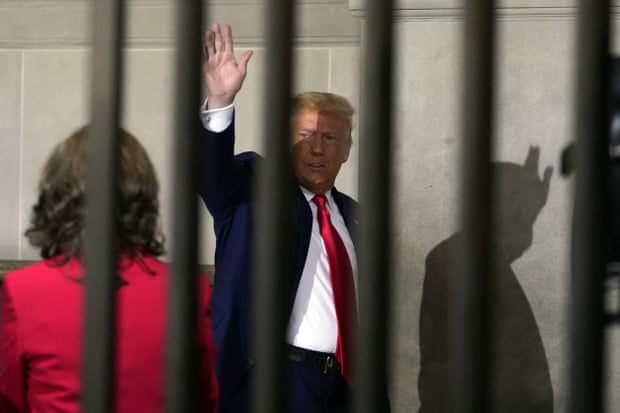
Donald Trump’s legal perils have become insurmountable and could snuff out the former US president’s hopes of an election-winning comeback, according to political analysts and legal experts.
On Wednesday, Trump and three of his adult children were accused of lying to tax collectors, lenders and insurers in a “staggering” fraud scheme that routinely misstated the value of his properties to enrich themselves.
The civil lawsuit, filed by New York’s attorney general, came as the FBI investigates Trump’s holding of sensitive government documents at his Mar-a-Lago estate in Florida and a special grand jury in Georgia considers whether he and others attempted to influence state election officials after his defeat there by Joe Biden.
The former US president has repeatedly hinted that he intends to run for the White House again in 2024. But the cascade of criminal, civil and congressional investigations could yet derail that bid.
“He’s done,” said Allan Lichtman, a history professor at American University, in Washington, who has accurately predicted every presidential election since 1984. “He’s got too many burdens, too much baggage to be able to run again even presuming he escapes jail, he escapes bankruptcy. I’m not sure he’s going to escape jail.”
After a three-year investigation, Letitia James, the New York attorney general, alleged that Trump provided fraudulent statements of his net worth and false asset valuations to obtain and satisfy loans, get insurance benefits and pay lower taxes. Offspring Don Jr, Ivanka and Eric were also named as defendants.
At a press conference, James riffed on the title of Trump’s 1987 memoir and business how-to book, The Art of the Deal.
“This investigation revealed that Donald Trump engaged in years of illegal conduct to inflate his net worth, to deceive banks and the people of the great state of New York. Claiming you have money that you do not have does not amount to ‘the art of the deal’. It’s the art of the steal,” she said.
Her office requested that the former president pay at least $250m in penalties and that his family be banned from running businesses in the state.
James cannot bring criminal charges against Trump in this civil investigation but she said she was referring allegations of criminal fraud to federal prosecutors in Manhattan as well as the Internal Revenue Service.
Trump repeated his go-to defence that the suit is “another witch hunt” against him and again referred to James, who is Black, as racist, via his Truth Social platform, also calling her “a fraud who campaigned on a ‘get Trump’ platform, despite the fact that the city is one of the crime and murder disasters of the world under her watch!”
But critics said the suit strikes at the heart of Trump’s self-portrayal as a successful property developer who made billions, hosted the reality TV show The Apprentice and promised to apply that business acumen to the presidency.
Laurence Tribe, a constitutional law professor at Harvard University, noted that the civil component “involves things of particular significance to Trump and his family and his organisation, namely their ability to defraud the public, to defraud banks, to defraud insurance companies, and to continue to subsist through corruption. Without all of that corruption, the entire Trump empire is involved in something like meltdown.”
Tribe added: “Trump is probably more concerned with things of this kind than he is with having to wear an orange jumpsuit and maybe answer a criminal indictment … As a practical matter, this is probably going to cause more sleepless nights for Mr Trump than almost anything else.”
No previous former president has faced investigations so numerous and so serious. Last month FBI agents searched Mar-a-Lago and seized official documents marked Top Secret, Secret and Confidential. Trump faces possible indictment for violating the Espionage Act, obstruction of a federal investigation or mishandling sensitive government records.
As so often during his business career, Trump sought to throw sand in the legal gears. He bought time by persuading a court to appoint a judge, Raymond Dearie, as a special master to review the documents. But so far Dearie appears to be far from a yes-man. On Tuesday he warned Trump’s lawyers: “My view is you can’t have your cake and eat it too.”
The ex-president also faces a state grand jury investigation in Georgia over efforts to subvert that state’s election result in 2020.
The justice department is investigating his role in the deadly January 6 attack on the US Capitol by a mob of his supporters intent on preventing the certification of Biden’s election victory. Its efforts have been boosted by the parallel investigation by a House of Representatives committee, whose hearings are set to resume next week.
In addition, the Trump Organization – which manages hotels, golf courses and other properties around the world – is set to go on trial next month in a criminal case alleging that it schemed to give untaxed perks to senior executives, including its longtime finance chief Allen Weisselberg, who alone took more than $1.7m in extras.
In a further setback on Wednesday, arguably Trump’s worst-ever day of legal defeats, a federal appeals court permitted the justice department to resume its review of classified records seized from Mar-a-Lago as part of its criminal investigation.
The former president, meanwhile, insisted that he did nothing wrong in retaining the documents. “There doesn’t have to be a process, as I understand it,” he told the Fox News host Sean Hannity. “If you’re the president of the United States, you can declassify just by saying: ‘It’s declassified’.”
“Even by thinking about it, because you’re sending it to Mar-a-Lago or to wherever you’re sending it ... There can be a process, but there doesn’t have to be.”
Despite it all, Trump has been laying the groundwork for a potential comeback campaign and has accused Biden’s administration of targeting him to undermine his political prospects.
Asked by a conservative radio host what would happen if he was indicted over the classified documents at Mar-a-Lago, Trump replied: “I think you’d have problems in this country the likes of which perhaps we’ve never seen before. I don’t think the people of the United States would stand for it.”
Kurt Bardella, an adviser to the Democratic National Committee, said: “If the best defence you have for your conduct is: if you hold me accountable, there will be violence, that sounds like someone who has no business being either in public service or being outside of jail.”
Bardella expressed hope that, at long last, Trump would be held to account. “Everything about Donald Trump has always been about the grift. It’s always been about the con. And now his unmasking is at hand.”
In recent polls, American voters ranked “threats to democracy” as the most important issue facing the country. At a time of climate collapse, inflation and a pandemic, this is a remarkable statement on the fragility of America’s fundamental rights and freedoms.
The country is seeing a dizzying number of assaults on democracy, from draconian abortion bans to a record number of book bans. Politicians who spread lies and sought to delegitimize the 2020 election are pursuing offices that will put them in control of the country’s election machinery. Meanwhile, the supreme court is enforcing its own agenda on abortion, guns and environmental protections – often in opposition to public opinion.”
Opinion Letitia James used Trump’s boasts against him. It was devastating
Opinion Letitia James used Trump’s boasts against him. It was devastating.

“In his best-selling 1987 book, “The Art of the Deal,” Donald Trump presented himself as the ultimate New Yorker — brash, brilliant, supremely successful. It is delicious, then, that it was New York Attorney General Letitia James who punctured this fiction with a stinging, Manhattan-tough one-liner.
“Claiming to have money that you do not have does not amount to the art of the deal,” she said Wednesday, announcing a $250 million civil lawsuit against Trump, his company and members of his family for a decade-long pattern of alleged fraud. “It’s the art of the steal.”
I honestly wonder which aspect of James’s 222-page complaint will rankle Trump more: the threat of potential fines and restrictions that could essentially mean the corporate death penalty for the Trump Organization? Or the damage to his fragile ego from the suit’s detailed allegations about how he wildly inflated his net worth?
Judging by Trump’s declaration that James is a “racist” on a “witch hunt,” and his lawyer’s insistence that James, a Democrat, filed the suit to launch her own political career, the announcement stung the former president, even if it has not yet fatally wounded his business empire.
My favorite detail in the suit is the allegation that Trump claimed his apartment at Trump Tower spanned more than 30,000 square feet and was worth $327 million, far more than any New York apartment has ever been sold for. In reality, James said, the apartment covers just under 11,000 square feet. That’s still huge; the Fifth Avenue triplex is still worth a lot of money. But why would he lie about such an easily checkable fact as square footage?
For that matter, why would he claim that a group of rent-stabilized apartments he owned were worth 65 times their actual value, according to James? Why would he claim his tower at 40 Wall Street was worth $524 million, when a contemporaneous professional appraisal set its value at roughly $200 million? Why would he claim that the Trump Organization had cash on hand that James said did not exist? Why would he assert, or boast, that the name “Trump” — just the gold-plated name itself — added huge amounts to the valuations of other properties?
According to the lawsuit, the practical reason was to fraudulently represent to banks that he and his company had more assets than they truly did. That allowed him to obtain loans at lower interest rates and insurance coverage with lower premiums, the suit alleges, amounting to an estimated $250 million in unwarranted benefits during the decade between 2011 and 2021. James’s suit seeks to recover that money from the firm — and to punish Trump, his daughter Ivanka, his sons Donald Jr. and Eric, and the Trump Organization by severely limiting, if not eliminating, their ability to do business in the state of New York.
But it doesn’t take Sigmund Freud to suspect a psychological explanation for Trump’s alleged lies, as well. Trump has always seemed to be compelled to exaggerate his accomplishments, even when there was no rational reason to do so.
Recall his very first day as president. He had a perfectly respectable crowd at his inauguration, given the iffy weather and the divisiveness of the 2016 election. But he ordered his press secretary, Sean Spicer, to insist — falsely, grandiloquently and laughably — that it was the biggest inaugural crowd in history. Note how, to this day, Trump routinely overstates the crowd size at his MAGA rallies, stoking his own ego by claiming his followers waited in miles-long lines to bask in the radiance of his presence.
Trump has always seemed to be especially touchy about his wealth, insisting that he is far richer than analysts at Forbes magazine and elsewhere reckoned. I have to wonder whether James had that sensitivity in mind when she prepared the statement she read at her news conference announcing the suit.
James’s investigators examined Trump’s declared valuations for 23 properties, including his Florida estate, Mar-a-Lago; the hotel on Pennsylvania Avenue near the White House that he recently sold; and several of his golf courses. She seemed to make a point of mentioning these marquee holdings and showing, she alleges, that they are not really worth what Trump claims. All that glitters might be gold, but in Trump’s case, it’s only 14-karat.
The fact that — according to James and the lawsuit — Trump allegedly obtained expert, outside appraisals and still boosted the properties’ values suggests incredible recklessness. Whether that is born of simple greed or inner need, it might end up costing Trump an awful lot of money.
James said she believed Trump may have left himself open to criminal fraud charges as well. The New York district attorney’s office issued a statement on Wednesday saying its criminal investigation of Trump remains open; and U.S. Attorney General Merrick Garland will have yet another fraught decision to make — whether these alleged inflated property valuations violated federal criminal statutes as well and warrant charges.
Hubris has taken Trump far in life. As the ancient Greeks knew, however, it’s not a very good long-term plan.“