Contact Me By Email


What To Do When You're Stopped By Police - The ACLU & Elon James White

What To Do When You're Stopped By Police - The ACLU & Elon James White

Know Anyone Who Thinks Racial Profiling Is Exaggerated? Watch This, And Tell Me When Your Jaw Drops.


This video clearly demonstrates how racist America is as a country and how far we have to go to become a country that is civilized and actually values equal justice. We must not rest until this goal is achieved. I do not want my great grandchildren to live in a country like we have today. I wish for them to live in a country where differences of race and culture are not ignored but valued as a part of what makes America great.

Wednesday, March 31, 2021

Young witnesses to George Floyd’s death testify they felt helpless as they watched him die and feared Derek Chauvin

Young witnesses to George Floyd’s death testify they felt helpless as they watched him die and feared Derek Chauvin

“MINNEAPOLIS — The teenager who filmed the viral video of Derek Chauvin kneeling on George Floyd’s neck tearfully recalled Tuesday how the Black man begged for his life and the “cold look” on the face of the White police officer accused of killing him.

In deeply emotional testimony, Darnella Frazier, who was just 17 when she came across Floyd being restrained by the police, testified of the lingering anxiety and guilt she feels about Floyd’s death and not doing more to intervene.

Frazier told the jury of looking at her father, her brother, her cousins and friends and the anguish she felt knowing it “could have been one of them” on the ground and how it had added to her guilt. “It’s been nights I stayed up apologizing and apologizing to George for not doing more and not physically interacting and not saving his life,” Frazier tearfully said.

But, Frazier added, referring to Chauvin, who sat a few feet away in the courtroom, “It’s not what I should have done. It’s what he should have done.”

Frazier was one of several eyewitnesses called to the stand Tuesday, including four girls who were under 18 when they saw Floyd being held to the ground by Chauvin and two other officers during a May 25 police investigation into an alleged counterfeit $20 bill. The jury also heard from firefighter Genevieve Hansen, who was off-duty and came across the scene while on a walk. Hansen burst into tears as she recounted begging officers to check Floyd’s pulse but being rebuffed.

In hours of testimony, during which some jurors looked uncomfortable and shocked, the teenagers testified about their feelings of helplessness and, in some cases, fear as they confronted the Minneapolis officers detaining Floyd while he moaned and begged for his life and ultimately became unresponsive.

“It wasn’t right,” Frazier told prosecutor Jerry Blackwell. “We all knew it wasn’t right.”

The teens testified in open court, but their images were not shown on the courtroom live stream because they are minors. Prosecutors had expressed concern about further traumatizing the girls, all of whom testified in nervous, childlike voices about seeing the Black man die before their eyes — a horror that came as they were out buying snacks or running errands on a late-spring evening.

One of the witnesses — Alyssa Funari, 18 — described how she had driven to Cup Foods, the store where the incident happened, to buy a charging cord for her phone and found Floyd moaning under the pressure of Chauvin’s knee. Like Frazier, she began filming — and watched as Floyd’s eyes rolled back in his head and he stopped moving.

“It was difficult because I felt like there wasn’t really anything I could do,” Funari said tearfully, pausing several times to regain her composure. “I knew time was running out or that it had already … that he was going to die.”

Kaylynn Ashley Gilbert, 17, said she drove up to the scene with a friend, who had testified earlier, and eventually got out of the car.

She saw Floyd “unconscious,” she said, Chauvin kneeling on his neck — “kind of digging in his knee” and “putting a lot of pressure on his neck that wasn’t needed.”

Floyd “wasn’t talking anymore, and when we pulled up, he was talking,” Gilbert said. “His eyes were closed. He wasn’t moving.”

She recalled asking officers: “Why are you guys still on top of him? He’s not doing anything wrong.”

For a second straight day, the jury was presented with bystander video of Floyd’s death — including cellphone footage shot by Frazier, Funari and Hansen — with Floyd’s moans punctuating the quiet downtown Minneapolis courtroom. The former officer, who is charged with second- and third-degree murder and second-degree manslaughter, often averted his eyes, but he showed no emotion as the footage was played on courtroom screens.

Frazier testified that she began filming the scene because she sensed that what was happening to Floyd “wasn’t right.” She described Floyd as “terrified, scared, begging for his life.”

“It seemed like he knew it was over for him,” Frazier said. “He was suffering.”

The girls described how as Floyd stopped moving, the small group of bystanders that had formed began yelling for Chauvin to get off Floyd and for Chauvin or one of the other officers at the scene — J. Alexander Kueng, Thomas K. Lane and Tou Thao — to check his pulse.

“(Chauvin) just stared at us, looked at us. He had like this cold look, heartless. He didn’t care. It seemed as if he didn’t care what we were saying,” Frazier testified.

As the crowd became more emotional and yelled louder for the officers to check on Floyd, Chauvin reached for his mace, and two of the girls recalled feeling “scared” at what the officer might do. “I felt like I was in danger when he did that,” Frazier told the jurors, as several looked toward her sympathetically. “I felt threatened.”

A few seconds later, prosecutors asked her to identify Chauvin, who stood and removed his mask so that Frazier could see him. The former officer, who looked uncomfortable, briefly glanced her way before taking his seat again. Frazier, in a choked voice barely above a whisper, described him at one point as “the officer that was kneeling on George Floyd’s neck.”

Later, Hansen described how she became concerned when she saw Floyd unresponsive with three officers atop him. Floyd’s face looked “puffy and swollen, which would happen if you are putting a grown man’s weight on someone’s neck,” she said. She also recalled seeing what looked like fluid coming from his body and how it reminded her of patients who “release their bladder when they die.”

She recalled trying to intervene and being pushed back by Thao, who expressed skepticism that she was really a firefighter. She said Chauvin ignored her pleas and kept his knee on Floyd’s neck. “In my memory, he had his hand in his pocket,” she said. “He looked so comfortable.”

Chauvin’s defense successfully argued to limit Hansen from saying she could have saved Floyd’s life. But the firefighter came close, describing what she would have done if officers had “granted” her access to the scene.

“I would have checked his airway. I would have been worried about a spinal cord injury because he had so much weight on his neck,” she said. “I would have checked for a pulse. And when I didn’t find a pulse, if that was the case, I would have started compressions.”

Hansen testified that she was mystified at why emergency workers didn’t respond to the scene more quickly, pointing out there was a fire station three blocks away. She said she later called 911 to report the officers. “I should have called 911 immediately, but I didn’t,” she said.

Under defense cross examination, she sparred with attorney Eric Nelson, who pressed her on whether it was proper for someone to interfere with the police and how she, as a firefighter, would react to someone telling her how to do her job. “I know my job, and I would be confident in doing my job, and there’s nothing anybody could do to distract me,” she shot back.

Nelson pointed out that she became “angry” at the scene — which Hansen didn’t dispute, adding that she also felt “desperate” to save Floyd’s life. “I don’t know if you’ve seen anybody be killed, but it’s upsetting,” Hansen said.

The tense back-and-forth led Hennepin County Judge Peter A. Cahill to dismiss the jury and admonish Hansen to not argue with Nelson.

“You will not argue with the court,” Cahill said. “You’ll not argue with counsel. They have the right to ask questions. Your job is to answer.”

Hansen’s testimony will continue Wednesday.

Proceedings resumed Tuesday with the continued testimony of Donald Williams II, a former wrestler turned mixed martial arts fighter, who testified that he tried to intervene because he believed Chauvin was holding Floyd using a move called a “blood choke,” which cuts circulation to a person’s neck and can be dangerous if held too long.

Nelson questioned him extensively on martial arts moves, including whether he had ever seen someone choked unconscious and then awaken ready to fight — an implication that the officers had reason to restrain the handcuffed Floyd even after he stopped moving.

Nelson, who has argued that Chauvin and the other officers felt threatened by the bystanders around them, asked Williams about his increasing anger at the scene and accused him of threatening the officers. “You can’t paint me out as angry,” Williams responded, adding that he was in control and displaying “professionalism.” At one point, he winked at Nelson as the men verbally sparred.

Williams explained he was increasingly upset because Chauvin and the other officers “were not listening to anything I was telling them” and that someone had to “speak out for Floyd.” He later called 911 to report Chauvin, giving the operator the officer’s badge number. “I believed I witnessed a murder,” he testified.

Hannah Knowles and Paulina Villegas contributed to this report.“

Democrats Splinter Over Strategy for Pushing Through Voting Rights Bill President Biden and leading congressional Democrats have made the far-reaching bill a top priority, but some proponents believe it needs major changes.

Democrats Splinter Over Strategy for Pushing Through Voting Rights Bill

“President Biden and leading congressional Democrats have made the far-reaching bill a top priority, but some proponents believe it needs major changes.

Senator Chuck Schumer announcing the For the People Act this month. Democrats have united around the idea that voting rights represent a modern-day civil rights battle that they cannot afford to lose.
Anna Moneymaker for The New York Times

Democrats in Congress are quietly splintering over how to handle the expansive voting rights bill that they have made a centerpiece of their ambitious legislative agenda, potentially jeopardizing their chances of countering a Republican drive to restrict ballot access in states across the country.

President Biden and leading Democrats have pledged to make the elections overhaul a top priority, even contemplating a bid to upend bedrock Senate rules if necessary to push it through over Republican objections. But they are contending with an undercurrent of reservations in their ranks over how aggressively to try to revamp the nation’s elections and whether, in their zeal to beat back new Republican ballot restrictions moving through the states, their proposed solution might backfire, sowing voting confusion and new political challenges.

The hand-wringing demonstrates how urgent the voting issue has become for both parties since November, when President Donald J. Trump spread false claims of voter fraud that many Republicans believed. In the months since, Republican-led statehouses have advanced a wave of new laws clamping down on ballot access.

Democrats have coalesced around the idea that pushing back on such measures is a modern-day civil rights battle that the party cannot afford to lose. “Failure,” Senator Chuck Schumer of New York, the majority leader, said last week, “is not an option.”

But while few Democrats are willing to publicly say so, the details of the more than 800-page bill — which would radically reshape the way elections are run and make far-reaching changes to campaign finance laws and redistricting — have become a point of simmering contention. Some proponents argue that Democrats should break off a narrower bill dealing strictly with protecting voting rights to prevent the legislation, known as the For the People Act, from collapsing amid divisions over other issues.

“Democrats have a narrow opportunity. There is a window here that could close anytime,” said Richard L. Hasen, an election law expert at the University of California, Irvine. “I worry the kind of fights necessary to keep even the Democratic coalition together could blow up the whole thing and lose the chance to get anything done.”

Senator Joe Manchin III, Democrat of West Virginia, has signaled that he is unwilling to vote for any elections bill that is not bipartisan.
Anna Moneymaker for The New York Times

A broad coalition of Democrats and liberal advocacy groups insist that the measure should not be broken apart, arguing that now is the time for an ambitious overhaul. But with Senator Joe Manchin III, a conservative West Virginia Democrat, opposed to the measure in its current form, Democratic leaders and Mr. Biden face tough decisions in the coming weeks about whether they can wrangle all their members behind it more or less as is, or must consider striking a narrower compromise.

The margin for error is exceedingly thin: With Republican opposition unanimous, Democrats would not only need to hold all 50 of their senators together in favor of the bill but also persuade them to change the Senate rules to exempt it from the legislative filibuster, something Mr. Manchin and others have insisted they will not do under any circumstances.

“Right now, my focus is to keep this bill together as one package and get it through the committee,” Senator Amy Klobuchar, Democrat of Minnesota and the chairwoman of the Rules Committee, said in an interview.

Asked whether she might be willing to break the bill into pieces down the line, she declined to answer directly.

As currently written, the bill constitutes a sweeping liberal wish list that includes restoring voting rights to felons who have served their sentences, making it easier to register and vote, reining in undisclosed campaign donations, securing elections against cyberattacks and ending the partisan gerrymandering of congressional districts. It was drafted as a statement of Democratic values during the last Congress, at a time when Republicans controlled Washington and there was no chance it would be enacted.

Now, with Democrats in power — albeit by slim margins on Capitol Hill — they must transform a messaging bill into a viable piece of legislation.

The most visible hurdle to date is the apparent opposition of Mr. Manchin, who said last week that he opposed allowing the federal government to wade into election law, which is typically left to the states. He signaled that he would be unwilling to vote for any elections bill that was not bipartisan, much less provide the 50th vote needed to change the Senate rules to get past an all-but-certain Republican filibuster.

“Pushing through legislation of this magnitude on a partisan basis may garner short-term benefits, but will inevitably only exacerbate the distrust that millions of Americans harbor against the U.S. government,” Mr. Manchin said.

Behind the scenes, two election lawyers close to the White House and congressional Democrats said Mr. Manchin was not the only one on their side with reservations about the measure. They insisted on anonymity to discuss the concerns because few Democrats want to concede that there are cracks in the coalition backing the measure or incur the wrath of the legion of liberal advocacy groups that have made its enactment their top priority.

Black House members, for instance, are deeply uneasy over the bill’s shift to independent redistricting commissions, which they fear could cost them seats if majority-minority districts are broken up, particularly in the South. Before the bill passed the House, its authors spent significant time reassuring members of the Congressional Black Caucus that there were adequate protections in place to preserve their districts. But a prominent committee chairman, Representative Bennie Thompson of Mississippi, remained so concerned that he voted against the bill, despite having sponsored it.

Some fixtures of the party establishment believe the small-dollar public financing plan, which sets a six-to-one matching program for donations under $200, could incentivize and turbocharge primary challenges, particularly from the far left, by allowing them to cut into incumbents’ usual fund-raising edge more quickly.

Then there is a more vexing political concern, voiced most clearly by Mr. Manchin but shared by others, that after Mr. Trump spent months falsely claiming that Democrats were cheaters trying to rig the 2020 election against him, some independent voters — fairly or not — will view the legislation as an attempt to do just that and punish the party in the 2022 midterms.

State elections administrators have raised their own complaints, too, quietly lobbying their senators to modify national voting requirements they say would be onerous or impossible to put in place by 2022. Some have complained they were simply not consulted on a major federal rewrite of the system they believe they have overseen effectively.

“I’ve been saying that no election administrators were harmed in the making of this bill,” quipped Charles Stewart III, a leading expert on elections at the Massachusetts Institute of Technology. “Running elections is detail-intensive, and it’s not just shifting stuff around. You’re adding new features and adding complexity, not just shifting complexity from one place to another.”

Many say they support the goals of the proposal, but fear it overreaches in some places and issues contradictory orders in others. For instance, the legislation states that properly postmarked ballots that arrive as long as 10 days after an election must be counted as valid. But it also gives voters up to 10 days to correct mistakes on mailed-in ballots, meaning that late-arriving ballots with errors could delay certifying an election for up to 20 days. Some administrators believe that a 20-day lag threatens to cause havoc with schedules for formalizing election results.

Others say the measure, which requires all federal elections to start with an identical set of rules, ignores the reality in the scores of thousands of jurisdictions that oversee the vote. One Democratic state elections director said the early-voting mandates in the bill would require a county of 2,000 residents to keep polls open for 15 days, 10 hours a day, even for an off-year congressional primary that draws only a handful of voters.

Such an inflexible requirement, said the director, who spoke on the condition of anonymity for fear of political repercussions, would create problems, not solve them.

Audra Melton for The New York Times

There are practical challenges as well. The legislation’s security mandates for voting machines require that they meet the latest standards, issued so recently that machines that comply have yet to be manufactured. A grandfather clause would require the tiny federal Election Assistance Commission to certify and issue waivers for scores of thousands of machines, some dating to the 1990s.

And a provision requiring states to shift redistricting to independent commissions is supposed to be put in place for political maps drawn this year, a deadline officials say would be all but impossible to meet.

For now, many of the bill’s proponents — including dozens of groups focused on campaign finance, voting, gerrymandering and nearly every other liberal policy priority that would stand to benefit from Democratic control in Washington — have locked arms to insist the package cannot, under any circumstances, be broken up.

They say Democratic leaders are contemplating minor changes to placate elections administrators and have given them reason to believe that Mr. Manchin, a longtime proponent of campaign finance reform, will ultimately come around and support not only the bill but a narrow filibuster exemption to push it through on a simple majority vote once it becomes clear Republicans are unwilling to play ball.

“There is baseline commitment to keeping this bill together and passing it as it is,” said Fred Wertheimer, one of the most respected government watchdogs in Washington. “With 49 co-sponsors of this bill, it’s not a situation where one should be negotiating against themselves to satisfy the desires of opponents. We strongly support adopting this bill as whole, enacting it as whole and getting it signed into law as whole.”

Black Executives Call on Corporations to Fight Restrictive Voting Laws Dozens responded after companies in Georgia said little against state legislation that put strict rules in place.

Black Executives Call on Corporations to Fight Restrictive Voting Laws

Dozens responded after companies in Georgia said little against state legislation that put strict rules in place.

Kenneth Chenault, left, a former chief executive of American Express, and Kenneth Frazier, the chief executive of Merck, organized a letter signed by 72 Black business leaders.
Left, Justin Sullivan/Getty Images; right, Spencer Platt/Getty Images

Dozens of the most prominent Black business leaders in America are banding together to call on companies to fight a wave of voting-rights bills being advanced by Republicans in at least 43 states. The campaign appears to be the first time that so many powerful Black executives have organized to directly call out their peers for failing to stand up for racial justice.

The effort, led by Kenneth Chenault, a former chief executive of American Express, and Kenneth Frazier, the chief executive of Merck, is a response to the swift passage of a Georgia law that they contend makes it harder for Black people to vote. As the debate about that bill raged in recent weeks, most major corporations — including those with headquarters in Atlanta — did not take a position on the legislation.

“There is no middle ground here,” Mr. Chenault said. “You either are for more people voting, or you want to suppress the vote.”

The executives did not criticize specific companies, but instead called on all of corporate America to publicly and directly oppose new laws that would restrict the rights of Black voters, and to use their clout, money and lobbyists to sway the debate with lawmakers.

“This impacts all Americans, but we also need to acknowledge the history of voting rights for African-Americans,” Mr. Chenault said. “And as African-American executives in corporate America, what we were saying is we want corporate America to understand that, and we want them to work with us.”

The letter was signed by 72 Black executives. They included Roger Ferguson Jr., the chief executive of TIAA; Mellody Hobson and John Rogers Jr., the co-chief executives of Ariel Investments; Robert F. Smith, the chief executive of Vista Equity Partners; and Raymond McGuire, a former Citigroup executive who is running for mayor of New York.

In the days before the Georgia law was passed, almost no major companiesspoke out against the legislation, which introduced stricter voter identification requirements for absentee balloting, limited drop boxes and expanded the legislature’s power over elections.

Big corporations based in Atlanta, including Delta Air Lines, Coca-Cola and Home Depot, offered general statements of support for voting rights, but none took a specific stance on the bills. The same was true for most of the executives who signed the new letter, including Mr. Frazier and Mr. Chenault.

Mr. Frazier said he had paid only peripheral attention to the matter before the Georgia law was passed on Thursday. “When the law passed, I started paying attention,” he said.

When Mr. Frazier realized what was in the new law, and that similar bills were being advanced in other states, he and Mr. Chenault decided to take action. On Sunday, they began emailing and texting with a group of Black executives, discussing what more corporations could do.

“There seems to be no one speaking out,” Mr. Frazier said. “We thought if we spoke up, it might lead to a situation where others felt the responsibility to speak up.”

Among the other executives who signed the letter were Ursula Burns, a former chief executive of Xerox; Richard Parsons, a former chairman of Citigroup and chief executive of Time Warner; and Tony West, the chief legal officer at Uber. The group of leaders, with support from the Black Economic Alliance, bought a full-page ad in the Wednesday print edition of The New York Times.

The executives are hoping that big companies will help prevent dozens of similar bills in other states from becoming law.

“The Georgia legislature was the first one,” Mr. Frazier said. “If corporate America doesn’t stand up, we’ll get these laws passed in many places in this country.”

In 2017, Mr. Frazier was the first chief executive to publicly resign from President Donald J. Trump’s business advisory councils after the president’s equivocating response to white nationalist violence in Charlottesville, Va. His resignation led other chief executives to distance themselves from Mr. Trump, and the advisory groups disbanded.

“As African-American business executives, we don’t have the luxury of being bystanders to injustice,” Mr. Frazier said. “We don’t have the luxury of sitting on the sidelines when these kinds of injustices are happening all around us.”

Companies have taken stands on state legislation in recent years, often to powerful effect. In 2016 and 2017, as conservatives advanced so-called bathroom bills in states including Indiana, North Carolina, Georgia and Texas, big companies went so far as to threaten to take their business elsewhere if the laws were enacted. Those bills were never signed into law.

Last year, the Human Rights Campaign began persuading companies to sign on to a pledge that states their “clear opposition to harmful legislation aimed at restricting the access of L.G.B.T.Q. people in society.” Dozens of major companies, including AT&T, Facebook, Nike and Pfizer, signed on.

To Mr. Chenault, the contrast between the business community’s response to that issue and to voting restrictions that disproportionately harm Black voters was telling.

“You had 60 major companies — Amazon, Google, American Airlines — that signed on to the statement that states a very clear opposition to harmful legislation aimed at restricting the access of L.G.B.T.Q. people in society,” he said. “So, you know, it is bizarre that we don’t have companies standing up to this.”

“This is not new,” Mr. Chenault added. “When it comes to race, there’s differential treatment. That’s the reality.”

Activists are now calling for boycotts of Delta and Coca-Cola for their tepid engagement before the Georgia law was passed. And there are signs that other companies and sports leagues are becoming more engaged with the issue.

The head of the Major League Baseball Players Association said he “would look forward” to a discussion about moving the All-Star Game from Atlanta, where it is planned for July. And Jamie Dimon, the chief executive of JPMorgan Chase, released a statement on Tuesday affirming his company’s commitment to voting rights.

“Voting is fundamental to the health and future of our democracy,” he said. “We regularly encourage our employees to exercise their fundamental right to vote, and we stand against efforts that may prevent them from being able to do so.”

That language echoed statements made by many big companies before the Georgia law was passed. The executives who signed the letter are likely to seek more.

“People ask, ‘What can I do?’” Mr. Chenault said. “I’ll tell you what you can do. You can publicly oppose any discriminatory legislation and all measures designed to limit Americans’ ability to vote.”

Monday, March 29, 2021

The New Voting Restrictions Many States Are Considering l FiveThirtyEigh...

In less than a week span, cases of coronavirus variant double in Florida

In less than a week span, cases of coronavirus variant double in Florida

“Florida, which was already the country's hardest-hit state for two kinds of coronavirus variants, more than doubled its tally of the variants in a report released Sunday by the Centers for Disease Control.

Florida had reported 1,075 variant cases through Thursday. Sunday's report added another 1,255 cases, bringing the state to 2,330.

The United States as a whole reported another 2,303 variant cases on Sunday, more than double the worst increase ever seen in the thrice-weekly CDC updates. The previous record was set Tuesday.

Back story:

That brings the country to 10,985 known coronavirus variants, a tally that more than doubled in the last two weeks as new coronavirus cases overall in the United States stopped their months-long decline.

Tedros Adhanom Ghebreyesus, director-general of the World Health Organization, recently noted that as long as the pandemic rages out of control anywhere, variants can emerge and pose risks to those thought to be immune.

Most of the variant cases in Florida, and the United States overall, are of B.1.1.7, a variant first seen in the United Kingdom that spreads more easily and may be more likely to kill its victims. But Florida also nearly doubled its case count of P.1, a variant first seen in Brazil, adding another 19 cases to reach 42. Florida, with about 1/15th of the country's population, now has about a fifth of the country's B.1.1.7 cases and a third of the P.1 cases.

Florida health officials say the state is the national leader in sequencing for variants of the virus.

“By leading in sequencing, the Department is actively looking for the variant in Florida, which is why more cases are being discovered in Florida,” spokesman Jason Mahon said in an email to the USA TODAY NETWORK-Florida in January.

Back story: The more contagious B.1.1.7 COVID variant is spreading quickly across Florida

Michigan, the country's second-highest state for variants, reported another 254 cases since Thursday and 625 cases in the last week, bringing its total to 1,242. Besides Florida and Michigan, other states more than doubled their variant counts in the last week included Arkansas, Kentucky, Maine, Missouri, North Carolina, New Jersey, Ohio, Pennsylvania, South Dakota, Tennessee and Virginia.

Connecticut, Indiana, Maine, Tennessee, Utah and Wisconsin all reported their first P.1 cases in the last week. Alabama, Indiana and South Dakota in the last week reported their first cases of B.1.351, a variant first seen in South Africa.“

Chris Wallace calls out Republican ON AIR for lying about Georgia’s wate...

Covid-19 Live Updates: Biden Calls on States to Reimpose Mask Mandates

Covid-19 Live Updates: Biden Calls on States to Reimpose Mask Mandates

“The president’s call comes hours after the C.D.C. director warned of an “impending doom” of possible virus spread. The Moderna and Pfizer-BioNTech vaccines are very effective against infections, the C.D.C. said. The origins of the coronavirus remain unclear after a W.H.O.-China inquiry.

RIGHT NOW

New York must offer the vaccine to all prisoners immediately, a judge rules.

President Biden called on state and local governments to reinstate mask orders amid a spike in coronavirus cases in parts of the nation, with only weeks to go until all adults are eligible for a vaccine.Matthew Busch for The New York Times

President Biden on Monday called on governors and mayors to maintain or reinstate mask-wearing orders, saying that because of “reckless behavior,” the coronavirus was again spreading fast, threatening the progress the nation has made so far against the pandemic.

“People are letting up on precautions, which is a very bad thing,” he said. “We are giving up hard-fought, hard-won gains.”

Mr. Biden asked the nation to persevere, saying that he had directed his coronavirus team to ensure that there was a vaccination site within five miles of 90 percent of Americans within three weeks.

He said doses are now plentiful enough that nine of 10 adults in the nation — or more — will be eligible for a shot by April 19. Previously, he had only called on states to broaden eligibility to all adults by May 1.

While it will take time for everyone to get an appointment, Mr. Biden said, “you won’t have to wait till May to be eligible for your shot.”

Buoyed by promises of bigger shipments of doses in coming weeks, many states have already moved quickly to allow more people to sign up for shots. On Monday, New York said all adults would be eligible starting April 6, joining at least 37 other states that will make all adult residents eligible for vaccinations by mid-April.

Asked if states should pause their reopening efforts, the president replied simply, “Yes.” He said that governors, mayors, local officials and businesses should demand mask-wearing, calling it a “patriotic duty” that is crucial to the nation’s fight against the virus.

Mr. Biden spoke a few hours after Dr. Rochelle Walensky, director of the Centers for Disease Control and Prevention, issued perhaps her most impassioned warning to date about a possible fourth surge of the coronavirus, saying she felt a recurring sense of “impending doom.”

The nation has “so much reason for hope,” she said, her voice trembling with emotion. “But right now I’m scared.”

“I am asking you to just hold on a little longer, to get vaccinated when you can, so that all of those people that we all love will still be here when this pandemic ends,” she said at a White House briefing.

According to a New York Times database, the seven-day average of new virus cases as of Sunday was about 63,000, a level comparable to late October, and up from 54,000 a day two weeks earlier, an increase of more than 16 percent. Similar upticks in the past over the summer and winter led to major surges in the spread of the virus, Dr. Walensky said. Still, new cases and deaths have declined from the early January peak, though the seven-day average of new deaths remains near 1,000 a day.

Federal health officials have expressed concerned about the spread of variants, as the United States remains behind in its attempts to track them, though the C.D.C.’s efforts to locate them has recently improved and will continue to grow. Some scientists predicted weeks ago that the number of infections could curve upward again in late March, at least in part because of the rise of variants of the coronavirus across the country. The variant that walloped Britain, called B.1.1.7, has led to a new wave of cases across most of Europe. B.1.1.7 is also rising exponentially in Florida where it accounts for a greater proportion of total casesthan in any other state, according to numbers collected by the C.D.C.

Dr. Walensky also noted an increase in travel. Over the last week, an average of 1.3 million people passed through security checkpoints at U.S. airports each day, according to the Transportation Security Administration. On Sunday alone, more than 1.5 million people went through T.S.A. screenings — a sharp increase from 180,000 on the same date in 2020.

“I think people want to be done with this,” she said, but what’s different this time is “we actually have it in our power to be done, with the scale of the vaccination. And that will be so much slower if we have another surge to deal with as well.”

The wave of new cases comes as the nation rapidly broadens eligibility for vaccines, the average number of daily shots continues to rise, and a new C.D.C. report released Monday confirmed the findings of last year’s clinical trials that vaccines developed by Moderna and Pfizer are highly effective against Covid-19. The report documented that the vaccines work to prevent symptomatic and asymptomatic infections under real-world conditions.

The seven-day average of vaccines administered hit 2.7 million on Sunday, a slight increase over the pace the previous week, according to data reported by the C.D.C. But worrisome hot spots continue popping up.

In nine states over the past two weeks, virus cases have risen more than 40 percent, the Times database shows. Michigan led the way with a 133 percent increase. The Northeast has also seen a troubling rise in virus cases. Connecticut reported a 62 percent jump in cases over the past two weeks, and New York and Pennsylvania both reported increases of more than 40 percent.

Michigan’s spike has not been traced to any one event, but epidemiologists havenoted that cases started to jump after the state eased restrictions for indoor dining on Feb. 1 and lifted other restrictions in January. Other hot spots included North Dakota, where cases rose by nearly 60 percent and Minnesota, where cases have jumped 47 percent. Of those states, North Dakota is the only one without a current mask mandate.“

What A Survey Of Georgia Voters Says About The Current Political Moment ...

Republicans have taken up the politics of bigotry, putting US democracy at risk

Republicans have taken up the politics of bigotry, putting US democracy at risk

There is no ‘surge’ of migrants at the border and there is no huge voter fraud problem – there is only hard-right attack 

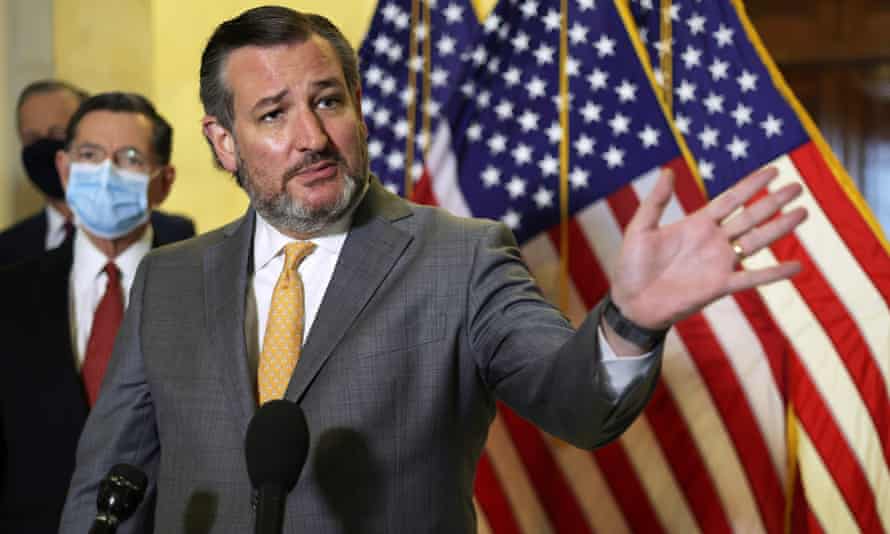
Ted Cruz speaks to members of the press on Capitol Hill.
Ted Cruz speaks to members of the press on Capitol Hill. Photograph: Alex Wong/Getty Images

Last modified on Sun 28 Mar 2021 09.44 EDT

Republicans are outraged – outraged! – at the surge of migrants at the southern border. The House minority leader, Kevin McCarthy, declares it a “crisis … created by the presidential policies of this new administration”. The Arizona congressman Andy Biggs claims, “we go through some periods where we have these surges, but right now is probably the most dramatic that I’ve seen at the border in my lifetime.”

Donald Trump demands the Biden administration “immediately complete the wall, which can be done in a matter of weeks – they should never have stopped it. They are causing death and human tragedy.”

“Our country is being destroyed!” he adds.

In fact, there’s no surge of migrants at the border.

US Customs and Border Protection apprehended 28% more migrants from January to February this year than in previous months. But this was largely seasonal. Two years ago, apprehensions increased 31% during the same period. Three years ago, it was about 25% from February to March. Migrants start coming when winter ends and the weather gets a bit warmer, then stop coming in the hotter summer months when the desert is deadly.

To be sure, there is a humanitarian crisis of children detained in overcrowded border facilities. And an even worse humanitarian tragedy in the violence and political oppression in Central America, worsened by US policies over the years, that drives migration in the first place.

But the “surge” has been fabricated by Republicans in order to stoke fear – and, not incidentally, to justify changes in laws they say are necessary to prevent non-citizens from voting.

Republicans continue to allege – without proof – that the 2020 election was rife with fraudulent ballots, many from undocumented migrants. Over the past six weeks they’ve introduced 250 bills in 43 states designed to make it harder for people to vote – especially the young, the poor, Black people and Hispanic Americans, all of whom are likely to vote for Democrats – by eliminating mail-in ballots, reducing times for voting, decreasing the number of drop-off boxes, demanding proof of citizenship, even making it a crime to give water to people waiting in line to vote.

To stop this, Democrats are trying to enact a sweeping voting rights bill, the For the People Act, which protects voting, ends partisan gerrymandering and keeps dark money out of elections. It passed the House but Republicans in the Senate are fighting it with more lies.

On Wednesday, the Texas Republican senator Ted Cruz falsely claimed the new bill would register millions of undocumented migrants to vote and accused Democrats of wanting the most violent criminals to cast ballots too.

The core message of the Republican party now consists of lies about a “crisis” of violent migrants crossing the border, lies that they’re voting illegally, and blatantly anti-democratic demands voting be restricted to counter it.

The party that once championed lower taxes, smaller government, states’ rights and a strong national defense now has more in common with anti-democratic regimes and racist-nationalist political movements around the world than with America’s avowed ideals of democracy, rule of law and human rights.

Donald Trump isn’t single-handedly responsible for this, but he demonstrated to the GOP the political potency of bigotry and the GOP has taken him up on it.

This transformation in one of America’s two eminent political parties has shocking implications, not just for the future of American democracy but for the future of democracy everywhere.

“I predict to you, your children or grandchildren are going to be doing their doctoral thesis on the issue of who succeeded: autocracy or democracy?” Joe Biden opined at his news conference on Thursday.

In his maiden speech at the state department on 4 March, Antony Blinken conceded that the erosion of democracy around the world is “also happening here in the United States”.

The secretary of state didn’t explicitly talk about the Republican party, but there was no mistaking his subject.

“When democracies are weak … they become more vulnerable to extremist movements from the inside and to interference from the outside,” he warned.

People around the world witnessing the fragility of American democracy “want to see whether our democracy is resilient, whether we can rise to the challenge here at home. That will be the foundation for our legitimacy in defending democracy around the world for years to come.”

That resilience and legitimacy will depend in large part on whether Republicans or Democrats prevail on voting rights.

Not since the years leading up to the civil war has the clash between the nation’s two major parties so clearly defined the core challenge facing American democracy.