Contact Me By Email


What To Do When You're Stopped By Police - The ACLU & Elon James White

What To Do When You're Stopped By Police - The ACLU & Elon James White

Know Anyone Who Thinks Racial Profiling Is Exaggerated? Watch This, And Tell Me When Your Jaw Drops.


This video clearly demonstrates how racist America is as a country and how far we have to go to become a country that is civilized and actually values equal justice. We must not rest until this goal is achieved. I do not want my great grandchildren to live in a country like we have today. I wish for them to live in a country where differences of race and culture are not ignored but valued as a part of what makes America great.

Sunday, May 04, 2025

Trump Live Updates: 'Meet the Press' Interview, Pope Image and Arts Grants - The New York Times

Trump Administration Live Updates: President Casts Doubt on Due Process Rights

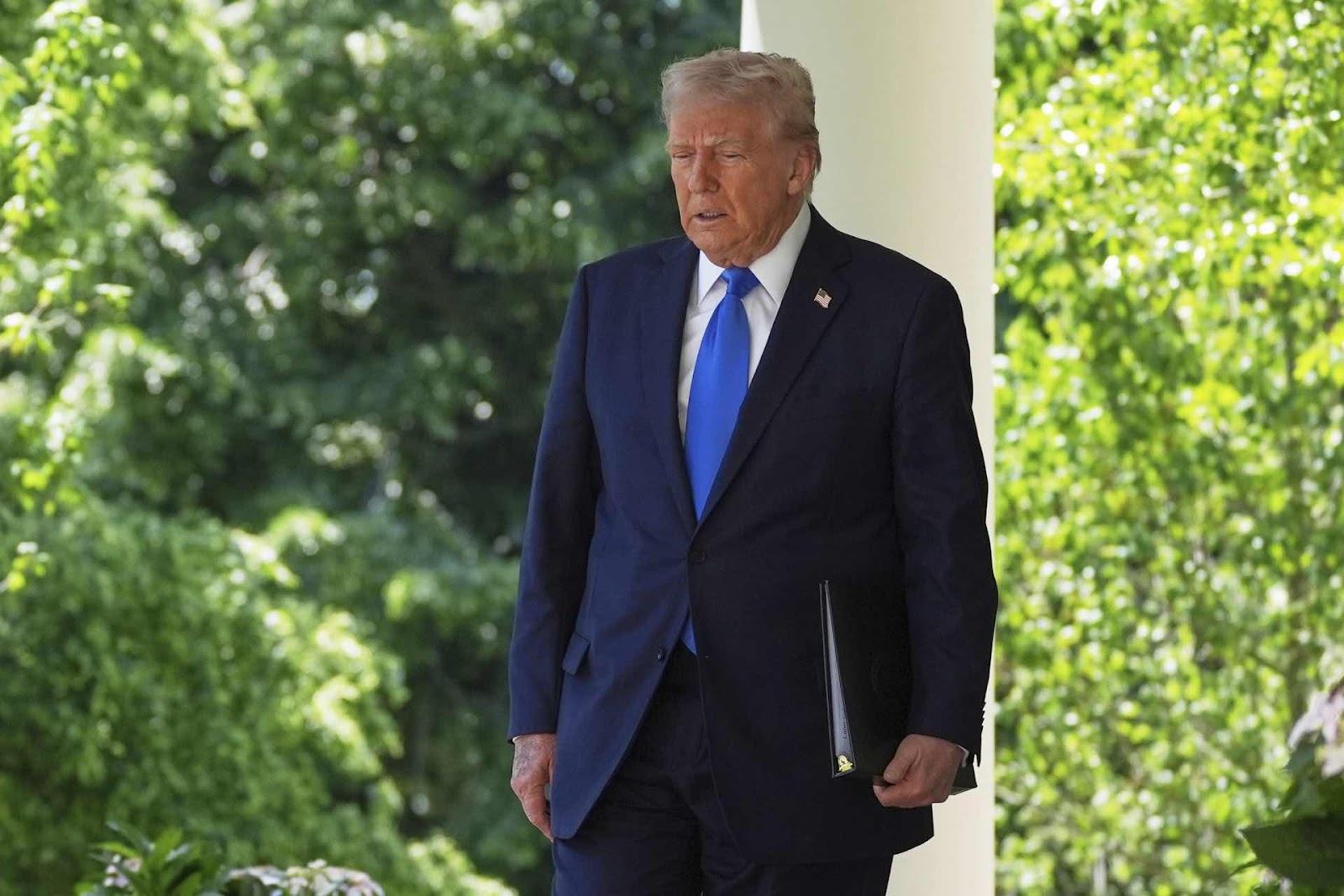
President Trump exiting a helicopter. Members of the military are saluting.
President Trump was questioned about his deportation program during an interview on NBC’s “Meet the Press.”Haiyun Jiang for The New York Times

Where Things Stand

  • "Due process: President Trump said in an interview aired on Sunday that he did not know whether it was his job to uphold the Constitution and wavered when asked whether every person on American soil was entitled to due process, even though the Fifth Amendment says as much. “It might say that,” Mr. Trump told NBC’s “Meet the Press” as he complained about the effect on his mass deportation program, “but if you’re talking about that, then we’d have to have a million or two million or three million trials.” Read more ›

  • Third term: Mr. Trump, who said in March that he was not joking about the possibility of seeking a third term, also told “Meet the Press” that doing so was “something that, to the best of my knowledge, you’re not allowed to do.” He floated Vice President JD Vance and Secretary of State Marco Rubio as two potential successors. Read more ›

  • Health research cuts: The Trump administration has scrapped more than $800 million worth of research into the health of L.G.B.T.Q. people, according to an analysis of federal data by The New York Times. Read more ›

President Trump has often mused about the idea of a third term and has suggested there were “methods” of circumventing the 22nd Amendment.Emily Elconin for The New York Times

President Trump poured cold water on the idea of serving a third term, an idea he has frequently teased but is prohibited by the Constitution, and instead floated Vice President JD Vance or Secretary of State Marco Rubio as possible successors in an interview aired on Sunday.

Mr. Trump said in the interview, with NBC’s “Meet the Press,” that he was reluctant to be drawn into a debate about who could follow him, but he called Mr. Vance a “fantastic, brilliant guy” and Mr. Rubio “great.” Mr. Trump added that “a lot” of people are great, but said, “certainly you would say that somebody’s the V.P., if that person is outstanding, I guess that person would have an advantage.”

President Trump’s comments came amid the many legal challenges to the administration’s agenda, especially the president’s aggressive deportation campaignHaiyun Jiang for The New York Times

President Trump said in an interview that aired on Sunday that he did not know whether every person on American soil was entitled to due process, despite constitutional guarantees, and complained that adhering to that principle would result in an unmanageable slowdown of his mass deportation program.

The revealing exchange, on NBC’s “Meet the Press,” was prompted by the interviewer Kristen Welker asking Mr. Trump if he agreed with Secretary of State Marco Rubio that citizens and noncitizens in the United States were entitled to due process.

Jonathan Swan
May 4, 2025, 10:03 a.m. ET

In the wide-ranging “Meet the Press” interview, Trump said that he will again extend the reprieve on TikTok if a deal isn’t done within the extended time period. The popular app had to make a deal to be separated from its Chinese owner, ByteDance, or face a ban in the United States. Trump also said he won’t support any Republican legislation that makes cuts to Medicare, Medicaid and Social Security.

Robyn Beck/Agence France-Presse — Getty Images
Jonathan Swan
May 4, 2025, 9:43 a.m. ET

President Trump, who has repeatedly teased the prospect of trying to serve an unconstitutional third term in office, went further than he had previously gone in saying that he did not intend to do that, despite the fact that the Trump Organization’s online store is selling Trump 2028 hats. “There are many people selling the 2028 hat,” Trump said on “Meet the Press,” “but this is not something I’m looking to do. I’m looking to have four great years and turn it over to somebody, ideally a great Republican, a great Republican to carry it forward.” Then he mentioned two Republicans who might fit the bill as his successor: Vice President JD Vance and Secretary of State Marco Rubio.

Jonathan Swan
May 4, 2025, 9:41 a.m. ET

Asked about Russia’s war in Ukraine, and the Trump administration’s efforts to negotiate an end to it, the president said there had been times when he was close to walking away from the talks and that he still might do so. “Well, there will be a time when I will say, ‘OK, keep going. Keep being stupid and keep fighting,’” Trump told Welker.

Jonathan Swan
May 4, 2025, 9:26 a.m. ET

Trump said he did not know whether every person on U.S. soil was entitled to due process, even though the Constitution says so, and he complained that adhering to that principle would result in an unmanageable number of “trials” that would slow down his mass deportation program. The revealing exchange was prompted by Kristen Welker asking Trump if he agreed with his Secretary of State Marco Rubio that everyone in America, citizens and non-citizens, deserved due process. “I don’t know,” Trump replied. “I’m not, I’m not a lawyer. I don’t know.” Welker reminded the president that the Fifth Amendment says as much. Trump said: “I don’t know. It seems — it might say that, but if you’re talking about that, then we’d have to have a million or 2 million or 3 million trials.”

Jonathan Swan
May 4, 2025, 9:20 a.m. ET

In the “Meet the Press” interview, Trump said he was not worried about a recession and he said, again, that he did not plan to fire Jerome H. Powell, the chairman of the Federal Reserve, before his term ends next year: “No, no, no. That was a total – why would I do that? I get to replace the person in another short period of time.”

Haiyun Jiang for The New York Times
Jonathan Swan
May 4, 2025, 9:14 a.m. ET

Trump got into a contentious exchange with Welker during the televised interview, angry that she brought up the fact that the price of strollers had been rising after his tariffs.

“Well, I don’t know, when you say strollers are going up, what kind of a thing?” Trump said. “I’m saying that gasoline is going down. Gasoline is thousands of times more important than a stroller or some place?”

Jonathan Swan
May 4, 2025, 9:10 a.m. ET

Noting that the U.S. economy shrank in the first quarter, Kristen Welker, the host of “Meet the Press,” asked President Trump when he would take responsibility for the economy. She asked when he would call it the Trump economy, rather than blaming President Biden for negative headlines. Trump’s response encapsulated his long relationship with credit and blame: “I think the good parts are the Trump economy and the bad parts are the Biden economy because he’s done a terrible job.”

Jonathan Swan
May 4, 2025, 9:08 a.m. ET

I’m watching President Trump on “Meet the Press” this morning. Trump has been softening his rhetoric against China and the markets have bounced back in anticipation that he’ll eventually lower tariffs. But in his “Meet the Press” interview, the president reverted to the sort of tough talk that had created widespread financial panic in the first place: Trump said that essentially cutting off trade with China, with his 145 percent tariff wall, “means we’re not losing a trillion dollars when we go cold turkey because we’re not doing business with them right now.”

Elizabeth Dias
May 4, 2025, 9:05 a.m. ET

In Rome on Sunday morning, Cardinal Timothy M. Dolan, archbishop of New York, responded to the image shared on President Trump’s social media accounts yesterday of the president in papal regalia, which appeared to be A.I.-generated. “I hope he didn’t have anything to do with it,” Cardinal Dolan told reporters. “As the Italians say, it was brutta figura,” the cardinal said, meaning that the image had made a bad impression. Many Catholics across the political spectrum saw the image as offensive. “Imagine the incandescent outrage, the swift condemnation, and the individual and joint protests from the US bishops if this had been done by Joe Biden or Barack Obama,” Father James Martin, a Jesuit priest, wrote on X, formerly Twitter.

Drawing blood for an S.T.I. test at a San Francisco AIDS Foundation clinic. The N.I.H. canceled several grants to a network of researchers who work on preventing and treating H.I.V. and AIDS in young adults, who account for a fifth of new infections each year in the United States.Max Whittaker for The New York Times

The Trump administration has scrapped more than $800 million worth of research into the health of L.G.B.T.Q. people, abandoning studies of cancers and viruses that tend to affect members of sexual minority groups and setting back efforts to defeat a resurgence of sexually transmitted infections, according to an analysis of federal data by The New York Times.

In keeping with its deep opposition to both diversity programs and gender-affirming care for adolescents, the administration has worked aggressively to root out research touching on equity measures and transgender health.

The National Endowment for the Arts began withdrawing and terminating grants from arts organizations around the country.Kayla Bartkowski/Getty Images

The National Endowment for the Arts withdrew and canceled grant offers to numerous arts organizations around the country on Friday night, sending a round of email notifications out just hours after President Trump proposed eliminating the agency in his next budget.

The move, although not unexpected, was met with disappointment and anger by arts administrators who had counted on the grants to finance ongoing projects.

President Trump at the funeral for Pope Francis last month at St. Peter’s Basilica in Vatican City.Eric Lee/The New York Times

President Trump on Tuesday had a ready answer when reporters asked who he would like to see become the next supreme pontiff. “I’d like to be pope,” he joked to reporters at the White House. “That would be my number one choice.”

He took the joke a step further on Saturday, sharing on social media what appeared to be an A.I.-generated photo of himself wearing the traditional vestments of the pope. The photo depicts him in a white cassock with a cross around his neck, his face solemn as he raises a pointed finger."

Trump Live Updates: 'Meet the Press' Interview, Pope Image and Arts Grants - The New York Times

Republicans in Congress Use Obscure Law to Roll Back Biden-Era Regulations - The New York Times

Republicans in Congress Use Obscure Law to Roll Back Biden-Era Regulations

"As G.O.P. lawmakers have largely ceded power to President Trump, they are also pushing the bounds of a little-known statute to undo federal rules — and potentially undermining the filibuster.

Republicans are working to find ways to steer around Democratic opposition and make the most of their governing trifecta of the House, the Senate and the White House.Kenny Holston/The New York Times

As President Trump moves unilaterally to slash the federal bureaucracy and upend longstanding policies, Republicans in Congress have embarked on a spree of deregulation, using an obscure law to quietly but steadily chip away at Biden-era rules they say are hurting businesses and consumers.

In recent weeks, the G.O.P. has pushed through a flurry of legislation to cancel regulations on matters large and small, from oversight of firms that emit toxic pollutantsto energy efficiency requirements for walk-in freezers and water heaters.

To do so, they are employing a little-known 1996 law, the Congressional Review Act, that allows lawmakers to reverse recently adopted federal regulations with a simple majority vote in both chambers. It is a strategy they used in 2017 during Mr. Trump’s first term and are leaning on again as they work to find ways to steer around Democratic opposition and make the most of their governing trifecta of the House, the Senate and the White House.

But this time, Republicans are testing the limits of the law in a way that could vastly expand its use and undermine the filibuster, the Senate rule that effectively requires 60 votes to move forward with any major legislation.

Because resolutions of disapproval under the Congressional Review Act need only a majority vote, they are some of the only legislation that can avoid a filibuster in the Senate. This allows them to circumvent the partisan gridlock that stands in the way of most significant bills.

Senator John Thune of South Dakota, right, the majority leader, with Speaker Mike Johnson. Mr. Thune must decide whether to go forward with a move that would undermine the filibuster.Haiyun Jiang for The New York Times

So far this year, Mr. Trump has signed three such measures: one overturning Biden-era regulations on cryptocurrency brokers, another canceling fees on methane emissions and a third doing away with additional environmental assessments for prospective offshore oil and gas developers. Another five, including one that eliminates a $5 cap on bank overdraft fees, have cleared Congress and await Mr. Trump’s signature.

That is a much slower pace than eight years ago, when Republicans erased 13 Obama administration rules within Mr. Trump’s first 100 days in office. Before then, the law had been successfully used only once, when President George W. Bush reversed a Clinton-era ergonomics rule.

Now Republicans are trying to go much further with the law, including using it to effectively attack state regulations blessed by the federal government. The House this week passed three disapproval resolutions that would eliminate California’s strict air pollution standards for trucks and cars by rejecting waivers from the Environmental Protection Agency that allowed them to take effect.

The move would also permanently prevent federal regulators from writing a similar rule in the future. Both the Government Accountability Office and the Senate parliamentarian, who is in charge of enforcing the chamber’s rules, have said that the E.P.A. waivers do not constitute federal regulations and thus are not subject to the Congressional Review Act.

The pressure now falls on Senator John Thune, Republican of South Dakota and the majority leader, to decide whether he will proceed with the measures anyway, sidestepping the parliamentarian in a move that would undermine the filibuster.

Mr. Thune’s decision is something of a warm-up act for an even more consequential showdown coming later in the year as Republicans try to deliver Mr. Trump’s agenda through the budget reconciliation process, another way of shielding legislation from a filibuster. G.O.P. senators already steered around the parliamentarian in early April, when they pushed through a budget blueprint that deemed the continuation of Mr. Trump’s tax cuts as cost-free, even though nonpartisan budget scorekeepers have estimated it would cost about $4 trillion over a decade.

President Trump has signed three resolutions of disapproval under the Congressional Review Act this year. Another five await his signature.Haiyun Jiang for The New York Times

Two spokespeople for Mr. Thune did not immediately respond to multiple requests for comment via phone or email on whether he would try to defy or otherwise circumvent the parliamentarian on the Congressional Review Act measures.

Democrats argue that Republicans’ efforts to kill the E.P.A. waivers amount to illegal overreach on states’ rights. They say the drive could inadvertently subject a plethora of executive actions, such as leasing rights for oil and gas fields as well as waivers for state Medicaid programs, to congressional review.

“House Republicans would set a dangerous precedent,” said Representative Frank Pallone Jr. of New Jersey, the top Democrat on the Energy and Commerce Committee. “That would mean countless numbers of executive actions made across the federal government would be at the mercy of the political winds of a vocal few in Congress.”

During debate this week on the measures canceling the E.P.A. waivers, Representative Zoe Lofgren, Democrat of California, said: “Abusing the Congressional Review Act is not the slope that you want to slide down.”

Republicans, on the other hand, argue that the scope of their review prerogatives should not be determined by unelected bureaucrats.

“It’s members of Congress — not the G.A.O., not the parliamentarian — who decides how we proceed under the C.R.A.,” Representative Chip Roy, Republican of Texas, said in a speech on the House floor.

Either way, experts warned that Republicans may come to regret reading the statute so broadly. Michael Thorning, the director of the Structural Democracy Project at the Bipartisan Policy Center, a nonprofit think tank, said doing so could hand Democrats a powerful tool to undo regulations that they dislike when they one day return to power.

Representative Chip Roy, Republican of Texas, said it was up to Congress, not the Government Accountability Office or the Senate parliamentarian, to decide how to proceed under the Congressional Review Act.Eric Lee/The New York Times

“The more you stretch and expand these processes, you really just undermine those to the point that they could eventually become meaningless if taken to the extreme,” Mr. Thorning said.

“At the end of the day, this is Congress’s decision,” he added. “The G.A.O. and the parliamentarian are just advisers. So, you know, members will have to take responsibility for these decisions.”

When President Joseph R. Biden Jr. entered office in 2021, congressional Democrats took a cue from Republicans and reinstated Obama-era caps on methane emissions that the Trump administration spent years working to overturn through executive action.

The Republican push to take a more aggressive stance on reversing federal regulations imposed by the Biden administration comes as the party has largely ceded other legislative branch prerogatives — over spending, trade and oversight — to the Trump administration.

Some Democrats are borrowing the tactic and pressing to use the Congressional Review Act to push back on Mr. Trump’s executive actions, including his move to cull the federal work force.

Senator Jeff Merkley of Oregon and Representative Maxine Waters of California, both Democrats, have proposed a bill that would make a federal agency’s staff cut plans — including the mass layoffs known as “reductions in force” undertaken by the Trump administration — subject to congressional review.

The measure would also require agencies to justify proposed staff cuts, quantify the impact on employees and agency operations, and present any alternatives the agency considered. It has no realistic chance of surviving the Republican-controlled Congress and would certainly be vetoed by Mr. Trump,

“Mass firings are an attack on the separation of powers,” Mr. Merkley said in an interview. “These have very big impacts on the provision of services to Americans, and Congress should have a voice in that.”

Mr. Merkley criticized Republicans for using the review law to try to attack the E.P.A. waivers for California, arguing that such a move constituted a “nuclear option” aimed at carving out an entirely new set of policy matters from the Senate’s filibuster.

“If the Republicans want to expand the Congressional Review Act, they should do it through legislation, not through a bogus reinterpretation,” Mr. Merkley said. “You want to expand the scope? Propose a bill. That’s what I’m doing.”

Maya C. Miller covers Congress as part of the Times Newsroom Fellowship, a program for journalists early in their careers. She is based in Washington.

A version of this article appears in print on  , Section A, Page 20 of the New York edition with the headline: Republicans Use an Obscure Statute to Roll Back Biden-Era Regulations."

Republicans in Congress Use Obscure Law to Roll Back Biden-Era Regulations - The New York Times

Friday, May 02, 2025

Justice Department ends Civil Rights-era school desegregation order in Louisiana

Justice Department ends Civil Rights-era school desegregation order in Louisiana

Students from Charlotte High School in Charlotte, North Carolina, ride a bus together on May 15, 1972.
Washington AP  — 

“When the Justice Department lifted a school desegregation order in Louisiana this week, officials called its continued existence a “historical wrong” and suggested that others dating to the Civil Rights Movement should be reconsidered.

The end of the 1966 legal agreement with Plaquemines Parish schools announced Tuesday shows the Trump administration is “getting America refocused on our bright future,” Assistant Attorney General Harmeet Dhillon said.

Inside the Justice Department, officials appointed by President Donald Trump have expressed desire to withdraw from other desegregation orders they see as an unnecessary burden on schools, according to a person familiar with the issue who was granted anonymity because they were not authorized to speak publicly.

Dozens of school districts across the South remain under court-enforced agreements dictating steps to work toward integration, decades after the Supreme Court struck down racial segregation in education. Some see the court orders’ endurance as a sign the government never eradicated segregation, while officials in Louisiana and at some schools see the orders as bygone relics that should be wiped away.

The Justice Department opened a wave of cases in the 1960s, after Congress unleashed the department to go after schools that resisted desegregation. Known as consent decrees, the orders can be lifted when districts prove they have eliminated segregation and its legacy.

The small Louisiana district has a long-running integration case

The Trump administration called the Plaquemines case an example of administrative neglect. The district in the Mississippi River Delta Basin in southeast Louisiana was found to have integrated in 1975, but the case was to stay under the court’s watch for another year. The judge died the same year, and the court record “appears to be lost to time,” according to a court filing.

“Given that this case has been stayed for a half-century with zero action by the court, the parties or any third-party, the parties are satisfied that the United States’ claims have been fully resolved,” according to a joint filing from the Justice Department and the office of Louisiana Attorney General Liz Murrill.

Plaquemines Superintendent Shelley Ritz said Justice Department officials still visited every year as recently as 2023 and requested data on topics including hiring and discipline. She said the paperwork was a burden for her district of fewer than 4,000 students.

“It was hours of compiling the data,” she said.

Louisiana “got its act together decades ago,” said Leo Terrell, senior counsel to the Civil Rights Division at the Justice Department, in a statement. He said the dismissal corrects a historical wrong, adding it’s “past time to acknowledge how far we have come.”

Murrill asked the Justice Department to close other school orders in her state. In a statement, she vowed to work with Louisiana schools to help them “put the past in the past.”

Civil rights activists say that’s the wrong move. Many orders have been only loosely enforced in recent decades, but that doesn’t mean problems are solved, said Johnathan Smith, who worked in the Justice Department’s Civil Rights Division during President Joe Biden’s administration.

“It probably means the opposite — that the school district remains segregated. And in fact, most of these districts are now more segregated today than they were in 1954,” said Smith, who is now chief of staff and general counsel for the National Center for Youth Law.

A group of students, left, enter the Boothville-Venice School in Plaquemines Parish, Louisiana, on September 12, 1966 as a group of mothers wait at the entrance of the school.

Desegregation orders involve a range of instructions

More than 130 school systems are under Justice Department desegregation orders, according to records in a court filing this year. The vast majority are in Alabama, Georgia and Mississippi, with smaller numbers in states like Florida, Louisiana and South Carolina. Some other districts remain under separate desegregation agreements with the Education Department.

The orders can include a range of remedies, from busing requirements to district policies allowing students in predominately Black schools to transfer to predominately white ones. The agreements are between the school district and the US government, but other parties can ask the court to intervene when signs of segregation resurface.

In 2020, the NAACP Legal Defense and Education Fund invoked a consent decree in Alabama’s Leeds school district when it stopped offering school meals during the Covid-19 pandemic. The civil rights group said it disproportionately hurt Black students, in violation of the desegregation order. The district agreed to resume meals.

Last year, a Louisiana school board closed a predominately Black elementary school near a petrochemical facility after the NAACP Legal Defense and Education Fund said it disproportionately exposed Black students to health risks. The board made the decision after the group filed a motion invoking a decades-old desegregation order at St. John the Baptist Parish.

Closing cases could lead to legal challenges

The dismissal has raised alarms among some who fear it could undo decades of progress. Research on districts released from orders has found that many saw greater increases in racial segregation compared with those under court orders.

“In very many cases, schools quite rapidly resegregate, and there are new civil rights concerns for students,” said Halley Potter, a senior fellow at The Century Foundation who studies educational inequity.

Ending the orders would send a signal that desegregation is no longer a priority, said Robert Westley, a professor of antidiscrimination law at Tulane University Law School in New Orleans.

“It’s really just signaling that the backsliding that has started some time ago is complete,” Westley said. “The United States government doesn’t really care anymore of dealing with problems of racial discrimination in the schools. It’s over.”

Any attempt to drop further cases would face heavy opposition in court, said Raymond Pierce, president and CEO of the Southern Education Foundation.

“It represents a disregard for education opportunities for a large section of America. It represents a disregard for America’s need to have an educated workforce,” he said. “And it represents a disregard for the rule of law.”

Thursday, May 01, 2025

Trump’s use of Alien Enemies Act for swift deportations is illegal, Trump-appointed judge rules

Trump’s use of Alien Enemies Act for swift deportations is illegal, Trump-appointed judge rules

The article describes a federal judge's ruling that Trump's use of the Alien Enemies Act for swift deportations is illegal. The judge ruled that the act only applies when the country is facing an armed, organized attack, which Trump's claims about the gang do not meet.

The Alien Enemies Act applies only when the country is facing an armed, organized attack, the judge ruled.


The Alien Enemies Act applies only when the country is facing an armed, organized attack, Rodriguez ruled. Trump’s claims about Tren de Aragua’s activities in the United States fall short of that bar, the judge added.

Trump has described the gang as an international criminal enterprise operating at the behest of the Venezuelan government. But Rodriguez noted that even Trump has not formally claimed that the gang is “entering the United States at the direction of Venezuela to conquer the country or assume control over a portion of the nation.”

Trump issued a proclamation in March deploying the Alien Enemies Act against Tren de Aragua. The act has been invoked just three other times in U.S. history — during the War of 1812, World War I and World War II.

Trump’s proclamation “exceeds the scope of the statute and, as a result, is unlawful,” Rodriguez concluded. Trump and other administration officials “do not possess the lawful authority under the AEA, and based on the Proclamation, to detain Venezuelan aliens, transfer them within the United States, or remove them from the country.”

Several other courts, including the Supreme Court, have pushed back in various ways against Trump’s use of the Alien Enemies Act in the past month and a half. But those other rulings have been preliminary and temporary. Rodriguez is the first judge to issue a definitive decision on whether the deportations are justified under the law, and his “permanent injunction” is more durable than the short-term blocks issued by other judges.

Still, Rodriguez’s ruling only covers his southern Texas-based district, and the Trump administration can appeal his decision to the 5th U.S. Circuit Court of Appeals, the most conservative federal appeals court in the country.

U.S. District Judge James Boasberg of Washington, D.C., was the first judge to try to stop the deportations under the Alien Enemies Act. Boasberg entered an emergency block on March 15, but the administration had already set the first round of deportations in motion. Hours after Boasberg’s order, 137 Venezuelan men who had been living in the U.S. were delivered to a notorious prison in El Salvador.

Advocates for the men say that many of them have no ties to Tren de Aragua or any other gang — and that they were given no meaningful opportunity to contest their deportations.

The Supreme Court lifted Boasberg’s block, saying lawsuits challenging Trump’s invocation of the AEA had to be filed in different courts, not in Washington, D.C. But the justices also directed the administration to provide meaningful due process to anyone else targeted for deportation under the AEA.

The justices stepped in a second time last month when the administration appeared to be amassing another group of alleged “alien enemies” in northern Texas and preparing them for hasty deportations with minimal notice. In a highly unusual, middle-of-the-night ruling, the high court ordered the administration not to deport those people until further notice.

Federal judges in Colorado and Manhattan last month also granted broad yet temporary blocks on deportations under the Alien Enemies Act.

Shortly after Rodriguez’s ruling, the judge separately denied the administration’s request for explicit permission to quickly deport one of the alleged “alien enemies” — Daniel Zacarias Matos — under a different immigration authority. Though prosecutors said the administration was prepared to move as quickly as Thursday to begin that deportation, Rodriguez said he needed more time to weigh the issues involved.“

Social Media Erupts Over Traoré’s Coup Attempt — Reactions You Need to ...

Georgia man faces murder charges after allegedly failing to disclose his HIV-positive status to his wife - Face2Face Africa

Georgia man faces murder charges after allegedly failing to disclose his HIV-positive status to his wife

Cleveland Broadie/Photo credit: Fox 28 Columbus 

"A Georgia man, Cleveland Broadie, has been indicted on malice and felony murder charges after allegedly failing to disclose his HIV-positive status to his wife, Denise Broadie, a cancer survivor.

Prosecutors claim his actions led to her 2022 death just two days after she was diagnosed with AIDS. The Rockdale County case centers on what officials describe as Cleveland’s “reckless conduct.”

Cleveland has pleaded not guilty to reckless conduct but has yet to enter a plea on the malice and felony murder charges tied to his wife’s death.

He and Denise Broadie married in 2014, three years before she was first diagnosed with breast cancer. Though she went into remission twice, her health continued to decline, ultimately leading to a 2022 AIDS diagnosis — just days before her death on April 2, which prosecutors link to Cleveland’s alleged failure to disclose his HIV status.

Cleveland, 62, now faces multiple legal battles as more allegations emerge. Originally charged with three counts of reckless conduct in 2023 after several women claimed he hid his HIV-positive status, investigators say Broadie had been taking HIV medicationsince 2006.

His late wife’s family intensified efforts to seek justice by hiring private investigators to prove he knowingly exposed Denise Broadie.

Cleveland was first arrested in July 2023 and booked again on April 16, 2025, following his recent indictment in the murder case.

Karen Young, Denise’s daughter who described her mom as a family matriarch with a heart of gold, told Fox 5 Atlanta that she believes there was “malice” in Cleveland’s actions. “At any time, he could have told her and given her the right to make the decision to stay with him,” she said. “Not that she would have.”

In a 2023 interview with Atlanta News First, Young revealed her mother unknowingly lived with untreated HIV for at least five years. She described Denise’s rapid health decline during her second fight with cancer — especially as it spread to her lungs — as devastating and unexplained at the time.

“If he would have just gave her that one courtesy, just to tell her to test herself for it and that could’ve been it and she got treatment for it,” Young said at the time. “It’s almost like God kept her alive so we could know what was really killing her.”

According to the outlet, which cited her death certificate, she died from pneumonia and respiratory failure “due to Human Immunodeficiency Virus-Acquired Immunodeficiency Syndrome.”

Denise Broadie’s family is urging the public to get tested for sexually transmitted diseases in the wake of her tragic death.

Last Edited by:Mildred Europa Taylor Updated: April 30, 2025"

Georgia man faces murder charges after allegedly failing to disclose his HIV-positive status to his wife - Face2Face Africa

Pete Seeger - "L'Internationale"