Contact Me By Email


What To Do When You're Stopped By Police - The ACLU & Elon James White

What To Do When You're Stopped By Police - The ACLU & Elon James White

Know Anyone Who Thinks Racial Profiling Is Exaggerated? Watch This, And Tell Me When Your Jaw Drops.


This video clearly demonstrates how racist America is as a country and how far we have to go to become a country that is civilized and actually values equal justice. We must not rest until this goal is achieved. I do not want my great grandchildren to live in a country like we have today. I wish for them to live in a country where differences of race and culture are not ignored but valued as a part of what makes America great.

Monday, September 06, 2021

Military Analysis Raises Questions About Deadly Drone Strike in Kabul

Military Analysis Raises Questions About Deadly Drone Strike in Kabul

A preliminary analysis said that it was “possible to probable” that explosives were in the car and that drone operators took only a cursory scan of the courtyard before launching an attack.

Neighbors and relatives stood near the damage last week after a U.S. drone strike in Kabul, Afghanistan.
Jim Huylebroek for The New York Times

WASHINGTON — The U.S. military’s top officer asserted last week that a drone attack on a sedan near the airport in Kabul, Afghanistan, was a “righteous strike” that foiled a plot by the Islamic State in the waning hours of the immense evacuation effort.

The officer, Gen. Mark A. Milley, the chairman of the Joint Chiefs of Staff, told reporters that secondary explosions after the drone strike last Sunday supported the military’s conclusion that the car contained explosives — either suicide vests or a large bomb. General Milley said that military planners took proper precautions beforehand to limit risks to civilians nearby.

But the military’s preliminary analysis of the strike and the circumstances surrounding it offer much less conclusive evidence to support those claims, military officials acknowledge. It also raises questions about an attack that friends and family members of the car’s driver say killed 10 people, seven of them children.

So far, there is no ironclad proof that explosives were in the car. The preliminary analysis says it was “possible to probable” that was so, according to officials who have been briefed on the assessment. Drone operators and analysts scanned the cramped courtyard where the sedan was parked for just a few seconds. Seeing no civilians, officials said, a commander ordered the strike, only for a grainy live-video feed to show other figures approaching the vehicle seconds later as the Hellfire missile raced closer to its target.

But military officials say that the initial analysis also supports a very strong circumstantial case of an imminent and serious threat to the airport, a case that American planners built over eight hours last Sunday, monitoring the movements of the sedan and eavesdropping on the communications of the suspected plotters.

With each passing hour, American analysts watched with dread as successive pieces of a plot to conduct a complex attack appeared to be “lining up,” as one senior military official briefed on the investigation said. Chatter that the airport would again be a target was intensifying, with President Biden publicly warning that another attack was “highly likely.”

The commander overseeing the drone strike faced a difficult decision: Take the shot while the sedan was parked in a relatively isolated courtyard, or wait until the sedan drove even closer to the airport — and denser crowds — increasing the risk to civilians.

According to four United States officials briefed on the preliminary military analysis or parts of it, this is how the strike unfolded.

At about 9 a.m. last Sunday, a white sedan, probably a Toyota Corolla, pulled out of a compound about five kilometers northwest of Hamid Karzai International Airport. Based on information from informants, electronic eavesdropping and imagery from U.S. surveillance aircraft, intelligence analysts believed the compound was a safe house for planners and facilitators for Islamic State Khorasan, or ISIS-K, the terrorist group’s affiliate in Afghanistan.

It was just three days after a suicide bomber for the affiliate had detonated an unusually large 25-pound explosive vest at the Abbey Gate entrance to the airport, spraying deadly shrapnel in a 70-foot radius and killing 13 U.S. troops and more than 170 Afghan civilians.

American intelligence analysts had intercepted messages from ISIS-K plottersthat another major attack against the airport was in the works. An attack was imminent that Sunday, two days before the United States was set to end its evacuation effort.

Thus, any vehicle coming or going from the compound that morning piqued the analysts’ interest. But operators paid special attention to the white sedan on the black-and-white feed from an MQ-9 Reaper drone soaring over Kabul.

Communications intercepted from the safe house indicated that the plotters there were directing the car on some kind of circuitous mission in the Afghan capital. The driver was instructed to meet a motorcyclist. Moments later, the car did just that.

This pattern continued for several hours, as the sedan made different stops in Kabul, sometimes picking up and dropping off passengers.

Just before 4 p.m., the sedan pulled into a compound unknown to the Americans, about eight to 12 kilometers southwest of the airport. A few minutes later, the driver and three other men loaded several wrapped packages into the trunk of the car. To the analysts watching the video feed, the men appeared to be straining to lift and gingerly carry heavy packages — as one would with explosives.

The driver and the men got into the sedan and drove away, heading north as the driver dropped the men off along the way. By about 4:45 p.m., the driver, now alone, pulled into a small courtyard about 2.5 kilometers west of the airport, just south of the original safe house. Another man came out to greet him.

At this point, the tactical commander controlling the armed Reaper drones had to make a quick decision. His authority to strike had been delegated by Gen. Kenneth F. McKenzie Jr., the head of the military’s Central Command in Tampa, Fla. Military officials declined to identify the commander’s identity, rank or organization, but said he is an experienced operator who has carried out multiple drone strikes in multiple theaters where the military has fought.

The rules of engagement allowed the military to conduct a strike if the operators and intelligence analysts had “reasonable certainty” that they had a legitimate ISIS-K target and they assessed there was a “reasonable certainty” that no women, children or other noncombatant civilians would be killed or injured.

The operators quickly scanned the close confines of the courtyard and saw only the one other man talking to the driver. The commander concluded this was the best time and place to take the shot. If the Americans waited and the vehicle wove through busy city traffic or approached the airport, the risk to civilians would be much greater — either from a drone strike or the detonation of suicide vests or a huge car bomb.

Understand the Taliban Takeover in Afghanistan


Who are the Taliban? The Taliban arose in 1994 amid the turmoil that came after the withdrawal of Soviet forces from Afghanistan in 1989. They used brutal public punishments, including floggings, amputations and mass executions, to enforce their rules. Here’s more on their origin story and their record as rulers.

The Americans took the shot. The Hellfire struck its target in less than a minute. As the missile closed in, the drone operators could see on the video feed that other figures were approaching the sedan.

The Hellfire, with a warhead containing 20 pounds of explosives, ripped into the car, creating the first explosion at 4:50 p.m. A few seconds later, an even larger fireball bloomed. Officials say a preliminary assessment by bomb experts concluded that it was “possible to probable” that explosives in the sedan had caused the second explosion, not a gas tank or something else.

The military analysis acknowledged that at least three civilians were killed. General Milley told reporters that at least one other person killed was “an ISIS facilitator.”

But other Pentagon officials also say they have little information on the driver, identified by colleagues and family members as Zemari Ahmadi. His neighbors, colleagues and relatives said he was a technical engineer with Nutrition and Education International, a charity based in Pasadena, Calif., and had no ties to ISIS-K.

Military officials concluded Mr. Ahmadi was an ISIS-K facilitator largely because of his actions as the driver from the moment the white sedan pulled out of the safe house until the strike killed him.

Immediately after the attack, any chatter from ISIS-K went silent. To protect their operational security, members of the group go dark after a drone strike like the one last Sunday, knowing that American officials will be listening. That silence continued through Friday, a senior U.S. military official said.

John F. Kirby, the Pentagon’s chief spokesman, said last week that an in-depth investigation into the strike was underway. It will be based on more detailed analyses of the video feeds of the strike and its aftermath, and other intelligence. Investigators do not have access to the strike site, which like the rest of Kabul is under Taliban control.

Meantime, senior military officials insist the drone strike prevented more American and Afghan casualties.

In a news conference on Monday, General McKenzie, the head of the Central Command, gave no details about the circumstances surrounding the strike other than to say that it dealt a crushing blow to ISIS-K as it sought to deliver one last attack before the U.S. withdrawal.

General Milley echoed those comments a few days later. “At this point, we think the procedures were correctly followed, and this was a righteous strike,” he told reporters. “Were there others killed? Yes, there are others killed. Who they are, we don’t know.”

Friday, September 03, 2021

New data shows just how hard Covid hit Trump counties - The stupid people, natural selection

New data shows just how hard Covid hit Trump counties

Why most Republicans won't defend the Texas abortion ban


Inside the Afghan Evacuation: Rogue Flights, Crowded Tents, Hope and Chaos President Biden has insisted that the evacuation of Kabul was done as efficiently as possible. But key documents obtained by The New York Times suggest otherwise.

Inside the Afghan Evacuation: Rogue Flights, Crowded Tents, Hope and Chaos

“President Biden has insisted that the evacuation of Kabul was done as efficiently as possible. But key documents obtained by The New York Times suggest otherwise.

Crowds gathered daily outside of the international airport in Kabul after the Taliban took control of the government.
Jim Huylebroek for The New York Times

WASHINGTON — On the last day of August, when President Biden called the airlift of refugees from Kabul an “extraordinary success,” senior diplomats and military officers in Doha, Qatar, emailed out a daily situation report marked “sensitive but unclassified.”

The conditions in Doha, according to their description, were getting worse. Almost 15,000 Afghan refugees were packed into airplane hangars and wedding-style tents at Al Udeid Air Base, home to the 379th Air Expeditionary Wing and nearby Camp As Sayliyah, a U.S. Army base in the Persian Gulf nation.

Two hundred and twenty-nine unaccompanied children were being held near the base, including many teenage boys who repeatedly bullied younger children. There were a “large number of pregnant women,” some of whom needed medical attention, and increasing reports of “gastrointestinal issues” among the refugees.

Tensions in the temporary shelters had “flared,” the report said, “due to prolonged stays and unpredictable exit dates.” At the Army base, “single males, including former Afghan military” had become unruly “and contraband weapons have been confiscated.” Overwhelmed, neither base was testing Afghan evacuees for the coronavirus.

The reports were daily distillations of the complexity, chaos and humanity behind the largest air evacuation in U.S. history, as scores of diplomats, troops, health workers, security officials and others scattered across the globe sought to rescue tens of thousands of refugees. Whatever plans the Biden administration had for an orderly evacuation unraveled when Kabul fell in a matter of days, setting off a frenzied, last-minute global mobilization.

Refugees pushed their way onto airplanes. Hundreds of children were separated from their parents. Rogue flights landed without manifests. Security vetting of refugees was done in hours or days, rather than months or years.

Mr. Biden and his aides have insisted that the evacuation of Kabul after the Taliban seized the city on Aug. 15 was done as efficiently as possible. But State Department emails, documents from the Health and Human Services, Homeland Security and Defense Departments, as well as interviews with officials and refugee advocates, suggest otherwise.

The conditions at Doha were chronicled each morning after Kabul fell in a daily situation report emailed broadly to State Department and military officials on behalf of Brig. Gen. Gerald A. Donohue, the commander of the air base; Greta C. Holtz, a veteran ambassador who oversaw evacuation efforts in the city; and John Desrocher, the top diplomat in Qatar.

Within hours of Mr. Biden’s speech on Aug. 31 at the White House marking the end of America’s two-decade war, a private charter plane from Mazar-i-Sharif, Afghanistan’s fourth-largest city, arrived at the air base in Doha — one of 10 way stations in eight countries — with no notice, carrying no American citizens but hundreds of Afghans. The manifest for the plane, apparently chartered by an ex-Marine’s law firm, offered “no clarity” about whether its passengers deserved special visas for helping American troops.

“There are multiple other ‘rogue’ flights that are seeking the same permissions” to land, emails from State Department officials sent that day said. “We have 300 people in Doha now who are basically stateless. Most have no papers.”

Doug Mills/The New York Times

Two days later, officials in Doha reported even more grim news: A 19-month-old child, who arrived from Kabul with “pre-existing conditions,” died at the air base amid ongoing concerns about dehydration, norovirus and cholera among the refugees.

“The child’s father is with her at the hospital,” officials wrote in an email with the subject line “Operation Allies Refuge SITREP No. 19.” “DOD and State are working to ensure the child’s remains will be processed and able to be returned to the family.”

Administration officials have acknowledged the rough conditions at Doha, but say they are working to improve them. White House officials declined to comment on the record for this article.

The total number of evacuees, and where they are currently waiting, is still not clear, though Mr. Biden said Tuesday that more than 120,000 had been evacuated. As of Friday, Alejandro N. Mayorkas, the secretary of the Department of Homeland Security, said about 40,000 people had arrived in the United States at airports near Washington, D.C., and Philadelphia. Officials expect about 17,000 more to arrive by next Friday, and thousands more may ultimately end up living in a dozen other countries.

American officials have said the refugees are being thoroughly vetted, with the authorities feeding fingerprints, portraits and biographical information into federal databases to weed out potential risks. Mr. Mayorkas said the Defense Department had sent hundreds of biometric screening machines to 30 countries.

But unclassified briefing documents titled “2021 Afghanistan Repatriation Mission” reveal that in some cases, spotty information is being collected: Flight manifests have been at times incomplete or missing, visa or citizenship status is unknown, and there is a lack of basic demographic data.

The documents show that the flights into the United States started as a trickle. On Aug. 19, four days after the Taliban seized control of Kabul, 226 people on two separate flights arrived at Dulles International Airport. Jordan Air JAV 4825 included 44 dogs — but no information about its 58 passengers.

Ten days later, on Aug. 29, 13 flights landed at Dulles carrying 3,842 people, including six refugees who tested positive for the coronavirus and six unaccompanied boys: four teenagers, one younger school-age boy and one toddler. Flight CMB 581, which landed that day at 6:38 p.m., carried 240 passengers. But government records provide few details: “about 3” American citizens, including two people over 65 and one passenger who tested positive for the virus.

The rest of the details are listed as unknown.

Mr. Mayorkas said of the about 40,000 people who had reached the United States from Afghanistan, about 22 percent were United States citizens and legal permanent residents and the rest were Afghans, including many who were at risk of retribution at the hands of the Taliban. 

Cristina Quicler/Agence France-Presse — Getty Images

Desperation at the gates of Kabul’s airport.

The confusion about the refugees began before they left Kabul, as overwhelmed consular officials struggled to identify and verify those who had valid claims to be evacuated.

A senior State Department official who was in Kabul described a desperate situation at the gates around the city’s airport and crowds that were so frenzied that officials worried they could slip “into a mob at any given moment.”

The Taliban changed its criteria at checkpoints “on a day-to-day, sometimes hour-by-hour basis,” the official said. At first, diplomats sent an electronic badge, or code, to Afghans who had been cleared for evacuation to show to guards at the gates. But it was shared so widely that officials no longer knew who should be let in.

“Within an hour everyone in the crowd had that new pass on their phones,” the official said.

“Every day was a constant improvisational effort to figure out what was going to work that day,” he said. “And I would say, everybody who lived it is haunted by the choices we had to make.”

Another official — a 25-year veteran of the State Department — arrived in Kabul on Aug. 17, two days after the Taliban took over and was immediately told to “work the gate.”

She described being sandwiched between security forces at all times while Afghan security forces swung sticks studded with nails at the crowd. Afghan guards frequently deployed flash-bang grenades and tear gas to try to disperse the crush of people. Both State Department officials described the events in Kabul in separate briefings to journalists but were not allowed to be identified under ground rules set by press officers.

As many as 30 unaccompanied children showed up at her gate each day, and were taken to a secure compound as officials sought to find their parents, before they were flown to Qatar, often alone.

“You couldn’t leave them there,” she said, recalling one boy, around 13 years old, who had blood all over his clothes. Someone in the crowd had been killed right in front of him, he told the American official.

“It was horrible, what people had to go through to get in,” she said.

Diego Ibarra Sanchez for The New York Times

A flight arrives in Doha without a manifest.

The first stop for many refugees has been the military bases at Doha, the first country to agree to temporarily host them.

Zainullah Zaki fought alongside U.S. Marines in the 2010 battle for Sangin, one of the deadliest campaigns of the 20-year Afghan war, and later worked in Kabul advising the U.S. Army. He has tried for years to get a visa to emigrate to America, but has been held up by his inability to get employment verification from a contractor that has long since folded.

He and his family arrived in Qatar on Aug. 18, where they remain at the military base. There is one small bed where his daughter sleeps, but the rest of his family — he and his wife and three other children — sleep on the floor without blankets or pillows.

“Conditions are not good,” he said in a WhatsApp message, though he added that there was now water and M.R.E.s, the packaged instant meals the military feeds to troops in the field. “It’s hot here and there is not a good place for sleeping.”

Not all refugees made their way to Doha by military transport.

The arrival of a private charter plane in Doha on Tuesday was a surprise to Ambassador Holtz, the veteran ambassador in Qatar who oversaw the evacuation efforts in the city.

In an email, she wrote: “Apparently the flight has landed with 300 people of unknown nationalities,” adding that the U.S. Central Command “didn’t want the Wing Commander to land the plane because it didn’t have ‘status.’ It had already landed.”

She added: “That is of concern.”

The unannounced arrival of the flight prompted a flurry of diplomatic communications between Doha and Washington as Ambassador Holtz and others rushed to find a place to put the refugees. Erin M. Barclay, a deputy assistant secretary of state, wrote that the plane was chartered by a Washington law firm known as the Federal Practice Group, “which we have not facilitated landing rights for nor have we received a final manifest for.”

Ambassador Holtz, reached in Doha, declined to comment, referring questions to the State Department press office. Ms. Barclay could not be reached for comment.

Understand the Taliban Takeover in Afghanistan


Who are the Taliban? The Taliban arose in 1994 amid the turmoil that came after the withdrawal of Soviet forces from Afghanistan in 1989. They used brutal public punishments, including floggings, amputations and mass executions, to enforce their rules. Here’s more on their origin story and their record as rulers.

A spokesman for the law firm, who declined to be quoted by name, said he believed the flight was arranged by the firm’s founder, Eric S. Montalvo, a former U.S. Marine.

A biography of Mr. Montalvo on his website says that he “undertakes work in Afghanistan and abroad, navigating language and cultural barriers, interpreting complex international law and unprecedented issues, working directly with members of Congress, foreign embassies, foreign governmental ministries.”

A senior administration official said this week that the incident underscored the State Department’s concerns about what he called well-meaning but uncoordinated rescue flights being orchestrated by private individuals. The official said refugees on the flight from Mazar-i-Sharif were taken to Ramstein Air Base in Germany to determine whether they should be allowed to come to the United States.

Gordon Welters for The New York Times

A scramble to find places for refugees to land.

As they raced to evacuate refugees from Kabul, the most critical question facing the Biden administration was: where to put them?

Jake Sullivan, the national security adviser, said the administration had anticipated needing transit centers for an eventual evacuation. But within days of the collapse of the Afghan government, the Pentagon and the State Department rushed to secure more agreements with countries in Europe and the Middle East to allow refugees to be housed temporarily at 10 U.S. bases — officially known as lily pads because the refugees were intended to stay there only a short time.

At the same time, military officials began “Project Allies Welcome,” setting up temporary housing at eight military bases in the United States.

Dulles Airport became the primary entry point. Health officials scrambled to set up space to process and test evacuees for the coronavirus as well as to quarantine for 14 those who tested positive.

But the process bogged down quickly as the numbers of refugees swelled. By Aug. 27, more than 15,000 refugees had arrived at Dulles and many of them waited for hours as customs officers struggled to process them for entry.

“Once flights have landed, the time to deplane has improved to under 12 hours, but there is still a significant amount of wait time,” the “2021 Afghanistan Repatriation Mission” document said. “The majority of flights have waited in excess of 12 hours.”

More than 100 Afghan children have also arrived in the country without a parent or legal guardian, according to the State Department. They are being held in state-licensed shelters in Illinois and Virginia that are overseen by the Health and Human Services Department — the same agency that has been overwhelmedthis year with a record number of migrant children arriving alone at the country’s border with Mexico.

Sarahbeth Maney/The New York Times

Most refugees receive ‘humanitarian parole.’

The question of what will happen over the long term to refugees who arrive in the United States is a moving target.

Some have arrived with completed visa applications in recognition of their service alongside the U.S. military. Those people, and their families, will become permanent residents and could earn citizenship.

But the vast majority of the refugees are being granted what is known as “humanitarian parole,” which allows them to live in the United States for a fixed period, in most cases two years. They may be required to apply for asylum and will get help to find a home in the United States while they wait for their cases to be processed.

Officials said they were considering asking Congress to pass legislation that would provide all of the refugees with legal status, much the way lawmakers did for Cubans in the 1960s and Vietnamese refugees in 1975.

As of Thursday, more than 26,100 Afghans fresh off planes had been shuttled to a cavernous room near Dulles, including 3,800 on Wednesday alone. Officials said the arriving evacuees were usually there for less than a day for processing — and in some cases out in an hour or two — surrounded by the sound of crying babies and exhausted-looking people.

During a tour on Thursday evening of the hangar-size facility, Secretary of State Antony J. Blinken was told that many people arrived dehydrated and in need of medical care; several women have given birth since they arrived in the United States, including one who had triplets on Wednesday. Additional interpreters have been sent to the center to make up for a shortage of staff who spoke Dari or Pashto when it first opened on Aug. 22.

Children ran throughout the maze of hallways between curtained-off rooms where people slept, covered with blue blankets. Seeing three children standing off to one side, Mr. Blinken stopped, crouched down, and introduced himself.

“Welcome to America, my name is Tony,” he said, tapping his chest. “Nice to meet you.”

Jennifer Steinhauer contributed reporting.“

Overlapping Disasters Expose Harsh Climate Reality: The U.S. Is Not Ready The deadly flooding in the Northeast, on the heels of destruction from Louisiana to California, shows the limits of adapting to climate change. Experts say it will only get worse.

Overlapping Disasters Expose Harsh Climate Reality: The U.S. Is Not Ready

“The deadly flooding in the Northeast, on the heels of destruction from Louisiana to California, shows the limits of adapting to climate change. Experts say it will only get worse.

A city bus was stranded in Queens early Thursday after floodwater poured into an underpass. The storm prompted the first-ever flash flood emergency alert in New York City.
Dakota Santiago for The New York Times

In Louisiana and Mississippi, nearly one million people lack electricity and drinking water after a hurricane obliterated power lines. In California, wildfire menaces Lake Tahoe, forcing tens of thousands to flee. In Tennessee, flash floods killed at least 20; hundreds more perished in a heat wave in the Northwest. And in New York City, 7 inches of rain fell in just hours Wednesday, drowning people in their basements.

Disasters cascading across the country this summer have exposed a harsh reality: The United States is not ready for the extreme weather that is now becoming frequent as a result of a warming planet.

“These events tell us we’re not prepared,” said Alice Hill, who oversaw planning for climate risks on the National Security Council during the Obama administration. “We have built our cities, our communities, to a climate that no longer exists.”

In remarks Thursday, President Biden acknowledged the challenge ahead.

“And to the country, the past few days of Hurricane Ida and the wildfires in the West and the unprecedented flash floods in New York and New Jersey is yet another reminder that these extreme storms and the climate crisis are here,” said Mr. Biden, who noted that a $1 trillion infrastructure bill pending in Congress includes some money to gird communities against disasters. “We need to do — be better prepared. We need to act.”

Max Whittaker for The New York Times

The country faces two separate but interlaced problems, according to climate and resilience experts.

First, governments have not spent enough time and money to brace for climate shocks that have long been predicted: everything from maintaining and fortifying electrical lines and storm water systems to clearing forests of undergrowth in order to reduce the ferocity of wildfires.

“We’re feeling all the effects of that deferred maintenance,” said Kristina Dahl, a senior climate scientist at the Union of Concerned Scientists.

But there’s a second, more sobering lesson: There are limits to how much the country, and the world, can adapt. And if nations don’t do more to cut greenhouse gas emissions that are driving climate change, they may soon run up against the outer edges of resilience.

“If we already can’t cope with where we are, then there’s little hope that it’s going to improve in a warming climate,” Dr. Dahl said.

Climate Fwd  A new administration, an ongoing climate emergency — and a ton of news. Our newsletter will help you stay on top of it.

The country’s vulnerability in the face of extreme weather was punctuated by the downpour that flooded the country’s largest city. New York City has invested billions of dollars in storm protection since Hurricane Sandy in 2012, investments that seemed to do little to blunt the impact of the deluge.

Rain poured down in furious torrents, turning the subway system into a kind of flume ride. Central Park recorded 7.19 inches of rain, nearly double the previous record set in 1927 for the same date, according to the National Weather Service, which issued the city’s first-ever flash flood emergency alert.

Ahead of the storm, city and state officials activated preparation plans: clearing drains, erecting flood barriers in the subway and other sensitive areas, warning the public. But the rainfall dumped more water, and faster, than what the city factored into its new storm water maps as an “extreme” flood event.

The pattern of damage reflects the relationship between climate exposure and racial inequality: impacts were more apparent in low-income communities of color, which, because of historic inequalities, are more prone to flooding, receive less maintenance from city services, and frequently experience lax housing code enforcement.

Most of those killed in New York City drowned when floodwaters rushed into their basement apartments. Many such apartments do not meet safety requirements, but have proliferated as affordable housing for the working poor and undocumented immigrants who may fear complaining to authorities about safety violations.

In one case, Tara Ramskriet, 43, and her son Nick, 22, drowned when water filled their basement apartment in the Hollis section of Queens so quickly family members could not pull them out against the flow and a wall collapsed, trapping them inside.

Neighbors were outraged, saying it took fatalities to bring city inspectors to the scene.

“This happens all the time,” said Jennifer Mooklal, 33, who lives across the street from the Ramskriets. “Even if it’s just rain, our basement gets flooded. We’ve been dealing with this problem for years and have been asking the city but no one is listening to us.”

Damage from extreme weather, and threats to human life, will only increase as the planet warms. For every 1.8 degrees Fahrenheit of global warming, the atmosphere holds about 7 percent more moisture, scientists have found. That means much heavier rainfall when storms do occur.

Gregg Vigliotti for The New York Times

Across the continental United States, the heaviest downpours have become more frequent and severe, according to the federal government’s National Climate Assessment. The Northeast has seen 50 percent more rainfall during the heaviest storms compared with the first half of the 20th century.

New York City is particularly vulnerable to flooding. Three-fourths of the city is covered by impervious surfaces like asphalt, which means runoff is channeled into streets and sewers rather than being absorbed by the ground.

And the city’s century-old subway system was not designed for a warming climate. Even on dry days, a network of pumps pours out 14 million gallons of water from its tunnels and stations. Heavy rains can overwhelm the system, as they did on Wednesday.

The Metropolitan Transportation Authority has invested $2.6 billion in resiliency projects since Hurricane Sandy inundated the city’s subways in 2012, including fortifying 3,500 subway vents, staircases and elevator shafts against flooding. Still, this week’s flash floods showed that the system remains vulnerable.

One reason is that city and federal officials focused on protecting against the kind of coastal storm surge that Sandy wrought, according to Amy Chester, managing director of Rebuild by Design, a nonprofit group that works on climate resilience.

But in the case of Hurricane Ida, the main threat was rainwater flowing downhill, not storm surge pushing in from the coast. So much water fell that it overwhelmed storm drains, overflowed riverbanks and poured into basements, from the hilly parts of Manhattan’s Washington Heights to the inland flats of Jamaica in Queens.

The investments that protect against storm surge differ from those that guard against extreme rain, Ms. Chester said.

Coping with severe rainfall means more places to absorb and hold water, whether that’s so-called green solutions like parks, or traditional structures like underground retention tanks. And it means increasing the capacity of the sewer system to handle a greater volume of water.

Because New York has mostly been spared the type of severe rainfall that occurred Wednesday, officials have made it less of a priority.

Other countries have heeded the warnings of climate scientists and acted.

In the Netherlands, where much of the country lies below sea level, the government strengthened flood design standards and in 2007 created a program called Room for the River, which in essence authorized the wholesale redesign and rebuilding of dozens of vulnerable watersheds around cities like Amsterdam and Rotterdam. The goal was to prepare for the sort of one-in-10,000-year floods that Dutch scientists were warning might become more frequent.

In that country, government water boards have the ultimate authority over land use. If they determine an area is needed for flood protection, its residents must move.

Specific taxes are dedicated to water management. There is no national flood insurance program for residents in flood zones in the Netherlands because, the Dutch argue, the government’s job is to protect people from floods, not help homeowners rebuild in areas vulnerable to damage.

Among other things, Room for the River created dozens of new parks, enhancing underserved neighborhoods, resettling populations living in flood zones into new homes out of harm’s way, and girding the nation’s economy in the process.

Bryan Anselm for The New York Times

It’s a different story in the United States, where efforts to adapt and mitigate American cities for severe storms and rising seas have been plodding. There are many reasons: Government’s reluctance to impose on private property, a legacy of racial and economic injustice, and a system of governance and regulation that often moves far slower than the hastening pace of climate change.

Jainey Bavishi, director of the New York City’s Mayor’s Office of Resiliency, said the city has spent more than $20 billion on resilience since Sandy and that work also includes some protections against extreme rainfall in addition to storm surge.

The city is about to break ground on a storm water retention system in Queens. And various other programs have been created to soak up more rainfall: incentives to cover roofs and traffic medians with grass, rain gardens and other more permeable surfaces to slow down and absorb rainwater.

The city’s Department of Environmental Protection, which handles drainage and sewage, has been quietly working on upgrades for the system, improving and widening the catchment basins under storm grates, designing systems to separate storm water runoff from sewage, and even rushing out before storms to unclog drains.

But storm water upgrades for the entire city amount to a massive, multiyear and multibillion-dollar project. It hasn’t attracted federal attention and support, particularly under former President Donald J. Trump when climate change preparation was not a priority. So far, officials have upgraded the storm water capacity of just a fraction of the city.

The rules that govern federal disaster money have also complicated the city’s efforts to deal with extreme rain. Of the $20 billion that New York City has spent on resilience since Sandy, $15 billion came from the federal government, and much of that money had to be linked to Sandy, which meant focusing on storm surge and sea-level rise, Ms. Bavishi said.

“We know that intense precipitation is a risk,” she said. “Last night’s storm underscored that cities need access to proactive federal funding to get this work done.”

Even with the right projects designed and funding in hand, climate change is outpacing the speed at which American communities can fortify themselves.

“It’s happening faster than we’ve anticipated,” said Dr. Dahl of the Union of Concerned Scientists, who is 43. “I didn’t expect all of this to happen at this point in my lifetime.”

Opinion: The Supreme Court takes an ominous step on abortion

The Supreme Court takes an ominous step on abortion

A woman walks by the Woman to Woman Health Center in downtown Dallas on Sept. 2. The Supreme Court allowing a new Texas law that bans most abortions has Republicans eager to pass identical measures across the country. (LM Otero/AP)

“Roe v. Wade began in Texas, when a Dallas woman sued to obtain an abortion in 1969. Antiabortion crusaders hope that the state also will be where women’s right to choose whether to have an abortion meets its end. A split Supreme Court permitted Wednesday a breathtaking infringement of Texas women’s abortion rights to come into effect, credulously embracing a cynical legal ploy the state used to evade judicial scrutiny and effectively ban abortion within its borders.

Ever since President Donald Trump stacked the Supreme Court with three new conservative justices, right-wing legislatures such as Texas’s have been passing restrictions that do not quite ban abortion but come extremely close. They are hoping the court will allow them to restrict abortion by increments, hollowing out Roe until abortion is difficult or impossible to access in much of the country. They have passed laws that restrict abortion as early as six weeks — too soon for many women even to know they are pregnant.

The Texas legislature added a cynical twist to its six-week ban, empowering private citizens rather than state officials to enforce it. Under the statute, antiabortion activists can haul abortion providers into court for assisting in the termination of a pregnancy after six weeks, seeking at least in which the suit’s target participated. This policy, which encourages stalking and vigilantism, was designed to prevent early judicial intervention. Because the legislature tasked no state entity with enforcing the law, abortion rights advocates had no obvious party to sue before it phased in. They tried suing state judges and county clerks, seeking to enjoin them from accepting the paperwork that private plaintiffs would have to file to claim their bounties. This is the petition the Supreme Court rejected Wednesday. Abortion rights groups must now wait until someone brings suit against an abortion provider to challenge the law in court — and then wait for the judicial process to consider the law’s constitutionality. Meantime, abortion will be nearly stamped out in Texas, even if the justices eventually rule that the state’s policy was unconstitutional all along.

This will have immediate consequences: Clinics are turning away Texas women seeking abortions. Many abortion facilities may close waiting for the legal process to conclude. Wealthy Texas women will drive or fly elsewhere to end their pregnancies, while low-income Texans will bear the brunt.

The majority insisted that it was not judging the Texas law’s constitutionality, just the procedure that the courts must follow to consider it. Chief Justice John G. Roberts Jr., who dissented, pointed out that the law’s serious legal issues and the severe consequences of allowing it to phase in should have persuaded the court to keep the law from taking effect until the justices could take a closer look. Instead, a majority of five justices threw up its hands and declared they could do nothing to stop Texas’s evisceration of constitutionally protected abortion rights for an unknown period of time. It’s an abdication of responsibility.”

Thursday, September 02, 2021

The Supreme Court overturned Roe v. Wade in the most cowardly way possible.

The Supreme Court Overturned Roe v. Wade in the Most Cowardly Manner Imaginable

"In a threadbare, unsigned order released at midnight, five ultraconservative justices functionally abolished the right to abortion.

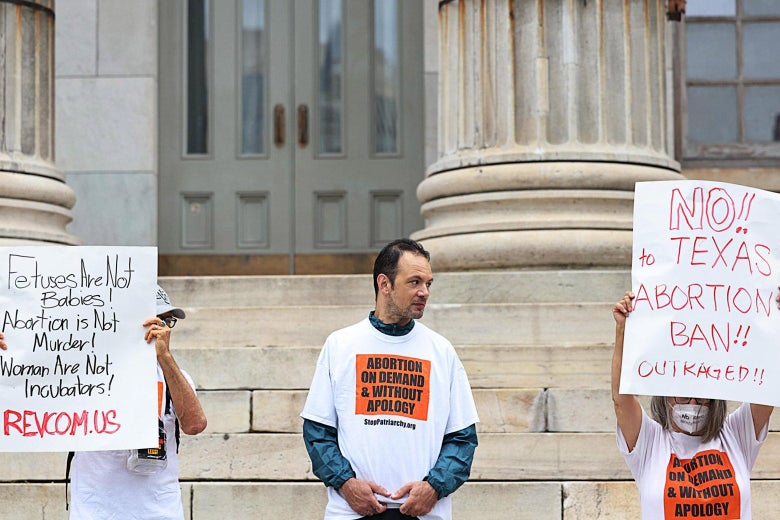
Demonstrators oppose Texas’ six-week abortion ban.
Demonstrators oppose Texas’ six-week abortion ban. Michael M. Santiago/Getty Images

At midnight on Wednesday, in an unsigned 5–4 decision, the Supreme Court effectively overturned Roe v. Wade. The five most conservative Republican-appointed justices refused to block Texas’ abortion ban, which allows anyone to sue any individual who “aids or abets” an abortion after six weeks, which is when the vast majority of operations occur. There is no exception for rape or incest. The decision renders almost all abortions in Texas illegal for the first time since 1973. Although the majority did not say these words exactly, the upshot of Wednesday’s decision is undeniable: The Supreme Court has abandoned the constitutional right to abortion. Roe is no longer good law.

Texas’ ban, known as SB 8, constitutes a uniquely insidious workaround to Roe. It outlaws abortion after six weeks but does not call on state officials to enforce its restrictions.
Instead, as Justice Sonia Sotomayor wrote in dissent, the law “deputized the State’s citizens as bounty hunters, offering them cash prizes for civilly prosecuting their neighbors’ medical procedures.” Random strangers can sue any “abettor” to an abortion anywhere in Texas and collect a minimum of $10,000, plus attorneys’ fees. The act’s language is incredibly broad, encompassing any friend, family member, clergy member, or counselor who facilitates the abortion in any way. Every employee of an abortion clinic, from front desk staff to doctors, is liable as well. And when an individual successfully sues an abortion provider, the court must permanently shut it down.

Texas Republicans devised this convoluted scheme to avoid judicial review of their ban, which blatantly violates binding Supreme Court precedent protecting the right to abortion before viability (around 23 weeks). And, in Sotomayor’s words, the ultraconservative majority’s decision to let the law stand anyway “rewards” these “tactics.” Abortion providers tried to work around Republicans’ scheme by suing the judges and clerks tasked with executing the ban as well as an individual who indicated that he would sue an abortion “abettor.” Nonetheless, the majority claimed that these providers failed to make a “strong showing” that their legal arguments against SB 8 would be “likely to succeed on the merits,” complaining about the “complex and novel antecedent procedural questions” of the case. After months spent rewriting the court’s own rules by awarding themselves the power to intervene in cases that present all manner of “novel” legal questions—including COVID restrictions and the eviction moratorium—the conservative majority decided it was powerless to halt a direct attack on Roe. And it did so with a thinly reasoned one-paragraph order handed down in the dead of night.

All four dissenters—the three liberal justices joined by Chief Justice John Roberts— wrote opinions condemning different aspects of the majority’s order. The most candid and outwardly furious, Sotomayor’s dissent, declared that her colleagues had “opted to bury their heads in the sand” in their “stunning” order.

“The Court,” Sotomayor wrote, “has rewarded the state’s effort to delay federal review of a plainly unconstitutional statute, enacted in disregard of the Court’s precedents, through procedural entanglements of the State’s own creation. The Court should not be so content to ignore its constitutional obligations to protect not only the rights of women, but also the sanctity of its precedents and the rule of law.”

Roberts’ dissent called Texas’ law not just “unusual” but “unprecedented” in its effort to delegate enforcement of an abortion ban “to the populace at large.” He would halt the law “so that the courts may consider whether a state can avoid responsibility for its laws in such a manner.” Justice Stephen Breyer condemned the majority’s assertion that SB 8’s convoluted structure prevents judicial review, explaining that this structure does not “make a critical legal difference” because federal courts may always halt a law that “threatens to invade a constitutional right.” And, in an unusually sharp dissent—even for her—Kagan denounced the majority’s continued abuse of the “shadow docket,” which “every day becomes more unreasoned, inconsistent, and impossible to defend.”

It is easy to get lost in the procedural complexities on which the majority hung its hat. But take a step back—as all three liberals did in their dissents—and the big picture becomes obvious: Roe is no longer the law of the land. For a precedent to remain binding, the Supreme Court must enforce it. On Wednesday, the Supreme Court refused to enforce Roe. As a result, virtually all abortions are now illegal in Texas. Any individual who tries to “abet” an abortion faces imminent financial ruin. Some of the state’s clinics have stopped performing the procedure on all but the roughly 10 percent of patients who come in before six weeks of pregnancy. Others, as Sotomayor pointed out, have stopped performing abortions altogether. Which means that almost all Texas women cannot obtain a legal abortion in their state, right now, already. If the conservative justices have not formally reversed Roe, they have at least suspended it in Texas. The writing is on the wall. And there is nothing to stop other GOP-controlled legislatures from copying Texas’ playbook.

While Roberts’ dissent was the least impassioned of the four, it may be the most surprising. The chief justice had no obligation to note his vote in this (or any) shadow docket case. Instead, he made it very clear that he could not condone the majority’s hasty, bad-faith retreat from precedent. By doing so, he highlighted the fact that Justice Amy Coney Barrett’s vote made all the difference in this case. If Justice Ruth Bader Ginsburg were alive, Texas women would have retained their right to reproductive autonomy.

The same would be true if Justice Anthony Kennedy had remained on the court and not been replaced by Justice Brett Kavanaugh. (Or if Merrick Garland, rather than Neil Gorsuch, had replaced Justice Antonin Scalia.) In defending her vote to confirm him to the bench, Republican Sen. Susan Collins said Kavanaugh believed that precedent was “not something to be trimmed, narrowed, discarded, or overlooked.” Now Kavanaugh has allowed Texas to overturn Roe, a nearly half-century-old precedent. He took less than three years to prove her wrong.

It was predictable that the Supreme Court would abandon Roe after Barrett replaced Ginsburg. But it is still “stunning,” as Sotomayor put it, that it would do so at midnight on a Wednesday in a shadow docket order with a few slapdash sentences of opaque reasoning. It is stunning, too, that the court would issue this order nearly a full day after it silently allowed Texas’ law to take effect. The majority’s decision reflects flagrant contempt for the right to abortion and a cynical tolerance for Republican politicians’ endless schemes to abolish it. The majority did not have the patience to wait until its coming term, when it will have the opportunity to overturn Roe the normal way, with full briefing, oral arguments, and a signed opinion. Nor did it have the courage to cop to its real view—that there is no constitutional right to abortion. Instead, the ultraconservative majority upended Roe under the cover of a procedural punt.

The Constitution deserved better. Abortion patients in Texas deserved better. The country deserved better. Instead, five Republican-appointed justices have stripped women in the nation’s second-largest state of their reproductive autonomy. And they did so in the most cowardly, dishonest, and shameful manner imaginable."

The Supreme Court overturned Roe v. Wade in the most cowardly way possible.

A 107 Years Old Dream Of Visiting Ghana Came True!-Tulsa Massacre Survivor

Dying of Coronavirus: A Family's Painful Goodbye | NYT News

Texas now has abortion ‘bounty hunters’: read Sonia Sotomayor’s scathing legal dissent | Sonia Sotomayor | The Guardian

Texas now has abortion ‘bounty hunters’: read Sonia Sotomayor’s scathing legal dissent | Sonia Sotomayor | The Guardian

"The court’s order is stunning. Presented with an application to enjoin a flagrantly unconstitutional law engineered to prohibit women from exercising their constitutional rights and evade judicial scrutiny, a majority of justices have opted to bury their heads in the sand.

Last night, the court silently acquiesced in a state’s enactment of a law that flouts nearly 50 years of federal precedents. Today, the court belatedly explains that it declined to grant relief because of procedural complexities of the state’s own invention. Because the court’s failure to act rewards tactics designed to avoid judicial review and inflicts significant harm on the applicants and on women seeking abortions in Texas, I dissent.

In May 2021, the Texas legislature enacted SB8 (the act). The act, which took effect statewide at midnight on 1 September, makes it unlawful for physicians to perform abortions if they either detect cardiac activity in an embryo or fail to perform a test to detect such activity. This equates to a near-categorical ban on abortions beginning six weeks after a woman’s last menstrual period, before many women realize they are pregnant, and months before fetal viability. According to the applicants, who are abortion providers and advocates in Texas, the act immediately prohibits care for at least 85% of Texas abortion patients and will force many abortion clinics to close.

The act is clearly unconstitutional under existing precedents. The respondents do not even try to argue otherwise. Nor could they: no federal appellate court has upheld such a comprehensive prohibition on abortions before viability under current law.

The Texas legislature was well aware of this binding precedent. To circumvent it, the legislature took the extraordinary step of enlisting private citizens to do what the state could not. The act authorizes any private citizen to file a lawsuit against any person who provides an abortion in violation of the act, “aids or abets” such an abortion (including by paying for it) regardless of whether they know the abortion is prohibited under the act, or even intends to engage in such conduct. Courts are required to enjoin the defendant from engaging in these actions in the future and to award the private-citizen plaintiff at least $10,000 in “statutory damages” for each forbidden abortion performed or aided by the defendant. In effect, the Texas legislature has deputized the state’s citizens as bounty hunters, offering them cash prizes for civilly prosecuting their neighbors’ medical procedures.

The legislature fashioned this scheme because federal constitutional challenges to state laws ordinarily are brought against state officers who are in charge of enforcing. By prohibiting state officers from enforcing the act directly and relying instead on citizen bounty hunters, the legislature sought to make it more complicated for federal courts to enjoin the act on a statewide basis.

Taken together, the act is a breathtaking act of defiance – of the constitution, of this court’s precedents, and of the rights of women seeking abortions throughout Texas. But over six weeks after the applicants filed suit to prevent the act from taking effect, a fifth circuit panel abruptly stayed all proceedings before the district court and vacated a preliminary injunction hearing that was scheduled to begin on Monday. The applicants requested emergency relief from this court, but the court said nothing. The act took effect at midnight last night.

  • From Justice Sotomayor’s dissent in Whole Woman’s Health et al v Austin Reeve Jackson, Judge, et al, on application for injunctive relief. She was joined by Justices Breyer and Kagan. This text has been lightly edited to remove some legal citations"


Texas now has abortion ‘bounty hunters’: read Sonia Sotomayor’s scathing legal dissent | Sonia Sotomayor | The Guardian

Supreme Court won't block strict Texas abortion ban - The Washington Post


'The bounty hunting bill:’ Texas law gives citizens up to $10,000 to help enforce abortion ban


Texas abortion law banning abortions as early as six weeks into pregnancy denounced by Sen. Warren