Contact Me By Email


What To Do When You're Stopped By Police - The ACLU & Elon James White

What To Do When You're Stopped By Police - The ACLU & Elon James White

Know Anyone Who Thinks Racial Profiling Is Exaggerated? Watch This, And Tell Me When Your Jaw Drops.


This video clearly demonstrates how racist America is as a country and how far we have to go to become a country that is civilized and actually values equal justice. We must not rest until this goal is achieved. I do not want my great grandchildren to live in a country like we have today. I wish for them to live in a country where differences of race and culture are not ignored but valued as a part of what makes America great.

Monday, August 02, 2021

Texans march on capitol to protect voting rights – will Washington listen? | US voting rights | The Guardian

Texans march on capitol to protect voting rights – will Washington listen?

By
 
Alexandra Villarreal
People participate in a rally to support voting rights at the Texas sate capitol in Austin. Photograph: Suzanne Cordeiro/AFP/Getty Images

When a legion of Texans descended on their state capitol on Saturday morning, the signs they carried conveyed raw terror about the erosion of their democracy.

Slogans included “Protect Voting Rights”, “End the Filibuster” and “Say No to Jim Crow”.

Some had just concluded a days-long, 27-mile march from Georgetown to Austin, praying with their feet in a desperate attempt to safeguard access to the vote. For hours, they withstood blistering heat to rally round a casket – a poetic nod to lawmakers in states across the country they say are trying to bury voting rights.

“When you look out here today and see the thousands, and you look at the diversity in this crowd, this is the America they are afraid of,” cried the Rev Dr William J Barber II, co-chair of the Poor People’s Campaign.

The high-stakes protest mirrored a historic march in 1965, when voting rights advocates risked their lives in Selma, Alabama, before the Voting Rights Act was secured. More than half a century later, a new generation of activists hope to protect and expand on those victories.

“When you get out there and you leave the comfort of your home, and in this case you put on your walking shoes and you cover 30 miles in the middle of the Texas summer in central Texas – you’re saying something through that sacrifice and through that struggle,” former US representative and presidential hopeful Beto O’Rourke told the Guardian before participating in the march.

Lawmakers introduced more than 400 restrictive voting bills in 49 states during the 2021 legislative cycle but Texas has emerged as a key battleground in a voting rights war that will ultimately shape the American electorate.

Its Republican leaders remain hell bent on passing laws that advocates warn will make it even harder to vote. So far, such efforts have been thwarted by a tidal wave of opposition.

“There probably are not many states, if any, that have as dark a history of voter suppression – violent voter suppression – as does Texas,” O’Rourke said. “And yet, you know, it may very well be Texas that helps us through this moment.”

Earlier this year, the Republican-controlled Texas legislature led the US in new proposals that would restrict voter access, advancing provisions to ban 24-hour and drive-thru voting, empower partisan poll watchers and target vote by mail.

At Saturday’s rally, Marilyn White said she was starting to panic.

“Texas is such a large state and there’s so many electoral votes and so many congressional seats,” she said. “So many votes that are at risk of being messed with or distorted.”

While Texans, faith leaders and politicians gave impassioned speeches, volunteers offered to register eligible voters on the crowded capitol lawn. Yet even they couldn’t ignore the culture of doubt and fear that permeates Texas elections.

“A lot of people, when they come up, they’re worried about registration because they’re worried that they’re gonna make a mistake and they might do something that would cause them to get a ticket or go to jail,” said Julie Gilberg, a captain with Powered by People, an advocacy group.

“They’re not really sure if their vote will count.”

Texas has the most restrictive voting processes in the US. Critics fear further obstacles will disproportionately affect voters with disabilities and people of color. Many believe Republicans touting “election integrity” to justify policies are politically motivated, inspired by rapid demographic change that threatens them at the polls.

“You have a lot of people here whose grandparents were effectively kept from the ballot box, who themselves have had issues trying to vote conveniently,” former US h secretary Julián Castro said.

“They understand that the legislation being proposed is gonna make it even worse, and they understand that this legislation is born of cynicism and a power grab.”

Beto O’Rourke and the singer Willie Nelson address the rally in Austin. Photograph: Bob Daemmrich/ZUMA Press Wire/REX/Shutterstock

Texas Democrats have twice outmaneuvered attempts to pass sweeping voting bills – first by walking off the state House floor in May, then by fleeing to Washington last month. They have been pushed and bolstered by activists, businesses and regular citizens, who have raised funds, written letters and testified into the night.

Yet voting rights champions can only waylay legislation for so long. And although they gathered at the Texas capitol on Saturday, they were effectively appealing to Washington, where federal voting protections have stalled in the US Senate.

“Mr President, the time to act is now,” Barber said. “Let me tell you something you might not be used to hearing from a preacher, but ain’t no need to have power if you’re not gonna use it for good.”

Frustration rippled through the crowd, where Texans fed up with their state officials demanded a response from the White House.

“President Biden I think can do a lot more,” said Tiffany Williams, an air force veteran who joined the march. “If you’re trying to be for the people, actually come down here and listen to us.”

Texans march on capitol to protect voting rights – will Washington listen? | US voting rights | The Guardian

A one-man scam Pac’: Trump’s money hustling tricks prompt fresh scrutiny The ex-president has built an arsenal of groups staffed with ex-officials and loyalists seemingly aimed at sustaining his political hopes for a comeback

‘A one-man scam Pac’: Trump’s money hustling tricks prompt fresh scrutiny

“Donald Trump’s penchant for turning his political and legal troubles into fundraising schemes has long been recognized, but the former US president’s money hustling tricks seem to have expanded since his defeat by Joe Biden, prompting new scrutiny and criticism from campaign finance watchdogs and legal analysts.

Critics note Trump has built an arsenal of political committees and nonprofit groups, staffed with dozens of ex-administration officials and loyalists, which seem aimed at sustaining his political hopes for a comeback, and exacting revenge on Republican congressional critics. These groups have been aggressive in raising money through at times misleading appeals to the party base which polls show share Trump’s false views he lost the White House due to fraud.

Just days after his defeat last November, Trump launched a new political action committee, dubbed Save America, that together with his campaign and the Republican National Committee quickly raked in tens of millions of dollars through text and email appeals for a Trump “election defense fund”, ostensibly to fight the results with baseless lawsuits alleging fraud.

The fledgling Pac had raised a whopping $31.5m by year’s end, but Save America spent nothing on legal expenses in this same period, according to public records. Run by Trump’s 2016 campaign manager Corey Lewandowski, Save America only spent $340,000 on fundraising expenses last year.

In another move, Trump last month announced he was filing class-action lawsuits against Facebook, Google and Twitter, alleging “censorship” due to bans by the platforms after the 6 January Capitol attack that Trump helped stoke. But the move prompted several legal experts to pan the lawsuits as frivolous and a fundraising ploy.

Trump’s new legal stratagem raised red flags, in part because he teamed up with America First Policy Institute (AFPI), a non-profit group led by ex-White House official Brooke Rollins. At a press briefing with Trump, Rollins publicly told supporters they could “join the lawsuit” by signing up on a website, takeonbigtech.org, a claim belied by details on the website which featured a red button with the words “DONATE to AFPI”.

“Donald Trump is a one-man scam Pac,” said Paul S Ryan, vice-president of policy and litigation with Common Cause. “Bait-and-switch is among his favorite fundraising tactics,” Ryan stressed, noting that Trump’s Save America Pac told “supporters he needed money to challenge the result of an election he clearly lost”, and then wound up not spending any on litigation last year.

“Now he’s at it again, with frivolous lawsuits filed [in July] against Facebook, Twitter and Google, accompanied by fundraising appeals,” Ryan added. “This time he’s got the unlimited dark money group America First Policy Institute in on the racket.”

Other experts voice strong concerns about Trump’s tactics with Save America

“The president deceived his donors. He asked them to give money so he could contest the election results, but then he spent their contributions to pay off unrelated debts,” said Adav Noti, a former associate general counsel at the Federal Election Commission and now chief of staff at the nonpartisan Campaign Legal Center.

Noti added: “ That’s dangerously close to fraud. If a regular charity – or an individual who didn’t happen to be president of the United States – had raised tens of millions of dollars through that sort of deception, they would face a serious risk of prosecution.”

Such concerns have not deterred Trump’s fundraising machine from expanding further with the launch of a super Pac, Make America Great Again Action, which can accept unlimited donations. Both the Super Pac and Save America are run by Trump’s ex campaign manager Lewandowski, who did not return calls seeking comment.

The Super Pac has reportedly hosted at least two events for mega donors at Trump’s golf club in Bedminster, New Jersey, and in Dallas, but it’s not known how much has been hauled in so far.

Both Pacs are seen as vehicles for Trump to raise more funds to influence 2022 congressional races, where he has vowed to try to defeat several politicians such as the anti-Trump Republican Liz Cheney who voted to impeach him this year after the Capitol attack.

Campaign filings for the first six months of 2021 reveal that Trump’s political groups led by Save America raised $82m dollars, an unprecedented total for an ex president. Save America banked most of the funds while spending some to pay for Trump’s travel and other expenses, instead of challenging election results in states like Arizona despite Trump’s false claims of fraud there.

Veteran campaign finance analysts say that the bevy of Trump-linked groups launched since his defeat raise new questions about his motives and political intentions

“Trump’s aggressive fundraising, using a variety of committees and surrogates, raises questions about whether his continual hints at running in 2024 is primarily a ploy for donations,” said Sheila Krumholz, who leads the nonpartisan Center for Responsive Politics. “Trump may be more interested in fundraising than actually running, especially given how unprecedented his post-loss fundraising is.”

Besides Trump’s fundraising pitches for his new Pacs and non-profits, some major Republicans groups have collaborated in fundraising appeals since his defeat, and keep piggybacking on his allure to the party base, despite Trump’s repeated falsehoods that the election was stolen

In the eight weeks post-election, for instance, the RNC, the Trump campaign and Save America reportedly raised about $255m, but only spent a small fraction on lawsuits.

Further, Trump’s cachet with small donors is still exploited by party allies including the National Republican Senatorial Committee, (NRSC) the fundraising arm for Republican senators.

For instance, the NRSC in July email fundraising pitches touted a free Trump T-shirt for a limited number of donors writing checks from $35 to $5,000 to “protect the America First Majority”.

Similarly, the RNC in a 19 July email alert rolled out a money pitch to become an “official 2021 Trump Life Member” for donors who chipped in $45 or more by midnight.

Charlie Black, a longtime Republican operative, said that Republicans committees realize that Trump’s “name has the most popular appeal to the grassroots, so naturally they’re going to try to figure out ways to use his brand where they can to raise more funds”.

But legal analysts caution that Trump’s fundraising modus operandi with his various new Pacs and non-profits are different, and carry clear risks for unwitting donors and US campaign finance laws.

“Our nation’s campaign finance and anti-fraud laws have proven no match for Trump’s schemes,” said Ryan of Common Cause. “So my one piece of advice for Trump supporters is donor beware!”

Fauci backs new masks guidance as Florida reports highest one-day Covid case total

Fauci backs new masks guidance as Florida reports highest one-day Covid case total

“Florida’s ban on mask mandates came under increasing scrutiny from public health officials on Sunday as the surging Delta variant pushed new daily cases of Covid-19 in the state to a record high.

The 21,683 new cases reported on Saturday was Florida’s highest one-day total since the start of the pandemic. It came a day after Ron DeSantis signed an executive order prohibiting school districts from requiring staff and students to wear masks.

On Sunday, the state broke its previous record for hospitalisations, also set more than a year ago. 

Dr Francis Collins, director of the National Institutes of Health (NIH), told CNN’s State of the Union he was baffled by the prohibition on requiring masks in schools, the latest in a series of autocratic moves by DeSantis including outlawing vaccine passports and stripping local authorities of the power to issue restrictions or mandates.

“I don’t understand the ban. Certainly this seems like something local officials ought to be able to decide based on their community’s circumstance,” Collins said.

“We do know that [children] are capable of getting pretty sick, we’ve lost about 400 children who have died from Covid-19 since this all started, and kids can also get long Covid where they ended up months later with difficulties with brain fog, and fatigue that interferes with their school performance.

“So this is not to be just dismissed as a zero risk. Kids also live in homes, are related to people in those homes, who are perhaps immunosuppressed. They could bring home the virus and cause bad outcomes.”

Also on Sunday, Dr Anthony Fauci, the chief White House medical adviser, took issue with the portrayal by DeSantis, a prominent Trump ally and potential Republican presidential nominee in 2024, that the ban was a protection of individual freedoms.

“The federal government has no right to tell parents that in order for their kids to attend school in person they must be forced to wear a mask all day, every day,” DeSantis said on Friday.

Fauci, who has clashed publicly with DeSantis, told CBS’s Face the Nation wearing masks to combat Covid was a “responsibility to society” and that data from the Centers for Disease Control and Prevention (CDC) and the American Academy of Pediatrics supported masks in schools.

“You understand people feeling that they have the individual right to make their own decisions, and I respect that for sure, but the issue is, if you’re going to be part of the transmission chain to someone else, then your decision is impacting someone else,” Fauci said.

“It’s not only impacting you, and you’ve got to think about it that you are a member of society and you have a responsibility.”

Vaccinated people can carry high levels of the virus and transmit the infection to the unvaccinated, data that prompted the CDC to amend guidance and recommend the vaccinated wear masks indoors in areas where transmission and infection rates are high.

“If you get breakthrough infections in individuals who are vaccinated and they don’t spread at all to anybody else you would not worry,” Fauci said. “If they went home to a vulnerable person in the household, children or an elderly person, there wouldn’t be any issue.

“But we know now they can transmit when they get breakthrough infections, even though they have minimal symptoms or no symptoms. We know they can do it. We know the mechanistic reason for it is that the level of viruses is high, so you want to make sure they don’t get infected. That’s the fundamental basis for the CDC modifying their guidelines.”

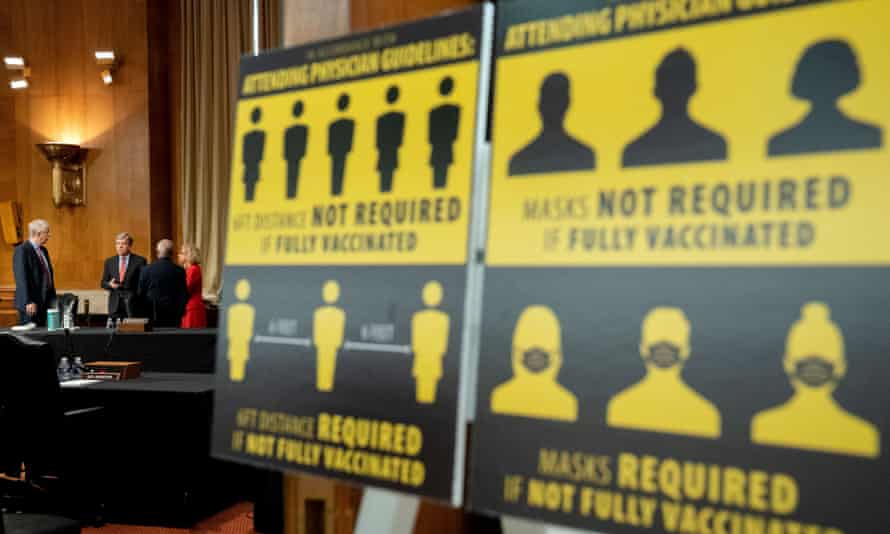
Francis Collins, at far left, waits for a May congressional hearing next to signs requiring masks if not vaccinated against Covid-19.
Dr Francis Collins, at far left, waits for a May congressional hearing on 26 May. Photograph: REX/Shutterstock

On ABC’s This Week, Fauci said he saw no need for a return to lockdowns, but said: “We’re looking to some pain and suffering in the future because we’re seeing the cases go up, which is the reason why we keep saying over and over again, the solution to this is get vaccinated and this would not be happening.”

As the highly contagious Delta variant spreads, Florida has become the new US epicenter of the virus, accounting for about one-fifth of new cases. The spike was a substantial leap from 17,093 the day before and surpassed the previous high, 19,334, set in January before vaccines became widely available.

Courthouses, theme parks and numerous businesses are again requiring the public to wear masks indoors. Disney World added a requirement that workers must be vaccinated; Universal Orlando Resort said all workers have to be masked indoors and that guests should follow CDC guidance.

Florida ranks about halfway in vaccinations, with 48.8% of residents over 12 fully vaccinated and 57.5% having received at least one dose.

DeSantis has urged residents to get vaccinated but has mocked CDC guidance on masking and dismissed the surge as “seasonal”.

Hospitals say they are being overwhelmed by admissions mostly of younger unvaccinated patients. Over the last week, 409 Floridians have died of Covid-19, with the total above 39,000.

The previous record for Covid hospitalisations in Florida was set on 23 July 2020. Florida then had 10,170, according to the Florida Hospital Association. The state ileads the US in per capita hospitalisations. In the past week, it has averaged 1,525 adult and 35 pediatric hospitalisations a day.

Collins also noted that other states including Louisiana, Missouri and Tennessee were experiencing significant upticks in infections, saying the virus was “having a pretty big party in the middle of the country”.

He told Fox News Sunday: “We are all determined to avoid lockdowns but if we’re going to be able to continue, whether in business or in school, to do things that we all really value, putting the mask on is the best way to ensure that things don’t get worse. It seems like a sacrifice worth making.

“We’ve made a lot of progress here compared to where we were a year ago, we just don’t want to do silly things to cause the Delta virus to come back even stronger.”

The G.O.P. Menace to Society

The G.O.P. Menace to Society

Tom Brenner for The New York Times

“It feels like every week now we learn of a new way that Donald Trump posed a threat to American democracy when he was president.

On Friday, we learned from new documents provided to lawmakers and obtained by The New York Times, that Trump “pressed top Justice Department officials late last year to declare that the election was corrupt even though they had found no instances of widespread fraud, so that he and his allies in Congress could use the assertion to try to overturn the results.”

As an aide’s notes of one conversation read, Trump put it plainly: “‘Just say that the election was corrupt + leave the rest to me’ and to congressional allies.”

That last part is the key: Trump wasn’t trying alone to destroy our democracy; he had help and support. Some of it was in Congress. But today it has spread to include Republican voters, and it is out of that spirit that the Jan. 6 insurrection was born.

A May Quinnipiac poll found that 85 percent of Republicans want candidates running for office to mostly agree with Donald Trump, and two out of three want Trump to run again for president in 2024.

What do you call members of a party who, from top to bottom, from elected officials to voters, largely believe a lie and a liar determined to undermine, corrupt and even destroy our democracy? What do you call a party whose leaders use that lie as a pretext to suppress the votes and voices of Americans with whom they disagree? What do you call a party slavishly devoted to a cult over the stability and prosperity of a country?

What do you call a party where many of its members have worked against a lifesaving, society-freeing vaccine in the middle of a pandemic, exposing many of their own followers to the deadly virus, all for the sake of being contrarian, anti-establishment and anti-science?

I call that party a national security threat and a cancer on our democracy.

Now, I am an unabashed liberal, and coming from me that will sound like naked partisanship. I understand that. Sometimes people prefer criticism of this Republican Party to come from disaffected Republicans. I get it. It feels more authentic, I guess.

But as Malcolm X once put it, “I’m for truth, no matter who tells it.”

I have heard all the things that the moderates and neutralists have to say: Overheated language helps nothing and alienates people who could otherwise be converted. Don’t cast as evil someone with whom you simply have a disagreement. Build bridges, don’t burn them.

I could understand and appreciate all of that in another time. I can recall being impressed by how well a conservative argument was asserted, even if I disagreed with it. I can remember when conservatism was just as intellectual as liberalism, and compromises could be made to feel like the combining of the best of both.

But I’m also not consumed by romantic, hagiographic illusions of yesteryear. No time in American politics has been perfect and without strife and drama. This is not the first time that the country has been gravely rived. We fought a Civil War, for Pete’s sake. We had Jim Crow that robbed most Southern Blacks of the right to vote for three-quarters of a century.

America has seen the darkest of seasons.

But we should also not underplay or sugarcoat the darkness of the current season.

I don’t see how we continue to pretend that this is politics as usual, that it’s normal squabbling between ideological opposites. No, something is deeply, dangerously wrong here. This is not the same as it has always been.

This Republican Party is a menace to society. That must be said. That is the truth.

And when one of the country’s two major parties is so close to the brink of the falls, it threatens to pull the entire country over.

So I have no intention of treating this Republican Party the way I treated it just 10 years or 20 years ago. That party doesn’t exist anymore. It died. This thing we have now is its zombie. Zombies can’t be reasoned with.

We have to stop making people who call this Republican Party out for what it is feel like extremists, reactionaries and alarmists, rather than truth tellers. It is not extreme to tell the truth, but it is delusional to twist yourself into a knot to not tell the unvarnished truth because you believe your tone of conciliation will lead to rehabilitation.

If you are reminiscing about another time, one of more comity and gentility, one in which differences between the parties seemed bridgeable over a beer or in a locker room, you are longing for a time when the white racist patriarchy reigned supreme and women, minorities and L.G.B.T people weren’t also in the halls of Congress.

The Republican Party is rebelling against change as much as anything else and Donald Trump is the apotheosis of their anger and irrationality.“

The South Must Teach Its Children the Truth

The South Must Teach Its Children the Truth

A boy watched a group of people protest the admission in 1957 of the Little Rock Nine to Central High School.
Buyenlarge/Getty Images

By Margaret Renkl

“Ms. Renkl is a contributing Opinion writer who covers flora, fauna, politics and culture in the American South.

NASHVILLE — There was a time when ancestor worship was almost obligatory in the South. The tiniest rural community, hardly more than a red-dirt crossroads, had its own graveyard, and those graves were never short of flowers. Sometimes the flowers were made of faded plastic, but they were always a marker of love, a sign of remembrance, even if the flower bearers knew the dead only from family stories that recalled the best of who they had been in life.

I often remind myself of this region’s constitutional reverence for the dead because it helps me come closer to understanding a heartbreaking truth: Many of my fellow white Southerners are deeply, dangerously wrong about matters of history that by now should be abundantly, self-evidently clear.

Though my own elders never, not even once, tried to glorify the Confederacy, plenty of other people I know grew up believing a story about the past that is so patently false it’s breathtaking. How could anyone look at the facts of what happened in the South before, during, and after the Civil War and conclude that white Southerners had fought on the side of honor, that slavery wasn’t really all that bad? How is it even possible for a war story to be burnished to such a sheen that nothing remains of the filth and blood and deceptions, or the true reasons for that war?

In a haunting recent essay for The Atlantic, Clint Smith recalls the many people he has met who believe such lies: “For so many of them, history isn’t the story of what actually happened; it is just the story they want to believe,” writes Dr. Smith. “It is not a public story we all share, but an intimate one, passed down like an heirloom, that shapes their sense of who they are. Confederate history is family history, history as eulogy, in which loyalty takes precedence over truth.”

Let’s consider the matter of Confederate monuments. The men these statues represent — Robert E. Lee, Nathan Bedford Forrest, Stonewall Jackson, Jefferson Davis, among others — were traitors. They betrayed their own country because they wanted to live in a place where it was still legal for white people to own Black people.

But that isn’t the history that monument supporters mean when they scream, “History, not hate.” Their “history” is a myth, an imagined story of valor and honor and benevolence toward enslaved people. Ratified by friends and neighbors whose families taught them the same version of the past, the myth of the Lost Cause carries the whiff of ancient wisdom, never mind that it is wholly false.

For decades even public education here avoided the truth. More or less universally in the South of my youth, lessons about the Civil War focused on battles fought and won, not on the lives of the enslaved people over whom the country was fighting. And that’s the best version of history we got, where the textbook’s sins were merely those of omission. The worst books taught outright falsehoods.

Many of us — perhaps most of us — know better now, despite the troubled history books we learned from. As evidenced by all the Confederate statues falling across the South, there are many, many people here who are working passionately to topple racist heroes. In some cases these statues were brought down by protesters last summer, in the aftermath of George Floyd’s murder. In others, their removal has been the work of decades, thwarted at every turn by conservative courts and Republican legislatures determined to defend a false version of history.

In this age of Facebook echo chambers and polarized news silos and Southern “leaders” who pander to the lowest common denominator among their constituents, getting to the point where everyone understands what Black people endured in the past and what they continue to endure even now will require schoolteachers to uproot the myths that are dug in so deep. And yet Republican legislatures across the South — though, crucially, not only in the South — have been working overtime to make sure that doesn’t happen.

Legislative attempts to restrict how children are taught about racism in schools have multiplied, according to the nonprofit news organization Chalkbeat, which tracked such efforts in 28 states. Tennessee, where I live, just passed a law banning any discussion of race that might cause a student “discomfort, guilt, anguish, or another form of psychological distress.” Laws like this one are designed to tie the hands of teachers and simultaneously appeal to the meanest elements of the Republican base.

I’ve watched this play out at close range as the Williamson County chapter of Moms for Liberty, a national organization of conservative parents, filed an official grievance with the state commissioner of education. The complaint alleges that “Wit & Wisdom,” a literacy curriculum used in more than 30 state school districts, including Williamson County, violates the new state restrictions.

The specific target of Moms for Liberty’s ire: a unit in the second-grade curriculum called “Civil Rights Heroes.” The texts singled out for objection include “Separate is Never Equal” by Duncan Tonatiuh, the story of a Mexican American family’s successful effort to integrate California schools; “Martin Luther King Jr. and the March on Washington” by Frances E. Ruffin; and “Ruby Bridges Goes to School: My True Story” by Ruby Bridges, the Black woman who integrated New Orleans public schools when she was a first grader.

It’s important to note that these titles are all early readers or read-aloud stories written for young children. Nothing in them is untrue, nor is anything “anti-American” or “anti-white,” as the Moms for Liberty argue. They’re just true stories, told simply, of people contending heroically with the terrible consequences of racism.

The Moms for Liberty complaint is based in a ludicrous reading of these wonderful books. I read every book in the unit and was amazed at how carefully they all kept the unavoidable ugliness to a level that would not traumatize a child — not a Black or Brown child whose ancestors may have faced far worse than the injustices recounted in these pages, and not a white child whose ancestors may have sympathized with the people hurling insults at 6-year-old Ruby Bridges.

On the contrary, the books take care to point out that some white people did stand up for the rights of their Black neighbors. Indeed, the only message that could possibly be derived from these stories is the need to treat others with dignity and to work for justice for all people. Today Ms. Bridges gives talks to schoolchildren about what happened to her as a little girl. In “Ruby Bridges Goes to School,” she writes, “I tell children that Black people and white people can be friends. And most important, I tell children to be kind to each other.”

People here are already standing in defense of history against the attempts of our Republican leaders to prevent the teaching of truth, and I have faith that more and more Southerners will work to overturn these laws that ban the teaching of truth, just as they worked last summer to bring down those Confederate statues.”

How Local Media Spreads Misinformation From Vaccine Skeptics Facebook and other social media have been under scrutiny for vaccine misinformation, but local outlets have also sometimes been active.

How Local Media Spreads Misinformation From Vaccine Skeptics

“Facebook and other social media have been under scrutiny for vaccine misinformation, but local outlets have also sometimes been active.

Local newspapers, radio and television stations and podcasts are often a starting point for anti-vaccine messaging, a researcher said.
Bryan Anselm for The New York Times

The Freedom’s Phoenix, a local news site in Phoenix, and The Atlanta Business Journal, a news site in Atlanta, both published the same article about coronavirus vaccines in March.

The author was Joseph Mercola, who researchers and regulators have said is a top spreader of misleading Covid-19 information. In the article, Dr. Mercola inaccurately likened the vaccines to “gene therapy” and argued against their usefulness.

A month later, The Freedom’s Phoenix and The Atlanta Business Journal also published another article by Dr. Mercola. This time, he blamed the billionaire Bill Gates for the pandemic, claiming Mr. Gates had “shadow control” of the World Health Organization.

Facebook and other social platforms have in recent weeks attracted attention for vaccine misinformation, as Covid cases surge from the infectious Delta variant and vaccination rates slow. But The Freedom’s Phoenix and The Atlanta Business Journal are two small publications — along with dozens of radio and television stations, and podcasts aimed at local audiences — that have also become powerful conduits for anti-vaccine messaging, researchers said.

Dr. Mercola and other superspreaders of anti-vaccine content, who have been listed by the nonprofit Center for Countering Digital Hate as the “Disinformation Dozen,” have appeared in articles in local publications or as guests on local radio shows and podcasts, according to a review by The New York Times. Some of their articles are regularly published by small-town newspapers or they are quoted as experts, The Times found.

Sherri Tenpenny, an osteopathic physician and vaccine skeptic, was recently on Coach Dave Live, a podcast in Ohio aimed at local audiences, misleadingly claiming that coronavirus vaccines disrupt people’s fertility. Christiane Northrup, a physician and anti-vaccine activist, showed up on the Lillian McDermott radio show in Florida and inaccurately said the vaccines would “change human DNA.” Ty Bollinger, another vaccine skeptic, was featured on News4 WSMV Nashville, an NBC-affiliated station in Tennessee, where he discussed why people should not get vaccinated.

Their appearances on local media can have an impact since Americans are more likely to believe what they read and hear from local news outlets. A 2019 Knight-Gallup study found that 45 percent of Americans trust reporting by local news organizations “a great deal” or “quite a lot,” compared with 31 percent for national news organizations.

“People think they are trusting their local news, something reliable and familiar, when in fact they are trusting misinformation,” said Rachel Moran, a fellow at the Center for an Informed Public at the University of Washington. “It is a huge problem and growing.”

The Freedom’s Phoenix, The Atlanta Business Journal, Coach Dave Live, Lillian McDermott show and News4 WSMV did not return requests for comment.

In an email, Dr. Mercola wrote, “Local communities must come together when the federal health agencies and mainstream media are under the influence of the pharmaceutical industry.”

Dr. Tenpenny, Dr. Northrup and Mr. Bollinger didn’t respond to requests for comment.

Many local media publications and stations have reported responsibly and factually on the pandemic. Gannett, the publisher with 100 daily newspapers and nearly 1,000 weekly publications across 43 states, has dedicated resources to fact-checking and teaching journalists that accuracy matters more than speed, said Amalie Nash, senior vice president for local news and audience development at USA Today, which is owned by Gannett.

The investment was crucial because in the pandemic, “people turned to us in record numbers to get information about lockdowns, mask policies and vaccines,” Ms. Nash said.

But as the local news industry has been hit by declining advertising revenues and cuts, some outlets have sometimes unknowingly run vaccine misinformation because they have fewer employees or less oversight than in the past, said Ken Doctor, a news industry analyst. Without the resources to publish original, independent journalism, they may also rely on whatever can be freely repurposed from online material, he said.

In total, local media remains a significant force. There were 1,762 local television stations and 3,379 radio stations operating in the United States last year, according to the Radio Television Digital News Association and Syracuse University. While print publications have been decimated, there are still about 1,300 daily papers and 5,800 weekly publications, with roughly half located in small rural communities, according to research from the University of North Carolina.

Jo Lukito, an assistant journalism professor who studies disinformation at the University of Texas at Austin, said local media is often a starting point that creates a “trading up the chain” effect.

It starts when a rumor is covered or published in local media, she said, where it can gain a sheen of credibility. Then “when you pitch it to a Fox News or a larger news platform, you can say that this other outlet covered it, so it must be real,” she said.

Ivan Kashinsky for The New York Times

One radio show that appears to have been part of that effect is Coast to Coast AM, which is syndicated on 640 local stations and reaches nearly three million weekly listeners. Its host, George Noory, has in recent years interviewed Dr. Tenpenny, Robert Kennedy Jr., a lawyer and anti-vaccine activist, and Erin Elizabeth, the founder of the website Health Nut News and a vaccine skeptic.

The activists have used their segments on the show to reinforce their messages. In a promotion for Dr. Tenpenny’s appearance to discuss the coronavirus in April 2020, for example, Coast to Coast AM’s website said, “She contends that there are so many unknowns in regards to testing, tracking, symptoms, and other factors, that the information we’re being told about the disease is meaningless.”

That line was shared on Dr. Tenpenny’s social media accounts and tweeted by some of her followers.

In a statement, Mr. Noory said, “We give all views on my program and that includes people who are opposed to vaccines.”

Vaccine misinformation has also been published on sites that purport to be local news, but which are pay-for-play content websites. These sites, where articles are ordered up and paid for by conservative think tanks, political operatives, corporate executives and public-relations professionals, have sprung up to fill the vacuum left by the loss of local publications.

Recent articles on some of those sites, such as Last Frontier News in Alaska and Bowling Green Today in Kentucky, highlighted people who died after receiving the Covid vaccines without saying that it was unclear if the vaccines were responsible, according to a review by The Times. The stories followed a pattern established on anti-vaccine blogs of pulling data from a national database of post-vaccine deaths without explaining the limitations of the data.

Last Frontier News and Bowling Green Today did not respond to requests for comment.

At least one local radio host has recently recanted his anti-vaccine stance. Phil Valentine, a conservative radio host in Tennessee, had declared in a blog post in December that he would not get the vaccine because his chances of dying from the virus were “way less than one percent.”

But Mr. Valentine was diagnosed with Covid-19 in July and has been hospitalized in critical condition. He has since issued a statement advising others to get vaccinated.

“Phil would like for his listeners to know that while he has never been an ‘anti-vaxxer’ he regrets not being more vehemently ‘pro-vaccine’, and looks forward to being able to more vigorously advocate that position as soon as he is back on the air, which we all hope will be soon,” his station, 99.7 WTN, said on July 23.

Last Wednesday, Mr. Valentine was put on a ventilator, 99.7 WTN said. The station has added a hashtag to its posts about the host: #prayforphil.“

Sunday, August 01, 2021

Riots Shatter Veneer of Coexistence in Israel’s Mixed Towns - The New York Times

Riots Shatter Veneer of Coexistence in Israel’s Mixed Towns

"Israel’s Jewish and Palestinian communities looked past each other until violence and bloodshed forced a reckoning.

Seventy-three years after Israel’s birth in the 1948 Independence War, in which hundreds of thousands of Arabs fled or were driven out at gunpoint, Jews and Arabs in Israel live side by side but largely blind to each others’ lives.
They had seen their status and their language downgraded by the nation-state law of 2018 that said the right to self-determination was “unique to the Jewish people.” The bill stated in plain language what discrimination in land regulations, education and other areas of life had felt like for decades.

“We are second-class,” said Ashraf Amer, a Palestinian social worker and activist in Acre. “When the Jews can see us at all.”


Riots Shatter Veneer of Coexistence in Israel’s Mixed Towns - The New York Times