Contact Me By Email


What To Do When You're Stopped By Police - The ACLU & Elon James White

What To Do When You're Stopped By Police - The ACLU & Elon James White

Know Anyone Who Thinks Racial Profiling Is Exaggerated? Watch This, And Tell Me When Your Jaw Drops.


This video clearly demonstrates how racist America is as a country and how far we have to go to become a country that is civilized and actually values equal justice. We must not rest until this goal is achieved. I do not want my great grandchildren to live in a country like we have today. I wish for them to live in a country where differences of race and culture are not ignored but valued as a part of what makes America great.

Tuesday, April 06, 2021

The next Georgia: Texas and Arizona emerge as voting rights battlegrounds | US voting rights | The Guardian

The next Georgia: Texas and Arizona emerge as voting rights battlegrounds

By
 
Sam Levine in New York 
The Guardian
    A booth is folded after voting ended in the 2020 US election in Marfa, Texas, on 3 November 2002. 
                        
                            Photograph: Adrees Latif/Reuters
    A booth is folded after voting ended in the 2020 US election in Marfa, Texas, on 3 November 2002. Photograph: Adrees Latif/Reuters

    As Georgia Republicans face backlash over new sweeping voting restrictions, activists in other states are escalating efforts to oppose similar restrictions advancing in other states.

    Texas and Arizona have emerged as two of the next major battlegrounds over voting rights. Texas Republicans last week advanced legislation that would limit early voting hours, prohibit drive-thru voting and give partisan poll workers the ability to record voters at the polls, among other measures. In Arizona, Republicans are moving ahead with an audit of ballots from the presidential race while also advancing legislation that would make it harder to vote by mail.

    Nationally lawmakers have introduced 361 bills to limit access to the ballot in some way, according to a tally by the Brennan Center for Justice. Fifty-five of those bills are advancing in legislatures.

    After companies like Delta and Coca-Cola faced criticism for waiting too long to speak out against the Georgia legislation, advocates have been heartened by swift corporate condemnation of the Texas measure. American Airlines, which is based in Texas, said Thursday it was “strongly opposed” to the Texas legislation. Microsoft and Dell also spoke out against the measures. Major League Baseball announced Friday it was moving the All-Star Game out of Atlanta in response to Georgia’s sweeping new law.

    Joe Straus, the former speaker of the Texas house of representatives, also came out against the measures on Thursday, tweeting that businesses had “good reason” to oppose the bill. “Texas should not go down the same path as Georgia. It’s bad for business and, more importantly, it’s bad for our citizens,” he said.

    Anthony Gutierrez, the executive director of the Texas chapter of Common Cause, a government watchdog group, said those statements were significant and could help sway lawmakers, including Dade Phelan, the speaker of the Texas house of representatives. Gutierrez has been involved in fights over voting rights for over a decade and said he could not recall another instance where there was the kind of broad opposition to the bills that exists now.

    “A lot of us are thinking that Texas is the next Georgia, but I think the big difference is all these prominent voices weighing in are coming in much earlier,” he said.

    A voter shows identification to a Harris county election clerk before voting in Houston, Texas, on 14 July 2020. Photograph: David J Phillip/AP
    A voter shows identification to a Harris county election clerk before voting in Houston, Texas, on 14 July 2020. Photograph: David J Phillip/AP

    Attention on Texas, one of the lowest-ranking states for voter turnout in 2020, escalated this week after lawmakers advanced a measure that appears squarely aimed at preventing local officials in urban areas from taking creative measures to expand voting access. In addition to blocking drive-thru and 24-hour voting, two popular options offered in Harris county, home to Houston, in 2020, the law also prevents officials from mailing absentee ballot applications to voters. In addition the bill imposes new requirements on people who assist voters and gives local election officials less flexibility in allocating election equipment.

    The measures would clearly empower partisan poll watchers. One measure allows poll watchers to record voters at the polls if they “reasonably believe” they are receiving illegal assistance. Another provision makes it harder for local officials in charge of an election precinct to remove poll watchers during voting.

    “It is a huge deal because of how many incidents we see in Texas of poll watchers misbehaving and needing to be disrupted for a good reason,” Gutierrez said.

    “This is an invasion of privacy, it’s an invasion of ballot secrecy, it could be potentially very intimidating,” said David Becker, the executive director of the Center for the Election Innovation and Research, who works with Republican and Democratic election officials across the country. “Texas has, as far as I’m concerned, the most disturbing bill that I have seen.”

    In Arizona, a state Joe Biden won by just over 10,000 votes in 2020, activists are also pushing a slew of anti-voting measures. One priority is a bill that would make changes to a list voters can join to automatically receive a mail-in ballot each election. About 75% of Arizona voters are on the list, according to the Associated Press (AP), but lawmakers want to enable the state to remove voters from the list if they don’t vote by mail in at least two consecutive elections. About 200,000 voters who didn’t vote by mail in 2018 or 2020 would be removed from the list, according to the AP.

    “This is a really important piece of our election system. It’s been in place just like it is for more than a decade. People trust it, they love using it,” said Emily Kirkland, the executive director of Progress Arizona, which is lobbying against many of the proposed changes. “This year, obviously fueled by all the conspiracy theories we saw going into and after the election, Republicans in the state legislature are attacking it.”

    Advocates are also concerned about another bill that would require voters to provide either their driver’s license or voter registration number along with their birthday when they return a mail-in ballot (Arizona currently uses signature comparison to verify the identity of mail-in voters). Those requirements would pose difficulties for many Native American voters, said Torey Dolan, a native vote fellow at Indian law clinic at Arizona State University.

    Dolan said that it can be difficult to find out a voter registration number online and noted that the bill currently did not allow for the use of tribal identification cards as a form of identification. A lot of Indigenous elders, she noted, were not born in hospitals and have delayed birth certificates, and therefore have approximate birthdays.

    “Arizona election law, before this cycle, was not equally accessible to Native Americans,” she said. “As more barriers go up, it only exacerbates that gap from access.”

    Officials count ballots at the Maricopa county recorder’s office in Phoenix, Arizona, on 4 November 2020. Photograph: Matt York/AP
    Officials count ballots at the Maricopa county recorder’s office in Phoenix, Arizona, on 4 November 2020. Photograph: \

    Aside from legislation, Arizona Republicans are also moving ahead with more efforts to stoke uncertainty about the results of the 2020 election. The state senate, controlled by Republicans, is moving ahead with a recount and audit of 2.1m ballots in Maricopa county, the state’s most populous, months after the state certified the election. The county has already completed an audit of its voting equipment, which found ballots were counted correctly.

    One of the four firms the senate hired to lead the audit is led by Doug Logan, who has publicly said he believes there was widespread voter fraud in 2020 and advanced other conspiracy theories about the election, according to the Arizona Mirror.

    “Can you imagine the outcry if Democrats in Pennsylvania, Michigan, or Wisconsin in 2016 in a state senate, had decided they wanted to, six months after an election, start an audit of the ballots of an election that was already certified and the people were already in office?” Becker said.

    “And then they hired the consultant, someone from out of state who had publicly argued that Hillary won the election and the election was fraudulent? That’s a mirror image of what’s happening in Arizona right now.”



    The next Georgia: Texas and Arizona emerge as voting rights battlegrounds | US voting rights | The Guardian

    Black Americans flock to gun stores and clubs: 'I needed to protect myself'

    Black Americans flock to gun stores and clubs: 'I needed to protect myself'

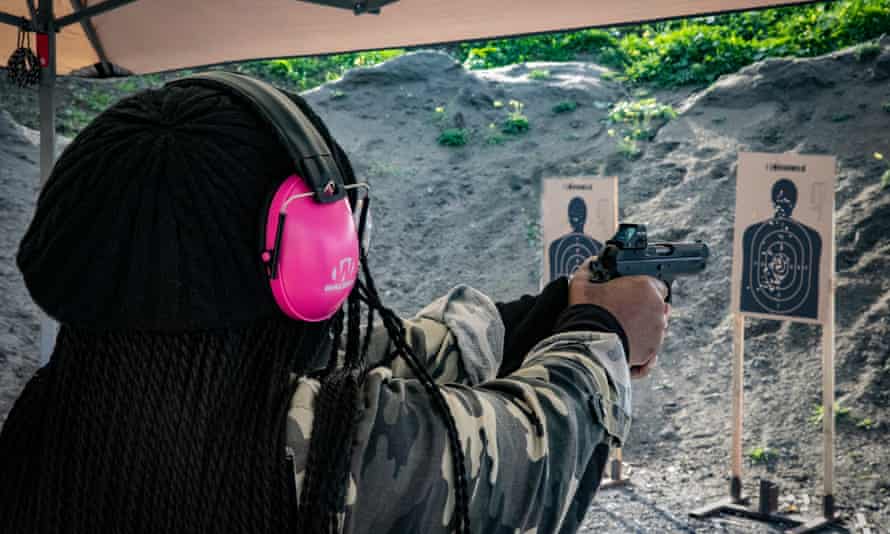
    Black novice gun owners line up for a shooting drill during a Black Gun Owners Association training at the Richmond Rod & Gun Club in Richmond, California.
    “Black novice gun owners line up for a shooting drill during a Black Gun Owners Association training at the Richmond Rod & Gun Club in Richmond, California. Photograph: Nathan Whalen

    Americans bought a record number of firearms last year. Gun ownership among Black Americans is up 58.2%

    Last modified on Mon 5 Apr 2021 06.01 EDT

    Janice Matthews* always knew she would be a gun owner someday. She was raised in Alabama where her family members rarely left their home unarmed. Still, after more than three decades in California she wasn’t in a rush to start shopping around at gun stores. Then the pandemic hit.

    Matthews started hearing rumors of food shortages and noticed store shelves emptied by shoppers panic-buying everything from bullets to toilet paper. After her daughter moved out of their home, she was left with an empty nest and a lot of anxiety.

    “I was thinking of what they predicted in the Bible and I thought I would have to protect the little bit that I had,” Matthews, 55, recalled.

    So one day in the spring of last year, she waited six hours in line outside a northern California gun shop to become one of the millions of Americans who became first-time gun owners in 2020.

    Americans bought a record number of firearms last year. An estimated 5 million people bought their first ever gun between March and August, according to the National Shooting Sports Foundation (NSSF), a trade organization, and that number continued to climb throughout the year. Black Americans saw the highest increase in new gun owners of any demographic, the NSSF found, with gun ownership in the group up by a staggering 58.2%.

    Though Black Americans have a multitude of reasons for buying a gun – some new gun owners told the Guardian about stress related to the pandemic, others about the anxiety of seeing scores of armed white protesters rallying against lockdown orders or the election results – many had a common experience in the process of obtaining one. They were met with apathy, and in some cases disrespect, from white gun store owners, gun club members and at shooting ranges.

    The cold shoulder they received has pushed scores to join Black gun clubs and seek training from Black experts. “June 2020 – when the riots were hitting different cities – my students increased,” said Rogers Anderson, who is the commander of the Black Gun Owners Association’s Oakland/Bay Area chapter and conducts training sessions at northern California shooting ranges. “Now 99.9% of my students are either single Black women or Black women with children who fear for their safety,” Anderson said.

    Janice Matthews is one of Anderson’s trainees. On the morning of 18 January, Martin Luther King Jr Day, Matthews and her friend Robin Lewis drove an hour to the Richmond Rod and Gun Club for a new beginner’s shooting session. The duo joined a pair of veteran trainers and five other novice firearm users, all but one Black. They spent the morning in a small field carved into a maze-like shooting range, filling cardboard targets with bullets from pistols and shotguns.

    Millions of Americans became first-time gun owners in 2020.
    Millions of Americans became first-time gun owners in 2020. Photograph: Nathan Whalen

    They practiced aiming in small pockets of semi-enclosed space on the terrain, and lined up side by side to practice their stance, with Anderson correcting first-timers’ finger placement before telling the class to “pull the trigger”.

    Matthews had sought out the training after being utterly disappointed last March when picking up her weapon – a 9mm handgun, selected on the recommendation of her brother. She found the store’s clerk to be unfriendly, rushing her out without showing her basic skills like locking and loading the gun.

    “I didn’t feel any comfort once I brought the gun home because I didn’t know what I was doing,” she said. “I couldn’t pull it out, cause if I did, the person would use it on me.”

    Her friend, Robin Lewis, said she had had a fear of guns ever since her brother was murdered in 2000. She went to the training on a whim. “Guns brought back traumatic triggers. I had never handled one and I had a fear of the unknown at first,” Lewis said. During the training in Richmond she fired handguns and rifles in a class that was half men and half women.

    “Just looking at the world and all that’s going on I knew I needed to protect myself,” Lewis continued. “I didn’t know shooting could be a hobby, but it’s all about learning. The less you know the more you fear it.”

    Once she gets more training under her belt, she wants to buy a 9mm handgun.

    ‘Education from someone who looks like me’

    Black gun ownership – sometimes referred to as the Black tradition of arms – has seen many iterations. After the American civil war, newly freed Black people formed militias to defend themselves against white supremacist violence. Into the mid-20th century, civil rights activists such as Medgar Evers and Martin Luther King Jr were known to carry guns and groups like the Deacons for Defense in the south and Black Panthers wielded their firearms publicly as a part of their activism.

    In recent months, Black gun owners with groups like the Not Fucking Around Coalition (NFAC) have marched with long guns slung across their chest and handguns visible in their holsters during protests over Covid-19 restrictions and demonstrations demanding justice for George Floyd and Breonna Taylor.

    Guns have continued to fly off store shelves amid the unrest following Donald Trump’s election defeat and the lingering pain around killings of Americans such as Ahmaud Arbery, who was shot and killed while on a run through a Georgia neighborhood.

    A veteran firearm instructor with the Black Gun Owners Association gives pointers during a drill at the Richmond Rod & Gun Club.
    A veteran firearm instructor with the Black Gun Owners Association gives pointers during a drill at the Richmond Rod & Gun Club. Photograph: Nathan Whalen

    “In times of uncertainty people want to be able to have the means to defend themselves,” said Robert J Cottrol, a law professor at George Washington University. “People are worried that they’re not being protected and they’ll have to do it themselves.”

    “Fear of crime and it being a hobby are not mutually exclusive. And the police are not always able to protect you,” he added.

    Nathan Adams, a 46-year-old northern California business owner, said he supported California’s strict gun laws before the 2020 election. But the intense focus on entrenched racism in policing led him to conclude that, “some law enforcement and some extremist groups are one in the same.”

    “People are tired of this stuff, me included. And if buying firearms is the route we have to go down to make sure that things don’t get shady over my tail light, then so be it,” Adams said after a session on the Richmond training ground.

    “None of the traditional groups were all that appealing. They’re always defending the second amendment unless it comes down to a minority, then they’re crickets. I didn’t wanna give my membership dollars to them,” he continued.

    “I would rather get the education from someone who looks like me instead of someone who says ‘lemme help this boy,’ echoed Delon Atkins, who attends trainings alongside Adams and said he had begun dabbling in firearms at the beginning of the pandemic. “I experienced that and didn’t like it. Being in an environment where I’m the only Black person made me wanna put my shield and armor up.”

    Mainly white conservative groups such as the National Rifle Association (NRA) have dominated the second amendment conversation since the late 90s and into the new millennium.

    Tired of the NRA’s failure to reach out to Black communities and vilification of slain Black gun owners, Black gun owners formed their own affinity groups like BGOA and the National African American Gun Association (Naaga) to encourage other Black Americans to embrace their right to own firearms and educate them on gun safety. Their membership only grew amid killings like the one of Philando Castile in Minnesota and Alton Sterling in Louisiana.

    “The value of these groups is learning with people who know your struggle and understand what’s happening and has been happening with this country,” said Anubis Heru, the owner of the 1770 Armory and Gun Club Denver, Colorado’s first Black-owned firearm store and simulator range. “Black people and women of color like to come to our facility because we’re not the typical redneck with a tattoo of the Three Percenters.”

    “Why would you want the racists to be the only ones with knowledge of firearms?” echoed Maj Toure, the founder of Black Guns Matter, a firearm education program aimed at new gun owners in urban communities across the US. “The seed was in the ground already, so when Covid happened there was fertile soil for us to reach Black people and teach them basic firearm safety.”

    ‘There’s empowerment’

    Geneva and Jonathan Solomon opened their Los Angeles gun store, Redstone Firearm, in 2016. They were met with appreciation from people who were jaded by their experiences with other gun store owners, the couple said, especially as the pandemic worsened and civil unrest and racial strife became more prevalent.

    They have received racist messages and threats since the store’s opening, though, and the abuse has escalated throughout months of racial tension and social unrest. They have even struggled to retain vendors once they discover that the Solomons are Black.

    “We continually get death threats, we get phone calls and emails saying, ‘You niggers shouldn’t be selling guns,’” Jonathan Solomon said. “I don’t think it’s going to stop especially as more groups see that Black people are gonna start shooting back and won’t be easy targets any more.”

    Two novice gun owners practice their marksmanship at a recent training for beginners organized by Black Gun Owners Association at the Richmond Rod & Gun Club.
    Two novice gun owners practice their marksmanship at a recent training for beginners organized by Black Gun Owners Association at the Richmond Rod & Gun Club. Photograph: Nathan Whalen

    Even with the racism they face, the Solomons say their business is growing, especially as more people learn they are Black-owned. They hope that once the spread of Covid ebbs, and racial tensions cool, Black Americans will begin to participate in shooting competitions and have a greater presence throughout the industry.

    “I really hope that the gun owners who bought them on a whim and aren’t really interested sell their guns. But for those who truly want to grow from beginner to intermediate, I want them to keep that momentum,” Geneva Solomon said. “I want to see more Black people get into competitive shooting. I want to see more family bonding around it.”

    Solomon’s particularly impressed with the rise in gun ownership among Black women. “It’s amazing that Black women are having these conversations and are making these decisions for themselves,” she said. “There may be an undertone of fear but there’s also empowerment to say, ‘You’re not gonna punk me.’”

    Janice Matthews has enjoyed training among other Black people and hopes to also shoot with an all-Black female cohort. Having gotten to grips with her handgun, she now plans to build her own rifle.

    She was deeply saddened by the recent high-profile mass shootings in Boulder, Colorado, and Orange, California, she said, and was especially angered by the racial implications of the murders in Atlanta, Georgia.

    “I don’t like racism at all so that shooting definitely made me mad,” Matthews said. She wanted to continue her own training, she added, to develop as a responsible gun owner.

    Nathan Adams said he planned to continue to attend BGOA trainings and be more involved with the group. Early in his gun ownership, he wondered if people would begin to stereotype him when he posted pictures with his firearm to social media. Amid high-profile mass shootings, Adams wondered if he and his fellow Black marksmen were “going to be lumped in with Proud Boy types”.

    “People are gonna put their own spin on it and as a part of a community that’s used to being misconstrued I can’t concern myself with that,” Adams said. “We know why we’re doing this and safety is our number one concern.”

    * The names of the new gun owners in this story have been changed to protect their identities.“

    Biden and Democrats Detail Plans to Raise Taxes on Multinational Firms Treasury Secretary Janet Yellen said the U.S. would support a global minimum tax, while top Democrats unveiled their own plan to raise taxes on multinational firms.

    Biden and Democrats Detail Plans to Raise Taxes on Multinational Firms

    “Treasury Secretary Janet Yellen said the U.S. would support a global minimum tax, while top Democrats unveiled their own plan to raise taxes on multinational firms.

    Senator Ron Wyden, Democrat of Oregon, released a new tax plan on Monday.
    Anna Moneymaker for The New York Times

    WASHINGTON — The Biden administration and top Democrats in Congress began detailing plans for significant changes to how the United States and other countries tax multinational corporations as they look for ways to raise revenues and finance President Biden’s $2 trillion infrastructure proposal.

    On Monday, Treasury Secretary Janet L. Yellen threw her support behind an international effort to create a global minimum tax that would apply to multinational corporations, regardless of where they locate their headquarters. Such a global tax, she said, could help prevent a “race to the bottom” in which countries cut their tax rates in order to entice companies to move headquarters and profits across borders.

    “Together, we can use a global minimum tax to make sure the global economy thrives based on a more level playing field in the taxation of multinational corporations,” she said. The effort is aimed at “making sure that governments have stable tax systems that raise sufficient revenue to invest in essential public goods and respond to crises, and that all citizens fairly share the burden of financing government.”

    At the same time, Democrats in Congress released their own proposal to add teeth to the de facto minimum tax that the United States already imposes on income earned abroad — one that would apply to American multinational companies regardless of what the rest of the world does. The proposal could raise as much as $1 trillion over the next 15 years from large companies by requiring that they pay higher taxes on profits they earn overseas, according to analyses of similar plans.

    Ms. Yellen’s support for a global minimum tax could help catalyze an agreement being worked out through the Organization for Economic Cooperation and Development, which seeks to reduce companies’ practice of booking profits in low-tax “haven” countries to avoid higher tax bills elsewhere. Negotiators are discussing a range of possibilities for such a plan, but they have not settled on several crucial details, including the rate of the minimum tax.

    The focus on raising taxes for large companies comes as the Biden administration begins its push to sell a $2 trillion infrastructure plan and finance it with higher taxes. Mr. Biden’s proposal includes raising the U.S. corporate tax rate to 28 percent from 21 percent and a variety of changes to international tax law, all meant to force companies to pay more to the Treasury after a plunge in corporate tax revenues spurred by President Donald J. Trump’s signature 2017 tax cuts.

    Democrats and White House officials say that their goal is to ensure companies pay their fair share and that they do not move jobs and profits abroad to avoid paying taxes in the United States.

    But some tax experts, along with large business lobbying groups, say the proposals could hobble American corporations on the global stage by forcing them to pay significantly higher tax rates than their competitors pay. That could be true even if global negotiators eventually agree to a worldwide minimum tax — because that tax rate could still be lower than what companies pay in the United States.

    If the Democratic plans succeed and Ms. Yellen and her global counterparts reach agreement, “there could be a cogent international tax system” with some effective incentives for investments in the United States, said Danielle Rolfes, a former international tax counsel for the Treasury Department in the Obama administration who is now a leader of KPMG’s international tax practice in Washington.

    But, she said, “I would be concerned, if the rates get too high, that the U.S. might have competitiveness issues.”

    Senator Patrick J. Toomey, Republican of Pennsylvania, said Ms. Yellen’s call for a global minimum tax was an admission that Mr. Biden’s plan to raise the corporate tax rate to 28 percent would make American companies less competitive.

    “This is why Secretary Yellen is imploring other developed countries to punish their workers and businesses with their own tax increases,” Mr. Toomey said in a statement. “‘Race to the bottom’ is the way the Biden administration describes competition among developed countries to get to a tax code that attracts investment and maximizes growth.”

    Mr. Biden dismissed that view on Monday, saying American companies could afford to pay a higher tax rate given many paid no taxes over the past several years.

    “You have 51 or 52 corporations of the Fortune 500 that haven’t paid a single penny in taxes for three years,” he said. “Come on, man. Let’s get real.”

    President Biden and Jill Biden, the first lady, arriving at the White House on Monday. Mr. Biden proposed spending $2 trillion on an infrastructure package, financed over 15 years by higher corporate taxes.
    Amr Alfiky/The New York Times

    And Ms. Yellen, in remarks before the Chicago Council on Global Affairs, noted that many developing and middle-income countries were struggling financially, in part because of insufficient tax revenue. That has made it harder for them to invest in robust rollouts of coronavirus vaccines, which she warned could hurt the global economy as the pandemic continues.

    “The result will likely be a deeper and longer-lasting crisis, with mounting problems of indebtedness, more entrenched poverty, and growing inequality,” Ms. Yellen said, estimating that as many as 150 million people could be pushed into extreme poverty this year. “This would be a profound economic tragedy for those countries, one we should care about.”

    At issue is how governments should tax income that multinational companies earn across borders. Large firms increasingly operate in multiple nations: Amazon sells to shoppers in Europe, for example, and Morgan Stanley offers financial services in China.

    With operations spread across multiple countries, many companies seek to reduce their tax bills by locating operations — or simply booking profits — in low-tax jurisdictions like Bermuda or Ireland. When Republicans passed their sweeping tax law in 2017, supporters said it would help to curb that practice and encourage domestic investment, both by reducing the corporate tax rate in the United States and by setting up a new system for taxing income earned abroad, including a measure that was meant to be like a minimum tax for all global income.

    But Democrats say the law and the administration’s use of the tax did the opposite, giving companies new incentives to locate factories and profits abroad. Both the plan Mr. Biden sketched out last week and a new proposal released by three Democratic senators on Monday would seek to reverse those incentives, taxing offshore income more aggressively and offering new targeted benefits for companies that invest in research and production at home.

    The proposal would increase the rate of the 2017 minimum tax and change how it is applied to income that corporations earn in various countries overseas, effectively forcing many companies to pay the tax on more of their income, while offering new targeted tax relief linked to domestic investments.

    The Senate plan comes from Senator Ron Wyden, Democrat of Oregon, who is in charge of writing tax legislation as chairman of the Finance Committee, and two Democratic colleagues: Senator Sherrod Brown of Ohio and Senator Mark Warner of Virginia.

    The presence of Mr. Brown, one of the most progressive Democrats on tax issues in the Senate, and the more centrist Mr. Warner as authors suggests the Wyden plan could attract widespread support in a Democratic caucus that most likely cannot afford to lose a single vote for Mr. Biden’s infrastructure plan.

    Adam Looney, a former Treasury Department tax official in the Obama administration who is now the executive director of the Marriner S. Eccles Institute for Economics and Quantitative Analysis at the University of Utah, praised the senators’ proposal. “The plan retains the now-familiar international tax regime,” he said, “but proposes to reform several lopsided tax breaks that provide rich benefits for international corporations without much in the way of investment or jobs in the U.S.”

    But Republicans, the leading business lobbying group and some tax experts panned the proposal and defended the Trump system as one that worked.

    The 2017 law “worked to improve a system that no one felt was working and struck a balance between the need for companies to be able to compete in the global economy while protecting the U.S. tax base,” said Caroline Harris, the vice president of tax policy at the U.S. Chamber of Commerce. “Today’s proposal to increase international taxes threatens to move us to a system even worse than where we started, to the detriment of economic growth, competitiveness and job creation.”

    Tax experts expressed similar concerns about enforcing the kind of global minimum tax Ms. Yellen is calling for and about what that might mean for American companies.

    “It’s administratively impossible to execute and it requires all countries in the world to hold hands,” said Peter Barnes, a lawyer at the tax firm Caplin and Drysdale who was previously a senior international tax counsel for General Electric. “Unless they can get 90 percent of the world’s countries to adopt it, countries will view exempting themselves from the system as a great way to create a potentially significant competitive advantage.”

    Other experts said the timing of the two efforts could pose challenges for American businesses, particularly if Mr. Biden succeeded this year at overhauling the United States system of international taxation, but global negotiations take years to translate into the actual imposition of new minimum taxes elsewhere.

    Any change to international taxation is far from guaranteed. The Senate proposal released on Monday is likely just the first of several plans to raise corporate tax revenue — all of which face a tricky road to passage given Democrats’ narrow margins in both chambers. And while global negotiations for a minimum tax are underway, an agreement, if reached, could take years to put in place.“

    Monday, April 05, 2021

    'The Reason George Floyd Died Was From An Overdose Of Excessive Force' |...

    Minneapolis Police Chief: Chauvin Restraint On Floyd 'Violates Our Polic...

    The Significance Of The Minneapolis Police Chief Taking The Stand | Katy...

    Doctor who pronounced George Floyd dead: 'Oxygen deficiency' likely caused cardiac arrest

    Inside Corporate America’s Frantic Response to the Georgia Voting Law Companies like Delta are caught between Democrats focused on social justice and populist Republicans. They face major political consequences no matter what they do.

    Inside Corporate America’s Frantic Response to the Georgia Voting Law

    Companies like Delta are caught between Democrats focused on social justice and populist Republicans. They face major political consequences no matter what they do.

    Ed Bastian, the chief executive of Delta Air Lines, abandoned all pretense of neutrality last week about the Georgia voting law. “The entire rationale for this bill was based on a lie,” he told employees.
    Etienne Laurent/EPA, via Shutterstock

    On March 11, Delta Air Lines dedicated a building at its Atlanta headquarters to Andrew Young, the civil rights leader and former mayor. At the ceremony, Mr. Young spoke of the restrictive voting rights bill that Republicans were rushing through the Georgia state legislature. Then, after the speeches, Mr. Young’s daughter, Andrea, a prominent activist herself, cornered Delta’s chief executive, Ed Bastian.

    “I told him how important it was to oppose this law,” she said.

    For Mr. Bastian, it was an early warning that the issue of voting rights might soon ensnare Delta in another national dispute. Over the past five years, corporations have taken political stands like never before, often in response to the extreme policies of former President Donald J. Trump.

    After Mr. Trump’s equivocating response to the white nationalist violence in Charlottesville, Va., in 2017, Ken Frazier, the Black chief executive of Merck, resigned from a presidential advisory group, prompting dozens of other top executives to distance themselves from the president. Last year, after the killing of George Floyd, hundreds of companies expressed solidarity with the Black Lives Matter movement.

    But for corporations, the dispute over voting rights is different. An issue that both political parties see as a priority is not easily addressed with statements of solidarity and donations. Taking a stand on voting rights legislation thrusts companies into partisan politics and pits them against Republicans who have proven willing to raise taxes and enact onerous regulations on companies that cross them politically.

    It is a head-spinning new landscape for big companies, which are trying to appease Democrats focused on social justice, as well as populist Republicans who are suddenly unafraid to break ties with business. Companies like Delta are caught in the middle, and face steep political consequences no matter what they do.

    “It was very hard under President Trump, and the business community was hoping that with a change of administration it might get a bit easier,” said Rich Lesser, the chief executive of Boston Consulting Group. “But business leaders are still facing challenges on how to navigate a range of issues, and the elections issue is among the most sensitive.”

    At first, Delta, Georgia’s largest employer, tried to stay out of the fight on voting rights. But after the Georgia law was passed, a group of powerful Black executives publicly called on big companies to oppose the voting legislation. Hours later, Delta and Coca-Cola abruptly reversed course and disavowed the Georgia law. On Friday, Major League Baseball pulled the All-Star game from Atlanta in protest, and more than 100 other companies spoke out in defense of voting rights.

    The groundswell of support suggests that the Black executives’ clarion call will have an impact in the months ahead, as Republican lawmakers in more than 40 states advance restrictive voting laws. But already, the backlash has been swift, with Mr. Trump calling for boycotts of companies opposing such laws, and Georgia lawmakers voting for new taxes on Delta.

    Sherrilyn Ifill, the president of the NAACP Legal Defense and Educational Fund, early last year. She has been pushing for companies to get involved in the voting issue.
    Krista Schlueter for The New York Times

    “If people feel like it’s a been a week of discomfort and uncertainty, it should be, and it needs to be,” said Sherrilyn Ifill, the president of the NAACP Legal Defense and Educational Fund, who has been pushing companies to get involved. “Corporations have to figure out who they are in this moment.”

    Throughout it all, Delta was at the center of the storm. Delta has long played an outsize role in Georgia’s business and political life, and since Mr. Bastian became chief executive in 2016, he has engaged with some thorny political and social issues.

    Delta supports L.G.B.T.Q. rights, and in 2018, after the school shooting in Parkland, Fla., Mr. Bastian ended a partnership with the National Rifle Association. In response, Republican lawmakers in Georgia voted to eliminate a tax break for Delta, costing the company $50 million.

    Yet as 2021 began and Mr. Bastian focused on his company’s recovery from the pandemic, an even more partisan issue loomed.

    In February, civil rights activists began reaching out to Delta, flagging what they saw as problematic provisions in early drafts of the bill, including a ban on Sunday voting, and asking the company to use its clout and lobbying muscle to sway the debate.

    Delta’s government affairs team shared some of those concerns, but decided to work behind the scenes, rather than go public. It was a calculated choice intended to avoid upsetting Republican lawmakers.

    In early March, Delta lobbyists pushed David Ralston, the Republican head of the Georgia house, and aides to Gov. Brian Kemp to remove some far-reaching provisions in the bill.

    But even as pressure mounted on Delta to publicly oppose the legislation, Mr. Bastian’s advisers were telling him to remain silent. Instead, the company issued a statement supporting voting rights generally. Other major Atlanta companies, including Coca-Cola, UPS and Home Depot, followed the same script, refraining from criticizing the bill.

    That passive approach infuriated activists. In mid-March, protesters staged a “die in” at Coca-Cola’s museum. Bishop Reginald Jackson, an influential Atlanta pastor, took to the streets with a bullhorn and called for a boycott of Coca-Cola. Days later, activists massed at the Delta terminal at the Atlanta airport and called on Mr. Bastian to use his clout to “kill the bill.” Still, Mr. Bastian declined to say anything publicly.

    Two weeks to the day after Delta dedicated its building to Mr. Young, the law was passed. Some of the most restrictive provisions had been removed, but the law limits ballot access and makes it a crime to give water to people waiting in line to vote.

    The fight in Georgia appeared to be over. Days after the law was passed though, a group of powerful Black executives frustrated by the results sprang into action. Soon, Atlanta companies were drawn back into the fight, and the controversy had spread to other corporations around the country.

    Alyssa Pointer/Atlanta Journal-Constitution, via Associated Press

    Last Sunday, William M. Lewis, Jr., the chairman of investment banking at Lazard, emailed a handful of Georgia academics and executives, asking what he could do. The group had a simple answer: get other Black business leaders to sound the alarm.

    Minutes after receiving that reply, Mr. Lewis emailed four other senior Black executives, including Ken Chenault, the former chief executive of American Express, and Mr. Frazier, the chief executive of Merck. Ten minutes later, the men were on a video call and resolved to write a public letter, according to two people familiar with the matter.

    That Sunday afternoon, Mr. Lewis emailed a list of 150 prominent Black executives that he curates. Before long, the men had collected more than 70 signatures, including Robert F. Smith, chief executive of Vista Equity Partners; Raymond McGuire, a former Citigroup executive who is running for mayor of New York; Ursula Burns, former chief executive of Xerox; and Richard Parsons, former chairman of Citigroup and chief executive of Time Warner.

    Mr. Chenault said some executives who were asked to sign declined. “Some were concerned about the attention that it would draw to them and their company,” he said.

    Mike Cohen for The New York Times

    Before the group went public, Mr. Chenault reached out to Mr. Bastian of Delta, according to three people familiar with the matter. The men have known each other for decades, and on Tuesday night they spoke at length about the Georgia law, and what role Delta could play in the debate.

    The next morning, the letter appeared as a full-page ad in The New York Times, and Mr. Chenault and Mr. Frazier spoke with the media. “There is no middle ground here,” Mr. Chenault told The Times. “You either are for more people voting, or you want to suppress the vote.”

    “This was unprecedented,” Mr. Lewis said. “The African-American business community has never coalesced around a nonbusiness issue and issued a call to action to the broader corporate community.”

    Mr. Bastian had been unable to sleep on Tuesday night after his call with Mr. Chenault, according to two people familiar with the matter. He had also been receiving a stream of emails about the law from Black Delta employees, who make up 21 percent of the company’s work force. Eventually, Mr. Bastian came to the conclusion that it was deeply problematic, the two people said.

    Late that night, he roughed out a fiery memo, which he sent to Delta employees on Wednesday morning. In it, he abandoned all pretense of neutrality and stated his “crystal clear” opposition to the law. “The entire rationale for this bill was based on a lie,” he wrote.

    Hours later, James Quincey, the chief executive of Coca-Cola, issued a more reserved statement that parroted some of Mr. Bastian’s language, also using the words “crystal clear.” Mr. Quincey, a British national who has managed the crisis from his home in London, then participated in a private 45-minute video meeting with Mr. Jackson and Ms. Ifill and tried to express his solidarity with their cause.

    “A lot of C.E.O.s want to do the right thing, they’re just scared of the blowback and they need cover,” said Darren Walker, who signed the letter and is the president of the Ford Foundation and on the boards of three public companies. “What the letter did was provide cover.”

    Dustin Chambers for The New York Times

    But for Delta and Coca-Cola, the repercussions were intense and immediate. Governor Kemp accused Mr. Bastian of spreading “the same false attacks being repeated by partisan activists.” And Republicans in the Georgia house voted to strip Delta of a tax break, just as they did three years ago. “You don’t feed a dog that bites your hand,” said Mr. Ralston, the house speaker.

    Senator Marco Rubio of Florida posted a video in which he called Delta and Coca-Cola “woke corporate hypocrites” and Mr. Trump joined the calls for a boycott of companies speaking out against the voting laws.

    Companies that had taken a more cautious approach weren’t targeted the same way. UPS and Home Depot, big Atlanta employers, also faced early calls to oppose the Georgia law, but instead made unspecific commitments to voting rights.

    In the wake of the Black executives’ letter and the statements by Delta and Coca-Cola, more companies have come forward. On Thursday, American Airlines and Dell, both based in Texas, declared their opposition to proposed voting legislation in that state. And on Friday, more than 170 companies signed a statement calling on elected officials around the country to refrain from enacting legislation that makes it harder for people to vote.

    It was messy, but to many activists, it was progress. “Companies don’t exist in a vacuum,” said Stacey Abrams, who has worked for years to get out the Black vote in Georgia. “It’s going to take a national response by corporations to stop what happened in Georgia from happening in other states.”

    The National Debt: Last Week Tonight with John Oliver (HBO)