Contact Me By Email


What To Do When You're Stopped By Police - The ACLU & Elon James White

What To Do When You're Stopped By Police - The ACLU & Elon James White

Know Anyone Who Thinks Racial Profiling Is Exaggerated? Watch This, And Tell Me When Your Jaw Drops.


This video clearly demonstrates how racist America is as a country and how far we have to go to become a country that is civilized and actually values equal justice. We must not rest until this goal is achieved. I do not want my great grandchildren to live in a country like we have today. I wish for them to live in a country where differences of race and culture are not ignored but valued as a part of what makes America great.

Sunday, April 04, 2021

Fatal Police Shootings Of Unarmed Black People Reveal Troubling Patterns. This has always been the American way.

Fatal Police Shootings Of Unarmed Black People Reveal Troubling Patterns
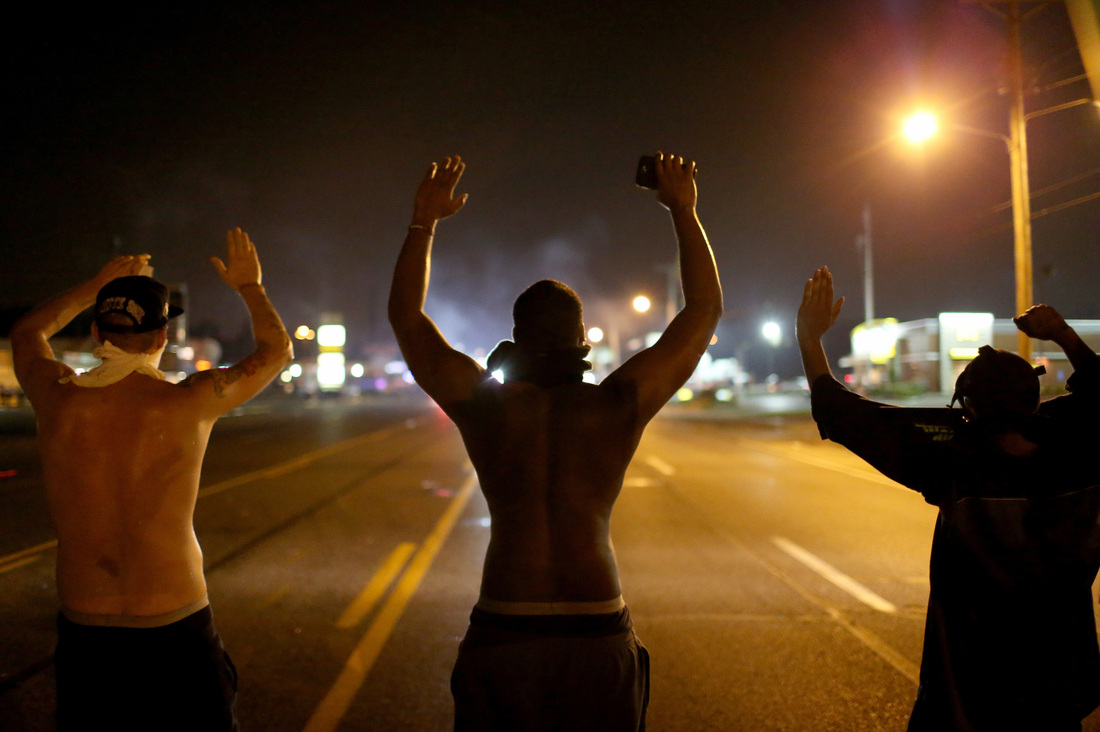
Demonstrators raise their arms and chant, "Hands up, don't shoot," in August 2014 as they protest the shooting death of Michael Brown in Ferguson, Mo.

Joe Raedle/Getty Images

Ronell Foster was riding his bicycle through the hushed streets of Vallejo, Calif., one evening when a police officer noticed that the bike had no lights and that he was weaving in and out of traffic.

The officer, Ryan McMahon, went after Foster with lights flashing, siren blaring and the car's spotlight pointed directly at him. Foster stopped. The pair exchanged words before Foster, who was on community supervision for a car theft conviction a month earlier, fled, eventually ditching the bicycle. McMahon caught up with Foster and jumped on top of him. The two struggled. McMahon, a rookie on the force, used a Taser on the father of two and struck him several times with his department-issued flashlight. Gunfire erupted — seven shots total. When it was over, Foster, 33, lay dying in the bushes in a darkened courtyard near an apartment complex.

Solano County District Attorney Krishna Abrams declined to bring charges against McMahon, who is white, saying the February 2018 fatal shooting of Foster, who was Black and unarmed, was justified. In a Jan. 31, 2020, letter to the Vallejo police chief, Abrams said that Foster "posed an immediate and extreme threat" to McMahon and that it was "objectively reasonable for Officer McMahon to defend himself and open fire on Foster."
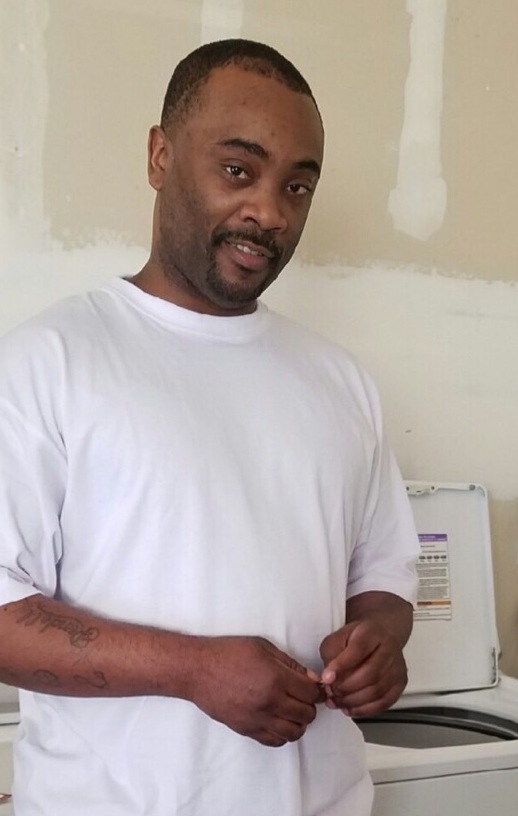
Ronell Foster was fatally shot by Vallejo, Calif., police Officer Ryan McMahon in 2018 after being stopped for riding his bicycle without a light. Foster was unarmed.

Foster family

A year later, he shot again.

This time, the slain man was aspiring Black rapper Willie McCoy, who was asleep in his silver Mercedes CLS500 outside a Taco Bell shortly before 11 p.m. on Feb. 9, 2019. An employee called 911 to report that McCoy was slumped over the steering wheel and blocking the drive-through. When McMahon and other officers arrived — six in all — one of them spotted a semiautomatic pistol in McCoy's lap. As McCoy slowly awoke, he moved his hand to scratch his chest, according to a report by an expert the city hired to review the shooting. Officers believed he was reaching for the gun, so they fired 55 shots in 3.5 seconds. McMahon said he fired after believing that the officers and residents were in "imminent danger." Officials cleared him over his role in that killing, too, but he was fired in September 2020 for violating department policy during the shooting "by engaging in unsafe conduct and neglect for basic firearm safety," a department official said.

"It's a very sad situation," McMahon said in a brief interview with NPR. "It's something I'm still dealing with. It hasn't gone away."

The deadly shootings of unarmed Black men and women by police officers in the U.S. have increasingly garnered worldwide attention over the last few years. The 2014 killing of Michael Brown in Ferguson, Mo., sparked a week of protests that catapulted the Black Lives Matter movement into the national spotlight. Since then, tens of thousands of people across the country have taken to the streets to protest police brutality of Blacks by mostly white officers.

Since 2015, police officers have fatally shot at least 135 unarmed Black men and women nationwide, an NPR investigation has found. NPR reviewed police, court and other records to examine the details of the cases. At least 75% of the officers were white. The latest one happened this month in Killeen, Texas, when Patrick Warren Sr., 52, was fatally shot by an officer responding to a mental health call.

For at least 15 of the officers, such as McMahon, the shootings were not their first — or their last, NPR found. They have been involved in two — sometimes three or more — shootings, often deadly and without consequences.

Those who study deadly force by police say it's unusual for officers to be involved in any shootings.

"Many officers will go their entire career without shooting — sometimes without pulling their gun out at all," said Peter Scharf, a criminologist and professor in the School of Public Health at Louisiana State University and co-author of The Badge and the Bullet: Police Use of Deadly Force. "It's rare."

Not every law enforcement agency releases detailed information about police shootings. The Los Angeles County Sheriff's Department and the Kansas City, Mo., Police Department, for example, refused to release specifics such as officer names or their race, citing open investigations.

Still, NPR reviewed thousands of pages of job applications, personnel records, use-of-force reports, citizen complaints, court records, lawsuits, news releases, witness statements and local and state police investigative reports to examine the backgrounds of the officers and analyze details of each shooting. We also interviewed use of force experts, criminologists, police, lawyers, prosecutors and relatives of victims.

Among NPR's other findings:

  • At least six officers had troubled pasts before being hired onto police departments, including drug use and domestic violence. One officer had been fired from another law enforcement agency, and at least two others were forced out.
  • Several officers were convicted of crimes while on the force, such as battery, and resisting and obstructing, but kept their jobs. In one instance, officials in a tiny Louisiana parish repeatedly fired and rehired a deputy who got into trouble with the law: three times over 30 years, records show.
  • More than two dozen officers have racked up citizen complaints or use-of-force incidents. A Fort Lauderdale, Fla., police officer had 82 reviews over use-of-force incidents but was never found in violation; a Vineland, N.J., officer had more than three dozen use-of-force incidents over a five-year period.
  • Several officers have violated their department policies and been cited for ethics violations, including a Hollywood, Fla., officer accused of trying to steer business to his company, and an Arizona state trooper accused of misuse of state property.

Nineteen of the officers involved in deadly shootings were rookies, with less than a year on the force. One was on the job for four hours, another for four days. More than a quarter of the killings occurred during traffic stops, and 24 of the dead — 18% — suffered from mental illness. The youngest person shot was a 15-year-old Balch Springs, Texas, high school freshman who played on the football team. The oldest was a 62-year-old man killed in his Los Angeles County home. Nearly 60% of the shootings occurred in the South, with more than a quarter in Texas, Georgia and Louisiana, NPR found.

The killings have led to at least 30 judgments and settlements totaling more than $142 million, records show. Dozens of lawsuits and claims are pending.

Charmaine Edwards (left) speaks to supporters during a protest outside a courthouse in Dallas in 2017. Her stepson, Jordan Edwards, was a 15-year-old in Balch Springs, Texas, when he was shot and killed by police.

LM Otero/AP

An examination of individual cases reveals the myriad ways that law enforcement agencies fail to hold officers accountable and allow them to be in a position to shoot again. In many instances, the criminal justice system refuses to prosecute, often resulting in departments putting officers back on the street instead of desk jobs where they have little contact with the public. Other times, police unions protect officers from accountability. And sometimes, departments are so desperate to recruit officers that they ignore warning signs such as an officer's troubled past and hire them anyway.

"Why do they get passes on killing people?" asked Paula McGowan, Foster's mother. "If the system was right ... they would hold these people accountable."

"Unnecessary and unreasonable"

Nathaniel Pickett II was walking back to his $18-a-night room at the El Rancho, a seen-better-days bungalow motel along historic Route 66 in Barstow, Calif. It was shortly after 9 p.m. on Nov. 19, 2015, and Nate, as his family called him, often took evening walks. As the 29-year-old former engineering student crossed the street, he caught the eye of Kyle Woods, a San Bernardino sheriff's deputy. Woods made a U-turn into the motel parking lot, jumped out of his cruiser and approached Pickett, police records show.

He demanded Pickett's name and birthdate. Pickett complied. In fact, he did everything Woods asked of him, including taking his hands out of his pockets. When Woods asked him if he lived at the motel and where he was from, Pickett said he didn't know. When Pickett asked if he had done something wrong, the deputy said he just wanted to talk to him.

"What's the problem?" Pickett asked Woods nine times as the deputy peppered him with questions about whether he had ever been arrested (yes), if he had lived in Barstow all of his life and where he was going.

"There is no problem," Woods responded.

Pickett asked if he could go to his room where he had lived since moving to Barstow seven weeks earlier. Woods would later admit under oath that he knew he had no probable cause to arrest him and that Pickett had the right to walk away. But when he tried, Woods grabbed him and told him to "stop resisting." Woods threatened to use a Taser on him. Pickett put his arms up and was running toward his room — Room 45 — when he tripped and fell in the breezeway. As he scooted backward from Woods, the deputy caught him. The two scuffled while a male citizen volunteer on patrol with Woods watched from a few feet away. Woods punched Pickett 15 to 20 times before pulling out his service weapon and threatening to shoot him. He fired, hitting Pickett twice in the chest — once with the barrel of the gun pressed against the man's chest.

Nathaniel Pickett II (right), who suffered from mental illness, was shot to death by a San Bernardino County, Calif., sheriff's deputy in 2015 after he was stopped while walking to a motel where he lived. Pickett was unarmed. His father (left) and mother sued the county and were awarded $33.5 million.

Nathaniel Pickett Sr.

"Ow," Pickett moaned. One of the bullets pierced his heart and left lung. Pickett was pronounced dead at the scene.

Woods, on the force for two years at the time but on the street for just a few months, said he shot him because he feared for his life.

Woods, who is Black, didn't give a statement to police about the incident for 28 days. And when he did, he said that he stopped Pickett after seeing him hop the motel fence. He thought Pickett was trespassing, and he was fidgety, like he might be under the influence, Woods said. Pickett had marijuana in his system, and his blood alcohol level was 0.01%, far below the level to be considered legally impaired, records show.

The deputy never faced criminal charges in Pickett's death, but the victim's family filed civil charges. And when he testified under oath at the civil trial, Woods told a different story: He said he never saw Pickett jump over the fence and that the gate actually was open. He also said it never occurred to him that Pickett could be mentally ill. Pickett was diagnosed with mental illness during his freshman year at Hampton University in Virginia and had been treated through the Mental Health Court in San Bernardino in 2012 after a conviction for resisting a peace officer and "false personation," records show.

Scott DeFoe, who spent two decades with the Los Angeles Police Department, testified as an expert witness at the civil trial. He said that Woods' use of force was "unnecessary and unreasonable."

"This is probably one of the worst cases I have looked at because of the mental health component," DeFoe testified. "There was no crime. ... He ran as he had a lawful right to do."

The jury in the civil trial was unanimous. Jurors agreed that Woods had no right to detain Pickett; used unreasonable or excessive force against him, which caused his death; and delayed getting him medical care. They awarded Pickett's family $33.5 million, one of the largest amounts ever in an officer-involved shooting case.

Nathaniel Pickett Sr., 65, said that Nate was the only child he had with Dominic Archibald, a two-time combat veteran and retired Army colonel. After their divorce in 1990 when Nate was not quite 5, the boy went to live with his mom. He became a Boy Scout and fancied Frank Sinatra music, art and sports — except football because he didn't like getting dirty. Archibald eventually enrolled him at the Fork Union Military Academy, an all-boys college preparatory boarding school in Virginia. She agreed to let him transfer in his senior year to Woodrow Wilson High School, a public school in Washington, D.C.

"We just wanted him to be happy," Pickett said.

Less than three years after Pickett's death, Woods was involved in a second on-duty shooting of another unarmed man.

Minutes after starting his 7 p.m.-7 a.m. shift on Jan. 14, 2018, Woods noticed the man, Ryan Martinez, driving his black Jeep in Barstow without an illuminated license plate. He activated his lights and siren, and hit the gas. During the pursuit, Martinez lost control of the car and ran off the road into a drainage ditch, police records show. The car flipped. Woods said he ordered Martinez to show his hands. He refused. Woods fired two shots at him but missed. Afraid that Martinez might have a gun, Woods used a Taser on him unsuccessfully before drive-stunning him in his leg. Woods then shot him in the chest and hand when he said the man "reached for his waistband area." Martinez, 27, survived. No gun was found at the scene, according to police records.

Woods was not wearing a body camera. Martinez did not respond to a request through his mother for an interview.

"He was shot 3" times, his mother, Kathy Searcy, said in a Facebook message to NPR that included photos of his bullet wounds. "Plus, he was being tased at the same time."

Michael Ramos, the San Bernardino County district attorney at the time of both shootings, declined to charge Woods, saying the deputy was justified in shooting both men. He said in a recent phone interview with NPR that he doesn't remember the cases but said he always adhered to the law when deciding whether to charge an officer with killing someone.
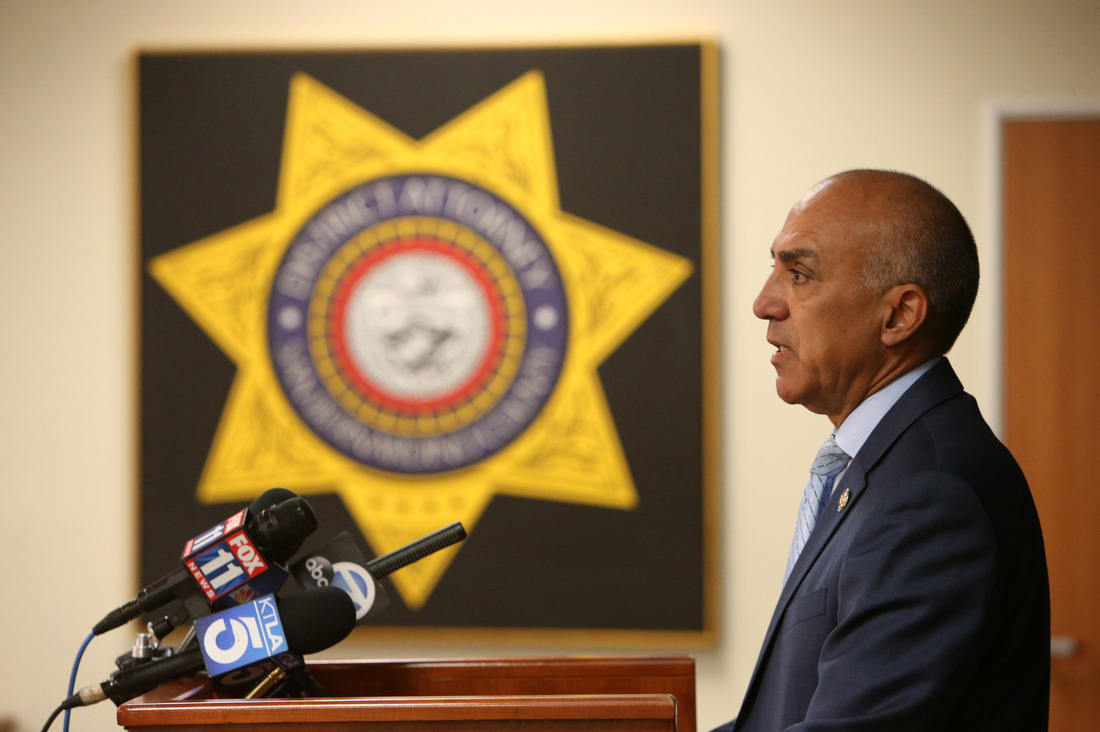
Then-San Bernardino County District Attorney Michael Ramos speaks during a press conference in 2018. In an interview with NPR, Ramos, now a former prosecutor, defended officers, saying that they have an impossible job.

Stan Lim/The Press-Enterprise Group via Getty Images

"Each case is different," said Ramos, who was the district attorney from 2003 to 2018, when he lost his reelection bid for a fifth term. "But when you apply the facts to the law, that's what you look at."

Ramos defended officers, saying that they have an impossible job.

"Taking someone's life is not easy," he said. "It's not something they brag about or high-five each other about. It's the last thing they want to do."

When asked if officers who kill unarmed people should be taken off the street, Ramos said that decision should remain with the departments.

"They should be given the resources, counseling and time off, but it's up to the chiefs," he said.

Authorities said that Woods "reasonably believed he had to use deadly force to protect his own life." He was placed on paid administrative leave for at least three days after each shooting, which is routine for officers involved in deadly force, said sheriff's department spokeswoman Jodi Miller.

Woods, 28, could not be reached for comment.

Vincent Ewing, the attorney who represented Woods and the county in the Pickett lawsuit, declined to comment on the record.

Pickett's father said he remains haunted by his son's killing.

"It doesn't ease with time," he said. "It still bothers me."

The most difficult time, he said, is when he occasionally sees Woods at the courthouse in Victorville, where the deputy is now assigned.

"He didn't show no remorse," Pickett said. "If he was remorseful, he would have said, 'Hey, I'm sorry.' "

Little accountability

The decision not to charge Woods is common. Authorities failed to charge officers in more than 80 cases, records show.

Of the officers involved in the deadly shootings of unarmed Black people over the last five years, 13 were charged with murder. Two were found guilty.

Three others charged with murder were acquitted, and one was found not guilty of murder but guilty of aggravated assault, false statements and violation of his oath of office. Seven murder cases are pending.

Of seven officers charged with manslaughter, two were found guilty.

In 33 shootings, officers were fired or resigned. At least three got their jobs back, and five went on to work for other law enforcement agencies, records show.

Philip Stinson, a criminal justice professor at Bowling Green State University in Ohio and former police officer in Virginia and New Hampshire, said it's difficult to prosecute officers charged with murder or manslaughter from an on-duty shooting because juries often sympathize with them.

"The courts are very reluctant to second-guess the split-second decisions of police officers in potentially violent street encounters that might be life-or-death situations," Stinson said. "They somehow seem to take everything that's been presented in the case, in the trial, and just disregard the legal standard."

Ronald C. Machen Jr., the U.S. attorney for the District of Columbia for more than five years during the Obama administration, said that prosecuting police officers who gun down unarmed Black men and women will continue to be challenging until there are more "minorities in the system."

"This is why you need Black prosecutors and Blacks on juries — to hold people accountable," Machen said. "For police officers to have the credibility to do their jobs, they have to be held accountable."

One officer, five shootings

The decision not to hold officers accountable doesn't rest solely with prosecutors. Police unions often make it all but impossible to remove an officer from the force despite repeated shootings and other infractions.

Jerold Blanding was involved in five shootings — two off-duty and three on duty — during his 24-year career with the Detroit Police Department, a review of more than 1,700 pages of agency records shows. One was fatal. He also shot a pigeon and was investigated over assaults on police officers, improper conduct, harassment, excessive use of force, domestic violence and threats. Yet he kept his job.

Known for having a temper, Blanding started having trouble three years after his March 1994 hiring when he shot a man while off-duty at a Detroit nightclub, police records show. The victim survived. A year later, he was involved in another off-duty, nonfatal shooting at an ATM after a man who was confused mistakenly tried to get into Blanding's car. Blanding was exonerated in both cases.
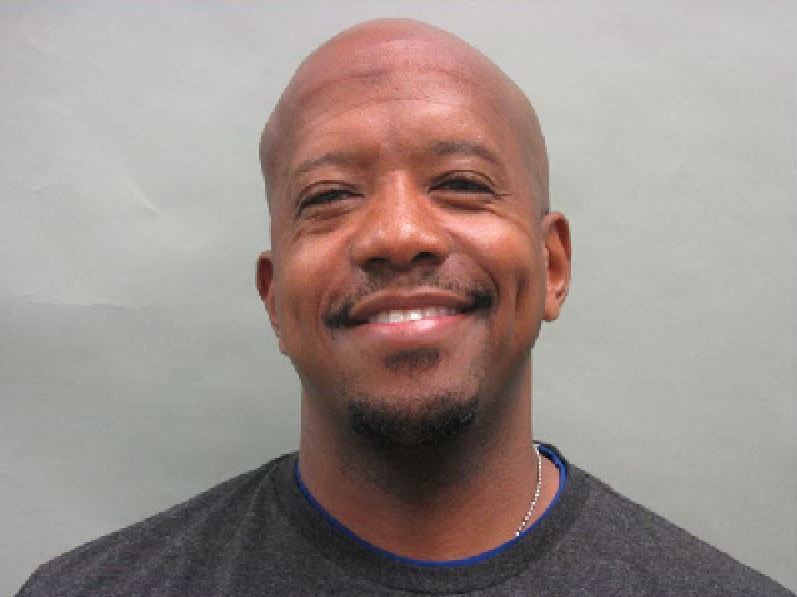
Jerold Blanding was involved in five shootings — two off-duty and three on duty — during his 24-year career with the Detroit Police Department, agency records show. One was fatal.

Michigan Department of Corrections

An internal affairs investigation in 2001 found that he displayed improper conduct after assaulting a female cop he was dating at the time. In 2002, Blanding was accused of making threats, and a year later, internal affairs launched another investigation — this time, into his excessive use of force. He had a third shooting in 2004 while working in drug enforcement. That man survived.

In August 2015, Blanding fired 16 shots at a man inside a car during a domestic dispute. The man, DeMar Parker, had gone to the home of his ex-girlfriend, with whom he had a young daughter. An argument erupted, and a Detroit police officer, her son's father, was called. He then called for another officer to meet him at the house. That officer brought along Blanding. When Blanding and the other officer arrived, Parker jumped in his silver Cadillac and sped off. He returned minutes later waving a pistol, police records show. Blanding saw the gun and opened fire on Parker's car, claiming he thought Parker was going to shoot one of the other officers or run him over. The Wayne County Prosecutor's Office declined to bring criminal charges against Blanding, though the department found he violated policy. Parker sued and settled with the city for $97,750, according to the city attorney's office.

In February 2017, in the backyard of an abandoned home, Blanding, who is Black, fatally shot 19-year-old Raynard Burton.

Blanding and his partner were patrolling a neighborhood of mostly burned-out and boarded-up houses and overgrown lots on Detroit's west side when a green Pontiac Bonneville whizzed past. The car spun out of control and crashed into a building. Burton, the driver, ran. When Blanding eventually caught him, he claimed he saw the teen "grab at his waist as if he had a weapon," records show. Blanding grabbed Burton with one hand while holding his department-issued weapon in the other. The pair struggled, and Blanding shot him once in the chest before yelling for his partner and calling for a supervisor — and his union steward. Burton, who was pronounced dead at the scene, was unarmed.

Blanding was not charged in that case either and returned to his job.

"I don't think there's an excuse for keeping people like that," said Geoffrey Alpert, a police use-of-force expert and criminology professor at the University of South Carolina, after hearing the details of Blanding's case from NPR. "That's just ridiculous."

Alpert said that retaining troubled police officers is risky and "has enormous consequences."

"The point is you want to get good cops and not fill your coffers with these questionable cops," he said. "Because in the long run, they're going to cost you more money."

Richard Rosenfeld, a criminology professor at the University of Missouri-St. Louis, said police unions play a major role in shielding officers.

"The most immediate obstacle is the union contract," Rosenfeld said. "The unions, all in the name of due process, have made it difficult to remove officers whose records indicate they engaged in serious misconduct."

Isaiah McKinnon, Detroit's police chief from 1994 to 1998, agreed. He said that city officials and police supervisors involved in negotiating the contracts also are to blame for a department's inability to get rid of officers who repeatedly violate policy.

"You terminate them and see if they will fight their way back, and most do because of the union contract," said McKinnon, who also served as the city's deputy mayor. "The unions are there to protect officers, but often they're contributing to what the officers are doing."

Blanding's troubles continued to mount without consequences, records show. In December 2017, he was accused of being intoxicated on the job and having his gun taken from his lap while he allegedly slept. The weapon was returned "without further action." Two days before Christmas in 2017, he called 911 after a domestic violence incident. He told the dispatcher that he was carrying a gun and to "send someone before he is back on the news."

But in early 2018, while out on stress leave and ordered not to carry a gun, Blanding showed up at the scene of a pedestrian accident and refused to answer questions about who he was or comply with orders given by other officers, records show. He reeked of alcohol and had slurred speech, one officer said. A preliminary breath test indicated Blanding's blood alcohol content was 0.18%, more than twice the legal limit in Michigan. They found two weapons on him along with his department identification card indicating he had "no gun status," records show. He cursed at officers, called them rookies, was handcuffed and put in the back of a squad car. They arrested him for possession of a weapon while intoxicated and violating the concealed pistol license.

Blanding was charged with eight counts of assaulting, resisting and obstructing, eight counts of felony firearm and three counts of possession of firearms while under the influence of alcohol. He pleaded guilty to one felony count of assaulting, resisting and obstructing. He was fined, given probation and ordered to do community service and attend Alcoholics Anonymous meetings, according to Chris Gautz, spokesman for the Michigan Department of Corrections. Blanding retired in September 2018 with a full pension, according to a police department spokesman.

When reached at his home recently, Blanding, 51, declined a request for an interview.

"I'm still seeking therapy," he said.

Detroit Police Chief James Craig declined through a spokeswoman to discuss Blanding or why he allowed him to stay on the force after multiple shootings.

"Unions have got to understand that they can't continue to have people over and over again who are doing these things continue to be police officers," said McKinnon, the former chief.

"He just wasn't the best pick"

Zechariah Presley wanted to be a police officer because it offered him a chance at a career where he could "make a difference." So, in May 2016, he applied to the St. Marys Police Department, a 32-member force in a town of 18,500 residents in southeastern Georgia, not far from the Florida state line.

Officials found that he "did not respond truthfully" to several questions during a truth verification exam and did poorly during candidate interviews, internal reports show. Department officials rejected him, saying he was "not a good candidate" and "very weak." He also acknowledged he lost a conditional job offer with a law enforcement agency in Texas after making a "sexual innuendo," records show.

"He just wasn't the best pick," Timothy Hatch, who was St. Marys police chief at the time, said in an interview with NPR. "He didn't come across in our interview process as someone who needed to be behind the badge."

Presley went 8 miles to the next town over and applied at the 40-member Kingsland Police Department a year later. He acknowledged on his background questionnaire of being involved in domestic violence, assault, buying or selling drugs, and other incidents. An internal report found Presley had 10 red flags and recommended officials review them before deciding whether to hire him.

They hired Presley anyway in July 2017.

Within months, residents filed complaints about him.

In a complaint, one 43-year-old Black man wrote that one day after he'd complained to the chief about the officer's conduct, Presley came and parked in front of his house. "I'm living in fear of my life," the man wrote, because of the abuse of power and constant harassment on traffic stops.

Former Kingsland, Ga., police Officer Zechariah Presley was found not guilty of manslaughter in the 2018 shooting death of Anthony Green, who was Black and unarmed. The officer was hired on the force despite numerous red flags, including a rejection from another police department in a neighboring town.

Kingsland, Ga., Police Department via AP

A Black female resident wrote that Presley followed her for about a mile and then stopped her for failing to use a turn signal when she changed lanes. She alleged that Presley racially profiled her. Presley is white.

Presley had seven use-of-force incidents in six months, three involving Tasers, records show. He once used a stun gun on a substitute teacher at the county Board of Education office. He was investigated internally twice within two days for misconduct. He received departmental warnings about violating policies and was suspended without pay for a day.

Yet he stayed on the force.

While on patrol one night in June 2018, Presley pulled into a convenience store parking lot and spotted a white Chrysler Pacifica and a man he recognized, Anthony Green. The two had a previous run-in, and he knew Green didn't have a valid license. As Green drove off, Presley followed him. Green ran his car onto the shoulder, prompting Presley to activate his blue lights. Green and a passenger jumped out and ran, but Green left his phone and went back to retrieve it, law enforcement records show. He took off running with Presley in tow, who unsuccessfully used a Taser on Green. When Green pushed him, Presley fired eight shots from his .40-caliber Glock, striking the 33-year-old Black man at least five times, including in his chest and back, according to records from the Georgia Bureau of Investigation, which handled the case. Green died at the scene.

Presley was charged with voluntary and involuntary manslaughter, and fired from the department. A jury of 11 whites and one Hispanic found him not guilty of manslaughter but guilty of violating the oath of public office in October 2019. A judge sentenced him to one year in prison and four years' probation, and ordered him to pay a $1,500 fine. Presley was released in May after serving seven months in prison.

Presley, 29, did not return phone calls seeking comment.

"The hiring of Zechariah Presley probably would not have taken place in my administration given the information I have," said Kingsland Police Chief Robert Jones, who took over the department in 2019.
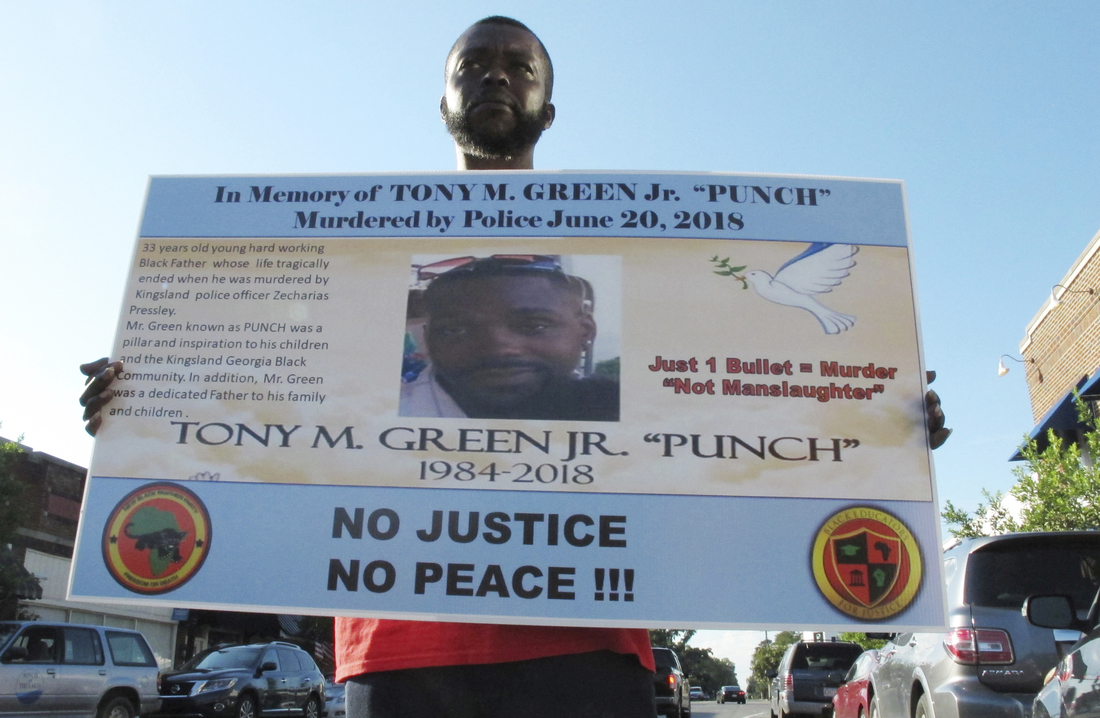
Tony White holds a sign showing a photo of his slain cousin, Anthony Green, outside Kingsland City Hall in the southeastern Georgia town. Authorities say Green was fatally shot in 2018, while he fled Presley, then a Kingsland police officer.

Russ Bynum/AP

Jones and others acknowledged that departments often hire officers such as Presley because they're desperate to recruit and are willing to ignore red flags.

"We need bodies," Jones said. "Some places have been willing to lower the standards and bring bodies in, and it's a recipe for disaster."

Rosenfeld, the criminology professor at the University of Missouri-St. Louis, said that departments, mostly small ones that lack resources, are "more willing to look past misdeeds."

"Small departments that are strapped for officers take them where they can find them," he said.

Green's death has prompted changes in the Kingsland department, including mental health treatment for officers and a hiring board to review candidates, Jones said.

"It's more important for us to move forward, train properly and to show that the stigma of what happened with Presley will not be tolerated," he said.

LaMaurice Gardner, a police psychologist in Detroit, said the toll that one shooting — or more — takes on a police officer can be devastating.

"People don't realize the psychological effects a shooting takes on an officer and their family," said Gardner, who has worked as a reserve officer for 26 years in suburban Detroit. "You're investigated like you're a perpetrator. You can't work on the street. You can't get overtime. Your peer support is pulled away."

Gardner acknowledged that departments face difficult issues now with police shootings, including of unarmed Black men and women.

"Are there bad cops out there? Hell, yeah, there are," he said. "Policies need to be changed."

NPR's Emine Yücel contributed to this report.“

America has never been a democracy. Just how severe will America's minority rule become?

Just how severe will America's minority rule become?

Outdated filibuster rules allow a small minority of the US population to hold the rest of the country hostage

‘The filibuster means that about 11% of the voting-age population has successfully elected Republican senators who can theoretically block anything that the other 89% of us might want.’
‘The filibuster means that about 11% of the voting-age population has successfully elected Republican senators who can theoretically block anything that the other 89% of us might want.’ Photograph: Leigh Vogel/UPI/Rex/Shutterstock

“As everyone from President Joe Biden to the conservative Democratic senator Joe Manchin to liberal groups now push to reform the Senate’s rules, the defense of the filibuster goes something like this: by design, our nation is a republic, not a direct democracy, and therefore we must create institutional obstacles to empower a minority of Americans to prevent the whims of the majority from being too hastily enshrined in legislation. By this logic, we must keep the Senate’s cloture rule, which requires 60 of the Senate’s 100 members to end a filibuster and move a bill to a vote.

Those who make this case seem to love sounding like erudite constitutional scholars steeped in the grandeur of American history, and they purport to be pluralists worrying about minority rights.

“Letting the majority do everything it wants to is not what the founders had in mind,” said the Senate Republican whip, John Thune, in a floor speech defending the filibuster this week. “The founders recognized that it wasn’t just kings who could be tyrants. They knew majorities could be tyrants, too, and that a majority if unchecked could trample the rights of the minority … so the founders created the Senate as a check on the House of Representatives.”

But an inconvenient fact undermines Thune’s argument and should set pluralists at ease: even if the filibuster were eliminated and bills could advance on a simple majority vote, the Senate would still be giving a minority of the American population enough Senate representation to block legislation supported by the majority of the country.

In the debate over the filibuster, then, the question is not whether you believe the majority should rule. Instead, the question is this: how small a minority should be given legislative veto power over the rest of the country?


Back in 2010, the Republican Senate majority leader, Mitch McConnell, was not wrong when he said the founders were “quoted as saying at the constitutional convention the Senate was going to be like the saucer under the teacup, and the tea was going to slosh out and cool off”.

To that end, the founders created a Senate giving large and small states equal representation. The idea was for the upper chamber to act as a stately bulwark against the more uncouth ideas that could bubble up from the rabble and its representatives in the lower chamber. In the words of James Madison, the Senate’s undemocratic structure was designed as a “necessary fence” against “the impulse of sudden and violent passions” of the people.

In the modern era, the structure of the Senate has often turned the upper chamber into a place that does not merely respect minority rights – it has actually allowed the minority to rule, regardless of the status of the filibuster. As CNN’s Ronald Brownstein recounted last year, “While the [Republican party] has controlled the Senate for about 22 of the past 40 years, Republican senators have represented a majority of the nation’s population for only a single session over that period: from 1997 to 1998.”

Maybe you like this undemocratic dynamic, because you believe it represents the founders’ ideals. Maybe you hate this dynamic, because you believe it makes a mockery of democracy. Whichever side you are on, here’s the point that is germane to the renewed debate over Senate rules: even if the filibuster is eliminated, a minority of the American population will still retain disproportionate, outsized power in Congress’s upper chamber, just as the founders desired.

That is because under simple-majority voting rules, the majority of the country’s population does not necessarily rule the Senate. Even without the filibuster, the Senate is still a place where the 265,000 South Dakotans who elected Thune get as much representation as the 2.2 million Georgia voters who elected Raphael Warnock. Consequently, a filibuster-free Democratic Senate would still allow a minority of the population’s senators to rule, if they so choose – because the Senate still provides far less than half the country with the 51 votes necessary to stop any legislation in its tracks.

To understand how, let’s do some math.

founding fathers painting
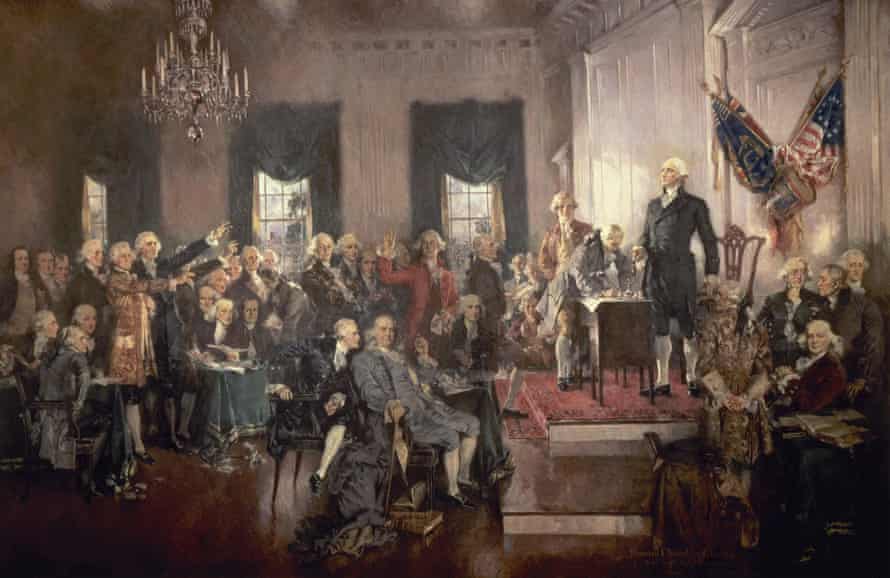
‘Maybe you like this undemocratic dynamic, because you believe it represents the founders’ ideals.’Photograph: Granger Historical Picture Archive/Alamy Stock Photo

Right now, the 50 Senate Democrats represent roughly 61% of the country’s population, according to census data. The 50 Senate Republicans represent just 49% of the population. All of the Republicans plus Manchin (the Democrat most likely to oppose progressive legislation) represent less than half the country’s population. And yet in a filibuster-free Senate, they could still use a simple-majority vote to stop anything pushed by 49 Senate Democrats who represent 61% of the country. (Note: the percentages don’t add up to 100 because six states have one Democratic and one Republican senator.)

If you happen to be one of those constitutional originalists worried about preserving the power of small states, don’t fret. The power imbalance becomes more pronounced when you take party out of the equation and just look at states with the least population. A whopping 52 senators from the least populated states currently represent just 17% of America’s total population – but they would still be able to stop all legislation in a filibuster-free Senate under simple-majority rules.

A different way to consider the situation is to think of each American being represented by two Senate votes. Right now, 49 Democrats represent 56% of all those votes. The Republican-Manchin caucus represents just 43% of all of those Senate votes. But again, even without the filibuster, conservatives would have 51 Senate votes to stop anything.

These numbers actually understate the situation. That’s because while senators technically represent their entire states, they only need half the voter turnout in their states to actually get into the Senate.

The point here is simple: no matter what is done with the filibuster, the much-worshiped “cooling saucer” is preserved, and every armchair constitutional scholar with a high self-regard will still get to smugly tell others we are a republic, not a democracy.

But these figures underscore not just that the filibuster can be safely discarded without trampling minority rights. They also spotlight how insane the filibuster actually is.

Using the same aforementioned math, the filibuster rules allowing 41 senators to halt legislation effectively empower a group of Republican senators representing just 22% percent of the population to gridlock the government. Again, considering that it only takes 50% of the vote to get elected, the filibuster means that about 11% of the voting-age population has successfully elected Republican senators who can theoretically block anything that polls show the overwhelming majority of the country might want.


Part of what makes the filibuster discourse so confusing is the differing definitions of “minority”.

When the founders created the Senate, they aimed to guarantee that the minority of the population still had rights – they didn’t care about the rights of political parties or factions (which many of them hated).

By contrast, when Republicans like Thune depict the filibuster as a noble bulwark protecting “minority rights”, he is not talking about protecting a minority of the population. He is talking about fortifying the power of the chamber’s minority political factions, regardless of how small a segment of the population those factions actually represent.

That’s a huge difference – and it helps explain the filibuster’s practical application.

Remember, the filibuster is not known as the instrument preventing the majority of the population from trampling the rights of racial or ethnic minorities. Quite the opposite: it has in practice empowered an ideologically conservative political faction to both deprive certain minority groups of their rights and block what the majority of the population wants.

When it comes to racial equality, Martin Luther King III noted in an op-ed this week: “The filibuster has historically been used as a tool to try to keep segregationist policies in place. In the 1920s, it was employed to stop anti-lynching legislation from moving forward. In the 1950s, Senator Strom Thurmond of South Carolina famously held the longest filibuster on record to delay, unsuccessfully, civil rights measures. And in a failed effort to block the Civil Rights Act of 1964, southern segregationists filibustered the bill for 60 working days.”

Similarly, think about the debate over firearm policy in the wake of yet more mass shootings. The Nation’s Ari Berman notes that after the Sandy Hook massacre, “bipartisan legislation requiring background checks for gun sales was supported by 86% of Americans and 54 senators but blocked by 46 senators representing just 38% of the country.”

In both cases, we see that Madison’s desire to restrict democracy in order to limit “the impulse of sudden and violent passions” of the public wrongly presumes that the only way those impulses are expressed is through the passage of new legislation. In practice, blocking legislation has been an equally pernicious expression of such volatile impulses and passions by a motivated but tiny segment of the population. The filibuster allows those impulses and passions to not just influence legislation but to wholly dominate public policy through that minority’s political factions.

In light of this history and the math of the Senate, proposals to merely reform the rules with half measures like a “talking filibuster” seem at best unnecessarily cautious, especially since the filibuster is now so routinely invoked to halt legislation.

Fully eliminating the filibuster would still allow a minority of the population to wield disproportionate power, because the chamber’s structure has baked-in rights for the minority of the population even in straight up-or-down vote situations.

Put another way: even without the filibuster, there can be a Senate majority party whose senators represent less than half the country. There can also be a transpartisan coalition of 51 senators who represent less than half the country and who can stop essentially anything.

The filibuster just makes this undemocratic system more undemocratic, in ways that cannot be justified. In the name of preventing a tyranny of the majority, it creates what I have called a tyranny of the tiny minority. It takes a House of Lords-style institution that has been rationalized by glib “we’re a republic, not a democracy” logic and transforms it into a cartoonishly undemocratic weapon of reactionary power.

The rationale for that transformation has amounted to vapid paeans to the founders. Everybody seems to have forgotten that Alexander Hamilton admitted: “To give a minority a negative upon the majority (which is always the case where more than a majority is requisite to a decision), is, in its tendency, to subject the sense of the greater number to that of the lesser.”

Even without the filibuster, the lesser number of the country will have more than enough Senate representation to express many of its political desires. Keeping the filibuster simply lets that lesser number completely rule everything.

  • David Sirota is a Guardian US columnist and an award-winning investigative journalist. He is an editor-at-large at Jacobin, and the founder of the Daily Poster. He served as Bernie Sanders’ presidential campaign speechwriter”

Racists beat my Chinese grandmother. She knew the police would never care. “Her experiences in the U.S. taught her never to expect protection from the authorities.

Racists beat my Chinese grandmother. She knew the police would never care.

“Her experiences in the U.S. taught her never to expect protection from the authorities.

New Yorkers march on March 20 to mourn the lives lost in the mass shooting in Atlanta earlier in the week.

In 1991, a group of boys followed my grandmother on her way home to our apartment in Queens. As she walked underneath the subway tracks’ long dark shadow, weighed down by red plastic grocery bags, they taunted her with pretend Chinese sounds. She yelled at them to shut up and leave her alone; her thick accent only made them laugh harder. Then one of them lunged at her with a stick and struck her left eye, blinding it permanently. A shopkeeper saw her fall and called for an ambulance. My aunt, determined to get justice, made the initial statement to police, found out one of the boys’ addresses and got the shopkeeper to agree to testify as a witness. But when my grandmother heard about the potential investigation, she said, “No, I don’t want trouble.”

I’ve thought of that incident often as, over the past year, hate incidents against Asians increased 150 percent nationwide. They increased 833 percent in New York City, where I live, and where just this week, a man kicked down and stomped on a 65-year-old Filipina American on her way to church. Community organizers, politicians and police think these figures grossly undercount the real number of incidents, an error often attributed to a cultural reluctance to go to the police. “Not wanting trouble” is a sentiment commonly associated with Asians in America — the one that makes outsiders associate them with words like “weak,” “passive,” “easy to overpower.”

That attitude was widespread in my grandmother’s social circle: Friends of hers in the neighborhood also had been harassed on the street by people making ching-chong noises and pulling at their eyes, spitting at them, following them, sometimes pelleting them with stones. They hadn’t reported these incidents, either. Still, hearing those words from my grandmother after her attack shocked me; I knew the woman who raised me to be outspoken, even aggressive. Back then, at age 15, I didn’t understand the generational gap that shaped our vastly different expectations of the country we lived in. Her harsh experiences of immigrant life had conditioned her never to seek protection from those in power — or anyone else, for that matter.

My grandparents had never been called “model minority,” a concept popularized decades after their arrival in the United States. They were, however, frequently tagged as vermin, pestilence and counterfeit human beings. My grandfather, who arrived in 1932, had lived with his father under the Chinese Exclusion Act, which denied them the right to become citizens, vote and receive the legal protections that came with citizenship. He had to carry a special identity card; if he was found without it, he faced deportation. Even after the act was repealed in 1943, an annual quota allowed just 105 Chinese “aliens” into the country. The message was clear: Chinese immigration would be tolerated only in extremely small quantities. The limit was even stricter for Chinese women, who had been specifically excluded from entering the country by laws characterizing them as immoral and prone to prostitution.

My grandmother, entering the United States as a 19-year-old bride in 1948, expected to be treated badly. At the time, so few Chinese women were in the country that she was often the first one people had ever met. She was aware that her presence was tolerated but not welcomed. She had no faith that she could call on the authorities, in any context, for protection. When she worked as a seamstress in the Long Island factories, co-workers often blamed her for their mistakes, knowing that she couldn’t speak English well enough to defend herself. On these occasions, she might lose half or all of her pay. When I asked why she didn’t get Grandpa or one of her kids to speak up for her, she said that she knew that no one took her seriously.

Learning more about the history of racial laws against the Chinese — there had been more than 20 — I came to understand how they had influenced my grandparents’ generation. If you live in a place that identifies you as undesirable, too foreign to be American, a threat to its civilization, then distrusting the authorities can be a survival tactic. You can follow the law, yes, but you can’t rely on it, because of the way it denigrates your person and your entire culture. You keep your distance from the authorities out of fear of deportation, jailing or violence — but also out of disdain for the injustice they are willing to uphold.

Though my grandparents raised me, my reference point for the Asian American experience was like that of Asians who had entered the country after 1965, after the national quota system had been abolished. This population constitutes the majority of Asian Americans living in the United States today. For us, this is where the Asian American experience begins: after civil rights laws prohibiting racial discrimination in employment, voting and housing became part of the social fabric. I trusted that the government and society at large were inclined toward fairness. I learned in school that I was part of this country’s celebrated multiculturalism; I belonged here and deserved the same rights others had. I believed this even after Grandma lost her eye. I told myself that assaults like hers were anomalies, or a local phenomenon. After this past year, however, with nearly 3,800 anti-Asian incidents recorded across the country, I have much less faith.

Thirty years ago, my grandmother had scoffed at the very idea of “hate crime.” She and my grandfather had lived through a period when hating the Chinese hadn’t been a crime; it had been an expectation. They would have been flabbergasted at today’s public rallies decrying anti-Asian violence, attended by politicians who condemn (rather than endorse) the violence, as well as by different racial and religious groups showing support and solidarity.

Those moments of unity have felt hopeful. But they cannot fully counteract the pain of these physical and verbal attacks. Rep. Grace Meng (D-N.Y.), responding to this week’s highly publicized assault, put it this way: “We have gone from being invisible to being seen as subhuman.” The assailant in that incident reportedly cursed at the 65-year-old New Yorker, yelling, “You don’t belong here.” Hearing such words from other Americans — especially other racial minorities — makes the idea of solidarity feel hollow and illusory; they’re also a sharp reminder that no matter how “assimilated” we become, a fundamental rejection has endured. Perhaps less has changed since my grandmother’s attack than I believed.

Today, the country seems to be experiencing a watershed moment, in which disparate Asian groups are banding together — demanding justice when attacks occur and accountability when justice is withheld. My grandparents would never have called themselves Asian American: They were Asians who lived in this country under conditions that made it impossible for them to truly regard themselves as American. My generation believes we belong, and we want more than simply to “avoid trouble.” We want what our elders barely hoped for — for others to recognize our belonging.”


Racists beat my Chinese grandmother. She knew the police would never care

Virus Variants Threaten to Draw Out the Pandemic, Scientists Say Declining infection rates overall masked a rise in more contagious forms of the coronavirus. Vaccines will stop the spread, if Americans postpone celebration just a bit longer.

Virus Variants Threaten to Draw Out the Pandemic, Scientists Say

Declining infection rates overall masked a rise in more contagious forms of the coronavirus. Vaccines will stop the spread, if Americans postpone celebration just a bit longer.

Signs encouraged social distancing along Ocean Drive Miami Beach, Fla., where revelers have flouted virus precautions during a tumultuous spring break. 
Scott McIntyre for The New York Times

For weeks, the mood in much of the United States has been buoyant. Cases, hospitalizations and deaths from the coronavirus have fallen steeply from their highs, and millions of people are being newly vaccinated every day. Restaurants, shops and schools have reopened. Some states, like Texas and Florida, have abandoned precautions altogether.

In measurable ways, Americans are winning the war against the coronavirus. Powerful vaccines and an accelerating rollout all but guarantee an eventual return to normalcy — to backyard barbecues, summer camps and sleepovers.

But it is increasingly clear that the next few months will be painful. So-called variants are spreading, carrying mutations that make the coronavirus both more contagious and in some cases more deadly.

Even as vaccines were authorized late last year, illuminating a path to the pandemic’s end, variants were trouncing Britain, South Africa and Brazil. New variants have continued to pop up — in California one week, in New York and Oregon the next. As they take root, these new versions of the coronavirus threaten to postpone an end to the pandemic. 

At the moment, most vaccines appear to be effective against the variants. But public health officials are deeply worried that future iterations of the virus may be more resistant to the immune response, requiring Americans to queue up for regular rounds of booster shots or even new vaccines.

“We don’t have evolution on our side,” said Devi Sridhar, a professor of public health at the University of Edinburgh in Scotland. “This pathogen seems to always be changing in a way that makes it harder for us to suppress.”

Seniors wait in line to receive vaccinations in Belford Roxo, Brazil. A variant first found in the country has appeared in North America.
Dado Galdieri for The New York Times

Health officials acknowledge an urgent need to track these new viruses as they crawl across the United States. Already, B.1.1.7, the highly contagious variant that walloped Britain and is wreaking havoc in continental Europe, is rising exponentially in the United States.

Limited genetic testing has turned up more than 12,500 cases, many in Florida and Michigan. As of March 13, the variant accounted for about 27 percent of new cases nationwide, up from just 1 percent in early February.

The Biden administration has pledged a “down payment” of $200 million to ramp up surveillance, an infusion intended to make it possible to analyze 25,000 patient samples each week for virus variants. It’s an ambitious goal: The country was sequencing just a few hundred samples each week in December, then scaling up to about 9,000 per week as of March 27.

Until recently, B.1.1.7’s rise was camouflaged by falling rates of infection overall, lulling Americans into a false sense of security and leading to prematurely relaxed restrictions, researchers say.

“The best way to think about B.1.1.7 and other variants is to treat them as separate epidemics,” said Sebastian Funk, a professor of infectious disease dynamics at the London School of Hygiene and Tropical Medicine. “We’re really kind of obscuring the view by adding them all up to give an overall number of cases.”

Other variants identified in South Africa and Brazil, as well as some virus versions first seen in the United States, have been slower to spread. But they, too, are worrisome, because they contain a mutation that diminishes the vaccines’ effectiveness. Just this week, an outbreak of P.1, the variant that crushed Brazil, forced a shutdown of the Whistler Blackcomb ski resort in British Columbia.

Andy Rain/EPA, via Shutterstock

The world is caught in a sprint between vaccines and variants, and the shots eventually will win, scientists say. But because each infection gives the coronavirus a chance to evolve still further, vaccinations in the United States and elsewhere must proceed as fast as possible.

Infections are rising again, driven to an uncertain degree by B.1.1.7 and other variants. Earlier this week, Dr. Rochelle Walensky, director of the Centers for Disease Control and Prevention, pleaded with Americans to continue to practice masking and social distancing, saying she felt a sense of “impending doom.”

“We have so much to look forward to — so much promise and potential of where we are and so much reason for hope,” she said. “But right now I’m scared.”

‘More infectious for more days’

The coronavirus was supposed to be slow to change shape. Like all viruses, it would pick up mutations and evolve into thousands of variants, scientists said at the beginning of the pandemic. But it would not change significantly for years — a stupid virus, some called it.

The pathogen defied those predictions. “We expected the virus to change,” said Dr. Michael Diamond, a viral immunologist at Washington University in St. Louis. “We didn’t quite anticipate how quickly it was going to occur.”

A variant is of concern only if it is more contagious, causes more severe disease, or blunts the immune response. The variants identified in Britain, South Africa, Brazil and California all fit the criteria.

B.1.1.7, the first to come to widespread attention, is about 60 percent more contagious and 67 percent more deadly than the original form of the virus, according to the most recent estimates.

The variant is no different from the original in how it spreads, but infected people seem to carry more of the virus and for longer, said Katrina Lythgoe, an evolutionary biologist at the University of Oxford. “You’re more infectious for more days,” she said.

So contagious is B.1.1.7 that Britain succeeded in driving down infections only after nearly three months of strict stay-at-home orders, plus an aggressive vaccination program. Even so, cases fell much more slowly than they did during a similar lockdown in March and April.

In continental Europe, a wave of B.1.1.7 cases was building for months, mostly unnoticed beneath a steady churn of infections. The variant wave is now cresting.

Lena Mucha for The New York Times
Laetitia Vancon for The New York Times

Poland’s rate of daily new cases has quintupled since mid-February, forcing the closure of most public venues. Germany’s has doubled, triggering a ban on nighttime gatherings in Berlin.

In France, where B.1.1.7 is causing three-quarters of new infections, some hospitals have had to move coronavirus patients to Belgium to free up beds. Roughly as many people are dying each day from Covid-19 in Europe as were this time a year ago.

For too long, government officials disregarded the threat. “Case plateaus can hide the emergence of new variants,” said Carl Pearson, a research fellow at the London School of Hygiene and Tropical Medicine. “And the higher those plateaus are, the worse the problem is.”

In the United States, coronavirus infections began a rapid decline in January, soon prompting many state leaders to reopen businesses and ease restrictions. But scientists repeatedly warned that the drop would not last. After the rate bottomed out at about 55,000 cases and 1,500 deaths per day in mid-March, some states — notably Michigan — began seeing an uptick.

Since then, the national numbers have steadily risen. As of Saturday, the daily count was up to nearly 69,000, and the weekly average was 19 percent higher than the figure two weeks earlier.

Even when cases were falling, researchers questioned the notion that vaccinations were the reason. Millions of Americans are immunized every day, but even now only 31 percent have received a single dose of a vaccine, and just 17 percent of the population have full protection, leaving a vast majority susceptible.

“The fact is that we’re still in a position now where we don’t have enough vaccinated people,” said Kristian Andersen, a virologist at the Scripps Research in San Diego. “And if we, like Texas, say we’re done with Covid-19, B.1.1.7 will come in and remind us that we are not right. I have no doubt about it.”

Joao Silva/The New York Times

The variant is particularly pervasive in Florida, where the state lifted restrictions and initially did not see a surge. Officials in other states cited this as a rationale for reopening. But now Florida’s infection rate is curving upward.

The variant may only have been obscured by what scientists like to call seasonality. Respiratory infections are usually rare in Florida in the spring, noted Sarah Cobey, an evolutionary biologist at the University of Chicago. Coronavirus infections peaked in Florida last year in the summer, as heat drove people indoors, and may do so again.

“I still don’t think we’re out of the woods,” Dr. Cobey said, referring to the country at large. “If we don’t have another wave this spring, then I’m going to be really, really worried about the fall.”

While most vaccines are effective against B.1.1.7, researchers are increasingly concerned about other variants that contain a mutation called E484K. (Scientists often refer to it, appropriately, as “Eek.”)

This mutation has evolved independently in many variants worldwide, suggesting that it offers the virus a powerful survival advantage.

In laboratory studies, the Pfizer-BioNTech and Moderna vaccines seem to be slightly less effective against B.1.351, the variant identified in South Africa. That variant contains the Eek mutation, which seems to enable the virus to partly sidestep the body’s immune response. The vaccines made by Johnson & JohnsonAstraZeneca and Novavax were even less potent against B.1.351.

“I think for the next year or two, E484K will be the most concerning” mutation, said Jesse Bloom, an evolutionary biologist at the Fred Hutchinson Cancer Research Center in Seattle.

The mutation slightly alters the so-called spike protein sitting on the surface of the coronavirus, making it just a bit harder for antibodies to latch on and destroy the invader.

The good news is that the virus seems to have just a few survival tricks in its bag, and that makes it easier for scientists to find and block those defenses. “I’m feeling pretty good about the fact that there aren’t that many choices,” said Michel Nussenzweig, an immunologist at Rockefeller University in New York.

The Eek mutation seems to be the virus’s primary defense against the immune system. Researchers in South Africa recently reported that a new vaccine directed against B.1.351 ought to fend off all other variants, as well.

Pfizer, BioNTech and Moderna already are testing newly designed booster shots against B.1.351 that should work against any variants known to blunt the immune response.

Instead of a new vaccine against variants, however, it may be just as effective for Americans to receive a third dose of the Pfizer-BioNtech or Moderna vaccines in six months to a year, said Dr. Anthony S. Fauci, head of the National Institute of Allergy and Infectious Diseases.

That would keep antibody levels high in each recipient, overwhelming any variant — a more practical strategy than making a specialized vaccine for each new variant that emerges, he said.

“My only concern about chasing all the variants is that you’d almost be playing Whac-A-Mole, you know, because they’ll keep coming up and keep coming up,” Dr. Fauci said. 

In one form or another, the new coronavirus is here to stay, many scientists believe. Multiple variants may be circulating in the country at the same time, as is the case for common cold coronaviruses and influenza. Keeping them at bay may require an annual shot, like the flu vaccine.

The best way to deter the emergence of dangerous variants is to keep cases down now and to immunize the vast majority of the world — not just the United States — as quickly as possible. If significant pockets of the globe remain unprotected, the virus will continue to evolve in dangerous new ways.

“This might be something that we have to deal with for a long time,” said Rosalind Eggo, an epidemiologist at London School of Hygiene and Tropical Medicine.

Still, she added, “Even if it changes again, which it is very likely to do, we are in a better, much stronger position than a year ago to deal with it.”