Contact Me By Email


What To Do When You're Stopped By Police - The ACLU & Elon James White

What To Do When You're Stopped By Police - The ACLU & Elon James White

Know Anyone Who Thinks Racial Profiling Is Exaggerated? Watch This, And Tell Me When Your Jaw Drops.


This video clearly demonstrates how racist America is as a country and how far we have to go to become a country that is civilized and actually values equal justice. We must not rest until this goal is achieved. I do not want my great grandchildren to live in a country like we have today. I wish for them to live in a country where differences of race and culture are not ignored but valued as a part of what makes America great.

Tuesday, January 27, 2026

Administration Social Media Posts Echo White Supremacist Messaging


Administration Social Media Posts Echo White Supremacist Messaging

​

“Government agencies, including the White House, Department of Labor, and Department of Homeland Security, have made social media posts containing imagery and slogans associated with far-right extremist groups. These posts, which reference neo-Nazi literature, QAnon conspiracies, and white nationalist anthems, have raised concerns among experts who study extremism. While some dismiss the accusations as conspiracy theories, others argue that the posts are deliberately coded messages aimed at recruiting a specific segment of the population.

​

A flurry of posts from the White House, Department of Labor and Department of Homeland Security have included images, slogans and even a song used by the white nationalist right.

An image of President Trump, partly in shadow, as he’s about to put his hands together while standing near a curtain
In the past month, government agencies have made dozens more social-media posts that include iconography associated with far-right extremist groups.Kenny Holston/The New York Times

The posts have referred to neo-Nazi literature, ethnic cleansing and QAnon conspiracies, mused about deporting nearly a third of the U.S. population, and promoted lyrics from an anthem bellowed by the far-right militants of the Proud Boys.

Their authors are not on society’s fringe. They are in the offices of the White House and the departments of Homeland Security and Labor, using official government accounts.

To some people, the administration’s posts sound patriotic. Others might sense at most a faint dog whistle to extremists. Some posts may just look odd. But those well-versed in the abstruse codes of right-wing extremism hear klaxons.

This month, the White House and the Department of Homeland Security jointly posted a recruitment ad for Immigration and Customs Enforcement on Instagram, Facebook and X, overlaid with the words “WE’LL HAVE OUR HOME AGAIN.”

That’s also the name of a song, written by members of a self-described “pro-White fraternal order,” that has been embraced by the Proud Boys and other white-nationalist groups. Hundreds of explicitly neo-Nazi and white-supremacist accounts have shared the song on Telegram, an encrypted messaging app, since 2020. The white supremacist who killed three Black people at a Jacksonville, Fla., dollar store in 2023 included lyrics from the song in his writing.

A social media post reads, “We’ll have our home again,” with a B2 bomber overheads and a cowboy on horseback before snowy mountains.
A social media post from the Department of Homeland Security uses the phrase “We’ll Have Our Home Again,” which is also the title of a song written by white nationalists and embraced by groups like the Proud Boys.

“There are two types of people to whom these messages will quickly look familiar,” Oren Segal, a vice president for counterextremism at the Anti-Defamation League, said of the panoply of postings, “white supremacists, and those who study white supremacists.”

A Homeland Security spokeswoman, Tricia McLaughlin, said that if the ICE recruiting post were actually about the song, it “would be a problem” and “morally repugnant.” But, she said, the post had no relation to the white-supremacist anthem.

“There are plenty of references to those words in books and poems,” she said, adding that she was “in charge of everything” posted on the department’s social media accounts.

But when the post was opened on Instagram’s mobile app, audio from the chorus of the song played in the background. After a reporter pointed this out, Ms. McLaughlin said The Times was participating in a left-wing conspiracy theory.

“I’m telling you it’s not there,” she said.

Less than 40 minutes after the interview on Thursday, the Instagram post — including audio from the song — disappeared from social media. Posts on X and Facebook, which did not include an audio component, are still visible.

It was The Times, Ms. McLaughlin said, that was “mainstreaming racism” by tying the agency’s post to the white nationalist anthem.

Richard Hanania, a political scientist who once wrote for white-nationalist publications under a pseudonym before moderating his views, said such accusations were part of the game.

“They do everything up to the line; it’s kind of clever,” he said. “‘We’ll Have Our Home Again’ is a white-nationalist song.” He added that to his knowledge, no other groups would use it.

In the past month, government agencies have made dozens more social-media posts that include iconography associated with far-right extremist groups.

As President Trump escalated his campaign to seize control of Greenland this month, the White House’s X account posted an image of a crossroads, with a sun-drenched White House on the left and Russia and China to the right. The caption read, “Which way, Greenland man?” Last year, an ICE recruitment post on Homeland Security’s X account asked, “Which way, American man?”

The slogans echo the title of a 1978 book — “Which Way Western Man?” — thatwhite-supremacist groups treat “as foundational,” said Robert Futrell, a sociologist at the University of Nevada, Las Vegas. The book claims that Jewish people are plotting to destroy Western civilization, that Adolf Hitler was right and that violence against Jews is justified.

This month, the Labor Department posted a noir-style image with the words “TRUST THE PLAN.” That’s also a central catchphrase of QAnon, an internet conspiracy theory that falsely claims the world is run by a cabal of Satan-worshiping pedophiles, and that Mr. Trump has been chosen to sunder it.

On New Year’s Eve, the White House’s X account posted a photo of Mr. Trump alongside the word “remigration.” That is a decades-old European concept centered on the expulsion of nonwhite people and immigrants deemed “unassimilated,” said Wendy Via, co-founder of the Global Project Against Hate and Extremism. 

Tens of thousands of Germans protested the concept two years ago after the country’s far-right Alternative für Deutschland party secretly met with neo-Nazis to discuss plans to implement it. (More than a dozen AfD politicians have reposted Mr. Trump’s “remigration” photo on X.)

Also this month, the Labor Department posted a video captioned “One Homeland. One People. One Heritage.” That phrase resembled a German slogan used by Nazis during World War II, “Ein Volk, Ein Reich, Ein Führer,” or “One People, One Realm, One Leader.”

The Department of Labor did not respond to multiple requests for comment, but Abigail Jackson, a White House spokeswoman, dismissed any connections between the government posts and extremism.

“It seems that the mainstream media has become a meme of their own: the deranged leftist who claims everything they dislike must be Nazi propaganda,” she said, adding, “Get a grip.”

Those who study the online right said one or two posts might be coincidental. But “when you add it all together,” said William Braniff, director of the Polarization and Extremism Research and Innovation Lab at American University, “it’s much harder to dismiss.”

Other experts were equally certain the apparent allusions were not an accident.

“These people used to be in the dark corners of the internet,” said Jessie Daniels, a sociologist at Hunter College who has studied online extremism for 30 years. “Now, they are holding public office.”

Part of the draw of the posts could be their potentially secret codes and numerological clues, especially in the recruitment images. They appear to be an appeal to “a very specific segment” of Americans, young men who live online and are disaffected by what they see as unwanted changes in American life, said Peter Simi, a Chapman University sociologist who studies extremist groups.

Shirin Sinnar, a Stanford law professor who studies the legal treatment of political violence, said “they are plainly trying to recruit a segment of the population that’s moved by this rhetoric.”

For years, Mr. Trump and his campaign have dealt with and rejected accusations that officials in the Trump inner circle were surreptitiously appealing to racists and antisemites. A Twitter post by the candidate in 2016 depicting Hillary Clinton beside a Jewish star, before piles of money, had previously appeared on a message board known for antisemitism and white supremacy.

Mr. Trump’s final campaign commercial that year featured grainy images of George Soros, the liberal American financier; Janet L. Yellen, then the chairwoman of the Federal Reserve; and Lloyd C. Blankfein, then the chairman of Goldman Sachs — all of them Jewish — as Mr. Trump warned darkly about the “global special interests.”

“It’s just a straight line between these ideas and the modern Trump administration,” Mr. Hanania said.

The Trump administration is “mobilizing these people and having them flood Twitter and create this environment that they’re winning,” he said. “The fact that the media and liberals react so strongly to this is kind of a badge of honor.”

Scott Greer, a right-wing podcaster and writer who considers himself part of the “online right” that these posts are ostensibly targeting, is not so sure of the administration’s motivation. Some on the Internet-obsessed right think the posts “are meant to bamboozle them into liking Trump,” he said. For his part, he added, even though some of the posts go “too far with what the normal, not-so-online MAGA base may be for,” he now thinks they reflect the broader trend of politicians “taking this more irreverent tone and using memes from the right and left.”

“We accept it as more a normal part of politics,” he said.

Many Republican leaders vehemently denounce antisemitism, and the Trump administration has put pressure on universities and other parts of American society to protect Jews from hate speech and attacks. But in recent months, some members of the party have openly wrestled with whether to reject some Trump supporters who have made antisemitic, bigoted or extremist remarks.

When asked in December whether far-right extremists and conspiracy theorists should be embraced as part of the Trump coalition, Vice President JD Vance declined to rule them out. In contrast, Mr. Trump said of antisemites in an interview this month with The Times, “I think we don’t need them,” emphasizing, “I think we don’t like them.”

Still, most of the social media posts remain, despite the scrutiny over possible allusions to extremism.“

Monday, January 26, 2026

Greg Bovino Loses His Job


Greg Bovino Loses His Job

​

“Border Patrol chief Gregory Bovino has been removed from his role as “commander at large” and will return to El Centro, California. His demotion follows the fatal shooting of Alex Pretti by Border Patrol agents under his command in Minneapolis. Homeland Security Secretary Kristi Noem and her adviser Corey Lewandowski are also at risk of losing their jobs.

​

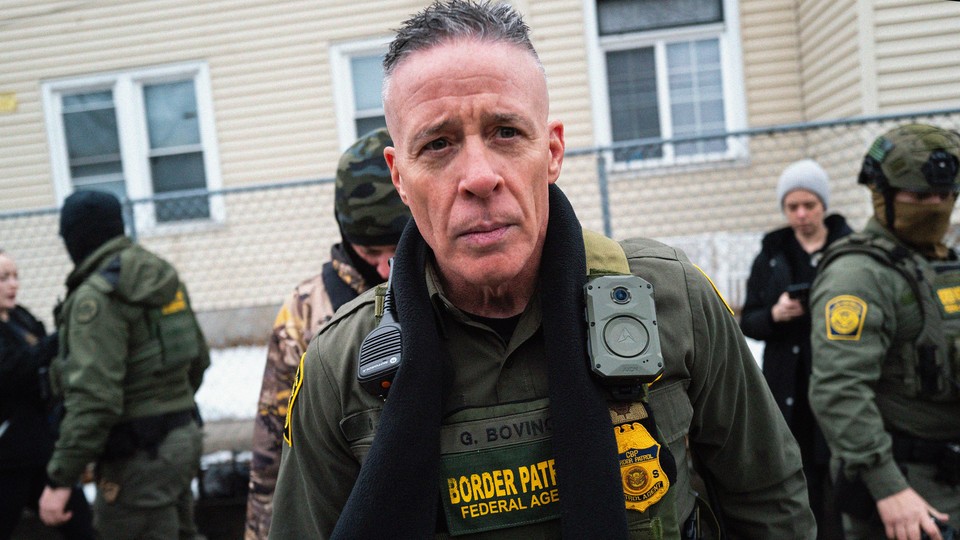
The Border Patrol chief has been ousted from his role as “commander at large,” and will return to El Centro.

Greg Bovino stares ahead, unsmiling
Stephen Maturen / Getty

Gregory Bovino has been removed from his role as Border Patrol “commander at large” and will return to his former job in El Centro, California, where he is expected to retire soon, according to a DHS official and two people with knowledge of the change.

Bovino’s sudden demotion is the clearest sign yet that the Trump administration is reconsidering its most aggressive tactics after the killing Saturday of 37-year-old Alex Pretti by Border Patrol agents under Bovino’s command.

Earlier today, President Trump appeared to signal in a series of social-media posts a tactical shift in the administration’s mass-deportation campaign. Trump wrote that he spoke with Minnesota Governor Tim Walz—whom the White House has blamed for inciting violence—and the two men are now on “a similar wavelength.” Tom Homan, the former ICE chief whom Trump has designated “border czar,” will head to Minnesota to assume command of the federal mobilization there, Trump said.

Homeland Security Secretary Kristi Noem and her close adviser Corey Lewandowski, who were Bovino’s biggest backers at DHS, are also at risk of losing their jobs, two of the people told me.

Read: The hype man of Trump’s mass deportations

For the past seven months, Bovino has been the public face of a traveling immigration crackdown on cities governed by Democrats. Noem and other Trump officials gave Bovino the “commander” title and sent him and his masked border agents to Chicago, Charlotte, New Orleans, and then Minneapolis. Bovino became a MAGA social-media star as he traveled the country with his own film crew and used social media to hit back at Democratic politicians and random critics online. Veteran ICE and CBP officials grew more and more uneasy as Bovino worked outside his agency’s chain of command and appeared to relish his role as a political actor.

In Minneapolis, the Trump administration used Bovino as its lead spokesperson, scheduling daily press conferences where he defended agents’ rough tactics and cast blame on protesters and local officials. Border Patrol commanders typically avoid engaging in political arguments with elected officials.

Bovino’s fall comes two days after Border Patrol agents in Minneapolis fatally shot Pretti, an intensive-care nurse who worked with veterans. Hours after the shooting, Bovino appeared at a press conference and echoed statements by the Department of Homeland Security alleging Pretti sought to “massacre” the federal agents. Bovino repeatedly claimed that Border Patrol agents, not Pretti, were the victims.

Videos of the encounter showed no evidence for his claims. Pretti, who was licensed to carry a concealed weapon, did not draw a firearm or attack the agents. The videos show one agent disarming Pretti in the moments just before another agent shot him in the back.

DHS and U.S. Customs and Border Protection officials did not immediately respond to questions about Bovino’s departure from Minnesota and his current role. Asked about Bovino and Noem, a White House spokesperson referred to Press Secretary Karoline Leavitt’s statement today that Noem has the president’s “utmost confidence and trust.”

In another post, Trump said he also spoke with Minneapolis Mayor Jacob Frey. “Lots of progress is being made!” the president wrote. “Tom Homan will be meeting with him tomorrow in order to continue the discussion.”

For Trump, the Truth in Minneapolis Is What He Says It Is - The New York Times

For Trump, the Truth in Minneapolis Is What He Says It Is

"The Trump team has advanced one-sided narratives to justify each of the killings, even when bystander video shows something else entirely.

Donald Trump sits at a large desk wearing a blue tie. A standing person holds a laptop showing a winter street scene.
President Trump has found that putting out a story line early and repeating it often can convince a sizable share of the public that does not credit contrary evidence.Doug Mills/The New York Times

By Peter Baker

Peter Baker, the chief White House correspondent, is covering his sixth presidency. He reported from Washington.

Sign up for the Tilt newsletter.  Nate Cohn, The Times’s chief political analyst, makes sense of the latest political data.

Twice since the start of the year, federal officers have gunned down protesters in Minneapolis with cellphone cameras rolling, and twice President Trump and his lieutenants have rushed forward with a message to the American people: Don’t believe what you see with your own eyes.

Without waiting for facts, the Trump team has advanced one-sided narratives to justify each of the killings and demonize the victims. Renee Good, a mother of three, was engaged in “domestic terrorism” and “viciously ran over the ICE Officer,” they declared. Alex Pretti, an I.C.U. nurse at a veterans’ hospital, was an “assassin” aiming to “massacre law enforcement.”

The trick is that the Trump versions of reality have collided with bystander videos watched by millions who did not see what they were told. Ms. Good did not run over the ICE agent who killed her; a video analysis suggested she was trying to turn away from him and he continued to shoot her even as she passed him. Mr. Pretti approached officers with a phone in his hand, not a gun; he moved to help a woman who was pepper sprayed and he was under a pileup of agents when one suddenly shot him in the back.

The videos, sometimes shaky, incomplete or at a distance, may not show the totality of what happened in those confusing split seconds on the street and they do not speak to what was going through the minds of the officers who were described as fearing for their lives and acting in self-defense. Many questions about exactly what happened remain unanswered and further investigation could change the understanding of the deadly events in Minneapolis, perhaps even bolstering the Trump administration’s assertions, but the administration is blocking independent inquiries.

Mr. Trump has found that putting out a story line early and repeating it often can, with the help of an ideological media and online surround-sound machine, convince a sizable share of the public that does not credit contrary evidence. Even after investigations, recounts and his own advisers and attorney general refuted Mr. Trump’s claim that he won the 2020 election, polls show that most Republicans still believe the election was stolen.

And so Mr. Trump and his team have taken the same reality-bending approach to the violence in Minneapolis in evident hopes of persuading the president’s political base, at least, that the protesters were responsible for their own deaths and that “the victims are the Border Patrol agents,” as Gregory Bovino, the official in charge of Mr. Trump’s Border Patrol operations, put it on CNN on Sunday.

And indeed, many of Mr. Trump’s supporters watch the same videos from Minneapolis and find in the sometimes murky images details that to them vindicate the shootings, actions by Ms. Good or Mr. Pretti that appear more threatening than what many others see. In effect, the videos have become a national Rorschach test for American polarization.

The families of Ms. Good and Mr. Pretti have expressed outrage over the distortions presented by the Trump administration. “The sickening lies told about our son by the administration are reprehensible and disgusting,” Mr. Pretti’s parents said in a statementto The Associated Press hours after his killing.

Minnesota officials have lashed out at Mr. Trump and his team, too. “When I hear the officials from the Trump administration describe this video in ways that simply aren’t true, I just keep thinking, ‘Your eyes don’t lie,’” Senator Amy Klobuchar, Democrat of Minnesota, said on “Meet the Press” on NBC on Sunday. “The American people aren’t sitting at a Trump cabinet meeting having to say everything to make him happy. They’re going to make their own judgments.”

Even some Republican lawmakers have been disturbed by the instantaneous jump to conclusions and the efforts to stymie inquiries that might contradict the government’s accounts. “Any administration official who rushes to judgment and tries to shut down an investigation before it begins are doing an incredible disservice to the nation and to President Trump’s legacy,” Senator Thom Tillis, Republican of North Carolina, wrote online.

Some administration officials sought to push back on Sunday. “You cannot look at a 10-second video and judge what happened,” Todd Blanche, the deputy attorney general, said on NBC. “You have to look at it from a full, full situation of what’s been happening in Minneapolis for the past several weeks, which is a simple fact.”

Mr. Trump tried to change the subject, attacking Gov. Tim Walz and other Democratic leaders of Minnesota for what he called stoking “the flames of Division, Chaos, and Violence,” and blaming them for the deaths of Ms. Good and Mr. Pretti. “Tragically, two American Citizens have lost their lives as a result of this Democrat ensued chaos,” the president wrote online late on Sunday.

This is a president and an administration with credibility problems even before the agents sent to Minneapolis by Mr. Trump as part of a broad immigration crackdown shot Ms. Good and Mr. Pretti to death. Trump administration officials have issued misleading accounts of several episodes arising from confrontations involving federal officers in recent months.

In September, a jury in Los Angeles acquitted a protester of assaulting a federal officer after the defense argued that officers, including Mr. Bovino, had lied about what happened. In November, a federal judge in Illinois concluded that officials, including Mr. Bovino, had lied about the actions of protesters. Of 100 people charged with felony assault on federal agents in four Democratic-led cities from May to December, 55 saw their charges reduced or dismissed outright, according to an Associated Press examination.

Just last week, the White House posted a digitally doctored photo to make it appear that a Minnesota protester was crying when she was arrested, even though she was not. Rather than back down when caught dissembling, the White House has doubled down, essentially accusing anyone who challenges its version of the truth of siding with criminals.

In response to those who pointed out that the protester image was fake, Kaelan Dorr, a White House deputy communications director, wrote online: “YET AGAIN to the people who feel the need to reflexively defend perpetrators of heinous crimes in our country I share with you this message: Enforcement of the law will continue. The memes will continue.”

Mr. Trump has a long record of dishonesty. He was convicted of 34 felony counts of falsifying business documents, he was found liable in civil court of defrauding lenders, his family-owned business was convicted of criminal tax fraud, he was indicted though not tried on charges of obstruction of justice and defrauding the United States, his charity was shut down after the authorities found a “shocking pattern of illegality” and his self-named university paid out $25 million to settle complaints by students who called the school a sham.

While in office, Mr. Trump has been a prolific source of prevarication on any number of topics, so much so that The Washington Post counted more than 30,000 false or misleading statements in his first term. Most significantly, he repeatedly spread lies about supposed fraud in the 2020 elections that inspired a mob of supporters to storm the Capitol on Jan. 6, 2021, to try to stop the transfer of power — and he continues to promote lies about those events even now on a White House web page that rewrites the history of that day.

Most Americans do not take Mr. Trump at his word. Only 32 percent of Americans consider Mr. Trump to be honest and trustworthy, according to a survey this month by The Economist and YouGov. A Gallup study in his first term found that barely half as many Americans trusted Mr. Trump as they did Presidents George W. Bush or Barack Obama at similar points in their tenures.

While other presidents have been dishonest at times with the public, they have tended to worry that being caught saying something untrue, even if unintentionally, would detract from their public standing. Mr. Trump boldly and brazenly says things he knows or has been told are not true and even after being corrected continues to say them again and again.

“You say something enough times and it becomes true,” he once told Mary Pat Christie, the wife of Chris Christie, the former governor of New Jersey, who has related his wife’s anecdote to associates. Stephanie Grisham, Mr. Trump’s former White House press secretary who has broken with him, recalled that he told her the same thing: “It doesn’t matter what you say, Stephanie — say it enough and people will believe you.”

John F. Kelly, the president’s longest-serving White House chief of staff in his first term, came to believe that Mr. Trump was a pathological liar. As Mr. Kelly has recounted, the president would sit with him and his press staff to go over what to tell reporters about some issue and Mr. Trump would try out lines without any regard for whether they were accurate or not. “But that’s not true,” Mr. Kelly would object. “But it sounds good,” Mr. Trump would reply.

The challenge for Mr. Trump at this point is the modern cellphone. There are scores or hundreds or more on the streets of Minneapolis these days and they are capturing at least a slice of reality regardless of the president’s storytelling. One of the central questions in American life today is whether a picture is worth more than a thousand of Mr. Trump’s words.

Peter Baker is the chief White House correspondent for The Times. He is covering his sixth presidency and sometimes writes analytical pieces that place presidents and their administrations in a larger context and historical framework."

For Trump, the Truth in Minneapolis Is What He Says It Is - The New York Times

Why Is the Trump Administration Demanding Minnesota’s Voter Rolls? - The New York Times

Why Is the Trump Administration Demanding Minnesota’s Voter Rolls?

"The Justice Department has urged Minnesota to hand over voters’ private data. It is part of a national push that has raised concerns about the Trump administration’s motives.

Attorney General Pam Bondi during a hearing in October.
Attorney General Pam Bondi has pushed Minnesota to turn over its full voter roll. Kenny Holston/The New York Times

After federal immigration agents shot and killed an American citizen in Minneapolis for the second time this month, Attorney General Pam Bondi sent a letter to Gov. Tim Walz of Minnesota that outlined what she described as three “simple steps” to “bring back law and order.”

Her final step, however, seemed to have little to do with immigration or the state’s fraud scandal, the stated reasons for the federal government’s presence in Minnesota.

“Third, allow the Civil Rights Division of the Department of Justice to access voter rolls to confirm that Minnesota’s voter registration practices comply with federal law,” she wrote. Minnesota’s secretary of state, Steve Simon, a Democrat, swiftly rejected the demand, calling it an “outrageous attempt to coerce Minnesota into giving the federal government private data on millions of U.S. citizens in violation of state and federal law.”

Ms. Bondi’s request was part of a nearly yearlong fight in which the Trump administration has sought voters’ private data from states across the country. Numerous states, including Minnesota, have not complied, and the Justice Department has sued them.

Here’s a look at what is happening and the concerns over privacy and elections that have arisen:

What, exactly, are these voter rolls?

Nearly every state has a public version of its voter roll that includes basic information like first and last names. Some of these rolls include addresses.

But the complete, unredacted voter file includes personal identifying information, like driver’s license numbers and Social Security numbers. This list is kept private and is maintained by top election officials in each state.

Traditionally, no one can obtain it through public records requests — not even the Justice Department.

Why does the Justice Department want these files?

Ms. Bondi has said that the Trump administration is trying to keep elections secure. But President Trump and his allies — who tried to overturn the 2020 election and continue to deny its legitimacy — have long pushed unsubstantiated claims about undocumented immigrants voting illegally.

And last year, the Justice Department began to try to build the largest set of national voter roll data it has ever collected, raising concerns that the data could be used to cast doubt on future election results.

Is this a normal request?

No, it’s highly unusual.

The Justice Department has taken aggressive steps in the past to try to root out voter fraud, including during former President George W. Bush’s administration. But the idea of the federal government obtaining states’ private voter information was long seen as an overreach, because the Constitution dictates that elections are run mainly by individual states, not the administration in Washington.

How many states have complied?

At least 11, all of them at least partly run by Republicans, according to data from the Brennan Center for Justice, a voting rights and democracy group. Some other states, largely Republican-led ones, have provided their voter data to a separate but related program in the Department of Homeland Security.

But roughly half of the country’s states, most of them led by Democrats, have rejected the requests. The Justice Department has sued at least 24 states and territories, including Minnesota, to force them to turn over their voter data.

Why have states refused?

Some states, including Minnesota, have laws that prevent the transfer of private information. Others have expressed worries about how the Justice Department will keep the enormous troves of private information secure.

But for many election officials and voting rights experts, the main concern is that the Justice Department’s effort is led by Trump allies who long falsely denied that former President Joseph R. Biden Jr. won the 2020 election.

“These data can be manipulated to support false claims about ineligible voting and justify efforts to thwart free and fair elections,” Wendy Weiser, who directs the Democracy Program at the Brennan Center, wrote on social media.

The Minnesota secretary of state, Mr. Simon, said this possibility was on his mind.

“Though I’m not necessarily predicting direct federal interference with elections, I am planning for it,” he said in an interview, “and it would be irresponsible to not do that.”

Do states have a right to withhold the data?

This is still being litigated, but some legal experts have pointed to the Constitution’s language that the “times, places and manner” of elections are governed by the states, and that only Congress — not the president — can make or change election laws.

This month, a federal judge in California dismissed the Justice Department’s lawsuitagainst California seeking to obtain its full voter roll.

“The taking of democracy does not occur in one fell swoop; it is chipped away piece-by-piece until there is nothing left,” wrote Judge David O. Carter, an appointee of former President Bill Clinton. “The erosion of privacy and rolling back of voting rights is a decision for open and public debate within the legislative branch, not the executive.”

Are there any other concerns?

Election officials also say that any national voter roll within the Justice Department would probably be rife with errors because each state’s voter file is updated every day, changing as voters move away or die.

“If any state were to provide a voter list, and the list against which the federal government or anyone else is checking it is out of date, you’re going to have a lot of falsely identified ineligible voters,” Mr. Simon said.

Nick Corasaniti is a Times reporter covering national politics, with a focus on voting and elections."

Why Is the Trump Administration Demanding Minnesota’s Voter Rolls? - The New York Times

Sunday, January 25, 2026

George Conway on MN shooting: Trump administration is “a criminal organi...

Inside ICE Detention: Stripped, Shackled, Starved

Woman dragged from car by ICE agents speaks out for first time

The Execution of Alex Pretti Broke Me

The Constitutional Plan to End The Trump Regime

Alex Jeffrey Pretti Knew He Wanted to Help Others


Alex Jeffrey Pretti Knew He Wanted to Help Others

​

“Alex Jeffrey Pretti, a 37-year-old registered nurse and U.S. citizen, was fatally shot by Border Patrol agents in Minneapolis. Colleagues and neighbors described him as a kind, hardworking, and passionate individual dedicated to helping others and advocating for social justice. His death has left those who knew him shocked and grieving.

​

Shot and killed by immigration agents on a Minneapolis street, he wanted to be a ‘force of good in the world.’

Armed and masked immigration agents stand in the street amid clouds of tear gas.
Protests broke out in Minneapolis near the site where federal officials shot and killed Alex Jeffrey Pretti, a 37-year-old Minneapolis resident, on Saturday morning.David Guttenfelder/The New York Times

The man fatally shot by Border Patrol agents in Minneapolis was Alex Jeffrey Pretti, a U.S. citizen with no criminal record, officials said.

Mr. Pretti, who was 37, was a registered nurse who worked in the intensive-care unit at the Veterans Affairs hospital in Minneapolis, according to interviews and public records, and lived in an apartment in Minneapolis a short drive away from where he was killed.

He had a firearms permit, required by state law in Minnesota to carry a handgun, officials said.

Colleagues and acquaintances of Mr. Pretti were stunned by his death, recalling a friendly neighbor and hardworking professional who was devoted to his patients.

Dr. Dimitri Drekonja said that the two had worked together for years. Mr. Pretti was capable, competent and friendly, he said, the kind of person who cared deeply about his work and his patients.

“He was a really great colleague and a really great friend,” he said. “The default look on his face was a smile.”

The two chatted regularly about mountain biking, one of Mr. Pretti’s passions.

Family members of Mr. Pretti declined to comment on Saturday. Michael Pretti, Mr. Pretti’s father, told The Associated Press that he had warned his son to be careful in Minneapolis.

“We had this discussion with him two weeks ago or so, you know, that go ahead and protest, but do not engage, do not do anything stupid, basically,” Michael Pretti said. “And he said he knows that. He knew that.”

Mr. Pretti received a bachelor’s degree from the University of Minnesota in 2011, a spokeswoman said. He graduated from a high school in Green Bay, Wis., in 2006, and was listed on the honor roll in a local newspaper. His parents now live in Colorado, and his former spouse lives in California.

A next-door neighbor, Jeanne Wiener, said she believed Mr. Pretti lived alone with his dog, but saw him walking frequently, and would speak with him several times a week.

Standing in her home, Ms. Wiener said she was shocked to hear of his death.

“We talk over the fence all the time,” she said. “He’s the sweetest, kindest, most unoffensive, most nonviolent person you’d ever want to meet.”

Ruth Anway, who worked with Mr. Pretti, described him as a passionate colleague and kindhearted friend with a sharp sense of humor.

Ms. Anway, a nurse, said she first met Mr. Pretti around 2014 when he was a research assistant at the hospital. She said she had encouraged him to pursue nursing.

“He really thrived in that environment,” she said in a phone interview on Saturday. “He wanted to be helpful, to help humanity and have a career that was a force of good in the world.”

In his free time, she said, Mr. Pretti loved to bike the trails around Minneapolis, and spent time with his dog, Joule.

Ms. Anway said Mr. Pretti followed the news closely and cared deeply about social justice and fighting for fairness.

“I’m not surprised he was out there protesting and observing,” she said.

Aasma Shaukat, a physician at the V.A. who worked with Mr. Pretti, said she had hired him to his first job in the research department at the hospital.

Mr. Pretti, then fresh from college and in his early 20s, had come to her with no medical training, but a deep drive, she said.

“He was your typical struggling young person with a lot of ambition, but no direction yet,” she said. “But he knew he wanted to help people in some way or another.”

Mr. Pretti spent the next few years working for Dr. Shaukat, assisting on medical studies and enrolling patients — while delivering pizzas at night to make ends meet.

The last time they spoke, Mr. Pretti had been working extra shifts as a nurse, saving up to buy a home and a new car.

“He was happy, and I was happy for him because his life was just starting,” she said. “This feels so senseless and just so wrong.”

Corina Knoll is a Times correspondent focusing on feature stories.

Julie Bosman is the Chicago bureau chief for The Times, writing and reporting stories from around the Midwest.

Maia Coleman is a reporter for The Times covering the New York Police Department and criminal justice in the New York area.“