Contact Me By Email


What To Do When You're Stopped By Police - The ACLU & Elon James White

What To Do When You're Stopped By Police - The ACLU & Elon James White

Know Anyone Who Thinks Racial Profiling Is Exaggerated? Watch This, And Tell Me When Your Jaw Drops.


This video clearly demonstrates how racist America is as a country and how far we have to go to become a country that is civilized and actually values equal justice. We must not rest until this goal is achieved. I do not want my great grandchildren to live in a country like we have today. I wish for them to live in a country where differences of race and culture are not ignored but valued as a part of what makes America great.

Monday, July 28, 2025

‘Our dreams were shattered’: the Black Californians forced from the city they built | California | The Guardian

‘Our dreams were shattered’: the Black Californians forced from the city they built

"In the 60s, the white city of Hayward removed residents of Russell City. Now a $1m reparations fund has been approved – and important histories are coming to light

Print of tank preparing to destroy homes
A print by Keith Dennison of a Sherman tank preparing to destroy homes, from 1960. Photograph: Oakland Museum of California/Collection of the Oakland Museum of California

In the early 1940s, Gloria Moore’s parents migrated west from Arkansas, seeking – as many Black southerners did at the time – work, and a reprieve from poverty and Jim Crow.

They first found jobs working in the wartime shipbuilding industry in Portland, Oregon, before ultimately settling in Russell City – a small, unincorporated community in the San Francisco East Bay, and a bastion of Black and Latino culture and life. There, the Moores bought several acres of land, built a house and raised Gloria and her three siblings.

Now 82, Moore remembers life in Russell City as rich, pastoral and communal. The local school, where her mother worked as a cook, had dedicated teachers and an impressive orchestra; the dirt roads that cut through town led to vast oak fields that exploded with wildflowers every spring; and residents always looked out for one another. “We really were a village,” Moore said, recalling reading National Geographic magazines over milk and cookies at the home of the local librarian.

But in 1963, that village was razed to the ground. Citing eminent domain, the predominantly white city of Hayward forcibly removed residents of Russell City from their land, paying homeowners paltry sums for their property before incinerating every building in the community to make way for an industrial park.

For the surviving members of the 205 families that were displaced, that trauma is haunting. “We lost everything. Our community was erased. My parents, they lost their dignity,” said Moore, who now lives in Los Angeles. “Our dreams were shattered and we were forced to scatter.”

From West Oakland to San Francisco’s Bayview-Hunter’s Point neighborhood, the Bay Area has a long history of displacement that has largely been forgotten by those not directly impacted. But thanks to the work of a state-wide reparations taskforce, as well as local reparations efforts – including in Hayward, where city and county officials last week committed to allocating $1m to a fund for former residents of Russell City – these little-known stories are coming to light.

For the next seven months, these histories are also on display at the Oakland Museum of California (Omca). Through the lenses of history, art, and architecture, Black Spaces: Reclaim and Remain explores patterns of displacement in the San Francisco East Bay as well as the resilience Black communities have shown despite being repeatedly pushed out of the homes and neighborhoods they have built – first from the racist deployment of policies like eminent domain and today through a housing affordability crisis that disproportionally affects communities of color.

For museum director Lori Fogarty, it’s a narrative with reverberations far beyond the Bay Area: “This is a very local story, but it’s also a national story.”


With close proximity to the Bay Area’s numerous shipyards and its own railroad stop, Russell City became a hub for Black southerners resettling in California during and immediately after the second world war. Although it was an unincorporated community, and therefore cut off from many of the services provided by the nearby municipality of Hayward, the town developed many of its own institutions, including a school, a fire brigade and a blues club that attracted the likes of Ray Charles and Etta James.

Despite this, the city of Hayward, which refused to deliver sewage and garbage services to Russell City despite residents’ repeated requests, labelled the city a “blight” – a term used repeatedly by local governments in the 1950s and 1960s seeking to remove communities of color from certain areas. In so doing, Hayward authorities gained grounds to lay claim over Russell City and force residents, like the grandparents of Marian Johnson, to sell their land for egregiously small sums.

Two women look at each other
Ernestine Nettles (left) and Marian Johnson at the opening of Black Spaces: Reclaim & Remain at the Oakland Museum of California. Photograph: Courtesy of the Oakland Museum of California

Johnson explains that her grandparents bought the land for $7,500, but only received $2,200 from the city in return. For years, she couldn’t understand why her grandparents sold the six lots they had purchased for their extended family in Russell City and moved to East Oakland. But once she learned about eminent domain, she realized they had been forced out.

“They bought plots of land so that their children wouldn’t have to pay mortgages, so their children could generate generational wealth by not having to pay rent,” Johnson said. “All of this was stripped from our family.”

Today, all that is left of Johnson’s family plot is a willow tree planted by her grandfather. “We would still be there,” she said, thinking of the present that could have been had Hayward not prioritized the development of an industrial park over the homes and livelihoods of more than two hundred families.

Johnson’s family story is one of those on display at Omca, where visitors are guided through three core elements that have defined the histories of Black displacement in the East Bay: homes and domestic spaces, cultural and communal institutions, and destructive policies. Objects like the suitcase Otis Williams carried with him from Louisiana to the Marin City shipyards and Ernest Bean’s 1940 home videos showing women pruning roses in a flourishing West Oakland garden transport viewers to a time of hope and prosperity; documents like a transcript of public hearings held regarding the Russell City redevelopment project and the paltry cheque made out to Johnson’s grandfather, Bernice Patterson, for his land serve as stark reminders of the destruction that soon followed.

“It’s important to understand that these are lived experiences,” said associate curator of history Dania Talley, who curated the exhibition.

In the adjacent hall are three pieces from community collaborators that tell the story of continued displacement in the Bay Area, as well as resistance and hope for the community’s future.

Particularly striking is the full-scale replica of the East Oakland house that activists with the housing justice organization Moms 4 Housing occupied for nearly two months in 2019.

For Carolle Fife, an Oakland councilmember who participated in the 2019 occupation, there is a clear through-line between the forced displacement of Russell City residents in the 1960s and the inaccessibility of housing — especially for people of color — nationwide today.

“This is something historically Black folks have been going through in every urban center, and now even rural spaces throughout this country, because of systemic racism,” Fife said on opening night of the exhibition.

Brandi Summers, an Oakland-born sociologist and associate professor at Columbia University, said the severity of the cost-of-living crisis in Oakland has once again forced displacement upon the city’s Black residents, who are today moving to more distant suburbs and exurbs, or out of the state entirely. “A lot of Black people actually don’t feel comfortable in Oakland any more, regardless of whether we can actually live here,” said Summers, who also leads the scholar and artist collective Archive of Urban Futures, one of the groups that collaborated on the exhibition.


Against the backdrop of that crisis, California has in recent years emerged as a national leader when it comes to acknowledging past harms perpetrated against Black communities. In 2020, the state legislature established a nine-person reparations taskforce. And in 2024, Governor Gavin Newsom allocated $12m to racial justice initiatives and issued a formal apology for California’s role in slavery.

Historical photo of children playing
Children playing volleyball on a dirt playground at Russell school. Photograph: Courtesy of the Hayward Area Historical Society

Individual localities have also engaged with the issue. San Francisco established its own advisory committee, which recommended in 2023 that the city issue individual reparations payments of $5m to qualifying individuals.

And last week, Alameda county approved $750,000 in redress funds for former residents of Russell City. Hayward, which in 2021 issued a formal apology for its role in the community’s destruction, earmarked an additional $250,000 for the fund.

But many activists and community members have expressed disappointment at what they see as insufficient progress, especially after bills that would have issued direct cash payments and enabled those displaced through eminent domain to reclaim lost land failed to pass through the legislature last summer. And for former residents of Russell City, the $1m redress fund is woefully inadequate.

“It is pennies on the dollar for the value of the land that you took,” said Johnson. “That’s just a slap in the face.”

AUP’s Summers worries that public interest and political favor are turning away from issues of Black equity – especially as the current federal administration targets institutions, such as the National Museum of African American History and Culture, that study and elevate the often-sidelined histories of Black Americans.

It is for these reasons, Summers says, that shedding light on the legacies of Black Americans’ past experiences of displacement, while still possible, is so critical. “As funding for the arts and humanities goes, stories that are less known will disappear,” she said.

For museum director Fogarty, the fact that Omca is telling histories of Black displacement at this moment is in itself a form of resistance. “Look at what’s happening. There is an overt governmental attack on these kinds of stories,” she said.

“There are many places in this country that this show could not be presented right now.”


‘Our dreams were shattered’: the Black Californians forced from the city they built | California | The Guardian

‘Revenge Is Not a Policy’: Israelis Voice Dissent Against the War in Gaza - The New York Times

‘Revenge Is Not a Policy’: Israelis Voice Dissent Against the War in Gaza

"After a long silence, prominent Israelis and activists are increasingly raising alarms about potential war crimes being carried out by the government.

People banging on drums, waving flags and raising a photo of baby against a backdrop of a large banner with portraits of people.
Protesters gathered in May at the Shaar Hanegev junction near the Gaza border, holding photos both of Israeli hostages and of children killed in strikes in the enclave.Amit Elkayam for The New York Times

By Isabel Kershner

To report this article, Isabel Kershner and the photographer Amit Elkayam attended Israeli antiwar protests near the border with Gaza and on university campuses in Tel Aviv and Jerusalem.

Abhorrence of Israel’s devastating war in Gaza has resonated for months in capitals and in university campuses abroad. Now, a growing number of Israelis are speaking out against what they describe as atrocities carried out in their name in the Palestinian enclave.

Israeli protesters are holding aloft portraits of Palestinian children killed in Gaza. Academics and authors, politicians and retired military leaders are accusing the Israeli government of indiscriminate killing and war crimes.

In the early months of the war, the vast majority of Israelis considered the offensive a just and necessary response to the deadly Hamas-led attack on Israel on Oct. 7, 2023, even if they were skeptical that the government’s long-term goal of eliminating Hamas was attainable, opinion polls showed.

Despite that, a majority of Israelis have long wanted a deal that would end the war in exchange of the release of all the hostages still held in Gaza and relieve soldiers exhausted by months of deadly conflict, according to the polls.

But in recent months, a small but increasingly vocal minority has made anguished calls to end the war on moral grounds, even if many Israelis aren’t even aware such protests are even happening. Many of the protesters may have supported Israel’s right to self-defense after the Hamas attack, but many now say it has gone way too far and contravenes their values.

“We are on the edge of the abyss,” said Tamar Parush, 56, a lecturer in sociology at Sapir College in southern Israel, speaking at a recent antiwar protest attended by hundreds of Israelis at the busy Shaar Hanegev junction near the border with Gaza.

“Revenge is not a policy,” she said, adding: “We could have fought a smarter war.”

Tamar Parush, an Israeli lecturer in sociology, standing on the edge of an antiwar protest near the Gaza border.Amit Elkayam for The New York Times

At first, such voices of internal dissent were raised only on the fringes of Israeli society.

About 1,200 people, mostly civilians, were killed by Palestinian assailants during the October attack, making it the deadliest day in Israel’s history, and about 250 others were taken hostage. Many Israelis held Hamas solely responsible for the subsequent suffering in Gaza and said they felt little sympathy for civilians there.

About 60,000 Palestinians have since been killed in the war, according to Gaza health officials, whose tally does not distinguish between combatants and civilians, but includes more than 10,000 children. The war has displaced most of the two million residents of Gaza several times and brought the territory to the brink of famine. More than 80 children have died from starvation and malnutrition, according to the Gaza health ministry.

Despite the desperate humanitarian crisis, a survey conducted in May by the Institute for National Security Studies at Tel Aviv University found that 64.5 percent of the Israeli public was not at all, or not very, concerned about the humanitarian situation in Gaza.

About three-quarters of Israeli Jews thought that Israel’s military planning should not take into account the suffering of the Palestinian civilian population in Gaza, or should do so only minimally, according to another recent survey by the Israel Democracy Institute, a nonpartisan research group in Jerusalem.

But the institute said that over time it had found a slight increase in the share of Israeli Jews who thought the suffering should be taken into account to a large extent, and a mirroring moderate decline in those who said they were unconcerned.

That increase is reflected in the growing discomfort and activism in Israel’s liberal camp.

“There has been a discernible shift in the discourse,” said Lee Mordechai, a historian at the Hebrew University of Jerusalem who has been documenting the war and believes that Israel is committing genocide in Gaza — an accusation vehemently rejected by the Israeli government.

“There is still a crisis in the peace camp over what can and can’t be said, but people are speaking out more,” Dr. Mordechai added.

Thousands of Palestinians headed northwest of Gaza City to receive food aid in June.Saher Alghorra for The New York Times

He was speaking at the Hebrew University campus in late May where dozens of students and faculty members held a half-hour silent vigil carrying portraits of children killed in Gaza. Simultaneous protests were taking place at Tel Aviv University and other campuses.

Some prominent Israelis have also raised alarms. Ehud Olmert, a former prime minister, decried what he called the “cruel and criminal killing of civilians” and the starvation of Gaza as a government policy. Moshe Yaalon, a former military chief and defense minister, has warned for months of ethnic cleansing. Yair Golan, a former deputy chief of the military and leader of the Democrats, a left-leaning opposition party, caused a furor when he said the government was killing babies “as a hobby.”

The Israeli government denies committing war crimes in Gaza, though the International Criminal Court has issued arrest warrants for Prime Minister Benjamin Netanyahu and his former defense minister, Yoav Gallant. Israel’s military insists that it acts in line with international law, saying it takes steps to minimize civilian casualties and is fighting a complex campaign against an enemy that hides among the population and exploits civilian infrastructure.

One inflection point came about a year into the war, Dr. Mordechai said, when reports emerged of an Israeli plan to move all the residents of northern Gaza to the south. The government did not officially adopt the plan, proposed by commanders in the reserves, but critics said that elements of it were quietly underway.

Then this year, in mid-March, Israel ended a two-month cease-fire and resumed fighting in a decision that many Israelis believed was primarily politically motivated, to help Mr. Netanyahu keep his far-right coalition partners from bringing down his government. A New York Times investigation found that Mr. Netanyahu had acted to prolong and expand the war, allowing Israel to defeat and weaken more of its enemies but also deferring an internal political reckoning.

Hundreds of reservists and retired officers in Israel’s air force signed an open letter in April urging the Israeli government to agree to a deal with Hamas to return hostages. “The continuation of the war doesn’t advance any of the declared goals of the war, and will bring about the deaths of the hostages, of I.D.F. soldiers and innocent civilians,” the letter stated, using an abbreviation to refer to the Israeli military. Hundreds of Israeli soldiers have been killed in Gaza.

About 140,000 Israelis from various professional fields have signed on similar letters, according to Standing Together, a grass-roots organization of Jewish and Arab Israelis that has spearheaded antiwar protests and advocates peace and equality.

Students held a silent protest at Tel Aviv University.Amit Elkayam for The New York Times

Thousands of Israelis packed the main conference center in Jerusalem in May for a “People’s Peace Summit” organized by a coalition of more than 50 local peace and social justice organizations. It began with a minute’s silence for all the victims of the war — Palestinians and Israelis, civilians and soldiers.

Since then, more than 1,300 university faculty members have signed an open letter decrying what they called a “horrible litany of war crimes and even crimes against humanity, all of our own doing.”

“We have been silent for too long,” the letter stated, adding, “It is our duty to stop the slaughter.”

The best-selling Israeli authors David Grossman, Zeruya Shalev and Dorit Rabinyan were among scores of writers who signed another letter expressing “shock” over Israel’s actions in Gaza. In the days after the October 2023 attack, Ms. Rabinyan had said that her compassion for the suffering on the other side was “paralyzed.”

The mainstream domestic news media has rarely provided vivid coverage of the humanitarian crisis in Gaza. While the left-wing Haaretz newspaper has covered the suffering, a popular right-wing television station, Channel 14, regularly provides a platform for people calling for even harsher action against Gaza’s civilians.

This month, Standing Together activists have been demonstrating outside the studios of the main Israeli television channels to press local journalists to report on the dire hunger situation in Gaza.

“People debate starving or deporting Gaza’s residents on television as if these are legitimate options,” said Michael Sfard, an Israeli human rights lawyer. “But a different voice is trying to penetrate the almost unified public discourse,” he added.

Criticizing soldiers’ conduct is also a sensitive matter in a country where most Jewish 18-year-olds are conscripted and many Israelis are loath to accuse an army made up of their own relatives or friends of war crimes.

Itamar Avneri, a Tel Aviv City Council member and a founder of Standing Together, said for that reason the group was careful to criticize the government, not the soldiers.

“This is a war of destruction,” he said at the protest near the Gaza border, adding, “The Gazans are our neighbors.”

Isabel Kershner, a Times correspondent in Jerusalem, has been reporting on Israeli and Palestinian affairs since 1990."

‘Revenge Is Not a Policy’: Israelis Voice Dissent Against the War in Gaza - The New York Times

Sunday, July 27, 2025

No Meals, Fainting Nurses, Dwindling Baby Formula: Starvation Haunts Gaza Hospitals - The New York Times

No Meals, Fainting Nurses, Dwindling Baby Formula: Starvation Haunts Gaza Hospitals

"After Israeli restrictions on aid, hunger has risen across Gaza. Doctors and nurses, struggling to find food themselves, lack the resources to stem the surge.

A young mother, in a dark dress and pink head scarf, feeds a bottle to her malnourished child.
Hanin Barghouth with her 3-month-old daughter, Salam, at Al-Aqsa Martyrs Hospital in central Gaza this week. At birth, her doctor said, Salam weighed roughly 6.6 pounds, and three months later, she weighs only 8.8 pounds — at least three pounds underweight.Bilal Shbair for The New York Times

In several of the hospitals still functioning in Gaza, nurses are fainting from hunger and dehydration. Managers often cannot provide meals for patients or medical staff. Doctors are running low on formula for newborn babies, in some cases giving them water alone.

And at least three major hospitals lack the nutritional fluids needed to properly treat malnourished children and adults.

Those scenes were described in interviews starting Friday with seven doctors — four from Gaza, and three volunteers from Australia, Britain and the United States. All of them worked this past week in four of the territory’s main hospitals.

After months of warnings, international agencies, experts and doctors say starvation is now sweeping across Gaza amid restrictions on aid imposed by Israel for months. At least 56 Palestinians died this month of starvation in the territory, nearly half of the total such deaths since the war began 22 months ago, according to data released on Saturday by the Gaza Health Ministry.

As starvation rises, medical institutions and staff, already struggling to treat war wounds and illness, are now grappling with rising cases of malnourishment.

Weak and dizzy, medics are passing out in the wards, where colleagues revive them with saline and glucose drips. Persistently short of basic tools such as antibiotics and painkillers, doctors are also running out of the special intravenous drips used to feed depleted patients.

In all four hospitals, the doctors described how they are increasingly unable to save malnourished babies and are instead forced to simply manage their decline. The babies are too weak to be flooded with nutrients, which could overload their system and cause them to suffer “refeeding syndrome,” which could kill them.

In some cases, the fluids that the doctors can safely give to the babies are not enough to prevent them from dying.

“I have seen ones that are imminently about to pass away,” said Dr. Ambereen Sleemi, an American surgeon who has been volunteering since early July at the Nasser Hospital in southern Gaza. The babies were brought to the hospital “starving and malnourished,” Dr. Sleemi said in a phone interview on Friday, “and they haven’t been able to get them back from the brink.”

Dr. Nick Maynard, a British surgeon who volunteered at the same hospital until Wednesday, described the shock of seeing a skeletal infant who looked only days old, but was in fact seven months.

“The expression ‘skin and bones’ doesn’t do it justice,” Dr. Maynard said in a phone interview on Friday. “I saw the severity of malnutrition that I would not have thought possible in a civilized world. This is man-made starvation being used as a weapon of war and it will lead to many more deaths unless food and aid is let in immediately.”

Asked for comment, COGAT, the Israeli military department that oversees aid to Gaza, said it “continues to work in coordination with international actors to allow and facilitate the continued entry of humanitarian aid into the Gaza Strip, in accordance with international law.” Late on Saturday night, the Israeli military began to drop airborne aid over northern Gaza, and said it would pause its military activity for several hours a day in key areas to make it easier to deliver aid by land.

One-third of Palestinians in Gaza are forced to go without food for days in a row, the World Food Program said recently. Of the young children and pregnant women treated at clinics run by Doctors Without Borders in Gaza, roughly one-fourth are suffering from malnutrition, the medical aid group said last week.

Doctors say that many other people have likely died from different conditions and injuries that could have been cured or healed if the victims had not been so weakened by malnourishment. Starvation is causing more mothers to suffer miscarriages or give birth prematurely, to malnourished babies with weakened immune systems and medical abnormalities.

“The result is a rise in infections, dehydration and even immune collapse in infants,” said Dr. Hani al-Faleet, a pediatric consultant at Al-Aqsa Martyrs Hospital in central Gaza. “The immediate cause of death in some of these cases is simple: The baby doesn’t get enough to eat, and neither does the mother.”

Starvation has risen sharply since Israel’s total blockade on food aid to Gaza between early March and late May, doctors and rights groups say. While Israel has since allowed food in, it introduced a new method of distribution that is flawed and dangerous, making it almost impossible for Palestinians to find food safely or affordably.

Before March, food handouts were mainly distributed under a U.N.-led system from hundreds of points close to where people lived. Now, they are supplied from a handful of sites run by Israeli-backed private American contractors that, for most Palestinians in Gaza, can be reached only by walking for miles through Israeli military lines.

Israeli soldiers have killed hundreds of people walking these routes, turning the daily search for food into a deadly trap.

Some food is still available from shops in Palestinian-run areas, but only at astronomic prices that are unaffordable to the largely unemployed civilian population. A kilogram, or 2.2 pounds, of flour costs up to $30, and a kilogram of tomatoes costs roughly $30; meat and rice are largely unavailable on the open market.

That has forced many Palestinians to routinely choose between two often fatal options: risk death by starvation, or risk death by gunfire to reach food aid sites that are likely to have run out of supplies by the time many arrive.

Israel publicly says the new aid system is necessary to prevent Hamas from stealing the aid. But Israeli military officials have acknowledged to The New York Times that they have no proof that Hamas has systematically stolen food supplied by the United Nations, the main provider of aid to Gaza during most of the war. Israel says that its soldiers have fired “warning shots” to quell unrest along the roads leading to the aid sites. Dr. Maynard and Dr. Sleemi described injuries that indicated soldiers had systematically fired at people’s torsos.

Israel also blames the United Nations for failing to deliver enough food to alleviate the situation. Israel said on Saturday that it had destroyed up to 100 truckloads of food in recent months because aid groups could not distribute the food before it passed its use-by date. U.N. officials say that Israeli restrictions have made it difficult to send convoys through an active war zone.

The food shortages add another challenge to an already very difficult environment for doctors.

“Some staff members have collapsed in operating rooms. Others have fainted in emergency wards because they have not received any proper food,” said Dr. Mohammad Abu Salmiya, the director of Al-Shifa Hospital in Gaza City. “The burden on them is immense.”

Salam Barghouth, a 3-month baby girl treated for malnutrition this week at Al-Aqsa Martyrs Hospital in central Gaza, is among the youngest Palestinians failed by the new aid distribution system. Her mother, Hanin Barghouth, 22, is too weak to walk to the new distribution sites. Her father, Akram Barghouth, 27, has never managed to reach the sites before the aid runs out, Ms. Barghouth said.

Like most Gazans, the parents are jobless, rely on donations from relatives and friends and said they survive mostly on falafel balls that cost roughly 10 times their prewar price.

As a result, Ms. Barghouth regularly skips meals and says she has lost 29 pounds, a fifth of her body weight, since the start of the war. She cannot produce enough breast milk to feed Salam, who was born on April 21, after Israel started the blockade.

At Salam’s birth, according to Dr. al-Faleet, her doctor, she weighed roughly 6.6 pounds. Three months later, she weighs only 8.8 — at least three pounds underweight, the doctor said.

“I’m breastfeeding her as much as I can, and when I can’t, I give her formula — but that’s only when I have it,” Ms. Barghouth said. She is reaching the end of a container of formula that she said cost roughly $120, approximately two and a half times the amount it costs outside Gaza.

“She came into the world during a war,” Ms. Barghouth added, “and I’m fighting every day to keep her alive in it.”

While Salam Barghouth can still access medical support in central Gaza, other starving children farther to the north are struggling to find it because aid groups have found it harder to bring supplies to them.

One of them is Yazan Abu al-Foul, 2, a child living with his family in a damaged building beside a beach in Gaza City. His ribs, spine and hip bones jut from his body. An aunt, Riwaa Abu al-Foul, said Yazan’s family cannot find enough food to feed him and hospital staff in his area have told them that they cannot provide him with inpatient care.

“They told us there is a shortage of materials and equipment,” Ms. Abu al-Foul said in a phone interview on Saturday.

A mother holds her emaciated 2-year-old son, his ribs protruding.
Naeema Abu al-Foul with her 2-year-old son Yazan, in Gaza City on July 19. Their family could not find enough food to feed him, and hospitals have told them that they cannot provide inpatient care.Saher Alghorra for The New York Times

Doctors at hospitals in northern, central and southern Gaza described similar hardships in interviews on Friday and Saturday.

“There are no nutritional supplements, no vitamins, no premature infant formula, no amino acid intravenous solutions — nothing,” said Dr. Abu Salmiya from Al-Shifa Hospital. “Their bodies need these basics, and without them they will die.”

Aaron Boxerman contributed reporting.

Patrick Kingsley is The Times’s Jerusalem bureau chief, leading coverage of Israel, Gaza and the West Bank.

See more on: The Israel Hamas War

More on the Middle East Crisis


Edinburgh University had ‘outsized’ role in creating racist scientific theories, inquiry finds

Edinburgh University had ‘outsized’ role in creating racist scientific theories, inquiry finds

​

“An inquiry into the University of Edinburgh’s history found it benefited from transatlantic slavery and was a haven for white supremacist theories. The university raised funds from donors linked to slavery and colonialism, and still holds bequests worth £9.4 million from these sources. The inquiry’s authors recommend redirecting these funds to support Black and minority academics and research on racism and colonialism.

​

Exclusive: Investigation finds one of Britain’s oldest and most prestigious universities benefited from transatlantic slavery and was haven for white supremacist theories

Edinburgh uni, map of slave trade route, skull from the Phrenology collection, phrenology head
Composite: Guardian Design/Alamy

The University of Edinburgh, one of the UK’s oldest and most prestigious educational institutions, played an “outsized” role in the creation of racist scientific theories and greatly profited from transatlantic slavery, a landmark inquiry into its history has found.

The university raised the equivalent of at least £30m from former students and donors who had links to the enslavement of African peoples, the plantation economy and exploitative wealth-gathering throughout the British empire, according to the findings of an official investigation seen by the Guardian.

The inquiry found that Edinburgh became a “haven” for professors who developed theories of white supremacism in the 18th and 19th centuries, and who played a pivotal role in the creation of discredited “racial pseudo-sciences” that placed Africans at the bottom of a racial hierarchy.

It reveals the ancient university – which was established in the 16th century – still had bequests worth £9.4m that came directly from donors linked to enslavement, colonial conquests and those pseudo-sciences, and which funded lectures, medals and fellowships that continue today.

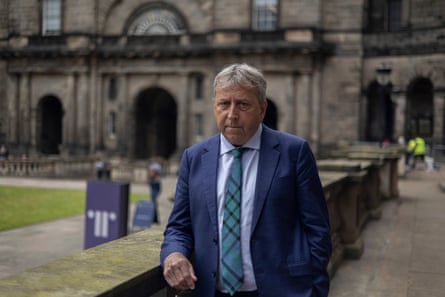
Sir Peter Mathieson, the university’s principal, who commissioned the investigation, said its findings were “hard to read” but that Edinburgh could not have a “selective memory” about its history and achievements.

Sir Peter Mathieson in the quad of Edinburgh’s Old College
Sir Peter Mathieson, the university’s principal, said Edinburgh could not have a selective memory about its history and achievements. Photograph: Jeremy Sutton-Hibbert/The Guardian

In an official statement, Mathieson extended the university’s deepest apologies for “its role not only in profiting materially from practices and systems that caused so much suffering but also in contributing to the production and perpetuation of racialised thought which significantly impacted ethnically and racially minoritised communities”.

The investigation also found that:

  • The university had explicitly sought donations from graduates linked to transatlantic slavery to help build two of its most famous buildings, Old College on South Bridge in the 1790s and the old medical school near Bristo Square in the 1870s.

  • The donations were equivalent to approximately £30m in today’s prices, or the higher figure of £202m based on the growth of wages since they were received, and as much as £845m based on economic growth since then.

  • The university had at least 15 endowments derived from African enslavement and 12 linked to British colonialism in India, Singapore and South Africa, and 10 of those were still active and had a minimum value today of £9.4m.

  • The university holds nearly 300 skulls gathered in the 1800s from enslaved and dispossessed people by phrenologists in Edinburgh who wrongly believed skull shape determined a person’s character and morals.

  • Fewer than 1% of its staff and just over 2% of its students were Black, well below the 4% of the UK population, and despite Edinburgh’s status as a global institution.

The report’s authors said their findings raised serious questions about the university’s role as the seat of the Scottish Enlightenment in the 18th and 19th centuries when it became famous for the work of luminaries such as the economist Adam Smith and the philosopher David Hume.

A skull labelled with Latin numerals in a glass case
A 14th-century skull from the Guanches people of the Canary Islands. The university holds nearly 300 skulls gathered by phrenologists in the 1800s from enslaved and dispossessed people.Photograph: Jeremy Sutton-Hibbert/The Guardian

The fact its history was in part “connected to slavery and colonialism, the violent taking of bodies, labour, rights, resources, land and knowledge is deeply jarring, not least for an institution so closely associated with the humanistic and liberal values of the Scottish Enlightenment”, it said.

The report’s authors urged the university to redirect the money from those bequests to hiring academics from Black and minority backgrounds and on research and teaching about racism and colonialism, partly to combat the institutional racism that permeated the institution, they argued.

Among a sweeping series of 47 recommendations, the review’s authors have also asked Edinburgh to support the unadoption of the definition of antisemitism published by the International Holocaust Remembrance Alliance (IHRA) because it stifled “free conversation” about Israel’s policies and actions in Gaza and the West Bank. Most UK universities recognise the IHRA definition.

The review also called on Edinburgh to urgently sell off its investments in companies with significant contracts with the Israeli government.

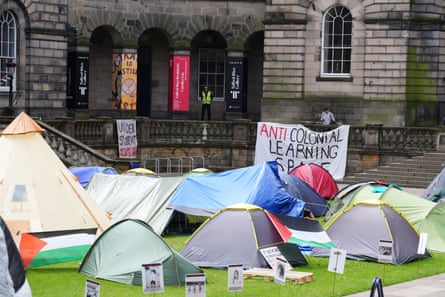
Mathieson said Edinburgh was “actively” reviewing its support for the IHRA declaration and its investments in Israel-linked companies after a series of protests by staff and students who have accused the university of complicity with Israeli actions in Gaza.

Students protest against the war in Gaza at an encampment at Old College.
The review’s authors have asked Edinburgh to cut its ties to a declaration on antisemitism because it stifled free conversation about Israel’s actions in Gaza. Photograph: Andrew Milligan/PA

He added that he recognised the strength of feeling but said he could not commit to withdrawing support for the IHRA definition or to divest in companies facing boycott until those reviews were complete. “Obviously this is a very hot, contemporary topic,” he said in an interview with the Guardian.

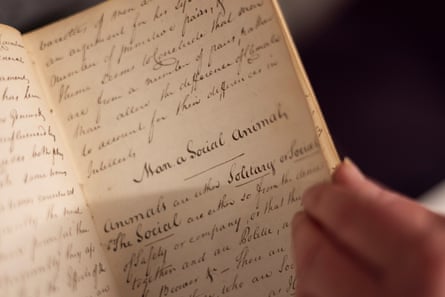
Mathieson said the decolonisation report had reached “deeply shocking” and “really discomforting” conclusions, including the discovery in student notebooks from the 1790s that one of its most famous moral philosophers, Dugald Stewart, had taught thousands of students that white Europeans were racially superior.

Ironically, Stewart and his mentor Adam Ferguson were “lifelong abolitionists” yet their theories of race had been used to justify slavery in the American south.

The university had to accept harsh truths about its past activities, as well as bask in its successes, Mathieson said. This review, he added, was the most extensive investigation of its kind carried out by any university in the UK.

One of Dugald Stewart’s notebooks.
A notebook from the 1790s of one of Edinburgh’s most famous moral philosophers, Dugald Stewart.Photograph: Jeremy Sutton-Hibbert/The Guardian

Mathieson said: “I think a lot of the report is hard to read, but I have confidence in its accuracy because I trust the experts that have produced it. I think we were seeking the truth – that’s really the purpose of a university, and it includes the truth about ourselves as well as the truth about anybody else.”

Mathieson and university executives set up the review, which was chaired by Prof Tommy J Curry, a specialist in critical race theory, and Dr Nicki Frith, an expert in reparations, in response to a groundbreaking review in 2018 by the University of Glasgow on its links to slavery and the Black Lives Matter protests after the murder of George Floyd in Minneapolis in 2020, which also affected Edinburgh.

Among other findings was evidence that the university had invested endowments derived from African enslavement into government war bonds, colonial bonds and buying Scottish Highland estates, and had received money from taxes levied on ships transporting sugar and tobacco from those plantations.

The university had reacted to the abolitionist cause with “inertia”, the report finds, by not joining three other Scottish universities and colleges who had petitioned parliament calling for the abolition of slavery, even though Edinburgh had professors at the forefront of abolitionist campaigning.

Curry said: “Scotland has a moral debt to pay by sustaining an ideology that helped to exploit, kill and dominate racialised people for centuries.

“There’s no argument against the fact that the people who orchestrated colonialism came from Edinburgh. It is not the only place they came from, but the University of Edinburgh was at the forefront at that time of creating and proliferating those theories.”

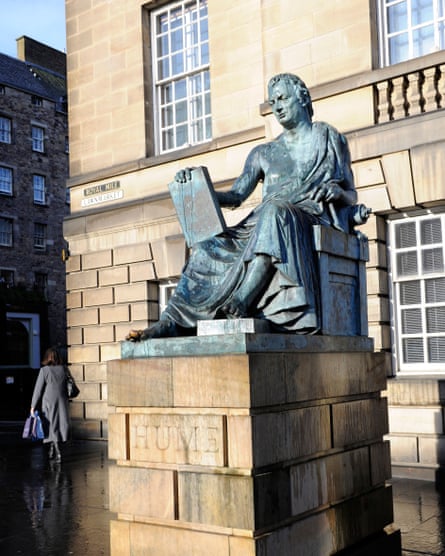
Edinburgh became one centre of the Black Lives Matter protests in 2020, when some staff and students demanded it rename a tower block named after Hume, the Enlightenment philosopher who published an overtly racist footnote that upheld the notion that black people were inferior.

A statue of David Hume on the Royal Mile, Edinburgh.
A statue of David Hume on the Royal Mile, Edinburgh. Photograph: Michael Doolittle/Alamy

To the fury of some historians, the university agreed to temporarily rename the building “40 George Square”. A further review by the university has recommended the change of name should be permanent and that a new naming committee investigates renaming another modern building named after Dugald Stewart due to his theories of race.

Mathieson indicated the university will accept many of the recommendations of the decolonisation review submitted by the 24-strong team of academics, researchers and consultants, but others would require consideration and external funding.

“If at the end of it we lose courage because we don’t like the conclusions, that kind of invalidates the original decision to do the work,” he said. “We knew that this was not going to be pretty.”

The university will set up a new race review implementation group which will actively support the review’s call for Edinburgh to establish a centre for the study of racisms, colonialism and anti-Black violence, he said, by helping find philanthropic donors and external funding, and find rooms for a community space.

Mathieson said the university also had a lot of work to do to understand why it had so few Black staff and students. In contrast, a third of its students are Asian, including nearly 9,300 students from China.

Edinburgh would “undoubtedly” fund new scholarships for students from minoritised groups, he said. “Some of the university’s resources can be and will be diverted to this.” Even so, he said, the university may be unable to repurpose some bequests linked to slavery or colonialism if their terms restrict the money to specific purposes.“