Contact Me By Email


What To Do When You're Stopped By Police - The ACLU & Elon James White

What To Do When You're Stopped By Police - The ACLU & Elon James White

Know Anyone Who Thinks Racial Profiling Is Exaggerated? Watch This, And Tell Me When Your Jaw Drops.


This video clearly demonstrates how racist America is as a country and how far we have to go to become a country that is civilized and actually values equal justice. We must not rest until this goal is achieved. I do not want my great grandchildren to live in a country like we have today. I wish for them to live in a country where differences of race and culture are not ignored but valued as a part of what makes America great.

Sunday, September 29, 2024

On private call, Arizona’s top Democrats debated a ‘dire’ ballot dilemma - The Washington Post

On private call, Arizona’s top Democrats debated a ‘dire’ ballot dilemma

"The three state officials learned a computer glitch meant 98,000 voters had not provided proof of citizenship. In a candid phone call, they debated what to do.

From left, Arizona Gov. Katie Hobbs, Arizona Secretary of State Adrian Fontes and Arizona Attorney General Kris Mayes (Joshua Lott/The Washington Post; Jabin Botsford/The Washington Post; Go Nakamura/Reuters) 

PHOENIX — Arizona’s Democratic leaders knew they had no good options when they jumped on a phone call this month. They had just learned tens of thousands of residents had been registered to vote for decades, even though there was no record they had provided proof of citizenship — a requirement under state law.

Their predicament was “an urgent, a dire situation,” Gov. Katie Hobbs said, according to audio of the call obtained by The Washington Post. Secretary of State Adrian Fontes said critics would “beat us up no matter what the hell we do.” Attorney General Kris Mayes worried they would be accused of rigging the 2024 election in a crucial state.

Changing the voting status of these Arizonans risked disenfranchising legitimate voters six weeks before the election. Letting them vote as they had in the past could violate the law. Even though the problem predated these officials by 20 years, it was on them to fix. And though it affected only state and local races, not the presidential or Senate elections, they knew after four years of attacks on the state’s election systems that no matter what they did, critics would have a ready-made issue to seize on if they didn’t like the outcome in November.

“When this goes public, it is going to have all of the conspiracy theorists in the globe — in the world — coming back to re-litigate the past three elections, at least in Arizona,” Hobbs said. “And it’s going to validate all of their theories about illegal voting in our elections, even though we all know that’s not true.”

During the 40-minute call on Sept. 10, the three bluntly took stock of the scope of the problem. They believed it affected about 148,000 voters, but later lowered the estimate to about 98,000. They knew the voting rights of Republicans, Democrats and independents were affected and they saw how the issue could erode confidence in state elections. The voters skewed Republican, and nearly all of them appeared to be citizens, but the group recognized the situation was politically explosive given that Republicans across the nation were already falsely claiming that massive numbers of noncitizens illegally vote for Democrats.

The governor suggested that these voters should be given ballots containing only federal races because of a state law that bars voters from casting ballots in state and local races if they have not provided proof of citizenship. But Fontes and Mayes argued that the state could not disenfranchise voters in any race so close to the election. They said requiring all of these voters to provide U.S. birth certificates or other documents in the coming weeks would create a logistical crisis for voters and election officials who were already stretched thin.

“Think about all of the 82-year-olds in wheelchairs who are not going to be able to make it to the polls and sure as hell aren’t going to, like, be able to find their f---ing driver’s licenses or birth certificates in time,” said Mayes, the attorney general. Arizonans this fall will vote on a state constitutional amendment to ensure access to abortion and decide whether Republicans hang on to their narrow control of the state legislature. Mayes said the group would be accused of disenfranchising Republicans to gain an advantage in those contests. “We can’t do that,” she said.

Fontes, who led most of the conversation, summed up their conundrum: “They’re going to beat us up no matter what the hell we do, no matter what the hell we say.”

A spokesperson for Fontes on Saturday emphasized that voting by noncitizens is “vanishingly rare,” despite claims from interest groups and figures aligned with former president Donald Trump. Mayes declined to comment. And the governor’s spokesperson, Christian Slater, responded with a statement: “From the beginning of the call, Governor Hobbs knew no matter the path forward it was critical to get legal certainty for any action taken by the Secretary of State. She’s glad that approach has paid dividends and instilled bipartisan confidence in Arizona’s free, fair, and secure elections.”

The candid and sometimes tense conversation provides a rare look at the precarious situationthat officials in battleground states often find themselves in. They don’t want to restrict access to eligible voters, but they also want to make sure to follow the rules to avoid accusations of fraud. Their ordinary duties — such as making sure that millions of voters are properly registered, sending out mail ballots on time and overseeing voting — are under intense scrutiny, and mistakes can quickly turn into rampant false claims.

The Democratic trio has firsthand experience with the mechanics of elections in the state — and the wrath of those who don’t like the outcomes. When Trump narrowly lost the 2020 presidential race in Arizona, he and his supporters questioned every aspect of the voting process and tried to pressure officials to change the results. Trump blamed his narrow defeat in the state in part on false assertions that thousands of undocumented immigrants had voted in the election. He and his allies never produced evidence of their claims.

At the time, Hobbs was the secretary of state and faced death threats as she defended the legitimacy of the outcome. Fontes was the recorder for the state’s most populous county of Maricopa and, like Hobbs, fought misinformation as he and his staff faced harassment and protests. Several top Trump allies, including his lawyer and chief of staff, have been charged for their alleged actions in the state after the election, a prosecution led by Mayes.

All three were elected during the 2022 midterms after campaigning on the pledge to protect democracy and beating out Trump-backed Republicans who had made rafts of false claims about elections in the state and the people who run them. Hobbs’s opponent, former television anchor Kari Lake, continues to challenge her loss in court, even as she now runs for Senate. Mayes won her race by 280 votes, leading to unproven accusations by her GOP opponent that the outcome was unfair.

Their call this month brought them together for the first time since they each took office in January 2023, according to staff for two of the officials. During the conversation, which included staff, they weighed options and had different ideas on how to try to limit the damage to the public’s confidence in the election systems.

Fontes kicked off the call by explaining an obscure problem that had gone unaddressed for 20 years. In 2004, Arizona passed a law requiring voters to provide proof of citizenship to vote. After nearly a decade of litigation, the Supreme Court in 2013 ruled a federal law prevented the state from requiring proof of citizenship to vote for president and other federal offices.

To comply, the state adopted a unique, dual-registration system. Those who provide citizenship documents receive full ballots that include local, state and federal races. Those who do not receive ballots with only races for federal offices.

This month, Maricopa County officials discovered a longtime legal resident who is not a citizen had been improperly shown in electronic systems as having provided citizenship documents. He had not voted, but his appearance on the voter rolls sent election officials scrambling for answers. Fontes’s office found tens of thousands of others had been marked as eligible to receive full ballots even though there was no record of them having provided citizenship documents.

Now the three Democrats discussed what to do. State law didn’t allow the state to provide these voters with full ballots but federal law bars states from making wholesale changes to their voter registration lists fewer than 90 days before an election, Fontes said on the call.

Hobbs noted “conspiracy theorists” could run wild with the situation and said they needed to be “as proactive as possible to look like we are taking every single action possible to shore up the confidence in our voting system.”

“If I was in your shoes, secretary, I would take those 148,000 voters and move them to fed-only and do everything I could to provide the resources for the counties to deal with that additional burden and to ensure the confidence in the system,” said Hobbs. “I’m sure that there’s a very small percentage of those voters that are not actually eligible.”

Mayes rebuffed that idea, noting the list included more Republicans than Democrats.

“If we do what you’re talking about, we’re talking about disenfranchising probably tens of thousands of Republican voters,” Mayes said, emphasizing the political heat they would take for such a move.

Fontes sided with Mayes, saying, “I have no intention of notifying 148,000 voters at this stage of the game that they have to scramble around when the state of Arizona has been providing them full ballots all this time.”

He said he could easily explain his stance. Not allowing this group of voters to automatically vote in all races could help Democrats, he noted, but “we’re doing the opposite because that’s a pro-voter move, and it’s the right thing to do.”

Later on the call, Hobbs flinched at discussing how many Republicans and Democrats were on the list. “I just think that cannot be part of the conversation because then we’re politicizing it,” she said.

Fontes said it would be “an absolute s--- show at the counties if we tell them they need to go chase down 150,000” voters to verify citizenship given the many demands on their offices. “I loathe to shove this down their throats at this stage of the game,” he said.

Mayes said it would be unfair — and possibly illegal — if they unilaterally determined that the residents could not vote in state races and a ballot measure to ensure access to abortion.

“Can you imagine telling 67,000 Republicans they can’t vote on the abortion initiative,” Mayes asked, her tone incredulous. “I mean, Katie, I understand your point about not politicizing this, but the reality is that if we let this happen, all of these elections are challengeable. They’re going to be calling for a new election.”

Responded Hobbs: “They’re going to be calling for new 2020 and ’22 elections as well.”

Fontes reiterated that he wanted voters to receive full ballots, and Hobbs shifted her stance to back him

“I hear you,” the governor said. “I agree with you. It’s your position to do that, not mine, and I’m going to support your call.”

But, she noted, they would face a wave of criticism. “It’s still going to create just this s--- storm of ‘told you so, all these illegals are voting,’ from the other side,” said the governor, referring to Republicans.

Fontes argued that no matter what they say or do, Republicans are “going to beat us up.”

Hobbs had suggested that the issue would be best solved with a court decision. “That would provide that cover, that legal cover,” the governor said. She suggested that the litigation should come “from someone who’s friendly to us,” who would align with their desire to keep the solution nonpartisan.

That notion within days evolved into what Fontes called a “friendly lawsuit” that Maricopa County Recorder Stephen Richer (R) brought against the secretary of state. Richer, like the three Democrats, has faced years of threats and harassment for doing his job. He lost his July primary election to another Republican and had shown a willingness to take bold political stands.

Fontes and Richer asked the state Supreme Court to quickly give them an answer. Around the same time, Hobbs announced the computer issues at the division of motor vehicles that caused the problem had been quickly fixed. Soon after, the court issued a ruling that said the voters’ eligibility to cast full ballots should remain in place. Richer declined to comment Saturday.

In the litigation, the Democratic leaders found allies among Republicans who recognized that their party had the most to lose because so many of their voters were on the list. The state Republican Party sided with Fontes in asking the state’s high court to keep intact the voters’ ability to cast full ballots.

But others pounced on the problem, just as Fontes and the others predicted. Laura Loomer, a far-right backer of Trump, on social media alleged the state “may have just illegally registered 100,000 illegal aliens to vote!”

The post ricocheted around social media, setting off the kind of viral messaging that Hobbs, Fontes and Mayes had feared."

On private call, Arizona’s top Democrats debated a ‘dire’ ballot dilemma - The Washington Post

Saturday, September 28, 2024

Blacks Beware! 10 Countries That You Never Want To Visit

1 MINUTE AGO: Trump & Vance HIT with CRIMINAL CHARGES in SHOCKING Twist


This hateful racist felon *Trump) and horrible human Vance need to be under the jail.

Opinion | UAE named U.S. defense partner despite its role in Sudan civil war - The Washington Post

Opinion Biden needs to pressure the UAE to help end Sudan’s civil war

President Joe Biden and Mohamed bin Zayed al-Nahyan, the leader of the United Arab Emirates, outside the Oval Office on Monday. (Mandel Ngan/AFP/Getty Images)

"United Arab Emirates President Mohamed bin Zayed al-Nahyan visited the White HouseMonday, a first for an Emirati leader. The high-level attention underscored deepening U.S. ties with a key Gulf Arab ally amid the ongoing wars in Gaza and across the Israeli-Lebanese border. The Biden administration announced a range of new areas for cooperation with the UAE, including artificial intelligence, space exploration, clean-energy technology and defense. President Joe Biden designated the UAE a “major defense partner.” India is the only other nation to have received that label, which allows for closer military cooperation, including joint training and exercises.

On a different subject, though — Sudan’s civil war, and the UAE’s role in fueling it — the meeting produced a more mixed message. A joint communique saved fewer than 250 of its nearly 4,000 words for the topic. That’s not many for a conflict that has seen up to 20,000 people, mostly civilians, killed and parts of the capital, Khartoum, reduced to rubble. Some 10 million people have fled their homes, another 26 million people face a risk of hunger, and there are warnings of famine or potential genocide in the Darfur region.

To be sure, the United States and the UAE expressed “deep concern” and “alarm” at the situation, coupled with their “firm and unwavering position” in favor of an immediate end to the fighting. “Both leaders reaffirmed their shared commitment to de-escalate the conflict,” the statement said. Conspicuously absent, however, was specific mention of the UAE’s own role in providing weapons, funding and intelligence to one side: the paramilitary Rapid Support Forces (RSF), whose troops have been accused of ethnic cleansing against the Black, non-Arab Masalit people of Darfur.

The UAE is the main backer of the RSF, which is commanded by Gen. Mohamed Hamdan “Hemedti” Dagalo. Using a staging area in neighboring Chad, the Emiratis have funneled advanced weaponry to the RSF and used Chinese-made Wing Loong II drones, with a 1,000-mile range and a 32-hour flight time, to deliver battlefield intelligence. The UAE has denied this, saying its presence in Chad is to assist Sudanese refugees and treat the wounded in a field hospital. But independent investigations, including by the New York Times, have found that the UAE’s humanitarian mission acts in part as a cover for military support of Mr. Dagalo’s forces.

Follow Editorial Board

Mr. Dagalo’s RSF — an offshoot of the Janjaweed Arab militia — is responsible for the ongoing atrocities in Darfur, which bear a sickening resemblance to the violence of the early 2000s. As was the case in Darfur at that time, there have been substantiated reports of summary executions of men and boys, and Masalit women being subjected to horrific gender-based violence, including sexual slavery and rape.

The UAE is far from the only outside power intervening in the 18-month-old war, which pitsMr. Dagalo’s RSF against what’s left of the Sudanese Armed Forces, or SAF, commanded by Gen. Abdel Fattah al-Burhan. Indeed, as has unfortunately been the case for many of Africa’s internal wars throughout history, this one has morphed into a proxy fight among geopolitical rivals. The UAE’s long-standing Middle East rival, Iran, backs Mr. al-Burhan; it has supplied drones to the SAF that helped it retake territory from the RSF. Russia formerly backed the RSF but now supports Mr. al-Burhan. Moscow and Tehran both covet future access to Sudan’s strategically important ports along its 530-mile Red Sea coastline — as does the UAE.

The United States, too, seems to see Sudan through the prism of geopolitics. Aligning with the UAE as a moderate Arab state might make sense in a broader strategic context; that country can serve as a regional counterweight to Iran, and the UAE is being eyed for a future role in rebuilding war-torn Gaza. The UAE’s role in Sudan makes it Russia’s enemy, too. Hence the implicit tension between Mr. Biden’s warm words for the UAE’s president in Washington and the valedictory speech he delivered to the United Nations the next day. “The world needs to stop arming the generals,” the president said, “to speak with one voice and tell them: Stop tearing your country apart.”

For now, at least, this is the administration’s position: to decry the human cost of Sudan’s war in general terms, while pursuing closer ties to the UAE, without demanding a clear public commitment that the UAE stop supporting a faction responsible for some of the conflict’s worst atrocities. If that sounds difficult to reconcile with the United States’ highest principles, it’s because it is."

Opinion | UAE named U.S. defense partner despite its role in Sudan civil war - The Washington Post

Israel Tracked Nasrallah for Months Before Assassination, Officials Say - The New York Times

Israel Tracked Nasrallah for Months Before Assassination, Officials Say

"The Israeli military decided to strike at the Hezbollah leader because it believed there was only a short window before he disappeared to a different location, three senior Israeli officials said.

Large plumes of smoke rise over a city.
Smoke billowing over Beirut early Saturday.Mohamed Azakir/Reuters

Israeli leaders had been aware of Hassan Nasrallah’s whereabouts for months and decided to strike him this past week because they believed they had only a short window of opportunity before the Hezbollah leader would disappear to a different location, according to three senior Israeli defense officials.

Two of the officials said that more than 80 bombs were dropped over a period of several minutes to kill him. They did not confirm the weight or make of the bombs.

Hezbollah operatives found and identified Mr. Nasrallah’s body early Saturday, along with that of a top Hezbollah military commander, Ali Karaki, according to the officials, who cited intelligence obtained from inside Lebanon. All three officials spoke on the condition of anonymity to discuss a sensitive matter.

Hezbollah confirmed on Saturday that Mr. Nasrallah was killed in the Israeli strikes.

The operation had been planned since earlier in the week, as Israeli political leaders spoke with their American counterparts about the possibility of a cease-fire in Lebanon, and before Benjamin Netanyahu, the Israeli prime minister, left Israel to give a speech at the United Nations, according to two of the officials.

All three officials said that Hashem Safieddine, a cousin of Mr. Nasrallah who is a key player in the movement’s political and social work, was one of the few remaining senior Hezbollah leaders not present at the site of the strike. They said that Mr. Safieddine, who has long been considered a potential successor to Mr. Nasrallah, could be announced shortly as Hezbollah’s new secretary-general."

Israel Tracked Nasrallah for Months Before Assassination, Officials Say - The New York Times

Opinion | No Turkish Delight for New York’s Mayor - The New York Times

No Turkish Delight for New York’s Mayor

Eric Adams, wearing a navy suit, exits a courthouse with aides.
Gus Aronson for The New York Times

"It was one of the most anthropologically fascinating dinner parties I ever attended. Cindy Adams, The New York Post gossip G.O.A.T., feted her 94th birthday at her rococo Park Avenue apartment in April.

We joked about her party motto: “If you’re indicted, you’re invited.” (She inherited the line from her late husband, the comic Joey Adams, who coined it to describe Roy Cohn’s louche soirees in the disco days.)

I was mesmerized looking around at an amazing web of scheming New York power brokers. A penthouse full of pulped egos, famous people who had had crazy downfalls. A spidery crop of tabloid Gotham villains uneasily circling one another and eating animal crackers and ice cream in the red-lacquered, Ming dynasty’d-out lair of the tabloid queen.

Woody and Soon-Yi were standing quietly in the middle of the room.

Bill O’Reilly was there with an assistant who was handing out cards awarding a free subscription to his substack. Nearby was Robert Thomson, the top lieutenant and best friend of Rupert Murdoch, the mogul who fired O’Reilly for sexual misconduct at Fox News. (Remember the loofah?!)

Kellyanne Conway was prowling, as was Don Lemon, who lost his CNN perch after saying Nikki Haley was no longer in her prime.

The smiling governor of New York, Kathy Hochul, was standing a few feet from the man she replaced and disavowed after he was accused of sexual transgressions. Andrew Cuomo was also in good spirits, with his lovely 93-year-old mother, Matilda, on his arm. He was out of a job, but New York media and political circles were buzzing that he was eyeing Gracie Mansion.

And there, walking right past Cuomo to the bar, was Mayor Eric Adams. He reversed Cindy’s mantra: He was invited, and now he’s been indicted.

I did a feature on the mayor in the summer of 2022, when he was six months into the job.

He had started with such flair and swagger, but by the time I was trailing around the city after him, his poll numbers were dropping. Some of the mayor’s aides at City Hall were getting very uneasy about his cronies and clubbing at the private Zero Bond. And later, some of his best aides began leaving his increasingly murky orbit.

“It’s like the second coming of ‘Beau James,’ Jimmy Walker,” one top Democratic politico told me, prophetically. Another Democratic mayor with flair, a star of the Roaring Twenties’ Tammany Hall machine, Walker was forced to resign after an investigation showed he had accepted a windfall from businessmen trying to secure municipal contracts. He argued that he took “beneficences,” not bribes, and avoided potential criminal prosecution by disappearing to Europe with his mistress, a Ziegfeld girl.

When I interviewed Adams, he was buoyant. He talked about his favorite show growing up, “Mutual of Omaha’s Wild Kingdom,” and I asked him which animal he related to. “Clearly, I am a lion,” he said, laughing. “I am meant to rule the jungle.”

As the daughter of a police detective, I was hoping that the former New York police captain would shine, not tarnish his office.

His story was powerful: The Brooklyn native joined the force after being beaten by the police as a teenager. His mother scraped to support six kids with cleaning work; as a child, Adams would sometimes have to take a bag full of clothes to school in case they were evicted by the end of the day.

I wanted to believe that this moderate Democrat could root out bad cops and bring justice to Black victims while quelling crime and pushing back on defund-the-police and coddle-the-criminal rhetoric on the far left.

But warning signs kept bubbling up.

Our interview — conducted after we rushed to the scene of a murder — was over dinner at Osteria la Baia, a restaurant owned by his friends the brothers Petrosyants, who pleaded guilty in 2014 to an illegal check-cashing scheme designed to evade anti-money-laundering rules.

Mayor Adams had chosen Philip Banks as deputy mayor of public safety, even though he was an unindicted co-conspirator in a corruption scandal involving Bill de Blasio donors in 2014. He had made Frank Carone his chief of staff, despite questions about his past business dealings.

I asked the mayor about all this, and he replied that he wanted to see the best in his friends, to give them second chances.

“The worst day of your life should not define your life,” he said. “I just believe that because I’ve had some worst days.”

And some more worst days are to come. His sketchy associates weren’t the only graspy problem. Adams himself was, according to law enforcement officials.

In a stunning tableau on Friday, Adams was arraigned downtown. He is the first sitting mayor of New York to be charged with a federal crime — a reflection of just how sloppy Adams must have been.

He pleaded not guilty and claims, Trump-style, to be a target of a rigged system out to get him — while Hochul mulled whether to remove him and Cuomo still circled.

It’s hard to believe that a New York mayor could be had for a bunch of luxury hotel suites and business-class seats on Turkish Airlines — taking circuitous routes to Europe, Asia and Africa.

The indictment charges Adams with bribery, fraud and soliciting illegal foreign campaign donations, alleging he got emoluments for clearing away obstacles for Turkish officials, most frighteningly, pressuring the fire department to open a new high-rise Turkish diplomatic building, despite its having a faulty fire safety system.

When I wrote about Adams, his biggest scandal — which I learned at our dinner — was that he still ate fish even though he claimed to be a vegan.

But it seems that wasn’t the only fishy thing about him.

Maureen Dowd is an Opinion columnist for The Times. She won the 1999 Pulitzer Prize for distinguished commentary. @MaureenDowd  Facebook"

Opinion | No Turkish Delight for New York’s Mayor - The New York Times

Friday, September 27, 2024

Trump can oppose releasing evidence in election interference case, judge rules

Trump can oppose releasing evidence in election interference case, judge rules

“The former president’s lawyers have until Tuesday to argue against the release of a special counsel filing explaining why Trump can be prosecuted.

Violent protesters storm the Capitol on Jan. 6, 2021. (John Minchillo/AP)

A federal judge on Friday gave lawyers for Donald Trump four days to challenge the partial public release of a nearly 200-page special counsel filing on why the former president can be criminally prosecuted for his efforts to overturn the results of the 2020 election.

In an order posted on the public docket of Trump’s criminal case in Washington, U.S. District Judge Tanya S. Chutkan gave Trump until noon Tuesday to dispute the government proposals on what to disclose and keep secret in its massive filing, and until Oct. 10 to object to similar proposed redactions in four attached documentary exhibits. The filing is a key part of the criminal case alleging Trump illegally attempted to overturn Joe Biden’s electoral victory, and it was expected to reveal new details of the evidence investigators had gathered.

Prosecutors said the main filing could include roughly 90 pages of new and previously disclosed facts explaining why Trump should still face trial after the Supreme Court’s landmark decision in July that gave presidents broad immunity from prosecution for their official actions.

Chutkan also made public a request by prosecutors to keep certain sensitive information secret in its opening immunity briefing filed Thursday. That sensitive information includes the names of witnesses other than those already identified in Trump’s 36-page indictment — such as former vice president Mike Pence — grand jury testimony, materials obtained through sealed search warrants, transcripts and reports of witness interviews, and materials obtained from other governmental entities, prosecutors wrote.

Prosecutors Thomas Windom and Molly Gaston made the request to withhold some information in a version to be made public later by the court “with the simultaneous goals of providing the Court with a detailed factual proffer; protecting Sensitive Materials and the witnesses whose accounts support that proffer; and allowing an appropriate degree of public access.”

Prosecutors said they were not redacting quotations or summaries of information from sensitive materials, but would blackout citations to their nonpublic sources. In an appendix, nonpublic materials in nonpublic source documents such as grand jury transcripts, witness interview reports and sealed search warrant returns would be redacted entirely.

In line with a gag order in the case, prosecutors said they also proposed limited redactions to some public materials, such as Trump’s social media posts that identified or targeted potential witnesses or people involved in underlying events, because they could be subject to threats, harassment or a chilling effect on their testimony.

Under Chutkan’s order, Trump’s objections to the proposed redactions and presumably any oral argument would be done under seal. Trump’s attorneys and a campaign spokesman did not immediately respond to a request for comment on Friday afternoon.

In court filings, lead Trump lawyers John Lauro and Todd Blanche have argued the timing of the government filing was “fundamentally unfair” or politically motivated with the Nov. 5, 2024, election fast approaching.

A consortium of news organizations, including The Washington Post, also is expected to ask Chutkan to unseal the material, given its newsworthiness and the importance of the underlying issues to the public.

The document is prosecutors’ response to Supreme Court’s July decision which set back special counsel Jack Smith’s case and required Chutkan to decide what charged conduct by Trump involved unofficial acts or acts that could be prosecuted without risk of intruding on the power of the presidency.“

Kemp Under Fire: Georgia Democrats Push for Ethics Hearing Amid Election Board Controversy

Kemp Under Fire: Georgia Democrats Push for Ethics Hearing Amid Election Board Controversy

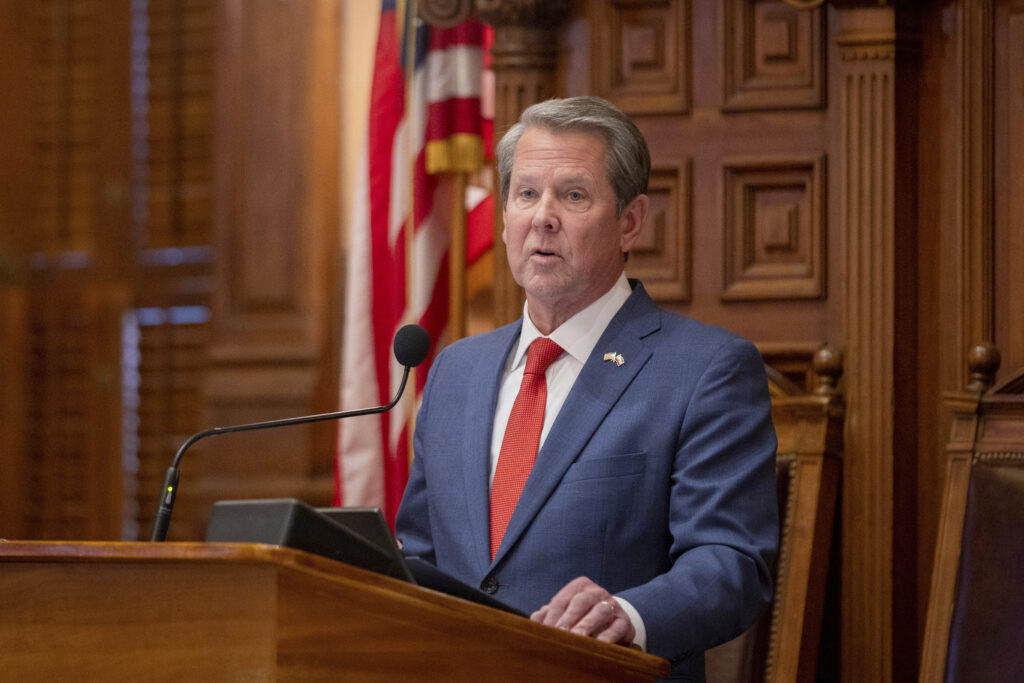
Gov. Brian Kemp addresses the House of Representatives at the Capitol in Atlanta, on Sine Die, the last day of the legislative session, Thursday, March 28, 2024. (Arvin Temkar/Atlanta Journal-Constitution via AP)

“A group of Georgia Democrats who are pursuing ethics charges against three MAGA Republican members of the Georgia State Election Board are suing GOP Gov. Brian Kemp over his failure to hold a public hearing in the matter.

The petition was filed Tuesday by state Sen. Nabilah Islam Parkes (D), former Fulton County election board Chair Cathy Woolard and Democratic Georgia Senate candidate Randal Mangham. The plaintiffs said they each filed formal ethics complaints against three members of the ethics board in August. 

sign up

After the 2020 election, Trump and his allies filed 65 lawsuits challenging the election results, 14 of which were in Georgia.

Democracy Docket is the only news outlet tracking and reporting on all of these cases — sign up for our free daily and weekly newsletters to get the latest updates sent straight to your inbox.

“State law is clear, Kemp has a duty to act,” Parkes said on X, “but he’s abdicated responsibility. If the governor won’t stop MAGA from hijacking our election, a judge will force him to.”

Under Georgia law, when formal ethics charges are filed with the governor, alleging a violation of state laws governing the conduct of public officials and employees, the governor is required to conduct a hearing “for the purpose of receiving evidence relative to the merits of such charges.”

The lawsuit says Kemp hasn’t performed this duty. The plaintiffs are asking the Fulton County court to compel Kemp to refer the charges to the Office of Administrative Hearings for a hearing on the ethics complaints.

But Kemp’s office indicated that the plaintiffs’ ethics complaints, all of which are included in the lawsuit, aren’t formal charges. In a statement to Democracy Docket, a spokesman said the office doesn’t comment on pending litigation, but added that “there have been no formal charges filed that would trigger the governor’s statutory authority to take action on these matters. As he has done in the past, the governor will follow the laws and constitution of our state.” 

In an opinion issued Sept. 6, Attorney General Chris Carr (R) explained that “formal charges” indicate “the requirement of something more than simply a generalized grievance brought by a member of the public.”

Carr said that while “formal charges” isn’t clearly defined under Georgia law, it must be sufficient to provide due process notice to the “member of any such board, commission, or authority” being accused of a violation of state law.

The three ethics complaints came after the board passed a new rule on Aug. 6 that could delay certification of the election. The rule says officials can only certify an election after conducting a “reasonable inquiry” into the results. Another rule passed on Aug. 19 allows county election members to examine all election-related documents. Those rules took effect in September and prompted lawsuits from both Democrats and Republicans.

Most recently, the board made national headlines when it passed a rule that would require three election workers at every polling place to hand count ballots cast on Election Day, even after they’ve already been counted by ballot scanners. The board’s three GOP members — Janice Johnston, Rick Jeffares and Janelle King — voted in favor of the rule. Chair John Fervier, who voted against it, raised concerns that the board went beyond its duty to interpret laws, not make them, especially months away from a presidential race. 

In Tuesday’s complaint, the plaintiffs say the three board members changed rules and regulations “to favor one political party and its candidates over others,” violating the ethical requirement that board members never engage in conduct that is “unbecoming to a member or which constitutes a breach of public trust.”

One of the plaintiffs, Woolard, resigned as chair of the Fulton County Board of Registrations & Elections in July. On Aug. 16, about a week after the state board passed the first new certification rule, she filed a formal complaint with Kemp, expressing concerns about the members’ conduct. Woolard sought a hearing within 30 days of the order to quickly resolve the matter before the election.

The ethics complaint accuses the members of violating the state’s open meetings law and ignoring counsel from the state attorney general’s office when it held a July 12 meeting without public participation.

Parkes’ complaint, included in the lawsuit, also accuses the members of illegally coordinating with the Georgia Republican Party and helping to aid former President Donald Trump in winning the state.

Woolard noted an instance in which Trump, at a rally in Atlanta on Aug. 3, called the members out by name, describing them as  “pit bulls fighting for honesty, transparency, and victory.”

“Member Johnston attended the rally,” the complaint said, “sat in the second row, and stood for applause while Trump repeatedly thanked her. Member King later stated she was “grateful for [Trump’s] encouragement and support.”

Woolard’s complaint said the trio’s conduct has created an “unacceptable appearance that their goal is to secure Trump’s victory in Georgia by any means necessary“