Contact Me By Email


What To Do When You're Stopped By Police - The ACLU & Elon James White

What To Do When You're Stopped By Police - The ACLU & Elon James White

Know Anyone Who Thinks Racial Profiling Is Exaggerated? Watch This, And Tell Me When Your Jaw Drops.


This video clearly demonstrates how racist America is as a country and how far we have to go to become a country that is civilized and actually values equal justice. We must not rest until this goal is achieved. I do not want my great grandchildren to live in a country like we have today. I wish for them to live in a country where differences of race and culture are not ignored but valued as a part of what makes America great.

Saturday, July 27, 2024

Trump tells supporters they won’t have to vote in the future: ‘It’ll be fixed!’ | US elections 2024 | The Guardian

Trump tells supporters they won’t have to vote in the future: ‘It’ll be fixed!’

"Former president implores Christian supports to vote ‘just this time’, then says he’s not Christian
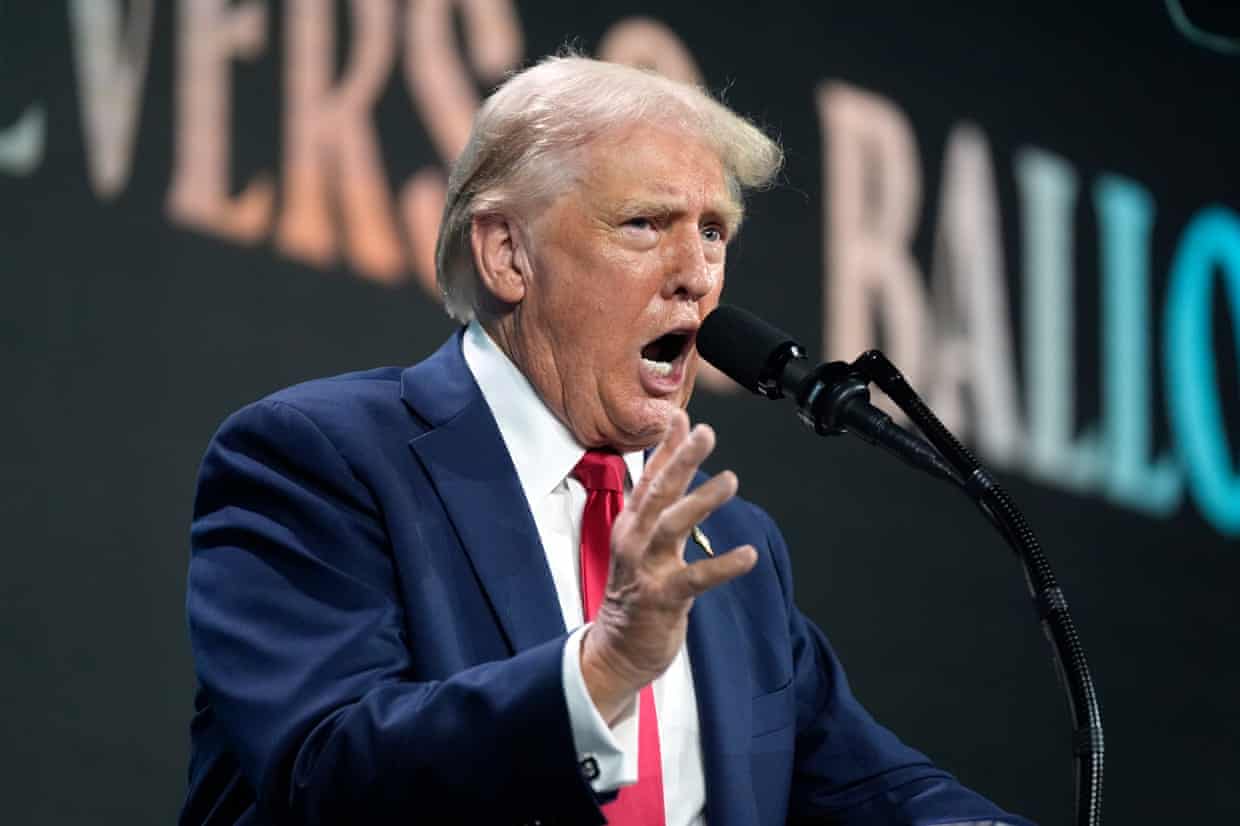
‘You won’t have to vote anymore, my beautiful Christians,’ Trump said at the the Turning Point rally on 26 July 2024, in West Palm Beach, Florida.
‘You won’t have to vote anymore, my beautiful Christians,’ Trump said at the the Turning Point rally on 26 July 2024, in West Palm Beach, Florida. Photograph: Alex Brandon/AP

Donald Trump has ignited alarm among his critics after telling a crowd of supporters that they won’t “have to vote again” if they return him to the presidency in November’s election.

“Christians, get out and vote! Just this time – you won’t have to do it any more,” the Republican former president said on Friday night at a rally hosted in West Palm Beach, Florida, by the far-right advocacy group Turning Point Action.

“You know what? It’ll be fixed! It’ll be fine. You won’t have to vote any more, my beautiful Christians.”

At that point, with a slight shake of his head and his right hand pressed against the left side of his chest, Trump said, “I’m not Christian.” But he added: “I love you. Get out – you gotta get out and vote. In four years, you don’t have to vote again. We’ll have it fixed so good, you’re not gonna have to vote.”

Trump’s remarks were immediately met with consternation in some political quarters.

The constitutional and civil rights attorney Andrew Seidel, for instance, replied to video of Trump’s comments circulating on X by writing: “This is not subtle Christian nationalism. He’s talking about ending our democracy and installing a Christian nation.”

He's talking to "my beautiful Christians" here. And saying they won't have to vote again. This is not subtle Christian Nationalism, he's talking about ending our democracy and installing a Christian nation. https://t.co/6vmzel9SAE

— Andrew L. Seidel (@AndrewLSeidel) July 27, 2024

Actor Morgan Fairchild added in a separate X post: “But … what if I want to vote again?? I was always raised that we get to vote again! That is America.” And NBC legal commentator Katie Phang said: “In other words, Trump won’t ever leave the White House if he gets re-elected.”

Trump’s comments on Friday came months after he remarked that he would be “a dictator on day one” if given a second four-year term in the White House. He has repeatedly made known his admiration for authoritarian leaders, including Russia’s Vladimir Putin, Hungary’s Viktor Orbán and North Korea’s Kim Jong-un. And a former White House aide reported that Trump once said Adolf Hitler – whose Nazi regime murdered 6 million Jews during the Holocaust amid the second world war – “did some good things”.

Meanwhile, the conservative Heritage Foundation’s Project 2025 has detailed plans to aim retribution at Trump’s actual and perceived enemies – whether politicians or bureaucrats – should he be re-elected.

Experts on authoritarianism warn the public to take Trump seriously when he speaks in that manner. And before Joe Biden halted his re-election campaign on 21 July and endorsed Kamala Harris to succeed him in the Oval Office, the Democratic president repeatedly sought to portray Trump as an existential threat to American democracy.

Trump’s supporters have tried to blame that rhetoric for the failed 13 July assassination attempt that targeted the former president at a political rally in Pennsylvania. The FBI saidon Friday that a bullet – whether whole or fragmented – hit Trump in one of his ears during that day’s shooting, which also killed a rally-goer and wounded two other spectators before a Secret Service sniper shot the gunman to death.

Yet many pointed out how Trump’s remarks on Friday seemed to be an indication that the Republican nominee for president had no plans to stop making explicit threats against democratic norms, including elections themselves.

“Oh. Trump just cancelled the 2028 election,” liberal political commentator Keith Olbermann wrote on X in a post containing a video clip of the ex-president’s remarks on Friday.

Caty Payette, the communications director for Democratic US senator Martin Heinrich of New Mexico, added in a separate X post: “When we say Trump is a threat to democracy, this is exactly what we’re talking about.”

Trump easily clinched the Republican nomination for November’s election despite having been convicted in May of 34 felony counts of falsifying business records in the New York state prosecution involving $130,000 paid to adult film actor Stormy Daniels. He has also been grappling with charges of illicitly trying to reverse the outcome of the 2020 election that he lost to Biden – efforts that were buoyed on 1 July when a US supreme court with three Trump appointees ruled that he enjoys immunity from being prosecuted for any acts deemed official.

And, among other legal issues, he has faced multimillion-dollar civil penalties for fraud and a rape allegation that a judge determined to be substantially true.

A poll released on Friday by the Republican-friendly Fox News network showed Trump in a tight race with vice-president Harris in key swing states that could decide November’s election. Before Biden’s withdrawal from the presidential election, polls generally showed Trump had built relatively comfortable leads in a number of key swing states."

Trump tells supporters they won’t have to vote in the future: ‘It’ll be fixed!’ | US elections 2024 | The Guardian

Nephew Says Trump Suggested Some Disabled People ‘Should Just Die’

Nephew Says Trump Suggested Some Disabled People ‘Should Just Die’

In a new memoir, Fred C. Trump III claims his uncle, Donald J. Trump, made cruel and racist comments.

Donald Trump seen in profile wearing a dark navy suit and red tie.
Former President Donald J. Trump during a campaign rally in Grand Rapids, Mich., on Saturday. Mr. Trump’s nephew, Fred C. Trump III, claimed in a book his uncle made cruel remarks about a disabled relative. Doug Mills/The New York Times

“In 2020, a few months before the last election, former President Donald J. Trump’s niece, Mary Trump, published a book about her uncle and how awful and psychologically warped she found him to be. At the time, her brother, Fred C. Trump III, put out a statement slamming his sister for such treachery.

Now, he’s wielding the knife. Next week, he will publish “All in the Family: The Trumps and How We Got to Be This Way,” a tell-all that puts the former president in a harsh light. The New York Times obtained a copy.

Fred and Mary Trump are the children of Fred Trump Jr., Donald’s older brother who struggled with alcoholism and died of a heart attack in 1981, when he was 42.

Fred Trump, 61, describes himself as fairly close to his uncle. He attended the 2017 inauguration (he writes that he had a better seat than John McCain) and visited the White House several times (the book includes a picture of its author sitting behind the Resolute Desk in the Oval Office).

Once, while in the Oval Office, the elder Mr. Trump insisted that his nephew stay in the room for a phone call he was about to have with King Abdullah of Jordan. He put the call on speakerphone, so his nephew could hear the king thank Mr. Trump for killing an Islamic State leader, Abu Bakr al-Baghdadi. “I killed him,” the former president boasted in front of his nephew, according to the book. “I killed him like a dog.”

But another White House meeting left the author with a chill, and, it is implied, the reason for writing the book.

Fred Trump’s son was born with a rare medical condition that led to developmental and intellectual disabilities. His care had been paid for in part with help from the family. After Mr. Trump was elected, Fred Trump wanted to use his connection to the White House for good. With the help of Ivanka Trump, his cousin, and Ben Carson, at the time the housing and urban development secretary, he was able to convene a group of advocates for a meeting with his uncle. The president “seemed engaged, especially when several people in our group spoke about the heart-wrenching and expensive efforts they’d made to care for their profoundly disabled family members,” he writes.

After the meeting, Fred Trump claims, his uncle pulled him aside and said, “maybe those kinds of people should just die,” given “the shape they’re in, all the expenses.”

The remark wasn’t a one-off, according to Fred Trump. A couple of years later, when he called his uncle for help because the medical fund that paid for his son’s care was running out of money, Fred Trump claims his uncle said: “I don’t know. He doesn’t recognize you. Maybe you should just let him die and move down to Florida.”

“Maybe I shouldn’t have been surprised to hear Donald say that,” he writes. “It wasn’t far off from what he’d said that day in the Oval Office after our meeting with the advocates. Only that time, it was other people’s children who should die. This time, it was my son.”

Another scathing anecdote in the book occurred decades earlier, in the 1970s, when the author claims to have heard his uncle use a racial slur after his car had been damaged and he was searching for someone to blame.

“‘Look what the niggers did,’” Fred Trump writes, quoting his uncle.

The author describes the former president as a product of an Archie Bunker-like, “us-versus-them” upbringing in Queens, but then notes: “Drunk or sober, my father never used the N-word, not that I ever heard. And neither had I.”

Steven Cheung, a Trump campaign spokesman, called Fred Trump’s account “completely fabricated and total fake news of the highest order.” 

“Anyone who knows President Trump knows he would never use such language, and false stories like this have been thoroughly debunked,” he said. Mr. Trump has previously been accused of using the slur while he was the host of his television reality show. He has denied it.

Fred Trump paints a somewhat nuanced portrait of his uncle, including details that suggest their relationship was often warm. They would watch “The Twilight Zone” together and play catch. When Fred Trump’s blue Schwinn bicycle was stolen, it was his uncle who took him to the precinct to demand the police do something, he writes.

The elder Mr. Trump would take his nephew golfing. When Fred Trump wanted help finding an engagement ring, his uncle told him to “Go see Ralph Destino. He’s the president of Cartier. He’ll help you pick something out.”

Donald and his ex-wife, Ivana, arrived at Fred Trump’s wedding in a limo (it was too rainy to land a helicopter), and Fred had decent relationships with some of his cousins, Donald Jr., Eric, and Ivanka (he attended her wedding to Jared Kushner).

One thing the book makes clear is that, in the Trump family, score-settling and feuding is a way of life. “Blood went only so far in this family,” he writes, “as far as the dollar signs.”

Fred Trump’s account retreads the well-documented fight that occurred after his uncle teamed up with two of his siblings to cut him and his sister out of their grandfather’s will. The legal battle that ensued was vicious and public, chronicled in the pages of the city’s tabloids.

And yet, once it was all settled, Fred writes that his uncle invited him to go golfing. “We’re through, right?” he asked him. When his nephew said they were, the elder Mr. Trump gave him a hug. (Then, according to the book, he stepped away and added, “Your lawyer never should have said that thing about your grandfather’s toupee.”)

Fred Trump writes that, when his uncle was running for president in 2016, the elder Mr. Trump’s sister, a federal judge named Maryanne Trump Barry, wanted to publish an opinion essay disparaging her brother, but ultimately decided against it.

And Fred Trump describes his fury toward his sister, Mary, for blindsiding him with her book. “Mary didn’t speak for me any more than anyone else in the family did,” he writes. “I hated that people kept assuming that.”

Fred Trump says he voted for Hillary Clinton in 2016 and Joe Biden in 2020. His uncle’s divisive presidency made it harder to be a Trump, he writes. (He claims to have woken up one day to find dead chickens strewed across his Connecticut lawn.)

In one peculiar scene at the end of the book, he recounts going to see his uncle after he had left the White House, because he was having trouble finding work. (Fred worked in commercial real estate, but not for the Trump Organization.) He told his uncle that their family’s name was now too “toxic,” and the former president “gave a small jolt” at hearing that.

As he turned to walk out, he claims his uncle admonished him: “Don’t ever say that the Trump name is toxic. Never say that.”

A version of this article appears in print on July 25, 2024, Section A, Page 16 of the New York edition with the headline: Trump Nephew to Publish Tell-All Book That Depicts Cruel and Racist Episodes. Order Reprints | Today’s Paper | Subscribe“

The Police Killing of Sonya Massey Argues for Alternatives to Reform

The Police Killing of Sonya Massey Argues for Alternatives to Reform

A photograph of the back of the head of two men. They are both wearing black hats. The person closest to the camera has a police radio attached to his left shoulder.
Christopher Anderson/Magnum Photos

By Tahir Duckett

“Mr. Duckett is a civil rights lawyer and activist. He is the executive director of Georgetown Law’s Center for Innovations in Community Safety.

On July 6, Sonya Massey called 911 to report an intruder. After Sean Grayson, a sheriff’s deputy, and another officer found no intruder outside of her home in Sangamon County, Ill., they knocked on her door. The situation escalated after Ms. Massey went to turn off her stove. Within seconds Mr. Grayson drew his gun and shot her in the head.

The death of George Floyd in 2020 drew public outrage and calls for a wide variety of police reforms. There is still a lot we don’t know about the Massey situation, including if she was experiencing mental distress. But the killing of Ms. Massey is a cold reminder of how little has changed in the years since.

It’s true that there have been piecemeal reforms at the state and local level. But at the federal level, the George Floyd Justice in Policing Act was unable to get past partisan gridlock in the Senate — and, in any case, many experts agree that the act would not do enough to reduce rates of police violence in the United States.

Amid a stalled federal legislative agenda, arguably the most significant development since 2020 is what appears to be a newfound willingness to prosecute officers who use unjustifiable deadly force. Between 2016 and 2019, only 43 police officers were charged with murder or manslaughter related to an on-duty shooting. From 2020 to 2023, more than 70 officers were charged. And yet, more than 1,100 people were shot and killed by police officers last year — the highest one-year number on record.

Mr. Grayson was fired and charged with first-degree murder, but that is unlikely to reduce rates of police violence. Such violence often arises because we ask the police to serve in an impossibly wide range of roles, many of which they aren’t well-suited for.

Police officers are charged with too wide a range of duties: from monitoring the status of your vehicle headlights to clearing homeless encampments and maintaining youth curfews. All of this amounts to tens of millions of U.S. residents having at least one contact with police officers each year. If we want more effective law enforcement and fewer police abuses, we need to start seriously investing in the programs across the country that have shown promise at taking work off the plate of law enforcement.

About 20 percent of police killings involve someone in mental distress. To meet the needs of residents experiencing issues like homelessness, addiction and behavioral health crises, cities like Albuquerque, Durham, N.C., and Denver have launched alternative response programs, in which unarmed civilians, instead of armed officers, are being dispatched to respond to thousands of calls for service.

Before launching these programs, both the police and the general public often expressed concern that unarmed responders will be hurt on the job, most likely by someone experiencing a mental health crisis. But in the past few years, no crisis teams in any of these places have had any known major injuries while on the job and people in need are getting more tailored responses for help.

These programs are a political winner; most police officers surely didn’t sign up for the job to arrest someone for sleeping in a Starbucks bathroom, and police chiefs have expressed enthusiasm about a reduction in the number of calls on their dashboard.

Many programs have started in recent years, perhaps the most enduring legacy of the George Floyd protests. But even the biggest programs only respond to a fraction of the calls that come in and few programs operate around the clock.

Community violence intervention programs rely on several overlapping strategies: outreach to high-risk individuals to offer services, focused interventions to prevent retaliatory violence, mediation and cognitive behavioral therapy to prevent violence before it happens.

This isn’t a question of defunding the police — it’s about funding some of the most promising community-led innovations in municipal governance in recent decades. President Biden’s administration has invested hundreds of millions of dollars in community violence intervention and alternative responses, with bipartisan support in Congress, and the investment may be yielding results. We are in the midst of one of the steepest declines in the homicide rate in recorded history, despite the fact that little seems to have changed in police staffing in recent years.

Nonetheless, House Republicans recently proposed slashing federal funding for the Department of Justice’s community violence intervention initiative — a clear step in the wrong direction. The federal government spends tens of billions on policing each year; it should similarly allocate significant annual investments into community violence intervention and alternative response.

Cities across the nation are showing us that we can widen the way that we think about community safety. Until we narrow the scope of what police officers can do, we’ll continue to see officers bring violence into situations that don’t require it”

Wednesday, July 24, 2024

Close to 40,000 Palestinians killed by military offensive in Gaza, health ministry says – as it happened | Israel-Gaza war | The Guardian

Close to 40,000 Palestinians killed by military offensive in Gaza, health ministry says – as it happened

"At least 39,145 Palestinians killed and 90,257 wounded since 7 October, Palestinian health ministry says

A Palestinian girl stands at a tent in a camp sheltering displaced Palestinians in Khan Younis.
A Palestinian girl stands at a tent in a camp sheltering displaced Palestinians in Khan Younis. Photograph: Bashar Taleb/AFP/Getty Images

Closing summary

  • The Israeli military has launched a fresh attack on the southern Gaza city of Khan Younis, killing at least 70 people according to medics, after ordering Palestinians to leave several neighbourhoods including areas that had been designated by the military as part of a humanitarian zone. Palestinian civil defence in the territory estimated that 400,000 people sheltering in the city were affected by the order, which included the eastern part of Al-Mawasi, a sandy strip of land without infrastructure where Palestinians have sought shelter in tent encampments in recent months.

  • Lebanese armed group Hezbollah broadcast drone video on Wednesday that it said showed air defence facilities, planes and fuel storage units at Israel’s Ramat David airbase, nearly 50km (30 miles) into Israeli territory. It was the third in a series of videos released by Hezbollah which the group has said are meant to demonstrate how far its surveillance of Israel has reached. The first video showed the Israeli port city of Haifa and the second the Israeli-occupied Golan Heights.

  • Israel’s military offensive in the Gaza Strip has killed at least 39,145 Palestinians and wounded 90,257 since 7 October, the Palestinian health ministry said on Wednesday. A total of 55 Palestinians have been killed and 110 wounded in the past 24 hours, the ministry said in a statement.

  • Pro-Palestinian demonstrators have blocked entrances to the Foreign Office in London in protest at the perceived failure of the new Labour government to do more to change UK policy towards Israel’s offensive in Gaza. As many as 300 people sealed off access to the Foreign Office on Wednesday morning with a large banner saying “Genocide Made in Britain”. Protesters said six demonstrators had been arrested.

  • British police on Wednesday arrested nine people during a protest against arms exports to Israel that briefly blocked the street outside the foreign ministry, highlighting pressure on the new Labour government over its stance on the Gaza war. Pro-Palestinian protesters in Britain have been campaigning for a government ban on arms sales to Israel following its offensive on Gaza in response to the 7 October attack.

  • There are also protests in Washington DC over the arrival of Israeli prime minister, Benjamin Netanyahu, including a sit-in at a congressional office building that ended with multiple arrests, according to the Associated Press. Some of the demonstrations have condemned Israel but others have expressed support while pressuring Netanyahu to strike a ceasefire deal and bring home the hostages still being held by Hamas.

  • SpaceX chief executive Elon Musk said that his Starlink satellite internet service has been activated in a hospital in Gaza, where many medical facilities have been destroyed by the war, with the help of the United Arab Emirates and Israel. The Gulf Arab state’s foreign minister, Sheikh Abdullah bin Zayed Al Nahyan, thanked the billionaire entrepreneur for supporting the UAE field hospital in Gaza, where many medical facilities have been demolished and medicines are scarce, Reuters reported.

  • Doctors in the largest hospital in Gaza’s southern city of Khan Younis yesterday pleaded for supplies from a facility overwhelmed by wounded people, as Israeli airstrikes, artillery fire and fighting on the streets continued. “There’s no space for more patients. There’s no space in the operating theatres. There is a lack of medical supplies, so we cannot save our patients,” Mohammed Zaqout, the director of Nasser hospital, told AFP. The UN’s office for humanitarian affairs (OCHA) said the hospital was facing “a new mass casualty influx, amid a dire lack of blood units, medical supplies and hospital beds”.

  • The German government has banned a Hamburg-based organization accused of promoting the Iranian leadership’s ideology and supporting Lebanon’s Hezbollah militant group, as police raided 53 properties around the country. The ban on the Islamic Center Hamburg, or IZH, and five suborganizations around Germany followed searches in November, AP reported. Interior minister Nancy Faeser said evidence gathered in the investigation “confirmed the serious suspicions to such a degree that we ordered the ban today.”

  • The Palestinian Authority’s budget deficit is projected to surge by 172% in 2024 compared to 2023, according to a statement from the cabinet on Tuesday, Reuters reports. Revenues are also expected to drop by 21% due to the ongoing conflict in Gaza. The announcement followed President Mahmoud Abbas’ approval of the emergency budget for 2024, which includes austerity measures such as reducing salaries, operational and capital expenditures, and maintaining minimal development expenditures.

That’s all from me, Tom Ambrose, and indeed the Middle East crisis live blog for today. Thanks for following along.

The Israeli military has launched a fresh attack on the southern Gaza city of Khan Younis, killing at least 70 people according to medics, after ordering Palestinians to leave several neighbourhoods including areas that had been designated by the military as part of a humanitarian zone.

Palestinian civil defence in the territory estimated that 400,000 people sheltering in the city were affected by the order, which included the eastern part of Al-Mawasi, a sandy strip of land without infrastructure where Palestinians have sought shelter in tent encampments in recent months.

The military claimed Hamas militants in Khan Younis and part of Al-Mawasi were using the area to launch rockets at Israel.

“We were displaced from the eastern regions, they called us to evacuate, we took our children and left,” Osama Qudeih told the Associated Press (AP). “There was no safe place left in the Gaza Strip … We went out walking in the streets, not knowing where to go.”

Another woman collapsed in exhaustion after saying it was her seventh or eighth displacement. “Every day we are displaced,” Kholoud al-Dadas told AP as she clutched her children. “Where are the countries? Where is the world, where are the presidents, where are they? Come and see how we are, our children, and what is happening to us.”

Nine arrests during London protest against Israel arms exports

British police on Wednesday arrested nine people during a protest against arms exports to Israel that briefly blocked the street outside the foreign ministry, highlighting pressure on the new Labour government over its stance on the Gaza war.

Pro-Palestinian protesters in Britain have been campaigning for a government ban on arms sales to Israel following its offensive on Gaza in response to the 7 October attack.

On the afternoon of 7 October, Nour Shahtout was busy doing her homework, when she received a text message from school, telling students not to come in the next day. She hasn’t been back since. “At the time, I thought I had the day off and could hang out with my friends,” says the 18-year-old. “Little did I know, everything was about to change.”

Two weeks later, Shahtout’s family home in Tel al-Hawa, a neighbourhood in the south of Gaza City, was bombed in an Israeli airstrike. “We had only 10 minutes to evacuate,” she recalls. “I grabbed my laptop, charger and as many books as I could fit into my bag.” Shahtout, a high-achieving student, had plans to study ICT and business at Al-Azhar University. “But the following month, the IDF destroyed that too,” she says.

The family evacuated to Khan Younis but the bombs followed. Over the next few months, they moved from one tent to the next, fled one city to the next, until they realised there was no safe place left in the Gaza Strip. After selling everything they owned to pay for their passage out, the family crossed into Egypt in March, like some 100,000 other Palestinians who have been able to get out of Gaza since the start of the conflict.

“I don’t like it here, I miss my friends and I want to go home,” says Shahtout, sitting cross-legged on a worn, blue rug in the one-bedroom apartment shared by two families. “I am stuck in this one room all day, where there is no space or privacy,” she adds. “I want to study and complete my degree but life has come to a standstill.”

The small living room serves as a bedroom for Shahtout, her parents and two brothers, with two large sofas, a table and a battered mattress leaning against one of the walls; Shahtout’s school books are piled in one corner.

In the United States, more than 30 House and Senate Democrats are not planning to attend Israeli prime minister Benjamin Netanyahu’s speech today to Congress, NBC News is reporting.

Netanyahu is scheduled to address a joint meeting on Congress this afternoon at 2pm ET.

To continue following Netanyahu’s speech today to Congress, please follow our US live blog here.

Lebanese armed group Hezbollah broadcast drone video on Wednesday that it said showed air defence facilities, planes and fuel storage units at Israel’s Ramat David airbase, nearly 50km (30 miles) into Israeli territory.

It was the third in a series of videos released by Hezbollah which the group has said are meant to demonstrate how far its surveillance of Israel has reached. The first video showed the Israeli port city of Haifa and the second the Israeli-occupied Golan Heights.

A spokesman for the Israeli military said in a statement on X that the video was filmed by a surveillance drone and the base’s operations were not affected, Reuters reported.

The latest video was more than eight minutes long and, Hezbollah said, mostly shot on Tuesday.

US president Joe Biden will host Israeli prime minister Benjamin Netanyahu at the White House on Thursday to discuss progress towards a ceasefire in Gaza and a hostage release, the White House said.

Vice-president Kamala Harris will meet separately with Netanyahu, it said on Wednesday. The Israeli leader is addressing the US Congress later on Wednesday amid protests and discontent among some US lawmakers over the conduct of the war in Gaza.

Here are some of the latest images from photographers on the ground in Gaza:

Two boys pose for the camera at a camp sheltering displaced Palestinians in Khan Younis.
Two boys pose for the camera at a camp sheltering displaced Palestinians in Khan Younis. Photograph: Bashar Taleb/AFP/Getty Images
A Palestinian girl at the same camp in Khan Younis.
A Palestinian girl at the same camp in Khan Younis. Photograph: Bashar Taleb/AFP/Getty Images
A handout picture released by the Israeli army showing troops in the Gaza Strip.
A handout picture released by the Israeli army showing troops in the Gaza Strip. Photograph: Israeli Army/AFP/Getty Images

A far-right Israeli minister says he has prayed at Jerusalem’s flashpoint Al-Aqsa mosque compound, yet again defying longstanding rules that allow Jews to visit but not to pray, the Reuters news agency reports.

The mosque compound is Islam’s third holiest site and a symbol of Palestinian national identity but it is also revered by Jews as the site of their ancient temple, destroyed by the Romans in 70 AD.

National security minister Itamar Ben Gvir told a symposium in the Israeli parliament.

I’m the political leadership and the political leadership authorises prayers on the Temple Mount.

“I prayed on the Temple Mount last week and Jews pray on the Temple Mount... There is no reason why parts of the Temple Mount should be off-limits for Jews.

While Jews and other non-Muslims are allowed to visit the mosque compound in Israeli-annexed east Jerusalem during specific hours, they are not permitted to pray or display religious symbols.

In recent years, the restrictions have been increasingly flouted by hardline religious nationalists like Ben Gvir, prompting a sometimes violent reaction from Palestinians.

The day so far

  • Israel’s military offensive in the Gaza Strip has killed at least 39,145 Palestinians and wounded 90,257 since 7 October, the Palestinian health ministry said on Wednesday. A total of 55 Palestinians have been killed and 110 wounded in the past 24 hours, the ministry said in a statement.

  • Pro-Palestinian demonstrators have blocked entrances to the Foreign Office in London in protest at the perceived failure of the new Labour government to do more to change UK policy towards Israel’s offensive in Gaza. As many as 300 people sealed off access to the Foreign Office on Wednesday morning with a large banner saying “Genocide Made in Britain”. Protesters said six demonstrators had been arrested.

  • At least six protesters have been arrested as hundreds of demonstrators shut down access to the foreign, commonwealth and development (FCDO) headquarters in central London on Wednesday morning, demanding the government halts all arms exports to Israel. Organisers, Workers For a Free Palestine, said at least six protestors were arrested while blocking access to the foreign office at the Whitehall and St James’ Park entrances.

  • There are also protests in Washington DC over the arrival of Israeli prime minister, Benjamin Netanyahu, including a sit-in at a congressional office building that ended with multiple arrests, according to the Associated Press. Some of the demonstrations have condemned Israel but others have expressed support while pressuring Netanyahu to strike a ceasefire deal and bring home the hostages still being held by Hamas.

  • SpaceX chief executive Elon Musk said that his Starlink satellite internet service has been activated in a hospital in Gaza, where many medical facilities have been destroyed by the war, with the help of the United Arab Emirates and Israel. The Gulf Arab state’s foreign minister, Sheikh Abdullah bin Zayed Al Nahyan, thanked the billionaire entrepreneur for supporting the UAE field hospital in Gaza, where many medical facilities have been demolished and medicines are scarce, Reuters reported.

  • Doctors in the largest hospital in Gaza’s southern city of Khan Younis yesterday pleaded for supplies from a facility overwhelmed by wounded people, as Israeli airstrikes, artillery fire and fighting on the streets continued. “There’s no space for more patients. There’s no space in the operating theatres. There is a lack of medical supplies, so we cannot save our patients,” Mohammed Zaqout, the director of Nasser hospital, told AFP. The UN’s office for humanitarian affairs (OCHA) said the hospital was facing “a new mass casualty influx, amid a dire lack of blood units, medical supplies and hospital beds”.

  • The German government has banned a Hamburg-based organization accused of promoting the Iranian leadership’s ideology and supporting Lebanon’s Hezbollah militant group, as police raided 53 properties around the country. The ban on the Islamic Center Hamburg, or IZH, and five suborganizations around Germany followed searches in November, AP reported. Interior minister Nancy Faeser said evidence gathered in the investigation “confirmed the serious suspicions to such a degree that we ordered the ban today.”

  • The Palestinian Authority’s budget deficit is projected to surge by 172% in 2024 compared to 2023, according to a statement from the cabinet on Tuesday, Reuters reports. Revenues are also expected to drop by 21% due to the ongoing conflict in Gaza. The announcement followed President Mahmoud Abbas’ approval of the emergency budget for 2024, which includes austerity measures such as reducing salaries, operational and capital expenditures, and maintaining minimal development expenditures.

  • Netanyahu has landed in Washington DC. Netanyahu’s first 24 hours have seen a series of small meetings with the families of hostages kidnapped by Hamas on 7 October, in which he said that progress was being made on negotiating a prisoner exchange of the remaining 120 hostages as part of a ceasefire deal but defended delaying for better terms.

  • Republican presidential nominee Donald Trump will host the Israeli prime minister on Friday at his resort in Palm Beach, Florida, Trump said on Tuesday.“Looking forward to welcoming Bibi Netanyahu at Mar-a-Lago in Palm Beach, Florida,” the former US president said in a post on Truth Social, using Netanyahu’s nickname. The meeting will be their first since the end of Trump’s presidency, during which the two forged close ties, and comes at a time of strains also between Netanyahu and Biden over Israel’s war against Hamas militants in Gaza.

  • Leaders from Hamas, Fatah and other Palestinian factions have agreed after three days of talks in Beijing to form a national unity government at an unspecified point in the future, in a move that has bolstered China’s status as a global mediator, particularly in the Middle East.

  • Vandals ransacked an Israeli-Palestinian restaurant in Berlin, smashing wine glasses and defiling the space with “disgusting acts” a week after it hosted a queer Jewish-Muslim brunch, its owners have said."

Close to 40,000 Palestinians killed by military offensive in Gaza, health ministry says – as it happened | Israel-Gaza war | The Guardian