Friday, January 28, 2022


Thursday, January 27, 2022
Tennessee school board bans Pulitzer prize-winning Holocaust novel, Maus | Holocaust | The Guardian
Tennessee school board bans Pulitzer prize-winning Holocaust novel, Maus
Author Art Spiegelman says decision by Mcminn county, which cited inappropriate ‘curse words’ and nudity, is ‘demented’

A Tennessee school board has banned a Pulitzer prize-winning novel from its classrooms over eight curse words and an illustration of a naked cartoon mouse.
The graphic novel, Maus: A Survivor’s Tale by New Yorker Art Spiegelman, uses hand-drawn illustrations of mice and cats to depict how the author’s parents survived Auschwitz during the Holocaust.
The graphic memoir elevated a pulp mass medium to high art when it nabbed a slew of literary awards in 1992 but appears not to have impressed educators in Mcminn county.
Ten board members unanimously agreed in favour of removing the novel from the eighth-grade curriculum, citing its use of the phrase “God Damn” and drawings of “naked pictures” of women, according to minutes taken from a board of education meeting earlier this month.

“There is some rough, objectionable language in this book,” director of school, Lee Parkison, is recorded as saying in the session’s opening remarks.
Parkison continued to say he had “consulted with our attorney” and as a result “we decided the best way to fix or handle the language in this book was to redact it … to get rid of the eight curse words and the picture of the woman that was objected to.”
Board member Tony Allman supported the move to remove the “vulgar and inappropriate” content, arguing: “We don’t need to enable or somewhat promote this stuff.”
“I am not denying it was horrible, brutal, and cruel,” Allman said in reference to the genocide and murder of six million European Jews during the second world war.
“It shows people hanging, it shows them killing kids, why does the educational system promote this kind of stuff? It is not wise or healthy,” he added.
Allman also took aim at Spiegelman himself, alleging: “I may be wrong, but this guy that created the artwork used to do the graphics for Playboy.”
“You can look at his history, and we’re letting him do graphics in books for students in elementary school. If I had a child in the eighth grade, this ain’t happening. If I had to move him out and homeschool him or put him somewhere else, this is not happening.”
Mike Cochran, another school board member, described parts of the book as “completely unnecessary”.
“We are talking about teaching ethics to our kids, and it starts out with the dad and the son talking about when the dad lost his virginity. It wasn’t explicit but it was in there,” Cochran said.
“We don’t need this stuff to teach kids history. We can teach them history and we can teach them graphic history. We can tell them exactly what happened, but we don’t need all the nakedness and all the other stuff.”
Cochran proposed revisiting the entire curriculum over concerns it was developed to “normalise sexuality, normalise nudity and normalise vulgar language.”
“If I was trying to indoctrinate somebody’s kids, this is how I would do it,” he added. “You put this stuff just enough on the edges, so the parents don’t catch it but the kids, they soak it in. I think we need to relook at the entire curriculum.”
The decision comes as conservative groups across the country are stepping up campaigns to ban books from school libraries, often focused on works that address race, LGBTQ issues or marginalized communities.
The board did have some supporters with Julie Goodin, an instructional supervisor and former history teacher, and Melasawn Knight, the federal programs supervisor, backing the novel’s inclusion in the curriculum.
“I think any time you are teaching something from history, people did hang from trees, people did commit suicide and people were killed, over six million were murdered. I think the author is portraying that because it is a true story about his father that lived through that,” Knight said.
“I can talk of the history, I was a history teacher and there is nothing pretty about the Holocaust and for me this was a great way to depict a horrific time in history,” Goodin added.
After much discussion over the redaction of words the members found objectionable, the board eventually decided that alongside copyright concerns, it would be better to ban the graphic novel altogether.
Spiegelman said he was “baffled” by the outcome in an interview with CNBC on Wednesday. “It’s leaving me with my jaw open, like, ‘What?’” the 73-year-old author said, adding he thought the school board was “Orwellian” for approving the ban.
Spiegelman’s Jewish parents were both sent to Nazi concentration camps and his mother took her own life when he was just 20.
“I’ve met so many young people who … have learned things from my book,” Spiegelman said. “I also understand that Tennessee is obviously demented. There’s something going on very, very haywire there.”
Opinion | Stephen Breyer Was the Right Justice for the Wrong Age - The New York Times
Stephen Breyer Was the Right Justice for the Wrong Age


"Ms. Greenhouse, a winner of a 1998 Pulitzer Prize, reported on the Supreme Court for The Times from 1978 to 2008 and was a contributing Opinion writer for 12 years, until last month.
Two misfortunes have befallen Stephen G. Breyer during his long Supreme Court career. One, which became apparent about halfway through his nearly 28-year tenure, was that it was his fate to be the quintessential Enlightenment man in an increasingly unenlightened era at the court. The second happened during this past year: the demand from the left that he step down and open his seat for President Biden to fill.
Justice Breyer’s belief in the power of facts, evidence and expertise was out of step in a postfactual age. The protections of the Voting Rights Act were no longer necessary in the South? The Constitution’s framers meant to give the populace an individual right to own a gun? Or, more recently, the federal agency charged with protecting American workers was likely powerless to protect the workplace from a deadly pandemic?
Really? Of course, Justice Breyer was on the losing side.
To my second point, it’s not that requests for him to step down were unreasonable. It’s that they became so vociferous, so belittling, really. It’s as if this distinguished public servant could be shoved out of the way, obscuring any idea of who he is and what his time on the court has meant. That is a loss not only for him — and he certainly deserves better — but also for the rest of us, because his career has much to teach us about the state of the court today.
At 83, Justice Breyer is a decade older than the next oldest justice, Clarence Thomas, and a generation older than the youngest, Amy Coney Barrett, who turns 50 on Friday. Like five of his colleagues (Chief Justice John Roberts and Justices Barrett, Elena Kagan, Neil Gorsuch and Brett Kavanaugh), he was once a Supreme Court law clerk.
But there is a difference. He clerked for Justice Arthur Goldberg during the Supreme Court’s heroic age, the period under Chief Justice Earl Warren when the court seemed to be pushing — or dragging — post-World War II America into recognizing the equality of the races and the rights of criminal suspects. The other five came of age in the subsequent era of judicial retrenchment, that era now reaching a climax.
Although the labels often affixed to Justice Breyer are “pragmatist” and “seeker of compromise,” it has always seemed to me that these, while not inaccurate, miss the mark. They discount the passion beneath the man’s cool and urbane persona, passion that I think stems from his early encounter with a court that understood the Constitution as an engine of progress.
That passion was obvious in his astonishing 21-minute oral dissent from the bench in 2007 from a school integration decision that, early in Chief Justice Roberts’s tenure, marked a significant turn away from the court’s commitment to ending segregation. The law professor Lani Guinier, in a famous article in The Harvard Law Review the next year, celebrated that dissent as “demosprudence,” a way of speaking law directly to the people in the expectation that they will then speak back to the lawmakers.
His passion was obvious this month, too, when the court heard a challenge to the Biden administration’s Covid vaccination rule for businesses employing 100 or more people. Justice Breyer radiated fury as he addressed Scott A. Keller, the lawyer representing the business plaintiffs.
“I mean, there were three-quarters of a million new cases yesterday,” the justice said, his voice rising. “New cases. Nearly three-quarters — 700-and-some-odd thousand, OK?” He continued that the number was 10 times as high as when the Occupational Safety and Health Administration “put this rule in. The hospitals are today, yesterday, full, almost to the point of the maximum they’ve ever been in this disease, OK?”
Noting that the standard for granting an injunction of the sort the plaintiffs requested required a showing that the court’s intervention was in the public interest, he asked: “Is that what you’re doing now, to say it’s in the public interest in this situation to stop this vaccination rule, with nearly a million people — let me not exaggerate — nearly three-quarters of a million people, new cases every day? I mean, to me, I would find that unbelievable.”
Of course, that’s what the court did, and of course, Justice Breyer dissented.
His dissenting opinion, written with Justices Kagan and Sonia Sotomayor, wasn’t particularly showy. It was, one might say, Breyeresque, using data, logic and the language of administrative law — a subject he taught for many years at Harvard Law School — to arrive at its central argument:
Underlying everything else in this dispute is a single, simple question: Who decides how much protection, and of what kind, American workers need from Covid-19? An agency with expertise in workplace health and safety, acting as Congress and the president authorized? Or a court, lacking any knowledge of how to safeguard workplaces and insulated from responsibility for any damage it causes?
That this argument failed to carry the day speaks volumes not only about how out of step Justice Breyer is with the court’s trajectory but also how out of step the majority is with the kind of fact-based analysis that he has brought to the problems the court is charged with solving.
In recent months, Justice Breyer has been mocked on the left for clinging to a romantic vision of the Supreme Court as an institution apart from politics. Surely, that argument has gone, if he could only get over that fiction and understand the political moment, he would hang up his robe.
That mistakes the man. He cut his eyeteeth in politics, working for Senator Edward Kennedy as chief counsel to the Senate Judiciary Committee. I’m sure he, along with the rest of us, has watched with clear eyes and a heavy heart as politics swamped the institution he loves.
His understanding of politics — that the only way to make a difference is by staying in the game — led him to stay on the court as the diminished liberal side’s senior associate justice, a role that will now pass to Justice Sotomayor. Although he will reportedly remain on the court until the end of this term, he chose to announce his plan to retire now, just after the court finished assembling the cases it will hear and decide through late June or early July. This suggests he has the months ahead fully in view and has decided that he has made all the difference he can make.
Now it’s time to let someone else try."
Wednesday, January 26, 2022
Opinion | Biden Promised a Black Woman on the Supreme Court - The New York Times
Biden Promised a Black Woman on the Supreme Court

"Joe Biden limped into the South Carolina primaries in 2020.
He had finished fourth in Iowa, fifth in New Hampshire, and second — a distant second — in Nevada.
He needed South Carolina to stay alive, a state where six in 10 Democratic voters are Black. He needed Black people to save him.
During a debate just days before voting began in South Carolina, Biden made a promise to Black voters. Everyone is entitled to be treated with dignity and everyone should be represented on the Supreme Court, he said: “I’m looking forward to making sure there’s a Black woman on the Supreme Court, to make sure we in fact get every representation.”
Black voters gave Biden the victory he needed, one that turned his campaign around and arguably set him on a path to win the nomination.
Now, with reports that Justice Stephen Breyer will retire in June or July, President Biden has a chance to make good on his promise and repay Black people — at least on this measure — for their support.
This opening could not have come at a better time for Biden. He is struggling in the polls, unable to overcome Republican obstructionism and resistance from within his own party to deliver on several of the major promises he made to Black voters, such as passing federal police reforms and voter protections.
Poll after poll has pointed to growing dissatisfaction among Black voters.
Morning Consult data from October found that Biden’s approval among Black voters was down 16 percentage points from the month before.
As NBC News reported in December:
“Biden’s approval among Black voters has been sliding throughout the year. A poll by HIT Strategies showed that 48 percent of Black voters said in November that Biden was addressing their needs, compared to 66 percent of respondents in June.”
And as The Associated Press reported last week:
“Just six in 10 Black Americans said they approved of Biden in a recent poll by The Associated Press-NORC Center for Public Affairs Research, down from about nine in 10 who approved in polls conducted through the first six months of Biden’s presidency.”
The perception of Biden as a disappointment has been hardening among Black voters, the voters he needed to win in 2020 and the ones he would need again in 2024.
The Biden administration’s attempts to turn things around have not borne fruit. This is not to say Biden hasn’t had some big wins, particularly early in his term, but rather, that the losses loom large in recent memory, and they are continually piling up.
A Supreme Court opening offers Biden an opportunity to move beyond those losses, to change the conversation and the narrative, to emerge with a significant victory that he can hold up as proof of his success. It would put a major mark in the plus column.
No justice Biden nominates can change the ideological balance of the court significantly, but all new justices change the dynamic on the court. And every time an excluded group is included, that is good for the institution and its credibility.
It is important, I believe, that Black people have a Black person on the court more in tune with the views of the Black community than Clarence Thomas, the lone Black justice for the last 30 years. It has always struck me as a tragedy that Thomas was chosen to replace the liberal lion Thurgood Marshall.
Ideologically, it was like night and day, or night overtaking the day.
I remember knowing the name Thurgood Marshall for as long as I can recall knowing anything about the Supreme Court. As a child, I’m not sure I could have named another justice. As Biden suggested in South Carolina, representation matters, not just the skin of a person but also their soul.
Marshall’s entire life was spent in the service of, and for the liberation of, Black people.
We need a justice who considers the Constitution in a cleareyed way, as Marshall put it in 1987:
I do not believe that the meaning of the Constitution was forever “fixed” at the Philadelphia Convention. Nor do I find the wisdom, foresight, and sense of justice exhibited by the Framers particularly profound. To the contrary, the government they devised was defective from the start, requiring several amendments, a civil war, and momentous social transformation to attain the system of constitutional government, and its respect for the individual freedoms and human rights, we hold as fundamental today.
I hope that little Black girls — and all children — can know the pride and sense of belonging I felt when I saw Marshall or said his name. I saw myself when I saw him. I believed that my voice was being heard because he was relaying it.
I also hope that young people will know, once again, what it feels like to have a person on the court who looks like them and can advocate for them and their positions, rather than being constantly confronted by the dissonance Thomas evokes.
Now is the time for a Black woman on the Supreme Court."
‘He’s a villain’: Joe Manchin attracts global anger over climate crisis | Joe Manchin | The Guardian
‘He’s a villain’: Joe Manchin attracts global anger over climate crisis
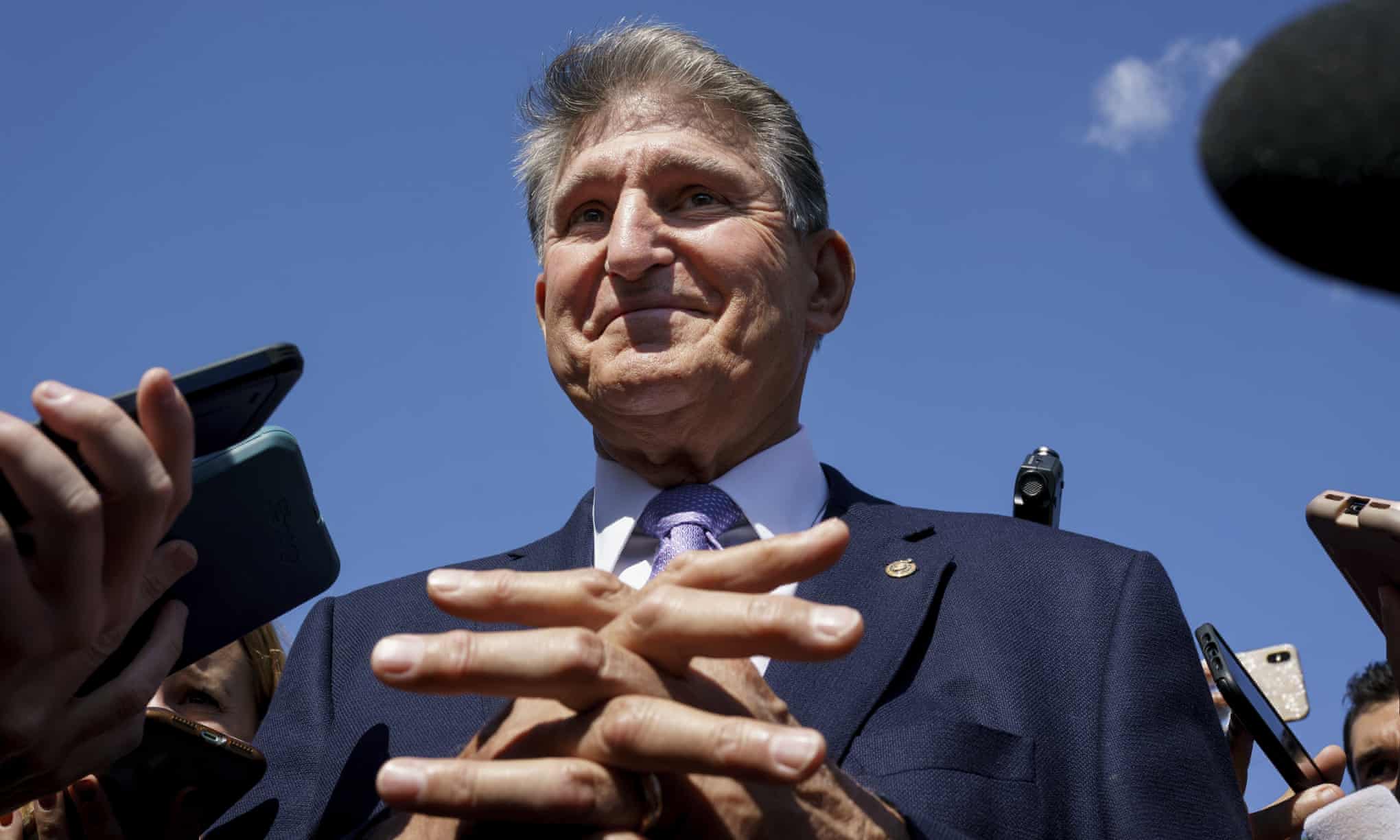
"Within the brutal machinations of US politics, Joe Manchin has been elevated to a status of supreme decision-maker, the man who could make or break Joe Biden’s presidency.
Internationally, however, the Democratic senator’s new fame has been received with puzzlement and growing bitterness, as countries already ravaged by the climate crisis brace themselves for the US – history’s largest ever emitter of planet-heating gases – again failing to pass major climate legislation.
For six months, Manchin has refused to support a sweeping bill to lower emissions, stymieing its progress in an evenly split US Senate where Republicans uniformly oppose climate action. Failure to pass the Build Back Better Act risks wounding Biden politically but the ramifications reverberate far beyond Washington, particularly in developing countries increasingly at the mercy of disastrous climate change.
“He’s a villain, he’s a threat to the globe,” said Saleemul Huq, director of the International Centre for Climate Change and Development, based in Bangladesh. “If you talk to the average citizen in Dhaka, they will know who Joe Manchin is. The level of knowledge of American politics here is absolutely amazing, we know about the filibuster and the Senate and so on.
“What the Americans do or don’t do on climate will impact the world and it’s incredible that this one coal lobbyist is holding things up. It will cause very bad consequences for us in Bangladesh, unfortunately.”
The often tortuous negotiations between Manchin, the White House and Democratic leaders appeared doomed on 19 December when the West Virginia senator said he could not support the $1.75tn bill, citing concerns over inflation and the national debt. The latest twist caused anguish to those who see their futures being decided by a previously obscure politician located thousands of miles away.
“I’ve been following the situation closely,” said Tina Stege, climate envoy for the Marshall Islands, a low-lying Pacific nation that risks being wiped out by rising sea levels. “We have to halve emissions in this decade and can’t do it without strong, immediate action by the US.”

Stege said the Marshall Islands was already suffering the impacts of the climate crisis and if the US doesn’t slash its emissions “the outcomes for countries like mine are unthinkable.”
Even America’s closest allies have looked on in dismay as a single lawmaker from Biden’s own party has stalled what would be the biggest – and arguably first – piece of climate legislation in the US’s plodding, and often rancorous, history of dealing with escalating global heating.
“Biden has done a fair bit in very challenging circumstances [but] in Canada we look on with bewilderment because it’s such a different political context. It’s very bizarre,” said Catherine McKenna, who was environment minister in Justin Trudeau’s government that introduced carbon pricing in 2019. “Politics is hard but I don’t think anyone has given up. We just really hope they are able to get a deal.”
McKenna said she was vilified by some Canadian provincial premiers who “fought to the death” against carbon pricing but that there was now broader support for climate action across the country, including within industry, than in the US. “It’s unfortunate that it’s just one person that is holding up something that’s so critically important,” she said of Manchin.
“Joe Manchin is a problem, and I think he needs to be called out,” said Ed Davey, a British MP who was previously the UK’s secretary of state for energy and climate change. “It’s in the US interest, in the interest of West Virginia and elsewhere, to take advantage of green zero-carbon technology, which is the future.”
Davey, who is now leader of the Liberal Democrats, warned that the US risks ceding leadership in clean energy to China if it doesn’t act. “People will end up paying higher prices, jobs will go and not be created, the security of America will be reduced, Beijing will be laughing,” he said, adding that Manchin was in effect “working on behalf of the Chinese government” by not supporting the transition away from fossil fuels.
China used last year’s Cop26 climate talks in Scotland to “insidiously point out to every country that US just can’t implement”, said Rachel Kyte, dean of The Fletcher School at Tufts University and a climate adviser to the UN secretary general. Kyte said many governments believe Biden is well-meaning but cannot follow through on his commitments, a frustration compounded by a lack of American action on related areas, such as climate finance for poorer countries.
“There’s almost a resentment that the US just can’t deliver,” she added. “There’s this sinking feeling about the politics of America. You can’t turn your back on the US because it’s still the biggest economy, but what are countries supposed to do?”
Much of this angst is now being channeled towards Manchin.
After more than a decade in national politics, the 74-year-old senator has suddenly garnered a level of infamy far beyond his fiefdom of West Virginia, where the centrist Democrat has served as governor and senator while reaping millions of dollars through his personal investments and campaign contributions from a coal industry that continues to loom large in his state. It’s a situation that has caused bafflement overseas.

“Who is Manchin, the Dem senator from West Virginia who betrayed Biden?” La Repubblica in Italy has demanded. Clarín, a newspaper in Argentina, has calledManchin a “rebelde” and a “tycoon with ties to the mining structure of West Virginia, the other Virginia of the USA”. Helsingin Sanomat, a Finnish newspaper, also noted Manchin’s links to the fossil fuel industry and lamented that he has “disagreed with the most ambitious climate action” put forward by the US.
The negotiations with Manchin involve stakes far greater than any normal political maneuvering in Washington. The world is already being strafed by wildfires, heatwaves, floods and societal instability wrought by the climate crisis and rising temperatures are on track to breach limits set by governments in the Paris climate accords, a situation that would push some parts of the world beyond human livability.
Salvaging this situation will be virtually impossible without swift action by the US, the world’s second largest carbon polluter and a major oil and gas exporter. Analysts say the half a trillion dollars of support for renewable energy and electric cars in the Build Back Better bill would give the US a decent chance of cutting its emissions in half this decade, which Biden and scientists say is imperative to avoid climate breakdown.
But Manchin’s opposition has already ensured the removal of a key element of the bill, a plan to force utilities to phase in clean energy over time, and the prospect of him joining Republicans to block the overall package has seen him come under intense criticism within the US.
Climate activists have confronted Manchin in Washington and kayaked to his yacht to remonstrate with him. Some fellow Democrats say he has “failed the American people”. Even the Sunday Gazette, the local paper of Charleston, West Virginia, has run a headline of ‘We need this so bad’, in reference to the bill.
All this has been to little effect, although Manchin did say earlier this month there could still be agreement on “the climate thing”, offering some vague hope to activists while not quite quelling their anger. “Senator Manchin is a fossil-fueled sociopath on a Maserati joyride while he lets the world burn,” said Janet Redman, climate campaign director at Greenpeace USA. “At the end of the day, Manchin cares less about his constituents than he does about the fossil fuel industry.”
The current, floundering attempt to pass climate legislation is a grimly familiar episode in a lengthy record of American inadequacy. Donald Trump donned a coal miner’s helmet on the campaign trail and removed the US from the Paris climate deal. Barack Obama failed to get cap-and-trade legislation past a recalcitrant Congress. George W Bush rejected the Kyoto climate accords. In 1993, a previous Democratic senator from West Virginia, Robert Byrd, blocked a Bill Clinton plan to tax carbon emissions.
Manchin is, in some respects, a “fall guy” for a deeper American political dysfunction over the climate crisis, Kyte said. “If Republicans weren’t in the lock-grip of certain vested interests, if they had a policy on climate adaptation or green jobs for the future, Joe Manchin wouldn’t have the influence he has,” she said.

“Joe Manchin has become the personification of a problem and removing him doesn’t solve it,” Kyte added. “It doesn’t give us a bipartisan agreement of the danger we are in. A political culture that allows you to enrich yourself and your family from industries you regulate and not declare a conflict of interest lies beyond Joe Manchin, it’s bigger than just him.”
Even if American political inertia hasn’t changed, the world certainly has – the last seven years were the planet’s hottest on record, cataclysmic wildfires are now year-round events in the US west and deadly flooding swamps basementsin New York, picturesque towns in Germany and subways in China. There is mounting fear that the world, including the US, does not have the time for yet another futile American effort to address the unraveling climate crisis.
“Unfortunately, politicians getting fossil fuel money are standing in the way and sacrificing the rest of us once again,” said Vanessa Nakate, a climate justice activist from Uganda. Nakate pointed out that Africa was suffering from climate change even though it is responsible for just a small fraction of global emissions.
“We are so reliant on the choices others make,” she said. “Our lives are literally in their hands.”