What To Do When You're Stopped By Police - The ACLU & Elon James White
What To Do When You're Stopped By Police - The ACLU & Elon James White
Know Anyone Who Thinks Racial Profiling Is Exaggerated? Watch This, And Tell Me When Your Jaw Drops.
This video clearly demonstrates how racist America is as a country and how far we have to go to become a country that is civilized and actually values equal justice. We must not rest until this goal is achieved. I do not want my great grandchildren to live in a country like we have today. I wish for them to live in a country where differences of race and culture are not ignored but valued as a part of what makes America great.
The U.S. doesn't have just one party of Trump to worry about. Try 51 of them.
At the national level, the Republican Party has been trying as hard as it can over the last six months to toe the line betweenshowing its fealty to former President Donald Trumpand not directly endorsing his lies about the 2020 election. This dance has led GOP leaders to twist themselves intoincreasingly incoherent knotsto avoid alienating their voting base.
But the problem is much, much worse at the state level. In effect, it's not just one party of Trump we're going to have to deal with — it's 51 of them. I don't see any easy fix for this — not when you consider the type of people who tend to dominate state politics and how little leverage anyone has over them.
In effect, it’s not just one party of Trump that we’re going to have to deal with — it’s 51 of them.
The extent of the rot recently came to light in Nevada with a vote to censure Secretary of State Barbara Cegavske in April. Her alleged crime — failing to declare that Trump lost the election only because of massive fraud — is all too familiar lately. But here's a twist for you: The extremely close vote to censure Cegavske may havecome down to a group of extremists:
The furor over the censure vote comes as local GOP officials in Nevada said they have been alarmed by recent attempts by people espousing extremist views to get involved in the party — including at least one man who has said he is a member of the Proud Boys.
In Las Vegas, the clash over the party’s future has pitted the new band of activists against elected Clark County GOP officials, who said they have already banned seven people from participating in local functions because of racist and antisemitic material they said was distributed on the messaging app Telegram in a channel connected to a group called Keep Nevada Open.
On one hand, it's encouraging that Nevada's elected officials are trying to push back against these people's having a place in their local party. On the other, it's troubling that they might lose their fight. From the top down,state and local parties are becoming increasingly Trumpian:
A VICE News review of public positions of all 50 GOP state chairs shows a significant number are openly pushing conspiracy theories, spouting unhinged rhetoric, and actively undermining voters’ trust in democracy. That includes the chairs of nearly every swing state in the U.S. And the trend is accelerating: Many of the most extreme chairs just won their chairmanships or have been reelected since Trump left office four months ago, a number of them with his explicit endorsement.
A quick review of my own bore that out. For example, Trump won Alabama handily, but voters are still very much into hearing about how rigged elections are — and how much of a scam democracy is. Ata Jan. 23 rally, just weeks after the Capitol riot, John Wahl,a butterfly farmer who was then senior vice chairman of the state GOP, delivered one of his biggest applause lines when he spoke about "fair and honest elections." Wahl, who became party chair in March, unsubtly said, "We should investigate any discrepancies and any unconstitutional voting practices that might have happened."
What's even more frightening is that the attacks are set to keep coming from both sides of the ballot. On one side, state parties are driving activists and recruiting candidates who fit into their Trumpian worldviews. On the other, asPolitico recently reported, a surge of candidates who believe or boost Trump's lies are trying to take control of elections in swing states as secretary of state:
The candidates include Rep. Jody Hice of Georgia, a leader of the congressional Republicans who voted against certifying the 2020 Electoral College results; Arizona state Rep. Mark Finchem, one of the top proponents of the conspiracy-tinged vote audit in Arizona’s largest county; Nevada’s Jim Marchant, who sued to have his 5-point congressional loss last year overturned; and Michigan’s Kristina Karamo, who made dozens of appearances in conservative media to claim fraud in the election.
It's a combination that promises to entrench the Trumpist attacks on democracy into the fabric of our electoral politics for years if its architects succeed. And given how clearly state-level machinations and adherence to Trump's conspiracy theorieslaid the groundwork for the Jan. 6 riot, there's no chance that the effects of these actions will stay within their borders.
More from MSNBC Daily
Must reads from Today's list
The last few decades have shown a remarkable nationalization of American politics, in partthanks to the slow demise of local media. This flattening has made it so that local laws about bathrooms in North Carolina can affect elections across the country and the White House's response to Covid-19 canplay out in school board races.
Until recently, it was still easy to write off a state representative who introduced an outlandish bill as a crank or to dismiss a state party's troubling stances as a local problem. But as the GOP finds itself populated more and more with leaders who are skeptical of democracy and willing to embrace Trump's lies in exchange for power, we can't afford to ignore them anymore.
I'm concerned that there may not be a national solution to this national problem. Thevoting rights billthe Democrats are trying to move through the Senate focuses on the running of federal elections — off-year local races would fall outside the purview. And the national GOP seems to have zero interest in disciplining its state parties or getting involved in their internal affairs.
Instead, it's going to be up to local activists and politicians to do the hard work to dislodge Trump's acolytes before they can do even more harm to our country's institutions. I have faith in them, but, man — they have their work cut out for them."
Imagine a community of great possibilities and prosperity built by Black people for Black people. Places to work. Places to live. Places to learn and shop and play. Places to worship.
Now imagine it being ravaged by flames.
In May 1921, the Tulsa, Okla., neighborhood of Greenwood was a fully realized antidote to the racial oppression of the time. Built in the early part of the century in a northern pocket of the city, it was a thriving community of commerce and family life to its roughly 10,000 residents.
Brick and wood-frame homes dotted the landscape, along with blocks lined with grocery stores, hotels, nightclubs, billiard halls, theaters, doctor’s offices and churches.
Greenwood was so promising, so vibrant that it became home to what was known as America’s Black Wall Street. But what took years to build was erased in less than 24 hours by racial violence — sending the dead into mass graves and forever altering family trees.
Hundreds of Greenwood residents were brutally killed, their homes and businesses wiped out. They were casualties of a furious and heavily armed white mob of looters and arsonists. One factor that drove the violence: resentment toward the Black prosperity found in block after block of Greenwood.
The financial toll of the massacre is evident in the $1.8 million in property loss claims — $27 million in today’s dollars — detailed in a 2001 state commission report. For two decades, the report has been one of the most comprehensive accounts to reveal the horrific details of the massacre — among the worst racial terror attacks in the nation’s history — as well as the government’s culpability.
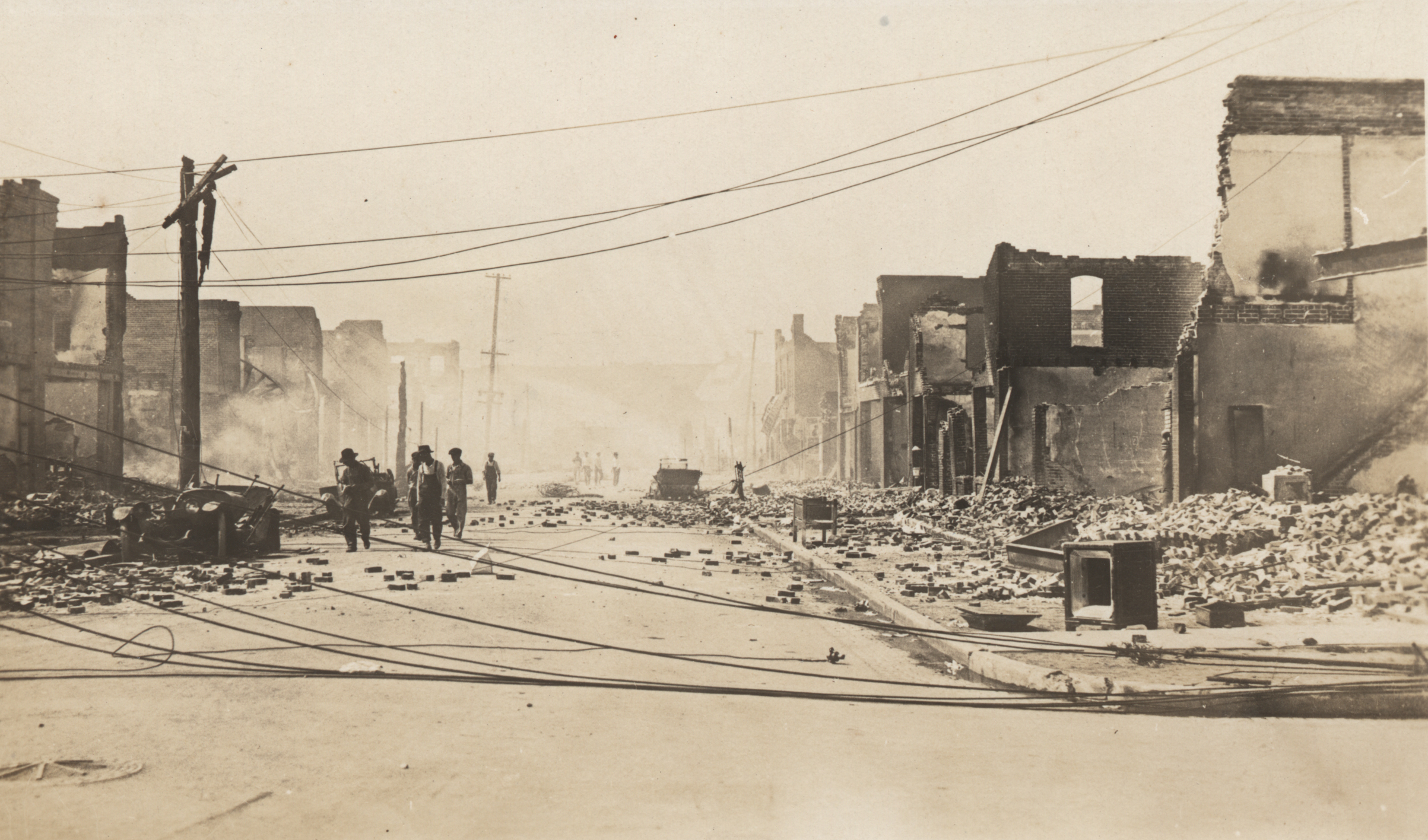
Greenwood Avenue, for years a thriving hub, was destroyed by racial violence in less than 24 hours.Department of Special Collections and University Archives, McFarlin Library at The University of Tulsa
The destruction of property is only one piece of the financial devastation that the massacre wrought. Much bigger is a sobering kind of inheritance: the incalculable and enduring loss of what could have been, and the generational wealth that might have shaped and secured the fortunes of Black children and grandchildren.
“What if we had been allowed to maintain our family business?” asked Brenda Nails-Alford, who is in her early 60s. The Greenwood Avenue shoe shop of her grandfather and his brother was destroyed. “If they had been allowed to carry on that legacy,” she said, “there’s no telling where we could be now.”
For decades, what happened in Greenwood was willfully buriedin history. Piecing together archival maps and photographs, with guidance from historians, The New York Times constructed a 3-D model of the Greenwood neighborhood as it was before the destruction. The Times also analyzed census data, city directories, newspaper articles, and survivor tapes and testimonies from that time to show the types of people who made up the neighborhood and contributed to its vibrancy.
The marquee block
Perhaps no other collection of businesses tells the story of Greenwood and Black entrepreneurship better than the 100 block of Greenwood Avenue, rising near the southern tip of the neighborhood. This marquee block was the pulse of the Black business community.
“My grandfather often talked about how you could enjoy a full life in Greenwood, that everything you needed or wanted was in Greenwood. You never had to go anywhere,” said Star Williams, 40, the granddaughter of Otis Grandville Clark, who was 18 during the massacre. “He talked about seeing Black success and how his sense of identity and pride came from Greenwood.”
The businesses on Greenwood Avenue were owned by people who were among Tulsa’s most prominent Black citizens.
A city within a city
Mr. Stradford and Mr. Gurley — who purchased large tracts of land in the early 1900s — were among the founders of Greenwood. They began building on the northern side of Tulsa beyond the railroad tracks, forming the bones of the city’s predominantly Black neighborhood that was separate from the white side of town.
Greenwood was one of the few places in the country offering Black citizens — less than six decades out of enslavement — a three-dimensional life.
In the evenings, residents had their choice of entertainment. Survivor accounts that were relayed to relatives recall neighbors getting “gussied up” to gather in Greenwood, with Thursdays being big because of “Maids’ Night Out.” Black domestics, many of them live-in workers who cleaned the homes of white residents across town, were off that day.
Many African-Americans migrated to Tulsa after the Civil War, carrying dreams of new chapters and the kind of freedom found in owning businesses. Others made a living working as maids, waiters, chauffeurs, shoe shiners and cooks for Tulsa’s new oil class.
In Greenwood, residents held more than 200 different types of jobs. About 40 percent of the community’s residents were professionals or skilled craftspeople, like doctors, pharmacists, carpenters and hairdressers, according to a Times analysis of the 1920 census. While a vast majority of the neighborhood rented, many residents owned their homes.
Occupations of Greenwood residents
Each dot represents a resident.
Professionals
Skilled craftspeople
Service workers
The New York Times·Note: Data is for 1920.
Segregation kept African-Americans from patronizing white-owned shops, and Greenwood thrived from community support of Black-owned businesses.
“Black folks faced an economic detour,” said Hannibal B. Johnson, an author and the education chair for the 1921 Tulsa Race Massacre Centennial Commission. “When they approached the gates to the wider Tulsa economy, they were turned away, so they ended up creating their own largely insular community.”
The massacre that ended it all
The assaults on Greenwood raged over two days. The morning of June 2, 1921 revealed emptiness and ruin in every direction.
Plumes of smoke hovered over the neighborhood. Ash coated the ground. Brick buildings had been reduced to bombed-out husks. And soon, the bodies of those killed would be stacked and discarded in mass graves and a river.
A composite image shows Greenwood ablaze during the massacre.Composite created with photographs from the Department of Special Collections and University Archives, McFarlin Library at The University of Tulsa
It all began on May 30 with two teenagers in an elevator in the Drexel building in downtown Tulsa and morphed into a sexual assault accusation.
Accounts vary about what happened between Dick Rowland, 19, a young Black shoe shiner, and Sarah Page, 17, a white elevator operator. One common theory suggests Mr. Rowland tripped and grabbed onto the arm of Ms. Page while trying to catch his fall. She screamed, and he ran away, according to the commission report.
The next day, Mr. Rowland was arrested and jailed in the Tulsa County Courthouse. By that afternoon, The Tulsa Tribune published a front-page news story with the headline “Nab Negro for Attacking Girl in Elevator,” which essentially mobilized a lynch mob that showed up at the courthouse.
Twice, a group of armed Black Tulsans, many of them World War I veterans, offered to help protect Mr. Rowland but were turned away by the sheriff.
As the Black men were leaving the second time, a white man attempted to disarm a Black veteran, and a gun went off in the scuffle. That clash and others that day marked the beginning of what would become Greenwood’s armed destruction. Some white rioters were even deputized and given weapons by civil officials.
Near dawn, the white mob descended on Greenwood. Black Tulsans fought back, valiantly defending their families and property. But they were woefully outnumbered.
Key moments in the massacre
A riot erupted at the courthouse in downtown Tulsa. Then a white mob moved northward into Greenwood
Nearly all of Greenwood is set ablaze.
Greenwood
Business
District
More buildings set afire in business district.
White mob sets first fires along Archer Street.
Shots are fired across the tracks.
Heavy gunfire ensues downtown.
Police
Headquarters
Riot erupts at courthouse. First shot fired.
Oaklawn
Cemetery
The New York Times
The mob indiscriminately shot Black people in the streets. Members of the mob ransacked homes and stole money and jewelry. They set fires, “house by house, block by block,” according to the commission report.
Terror came from the sky, too. White pilots flew airplanes that dropped dynamite over the neighborhood, the report stated, making the Tulsa aerial attack what historians call among the first of an American city.
The numbers presented a staggering portrait of loss: 35 blocks burned to the ground; as many as 300 dead; hundreds injured; 8,000 to 10,000 left homeless; more than 1,470 homes burned or looted; and eventually, 6,000 detained in internment camps.
The white mob indiscriminately shot Black people in the streets during the massacre, which left as many as 300 dead.Department of Special Collections and University Archives, McFarlin Library at The University of Tulsa
The neighborhood economy was destroyed. Two dozen grocery stores. Thirty-one restaurants. Four drug stores.
Greenwood, where Black success embodied the American dream, was no more, suddenly, dreadfully wiped out.
What was lost
Greenwood would be rebuilt, and for a few decades, it would again thrive before falling to urban renewal and other forces. But that spring of 1921 unmoored and unrooted the neighborhood with lasting effects.
Not long after the attack, shell-shocked survivors — who were blamed for the violence — returned home to ruin. Amid the charred remnants, they were forced to make an excruciating decision that would change family histories forever: leave and start over again somewhere else, or rebuild.
They also faced another kind of white resistance: a fire ordinance intended to prevent Black property owners from rebuilding on their own and insurance companies that refused to pay damage claims.
“Greenwood wasn’t a gift from anyone, it was created by the citizens of Greenwood who withstood the tragedy of 1921 and rebuilt it again,” said Scott Ellsworth, the author of the recently released book, “The Ground Breaking: An American City and Its Search for Justice.” “Greenwood is the story of resilience. It is the story of courage.”
Those who stayed began stitching their lives back together almost immediately. They joined forces and began rebuilding homes and businesses. Within a day, C.L. Netherland, a massacre survivor and minister whose barber shop at 110 Greenwood Avenue was destroyed, purchased a folding chair, a strop and razor, and set up shop on a sidewalk.
The massacre also claimed the new Mount Zion Baptist Church, whose first service in its new building had been held less than two months earlier. The congregation’s hundreds of members had financed and built the $92,000 church over several years, according to “Black Wall Street: From Riot to Renaissance in Tulsa’s Historic Greenwood District,” a book by Mr. Johnson, education chair for the centennial commission. It would have been easier to declare bankruptcy. Instead, church members rebuilt and dug in. It took an additional 21 years before the initial debt was repaid.
The Mount Zion Baptist Church burned down during the massacre.Department of Special Collections and University Archives, McFarlin Library at The University of Tulsa
The final insult of the massacre came in the silence. For decades, Tulsa deliberately ignored and covered up what had happened in Greenwood. Many descendants said they learned about the mob and the killings only as adults — and even then, some of the recounting was told in whispers.
“You could see the pain in my grandmother’s eyes when she talked about what happened,” said LeRoy Gibbs II, 52, the grandson of Ernestine Gibbs, a massacre survivor who was 17 when the violence unfolded. “Before she would get too far, before it became too painful, she would shift and start talking about where we are today.”
Some surviving business owners who built the 100 block of Greenwood Avenue had remarkable second chapters. Others, who struggled in the aftermath, had heartbreaking stories. The Williams family, among the most successful before the massacre, stayed and rebuilt.
Mr. Smitherman, the civil rights activist who ran The Tulsa Star, eventually landed in Buffalo, where he became the publisher of The Buffalo Star (later named The Empire Star). He was among several Black Tulsans indicted for “inciting a riot,” and was exonerated posthumously.
Ms. Parrish, the journalist who ran a typing school, stayed to chronicle the massacre. The two wealthy men who helped found Greenwood were hit hard financially. Mr. Stradford, who was indicted, escaped to Kansas and then Chicago. He never recovered his fortune. Mr. Gurley reportedly lost nearly $158,000 in 1921, or $2.3 million in today’s dollars.
James Nails, who had opened a shoe shop with his brother Henry, rebuilt but never really recovered. He eventually left Tulsa.
“He was really unable to carry on emotionally, psychologically,” Ms. Nails-Alford said. “You get your education, you work hard, you start businesses, you’re able to employ your family members and community members, and then you lose it all within hours. It takes away a man’s dignity.”
There is a pending lawsuit and ongoing discussions about how and whether to compensate the families of the Tulsa Massacre victims. No compensation has ever been paid under court order or by legislation.
To this day, not one person has been prosecuted or punished for the devastation and ruin of the original Greenwood.
Methodology
The buildings, maps and data presented in this article are based on historical records. In as many cases as possible, multiple sources were used to confirm details like the location of businesses and residences. When there were differing accounts or information, The Times used what was cited by the most sources. The number of killings in the massacre has been estimated to be up to 300, but a precise number was not available. Street addresses of some buildings were numbered in different ways, depending on the source.
The 3-D model of Tulsa, Okla., was created using a series of both computerized and manual steps that transformed historical material into digital data. First, we took images of Sanborn insurance maps from 1920 and 1915 and used a process called georeferencing to align them to modern geography. The 1920 maps came from the Tulsa Historical Society and Museum and were used to reconstruct as much of Greenwood and downtown Tulsa as possible. The 1915 maps were from the Library of Congress and were used to fill in other parts of Tulsa, where 1920 maps were not available.
Next, we wrote a computer program to extract the building outlines from those maps using a technique called machine learning. We also created an application to input the height information for each building from the Sanborn maps.
Archival photographs and maps were used to create a detailed model of the 100 block of Greenwood Avenue. Buildings or parts of buildings without photographic reference are shown without details. The street grid was created by georeferencing a 1921 street map of Tulsa from the Library of Congress.
We utilized a combination of optical character recognition and manual data entry to digitize the Polk-Hoffhine Tulsa City Directory from 1921, obtained from the Tulsa City-County Library. Those data were used to analyze and map businesses in Greenwood. Additional businesses were identified using the “Tulsa Colored Business Directory” in The Tulsa Star (1913-21) and The List of Losses published in “Events of The Tulsa Disaster” by Mary E. Jones Parrish. Owners of businesses on the 100 block were identified using The Tulsa Star and accounts of survivors and their descendants.
To create the maps of the occupations of African-American residents in Greenwood, we analyzed 1920 U.S. census data from Ancestry.com for residents for which occupation data was recorded. Our analysis included residents who the 1920 census classified as Black or mulatto. We then mapped the homes of thousands of those residents using the 1920 Sanborn maps.
Street maps from 1921 and Sanborn maps from 1939 were also used to help map addresses. The addresses of landmarks and other buildings were used to help determine the order of house numbers on a block. In some cases, Open Street Maps was used to locate addresses where the numbering system had not changed. Street name changes from the 1920 and 1921 city directories were incorporated in this process.
We categorized occupations into three broad categories: professionals, skilled craftspeople and service workers. Records in which occupations were illegible, or were without a house number or clear address were excluded.
While the Greenwood neighborhood boundary is not officially defined, the outline shown in this piece includes the predominantly African-American area shown in the 2001 state commission report as well as some additional areas, based on our analysis of census data.“
Despite gains against the virus, the C.D.C. director said the large segment of Americans who aren’t vaccinated must remain careful. Moderna announced that its Covid-19 vaccine was powerfully effective in 12- to 17-year-olds. It plans to apply for F.D.A. authorization.
The holiday weekend comes amid a national decline in coronavirus cases, hospitalizations and deaths.Alex Wong/Getty Images
As Memorial Day weekend approaches, the head of the Centers for Disease Control and Prevention offered a hopeful message mixed with caution on Tuesday for Americans planning to celebrate the traditional beginning of summer with friends and family.
“If you are vaccinated, you are protected, and you can enjoy your Memorial Day,” the C.D.C. director, Dr. Rochelle P. Walensky, said during a White House news conference. “If you are not vaccinated, our guidance has not changed for you, you remain at risk of infection. You still need to mask and take other precautions.”
After countless traditional Memorial Day events and other first rites of summer were canceled last year because of the pandemic, vaccinated Americans may be looking forward to crowded beaches and packed backyard barbecues, getting back to what Dr. Walensky described as “something closer to normal.”
As of Tuesday, 50 percent of those 18 or older in the U.S. were reported as fully vaccinated, according to data from the C.D.C. More than 61 percent of adults have received at least one shot, though the pace has been slowing. President Biden set a goal on May 4 of at least partly vaccinating 70 percent of adults by July 4 as the administration has shifted its strategy in order to reach those who may still not have gotten shots.
But Dr. Walensky also urged those who remain unvaccinated to add a new activity to their Memorial Day rituals. “I want to encourage you to take this holiday weekend to give yourself and your family the gift of protection by getting vaccinated,” she said. “We are on a good downward path, but we are not quite out of the woods yet.”
Dr. Walensky’s remarks come after the C.D.C. earlier this month said that it was no longer necessary for fully vaccinated people to mask or maintain social distance in many settings. The change was a major step for the federal government toward coaxing Americans closer to a post-pandemic world, even as the spread of the virus persists the globe. And as U.S. states and retailersgradually began adopting the guidance, being able to distinguish who was vaccinated or who was not essentially turned into an honor system that relies on unvaccinated people keeping their masks on in public.
Vaccination requirements have become a cultural flash point as the shots become more accessible.
Republican governors in Georgia, Alabama, Arizona, Florida, Idaho, Montana and Texas have denounced so-called vaccine passports, or digital proof of vaccination, and have issued executive orders restricting their use. On Tuesday, Georgia Gov. Brian Kemp signed an executive order that prohibits state agencies from implementing a vaccine passport program or requiring proof that people have been vaccinated against Covid-19.
transcript
Fauci Optimistic Over Moderna Vaccine for Teenagers
Moderna said Tuesday that its Covid-19 vaccine was 100 percent effective in a study of adolescents ages 12 to 17. Dr. Anthony S. Fauci, the infectious disease expert, was optimistic about the vaccine’s ability to ensure in-person school in the fall.
“The significance of the Moderna press release that they will have 12 to 18-year-old — that they will have an application in next month.” “Yeah, well, certainly that’s one of the things we would like to have, because if you put the Pfizer together, which already will be able to vaccinate, and are vaccinating 12 to 15-year-olds, together with the recent data from Moderna, which likely would lead as we enter into the beginning of the new fall term, that hopefully we’ll be able to get adolescent vaccine. I mean, high school students vaccinated actually before they enter the fall term, which is really very good news. So now we have not only a single company, Pfizer, but it looks very much like we’ll have the source of another similar vaccine in mRNA for Moderna. So all good.”
Moderna said Tuesday that its Covid-19 vaccine was 100 percent effective in a study of adolescents ages 12 to 17. Dr. Anthony S. Fauci, the infectious disease expert, was optimistic about the vaccine’s ability to ensure in-person school in the fall.Brandon Thibodeaux for The New York Times
Moderna said on Tuesday that its coronavirus vaccine, authorized only for use in adults, was powerfully effective in 12- to 17-year-olds, and that it planned to apply to the Food and Drug Administration in June for authorization to use the vaccine in adolescents.
If approved, its vaccine would become the second Covid-19 vaccine available to U.S. adolescents. Federal regulators authorized the Pfizer-BioNTech vaccine this month for 12- to 15-year-olds.
The Pfizer shot was initially authorized for use in people 16 and older, while Moderna’s has been available for those 18 and up.
Proof of the vaccines’ efficacy and safety for adolescents is helping school officials and other leaders as they plan for the fall. On Monday, Mayor Bill de Blasio said that all public school students in New York City, the largest school system in the United States, would return to in-person learning in the fall.
New York’s move comes as several states have indicated that they will restrict remote learning, including Connecticut, Illinois, Massachusetts and New Jersey.
The Moderna results, which the company announced in a statement, are based on a clinical trial that enrolled 3,732 people ages 12 to 17, two-thirds of whom received two vaccine doses. There were no cases of symptomatic Covid-19 in fully vaccinated adolescents, the company reported. That translates to an efficacy of 100 percent, the same figure that Pfizer and BioNTech reported in a trial of their vaccine in 12- to 15-year-olds.
“These look like promising results,” said Dr. Kristin Oliver, a pediatrician and vaccine expert at Mount Sinai Hospital in New York. “The more vaccines we have to protect adolescents from Covid, the better.”
Moderna also reported that a single dose of its vaccine had 93 percent efficacy against symptomatic disease.
“Those cases that did occur between the two doses were mild, which is also a good indicator of protection against disease,” Saskia Popescu, an infectious disease epidemiologist at George Mason University, said in an email.
The side effects were consistent with what has been reported in adults: pain at the site of the injection, headache, fatigue, muscle pain and chills. “No significant safety concerns have been identified to date,” the company said.
The adolescents in the study will be monitored for a year after their second dose.
The results were announced in a news release that did not contain detailed data from the clinical trial. And Dr. Angela Rasmussen, virologist at the Vaccine and Infectious Disease Organization at the University of Saskatchewan, said that the vaccines’ efficacy can be trickier to evaluate in children, who are less likely to develop symptomatic disease than adults.
Nevertheless, she said, the results are in line with what scientists expected and suggest “that adolescents respond to the vaccine comparably to adults who receive it.”
Moderna said it planned to submit the data for publication in a peer-reviewed journal.
Receiving a coronavirus vaccine in Miami last week.Saul Martinez for The New York Times
The Centers for Disease Control, which announced its decision earlier this month, will continue to gather data about mild breakthrough cases that are reported to the agency voluntarily by local health departments, but will only investigate the most serious cases of breakthrough infections — about one in 10.
Until May, the agency was monitoring all cases. A report issued Tuesday said that as of the end of April, when some 101 million Americans had been vaccinated, the agency had received 10,261 reports of breakthrough infections from 46 states and territories, a figure it said was probably a “substantial undercount.”
Of those, 995 people were known to have been hospitalized, and 160 had died, though not all as a direct result of Covid-19, the new study said.
Although the agency will continue to carry out vaccine effectiveness studies, it will focus on specific populations like health care workers, essential workers, the elderly and residents of long-term care facilities, a C.D.C. spokeswoman said.
Some scientists have criticized the retrenchment, saying it is wasting an opportunity to learn about the real-world effectiveness of different vaccines and to pick up on when vaccine protection begins to wane, whether variants play a significant role in breakthrough infections, and whether some patients are more susceptible than others to a post-vaccine infection.
“We are driving blind, and we will miss a lot of signals,” said Ali Mokdad, an epidemiologist at the University of Washington who spent many years as a senior scientist at the C.D.C.
“The C.D.C. is a surveillance agency,” Dr. Mokdad said. “How can you do surveillance and pick one number and not look at the whole?”
But other scientists said they support the C.D.C.’s pivot to concentrate on the most serious cases.
“We have to prioritize what we’re doing, and the priority is to understand the cases associated with severe disease,” said Dr. Kathryn Edwards, a professor of pediatrics in the division of infectious diseases at Vanderbilt University School of Medicine who studies vaccine safety and effectiveness.
Some people who were infected with the virus when they thought they were protected by the vaccine are troubled by the lack of interest in their cases.
“Don’t people want to know about this?” asked Julie Cohn, a 43-year-old mother from Short Hills NJ., who was infected after she was fully vaccinated, and is still suffering lingering effects of Covid-19 nearly two months later. “Where do people like me go? What happens next? The practitioners in my life have been shocked and are trying to figure out how to move forward, but there are so many questions. And if no one is studying this, there won’t be answers.”
A vaccination site at Brent Central Mosque in London in early April.Andrew Testa for The New York Times
A new and potentially more contagious variant of the coronavirus has begun to outpace other versions of the virus in Britain, putting pressure on the government to shorten people’s wait for second doses of vaccines and illustrating the risks of a faltering global immunization drive.
The new variant, which has become dominant in India since first being detected there in December, may be responsible in part for a virus wave across South Asia.
Efforts to understand the variant picked up once it began spreading in Britain, one of at least 49 countries where it is present. Scientists there are sequencing half of all coronavirus cases.
The preliminary results out of Britain, drawn from a few thousand cases of the variant, contained both good and bad news, scientists said.
The variant, known by evolutionary biologists as B.1.617.2, is “highly likely” to be more transmissible than the variant behind Britain’s devastating wintertime surge, government scientists have said.
Helpfully for Britain and other wealthy nations, the variant has emerged at a less dire moment of the pandemic. More than four out of every five people in England above age 65 have been given both doses of a coronavirus vaccine, driving down hospitalizations and deaths.
The Pfizer-BioNTech vaccine offered 88 percent protection against the variant first sampled in India, only a slight drop from the 93 percent protection given against the variant from Britain, Public Health England said. The AstraZeneca-Oxford vaccine was 60 percent effective against the variant from India, compared with 66 percent against the one first seen in Britain.
Because people in Britain started receiving AstraZeneca’s vaccine later than Pfizer’s, they have been followed for a shorter period, meaning that the effectiveness figures for that vaccine may underestimate the true numbers, scientists said. Other studies in England have shown little to no difference between the effectiveness of the Pfizer and AstraZeneca vaccines.
For now, a rise in cases of the variant from India has not caused an overall surge in the virus in Britain. And not all scientists are convinced that the variant is as contagious as feared. The true test will be whether it surges in other countries, especially those — unlike Britain — that are grappling with high case counts of other variants, Andrew Rambaut, a professor of molecular evolution at the University of Edinburgh in Scotland, wrote on Twitter.
Local officials in eight areas of the country where the variant has been found to be spreading criticized the government on Tuesday for not doing more to publicize new, stricter guidelines on social distancing in those areas. The recommendations, which are not legally binding, also discourage travel into and out of the areas, which include towns in north and central England.
Local lawmakers said many residents were unaware of the new guidance, which comes ahead of a holiday weekend during which people would typically travel domestically.
Charles Neidich, an American clarinetist, traveled to Taiwan to perform, but his concert was abruptly cancelled when a surge in coronavirus cases prompted performance venues to shut down.I-Hwa Cheng for The New York Times
For much of the coronavirus pandemic, Taiwan was a sanctuary for performing artists: A rare place that was almost Covid-free, where audiences could attend live dance festivals, full-fledged theater productions and classical music recitals in person.
But a recent surge in cases — Taiwan’s worst outbreak since the start of the pandemic — has brought a halt to cultural life on the self-governing island, forcing performing arts centers, concert halls and museums to shut their doors, just when those kinds of facilities are starting to come back to life in many other countries.
Taiwan’s experience is a reminder of the continuing uncertainty of life in the pandemic, the threat posed by the virus and its power to upset even the most carefully crafted of plans. Semi-staged performances of Verdi’s “Falstaff” have been called off. The French musical “Notre Dame de Paris” has been postponed.
“Everything blew up,” said the American clarinetist Charles Neidich, who recently made the 7,781-mile trip to Taipei from New York, only to have his first live performance in more than 400 days canceled.
Though the number of cases in Taiwan is low compared with many parts of the world — 283 new cases were reported on Tuesday, fewer than in New York City— the island’s authorities are doubling down on restrictions, hoping that lockdowns can bring the virus under control within weeks or months while Taiwan tries to speed up its lumbering vaccination program.
Taiwan’s closing of its borders early in the pandemic and its strict public health measures, including mask mandates and extensive contact tracing, turned the island of 23.5 million into a coronavirus success story. But the emergence of more contagious variants in recent months, a relaxation of quarantine rules and a vaccine shortage gave the virus an opening.
The government has provided tens of millions of dollars in subsidies to arts groups during the pandemic, but some performers say the grants have not been enough to offset losses. Officials say restrictions on large gatherings are necessary to curb the rising rate of infections.
Performers from Taiwan and abroad have been caught in the middle, grappling with lost income and an avalanche of canceled engagements. But many artists are optimistic that concerts, dances, plays and museum exhibitions will soon return.
Gov. Kay Ivey of Alabama giving a thumbs up to people in line to get Covid-19 vaccinations at a National Guard clinic in April.Kim Chandler/Associated Press
Vaccine passports will not be at play in the state of Alabama.
On Monday, the state’s governor, Kay Ivey, signed into law legislation that bans government institutions, along with schools and private businesses, from refusing goods, services or admission to people because of their immunization status.
The law, which goes into immediate effect, says that state and local governments “may not issue vaccine or immunization passports, vaccine or immunization passes or any other standardized documentation for the purpose of certifying the immunization status of an individual.”
Under the law, educational institutions can still require students to prove their vaccination status, but only for specific vaccines that were required as of Jan. 1 and if the institution gives “an exemption for students with a medical condition or religious belief that is contrary to vaccination.”
More than 400 college campuses are requiring students to be inoculated with a Covid-19 vaccine before enrolling this fall semester, with most of the mandates coming from states that voted for President Biden.
In a statement on Monday, Ms. Ivey said that although she had received the coronavirus vaccine and was “glad for the peace of mind it brings,” people should not be required to be inoculated.
“I am supportive of a voluntary vaccine, and by signing this bill into law, I am only further solidifying that conviction,” Ms. Ivey wrote.
In the United States, vaccine passports are not mandatory but allow people to easily prove that they are vaccinated. The passports have become a cultural flash point as the shots become more accessible. In Alabama, almost 29 percent of the state’s population is fully vaccinated, about 10 percent less than the U.S. average, as of Monday, according to a New York Times database.
Republican governors in Arizona, Florida, Idaho, Montana and Texas have denounced the use of vaccine passports and have issued executive orders similar to Alabama’s new law. On Tuesday, Gov. Brian Kemp of Georgia signed an executive order that prohibits state agencies from implementing a vaccine passport program or requiring proof that people have been vaccinated against Covid-19.
“Vaccination is a personal decision between each citizen and a medical professional — not state government,” Mr. Kemp wrote on Twitter in response to the order.
In March, New York State introduced the Excelsior Pass, a digital version of a vaccine passport, which allows residents to show businesses and venues that they have proof of vaccination or that they have received a negative virus test.
At the federal level, the Biden administration has said the government will not issue a digital system that tracks people’s coronavirus vaccination status.
“The government is not now nor will we be supporting a system that requires Americans to carry a credential,” Jen Psaki, the White House press secretary, said in April. “There will be no federal vaccinations database and no federal mandate requiring everyone to obtain a single vaccination credential.”
Americans whose passports expired overseas during the pandemic can use them to get home, the State Department said. Passengers walked through the baggage claim area at the Las Vegas airport. Joe Buglewicz for The New York Times
American citizens abroad who saw their passports expire during the Covid-19 pandemic are now able to return to the United States before renewing their travel documents, a shift of policy announced by the State Department on Monday.
The decision, which applies to Americans who are currently outside the country and hold passports that expired on or after Jan. 1, 2020, comes after reports that more than 100,000 Americans abroad are struggling to obtain consular appointments.
In many countries, American citizens who need to renew their passports must apply in person at a U.S. embassy or consulate. But many of those offices remain hobbled by Covid-19 restrictions and staffing reductions, and some are closed for all but emergency services. Difficulties and delays in getting appointments for renewals have left many Americans without a path back to the United States.
Some American expatriates have turned to immigration lawyers for help. Others have paid high fees to bootleggers and passport courier companies to obtain hard-to-get embassy appointments.
The State Department’s new exception for expired passports applies both to adults, whose documents are valid for 10 years, and to children, whose passports expire after 5 years. It applies only when entering the United States; travelers leaving the country will still be required to have current documents.
New parents should note that the exception does not apply to babies born overseas who have not yet been issued a passport or an official record of a child’s claim to U.S. citizenship, known as a Consular Report of Birth Abroad.
To take advantage of the exception, citizens must be in possession of their expired passport, and must be flying to the United States, either directly or on a connecting flight with a short layover. Expired passports cannot be used for travel from one foreign country to another.
All American citizens returning to the country must still show proof of a negative Covid-19 test result taken within 72 hours of departure.
Mayson Barillas, 11, recently recovered from Covid-19 multisystem inflammatory syndrome.Rosem Morton for The New York Times
Children who get sick from the rare but serious Covid-related inflammatory syndrome may surmount their most significant symptoms within six months, but they may still have muscle weakness and emotional difficulties at that time, a new small study suggests.
Published in the journal Lancet Child and Adolescent Health on Monday, the study appears to be the first detailed look at the health status of children six months after they were hospitalized with the condition, called Multisystem Inflammatory Syndrome in Children or MIS-C. The syndrome typically emerges two weeks to six weeks after a coronavirus infection, often quite a mild one.MIS-C can result in hospitalizations for children with severe symptoms involving the heart and several other organs.
A major question has been whether children who survive MIS-C will end up with lasting organ damage or other health problems. The new study, which looked at 46 children under 18 who were admitted to a London hospital for MIS-C (it has a different name and abbreviation, PIMS-TS, in Britain), suggests that many of the most serious problems can resolve with time.
“To be honest, I think we all didn’t know what to expect,” said Dr. Justin Penner, a pediatric infectious disease physician at the hospital involved in the study, Great Ormond Street Hospital. “We didn’t know which body systems would require assistance or become a problem one month, three months, six months down the line.”
The children in the study were hospitalized between April 4 and Sept. 1, 2020, part of the first wave of the inflammatory syndrome. They all had systemic inflammation, and most had symptoms involving multiple organ systems, such as the heart, kidneys or circulatory system. Forty-five had gastrointestinal symptoms, and 24 had neurological symptoms like confusion, memory problems, hallucinations, headaches or problems with balance or muscle control.
Sixteen of the children were placed on ventilators, 22 needed medication to help their hearts pump more effectively and 40 were treated with immunotherapies like intravenous immunoglobulin. All survived.
Six months after they were discharged from the hospital, one child still had systemic inflammation, two had heart abnormalities and six had gastrointestinal symptoms. All but one were able to resume school, either virtually or in person.
Still, 18 were experiencing muscle weakness and fatigue, scoring in the bottom 3 percent for their age and sex on the six-minute walking test, a standard test of endurance and aerobic capacity. And 15 were experiencing emotional difficulties like anxiety or severe mood changes, according to questionnaires answered by either the parents or the children.
The couple chartered a plane operated by SpiceJet, an Indian carrier.Dibyangshu Sarkar/Agence France-Presse — Getty Images
The authorities in southern India are investigating a couple who are reported to have chartered a plane and performed a marriage ritual in midair in front of scores of guests, a breach of Covid-19 guidelines in a country that is being devastated by a second wave of the coronavirus.
The couple hadintended to tie the knot in front of family and friends at a hotel in the southern state of Tamil Nadu, but coronavirus restrictions capped the guest list at 50 people.
Instead, according to reports in the Indian news media, the couple chartered a commercial aircraft operated by SpiceJet, an Indian carrier, and boarded the plane on Sunday morning along with about 160 people. The flight traveled from Madurai in Tamil Nadu to the city of Bangalore, a journey of more than an hour.
Family members of the couple, whom the authorities have not named, told the airline that they had already gotten married and were taking their guests on a postnuptial joy ride.
As the aircraft flew over the Meenakshi Amman Temple, spread over about 14 acres on the southern bank of Madurai, the bride and groom stood along with other passengers. A video shared on social media showed the groom placing a traditional ornament around the bride’s neck while passengers cheered and took photos.
The bride wore flowers and jewelry, traditional wedding attire for Hindus, while the groom wore customary southern Indian clothes. Guests were pictured maskless and crowded close together on the nearly packed flight.
A SpiceJet spokesperson said that the airline had informed the passengers about pandemic guidelines, including requirements that they wear masks and refrain from photography onboard.
“The agent and the guest passengers were briefed in detail, both in writing as well as verbally, on social distancing and safety norms to be followed as per Covid guidelines both at the airport and onboard the aircraft throughout the journey,” the airline said in a statement.
India on Tuesday reported more than 196,000 new cases and 3,511 deaths from the virus, a slight decline from the global highs of recent weeks. For the 12th consecutive day, the number of people recovering from the virus outnumbered new infections, according to national data, although experts believe that India’s tallies of infections and deaths are significantly lower than the true toll.
Tamil Nadu has India’s fourth-highest coronavirus caseload. The state is averaging 34,000 new cases daily, and recorded 422 deaths from the virus on Monday.
GLOBAL ROUNDUP
Older people waiting to receive a coronavirus vaccine in Tokyo on Monday.Carl Court/Getty Images
The State Department on Monday warned Americans against traveling to Japanas the country experiences an increase in coronavirus cases less than two months before the start of the Tokyo Olympics.
The move has little practical effect, as Japan’s borders have been closed to most nonresident foreigners since the early months of the pandemic. But the warning is another blow for the Olympics, which are facing stiff opposition among the Japanese public over concerns that they could become a superspreader event as athletes and their entourages pour in from around the world.
The Japanese authorities have insisted that they can carry off the Olympics safely, and the State Department declaration is unlikely to affect the United States’ decision to send its athletes to the Olympics, whose organizers are not requiring participants to be inoculated.
The United States added Japan to a list of dozens of nations that have received its highest-level travel warning — “do not travel” — after the country’s virus incidence rate rose to a threshold that triggers such a declaration.
Starting in late April, large parts of the country entered a state of emergency as more contagious variants of the virus drove a rapid increase in case numbers. Although the numbers in Japan are low by global standards — averaging about 4,800 new cases daily, according to a New York Times database — fewer than 5 percent of residents have received a first shot of a coronavirus vaccine, putting Japan last among major developed nations in its vaccination campaign.
In other news around the world:
In Australia, the authorities in Melbourne are racing to contain a coronavirus outbreak after four people tested positive on Monday and another five on Tuesday. The outbreak, the first in Victoria State in three months, is believed to stem from a man who was infectious in the state in early May. Officials announced new restrictions on indoor gatherings and renewed pleas for Australians to get inoculated. So far, 3.6 million vaccine doses have been given in Australia, which has a population of 26 million. In response to the new cases, New Zealand said it would pause travel to and from Victoria for three days.
Health experts in Hong Kong are urging residents to be inoculated before millions of doses of the Pfizer-BioNTech vaccine expire within roughly three months. Less than one-fifth of the city’s 7.5 million people have received a dose amid mistrust of the government, fears over side effects and a lack of urgency as the Chinese territory records few new infections. Thomas Tsang, an adviser to the government’s vaccine task force, said on a radio program on Monday, “What we have is probably all we have for the rest of the year.”
Mushroom, a poodle, being examined lats week at Modern Animal, a membership-based veterinary clinic in Los Angeles.Rozette Rago for The New York Times
More than 12.6 million United States households adopted animals from March to December of last year, according to the American Pet Products Association, helping to propel an increase in visits and revenue to veterinary offices.
That heightened demand has drawn investors and others to the market for veterinary services. Landlords who might have spurned tenants associated with unpleasant odors and noise are more amenable to leasing to the clinics after a year when the vets paid their rent while other businesses fell behind. And architecture firms that specialize in the design of vet space are busier than ever.
Tech-savvy start-ups are promising a reinvention of the experience, with phone apps, round-the-clock telemedicine and boutique storefronts with refreshments (for pet owners).
The pet care business is riding a growth spurt: Morgan Stanley projected that it would be a $275 billion industry in 2030, up from $100 billion in 2019, with vet care the fastest-growing segment over the next decade.
“Ten years ago, there was a baby boom,” Arash Danialifar, the chief executive of GD Realty Group, a California company that has leased space to a veterinary start-up, said about the proliferation of shops selling children’s fashion. “Now, it’s all about pets.”