Thursday, June 27, 2019


Wednesday, June 26, 2019
This photo is about bodies – migrant bodies, and our body politic. Don't look away | Opinion | The Guardian

"This is a story about bodies.
A body of water. A river running through mountain, bosque, desert and city; along two pueblos, between two states and separating two countries.
I lived beside a running body of water for a time – this is what I learned: it is impossible to ignore its power. It whispers its summons: cross here. Ford the still points. Wade. Float. Swim. Drown.
Once, many years ago, I heard that after a prolonged torrential rainfall the Rio Grande (Rio Bravo del Norte, to Mexicans) had reached unprecedented levels. Its floodwaters swept through a riverfront church, pulled a large wooden cross from the wall and carried it on its current. A woman who had camped out on the Mexican side of the river with her two children, waiting to cross into the US, saw the dark shape in the water. Before it surged past her, she pushed her children into the river, toward it. “Hold on,” she said. “Hold on to it until you reach the other side.”
Maybe she believed they would be borne above the waters by faith. Maybe she so despaired of their survival on her side of the river she was willing to chance it. Maybe someday she might stop replaying the exact moment when she let go of their hands in the water.
You cannot step into the same river twice, but you can step into the same story again and again and again. A story of desperate need and desperate hope that drives people to risk everything in uncertain and unfamiliar waters.
On Monday, Valeria Martínez, a two-year-old Salvadoran child, was found drowned in the shallows of the Rio Grande; her father, Óscar Alberto Martínez, 26, by her side. The photo that circulated is as haunting, in its way, as the 2015 photograph of Alan Kurdi, the three-year-old Syrian child whose image – tiny, lifeless, lying face down in the surf in Greece – moved European leaders to re-examine their policies toward migrants.
In this photo, Valeria wears little black sneakers and her red pants show the padded bottom that indicates a diaper beneath. Martínez, face down in the water, has tucked his daughter under his shirt so she won’t be torn away from him in the river. And then there’s this: she clung to him – as I remember my own daughter at that age, clinging to me when I carried her into a hospital, and we were both terrified to death but together, together – because Valeria’s arm is still flung around his neck when they are found.
This is a story about bodies – but not just Valeria’s body, and Martínez’s.
It is a story about the body politic. About how we, the people of this nation, react to a photo that illuminates the lethal consequences of the manipulation and damage that has been done to the asylum process.
By some accounts Valeria’s family had spent months in Mexico waiting to get on a list that might – no guarantees – enable them to lodge their asylum request at a port of entry. The “metering” and “remain in Mexico” policies that Donald Trump has instituted during his tenure have forced some asylum-seeking families – displaced by the climate crisis or grinding poverty or devastating violence – to try and find another way to have their asylum claim heard in the US, even if it is a risky way, even if it means battling a body of water.
Likewise, the administration’s use of the border patrol – and even active-duty military troops – to physically prevent asylum seekers from reaching ports of entry has had a chilling effect on established asylum processes.
Organizations like Human Rights First have proposed a “genuine humanitarian response” to the asylum crisis the administration has created: deploying Customs and Border Protection (CBP) officers to ports of entry to assist in asylum processing, appointing more immigration judges and interpreters, along with making immigration courts independent, among other solutions. Other NGOs and agencies used to dealing with refugee and asylee needs from a trauma-informed and humanitarian perspective probably have suggestions and potential solutions, too. And from these we may be able to establish a roadmap that is less oppressive than the one proposed by this administration.
Years ago, when I was envisioning the immigration dystopia that would become my novel Ink, I needed to create a “catalyst” moment, when the public at large became aware of what was happening in the novel’s universe in the same sort of way my protagonists were experiencing it. After a lot of dithering, I finally settled on a photograph of a child as that catalyst, and as it was shared and reshared by news sites and individuals alike, it became a proof and test of my proxy world’s humanity.
I have thought about that a lot in the past two years, as I’ve seen people stirred to action by the photographs of immigrant children separated from their parents by CBP and ICE. And now too, with this photo of Valeria and her dad.
What will the body politic do with the evidence before it?
I hope the answer is that we, as the recently coined hashtag says, will not look away. Because if we do, we will be haunted by more than just a photograph.
- Sabrina Vourvoulias is the author of Ink (Rosarium Publishing, 2018), a near-future immigration dystopia, and is the editor of Generocity.org, a Philadelphia social impact news and event group"
Tuesday, June 25, 2019

Opinion | Trump’s ‘Concentration Camps’ - The New York Times

"By Charles M. BlowJune 23, 2019
I have often wondered why good people of good conscience don’t respond to things like slavery or the Holocaust or human rights abuse.
Maybe they simply became numb to the horrific way we now rarely think about or discuss the men still being held at Guantánamo Bay without charge or trial, and who may as well die there.
Maybe people grow weary of wrestling with their anger and helplessness, and shunt the thought to the back of their minds and try to simply go on with life, dealing with spouses and children, making dinner and making beds.
Maybe there is simply this giant, silent, cold thing drifting through the culture like an iceberg that barely pierces the surface.
I believe that we will one day reflect on this period in American history where migrant children are being separated from their parents, some having been kept in cages, and think to ourselves: How did this happen?
Why were we not in the streets every day demanding an end to this atrocity? How did we just go on with our lives, disgusted but not distracted?
Thousands of migrant children have now been separated from their parents.
As NBC News reported in May:
“At least seven children are known to have died in immigration custody since last year, after almost a decade in which no child reportedly died while in the custody of U.S. Customs and Border Protection.”
Homeland Security’s own inspector general has described egregious conditions at detention facilities.
And, last week, an attorney for the Trump administration argued before an incredulous panel of judges on the Ninth Circuit that toothbrushes, soap and appropriate sleeping arrangements were not necessary for the government to meet its requirement to keep migrant children in “safe and sanitary” conditions.
As one of the judges asked the attorney:
“Are you arguing seriously that you do not read the agreement as requiring you do something other than what I described: Cold all night long. Lights on all night long. Sleep on the concrete floor and you get an aluminum blanket?”
Stop and think about that. Not only do these children in question not have beds, they are not even turning off the lights so that they can go to sleep. Sleep deprivation is a form of torture, plain and simple.
How is this happening? Why is this happening?
An Associated Press report last week discussed the descriptions by lawyers of “inadequate food, water and sanitation for the 250 infants, children and teens” at a Texas border patrol station.
According to the report:
“A 2-year-old boy locked in detention wants to be held all the time. A few girls, ages 10 to 15, say they’ve been doing their best to feed and soothe the clingy toddler who was handed to them by a guard days ago.”
The report explained at another point:
“Three girls told attorneys they were trying to take care of the 2-year-old boy, who had wet his pants and had no diaper and was wearing a mucus-smeared shirt when the legal team encountered him.”
The report described at another point:
“A 14-year-old girl from Guatemala said she had been holding two little girls in her lap. ‘I need comfort, too. I am bigger than they are, but I am a child, too,’ she said.”
Anyone whose heart doesn’t break upon reading that is a monster. And yet, too many Americans seem perfectly O.K. with these conditions. Last year, Fox News’s Laura Ingraham compared child detention centers to “summer camps.” These are not summer camps. They are closer to what Representative Alexandria Ocasio-Cortez called them: concentration camps.
She received quite a bit of blowback for that description, her critics complaining that the term was too closely tied to the ghastly horrors of the Holocaust.
No one wants to be accused of invoking Godwin’s law: “As an online discussion continues, the probability of a reference or comparison to Hitler or the Nazis approaches 1.” In other words, 100 percent.
However, last week MSNBC anchor Chris Hayes wrote on Twitter:
“Last comment on this: ‘concentration camp’ is an extremely charged term and I get why many people are, in good faith, uncomfortable with its application for Godwin’s Law purposes among others. So let’s just call them “detention camps” and focus on what’s happening in them.”
The creator of the law himself, Mike Godwin, responded:
“Chris, I think they’re concentration camps. Keep in mind that one of their functions by design is to punish those individuals and families who are detained. So even the “charged” term is appropriate.”
Folks, we can use any form of fuzzy language we want, but the United States under Donald Trump is currently engaged in an unconscionable act. He promised to crack down on immigrants and yet under him immigrants seeking asylum have surged. And he is meeting the surge with indescribable cruelty.
Donald Trump is running concentration camps at the border. The question remains: what are we going to do about it?"
Emergency Aid for Migrants Badly Divides Democrats - The New York Times

"Speaker Nancy Pelosi has called for passage of the emergency aid package, saying that it protects families and “does not fund the administration’s failed mass detention policy. ”Gabriella Demczuk for The New York Times
WASHINGTON — Congress is trying to rush $4.5 billion in emergency humanitarian aid to the southwestern border while placing new restrictions on President Trump’s immigration crackdown, spurred on by disturbing images of suffering migrant families and of children living in squalor in overcrowded detention facilities.
But with a House vote on the package planned for Tuesday, some Democrats are revolting over the measure, fearing that the aid will be used to carry out Mr. Trump’s aggressive tactics, including deportation raids that he has promised will begin within two weeks. Republicans are siding with the White House, which on Monday threatened a veto. They oppose restrictions in the measure that are meant to dictate better standards for facilities that hold migrant children and to bar the money from being used for enforcing immigration law.
Those twin challenges have left the fate of the bill up in the air, even as evidence of deplorable conditions at the border underscores both the urgent need for the money and the bitter rift over Mr. Trump’s policies.
Officials confirmed Monday that hundreds of migrant children had been transferred out of a Border Patrol station in Clint, Tex., where they did not have soap, toothbrushes, clean clothes or enough food. The move followed detailed reports about the dismal conditions that there were no diapers for toddlers and that children as young as 8 were caring for infants.
A spotlight on the people reshaping our politics. A conversation with voters across the country. And a guiding hand through the endless news cycle, telling you what you really need to know.
Those reports led to a backlash from elected officials and a rise in donations to immigrant advocacy groups aimed at sending supplies to the shelter. Officials said only 30 children remain in the Clint station, which was intended as a temporary holding center. Children are supposed to be transferred out after 72 hours, but many had been held there for weeks.
Speaker Nancy Pelosi huddled privately into the evening with concerned Democrats on Monday to try to keep the bill on track, with little time to spare.
“Democrats distrust this president because we have seen his cruel immigration policies and lawless behavior terrorize our constituents,” Representative Nita M. Lowey of New York, the chairwoman of the House Appropriations Committee, said on Monday evening as she pleaded with fellow Democrats to support the package. “That is why we have language to stop transfers of money for immigration raids and detention beds. But we cannot allow our anger at this president to blind us to the horrific conditions at facilities along the border as the agencies run out of money.”
The aid package poses a difficult dilemma for Democrats, who are torn between their desire to champion humanitarian help for migrants and their concern that any money they approve will be used by the Trump administration to advance what they consider to be a fundamentally inhumane set of policies. They are also loath to be seen as the ones holding up soap, diapers and food for babies, keenly aware that Mr. Trump and his team are eager to blame Democrats for the dire conditions.
“The administration chooses to direct the vast majority of funding toward enforcement, and then cries poverty when it comes to diapers and food,” said Heidi Altman, the policy director at the liberal National Immigrant Justice Center. “It’s a hostage-taking way of engaging in policy.”
Hispanic-American lawmakers are particularly split; some are arguing that it is crucial to get the aid to agencies and outside groups assisting migrants at the border, while others say they will not be complicit in sending any money to the very departments that have carried out Mr. Trump’s harsh initiatives against immigrants.
“I will not fund another dime to allow ICE to continue its manipulative tactics,” Representative Alexandria Ocasio-Cortez, Democrat of New York, said on Monday evening on her way into the meeting in Ms. Pelosi’s Capitol office.
The gathering stretched on for more than an hour as lawmakers aired their differences and complaints about the package. “It’s intense,” Representative Tony Cárdenas, Democrat of California, said as he emerged from the session, saying he was leaning toward supporting the aid. “No yelling, no screaming, but it’s intense.”
Several members of the Congressional Hispanic Caucus and the Congressional Progressive Caucus are pushing to attach stricter conditions to the money, including higher humanitarian standards for facilities that hold migrant children.
But given the urgent nature of the situation facing migrants, some lawmakers, particularly those from districts on the border, said there was no time to hold out for such additions.
“Are there things I would like to change? Absolutely,” said Representative Veronica Escobar, Democrat of Texas, whose El Paso district abuts the border. “But we have a real crisis.”
She said Democrats were trying to advance “a bill that reflects more of our values,” but added: “We’re running out of time. We all saw what happened in Clint — there’s no time.”
Concern about the funding bill swelled over the weekend, after Mr. Trump tweeted on Sunday that he was suspending the raids for two weeks to provide time for a bipartisan compromise on changing asylum laws and closing immigration “loopholes.” His abrupt reversal came after Ms. Pelosi telephoned Mr. Trump to ask for a delay.
Ms. Pelosi praised the postponement, and in a strongly worded statement later on Sunday she called for passage of the emergency aid package, saying that it protects families and “does not fund the administration’s failed mass detention policy.” It would also do nothing to change asylum laws to meet Mr. Trump’s demands.
“As members of Congress and as Americans, we have a sacred moral responsibility to protect the human rights and the lives of vulnerable children and families,” she said. “To do anything less would be an outrageous and unacceptable violation of our oath and our morality.”
But even as the speaker was pressing to advance the bill, dozens of House Democrats were in revolt over it. In separate conference calls on Sunday, more than 30 members of the Progressive Caucus and more than 15 members of the Hispanic Caucus aired their concerns, many of them arguing that the legislation did not set high enough standards for migrant shelters or do enough to block money from going toward enforcement.
“We all want to address the problems at the border, but we don’t know that there are enough sticks in this bill to make sure that the Trump administration actually spends the money the way they’re supposed to,” said Representative Pramila Jayapal, Democrat of Washington and the co-chairwoman of the Progressive Caucus. “He’s creating these crises and then trying to point a finger at Democrats to give him more money, which he then uses for his own purposes.”
Ms. Jayapal said there was no reason to believe that the Trump administration would abide by any restrictions included in the legislation or standards dictated by the measure, given its “lawless” behavior when it came to immigrants.
The conflict in the House stands in contrast to the Senate, where Republicans and Democrats on a key committee came together last week to approve a $4.6 billion border aid package that contained some limitations to bar the administration from using the resources for enforcement. It would, for instance, prohibit the Office of Refugee Resettlement, the division of the Department of Health and Human Services that houses unaccompanied migrant children, from sharing information with immigration officials about people who take custody of the children.
Representative Pramila Jayapal said there was no reason to believe that the Trump administration would abide by any restrictions included in the legislation or standards dictated by it.Erin Schaff/The New York Times
The House bill goes further than the Senate legislation in placing restrictions on the money. Facilities that house unaccompanied children would have a slightly shorter time frame — 12 months instead of 14 months — to meet existing legal standards for healthy, sanitary and humane conditions; they would have to allow oversight visits from members of Congress without warning; and the Department of Health and Human Services would have to report a child’s death in its custody to Congress within 24 hours.
Representative Chuck Fleischmann of Tennessee, the senior Republican on the panel overseeing the bill, said he opposed the measure as written by House Democrats. “You will see just about every Republican in the House vote against the Democratic supplemental bill,” Mr. Fleischmann said, citing the added restrictions and the lack of funding for back pay for Immigration and Customs Enforcement.
And even if they are able to muscle it through, he added, doing so sets up a negotiation to resolve differences with the Senate that will only delay the aid. “The enemy right now is time,” said Mr. Fleischmann, who supports the Senate bill.
“It is agreeable to the White House,” he said, “so we have two-thirds of the puzzle complete there.”
The White House on Monday issued a statement threatening that Mr. Trump would veto the House measure because it “does not provide adequate funding to meet the current crisis” and “contains partisan provisions designed to hamstring the administration’s border enforcement efforts.”
Ms. Pelosi has told colleagues that while she understands their concerns about the aid measure, its demise in the House would essentially cede the issue to the Senate and its weaker bill, according to people familiar with the conversations who described them on the condition of anonymity.
But many Democrats are pressing for more. They want to give the administration less time to comply with existing standards for facilities that house children, and to include higher health, nutritional, hygiene and sanitation standards for Customs and Border Protection facilities.
They would ban for-profit companies from running migrant shelters and would scrap funding for the United States Marshals that is specifically geared toward referring people who entered or re-entered the country illegally for criminal prosecution. And they want stronger prohibitions against sharing the immigration records of people who come forward to take custody of unaccompanied migrant children.
The measure has also exposed a rift among immigrant advocacy groups, with some of the most liberal organizations actively calling on lawmakers to oppose it and others privately saying the aid, however imperfect, is desperately needed.
The grass-roots group Indivisible began a social media campaign to urge members of Congress to vote against the legislation as a way of starving “Trump’s deportation machine,” in a tweet with the hashtag #notonedollar.
The language echoes that of several liberal Democrats who announced on Friday that they were opposed to the funding bill, saying they could not “in good conscience” back legislation that sent money to Customs and Border Protection and Immigration and Customs Enforcement to “support a fundamentally cruel and broken immigration system.”
“These radicalized, criminal agencies are destroying families and killing innocent children,” said a statement by four freshman representatives, Ms. Ocasio-Cortez, Ilhan Omar of Minnesota, Ayanna Pressley of Massachusetts and Rashida Tlaib of Michigan. “It is absolutely unconscionable to even consider giving one more dollar to support this president’s deportation force that openly commits human rights abuses and refuses to be held accountable to the American people.”
Emergency Aid for Migrants Badly Divides Democrats - The New York Times
Monday, June 24, 2019
For Joe Biden, Friendship Is Magic. "His praise of white supremacists is not a blunder but a key to his clubby worldview.
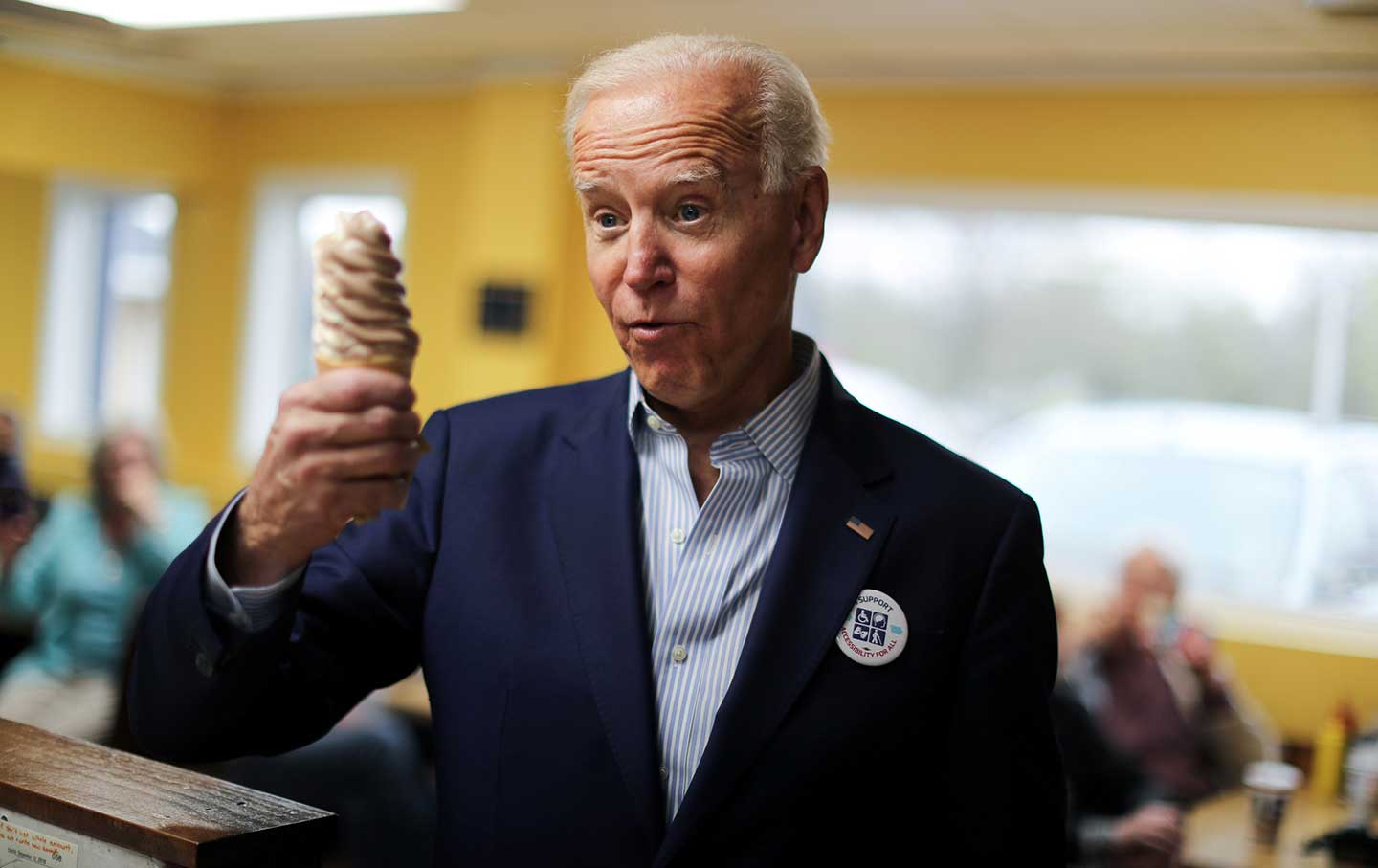
"His praise of white supremacists is not a blunder but a key to his clubby worldview.
By Jeet Heer Today 6:00 am
Joe Biden loves to rattle off the names of dead racist politicians he befriended in the same spirit of nostalgic reverie that a hero of a 19th-century French novel might reminisce about the mistresses he enjoyed as a young man. At a fundraiser on Tuesday, the current front-runner in the Democratic presidential primary cited his warm relationship with the late James O. Eastland and the late Herman Talmadge, both ardent segregationists. “I was in a caucus with James O. Eastland,” Biden told the audience. “He never called me ‘boy,’ he always called me ‘son.’” (Was Biden even aware of the racist code that reserved “boy” for black men and “son” for white ones?). Biden added, “At least there was some civility. But today, you look at the other side and you’re the enemy.”
Biden’s rivals and the media jumped on this supposed blunder. Senator Cory Booker, among others, called on Biden to apologize. The Washington Post described Biden’s remarks as belonging to the “pantheon of campaign-defining gaffes.”
But did Biden really make a faux pas? Or was it a frank statement about what the veteran politician actually thinks? Biden’s advisers reportedly warned him against using Eastland as an example. Biden discounted their warnings, which suggests the remarks were made with forethought. Far from speaking off-the-cuff, Biden was expressing one of his deepest convictions: that the vocation of politics is all about friendship.
Biden’s famous affability isn’t just an aspect of his personality. It’s a core belief. Like the talking horses in the animated kids show My Little Pony, Biden believes that “friendship is magic.”
Biden’s vision is similar, in some respects, to Obama’s promise in 2008 to unite a divided America. But Obama’s post-partisan politics was an attempt to get debates on key issues like health care settled by reasoned public debate. Biden’s post-partisanship is more narrowly personal.
For Biden, one-to-one relationships are the essence of life and politics. In his 2003 eulogy for the famously racist Senator Strom Thurmond, Biden said that “friendship and death are great equalizers, where our differences become irrelevant and the only thing that is left is what’s in our heart.”
Biden knows all about death, having lost his first wife and a 1-year-old daughter in a car accident in 1972, as well as an adult son to brain cancer in 2015. Being a man of grief and resiliency defines Biden. “The Bidenite glad-hander,” as George Blaustein observed in The New Republic, “offers emotional connection in a society of strangers, and having known sorrow makes Biden the best glad-hander in the business.” The experience of unspeakable grief is what gives Biden’s thirst for friendship its authenticity, freeing it from the tawdriness of mere networking.
Biden is quick to play up his friendships, whether with Barack Obama or Strom Thurmond. On June 8, he tweeted, “Happy #BestFriendsDay to my friend, @BarackObama.” This mawkish tweet was accompanied by a photo of a braided friendship bracelet that read “Joe” and “Barack” along with little emblems of joy (including a star and a happy face).
In a heartfelt eulogy, Biden recalled how Thurmond had defended him from an accusation of plagiarism in law school. “When partisanship was a winning option, he chose friendship,” Biden said.
Biden claims Thurmond underwent a change of heart on racism, a redemption narrative at odds with the evidence. (Biden made the same claim about another racist pal, John C. Stennis.) Thurmond died at the age of 100 without acknowledging that he was the father to an African-American daughter, the product of a relationship he had as a young man with a 16-year-old maid. Whatever private remorse Thurmond or Stennis might have felt does nothing to address the impact of their decades-long advocacy of racism from the commanding heights of American politics.
Politics is defined by a choice of friends and enemies. Bernie Sanders’s foes are the 1 percent. Elizabeth Warren’s nemesis is monopolistic corporations—or the Republican Party. Joe Biden’s target is just one man: Donald Trump. Biden’s theory of political change is a simple one: Get rid of Trump and we can all be friends again. “The thing that will fundamentally change things is with Donald Trump out of the White House,” Biden told donors in early July. “Not a joke. You will see an epiphany occur among many of my Republican friends.”
Biden’s cult of friendship is so heartfelt that it seems churlish to point out that it is also absurd. Even New York magazine’s Jonathan Chait, who shares much of Biden’s centrist politics, notes that the Obama years provide ample evidence that bipartisan conviviality is not enough. Biden’s bonhomie helped secure a handful of Republican senatorial votes in one key issue (stimulus funding), but was otherwise effective only on minor matters. Biden’s back-slapping geniality was no match for the ferocious partisanship of Mitch McConnell. Partisan polarization and Republican extremism go far beyond Donald Trump, and won’t be solved by gregariousness.
From the outside, what Biden sees as friendship looks more like cliquishness. Strom Thurmond helped his buddy Joe—a smart move in a clubby world. Thurmond was a notorious sexual harasser, who benefited from the old-boys’-club protectiveness of the Senate. But aside from such personal back-scratching, Thurmond prioritized not just partisanship but an ideological commitment to white supremacy. It was that overriding goal of white power that made Thurmond break with the Democrats in 1948 to run as a Dixiecrat and eventually become a Republican in 1964.
Thurmond knew politics wasn’t really about personal loyalty (after all, he betrayed his own party) but about pushing an agenda. This is an insight Joe Biden lacks. The Jim Crow system that Thurmond upheld wasn’t defeated by his change of heart or his friendship with other politicians, but through a mass protest movement that broke the logjam of cozy Washington.
Nor did Biden’s friendship with Thurmond achieve much good. Biden cites their work on the 1991 Thurmond-Biden Crime Bill, one of the building blocks of American mass incarceration. As for James O. Eastland, Biden bonded with him over a shared opposition to school integration. “I want you to know that I very much appreciate your help during this week’s Committee meeting in attempting to bring my antibusing legislation to a vote,” Biden wrote to Eastland in 1977.
Democrats might ask themselves: With friends like Biden and his pals, who needs enemies?"
For Joe Biden, Friendship Is Magic
Border Patrol finds four bodies, including three children, in South Texas
The body of a 20-year-old woman was found together with the children, the sheriff said.
Border Patrol agents found four bodies, including three children, near the Rio Grande in South Texas on Sunday, Hidalgo County Sheriff Eddie Guerra said.
Two of the children were infants and one was a toddler, Guerra said. The adult was a 20-year-old woman, he said.
The deaths come amid a huge influx of undocumented immigrants at the Southwest border and demonstrate how treacherous it is to journey, often on foot, to the U.S. from Mexico and Central America.
The bodies were found southeast of Anzalduas Park in the Las Paloma Wildlife Management Area, just north of Reynosa, Mexico, and south of McAllen, Texas, Guerra said.
He said deputies were awaiting FBI agents to lead the investigation.

More than 132,000 people were stopped while crossing the border illegally or presenting themselves at legal ports of entry in the month of May — the most in 13 years, U.S. Customs and Border Protections officials said.
At least seven children are known to have died at the border since last year, though they were in CBP custody at the time. The most recent death, of 16-year-old Carlos Gregorio Hernández Vásquez, occurred last month after the teen was diagnosed with the flu."
Border Patrol finds four bodies, including three children, in South Texas
Sunday, June 23, 2019
Taking Migrant Children From Parents Is Illegal, U.N. Tells U.S. - The New York Times

Blame those cowards who fear impeachment for what is happening to these children. Trump continues to break the law and immoral people refuse to due their Constitutional duty to impeach him or constituents impose impeachment for political reasons.
"First they came for the socialists, and I did not speak out—because I was not a socialist.
Then they came for the trade unionists, and I did not speak out— because I was not a trade unionist.
Then they came for the Jews, and I did not speak out—because I was not a Jew.
Then they came for me—and there was no one left to speak for me." Martin Niemöller
Taking Migrant Children From Parents Is Illegal, U.N. Tells U.S. - The New York Times
Saturday, June 22, 2019
Subscribe to:
Posts (Atom)