Contact Me By Email


What To Do When You're Stopped By Police - The ACLU & Elon James White

What To Do When You're Stopped By Police - The ACLU & Elon James White

Know Anyone Who Thinks Racial Profiling Is Exaggerated? Watch This, And Tell Me When Your Jaw Drops.


This video clearly demonstrates how racist America is as a country and how far we have to go to become a country that is civilized and actually values equal justice. We must not rest until this goal is achieved. I do not want my great grandchildren to live in a country like we have today. I wish for them to live in a country where differences of race and culture are not ignored but valued as a part of what makes America great.

Sunday, April 30, 2017

The Banal Horror of Arkansas’s Executions - The New Yorker

NewImage

"By the opaque reasoning of capital punishment, the state of Arkansas grew some unknowable fraction safer last Monday evening, when Jack Jones, a fifty-two-year-old, overweight, hypertensive, diabetic amputee, was strapped to a gurney in the Cummins Unit prison and administered drugs to successively sedate him, impair his breathing, stop his heart, and kill him. According to the state’s timeline, the process was a model of efficiency, taking only fourteen minutes to complete—less time than one might spend registering a vehicle at the Little Rock D.M.V. This was significant, as the night’s work was just getting started. Arkansas was staging the first double execution in the United States since 2000. Three hours later, Marcel Williams, a forty-six-year-old man who also suffered from diabetes, obesity, and hypertension, was strapped to the same gurney, injected with the same cocktail of drugs, and declared dead within seventeen minutes.

Jones’s and Williams’s executions were the second and third in a four-day period; at the same facility, on the preceding Thursday, Ledell Lee, aged fifty-one, became the first prisoner to be put to death in Arkansas since 2005. A fourth man, Kenneth Williams, aged thirty-eight, who had been on death row since 2000, was executed at Cummins on Thursday, shortly before midnight, when his warrant was set to run out. These four were among eight men whom Arkansas sought to execute in eleven days. With the state’s supply of the sedative midazolam due to expire at the end of the month, the proposed schedule came to resemble a lethal clearance sale. To socioeconomics and race—the known and inescapably arbitrary factors in the application of the death penalty—we may now add a novel dynamic: the shelf life of benzodiazepine compounds. There is a banal horror in the bureaucratic diligence that noted the drug’s expiration date, calculated how many people might be killed before it passed, and generated the warrants that Asa Hutchinson, the state’s Republican governor, signed.

McKesson Medical-Surgical, Inc., which distributes vecuronium bromide—a drug that is commonly used during surgery but that can also be used to stop a person’s breathing—filed suit against Arkansas, claiming that it had been duped into providing an ingredient of the cocktail. Four of the executions were blocked by court order. The Eighth Amendment prohibition against ‘cruel and unusual’ punishment served as a measure of the elastic morality that facilitates the death penalty: does it constitute cruelty to infuse the condemned with a sedative, rather than a stronger anesthetic, particularly if, as attorneys for Jones and Williams argued, the circulatory conditions of the men might impair its effectiveness?

The rush of executions is notable not only for its barbarism but also for its contrast to prevailing thinking about capital punishment. Support for the death penalty peaked in 1994, with eighty per cent of Americans in favor. Last year, a Pew study found that the number had fallen to forty-nine per cent—the first time since 1971 that less than half of the public supported it. The declining crime rate accounts for part of the drop: in the mid-nineties, murders were twice as common as they are now. At the same time, the idea that death serves as a deterrent to other criminals has been consistently unsupported by evidence. Data from the Death Penalty Information Center show that, in the past forty years, there have been eleven hundred and eighty-four executions in the South, compared with four in the Northeast, yet homicide figures in 2015 were nearly seventy per cent higher in Southern states than in Northeastern ones. The death penalty is about retribution for past offenses, not prevention of future ones.

There is also a growing awareness that it is perhaps impossible to create a justice system that both executes criminals and avoids killing innocents. The sclerotic appeals process insures that years, if not decades, will pass before the condemned meet their state-authored fate. But streamlining the process only increases the likelihood that innocent people will die. Since 1973, a hundred and fifty-eight inmates on death row have been exonerated of the crimes for which they were sent there. A prisoner in Ohio named Ricky Jackson spent thirty-nine years on death row before a key witness admitted to lying in the testimony that led to his conviction. Jackson is alive solely because of the inefficiency of the system that sought to kill him.

That complexity has been reflected in the politics of death-penalty prosecutions. In January, Bob Ferguson, the Washington State attorney general, proposed a bill that would eliminate the death penalty in his state. The same month, Beth McCann, the Denver district attorney, announced that her city was done with it. In March, Aramis Ayala, the state attorney for the Ninth Circuit, in Florida, announced that her office would not pursue capital punishment in any cases. Her office was in the midst of prosecuting Markeith Loyd, who is accused of murdering his pregnant girlfriend and a policewoman. Ayala said, ‘I’ve been unable to find any credible evidence that the death penalty increases safety for law-enforcement officers.’ She added that the expense of death-penalty appeals drains resources from other prosecutions. In response, Governor Rick Scott removed the Loyd case, along with twenty-two others, from Ayala’s jurisdiction—an action she is challenging in court.

Last year, the Presidential election was won by a man who had demanded the death penalty for five young black and Latino men who were convicted of a brutal rape in Central Park that they did not commit. He appointed an Attorney General who had successfully fought to vitiate federal prohibitions on the execution of the mentally ill. He chose a Supreme Court Justice who, in his first major vote on the Court, cast the decisive one, in a 5–4 decision, to allow an execution to proceed—that of Ledell Lee, who died minutes later.

These are the actions of powerful men in service of outmoded ideas. We in this country are unaccustomed to mass executions carried out under government auspices. We would prefer to believe that such things happen in less evolved locales. Yet that is precisely what the state of Arkansas set out to achieve. The condemned men perpetrated a litany of horrors, but the rationales for putting them to death—a decades-delayed catharsis for the victims’ families, a lottery-slim chance that some future violence will be deterred—are as close to their expiration as Arkansas’s supply of midazolam. 

Jelani Cobb has been a contributor to The New Yorker and newyorker.com since 2012, writing frequently about race, politics, history, and culture. He is the author of ‘The Substance of Hope: Barack Obama and the Paradox of Progress.’ More"

Bob Woodward and Carl Bernstein BLAST Trump At 2017 WHCA Dinner. #ManchurianPresident #LiarInChief #ResistamceIsNotFutile

Saturday, April 29, 2017

Report: FOX boss made black workers arm wrestle for whites New York magazine editor Gabriel Sherman tells Joy Reid that a group of African-American FOX employees have filed suit alleging they were made to arm wrestle for the amusement of white coworkers. Her panel joins to discuss. AM Joy on MSNBC


AM Joy on MSNBC: ""

(Via.)

Dean on Jeff Sessions: I get the feeling it’s incompetence Why can’t Attorney General Jeff Sessions fill dozens of empty U.S. attorney positions? Joy Reid and former Nixon White House counsel John Dean discuss Sessions’ unworkable immigration crackdown. AM Joy on MSNBC


AM Joy on MSNBC: ""

100 Days of Noise From Donald Trump - The New York Times

NewImage

"It was fitting that President Trump closed out his first 100 days in another bumbling attack on Obamacare, trying and failing to jam a bill through the House this week that had no chance of passing the Senate, just to create the illusion of action.

The sorry saga of health care under this president bears all the Trumpian hallmarks that Americans are learning to expect: the dishonest campaign promise (‘health care for everyone’); the clownish attempts to write a bill; the miniaturization of Paul Ryan (remember that guy?); the rivalrous White House confederation of Bannonite anarchists and glittering cosmopolites; the dearth of nonwhites and nonmales at the table; the absence of any strategy and of any vision beyond ‘winning.’

All that’s needed to complete the Trump pattern is the insultingly obvious effort by the president’s kin to cash in. A health care summit meeting at the Trump International Hotel in Washington, maybe.

If only this administration could simply play as comedy, as pratfalls and double takes. Unfortunately, the saga of health care also reveals the capacity of Mr. Trump to do harm, through incompetence and indifference, if not effective action. Rather than build on the foundation of the Affordable Care Act, and take credit for a strengthened system, Mr. Trump is causing the prospect of nationally affordable care to recede through malign neglect.

Governing, so far, has turned out to be more than Mr. Trump can manage. He didn’t know very much coming into the job of president, including how little he knew, and the extent of his own ignorance has come as a continual surprise to him. “Nobody knew that health care could be so complicated,” he famously marveled the first time he was preparing to fail at passing legislation. He expressed the same wonder of discovery at the complexity of North Korea.

"...his central campaign pledge, to make America great again, presumably by creating vast numbers of jobs for those who helped elect him?...

lorraine 1 hour ago

How is Bannon's promotion of anarchy not a crime? I'd like to see the military escort these criminals out of OUR house. Military rule for...

JCX 1 hour ago

The NYT Editorial Board and its op-ed writers (Blow, Kristoff) have done a brilliant job thus far highlighting the utter incompetency,...

In private life, Mr. Trump was accustomed to negotiations based on the simple reality that everyone involved shared the same objective: profit. He has struggled to bargain with legislators, who want to satisfy many constituencies and have conflicting notions of the national interest. In that sense, legislative deals require far more art than commercial ones, and for that reason, Mr. Trump has found himself in over his head. This week, after congressional Democrats called his bluff, threatening a government shutdown rather than acceding to his bluster, he slunk away from a demand that Congress start paying for his wasteful border wall — you know, the one Mexico has refused to pay for.

“I thought it would be easier,” Mr. Trump admitted about his job to Reuters this week.

Does he show any signs of learning on the job? In fact, yes. He has backed off dangerous pledges like tearing up the Iran nuclear deal and accusing China of manipulating its currency. He replaced his first national security adviser — the cartoonish Michael Flynn, who turned out to have been on not only the Russian payroll but also the Turkish one — with the formidable Lt. Gen. H. R. McMaster.


But since his risible assertion of “American carnage” in the streets during his Inaugural Address, Mr. Trump has continually fomented fear and bullied vulnerable groups, particularly unauthorized immigrants. He has shown no interest in reaching beyond the minority of Americans who elected him, one reason his approval ratings are the lowest on record for a president at this point in his term.


And what of his central campaign pledge, to make America great again, presumably by creating vast numbers of jobs for those who helped elect him? This may prove the emptiest of his promises. The giant infrastructure program, which would indeed yield jobs, is nowhere to be seen. In its place are proposed tax cuts to benefit mainly the wealthy and photo-op executive orders to deregulate energy businesses that, even if sustained by the courts — a long shot — will merely enrich the likes of the Koch brothers.


Yet if his ratings are dismal, the other measure Mr. Trump has always lived by — his revenue — is booming, as he uses the presidency to promote his properties. His determination to leverage his office to expand his commercial empire is the only objective to which Americans, after 100 days, can be confident this president will stay true."


(Via.).  .100 Days of Noise From Donald Trump - The New York Times:

Governing, so far, has turned out to be more than Mr. Trump can manage. He didn’t know very much coming into the job of president, including how little he knew, and the extent of his own ignorance has come as a continual surprise to him. “Nobody knew that health care could be so complicated,” he famously marveled the first time he was preparing to fail at passing legislation. He expressed the same wonder of discovery at the complexity of North Korea.

Continue reading the main story

RECENT COMMENTS

BoRegard

 1 hour ago

"...his central campaign pledge, to make America great again, presumably by creating vast numbers of jobs for those who helped elect him?...

lorraine

 1 hour ago

How is Bannon's promotion of anarchy not a crime? I'd like to see the military escort these criminals out of OUR house. Military rule for...

JCX

 1 hour ago

The NYT Editorial Board and its op-ed writers (Blow, Kristoff) have done a brilliant job thus far highlighting the utter incompetency,...

  • SEE ALL COMMENTS


In private life, Mr. Trump was accustomed to negotiations based on the simple reality that everyone involved shared the same objective: profit. He has struggled to bargain with legislators, who want to satisfy many constituencies and have conflicting notions of the national interest. In that sense, legislative deals require far more art than commercial ones, and for that reason, Mr. Trump has found himself in over his head. This week, after congressional Democrats called his bluff, threatening a government shutdown rather than acceding to his bluster, he slunk away from a demand that Congress start paying for his wasteful border wall — you know, the one Mexico has refused to pay for.

“I thought it would be easier,” Mr. Trump admitted about his job to Reutersthis week.

Does he show any signs of learning on the job? In fact, yes. He has backed off dangerous pledges like tearing up the Iran nuclear deal and accusing China of manipulating its currency. He replaced his first national security adviser — the cartoonish Michael Flynn, who turned out to have been on not only the Russian payroll but also the Turkish one — with the formidable Lt. Gen. H. R. McMaster.

But since his risible assertion of “American carnage” in the streets during his Inaugural Address, Mr. Trump has continually fomented fear and bullied vulnerable groups, particularly unauthorized immigrants. He has shown no interest in reaching beyond the minority of Americans who elected him, one reason his approval ratings are the lowest on record for a president at this point in his term.

And what of his central campaign pledge, to make America great again, presumably by creating vast numbers of jobs for those who helped elect him? This may prove the emptiest of his promises. The giant infrastructure program, which would indeed yield jobs, is nowhere to be seen. In its place are proposed tax cuts to benefit mainly the wealthy and photo-op executive orders to deregulate energy businesses that, even if sustained by the courts — a long shot — will merely enrich the likes of the Koch brothers.

Yet if his ratings are dismal, the other measure Mr. Trump has always lived by — his revenue — is booming, as he uses the presidency to promote his properties. His determination to leverage his office to expand his commercial empire is the only objective to which Americans, after 100 days, can be confident this president will stay true.

George Takei: Internment, America’s Great Mistake - The New York Times - One of America's many racist outrages.

NewImage

"Every year since the late 1960s, on the last Saturday in April, there has been a pilgrimage to a place called Manzanar in California, where one of 10 United States internment camps once stood. The annual journeys began as a way to remember those Japanese-Americans who were incarcerated during World War II and to mark a dark chapter in our history. The pilgrimage includes elderly original internees and their families, as well as neighbors of the site, schoolchildren and, since Sept. 11, American Muslims, who see parallels between what once happened and today.
Manzanar is the best known of the camps, because it often made the news during the war owing to unrest, strikes and even shooting deaths. At its peak, the camp held over 10,000 Japanese-Americans inside its barbed wire. Most hailed from Los Angeles, some 230 miles to the south. A vast majority were also American citizens, held without charge or trial for years, for the crime of looking like the people who had bombed Pearl Harbor.
Manzanar is now a National Historic Site thanks to the work of Sue Kunitomi Embrey and the Manzanar Committee, which lobbied for decades to obtain the designation. I have visited it often, but my personal pilgrimages have been to two other camps that once held my family and me. One is in Rohwer, Ark., in what was then fetid, uninhabitable swampland, and the other is in the cold, desolate wastes of Tule Lake, Calif. That was the harshest camp, with more than 18,500 inmates behind three layers of barbed-wire fence and with tanks patrolling the perimeter.
I was 5 years old at the beginning of our internment in Arkansas. I remember every school morning reciting the Pledge of Allegiance, my eyes upon the stars and stripes of the flag, but at the same time I could see from the window the barbed wire and the sentry towers where guards kept guns trained on us.


I was 7 years oldwhen we were transferred to another camp for “disloyals.” My mother and father’s only crime was refusing, out of principle, to sign a loyalty pledge promulgated by the government. The authorities had already taken my parents’ home on Garnet Street in Los Angeles, their once thriving dry cleaning business, and finally their liberty. Now they wanted them to grovel; this was an indignity too far.

A pilgrimage to Tule Lake also occurs every year, symbolically on July 4. I have gone three times. I remember a terrifying moment while I was held there when armed military police burst into the barracks and hauled away several young men.
On the pilgrimages, I finally saw where they had been taken: a concrete cell block called the stockade. On the concrete walls, there was graffiti, now made illegible by the passage of time. Also fading were brown splotches I was told were blood stains. This was what could happen in an America that had become un-American.


It has been the lifelong mission of many to ensure we remember the internment. Our oft-repeated plea is simple: We must understand and honor the past in order to learn from and not repeat it. But in the 75 years since President Franklin D. Roosevelt signed Executive Order 9066 authorizing the internment of Japanese-Americans, never have we been more anxious that this mission might fail.
It is imperative, in today’s toxic political environment, to acknowledge a hard truth: The horror of the internment lay in the racial animus the government itself propagated. It whipped up hatred and fear toward an entire group of people based solely on our ancestry.
Officials claimed they could not distinguish among us to determine who were “spies” and “saboteurs” and who were innocents. Yet not a single instance of espionage or sabotage was ever prosecuted or proved among the 120,000 internees. It was the ultimate in “fake news,” encouraged by a vicious, jingoistic press and politicians seeking to capitalize on the national hysteria.


If this seems a practice only of years long past, consider that today we need merely replace “Japanese-Americans” with “Muslims” for the parallels to emerge. Once again, we are told by our government that a blanket ban is needed. So brazen is this same troubling logic that a Trump surrogate even cited Japanese-American internment as a precedent for the Muslim ban. Both rely upon the presupposition of guilt, one by race, the other by religion. Most chilling of all, both arise out of government policy and action.


When nations make historic mistakes, atonement may never truly come. It took almost 50 years for the United States to apologize to those it had interned. While modest reparations were eventually paid, it was far from enough to restore what had been so unjustly taken. My father, who bore our family’s anguish at the imprisonment hardest, died nine years before President Ronald Reagan’s 1988 apology, never to know of the government’s belated acknowledgment of the pain it had caused. To this day, the Supreme Court has not overruled its infamous Korematsu opinion of 1944, which validated our mass incarceration in deference to national security.


My way of remembering the cruelties of the past was to help found the Japanese American National Museum, as well as to turn my family’s experience into a Broadway show, “Allegiance,” in the hope that more will heed the warning. The pilgrimages to camps like Manzanar, Rohwer and Tule Lake are another way of honoring those who suffered, and lost, and had to rebuild shattered lives. They remind us all today of the threat to American values from cynically manufactured fear and the deliberate targeting of a vulnerable minority."

George Takei: Internment, America’s Great Mistake - The New York Times: ""

Donald Trump tells NRA: 'I am going to come through for you' | US news | The Guardian. This is truly Hilary Clinton's "basket of deplorables. Nice people do not join the NRA,

NewImage


  "Donald Trump marked his 99th day as US president by basking in the noisy adulation of his base and making a pledge to the National Rifle Association: ‘You came through for me and I am going to come through for you.’

The caustic spectacle that powered Trump to victory in last year’s election was on full display before he took the stage in Atlanta, with big-screen ads denouncing his defeated opponent Hillary Clinton, loud boos for former president Barack Obama and speaker after speaker railing against media and Hollywood elites."

(Via.). Donald Trump tells NRA: 'I am going to come through for you' | US news | The Guardian:

Thursday, April 27, 2017

The education of Donald Trump The White House remains on a collision course between the president's fixed habits and the demands of his new job. By JOSH DAWSEY , SHANE GOLDMACHER and ALEX ISENSTADT. The education of Donald Trump - POLITICO

North Carolina woman voted illegally for Trump but won't be charged for 'compassionate' reasons. Even though Donald Trump claims that voter fraud helped Hillary Clinton, it turns out that it actually helped him.

FAYETTEVILLE, NC - DECEMBER 06:  President-elect Donald Trump addresses an audience at Crown Coliseum on December 6, 2016 in Fayetteville, North Carolina. Trump took time off from selecting the cabinet for his incoming administration to celebrate his victory in the general election. (Photo by Sara D. Davis/Getty Images)


"Donald Trump has made a whole lot of noise about voter fraud in last year’s presidential election.|

 The fact that he lost the popular vote continues to drive him absolutely nuts and, though he’s already been in the White House for almost 100 days, he continues to talk about how millions of people cast illegal votes. Well, he’s right. Not about the millions, but there is proof that some people voted illegally and most of them seem to have been for him. In North Carolina, for instance, a woman admitted that she cast an illegal vote for Trump in the presidential election, in order to fulfill her mother’s dying wish. The state prosecutor, a Republican, announced that she is not going to be charged for this crime. Big surprise, huh?


District Attorney David Learner, chief prosecutor for Catawba, Burke and Caldwell counties, announced his decision Wednesday not to pursue the case, which had been referred to him by the State Board of Elections.


Learner, a Republican, withheld the name of the voter but said she had cast the improper vote for Trump last November “out of sheer ignorance” of the law and while “grieving the loss of her mother.”


North Carolina woman voted illegally for Trump but won't be charged for 'compassionate' reasons

Study Shows a Third of Childhood Lead Poisoning Goes Undiagnosed | Colorlines

A Hidden Problem: Lead-Poisoned Children in the United States. April 2017. Available online at www.cehtp.org/hiddenlead.


"A study published today (April 27) in the peer-reviewed journal Pediatrics shows what lead poisoning among U.S. children looks like—and it’s bad.


Roughly a third of children exposed to lead likely go undiagnosed, according to the study. The study looked at 39 states where data is available from 1999 to 2010. Only 607,000 of the 944,000 cases in states that report to the Centers for Disease Control Control and Prevention (CDC) are identified. That means 36 percent of cases go unnoticed.


Lead poisoning is extremely dangerous for children, so much so that the CDC has determined no amount of lead safe is for them. The toxic metal can damage the brain and nervous system, slowing a child’s growth and development, which can lead to learning and behavioral problems.


The lead author of the study, Eric Roberts, who serves as a co-principal investigator at the Public Health Institute’s California Environmental Health Tracking Program, expressed concern over these numbers in a press release—particularly because lead poisoning is preventable.


“Now we know that many more children who have been exposed to lead are not tested, not counted and not treated,” Roberts said. “Without the true numbers, we can’t help the children who have been poisoned, or root out how and why so many children are being poisoned in the first place.”


While underreporting is true across the U.S., it is most severe in the South and West. However, the number of lead-poisoned children is higher in the Northeast and Midwest.


The most high-profile case of lead poisoning in children is the ongoing water crisis in Flint, Michigan. April 25 marked the three-year anniversary of when city officials switched their water source, which partially led to lead entering Flint’s drinking water system. Residents still rely on bottled or filtered water for their daily needs like cooking and washing.


But lead poisoning—and water contamination overall—is pervading communities around the United States, especially those whose residents are predominantly of color. Other studies have, like one  the CDC published in 2009 that found Black and Mexican-American children suffer from lead poisoning at higher rates than their White counterparts. That’s 11.2 percent of Black children and 4 percent of Mexican-American children, with only 2.3 percent of White children."

Study Shows a Third of Childhood Lead Poisoning Goes Undiagnosed | Colorlines

Tax credits in GOP plan 'unusable' in NY Republican Congressman Dan Donovan of New York explains that the tax credits in the GOP's current health care plan would be unusable in his state due to abortion coverage requirements. All In with Chris Hayes on MSNBC


All In with Chris Hayes on MSNBC

This is Insane Revised MO statute increases punishment on grade school fights - | WBTV Charlotte

Jared Kushner courts scandal with sketchy business backers | MSNBC


Jared Kushner courts scandal with sketchy business backers | MSNBC

Republican = unashamed sefishness House GOP Exempts Itself From Zombie Trumpcare

Image


"As House Republicans scramble to get 218 votes to move their revised health plan (a.k.a. Zombie Trumpcare) out of the House, it seems that out of either carelessness or hypocritical avarice they have made a huge drafting mistake by trying to exempt themselves and their employees from the new system. Sarah Kliff explains:


The new Republican amendment, introduced Tuesday night, would allow states to waive out of Obamacare’s ban on pre-existing conditions. This means that insurers could once again, under certain circumstances, charge sick people higher premiums than healthy people.


Republican legislators liked this policy well enough to offer it in a new amendment. They do not, however, seem to like it enough to have it apply to themselves and their staff. A spokesperson for Rep. Tom MacArthur (R-N.J.) who authored this amendment confirmed this was the case: members of Congress and their staff would get the guarantee of keeping these Obamacare regulations.


House GOP Exempts Itself From Zombie Trumpcare

Sunday, April 23, 2017

March for Science puts Earth Day focus on global opposition to Trump | Environment | The Guardian

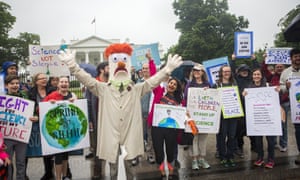
Members of the Union for Concerned Scientists pose for photographs with Muppet character Beaker in front of the White House before heading to the National Mall for the March for Science on Saturday in Washington DC.


"Hundreds of thousands of climate researchers, oceanographers, bird watchers and other supporters of science rallied in marches around the world on Saturday, in an attempt to bolster scientists’ increasingly precarious status with politicians.


Bill Nye the Science Guy on Trump: 'We are in a dangerous place'


The main March for Science event was held in Washington DC, where organizers made plans for up to 150,000 people to flock to the national mall, although somewhat fewer than that figure braved the rain to attend. Marchers held a range of signs. Some attacked Donald Trump, depicting the president as an ostrich with his head in the sand or bearing the words: “What do Trump and atoms have in common? They make up everything.”


More than 600 marches took place around the world, on every continent bar Antarctica, in events that coincided with Earth Day."


March for Science puts Earth Day focus on global opposition to Trump | Environment | The Guardian