What To Do When You're Stopped By Police - The ACLU & Elon James White
What To Do When You're Stopped By Police - The ACLU & Elon James White
Know Anyone Who Thinks Racial Profiling Is Exaggerated? Watch This, And Tell Me When Your Jaw Drops.
This video clearly demonstrates how racist America is as a country and how far we have to go to become a country that is civilized and actually values equal justice. We must not rest until this goal is achieved. I do not want my great grandchildren to live in a country like we have today. I wish for them to live in a country where differences of race and culture are not ignored but valued as a part of what makes America great.
"For years, critics have claimed that the US' Foreign Intelligence Surveillance Court is a pushover: it's allegedly so reluctant to reject spying orders that it's little more than a speed bump for the FBI and NSA. True or not, that reputation isn't about to change any time soon. Reuters has obtained a Justice Department memo showing that FISC didn't reject any of the 1,457 surveillance order requests it received in 2015, even in part. That's no different than in 2014, but it suggests that the court isn't any less forgiving in an era of tighter government controls."
"In the landmark case Gideon v. Wainwright, the Supreme Court held in 1963 that the state or local government had to provide a lawyer to any defendant facing prison time who could not afford his or her own. This was no minor decision. Approximately 80 percent of all state criminal defendants in the United States qualify for a government-provided lawyer.
Yet despite this constitutional guarantee, state and county spending on lawyers for the poor amounts to only $2.3 billion — barely 1 percent of the more than $200 billion governments spend annually on criminal justice.
Worse, since 1995, real spending on indigent defense has fallen, by 2 percent, even as the number of felony cases has risen by approximately 40 percent.
Not surprisingly, public defense finds itself starved of resources while facing impossible caseloads that mock the idea of justice for the poor.
In Fresno, Calif., for instance, public defenders have caseloads that are four times the recommended maximum of around 150. In Minnesota, one public defender followed by a reporter estimated that he had about 12 minutes to devote to each client that day. There is no way these lawyers can manage the cases being thrown at them.
In New Orleans, caseloads are so high that the parish’s public defender office has started to refuse to take cases, including murder cases. Public defender offices in other states, including Florida, Missouri, New York and Pennsylvania, have taken similar steps when caseloads have grown too heavy.
To make things worse, 43 states now require indigent defendants to pay at least a portion of their lawyers’ fees, even though these defendants are by definition indisputably poor.
The situation in South Dakota highlights the insanity of this. South Dakota charges a defendant $92 an hour for his public defender, owed no matter the outcome of the case. If a public defender spends 10 hours proving that her client is innocent, the defendant still owes the lawyer $920, even though he committed no crime and his arrest was a mistake.
Failure to pay is a crime. Someone who qualifies as indigent may be acquitted, only to be convicted of being too poor to pay for the legal services the Constitution requires the state to provide.
"From the 1930s through the 1960s, most African-Americans could not get mortgages because the government had deemed neighborhoods where they lived ineligible for federal mortgage insurance, the Depression-era innovation that made mortgages widely affordable.
The situation exposed black families to hucksters who peddled homeownership through contracts for deed, in which a home seller gives a buyer a high-interest loan, coupled with a pledge to turn over the deed after 20 to 40 years of monthly installment payments. These contracts enriched the sellers by draining the buyers, who built no equity and were often evicted for minor or alleged infractions, at which point the owner would enter into a contract with another buyer. In the process, families and neighborhoods were ruined.
Contracts for deed are making a comeback. They are increasingly being used by investment firms that have bought thousands of foreclosed homes and want to sell them to lower-income buyers “as is,” according to a recent report in The Times by Alexandra Stevenson and Matthew Goldstein. Many of the homes are in Alabama, Georgia, Michigan, Missouri and Ohio. In one example in the article, investors who bought foreclosed homes at an average price of $8,000 issued a contract on one in Ohio in 2011 for $36,300 at 10 percent interest.
Contracts for deed make gouging possible, because unlike traditional mortgages, there is no appraisal or inspection to ensure that the loan amount is reasonable. They also let an investor swiftly evict buyers for missed payments, rather than giving them time to catch up, as required under a mortgage. And they usually require the buyer to pay hefty upfront fees. Unlike a rental security deposit, however, the fee is almost never refundable.
Contracts for deed are similar in some ways to the subprime lending that contributed to the housing bust in this century. Investors in the contracts include some of the Wall Street players who inflated the mortgage bubble, including Daniel Sparks, the former Goldman Sachs executive, whose department was betting on a crash in 2007 even as the bank was selling toxic mortgage securities. The stated rationale for contracts for deed is that low-income buyers cannot qualify for mortgages — the same line that was used to justify subprime lending.
What became evident from the crash was that many subprime borrowers who were wiped out — and who were disproportionately black and Hispanic — could have qualified for better terms and were misled.
Even for buyers truly unable to get mortgages, contracts for deed nearly always inflict harm. The exception is a few programs where public agencies or nonprofits use interest-free contracts to sell homes to needy families and then help them refinance into traditional mortgages. Federal housing agencies could foster that approach by selling more of their foreclosed properties to nonprofits."
Levar Allen is a 17-year-old standout three-sport student athlete at Parkway High School in south Bossier City, La.
An award-winning wrestler, football and basketball player, Levar is beloved at school and in the community. He's never been in trouble with the law a day in his life — until now.
Levar did what millions of kids in America are doing — he exchanged naked text messages with a 16-year-old classmate.
First, she sent Levar a nude video and then he sent her one in return. Call it gross, but a recent study found that 54% of kids under the age of 18 have done so before.
Parents may hate it, but when it's consensual, it's definitely safer than in-person intercourse.
But Levar lives in the deep South.
He's black. And it appears his biggest mistake wasn't doing what the majority of American teens have done. His biggest mistake was doing so with a white girl.
Her parents called the police when they discovered what was happening.
Of course, they arrested Levar and he was charged with contributing to the delinquency of a juvenile and possession of child pornography for the video he still had of her on his phone.
Yes, she's 16 and he's 17.
Yes, she sent him a video first.
Yes, this was consensual.
Yes they attend the same high school together.
Yes, this is a bogus symptom of the mass criminalization of black folk in the New Jim Crow.
When pressed on whether or not race played a role, Lt. Bill Davis, who is also white, seemed offended and told KSLA-TV, "I have nothing to say about that. It doesn't matter what your race, what your religion, what your ethnicity, don't do child pornography! Plain and simple."
Except a 16-year-old and 17-year-old in the same school consensually sending each other sexual videos of themselves isn't child pornography.
In Louisiana, the law states that anyone under the age of 17 found to be sexting any person of any age can be charged with a misdemeanor. It's not widely prosecuted. If a 17 year old, even if they are in high school together, does the very same thing, with a 16 year old, they can be charged with with child pornography. The law lacks the nuance it deserves and ultimately criminalizes common youth misbehavior between peers.
Now, this young man faces the prospect of having a criminal record and his mother is having to scrape together every single dime she can find, $4,000 already, just to defend him from these outrageous charges.
BOSSIER PARISH SHERIFF'S OFFICE
Levar Allen's mother claims her son was discriminated against after the 17-year-old, found sexting a fellow teenager who is white, was arrested and charged with possession of child pornography.
"Former House Speaker John Boehner seems to be enjoying his retirement—and wouldn’t you, after what he went through in Washington? One reason for his buoyant mood, besides the chance to cut grass, is the opportunity to stay far, far away from Senator Ted Cruz.
Asked about Cruz during an appearance at Stanford University on Wednesday, Boehner called him “Lucifer in the flesh,” according to the The Stanford Daily.
“I have Democrat friends and Republican friends. I get along with almost everyone, but I have never worked with a more miserable son of a bitch in my life,” Boehner added. He said he would not vote for Cruz in a general election, though he would vote for his fellow tangerine-tinted Republican Donald Trump."
"In Bahrain, it took an asthmatic man’s life. Bahrain bought it from South Korea, where it’s been used on dissidents for decades. In Egypt, it choked 37 men to death in the back of a police truck. Egypt got it from the USA. It’s tear gas, and it’s becoming a staple of life in American prisons.
Tear gas is mostly known in the United States as a “crowd control weapon” for dispersing unwanted demonstrators. Beloved of US SWAT teams and riot cops, ubiquitous in police arsenals, it played a key role in suppressing civilians during the protests of the Arab Spring. From Ferguson in 2014 to Rio de Janeiro this year, it’s become notorious for its risks and health effects: miscarriages, lung damage, blunt-force trauma, asphyxiation. So why are we using it on captives?
“They started out by using MK9, which is a form of pepper spray. Then they put a fogger attachment on it, to pipe it into the cell. Then they upped it to Sting-Ball grenades. They threw two grenades into the cell—a cell that’s approximately 80 square feet.
"They threw two grenades into the cell—a cell that’s approximately 80 square feet."
“After that, they used a pepper-ball gun. That’s a 37-millimeter rifle that shoots these little concentrated balls of pepper-spray mixture in the cell. They did all of this back to back to back, without stopping. And then they go in and they use physical force, and they taser, and they put him in a restraint chair.”
That’s how Mountain State Justice staff attorney Aaron Moss describes one inmate’s experience—which he saw on video—at West Virginia’s maximum-security Mount Olive Correctional Complex. Internal documents from Mount Olive, reviewed by The Nation, confirm that its head warden has declared “martial law” in parts of the facility, superseding standard use-of-force regulations by decree. His declaration authorized the use of “less-lethal” weapons, including grenade launchers, at staff discretion.
The War Resisters League, through a letter-writing campaign run in its prison newsletter, obtained testimony from 18 states on the use of tear gas and pepper spray against inmates—in men’s and women’s prisons, maximum- and medium- security facilities, across the country. For unrestrained use of force on restrained inmates, Mount Olive might be the most well-documented example.
“The guards have said under this protocol they are free to use chemical agents at their own discretion—5-7 people are sprayed a week,” says Fred Douty, a Mount Olive inmate, in a letter to WRL. Douty himself was sprayed on at least one occasion; he says a prison nurse diagnosed him days later with first-degree chemical burns.
"On January 24, 2013, the Florida Department of Corrections received a grievance letter from an inmate named Harold Hempstead, who was imprisoned at the Dade Correctional Institution. The letter was brief and its tone was matter-of-fact, but the allegations it contained were shocking, raising troubling questions about the death of a mentally ill inmate named Darren Rainey, who had collapsed in a shower seven months earlier, on June 23, 2012—a case that I wrote about in the magazine this week. According to Hempstead’s letter, the death had been misrepresented to disguise the abuse that preceded it. The reason Rainey collapsed in the shower, Hempstead alleged, was that he had been locked in the stall by guards, who directed scalding water at him. Hempstead’s cell was directly below the shower. That night, he had heard Rainey yelling, “I can’t take it no more,” he recalled. Then he heard a loud thud—which he believed was the sound of Rainey falling to the ground—and the yelling stopped. Hempstead concluded his letter by calling for an investigation."
On Friday, Virginia Governor Terry McAuliffe, flanked by veteran civil-rights leaders, announced what he called a “landmark” restoration of voting rights for convicted felons.
"In breaking news, another tragic incident of police murder has just occurred over night, leaving a 6-year-old boy dead.
The shooting took place in Marksville, Louisiana. Now, the father of that 6-year-old is in critical condition as well.
The Advocate reports, that the 6-year-old, Jeremy David Mardis, of Effie, “was killed by multiple gunshot wounds to the head and torso. He was pronounced dead at the scene, Avoyelles Parish Coroner L.J. Mayeaux said Wednesday. The boy was a student at Lafargue Elementary in Effie.”
The shooting took place on Martin Luther King Drive in Marksville. It happened “at the end of a pursuit and involved multiple citymarshals from Ward 2,” according to Louisiana State Police spokesman Trooper Daniel “Scott” Moreau.
The police are saying that the driver was attempting to get away from officers, who followed in what became a high speed chase.
The Associated Press reports that the coroner explains that Few hit a dead end. He then backed out to try to get away. But that’s when officers unloaded on him and his 6-year-old son."
This article was originally published on Presidents' Day 2012.
Unlike the statement in Indian Country Today Media Network’s “Best Presidents for Indian country” story, it’s a bit easier identifying the “worst” presidents for Indian country. Five tend to stand out with the majority of the rest huddled together after that. Here are our nods to the presidents who did more harm than good for Native Americans while in office.
Portrait of Andrew Jackson (Copyright Bettmann/Corbis / AP Images)
Andrew Jackson:A man nicknamed “Indian killer” and “Sharp Knife” surely deserves the top spot on a list of worst U.S. Presidents. Andrew Jackson “was a forceful proponent of Indian removal,” according toPBS.Others have a less genteel way of describing the seventh president of the United States.
“Andrew Jackson was a wealthy slave owner and infamous Indian killer, gaining the nickname ‘Sharp Knife’ from the Cherokee,” writes Amargi on the websiteUnsettling America: Decolonization in Theory & Practice. “He was also the founder of the Democratic Party, demonstrating that genocide against indigenous people is a nonpartisan issue. His first effort at Indian fighting was waging a war against the Creeks. President Jefferson had appointed him to appropriate Creek and Cherokee lands. In his brutal military campaigns against Indians, Andrew Jackson recommended that troops systematically kill Indian women and children after massacres in order to complete the extermination. The Creeks lost 23 million acres of land in southern Georgia and central Alabama, paving the way for cotton plantation slavery. His frontier warfare and subsequent ‘negotiations’ opened up much of the southeast U.S. to settler colonialism.”
Jackson was not only a genocidal maniac against the Indigenous Peoples of the southwest, he was also racist against African peoples and a scofflaw who “violated nearly every standard of justice,” according to historianBertram Wyatt-Brown. As a major general in 1818, Jackson invaded Spanish Florida chasing fugitive slaves who had escaped with the intent of returning them to their “owners,” and sparked the First Seminole War. During the conflict, Jackson captured two British men, Alexander George Arbuthnot and Robert C. Ambrister, who were living among the Seminoles. The Seminoles had resisted Jackson’s invasion of their land. One of the men had written about his support for the Seminoles’ land and treaty rights in letters found on a boat. Jackson used the “evidence” to accuse the men of “inciting” the Seminoles to “savage warfare” against the U.S. He convened a “special court martial” tribunal then had the men executed. “His actions were a study in flagrant disobedience, gross inequality and premeditated ruthlessness… he swept through Florida, crushed the Indians, executed Arbuthnot and Ambrister, and violated nearly every standard of justice,” Wyatt-Brown wrote.
ADVANCE FOR THE STORY SLUGGED: SOUTH KOREA TORTURED CHILDREN - In this undated image provided by the Committee Against Institutionalizing Disabled Persons, a civic group representing the former inmates, child inmates line up for morning assembly at the Brothers Home in Busan, South Korea. An Associated Press investigation shows that rapes and killings of children and the disabled three decades ago at a South Korean institution for so-called vagrants, the Brothers Home, were much more vicious and widespread than previously realized.
"After being indoctrinated online into the world of white supremacy and inspired by a racist hate group, Dylann Roof told friends he wanted to start a “race war.” Someone had to take “drastic action” to take back America from “stupid and violent” African Americans, he wrote.
Then, on June 17, 2015, he attended a Bible study meeting at the historic Emanuel A.M.E. Church in Charleston and murdered nine people, all of them black.
Dylann Roof, the suspect in the massacre of nine African Americans in Charleston, S.C., in June 2015.
Dylann Roof, the suspect in the massacre of nine African Americans in Charleston, S.C., in June 2015. (Corbis)
The act of terror shocked America with its chilling brutality.
But Roof did not spark a race war. Far from it.
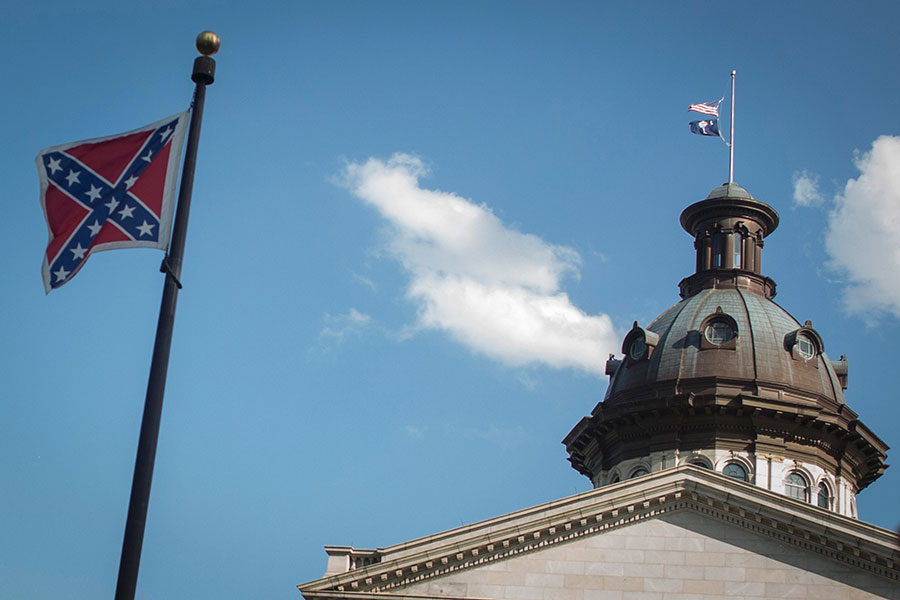
Instead, when photos surfaced depicting the 21-year-old white supremacist with the Confederate battle flag — including one in which he held the flag in one hand and a gun in the other — Roof ignited something else entirely: a grassroots movement to remove the flag from public spaces.
In what seemed like an instant, the South’s 150-year reverence for the Confederacy was shaken. Public officials responded to the national mourning and outcry by removing prominent public displays of its most recognizable symbol.
It became a moment of deep reflection for a region where the Confederate flag is viewed by many white Southerners as an emblem of their heritage and regional pride despite its association with slavery, Jim Crow and the violent resistance to the civil rights movement in the 1950s and 1960s.
The moment came amid a period of growing alarm about the vast racial disparities in our country, seen most vividly in the deaths of unarmed African Americans at the hands of police.
Under intense pressure, South Carolina officials acted first, passing legislation to remove the Confederate flag from the State House grounds, where it had flown since 1962. In Montgomery, Alabama — a city known as the Cradle of the Confederacy — the governor acted summarily and without notice, ordering state workers to lower several versions of Confederate flags that flew alongside a towering Confederate monument just steps from the Capitol.
"According to Georgia police, J.J. Harper was well-known in Georgia for his role in the local chapter of the KKK:
Law enforcement confirmed Harper's involvement in the white supremacy movement.
"Yes, he was. He had a membership drive on the courthouse steps," said Deputy David Grantham with the Dooly County Sheriff's Office.
During the standoff, Harper told officers and various news outlets that "someone was going to die today".
Harper shot multiple rounds at officers before walking back inside his home.
Agents confirm they fired a round at Harper before a gunshot was heard inside the home.
Police were called to the home after a domestic dispute. Harper kept police at bay for roughly eight hours, telling those on site that "someone is going to die today."
"Prisoners are brutalized by correctional officers with scandalous frequency. A recent abuse scandal in Los Angeles County ultimately sent former Sheriff Lee Baca to jail. In Texas, “the state prison system’s inspector general has referred nearly 400 cases of staff sex crimes against inmates to prosecutors. An analysis by The Marshall Project found that prosecutors refused to pursue almost half of those cases.” In Maricopa County, Arizona, Sheriff Joe Arpaio’s list of misdeeds is too long to summarize in a sentence. In New York, the union for prison guards has helped dozens of abusive members to keep their jobs. Last year, human rights groups “called for a U.S. Department of Justice investigation into Florida state prisons, contending that ‘immediate intervention’ is necessary to stop the widespread abuse, neglect, torture and deaths of inmates in the Florida Department of Corrections.”
And in Cook County, Illinois? There is brutal inmate abuse there, too. But Cook County Sheriff Tom Dart is making efforts as aggressive as any I’ve seen to confront and improve on the status quo. In recent years, he installed 2,400 fixed-position video cameras and purchased handheld cameras and body cameras for guards.
Then, last week, he took a very unusual step: “He decided to release videos in cases where a civilian oversight board has sustained allegations of excessive force without waiting for Freedom of Information Act requests,” the Washington Post reports.
He declared, “The public has a right to know when officers abuse the public trust.” If you follow police reform efforts you’ve probably guessed who opposes his approach:
The local union called the videos' release “nothing but a political move.”
“Posting these videos on public websites is not only a violation of privacy of our officers, but it’s infringing on their right to a fair trial. The 'transparency' of these videos only goes one way,” Teamsters Local 700 said in a statement. “It’s not a true outlook of what happens at the jail on a daily basis, which are only small clips of the entire alleged incidents.”
There is a grain of truth to what the correctional officer’s union says. This is a political move. The sheriff wants to fire guards who abuse inmates. The union fights to save the jobs of guards who abuse inmates. And insofar as it can wage the fight behind closed doors, it can more easily prevail. But the political calculation changes if the public is permitted to see the behavior in question. Suddenly it’s a lot harder to keep guards on the job after particularly egregious brutality."
"This is a story and a case that will go down in the history of New York and of race relations in the US,” said Cathy Dang, the executive director of CAAAV, a pan-Asian community group in New York that has been at the forefront of Asian American organizations opposing the pro-Liang movement. Dang and her allies see support for Liang as being driven by a desire for Chinese Americans to be treated as equal to whites in the racial hierarchy.
“The question is: do we really want to become the oppressor?” she asked."