Contact Me By Email


What To Do When You're Stopped By Police - The ACLU & Elon James White

What To Do When You're Stopped By Police - The ACLU & Elon James White

Know Anyone Who Thinks Racial Profiling Is Exaggerated? Watch This, And Tell Me When Your Jaw Drops.


This video clearly demonstrates how racist America is as a country and how far we have to go to become a country that is civilized and actually values equal justice. We must not rest until this goal is achieved. I do not want my great grandchildren to live in a country like we have today. I wish for them to live in a country where differences of race and culture are not ignored but valued as a part of what makes America great.

Monday, August 04, 2025

Jack Smith, Obama, Harris and More Politicians Targeted by Trump

Trump’s Revenge List Includes These Politicians, Leaders

"From attacks to former President Barack Obama to threats to a Black U.S. Capitol police officer, Trump has made his political hit list very clear.

During the 2024 campaign cycle, President Donald Trump made over 100 threats to his adversaries. Now that he’s back in office, many believe the president will actually follow through with prosecuting his enemies big time. And already, he’s flexing his political muscles to do so. 

From attacks aimed at former President Barack Obama and Vice President Kamala Harris to threats to Former Rep. Liz Cheney and a Black U.S. Capitol police officer, Trump has made his hit list very clear. Now, we’re giving you the tea on some of the many folks Trump has vowed to go after and exactly how we even got here. 

Former President Joe Biden

FASANO, ITALY – JUNE 13: U.S. President Joe Biden attends a roundtable session entitled “Africa, climate change and development” on day one of the 50th G7 summit at Borgo Egnazia on June 13, 2024 in Fasano, Italy. The G7 summit in Puglia, hosted by Italian Prime Minister Giorgia Meloni, the seventh held in Italy, gathers leaders from the seven member states, the EU Council, and the EU Commission. Discussions will focus on topics including Africa, climate change, development, the Middle East, Ukraine, migration, Indo-Pacific economic security, and artificial intelligence. (Photo by Christopher Furlong/Getty Images)

Ever since losing to former President Joe Biden in 2020, Trump has continued to blast him and his family, even calling for Biden to be “arrested for treason.” Trump said he would “appoint a real special prosecutor to go after the most corrupt president in the history of the United States of America, Joe Biden, and the entire Biden crime family.” This, on top of constant allegations of corruption and treason inside the Biden camp resulted in the former president pardoning his family. Trump later suggested it was a mistake that Biden didn’t pardon himself, according to The Hill. 

NY Attorney General Letitia James

NEW YORK, NEW YORK – FEBRUARY 14: NY Attorney General Letitia James speaks during a press conference on the Department of Government Efficiency (DOGE) at Manhattan Federal Courthouse on February 14, 2025 in New York City. James was joined by Connecticut Attorney General William Tong for a press conference ahead of a scheduled court hearing as they discussed their ongoing lawsuit with 17 other state attorneys general to stop Elon Musk’s DOGE from accessing personal data housed in the Treasury Department. (Photo by Michael M. Santiago/Getty Images)

Ever since N.Y. Attorney General Letitia James brought a fraud lawsuit against Trump, she’s been on his hit list. In Nov. 2023, Trump accused James of fraud, adding “She should be prosecuted!” Then again in 2024, he told a rally crowd the AG should be “arrested and punished.” Now, the Trump administration has opened a formal investigation into James, the Albany Times Union first reported. Trump also has appealed the fraud case judgement, which would cost him half a billion dollars,according to CBS News. 

Attorney Jack Smith

WASHINGTON, DC – AUGUST 01: Special Counsel Jack Smith delivers remarks on a recently unsealed indictment including four felony counts against former U.S. President Donald Trump on August 1, 2023 in Washington, DC. Trump was indicted on four felony counts for his alleged efforts to overturn the 2020 election. (Photo by Drew Angerer/Getty Images)

Special Counsel Jack Smith– the same man who brought two cases against Trump– is now being investigated by the Office of Special Counsel for alleged “unprecedented interference in the 2024 election,” NBC News reported. Many in Trump’s camp, like Ark. Sen. Tom Cotton have tweeted against Smith. “Jack Smith’s legal actions were nothing more than a tool for the Biden and Harris campaigns,” Cotton wrote on X. “This isn’t just unethical, it is very likely illegal campaign activity from a public office.” Smith resigned from his position one week before Trump’s second inauguration. 

Former FBI Director James Comey

NEW YORK, NEW YORK – MAY 19: Investigative Journalist Richard Esposito and Author James Comey, former FBI Director, speak at the Barnes & Noble Upper West Side on May 19, 2025 in New York City. Comey sat with Esposito to discuss his career and new book “FDR DRIVE,” the third of a series of fictional crime novels featuring attorney Nora Carleton. (Photo by Michael M. Santiago/Getty Images)

In 2017, Trump famously fired then-FBI Director James Comey. Many Democrats claimed it was because Comey was reportedly investigating links between Trump and Russia, but the administration said “a fresh start is needed,” according to BBC. This led to Trump calling Comey an “untruthful slime ball,” in a Twitter rant. He accused Comey of lying to Congress and “leak[ing] CLASSIFIED information, for which he should be prosecuted,” Trump wrote. 

Former Vice President Kamala Harris

LOS ANGELES, CALIFORNIA – JUNE 06: Former Vice President Kamala Harris speaks at the State of the People POWER Tour opening ceremony on June 6, 2025 in Los Angeles, California. The ten city State of the People POWER Tour is a national campaign aimed at ‘uniting Black communities through healing, direct relief, and power building.’ (Photo by Mario Tama/Getty Images)

Outside of his attacks to former Vice President Kamala Harris ethnic identity, intelligence and leadership ability, Trump has also gone after her for her role in the immigration crisis. He’s previously called her the Southern “border czar,” suggesting Harris “should be impeached and prosecuted” for her role in the so-called “invasion” into the U.S. by undocumented immigrants.

Former Trump Attorney Michael Cohen

NEW YORK, NEW YORK – MAY 14: Former Donald Trump attorney Michael Cohen departs from his home to attend his second day of testimony at Manhattan Criminal Court on May 14, 2024 in New York City. Former U.S. President Donald Trump faces 34 felony counts of falsifying business records in the first of his criminal cases to go to trial. (Photo by David Dee Delgado/Getty Images)

Remember when Michael Cohen, the former attorney for Trump, turned on him and testified in his notorious hush money trial? Well, Trump hasn’t forgotten about it either! In fact, the president said his former ally “should be prosecuted for lying.” He also accused Cohen of being responsible for “all of the tumult and cost he put the D.A.’s Office through.” Since then, Cohen has remained a critic of his former client.

Former President Barack Obama

CHICAGO, ILLINOIS – DECEMBER 05: Former President Barack Obama addresses the Obama Foundation’s 2024 Democracy Forum on December 05, 2024 in Chicago, Illinois. The 2024 Democracy Forum focused on “pluralism” and exploring how diverse communities can work together. (Photo by Scott Olson/Getty Images)

Trump’s plot against Former President Barack Obama goes all the way back to the false birtherism conspiracy suggesting Obama is not an American citizen. Over the years Trump has perpetuated the theory, which many have said was born out of racism and xenophobia. Nevertheless, Trump recently shifted his attacks on Obama to allegations of treason. As we previously reported, Trump has outwardly called for Obama’s arrest for his alleged role in the Russian interference scandal of 2016. 

NY Judge Arthur Engoron

NEW YORK, NEW YORK – JANUARY 11: Former U.S. President Donald Trump sits in the courtroom during his civil fraud trial at New York Supreme Court on January 11, 2024 in New York City. Trump won’t make his own closing arguments after his lawyers objected to Judge Arthur Engoron insistence that Trump stay within the bounds of “relevant, material facts that are in evidence” of the case. Trump faces a permanent ban from running a business in New York state and $370 million in penalties in the case brought by state Attorney General Letitia James. (Photo by Jefferson Siegel-Pool/Getty Images)

During a Jan. 2024 campaign event, Trump set his sights on Arthur Engoron, a New York trial judge. According to him, Engoron’s role presiding over his fraud case in New York is grounds for him to “be arrested and punished accordingly.”

Former Secretary of State Hillary Clinton

SAN FRANCISCO, CALIFORNIA – MARCH 24: Hillary Clinton speaks onstage during the Common Sense Summit on Kids and Families 2025 on March 24, 2025 in San Francisco, California. (Photo by Kimberly White/Getty Images for Common Sense Media)

When former presidential candidate Hillary Clinton’s email scandal shocked the nation, Trump infamously said “Lock her up!” Over the years since then, Trump hasn’t slowed down on his calls to have the former secretary jailed, although he’s never acted on them. “Wouldn’t it be terrible to throw the president’s wife and the former secretary of state… into jail?” Trump told Newsmax in 2024. “It’s a terrible, terrible, path that they’re leading us to and it’s very possible that it’s going to have to happen to them.”

Manhattan District Attorney Alvin Bragg

NEW YORK, NEW YORK – JUNE 12: Manhattan District Attorney Alvin Bragg speaks at a press conference as he comments on the outcome in the retrial of former film producer Harvey Weinstein on June 12, 2025 in New York City. The judge in Harvey Weinstein‘s sex crimes retrial declared a mistrial on the count of third-degree rape involving Jessica Mann after the jury foreperson refused to continue deliberations following an alleged threat by another juror. Previously, a jury unanimously found Weinstein guilty of sexually assaulting one woman and not guilty of assaulting another in a partial verdict. (Photo by Yuki Iwamura-Pool/Getty Images)

After being convicted in May 2024 for 34 felonies in the hush money scandal , Trump told reporters “there is a case to be made” against the N.Y. attorneys who prosecuted him. To be specific, Trump said, “That the prosecutor should be prosecuted — the district attorney should be prosecuted,” referring to Manhattan District Attorney Alvin Bragg.

Former Speaker Nancy Pelosi

WASHINGTON, DC – MAY 21: Rep. Nancy Pelosi (D-CA) speaks during a rally opposing House Republicans Tax Proposal prior to the final House Vote on Capitol Hill on May 21, 2025 in Washington, DC. (Photo by Jemal Countess/Getty Images for Families Over Billionaires)

As one of the many politicians who never shied away from criticizing the president, former Speaker of the House Nancy Pelosi has become the target of Trump attacks. In 2024, he called her “a bad, sick woman.” He added, “She’s crazy as a bedbug.” Trump has also said Pelosi “could’ve gone to jail” after ripping up a copy of Trump’s State of the Union address from 2020. 

Former Rep. Jamaal Bowman

MOUNT VERNON, NEW YORK –  JUNE 24: Rep. Jamaal Bowman (D-NY) watches as Rep. Ayanna Pressley (D-MA) speaks during a Get Out the Vote campaign event at Hartley Park on June 24, 2024 in Mount Vernon, New York. On the eve of the New York Primary Day, Bowman was joined by Rep. Alexandria Ocasio-Cortez (D-NY) and Rep. Ayanna Pressley (D-MA) as he held a GOTV event for volunteers of his campaign. The incumbent congressman is running for re-election for the NY 16th District against Democratic candidate George Latimer. (Photo by Michael M. Santiago/Getty Images)

Former N.Y. Rep. Jamaal Bowman is no stranger to controversy. In 2023, he made headlines after pulling a Capitol Hill fire alarm during a government shutdown vote. That led Trump to call for him to face an obstruction of Congress charge. “It was a very dangerous ‘Obstruction of an Official Proceeding,’ the same as used against our J-6 prisoners,” Trump wrote on Truth Social. “Actually, his act may have been worse. HE MUST SUFFER THEIR SAME FATE. WHEN WILL HIS TRIAL BEGIN???”

Former Rep. Liz Cheney

ROYAL OAK, MICHIGAN – OCTOBER 21: Former U.S. Rep. Liz Cheney (R-WY) speaks at a town hall with Democratic presidential nominee, Vice President Kamala Harris, at the Royal Oak Music Theatre on October 21, 2024 in Royal Oak, Michigan. Cheney joined Vice President Harris for stops Monday in Pennsylvania, Michigan and Wisconsin. (Photo by Sarah Rice/Getty Images)

In the growing list of Republicans against Trump, former Wyo. Rep. Liz Cheney endorsed VP Harris over Trump in the 2024 presidential election cycle. In March 2024, Trump took to Truth Social to declare Cheney “should go to jail.” A couple months after that, Trump added fuel to the fire, reposting a message declaring that Cheney is “guilty of treason.” Just days before the November election, Trump said, “Let’s put her with a rifle standing there with nine barrels shooting at her.”

U.S. Capitol Police Lt. Michael Byrd

On Jan. 6, 2021, U.S. Capitol Police Lt. Michael Byrd shot and killed Capitol rioter Ashli Babbitt after she attempted to break into the Speaker’s Lobby. Even though Byrd was cleared of any wrongdoing by the Justice Department, Trump has since called for him to be prosecuted. “Ashli Babbitt was murdered,” he wrote on Truth Social. He also called Byrd a “thug” and a “coward.”

Former Chief Medical Advisor Dr. Anthony Fauci

WASHINGTON, DC – JUNE 03: Dr. Anthony Fauci, former Director of the National Institute of Allergy and Infectious Diseases, arrives to testify before the House Oversight and Accountability Committee Select Subcommittee on the Coronavirus Pandemic at the Rayburn House Office Building on June 03, 2024 in Washington, DC. The Subcommittee is holding a hearing on the findings from a fifteen month Republican-led probe of former Director of the National Institute of Allergy and Infectious Diseases Dr. Anthony Fauci and the COVID-19 pandemic’s origins. (Photo by Chip Somodevilla/Getty Images)

On the same day Trump took office in Jan. 2025, he shockingly removed security clearances from 51 former intelligence officials and took away security details for many of his opponents, including Dr. Anthony Fauci, who was previously the Chief Medical Advisor to President Biden. He also accused Fauci of committing “crimes against humanity” in the wake of the COVID-19 pandemic. Because of this, Trump said Fauci should be met with legal action."

Jack Smith, Obama, Harris and More Politicians Targeted by Trump

'We are in a battle.' Jasmine Crockett SLAMS Texas GOP's redistricting plan

The Dark Legacy of Slavery in Ethiopia: Colorism & Anti-Blackness Exposed!

Prof. Rashid Khalidi Slams “Crushing Repression” at Columbia, Cancels Course over Trump Settlement | Democracy Now!


Prof. Rashid Khalidi Slams “Crushing Repression” at Columbia, Cancels Course over Trump Settlement | Democracy Now!

Opinion | You Are Contaminated - The New York Times


OPINION
DAVID WALLACE-WELLS

You Are
Contaminated


Illustration by Timo Lenzen

Listen to this article · 19:41 min Learn more
David Wallace-Wells
By David Wallace-Wells
Opinion Writer
Everywhere they look, they find particles of pollution, like infinite spores in an endless contagion field. Scientists call that field the “exposome”: the sum of all external exposures encountered by each of us over a lifetime, which portion and shape our fate alongside genes and behavior. Humans are permeable creatures, and we navigate the world like cleaner fish, filtering the waste of civilization partly by absorbing it.

There is plastic in salty sea foam freshly sprayed by crashing waves, in dreamy Japanese mountaintop clouds and in the breath of dolphins. When scientists test Antarctic snow, or the ice upon Mount Everest, plastics are there. When, in 2019, an explorer reached the ocean’s greatest depths in the otherworldly Mariana Trench, he found that plastics had beaten him there, too, miles past the reach of natural light.

Plastic is now threaded through the flesh of fish, where it is interfering with reproduction, and the stalks of plants, where it is interfering with photosynthesis, and in much else we place upon our dinner plates and set about eating. There might be plastic in your saliva, and almost certainly in your blood. Plastic has been found in human hearts and kidneys and other organs, in the breast milk expressed by new mothers and on both sides of their placentas. And because plastic has been found in ovarian follicular fluid and testicular tissue and in the majority of sampled human sperm, it is already embedded in not just the yet-to-be-born but the yet-to-be-conceived.

The penetration appears so complete that some researchers have begun to worry that their methods, too, are compromised by ambient contamination and plastic materials in the lab. Some have called for whole new protocols to systematically stress-test the findings of their colleagues, which seem on first blush simply impossible. But to trust their findings is to believe, for instance, that the buildup inside brain tissue has grown 50 percent in just eight years, and that, as of last year, there might be inside your skull the equivalent of a full plastic spoon — by weight perhaps one-fifth as much polymer as there is brainstem in there.
It isn’t just plastics. Centuries after we began using the term “nature” to describe what it was that modern civilization was despoiling — and several decades since the environmental writer and activist Bill McKibben warned of the end of nature — there is no longer really such a thing, or such a place, as pristine. There is now some kind of contamination in much of what we eat, and breathe, and touch, which is how it gets inside us: by digestion, in the gut; via respiration, in the lungs; and through our pores, the smallest particles delicate enough to slip through the skin when they aren’t being carried, practically weightless, thousands of miles through the air. This essay is the first in a series on the subject — the way our lives are embedded in ecological context, and vice versa, each of us inescapably linked to one another and to the external world, now woven through with waste.

A more poetic phrase is “second body,” which comes from the essayist and novelist Daisy Hildyard, whose beautiful 2017 book of the same name sketches a twinned experience — alongside your fleshly body is another kind, distended through overlapping and external ecosystems. If memory is a butterfly net, collecting some magical fluttering treasures and letting others fly free, so too are those second bodies, trawling for poisons alongside other morsels to eat and breathe and otherwise shape into the stuff of personal fate.

“Your first body could be sitting alone in a church in the center of Marseille,” Hildyard writes, “but your second body is floating above a pharmaceutical plant on the outskirts of the city, it is inside a freight container in the docks, and it is also thousands of miles away, on a flood plain in Bangladesh, in another man’s lungs.”

Beyond plastics, there is PFAS, that category of long-lasting industrial compounds often called “forever chemicals,” pervasive enough that the better branding might be “everywhere chemicals”: found in sea foam and sewage sludge used as fertilizer; in our eggs, in our seafood, in our food wrappers and nonstick pans; in fields of artificial turf, in groundwater serving up to 95 million Americans and in almost half of all sampled tap water in the country. “There’s a new acid in our rain,” the journal Nature recently declared, referring to the forever chemical TFA that has, in two decades, grown six times more prevalent in American surface waters.

Endocrine-disrupting chemicals called phthalates have been found in cosmetics and perfumes and shampoo. And because of the presence of what are called polycyclic aromatic hydrocarbons, cancer risk for children has been estimated to be 10 times higher in playgrounds with poured rubber surfaces introduced to cushion children when they fall.
Editors’ Picks


He Was Getting Weaker and More Confused. Could It Be His Drinking?

Superman’s Earthly Birthplace? It’s Cleveland, and It’s Embracing Its Hero.

Exercising in the Heat Can Boost Your Fitness.

River deltas are flowing full with nitrogen and phosphorous fertilizer runoff, producing when flushed into larger bodies of water some of the oceans’ most notorious anoxic “dead zones.” Increasingly, waterways are suffused with pharmacological runoff, too: antidepressants and anti-anxiety medications, cocaine and methamphetamine, heart medicine and painkillers. Up to 80 percent of studied American streams are positive for some kind of chemical or drug contamination; researchers estimate that more than 8,000 tons of antibiotics are now discharged into the world’s river systems each year, with 750 million people living within 10 kilometers (six miles) of rivers in which antibiotics exceed accepted standards.

Over the last couple of decades, geologists and like-minded ecologists began to popularize the term “Anthropocene” to describe the new world we all now inhabit — in which, for instance, 96 percent of all mammal life by mass is humans and their livestock. Others tracked the many measures of what they called the “great acceleration” — global explosions of not just carbon dioxide emissions but methane and nitrous oxide, among other forms of pollution and ecosystem degradation. “Maybe this has been our fate all along,” Mark O’Connell wrote in 2023: “to achieve final communion with our own garbage.”

From above comes smoke, with wildfires now routinely blanketing even the Great Plains and dense urban areas with thickly toxic clouds. And even when clear, the air is alive, as The Times’s Carl Zimmer has written, with each of us breathing in more than two thousand gallons of it daily — full of spores and microbes and the industrial detritus known as particulate matter, too. Air pollution, produced primarily by the burning of fossil fuels, kills millions of people each year, globally, and though the number is steadily declining, more than 90 percent of the world still breathes technically unhealthy air.

You may wonder, then, what we mean by “unhealthy.” But the list of medical consequences associated with particulate exposure is long and growing: respiratory disease and cardiac conditions, developmental disorders and various cancers, dementia and Alzheimer’s and premature birth and low birth weight. Studies suggest a link between exposure to air pollution and damaged cognitive performance and economic performance and increased rates of violent crime and hospitalization for mental-health disorders.

Recent research has found a connection between such pollution and genomic changes in the tumors of lung cancer patients who had never smoked, and the chemical contamination produced by wildfire smoke can be detected in local waterways as many as eight years later. And because trees absorb some particulate matter, cutting them down to clear land for roads and agriculture can be powerfully consequential for human health, with one recent paper suggesting Brazilian deforestation was responsible for over 700,000 premature deaths through its effects on air pollution.
The all-over-everywhere penetration of waste is a marvel of industrial civilization, in its way, a sign that a certain kind of human conquest over the planet may be approaching its apex. But it is also not exactly new.

Scientists began taking note of plastic in the ocean in the 1960s and ’70s, around the same time the E.P.A. was established to fight dozens of other forms of environmental contamination, often more visible. And growing recent alarm illustrates one perversely reassuring paradox of some pollution research: With particulate matter, for instance, the findings have gotten grimmer just as the menace itself has begun to subside. In some cases, you can even see the tally of pollution effects as a sign of broader progress, since in previous generations people didn’t live long enough, or healthily enough, for the damage to really register. Nevertheless, there was harm.

There were those who knew that lead was toxic nearly 2,000 years ago, before anyone even tried to leaven gasoline with it; Pliny the Elder called lead a “deadly poison.” Yet half of all Americans alive today were exposed to dangerous levels of lead as children, and half of all children in the developing world have lead poisoning today; one estimate suggests lead was responsible for more than five million cardiovascular disease deaths in a given year, in addition to impeding neurological development and in ways that have been linked to increased criminal behavior.

Some have suggested lead explains the sudden rise of serial killers in the United States during the 1970s and ’80s, and others that you can write the whole history of postwar American politics in lead: an inner-city crime wave, supercharged by leaded gas and paint, powering white flight and suburbanization and the racialized politics that followed. This is not to mention the thesis that lead exposure uniquely deformed the brain development of Generation X, or recent research suggesting such poisoning could have brought down Ancient Rome — which, other historians now say, was felled in part by the contagion of plague.

Viruses and bacteria form a contagion field, as well, shaping some lives long after an initial illness subsides. We learned this pattern during the pandemic emergency, and fearfully called it “long Covid” before devolving into debates about whether it was real. A better term might be “long everything,” since infections of all kinds have knock-on effects, many of them hard to believe at first: that Epstein-Barr, which also causes mononucleosis, may elevate your risk of M.S. 32 times over, that the parasite Toxoplasma gondii, common in house cats, can potentially nearly double your risk of schizophrenia, and that “sleeping” cancer cells in the lungs can be reactivated in patients in remission by infection with flu or Covid-19. Perhaps this seems a bit eerie, but we might want to apply the same frame to many more aspects of the exposome: that much of what we chalk up to chance or bad luck may prove, in time and in part, explicable.
In the aftermath of the pandemic emergency, MAHA has proselytized about the infiltration of our agriculture by chemical contaminants, and though the current risks to human health from pesticides and foods that MAHA has singled out appear somewhere between modest and trivial, the fact of environmental contagion through farming is real.

Some studies suggest exposure to multiple pesticides might raise the risk of pregnancy complications, and could potentially increase the risk of childhood brain cancer by more than a third. Iowa reports the country’s second-highest cancer rates, which some researchers and residents suspect is the result of pesticides and insecticides and fertilizer. Simply living near a golf course, one study recently documented, can more than double your risk of Parkinson’s, likely through exposure to pesticides sprayed on the grass and seeping into local waterways. The effect is sometimes called “pesticide drift,” which suggests another way of imagining the exposome is through the evocative phrase “drift harms.”

If this all triggers expansive, even mythic reveries in you — well, it does in me, too. Americans have been so raised on stories of self-reliance and self-ownership, the principles of personal responsibility and personal agency and personal autonomy, that it is hard to make room for any ecological influence without drawing on analogies that seem squishy, conspiratorial, New Age-y, naïve.

But I think of the immanent, capricious spirits of our polytheistic past, or of the shadow stitched back onto the stockinged leg of Peter Pan. I think of the way that environmental conditions have so shaped the lives of humans that we know them now, from elementary school, as a species-scale evolutionary force — even while we tell ourselves, seemingly every day, that we are the masters of our own destinies.

I think of environmental forces helping bring about the collapse of whole empires, from the Akkadian to the Ming. I think of everything we’ve learned about the gut microbiome, in recent years — its potential to regulate mood and body mass and the progress of disease and mental health — and what it would mean to expand the horizon of that understanding so that it lassoes much more of the external world into its conceptual reach. I think of smoke escaping from a point source, then dissipating and descending, seeding the surrounding community with just a few more cases of cancer or C.O.P.D. Inside those homes — whether they lie within what are called “sacrifice zones” or beyond them — do those grieving the dead think to ask what killed them?
Humans are porous beings, in ways more fluid than fortress. And though environmental contamination is not new it increasingly plays like a grievous violation: In an age of social atomization we are growing ever more enamored with the ideal of the independent self and the fantasy of the body as autonomy incarnate. In its maximalist form, at least, each is an illusion. Every time we pant, or press, or swallow, we welcome into not just our delicate biology but into those cherished fables, too, the ecological influence of the exposome.

As ever, the news sounds hysterical, so many hair-raising headlines about environmental contamination it can be hard to judge what is new or newly alarming. And perhaps it is a bit hysterical. The precise effects remain broadly mysterious, partly because the science of the exposome is young, and when it comes to matters of what MAHA calls “bodily autonomy,” we tend to fill in blanks with panic.

You may read about a connection between microplastics and diabetes, or come across the phrase “Teflon flu.” You may hear warnings from influencers and government health officials, too, about a chronic illness epidemic, or even the universal poisoning of our children. But the signs we can recognize today point toward something more like unsettling degradation than an onrushing medical apocalypse. Look out over the horizon at the shape of human health and the effects do not exactly stand out like lighthouses. You’ve got to look a bit more closely.

Eighty percent of people’s blood samples may contain microplastics, after all, but 80 percent of us aren’t yet dying of blood cancers. Colorectal cancer does not dominate health outcomes for those under 50, but environmental contamination may play a role in its recent rise among the young. Overall, cancer death rates have been dropping, and survival rates have been rising, for the many decades of pollution’s Great Acceleration. And though we encounter reports now daily, it seems, about toxic substances in our baby food and our tampons, our air fresheners and our yoga pants, we rarely ask, how toxic? At what dose? To how many? And compared to what?

The dose matters, which is why it might be safer to eat food from an industrial farm than to live next door to it. But each element of the contagion field, growing or shrinking, is also governed by what I call the rule of little numbers in a big world, which explains how even small effects quickly add up.
Perhaps a novel disease kills fewer than 1 percent of those infected, but when billions fall sick, the death toll grows world-historical. Perhaps you are breathing air tainted with wildfire smoke only several weeks each year, and perhaps the risks to your health are only on the margins, but when the same is true for tens of millions across the West — or Midwest, or Eastern Seaboard — the damage mounts. For anybody in particular, the additional danger can seem trivial. But no accounting at the individual level truly tells the story of ecological risk, which is held collectively, however unequal its distribution. And no individual action is sufficient to eliminate it. This is, of course, a fundamental principle of public health, though in the aftermath of our most recent public health emergency the country appears to have turned away from it.

Whole environmental movements of the past have been built on fears of incipient contamination. But what are the lessons when pollution is seemingly everywhere, and in everyone, already?

Today, it is no longer entirely rational to imagine an escape, though, reflexively, we do so anyway — entertaining fantasies of purification and paying for novel detox treatments. Perhaps we will soon be cultivating gut microbes to chew through PFAS collecting in our digestive tracts; perhaps we will unleash microscopic G.M.O. sanitation teams on 27 million metric tons of nanoplastics in the oceans. Already, there are those undertaking a kind of boutique dialysis treatment claiming to rid the blood of microplastics. But for most of us, this doesn’t seem like the kind of problem you can so easily solve — say, by discarding a worn plastic spatula or restricting your child to wood-chip playgrounds.

Progress through public policy isn’t easy, either, though improvements over decades past suggest it is, nevertheless, possible. Internationally, final negotiations to produce a global plastics treaty begin this week — but in the absence of policy, production is expected to double or triple over the next decades, and global plastic manufacturing has grown more than 400-fold since World War II. The author Assaad Razzouk calls it “the mother of all oil spills,” and, because plastics are made from fossil fuels, it was put there by some pretty familiar environmental villains. For decades, we were told that the problem of plastic could be solved by recycling, though those in the industry knew it wasn’t true and probably would never be.

Domestically, the Clean Air Act counts as probably the most beneficent piece of environmental legislation in American history, saving still more than 200,000 lives each year. But the E.P.A. is looking not to extend those gains or the kinds of standards and regulations which produced them. Instead, the agency is moving backward, as rollbacks to environmental policy threaten to unleash mercury and dioxins and even lead into our mouths and lungs. Last month, it proposed bringing back the herbicide dicamba, banned twice by federal courts since just 2020, and Donald Trump granted 12 petrochemical facilities in Louisiana’s “cancer alley” two-year exemptions from regulations to reduce cancer risk. As MAHA promises less food dye, MAGA gives us more pollution, as though anyone anywhere was clamoring for it.
If anything, we are clamoring for the opposite: a cleaner and less polluted world, as MAHA, in all its confusion, reminds us. In many cases, in many places, Americans are fighting for piecemeal progress too — with lawsuits, in state legislatures, with local ordinances — because another lesson of universal-seeming contamination is that, while true purification of the world may be a naïve goal, reductions do matter, particularly at the point of production.

Those little numbers add up, too, and also instruct us: Environmental contagion is important not because it is possible to keep everything at bay, but precisely because we cannot. The world is inside us, now. What are we going to do about it?"


Opinion | You Are Contaminated - The New York Times

Saturday, August 02, 2025

"FIVE ALARM FIRE!” BOMBSHELL Supreme Court development

Texas GOP Wipes Out Black Districts to Obey Trump’s Demand to Steal Five Seats

‘We are dying slowly, save us’: starvation takes hold in Gaza after a week of appalling milestones

‘We are dying slowly, save us’: starvation takes hold in Gaza after a week of appalling milestones

“Parents watch children waste away as deliberate aid restrictions from Israel mean hunger is becoming a killer, as experts confirm famine is currently playing out

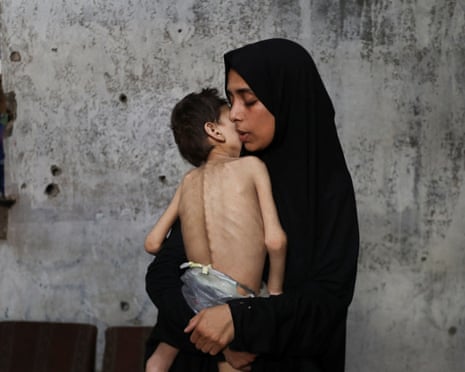
A displaced mother holding her visibly malnourished son
A displaced mother holding her malnourished son at a school in Gaza City where they were sheltering in July. Photograph: Mahmoud Issa/Reuters

The people of Gaza did not need this week’s official confirmation from UN-backed hunger experts that the “worst-case scenario of famine” was unfolding there. For months they have watched as their children waste away.

“All my children have lost nearly half of their body weight,” said Jamil Mughari, a 38-year-old from Maghazi in central Gaza. “My daughter, who is five years old, now weighs only 11kg. My son Mohammad has become just skin and bones. All my children are like this.

“I myself used to weigh 85kg, and now I’m down to 55.”

He was struggling to sustain the strength required to find food for his family. “Sometimes, while walking in the street, I feel dizzy and that I’m about to collapse, but I force myself to stay upright. I also sometimes experience shivering,” he said.

Over the course of the week, Gaza passed two appalling milestones. The official Palestinian death toll passed 60,000, although the real figure, including those buried under the rubble from Israeli airstrikes, is likely to be far higher.

Chart showing the number of people killed or injured while seeking aid

The human cost is likely to continue to rise steeply as starvation catches up with bombs and gunfire as an indiscriminate killer. On Tuesday, the Integrated Food Security Phase Classification (IPC), a panel of experts from the UN and other aid organisations, which had long warned of the threat of famine, confirmed that the line had been crossed.

“The worst-case scenario of famine is currently playing out in the Gaza Strip,” the IPC said, as it called for a ceasefire to prevent further “catastrophic human suffering”.

The 2.2 million people of Gaza have long been experts in hunger, forced to scavenge for food each day in the face of Israel’s deliberate and severe restrictions to aid deliveries.

Mughari said that food was almost nonexistent: “We can go for a week or two without any flour. Sometimes we only have one meal a day, which is lentils, and sometimes we find nothing at all to eat – we spend the day drinking water just to feel full.”

Cumulative recorded deaths in Gaza as a direct result of malnutrition

His family has had to move seven times since the war began, forced to flee repeated Israeli offensives. But there was no way to escape the hunger that now grips the entire territory.

“Sometimes we get lentils from donations or charitable people, or we borrow some money to buy them, that’s it,” he said. “We don’t receive any food aid from soup kitchens; those are only for certain camps, in small quantities.

“They [Israelis] spread news about aid coming in, but only the strong and those with weapons seize the trucks and sell the goods at extremely high prices. How can the poor afford to buy them at such prices?”

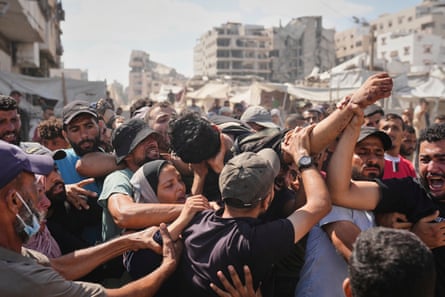
The four food distribution sites across Gaza run by the Gaza Humanitarian Foundation are open for only a few minutes a day, leading to huge crowds of desperate people, who have come under Israeli fire while seeking humanitarian assistance, leading to mass casualties.

Mourners carrying the body of a Palestinian man who was killed while trying to reach aid trucks entering northern Gaza through the Zikim crossing with Israel.
Mourners carrying the body of a Palestinian man who was killed while trying to reach aid trucks entering northern Gaza through the Zikim crossing with Israel. Photograph: Jehad Alshrafi/AP

Mansoura Fadl al-Helou, a 58-year-old widow, is too frail to go to the distribution points and refuses to let her son go, for fear he would not come back alive.

“The situation there is terrible and very dangerous. The worst part is the chaos among the men – people pushing and throwing each other to the ground,” she said. “Only my one son is here, but I always stop him from going near the aid trucks because of the danger posed by the army. I couldn’t bear to see him come back to me as a martyr.”

Mughari has undergone open-heart surgery and all his children are under 12. Even if they wanted to risk their lives for the chance of finding food, they are unable to.

“I try to remain steadfast so I can provide my children with anything to eat,” he said. “We have sent many messages to the world, but no one has moved. We no longer know what to say. All I can tell the world is that we are dying slowly, save us from this tragedy.”

Tonnes of food aid entering Gaza by month, 2025

Among the horrors the Israel-Gaza war has brought to its people, the torture of parents seeing their children starve and being powerless to save them is surely one of the worst.

“My youngest daughter is 14 years old, and her ribcage bones are clearly visible due to extreme weakness and malnutrition,” said Abu al-Abed, a father from Deir al-Balah. “I have four daughters and three sons. They suffer from dizziness and fatigue because of the lack of food. If I, their father, feel this way, how much worse must it be for them?”

He said they did not receive any aid and that the food market was expensive and they could afford to buy only a little there. “The prices are extremely high; they haven’t reached such levels of inflation even in European countries. And here in Gaza, there is no source of income at all.

“There used to be soup kitchens in the area, but now they no longer exist. There are no places that provide free food any more.

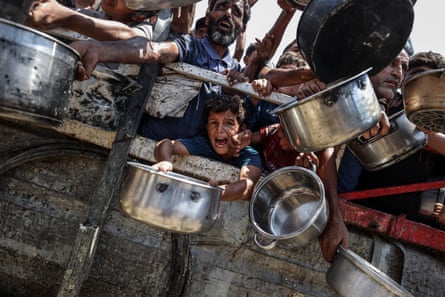
Numerous people including a small child desperately holding out pots and pans from behind a fence
Palestinians struggling to receive meals from a charity in Gaza City in July. Photograph: Anadolu/Getty Images

He said he no longer believed the world had any sense of responsibility. “For years, they boasted about human rights and the protection of lives. What I see now is that all of this was a lie, we were deceived by these slogans.

“If we had asked them to protect the rights of animals in Gaza, they would have responded immediately and done the impossible. But when it comes to the rights of the Palestinian people, no one remembers us or feels for us, not the Arabs, not the Muslims, not the Christians, no one.”

The official IPC recognition of what the people of Gaza knew only too well – that they are starving – brought some faint hope that the outside world would finally stir itself to act, though long experience did not bring much confidence that would happen.

Al-Helou said: “We have been suffering from this famine for a long time, and no one has acted. I hope that through this message, the world will finally move to help us and save us from this slow death.”

The news of the UK’s pledge to recognise Palestine in September, barring a ceasefire and a fundamental change in direction from Israel, impressed her even less.

“I don’t know what would change if the British government recognises the state of Palestine. What kind of state has no sovereignty, no right to self-defence?” she asked. “It’s a good step to recognise us and the state of Palestine, but it should be a real recognition – not symbolic. A state with real rights, real sovereignty, and a people with rights like any other nation.”