Contact Me By Email


What To Do When You're Stopped By Police - The ACLU & Elon James White

What To Do When You're Stopped By Police - The ACLU & Elon James White

Know Anyone Who Thinks Racial Profiling Is Exaggerated? Watch This, And Tell Me When Your Jaw Drops.


This video clearly demonstrates how racist America is as a country and how far we have to go to become a country that is civilized and actually values equal justice. We must not rest until this goal is achieved. I do not want my great grandchildren to live in a country like we have today. I wish for them to live in a country where differences of race and culture are not ignored but valued as a part of what makes America great.

Sunday, March 09, 2025

Opinion | A Supreme Court Case Threatens the Church-State Divide - The New York Times

The Urgent Supreme Court Case That’s Not Getting Enough Attention

A photo of hands holding rosary beads.
Daniel Ribar for The New York Times

By Linda Greenhouse

"Ms. Greenhouse, the recipient of a 1998 Pulitzer Prize, reported on the Supreme Court for The Times from 1978 to 2008 and was a contributing Opinion writer from 2009 to 2021.

While the country holds its breath for the Supreme Court’s responses to the Trump administration’s serial depredations, it’s hard to focus on anything else. Nonetheless, a caseset for argument next month before the court merits more attention than the little it has received, given its destabilizing potential for public education. The central question is whether a state that allows charter schools as alternatives to traditional public schools, as nearly all states do, must agree to fund those that are explicitly religious.

To emphasize: The court is not being asked to decide whether a state may, if it chooses, include a taxpayer-funded parochial school among its charter school offerings. That question alone would challenge the long-held understanding of the separation of church and state in the context of public education. This case goes further. It concerns what would be the first fully taxpayer-supported religious school in modern American history. The internet-based “virtual” Catholic school that the Archdiocese of Oklahoma City and the Diocese of Tulsa seek to operate, St. Isidore of Seville Catholic Virtual School, would promote the “evangelizing mission of the Church.” The question is whether the Constitution requiresOklahoma to permit the school to open its virtual doors as a public charter school.

This is far from the first collision between the two religion clauses of the First Amendment, the protection for the “free exercise” of religion and the prohibition against religion’s official “establishment.” But this case reaches the court at a time of rapid change in the justices’ treatment of the relationship between the two clauses. Not so long ago, the Supreme Court was willing and able to manage the inherent tension between the two clauses by giving weight to each.

For example, the question in a 2004 case was the constitutionality of a state’s explicit exclusion of ministerial studies from eligibility for an otherwise widely available state scholarship program. A student who wanted to use the scholarship to study for the ministry argued that his inability to do so violated the Free Exercise Clause. The court rejected that argument, holding that while the Establishment Clause would have permitted the state to subsidize ministerial training if it chose, the Free Exercise Clause did not impose such a requirement.

In rejecting the argument that the state had imposed a burden on the free exercise of religion, the court said the state was not penalizing or criminalizing a religious service or rite, prohibiting ministers from participating in a community’s affairs or requiring students to choose between their religious beliefs and receiving a government benefit. Instead, the court said, “the state has merely chosen not to fund a distinct category of instruction,” which it said was a legitimate interest of the state in preventing an establishment of religion.

The court’s goal was to maintain “play in the joints” between the two clauses that frequently were in tension with each other, Chief Justice William Rehnquist wrote in the majority opinion in Locke v. Davey.

But “play in the joints” has fallen out of favor in the current court. In a 2022 case, Carson v. Makin, the question was whether a state could exclude religious schools from a program that permitted people who lived far from a public secondary school to send their children elsewhere at state expense. The court held that the exclusion of religious schools from eligibility violated the free exercise rights of parents who would have chosen a religious school. The 2004 decision turned out, after all, not to stand for the broad principle of maintaining a balance between the two religion clauses. Chief Justice Rehnquist’s successor, John Roberts, wrote in the Carson decision that Locke v. Davey should be interpreted to apply only to its precise facts and “cannot be read beyond its narrow focus on vocational religious degrees to generally authorize the state to exclude religious persons from the enjoyment of public benefits on the basis of their anticipated religious use of the benefits.”

In a series of cases beginning in the early 2000s and culminating with that one, the court has substituted for what would have been Establishment Clause concerns a seemingly limitless nondiscrimination principle: Whatever the government does for anyone, it has to do for religion, too. Further, the court’s invocation of the Free Exercise Clause in these cases has depended on the notion that when parents choose a generally available financial subsidy like a voucher or tax credit for religious use, that is a private choice in which the government plays no role.

The challenge in the case involving the virtual Catholic school, Oklahoma Statewide Charter School Board v. Drummond, is whether the court can sustain the fiction of private choice when it’s no longer a matter of individuals directing a state tuition subsidy to a private school that happens to be religious. St. Isidore would be, like the other charter schools that some 50,000 Oklahoma students currently attend, a taxpayer-financed public school.

Or so the Oklahoma Supreme Court held last June when it declared that the state’s Charter School Board’s approval of St. Isidore violated the federal Establishment Clause as well as the Oklahoma Constitution and the state law governing charter schools.

“Under the Act,” the state court wrote, referring to the Oklahoma Charter Schools Act, “a charter school is a public school.” The court noted that while charter schools are free from some state regulations, they have to adhere to numerous other rules that apply to ordinary public schools. Their teachers are eligible for the same state retirement benefits as other public school teachers, the court observed. “St. Isidore will be acting as a surrogate of the state in providing free public education as any other state-sponsored charter school,” the court said. “What St. Isidore requests from this court is beyond the fair treatment of a private religious institution in receiving a generally available benefit, implicating the Free Exercise Clause. It is about the state’s creation and funding of a new religious institution violating the Establishment Clause.”

As the state court emphasized, the characterization of St. Isidore as a public school matters because only in that case is it a “state actor” to which the federal Constitution applies. The Charter School Board and St. Isidore itself, both of which are appealing the Oklahoma court’s decision, are arguing vigorously to the justices that the school is, in fact, private and that the nondiscrimination principle should resolve its case. “St. Isidore is not an arm of the Oklahoma government,” the school said in its petition seeking Supreme Court review, “and Oklahoma has plainly violated its Free Exercise rights by cutting it off from the benefits created by the Charter Schools Act” solely because it is religious.

The school is represented in its Supreme Court appeal by lawyers including Notre Dame Law School’s Religious Liberty Clinic. That is probably the reason that Justice Amy Coney Barrett, who spent 15 years as a law professor at Notre Dame and has taught classes there while on the bench, has recused herself from the case. The Charter School Board is represented by Alliance Defending Freedom, the prominent Christian litigating group that has scored a series of recent victories at the Supreme Court.

The case is deeply entangled in Oklahoma politics. It was the state’s attorney general, Gentner Drummond, who sued the Charter School Board to keep the school from opening. The state’s governor, J. Kevin Stitt, strongly supports the school and filed his own brief, which opposes the brief that Attorney General Drummond filed. Both officials are Republicans.

Before the board approved St. Isidore’s charter, Mr. Drummond had warned against creating a “slippery slope” that would compel approval of charter school applications by any and all religious groups, “even those most Oklahomans would consider reprehensible and unworthy of public funding.” The warning was valid as far as it went, but it should have gone further. Yes, an occasional Muslim madrasa seeking to incorporate as a charter school would be likely to cause controversy, but the problem is much broader. It is easy to imagine a scramble for public resources among mainstream faith groups, each with a curriculum in mind. As of 2021, some 3.7 million students were enrolled in public charter schools across the country. How many millions more might be drawn to a safely siloed religious education if it is available at taxpayer expense? And who will be left in the secular public schools?

A quarter-century ago, Justice David Souter, a devout Episcopalian and a strict separationist, dissented from a decision that expanded the eligibility of religious schools for various types of equipment and other public resources.

“The establishment prohibition of government religious funding serves more than one end,” the now-retired justice wrote in his dissenting opinion in Mitchell v. Helms. “It is meant to guarantee the right of individual conscience against compulsion, to protect the integrity of religion against the corrosion of secular support, and to preserve the unity of political society against the implied exclusion of the less favored and the antagonism of controversy over public support for religious causes.”

At a time of surging Christian nationalism in response to the country’s evolving demography, that warning is even more timely now than it was then.

This case puts the Supreme Court to a choice. If St. Isidore of Seville Catholic Virtual School is a public school, the court can uphold it only by further erasure of the Establishment Clause. If the justices deem it sufficiently private to evade the Constitution’s reach, they will have invited further fragmentation of public education, one of the few experiences that most Americans share. At this fraught moment for the court and the country, it may not be too much to suggest that the future of an increasingly fragile civil society is at stake as well."

Opinion | A Supreme Court Case Threatens the Church-State Divide - The New York Times

Saturday, March 08, 2025

Trump policies could fuel illicit drug trade despite vow to curb fentanyl | Trump administration | The Guardian

Trump policies could fuel illicit drug trade despite vow to curb fentanyl

"‘Coercive’ tariffs and federal funding cuts could worsen flow of illicit drugs into US, ex-government officials warn

a man holds a piece of foil
A homeless man holds a piece of aluminum foil he used to smoke fentanyl in Seattle, Washington, in 2022.Photograph: John Moore/Getty Images

Donald Trump’s policies could leave the US more vulnerable to dangerous synthetic drug trafficking from abroad, even as the administration has vowed to stop fentanyl from entering the country, former government officials say.

This week, Trump imposed tariffs on Mexico, Canada and China, ostensibly as a tactic to stem the flow of illicit drugs into the US.

Jim Crotty, the former Drug Enforcement Administration deputy chief of staff, called the approach “coercive” and said it has the potential to backfire. Federal funding cuts could also leave US borders more insecure, according to Enrique Roig, a former Department of State official who oversaw Bureau of International Narcotics and Law Enforcement Affairs (INL) portfolios and who has also worked with USAid.

US overdose deaths began to decrease significantly for the first time in 2023, after rising for decades. But Crotty notes this progress is fragile.

“We’re seeing this decrease in overdose deaths and everyone’s still trying to suss out exactly why. I don’t think now is the time that we want to stop any of those existing efforts because we know that at least some, or a combination of them, have been working,” Crotty said.

Roig agreed: “All this has to be working together in concert.”

Federal funding cuts could put the US behind when it comes to drug detection technology. The global drug supply has increasingly shifted towards highly potent synthetic substances such as fentanyl and newly emerging nitazenes. Often, these drugs arrive in the US in the form of powders or precursor chemicals that take up minimal space, and are difficult to detect by odor.

Roig says advanced drug detection technology is therefore vital, but Trump’s federal funding and staff cuts mean less money for the latest technology and equipment, and fewer people to install it.

Ram Ben Tzion, the CEO of Publican, which provides drug detection technology to government agencies outside the US, says cutting-edge methods detect suspicious shipments even before they get to the border. Publican uses large language models to flag shipments that “don’t make sense” and are likely to contain illicit substances. For example, his company once found fentanyl precursors in a shipment to a residential address in California. The shipment claimed to contain fashion items, but came from a Chinese construction company.

Similarly, the UN Container Control Programme, which has historically received state department funding, helps authorities flag suspicious shipments before they reach their destination. This program has helped authorities around the world seize hundreds of tonnesof illicit drugs each year. Roig says federal funding cuts have stalled CCP’s implementation in Mexico, even though it’s a primary security target for Trump.

Some of Trump’s measures are more showy than they are constructive, Crotty and Roig said. The designation of certain cartels as terrorist organizations “doesn’t do much of anything”.

It’s symbolic, says Crotty, given that they were already designated transnational criminal organizations. Other measures are a harmful waste of money, according to Roig. Just this week, for instance, the administration suspended the use of military planes to deport immigrants, including those accused of drug related crimes, due to the extravagant cost.

Roig says this measure was completely unnecessary, as “Ice already has its own fleet of airplanes” that are much cheaper.

Crotty is concerned the aggression could backfire.

“The Mexican people are protective of their culture and their sovereignty. If you push them too hard, could it do more harm than good?” he said.

Mexico sent 10,000 troops to its US border to cooperate with Trump’s demands, but Crotty says “while in a vacuum that sounds like a whole lot”, Mexico’s border is vast, and drugs are often transported in “minute quantities”. So, the US needs Mexico’s cooperation when it comes to intelligence – otherwise “you’re not going to find the proverbial needle in the haystack”, Crotty said.

Roig said that “it’s important that we do this in cooperation with Mexico and not alienate them,” adding that Trump’s aggressive stance toward China could harm the Biden administration’s progress negotiating with the Chinese government to cooperate on counternarcotics initiatives.

Massive USAid cuts also threaten programs intended to curb the “root causes” of the drug trade, says Roig. Some USAid-funded programs simultaneously tackled drug smuggling and another one of Trump’s key issues, migration – as cartels that traffic drugs also traffic people.

When Roig worked with USAid, he says he spent a lot of time on “community violence prevention efforts”, including programs to keep young people from joining international crime organizations and cartels. (Notably, the Trump administration has purged many websites describing USAid programs.)

If the drug supply does increase, it could mean US overdoses begin to rise again as well. But Crotty is worried we won’t even know if that happens. Layoffs at the Centers for Disease Control and Prevention could leave fewer people to track overdose deaths, and Trump’s attack on government data sharing could keep everyone in the dark.

“​​ CDC maintains the overdose death dashboard. A lot of that stuff is data driven. Are they still going to have access to the data?” he said.

The Guardian contacted INL and UNODC for comment."


Trump policies could fuel illicit drug trade despite vow to curb fentanyl | Trump administration | The Guardian

Friday, March 07, 2025

Judge orders Trump administration to pay some USAid debts by Monday | Trump administration | The Guardian

Judge orders Trump administration to pay some USAid debts by Monday

"District judge calls payment of some of the $2bn owed to partners of USAid and state department ‘concrete’ first step

a person carrying a bag
The administration terminated more than 90% of USAid contracts. Photograph: Jemal Countess/Getty Images

A federal judge on Thursday ordered the Trump administration to speed up its payment on some of nearly $2bn in debts to partners of the US Agency for International Development (USAid) and the state department, giving it a Monday deadline to repay the non-profit groups and businesses in a lawsuit over the administration’s abrupt shutdown of foreign assistance funding.

The US district judge Amir Ali described the partial payment as a “concrete” first step he wanted to see from the administration, which is fighting multiple lawsuits seeking to roll back the administration’s dismantling of USAid and a six-week freeze on USAid funding, which has forced US-funded organizations to halt aid and development work around the world and lay off workers.

Ali’s line of questioning in a four-hour hearing on Thursday suggested skepticism of the Trump administration’s argument that presidents have wide authority to override congressional decisions on spending when it comes to foreign policy.

It would be an “earth-shaking, country-shaking proposition to say that appropriations are optional”, Ali said.

“The question I have for you is, where are you getting this from in the constitutional document?” he asked a government lawyer, Indraneel Sur.

Thursday’s order is in an ongoing case with more decisions coming on the administration’s termination of more than 90% of USAid contracts worldwide this month.

Ali’s ruling came a day after a divided US supreme court rejected the Trump administration’s bid to freeze funding that flowed through USAid. The high court instructed Ali to clarify what the government must do to comply with his earlier order requiring the quick release of funds for work that had already been done.

The funding freeze stemmed from an executive order signed by Trump on 20 January, his inauguration day. The administration appealed after Ali issued a temporary restraining order and set a deadline to release payment for work already done.

The administration said it had replaced a blanket spending freeze with individualized determinations, which led to the cancellation of 5,800 USAid contracts – more than 90% of the agency’s contracts for projects – and 4,100 state department grants totaling nearly $60bn in aid."

Judge orders Trump administration to pay some USAid debts by Monday | Trump administration | The Guardian

Opinion | If Trump Defies the Courts, Then What? - The New York Times

The One Question That Really Matters: If Trump Defies the Courts, Then What?

Harris Allen for The New York Times

By Erwin Chemerinsky

"Mr. Chemerinsky is the dean of the Berkeley School of Law at the University of California and the author of the book “No Democracy Lasts Forever: How the Constitution Threatens the United States.”

It is not hyperbole to say that the future of American constitutional democracy now rests on a single question: Will President Trump and his administration defy court orders?

Federal judges have issued more than a dozen temporary restraining orders and preliminary injunctions against Trump administration actions. But it is unclear whether the government will comply, and in at least two cases, judges have said their orders were ignored.

The Trump administration is already facing at least 100 legal challenges. Two recent court orders no doubt will test Mr. Trump’s patience.

The Supreme Court this week upheld the authority of a Federal District Court judge in Washington to lift a Trump freeze on nearly $2 billion in foreign aid appropriated by Congress. The government had missed a deadline set by the judge to send out the money, which Mr. Trump had blocked on his first day in office. And on Thursday, another federal judge, in Rhode Island, extended an order forcing the Trump administration to release billions of dollars in congressionally approved funds for nearly two dozen states and the District of Columbia. The judge said the White House had “put itself above Congress” in blocking the money.

But the hard truth for those looking to the courts to rein in the Trump administration is that the Constitution gives judges no power to compel compliance with their rulings — it is the executive branch that ultimately enforces judicial orders. If a president decides to ignore a judicial ruling, the courts are likely rendered impotent.

Perhaps the threat of flouting court orders, suggested by Mr. Trump, and his vice president, JD Vance, and some of his nominees, is a way to put pressure on courts to treat the Trump administration favorably. Trump allies have also been pressing for the impeachment of judges who rule against his administration’s policies. Elon Musk wrote recently on his platform X that “the only way to restore rule of the people in America is to impeach judges” and “we must impeach to save democracy.” Mike Lee of Utah, a Republican on the Senate Judiciary Committee, said on social media that “corrupt judges should be impeached and removed” and that rulings against the administration gave the impression of a “judicial coup.”

Removing federal judges because of disagreement with their rulings would be unprecedented. The Constitution allows for impeachment only for “treason, bribery, or other high crimes and misdemeanors.” There is no plausible basis for claiming that standard has been met. And it is risible to see conservatives, who repeatedly went to court to enjoin Biden and Obama administration policies, now saying that the judiciary should not review executive branch actions. All of this is about an administration that does not want to be constrained by the Constitution, laws or courts.

It is unsettling even to be asking whether the president would defy a court order. Throughout American history, presidents have complied with mandates from the courts, even when they disagree. In the 1930s, the Supreme Court struck down many of the New Deal programs of Franklin Roosevelt. He was angry and proposed expanding the size of the Supreme Court to uphold his initiatives, but never went as far as defying the rulings. When the Supreme Court declared unconstitutional Harry Truman’s order to seize steel mills during the Korean War, a major blow to his presidency, Truman, too, was angry, but he complied with the decision.

Similarly, when the court ordered Richard Nixon to turn over the White House tapes, he did so even though it meant the end of his presidency. More recently, when courts blocked Biden administration policies — from student loan relief to vaccine mandates — the White House complied.

At times, there have been disputes between courts and agencies over compliance with judicial orders. In a 2018 Harvard Law Review article, the Yale law professor Nicholas Parrillo wrote that “the federal government’s compliance with court orders is imperfect and fraught, especially with orders compelling the government to act affirmatively.” In part, this has been because agencies may lack the money, personnel or information they need to comply.

But there are no definitive instances of presidents disobeying court orders. The line attributed to Andrew Jackson about the chief justice, that “John Marshall has made his decision, now let him enforce it,” is likely apocryphal. Purportedly about a Supreme Court ruling that Georgia could not enforce its laws against whites on Cherokee land, the quotation did not appear in print until long after Jackson’s death. And, in fact, the court order was directed at Georgia, not Jackson or the federal government. In addition, modern scholarship has undermined the story that Abraham Lincoln defied an order from the chief justice invalidating a suspension of habeas corpus during the early days of the Civil War.

Thus far, the Trump administration has given conflicting signals as to whether it will defy court orders. On Feb. 11, Mr. Trump said, “I always abide by the courts, and then I’ll have to appeal it.” And that same month, the acting solicitor general, Sarah Harris, wrote in a footnote in a brief to the Supreme Court: “The executive branch takes seriously its constitutional duty to comply with the orders of Article III courts.”

But just one day prior, Mr. Trump posted on social media, “He who saves his Country does not violate any Law.” A week earlier, Vice President JD Vance posted, “Judges aren’t allowed to control the executive’s legitimate power,” implying that president decides what is “legitimate.” This follows a history of assertions by Mr. Vance suggesting that the president need not comply with adverse court rulings. And while this did not involve a court order, in January, in one of his first acts in office, Mr. Trump signed an executive order to delay enforcing a federal ban on TikTok, even though that ban had just been upheld by a unanimous Supreme Court.

The reality — and Mr. Trump and those around him know it — is that he could get away with defying court orders should he, ultimately, choose to do so. Because of Supreme Court decisions, Mr. Trump cannot be held civilly or criminally liable for any official acts he takes to carry out his constitutional powers.

Those in the Trump administration who carry out his policies and violate court orders could be held in contempt. But if it is criminal contempt, Mr. Trump can issue them pardons. Although civil contempt can involve being jailed until the person complies with the court order, that is enforced by the United States marshals, who are part of the Department of Justice and thus under the president’s control.

Defiance of court orders could be the basis for impeachment and removal. But with his party in control of Congress, Mr. Trump knows that is highly unlikely to happen.

If the Trump administration chooses to defy court orders, we will have a constitutional crisis not seen before. Perhaps public opinion will turn against the president and he will back down and comply. Or perhaps, after 238 years, we will see the end of government under the rule of law."

Opinion | If Trump Defies the Courts, Then What? - The New York Times

Tuesday, March 04, 2025

Member of Elon Musk's DOGE team resigns after racist posts resurface

Member of Elon Musk's DOGE team resigns after racist posts resurface


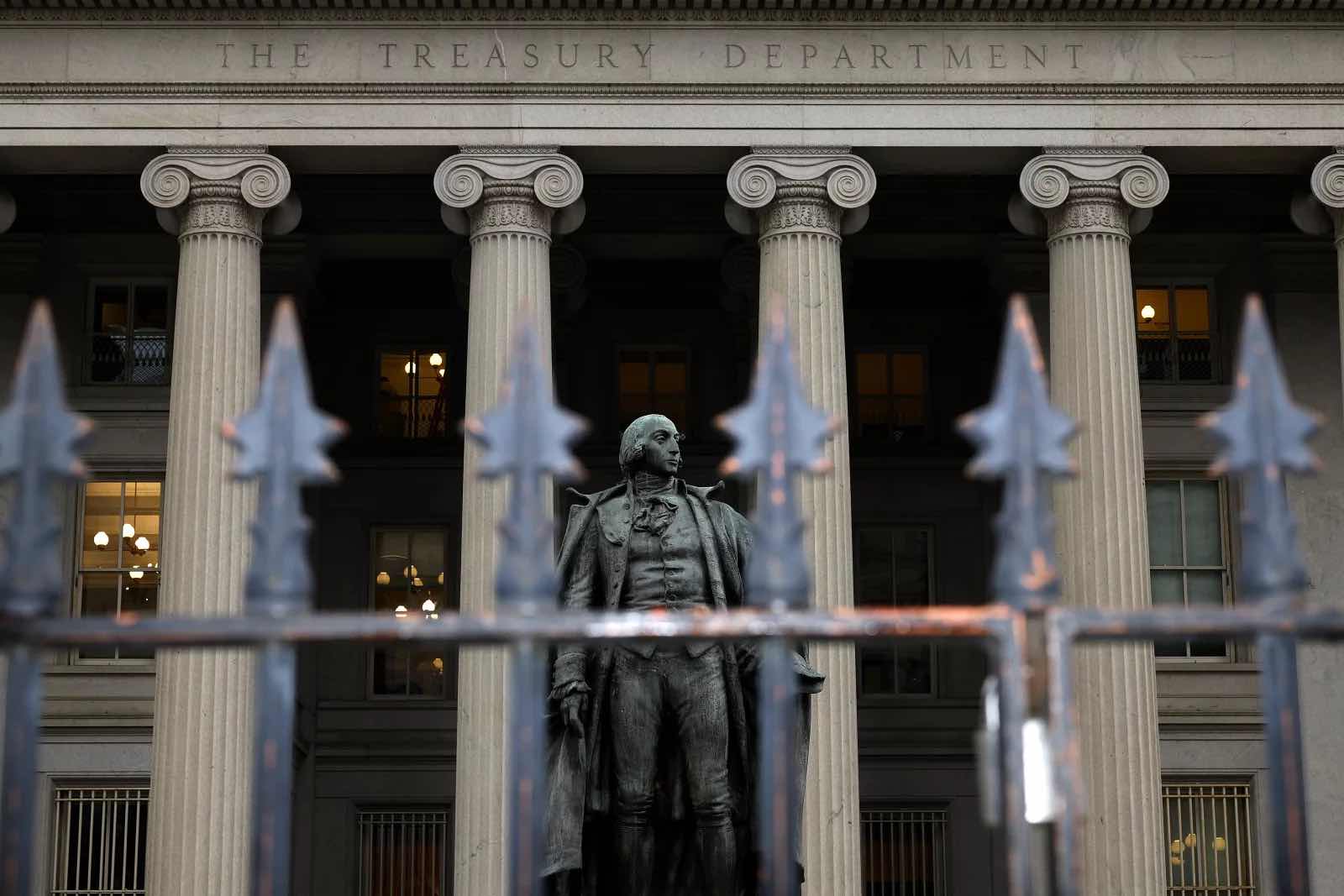
A statue of Alexander Hamilton is seen outside the U.S. Department of Treasury building in a 2023 file photo.
Chip Somodevilla/Getty Images

A staffer connected to Elon Musk's Department of Government Efficiency resigned on Thursday after now-deleted racist social media posts were resurfaced.

The resignation was confirmed by a White House official who was not authorized to speak publicly.

Marko Elez, a 25-year-old software engineer, was working inside the Treasury Department to cut costs and root out fraud, as part of Musk's DOGE effort. Elez, who formerly worked at Musk companies X and SpaceX, was one of two temporary appointees at Treasury connected to DOGE who have been granted access to a highly sensitive Treasury system that processes trillions of dollars in payments every year.

The Wall Street Journal reported on a number of 2024 posts from an account connected to Elez on Musk's X platform and noted that White House officials confirmed his resignation after the paper pointed out Elez's activity on the social media site.

"You could not pay me to marry outside of my ethnicity," the account wrote in September. "Normalize Indian hate," a separate post from that month read.

In July of last year, the account posted: "Just for the record, I was racist before it was cool."

In other posts, from December, the account pushed for repealing the Civil Rights Act and shared: "I just want a eugenic immigration policy, is that too much to ask."

All of the posts have now been deleted, but NPR has independently confirmed them using the Internet Archive's Wayback Machine, which scrapes and archives vast parts of the open web.

Elez did not return NPR's requests for comment.

Vice President J.D. Vance on Friday said he disagrees with Elez's posts but that "stupid social media activity" should not "ruin a kid's life," he wrote on X. "So I say bring him back," which President Trump said he would support. 

Musk replied with: "He will be brought back. To err is human, to forgive divine."

The resignation of Elez comes amid growing questions from lawmakers and former federal government employees about the dozens of staffers Musk has tapped to help him pursue aggressive cost-trimming, and in some cases, attempt to dismantle entire agencies.

As critics highlight legal and ethical issues surrounding DOGE's seemingly unchecked pursuit of government austerity, Democrats in Congress are running into obstacles. A Democratic-led attempt to subpoena Musk about possible conflicts of interest over juggling his DOGE role with the six companies he operates was blocked by Republicans on Wednesday. Democratic Senators are issuing blistering statements, and writing letters to Musk's companies demanding answers, but such moves are unlikely to result in testimony in Washington, as long as Republicans hold a majority in both chambers.

Elez's access to the Treasury payment system had raised alarms over whether sensitive data, including banking information of millions of Americans, is being shared with Musk and his allies.

Two unions representing federal employees and an advocacy group representing retirees sued the Treasury Department, accusing it of violating federal privacy laws.

Elez had recently been appointed a special government employee at the Treasury, the government told the federal judge hearing the case this week. That's a temporary appointment that allows the worker to perform "limited services."

A Justice Department lawyer said that Elez and another special employee at the Treasury connected to DOGE, Tom Krause, had "read-only" access to the payments system and that no data was being shared outside the agency, including with Musk's White House-based DOGE team.

The judge has issued an order temporarily barring the Treasury from giving access to the payment system to anyone outside the department.

Treasury Secretary Scott Bessent defended the DOGE team on Bloomberg Television on Thursday, saying the unit consists of trained professionals. 

"This is not some roving band running around doing things. This is methodical and it is going to yield big savings," Bessent said.“

Trump Is SHOCKED! Ghana’s President Demands U.S Troops Withdrawal

“Sugarcane”: Oscar-Nominated Film Explores “Colonial Silence” Around Indian Residential Schools | Democracy Now!

“Sugarcane”: Oscar-Nominated Film Explores “Colonial Silence” Around Indian Residential Schools | Democracy Now!