Contact Me By Email


What To Do When You're Stopped By Police - The ACLU & Elon James White

What To Do When You're Stopped By Police - The ACLU & Elon James White

Know Anyone Who Thinks Racial Profiling Is Exaggerated? Watch This, And Tell Me When Your Jaw Drops.


This video clearly demonstrates how racist America is as a country and how far we have to go to become a country that is civilized and actually values equal justice. We must not rest until this goal is achieved. I do not want my great grandchildren to live in a country like we have today. I wish for them to live in a country where differences of race and culture are not ignored but valued as a part of what makes America great.

Thursday, September 05, 2024

Georgia school-shooting suspect struggled with mental health, aunt says


Georgia school-shooting suspect struggled with mental health, aunt says


(Why hasn’t his father been arrested for not securing the guns as he was directed to do after his son’s previous threats?)


The parents of the 14-year-old high-school-shooting suspect have not commented publicly after the deadly attack at Apalachee High School.

Students kneel in front of a makeshift memorial at Apalachee High School on Thursday in Winder, Ga. (Jessica McGowan/Getty Images)

The 14-year-old arrested after a mass killing at Georgia’s Apalachee High Schoolhad been “begging for months” for mental health help before he allegedly carried out a deadly attack Wednesday, according to an aunt of the shooting suspect.

He “was begging for help from everybody around him,” Annie Brown, the aunt, told The Washington Post. “The adults around him failed him.”

Brown, who lives in Central Florida, declined to elaborate on the teen’s mental health challenges but said she tried from afar to get him help. She said his struggles were exacerbated by a difficult home life. He and his family had “previous contacts” with the local child services department, Chris Hosey, the director of the Georgia Bureau of Investigation, said at a news conference Wednesday night.

Brown said that in January she helped her nephew enroll at Haymon-Morris Middle School in Barrow County so he could finish eighth grade following a period of absenteeism. He had just started ninth grade at Apalachee High this school year, she said.

Law enforcement authorities have confirmed that he was a student at Apalachee. A spokesperson for the school district did not immediately respond to a request for comment on his prior enrollment history.

The shooting at Apalachee on Wednesday morning left four people dead: two staff members and two students. Authorities have identified the suspect as Colt Gray. Gray’s parents have not commented publicly. The Post’s efforts to reach them for comment were unsuccessful.

Authorities have also said he was interviewed in May 2023 by law enforcement officers in neighboring Jackson County who were investigating online threats to carry out a school shooting.

At the time, Gray “expressed concern that someone is accusing him of threatening to shoot up a school, stating that he would never say such a thing, even in a joking manner,” according to records of the investigation by the Jackson County Sheriff’s Office, which had received a tip from the FBI about a threat to open fire in a local middle school.

The threatening comments were made on the social media platform Discord from an account associated with an email address that the FBI believed was owned by the teen, the records say. The teen told officers he had previously used Discord but got rid of his account months earlier “because too many people kept hacking his account and he was afraid someone would use his information for nefarious purposes,” the records show.

The account flagged by the FBI featured a profile name written in Russian that, when translated, spelled out “Lanza,” referring to Adam Lanza, the Sandy Hook Elementary school shooter, according to the records.

The suspect’s father, Colin Gray, told investigators at the time that he was unfamiliar with Discord and said he had no knowledge of the email address associated with the Discord account that made threats. He also said that his son “does not know or speak Russian,” according to the records.

He told officers that he allowed his son to use his hunting rifles when supervised but that the child, who was 13 at the time, did not have “unfettered access to them.” The weapons were kept in the house, according to the report.

The records show that one officer said he urged the man to keep the firearms locked away and advised him on May 21 to “keep the teen out of school until the matter could be resolved.”

On May 23, the investigator noted that the case would be “exceptionally cleared” because the tip alleging Colt’s role in the threat could not be substantiated. Officers were unable to confirm that the Discord account was linked to Colt Gray, and information included in the FBI tip was “unreliable,” the records say. The officers noted in the report that the FBI tip included a brief physical description of the suspect that did not match the teen’s appearance. The source of the physical description was unclear in the records.

At the time of Jackson County’s investigation, the teen’s father told officers that he and his wife had split up after their family was evicted from their home a few months earlier. The father said he and his son had moved and that, while his son had experienced “some problems” at the middle school he previously attended, things had “gotten a lot better” now that he was attending a new school.

It is unclear when the teenager stopped attending that school, Jefferson Middle School in Jefferson, Ga.

Charles Polhamus, the suspect’s grandfather, told The Post he would have never thought his grandson capable of violence. Although the two had not spoken in more than a year, Polhamus, who was once his grandson’s baseball coach, remembered the teen as an overall “good kid.” Polhamus said he felt terrible for the victims.

Brown said that since the shooting, she has been praying for “the families who have been affected because of my nephew’s actions.”

She said she would also continue to support her nephew. Without excusing his actions, Brown said he was still “just a baby” who was never given the mental health support he needed and repeatedly requested.

Alice Crites and Chris Dehghanpoor contributed to this report.”

What Does a Couple Do When One Partner Is Deported?

What Does a Couple Do When One Partner Is Deported?

“American citizens whose spouses have been deported face wrenching decisions on what is best for their future, especially when they have children.

Sandra Reyes stands behind her husband, Hector Reyes, with one hand on his shoulder and the other on his arm, on a roadside with the U.S.-Mexico border behind them.
Hector and Sandra Reyes near the U.S.-Mexico border in Ciudad Juárez. In 2017, Mr. Reyes was barred from entering the United States for 20 years.Paul Ratje for The New York Times

By Christina Morales

Christina Morales interviewed more than two dozen immigrants who were deported or barred from re-entering the country, as well as their American family members and experts.

Hector Reyes parked his truck in the Mexican border town of Ciudad Juárez, his phone lighting up with photos and videos of his son Daniel receiving his high school diploma.

The ceremony was happening only a mile away in El Paso. But Mr. Reyes had been deported in 2017 and barred for 20 years from entering the United States for having twice illegally crossed the border.

His wife and two children, all American citizens, have made a life in El Paso, while Mr. Reyes lives eight blocks from the border. He recalled looking up at the sky on the night of the graduation in May, waiting to see the fireworks that would mark the end of his son’s high school years.

“This life,” he said, “I don’t wish it to nobody.”

Families like Mr. Reyes’s have been closely watching a new Biden administration policy that aims to provide a pathway to citizenship for the undocumented spouses of U.S. citizens. Though the initial program was not open to people living outside the country, the families said it was a first sign that there was an openness to reconsidering their plight. The deported spouses understood it to be a long shot, but perhaps their only chance of overcoming lifetime or decades-long bans from coming to the United States.

But the new program was swiftly met with strong Republican opposition, and was put on hold by a federal judge in Texas after 16 states sued to block it. With former President Donald J. Trump threatening mass deportations if he regains the presidency in November, the families could not only lose their bid for consideration but also see many more joining their ranks.

Some of the most common reasons for deportations and entry bans include entering the United States without authorization, returning after a deportation, overstaying a visa, working without permission or committing a crime, said Jorge Loweree, the managing director of programs at the American Immigration Council, an advocacy group for immigrants.

In interviews, the couples described the at times extraordinary efforts they had taken to maintain their relationships, and the wrenching decisions they had faced over whether to follow the deported spouse overseas or remain in the United States for better-paying jobs, educational opportunities and improved safety and security.

“We should be talking about family unity, not family unity for some people,” said Tran Dang, the founder and director of the Rhizome Center for Migrants, a legal clinic that provides services to deported people and their families.

A broad array of stakeholders, from business leaders to immigrant advocates, have been calling for an overhaul of immigration laws for decades, long before the border surges of recent years. But an increasingly polarized Congress has failed to reach a consensus, leaving the country with an antiquated, dysfunctional system.

The number of migrants crossing illegally has plunged in recent months, after a change in asylum policy introduced by the Biden administration in June. But the border remains a core issue for Republicans on the campaign trail.

“Until we solve the crisis at our southern border, we can’t do anything else,” said John Thomas, a Republican strategist and managing partner at Nestpoint Associates. “We can clean up the rest of the system afterward.”

There is no reliable data for how many American citizens have spouses who have been deported, but immigrant advocates estimate that they number in the tens of thousands.

For most couples in this situation, straddling the border is not an option. Many of the American partners have to decide whether to permanently move abroad or live far away from their spouses. Inevitably, some relationships don’t survive the challenge and have ended in divorce.

When Dr. Regina Cano married Juan Manuel Cano de la Cruz in 2011, their plan was to live near her family in Cincinnati while she finished her residency in family medicine.

But after Mr. Cano de la Cruz, a Mexican citizen who was living in the United States without authorization, applied for his green card in 2013 at the U.S. consulate in Juárez, an officer not only denied his application but also permanently barred him from entering the United States. The reason, Mr. Cano de la Cruz said, was that he had sent money to his father and brother, which was viewed as funding illegal immigration as they had later crossed the southern border without authorization.

“I didn’t know that it was against the law,” he said of sending the money. “It frustrated me for years.”

For the Canos, their solution has been to live together in Guadalajara, where they now have two sons, a 7-year-old and a 6-month-old.

“My husband told me to stay and make money,” Dr. Cano recalled. “I was separated from him for two years, and I didn’t want to live like that anymore.”

Now, Dr. Cano and her sons fly to Ohio several times a year so the children can squeeze in visits with their American grandparents and cousins, and she can earn extra money covering shifts for other doctors on maternity leave or vacation.

As is the case with many families, the hardest decisions for these couples often center on what will be best for their children.

At first, Laura Araujo thought the most practical choice was to move to the Mexican city of Toluca with her three children after her husband’s green card application was denied in 2017. (He had twice crossed the border illegally.) Ms. Araujo and her husband, Alberto Araujo Rodríguez, ended up raising those children in Mexico for five years, and had two more.

“We weren’t necessarily immigrating for a better life,” she said of the move. “We were immigrating to be together.”

In 2022, the couple decided it was best for the children’s education for Ms. Araujo and the children to move back to Maryland.

“I came back to the house we used to live in together and his ghost was everywhere,” Ms. Araujo said. “At the end of the day, I sit there by myself. I don’t have my husband.”

Mr. Araujo Rodríguez now has a Canadian work permit and works at a dairy farm in Newfoundland to better support his family.

“I hope that these sad tears one day turn into happy ones,” Mr. Araujo Rodríguez said about a recent trip the family took to visit him in Canada. “It breaks my heart when I see my children like that. They need their father.”

Cassandra Holguin, whose fiancé had entered the country illegally and was deported to Mexico recently, is still trying to come to terms with what happened and how they will raise their son, Milo, who turns 2 this week.

In May, nearly one month after her fiancé, Francisco Javier Gamiño Jaramilo, was deported, Ms. Holguin took Milo to Guanajuato so that he could see his father. On their last night before returning to Texas, Mr. Gamiño Jaramilo begged her to stay.

“Please don’t leave me,” he told her in Spanish. “I don’t want to be here alone. I won’t make it.”

Ms. Holguin worried for her fiancé’s well-being, so she decided to leave Milo behind with him temporarily while she returned to Texas to take care of her three older children. She cried for the next two weeks, she said, and has lost 43 pounds from not eating.

“It feels like I’m living a dream every single day,” she said.

In Juárez, Mr. Reyes faces at least 13 more years before he can re-enter the United States. His children will be in their 30s by then.

“He’s a good citizen,” said Mr. Reyes’s wife, Sandra Reyes. “We had good money, we had our own house, we had cars. We didn’t ask for one dime from the government.”

“Even like that, it wasn’t enough,” she added.

Miriam Jordan contributed reporting. Susan C. Beachy contributed research.“

Republicans Seize on False Theories About Immigrant Voting

Republicans Seize on False Theories About Immigrant Voting

“Activists, party lawyers and state officials are mobilizing behind a crackdown on a supposed scourge of noncitizens’ casting ballots. Voting rights advocates say the effort is spreading misinformation.

Voters stand at polling stations lined up against a brick wall in a large indoor space.
Although nothing indicates that noncitizens are voting in large numbers, the notion that they will flood the polls to vote for Democrats is animating a sprawling network of Republicans.Jim Vondruska for The New York Times

In late July, a group of Republican activists met on a Zoom call to discuss preparations for the November election. The topic was how to keep undocumented immigrants from voting in November, a problem they claim, inaccurately, to be a looming threat to a fair election.

One woman, a local party chair from Georgia, recommended scouring school enrollment figures to find neighborhoods with large numbers of migrants. Another, Darlene Hennessy, an activist from the Detroit area, recommended hanging up signs in “ethnic” neighborhoods warning people not to vote if they were not eligible. She also suggested searching voter rolls for certain types of surnames.

“I think it’s unfortunate, but sometimes the only way you can find out is to look for ethnic names,” Ms. Hennessy said, according to a recording of the call obtained by The New York Times.

“We don’t want to be doing anything illegal,” she added.

There is no indication that noncitizens are voting in large numbers. And yet the notion that they will flood the polls — and vote overwhelmingly for Democrats — is animating a sprawling network of Republicans who mobilized around former President Donald J. Trump’s false claims of a rigged election in 2020 and are now preparing for the next one.

Activists like Ms. Hennessy, prominent lawyers, Republican lawmakers, right-wing influencers and other allies of Mr. Trump have ramped up pressure on local election officials to take steps that they say will keep noncitizens from tilting the election in Democrats’ favor. They have pressed for voter roll purges, filed lawsuits, prepared for on-the-ground monitoring of polling places and spread misinformation online.

Republican elected officials have responded. In Texas, the state’s Republican attorney general, Ken Paxton, recently announced an investigation into whether organizations were purposely registering noncitizens to vote. (He also authorized the state police to search the homes of activists who had been registering Latino voters as part of an investigation into allegations of voter fraud.) In Alabama, the secretary of state recently deactivated the registrations of more than 3,000 people, including some who are naturalized citizens, according to news reports, forcing them to update their records before they can vote.

Secretaries of state in Ohio and Montana are suing the Biden administration accusing officials of encouraging noncitizens to vote. In Congress, members of the House Freedom Caucus have pushed to include a bill focused on noncitizen voters in a spending package this fall.

This surge of activity is raising a range of concerns among voting rights advocates and lawyers. The Republican activists’ discussions carried echoes of Jim Crow-era practices that kept Black and Latino voters from the polls. There is no indication that activists have taken action, but if they did target neighborhoods with signs that could violate laws that prohibit voter intimidation, the voting rights advocates said. And efforts to purge voter rolls of noncitizens, if not executed carefully, could add hurdles for citizens voting legally.

“This narrative that noncitizens are voting is really an attack on voters of color and particularly Latino voters and new Americans,” said Hannah Fried, the executive director of All Voting is Local, a voting rights group.

But Ms. Fried and other voting rights advocates saw another risk: Several of the people raising the specter of noncitizens’ voting also led the charge to overturn Mr. Trump’s defeat in 2020. Their focus on this narrative now threatens to sow more distrust in the election system and could be used to justify election challenges should Mr. Trump lose again.

“Since 2020, we’ve seen a sustained effort to foment distrust in our election system and election results, and I think this is another effort to do more of that work,” said Jessica Marsden, a lawyer for Protect Democracy, a group that monitors threats against fair elections.

State audits and studies from groups across the political spectrum have repeatedly found that a relatively small number of noncitizens make it onto voter rolls, and a far smaller number cast ballots. A recent analysis published by the Cato Institute, the libertarian think tank, found that the number of votes cast by noncitizens discovered through state audits in 2016 ranged from three in Nevada, out of over a million votes cast, to 41 in North Carolina, where nearly five million votes were cast.

Republicans argue that even one illegal vote is too many and that the data is not capturing the scope of the potential problem given the millions of undocumented immigrants in the country. Their efforts, they say, will help restore eroding trust and do not impede legitimate voters from casting ballots.

Cleta Mitchell, whose Election Integrity Network organized the July conference call of activists, said she believed that the “vast numbers of illegals” in the country represented a “huge threat to the integrity of our elections.”

“I’m sure you would agree that every illegal vote cancels a legal, citizen’s vote — so that even one such vote is a problem for democracy,” she said in an email to The Times.

An Old Theory Gains New Traction

The focus on noncitizen voting is somewhat new for the movement that grew out of Mr. Trump’s defeat in 2020. Mr. Trump’s backers claimed that election machines had been hacked, among other unfounded conspiracy theories. During the 2022 midterm elections, they homed in on the theory that scores of “mules” would illegally stuff ballots into drop boxes.

Now, the theories about noncitizens’ voting have gained traction in a party already incensed by the surge of illegal immigration in recent years.

Federal law requires voters to swear that they are citizens, under penalty of perjury, in order to register to vote. But conservatives have long argued that sworn statements and other actions taken by states are not enough to keep noncitizens off the rolls.

Conservative groups like the Heritage Foundation and the Public Interest Legal Foundation have tracked alleged instances of noncitizen voting, some of which turned out to be wrong. Even small numbers can decide tight elections, they say, and bolster the case for laws that require voters to show not just state identification but also proof of citizenship — such as a birth certificate or a passport — to register and vote.

Democrats typically have held that such laws put too much of a burden on voters and are unnecessary.

One researcher, Aaron Reichlin-Melnick, a senior fellow at the American Immigration Council, an immigrant rights group, recently reviewed the Heritage Foundation’s data and found just 68 documented cases of noncitizens’ voting going back to the 1980s. And although the current frenzy is focused on undocumented immigrants, only a small fraction of those cases — just 10 — involved people living in the country illegally. (Heritage contends that its database is only a sampling of prosecuted cases.)

At times, much bigger, election-swaying numbers were cited, without proof. After the 2016 election, Mr. Trump claimed he would have won the popular vote — not just the electoral college vote — if it was not for the millions of votes cast by unauthorized immigrants. The commission he formed to investigate the matter disbanded without a final determination or findings of widespread fraud.

In 2019, Texas’ secretary of state, David Whitley, claimed he had identified nearly 100,000 noncitizens on the rolls and demanded that many produce proof of citizenship. Subsequent lawsuits and examination by voting rights advocates showed that the review was based on faulty methodology: The list included many people who had once submitted immigration documents to obtain a state identification. But they had since become naturalized as citizens, making them lawful voters. Mr. Whitley resigned amid blowback from the episode.

More recently, claims about noncitizens’ voting have connected to a broader conspiracy theory, started by white supremacist groups, about immigrants arriving to “replace” U.S. citizens. Prominent Republican politicians, including Mr. Trump’s vice-presidential candidate, Senator JD Vance of Ohio, and right-wing media figures have suggested that Democrats are deliberately allowing an “invasion” of immigrants and helping them vote in a bid to win elections.

In a speech last month in North Carolina, Mr. Vance said Vice President Kamala Harris’s “party wants more power, and the way they’re going to do it is she wants to give all those illegal aliens the right to vote.”

Such claims have spiraled so far beyond the facts that even one prominent promoter of concerns about noncitizen voters recently shot them down. In written testimony before the House of Representatives in May, J. Christian Adams, the leader of the Public Interest Legal Foundation, stressed that “foreign voting, as my organization has witnessed, is not a grand conspiracy but rather a chaotic series of disparate and different events.”

Activists on the Ground

Ms. Mitchell, a longtime Republican lawyer who worked for Mr. Trump on his attempt to subvert the 2020 results, and her Election Integrity Network, a national coalition of activists, have been a leading force acting on the theory, according to a review of documents and recordings.

Ms. Mitchell worked this year with Representative Chip Roy, Republican of Texas, and Senator Mike Lee, Republican of Utah, on federal legislation that would require proof of citizenship to vote. And she joined with the conservative group Tea Party Patriots to form Only Citizens Vote, a project focused solely on the issue and supporting the bill.

“I think God put this in my heart,” Ms. Mitchell said on an organizing call in May.

Only Citizens Vote distributes kits instructing activists how to monitor voter registration groups, question elections officials and organize a “citizens watch” at elections offices. For state legislators, it offers model legislation and scripted questions to ask election officials.

Akyn Beck, who runs elections in rural Floyd County, Ga., said she had seen the group’s work in action. She recently tussled with local activists who accused her of recruiting undocumented immigrants to vote after she asked poll workers if they spoke Spanish, among other languages. Her aim was to prepare to help accommodate voters not proficient in English, she said.

One activist sent her a sign that was identical to one posted online by Only Citizens Vote. It shows a large stop sign and warns that people can be convicted of a crime and deported for voting. The message is repeated in Spanish on its other side.

Ms. Beck said she found the sign to be intimidating for voters and overly aggressive.

“For individuals who aren’t doing this for a living, I fear they just might not understand and maybe not want to cast a ballot out of fear of what could happen,” Ms. Beck said.

Asked about that concern, Ms. Mitchell noted in an email to The Times that the Georgia secretary of state and the state’s election board have both recently issued new guidance requiring polling places to post other signs noting citizenship requirements.

After Ms. Mitchell was included in a mass email in July that mentioned targeting ethnic neighborhoods, she warned the group to be “ever mindful not to use language or suggest actions that could be construed as intentionally or unintentionally having the effect of discouraging any legally eligible person from registering or voting.” Blanketing ethnic or minority neighborhoods with materials that are “not targeted at white neighborhoods could subject people to everything from negative publicity to criminal prosecutions,” she added.

Ms. Hennessy’s remarks on the Zoom call, which Ms. Mitchell did not participate in, occurred the same day. Asked about her remarks, Ms. Hennessy said in a statement that she regretted her language and would be stepping down from her leadership role in the Michigan chapter of Ms. Mitchell’s project.

“I do not want my inadvertent choice of words to be a distraction from the crucial work of the initiative Only Citizens Vote,” Ms. Hennessy said.

The activists’ work is having an impact.

The Republican National Committee has filed two lawsuits in North Carolina claiming that the state has improperly allowed noncitizens on the voter rolls. In one of the cases, the party says it has found 225,000 “possible noncitizens” who should be removed from the rolls or required to vote on provisional ballots until they provide additional information.

Its case stems from data collected by activists affiliated with an Election Integrity Network group in North Carolina and others. On a call last month, activists discussed how to address the findings, with several acknowledging that there was no evidence that the voters were ineligible, but rather that there was a potential problem with how the list had been maintained, according to recordings reviewed by The Times.

“The forms were faulty,” Jim Womack, a leader of the Election Integrity Network group in North Carolina, said in an interview with The Times. “You can’t disenfranchise a voter because of a faulty form.”

In a news release announcing the lawsuit, the party accused the elections agency of “opening the door for noncitizens to vote.”

A spokesman for the North Carolina Board of Elections said the R.N.C. lawsuit “misunderstands the data and vastly overstates any alleged problems with voter registrations.”

Other groups have filed lawsuits based on claims of noncitizen voting in Arizona and Wisconsin, both swing states where Mr. Trump challenged the results in 2020. The false theories about widespread noncitizen voting could be used to dispute the outcome again, said Elisabeth Frost, a lawyer with the Elias Law Group, which represents Democrats in elections cases.

“At the end of the day,” she said, “if certain players are in a position where they want to question the legitimacy of the results, they have built this entire atmosphere around it.”

Nick Corasaniti contributed reporting.“

Rebecca Cheptegei, Olympic Runner From Uganda, Dies After Gasoline Attack

Rebecca Cheptegei, Olympic Runner From Uganda, Dies After Gasoline Attack

“The athlete, who was set on fire in Kenya by a man with whom she was in a relationship, competed in the women’s marathon at the Paris Olympics this summer.

A woman in competition gear runs during a race.
Rebecca Cheptegei competing in a race in Uganda last year.Associated Press

Rebecca Cheptegei, a Ugandan long-distance runner who competed in the women’s marathon at the Paris Olympics before she was severely burned in a gasoline attack this week, died Thursday in Kenya. She was 33.

Ms. Cheptegei died in an intensive care unit at the Moi Teaching and Referral Hospital in the city of Eldoret, said Dr. Owen Menach, who is on staff at the hospital. The cause was multiple organ failure, he said in a phone interview.

The Kenyan police had said that a man with whom she was in a relationship, Dickson Ndiema, set her on fire with gasoline Sunday afternoon.

Her kidneys had failed at the time of her hospitalization after she sustained burns to 80 percent of her body, Dr. Menach said. She also sustained inhalation burns, according to Dr. Kimani Mbugua, another hospital official, and had been in a critical condition after the attack.

Jeremiah Kosiom, the police commander for the Trans Nzoia County Police, said that they planned to charge Mr. Ndiema with murder as soon as he recuperated from injuries he sustained in the attack. Mr. Ndiema suffered burns to 30 percent of his body and was being treated at same hospital, Mr. Kosiom said.

The death of Ms. Cheptegei, a professional runner who finished 44th in the marathon at the Paris Olympics, prompted outcry and horror from women’s rights campaigns, who have long raised the alarm about a disturbing upsurge in the killings of women in Kenya and other African nations. At least 500 women in Kenya have been victims of femicide — a term used for the killing of women and girls — between 2016 and 2023, according to a report from Africa Data Hub, a group collating cases from Kenyan news media.

The police, who are investigating the attack, said earlier that Ms. Cheptegei and Mr. Ndiema had quarreled over an unknown issue before the attack, after which he entered her home in Kenya with a jerrycan of gasoline, poured it on her and set her on fire.

Joseph Cheptegei, the runner’s father, said that the two had been involved in a property dispute. He had previously reported concerns to the police that Mr. Ndiema had been intimidating his daughter, he said to reporters outside the hospital on Thursday, and accused them of “taking the matter for granted.”

World Athletics, the international governing body for the sport, said in a statement that it was shocked and deeply saddened to learn Ms. Cheptegei had died “as a result of an alleged domestic abuse attack.” 

Ms. Cheptegei qualified for the Paris Games, her first Olympics, after finishingthe Abu Dhabi Marathon in 2022 in 2 hours, 22 minutes and 47 seconds, her best time and a Ugandan record, according to World Athletics. She made her marathon debut in 2021 but began running as a teenager, representing Uganda across 15 years at major championships in track, road, cross country and mountain races. Among her milestones was winning the 2022 Up and Downhill race at the World Mountain and Trail Running Championships in Thailand. 

“Our sport has lost a talented athlete in the most tragic and unthinkable circumstances,” said Sebastian Coe, the body’s president. “Rebecca was an incredibly versatile runner who still had lots left to give on the roads, mountains and cross country trails.” He added that the organization would discuss how to protect female athletes from “abuse of all kinds.”

Other athletes have been among the victims of femicide. In 2021, Agnes Jebet Tirop, a Kenyan star runner who set a world record in the 10-kilometer race, was stabbed to death in her home, and her husband was charged with her murder. A year later, Damaris Muthee Mutua, a Kenya-born athlete who competed for Bahrain, was found strangled in Iten, Kenya.

Africa had the highest rate of gender-related killings of any continent in 2022, according to the United Nations, which estimated that 20,000 women were killed there, though the actual figure could be even higher.

“This tragic incident is part of a larger, disturbing pattern of violence against women, including high-profile female athletes,” said Njeri wa Migwi, executive director of Usikimye, a Kenyan nonprofit working with victims of gender-based violence. She added that the case highlighted the urgent need for stronger protections and more accountability: “We are calling for swift justice in this case.”

Rebecca Cheptegei’s mother, Agnes Cheptegei, with other family members at a news briefing after her daughter’s death on Thursday.Jimmy Gitaka for The New York Times

“It’s genuinely a huge alarm,” said Zaha Indimuli, an organizer for End Femicide Kenya, an advocacy movement that held a sweeping demonstration in Kenya this year. “We are all scared.”

“I can’t even explain the horror of what she might have gone through,” Ms. Indimuli said, adding that the killing of a high-ranking athlete gave her the sense that no woman was safe. “Women are constant walking targets for perpetrators,” she said. She noted that in many cases the perpetrators were boyfriends, husbands or other men already known to them.

Ms. Indimuli said the claims of gender-based violence needed to be taken more seriously, pointing to a culture of disregard toward the lives of women and girls. “We need to see these perpetrators being held accountable in a court of law,” she said.

The Kenyan authorities were investigating the circumstances of Ms. Cheptegei’s death, Peter Ogwang, Uganda’s state minister for sports, said on social mediaafter her death.

Donald Rukare, the president of the Uganda Olympic Committee, said on social media that the attack was “a cowardly and senseless act that has led to the loss of a great athlete.”

A vigil was held for Ms. Cheptegei on Wednesday night, Ms. Indimuli said, with many women praying that she would survive. Now, she said, a team of campaigners had traveled to Eldoret to support her family, including her two children, and to help them navigate the aftermath of her death.

“We wanted to stand in solidarity,” she said. “At least we can be able to get justice.”

Jimmy Gitaka contributed reporting from Eldoret, Kenya.

John Yoon is a Times reporter based in Seoul who covers breaking and trending news“

GBI: 2 students, 2 teachers killed at Apalachee High School; 14-year-old alleged shooter booked into detention center

GBI: 2 students, 2 teachers killed at Apalachee High School; 14-year-old alleged shooter booked into detention center

The shooting happened early Wednesday at the Barrow County school.

Teen booked in detention center after Apalachee High shooting that killed 4, sent 9 to hospital

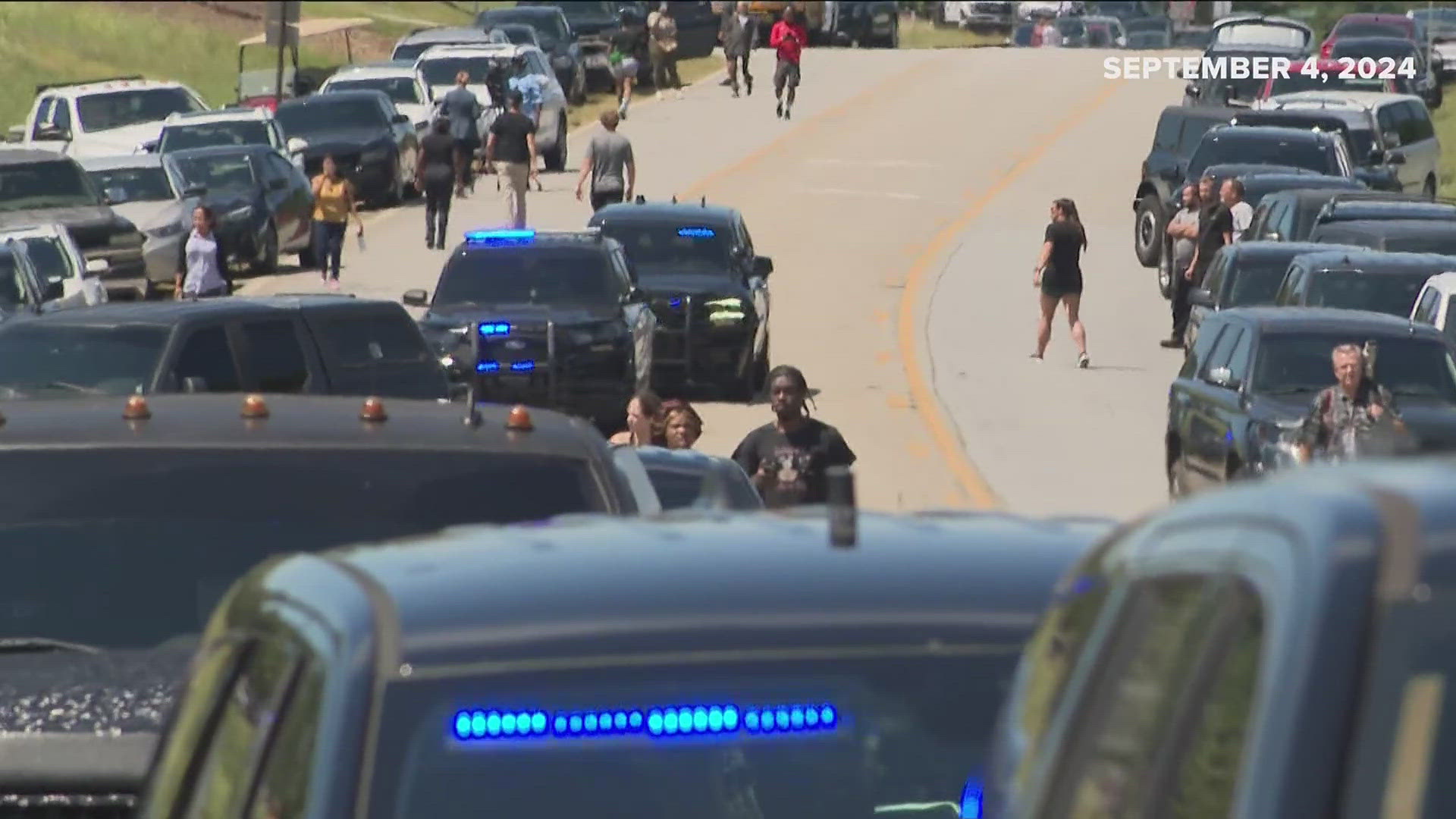
“BARROW COUNTY, Ga. — Many are still grappling with the pain after a shooting at Apalachee High School in Barrow County Wednesday morning, where four people were killed, and nine others were hospitalized, according to reports from the Georgia Bureau of Investigation. 

As of Thursday, the shooter, identified as 14-year-old Colt Gray, a student at the school, has been booked into the Gainesville Detention Center. 

Gray will be charged with murder, the GBI said. Sheriff Jud Smith said that authorities were looking into how he obtained a weapon and got it into school Wednesday morning. Authorities said the gun was an automatic rifle but have not added any other details. 

The bureau said deputies with the sheriff's office responded minutes after reports of an active shooter at 10:20 a.m. and encountered the suspect, who "immediately surrendered to these officers, and he was taken into custody."

The GBI identified the victims as the following:

  • Teacher Richard Aspinwall, 39
  • Teacher Christina Irimie, 53
  • Student Mason Schermerhorn, 14 
  • Student Christian Angulo, 14

"Obviously the shooter was armed, and our school resource officer engaged him and the shooter quickly realized that if he did not give up, that it would end with an OIS (officer-involved shooting)," Sheriff Smith said, describing how the suspect was taken into custody. "He gave up, got on the ground and the (officer) took him into custody."

"The shooter was interviewed, speaking with investigators earlier, along with the GBI," Sheriff Smith said. "It is helping our investigation."

The Federal Bureau of Investigation said that Gray was actually investigated in 2023 by the Jackson County Sheriff's Office after Gray allegedly posted online threats containing photos of guns in a threat to commit a school shooting. The time and location were unknown.

Gray was 13 years old at the time. At the time, the father said that though he had hunting guns in the house, his son did not have "unsupervised access" to them. The boy also denied making the online threats.

The sheriff added, touching on a personal note: "This hits home for me, I was born and raised here, I went to school in this school system, my kids go to this school system. I'm proud of this school system, my heart hurts for these kids, my heart hurts for our community -- but I wanna make it very clear that hate will not prevail in this county. I want that to be very clear and known, love will prevail over what happened today. I assure you of that."

A woman, Katie Phenix, posted on Facebook that her father, David Phenix, had been among those shot and hospitalized. She said he was shot in the foot and hip, that his hip bone had been shattered and that he was in the hospital alert and stable following surgery.

Photos | Mass shooting scene at Apalachee High School

CNN previously reported a threat was phoned into the school in the morning, "warning there would be shootings at five schools and that Apalachee would be the first." There were no shootings at other schools, and it isn't yet known who placed the call. The sheriff said he was not aware of that detail at the afternoon press conference.

On X, Gov. Brian Kemp posted a statement saying he and his family are "heartbroken" and that he will continue to "make any and all resources available to help this community on this incredibly difficult day and in the days to come."

President Joe Biden said he and First Lady Jill Biden were "mourning the deaths of those whose lives were cut short due to more senseless gun violence and thinking of all of the survivors whose lives are forever changed."

11Alive confirmed that Grady Hospital in Atlanta had received one patient. Northeast Georgia Medical Center said two patients were transported to their facility in Winder and one was taken to their larger hospital in Gainesville; five people also self-transported to their facilities with anxiety or panic attack symptoms.

Students were being released to parents and guardians around 11:30 a.m., the district told 11Alive. 

School, Winder community response

The Barrow County School District said classes will be canceled at all schools in the district Thursday and Friday, with crisis counselors available at the central district offices from 8 a.m. to 4 p.m.

Unconfirmed reports earlier circulated about other schools in the area, but there were no additional shooting scenes. The principal of Holsenbeck Elementary said in a Facebook post that all district schools were in a soft lockdown -- the principal indicated in a follow-up post at 1:47 p.m. that their lockdown was lifted and they would be dismissing at normal time.

Around 2 p.m., Winder Police asked parents picking up children at other schools to be patient with traffic. Winder Police said:

Schools will begin to transition from hard lockdowns to soft and will work to release students on time as this transition occurs. Buses will run as close to normal schedules as possible. The school asks that all parents choosing to pick up their children in person to please be patient as the traffic will be heavy. AGAIN, PLEASE DO NOT BLOCK ROADWAYS, SIDEWALKS, BUS AND CAR LANES AT SCHOOL SITES. Emergency vehicles are still needing to get in and out of the various schools and especially at Apalachee HS. 

A community vigil is being planned for 7 p.m. tonight at Jug Tavern Park.

Live report

President Biden statement

Jill and I are mourning the deaths of those whose lives were cut short due to more senseless gun violence and thinking of all of the survivors whose lives are forever changed. What should have been a joyous back-to-school season in Winder, Georgia, has now turned into another horrific reminder of how gun violence continues to tear our communities apart. Students across the country are learning how to duck and cover instead of how to read and write. We cannot continue to accept this as normal. 
 
We are closely coordinating with officials at the federal, state and local level, and are grateful for the first responders who brought the suspect into custody and prevented further loss of life.
 
Ending this gun violence epidemic is personal to me. It’s why I signed into law the Bipartisan Safer Communities Act – the most meaningful gun safety bill in decades – and have announced dozens of gun safety executive actions. I also established the first-ever White House Office of Gun Violence Prevention, overseen by Vice President Harris. We’ve made significant progress, but this crisis requires even more.
 
After decades of inaction, Republicans in Congress must finally say ‘enough is enough’ and work with Democrats to pass common-sense gun safety legislation. We must ban assault weapons and high-capacity magazines once again, require safe storage of firearms, enact universal background checks, and end immunity for gun manufacturers. These measures will not bring those who were tragically killed today back, but it will help prevent more tragic gun violence from ripping more families apart.

Gov. Brian Kemp statement

Marty, the girls, and I are heartbroken by today's tragedy at Apalachee High School. This is a day every parent dreads, and Georgians everywhere will hug their children tighter this evening because of this painful event. We continue to work closely with local, state, and federal partners to make any and all resources available to help this community on this incredibly difficult day and in the days to come.

Earlier:

I have directed all available state resources to respond to the incident at Apalachee High School and urge all Georgians to join my family in praying for the safety of those in our classrooms, both in Barrow County and across the state. We will continue to work with local, state, and federal partners as we gather information and further respond to this situation.”