‘Not a normal war’: doctors say children have been targeted by Israeli snipers in Gaza
IDF says it ‘completely rejects’ charge that its soldiers deliberately fired on any of the thousands of civilians killed in Israeli offensive
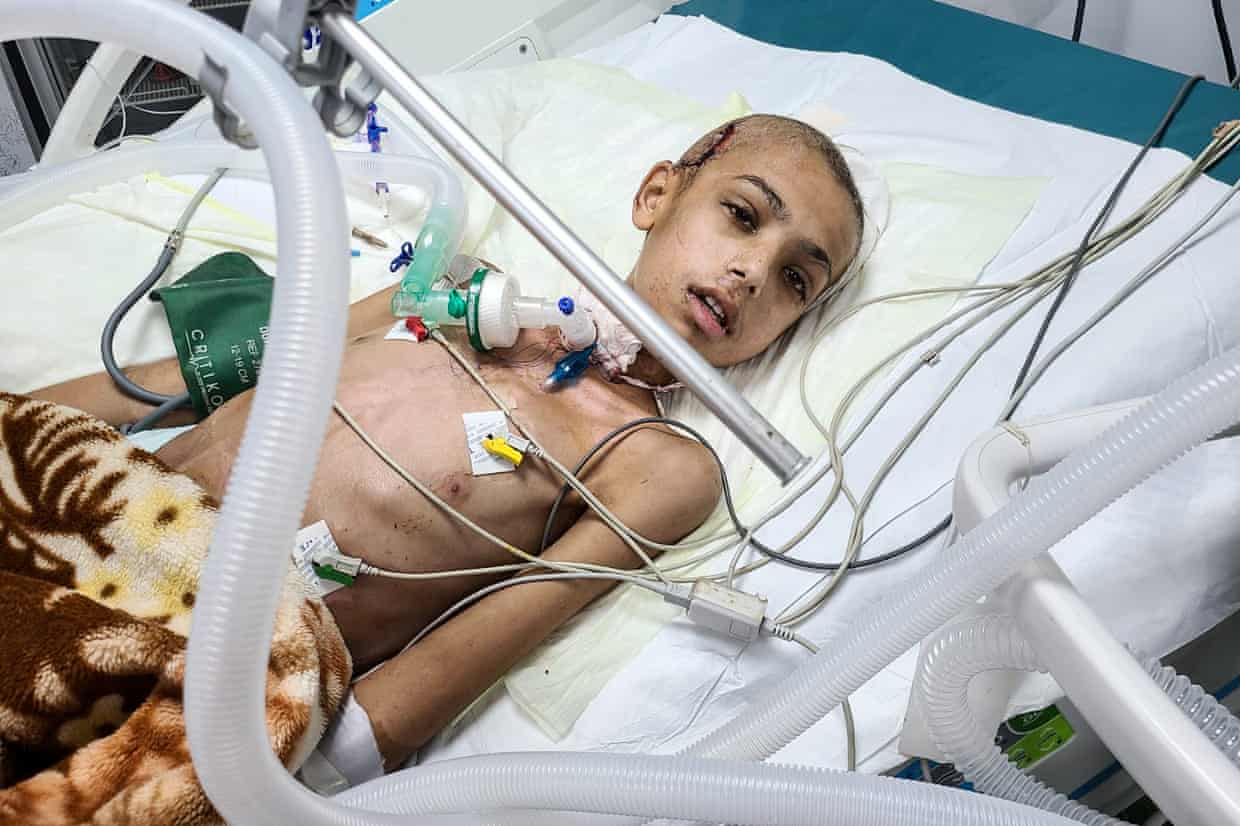
Dr Fozia Alvi was making her rounds of the intensive care unit on her final day at the battered European public hospital in southern Gaza when she stopped next to two young arrivals with facial injuries and breathing tubes in their windpipes.
“I asked the nurse, what’s the history? She said that they were brought in a couple of hours ago. They had sniper shots to the brain. They were seven or eight years old,” she said.
The Canadian doctor’s heart sank. These were not the first children treated by Alvi who she was told were targeted by Israeli soldiers, and she knew the damage a single high-calibre bullet could do to a fragile young body.
“They were not able to talk, paraplegic. They were literally lying down as vegetables on those beds. They were not the only ones. I saw even small children with direct sniper shot wounds to the head as well as in the chest. They were not combatants, they were small children,” said Alvi.
Children account for more than one in three of the more than 32,000 people killed in Israel’s months-long assault on Gaza, according to the Palestinian health ministry. Tens of thousands more young people have suffered severe injuries, including amputations.

Nine doctors gave the Guardian accounts of working in Gaza hospitals this year, all but one of them foreign volunteers. Their common assessment was that most of the dead and wounded children they treated were hit by shrapnel or burned during Israel’s extensive bombardment of residential neighbourhoods, in some cases wiping out entire families. Others were killed or injured by collapsing buildings with still more missing under the rubble.
But doctors also reported treating a steady stream of children, elderly people and others who were clearly not combatants with single bullet wounds to the head or chest.
Some of the physicians said that the types and locations of the wounds, and accounts of Palestinians who brought children to the hospital, led them to believe the victims were directly targeted by Israeli troops.
Other doctors said they did not know the circumstances of the shootings but that they were deeply troubled by the number of children who were severely wounded or killed by single gunshots, sometimes by high-calibre bullets causing extensive damage to young bodies.
In mid-February, a group of UN experts accused the Israeli military of targeting Palestinian civilians who are evidently not combatants, including children, as they sought shelter.
“We are shocked by reports of the deliberate targeting and extrajudicial killing of Palestinian women and children in places where they sought refuge, or while fleeing. Some of them were reportedly holding white pieces of cloth when they were killed by the Israeli army or affiliated forces,” the group said.
The Guardian shared descriptions and images of gunshot wounds suffered by eight children with military experts and forensic pathologists. They said it was difficult to conclusively determine the circumstances of the shootings based on the descriptions and photos alone, although in some of the cases they were able to identify ammunition used by the Israeli military.
Eyewitness accounts and video recordings appear to back up claims that Israeli soldiers have fired on civilians, including children, outside of combat with Hamas or other armed groups. In some cases, witnesses describe coming under fire while waving white flags. Haaretz reported on Saturday that Israel routinely fires on civilians in areas its military has declared a “combat zone”.
The Israel Defense Forces (IDF) deploy snipers – or sharpshooters, as the military calls them – during combat operations, often as part of elite units. They are trained to “target and eliminate particularly difficult terrorist threats”, according to the military’s own definition.
Israeli and foreign human rights groups have documented a long history of snipers firing on unarmed Palestinians, including children, in Gaza and the West Bank.
Palestinians in Gaza also report a terrifying new development in the latest Gaza war – armed drones able to hover over streets and pick off individuals. Called quadcopters, some of these drones are used as remote-control snipers that Palestinians say have been used to shoot civilians.

The IDF said it “completely rejects” allegations that its snipers deliberately fire on civilians. It said it cannot address individual shootings “without coordinates of the incidents”.
“The IDF only targets terrorists and military targets. In stark contrast to Hamas’s deliberate attacks on Israeli civilians, including men, women and children, the IDF follows international law and takes feasible precautions to mitigate civilian harm,” it said.
Doctors say otherwise.
Dr Vanita Gupta, an intensive care doctor at a New York City hospital, volunteered at Gaza’s European hospital in January. One morning, three badly wounded children arrived in quick succession. Their families told Gupta that the children had been together in the street when they came under fire and that there had been no other shooting in the area. She said no wounded adults were brought in to the hospital at the same time and from the same place.
“One child, I could see there was a shot to the head. They were doing CPR on this five- or six-year-old girl who obviously died,” said Gupta.

“There was another little girl about the same age. I saw a bullet entry wound on her head. Her father was there, crying and asking me, ‘Can you save her? She’s my only child.’”
Gupta said that a third young child also had a shot to the head and was sent for a CT scan.
“The neurosurgeon looked and said, ‘There’s no hope.’ You could see the bullet had gone through the head. I don’t know how old he was, but young,” she said.
Family members told Gupta that the Israeli army had withdrawn from the area about four kilometres from the hospital.
“They said people started returning to their homes because the army was gone. But the snipers stayed on. The families said they opened fire at the children,” she said.
Doctors who worked at the Nasser hospital in southern Gaza said what appeared to be targeted Israeli fire killed more than two dozen people, including children, as they entered or left the hospital in the first weeks of this year.
Among the casualties was 14-year-old Ruwa Qdeih. Doctors say she was shot dead outside the hospital in Khan Younis as she went to collect water. They said there was no fighting in the area at the time and that she was killed by a single shot and then men who went to recover her body were also shot at.
In Gaza City, three-year-old Emad Abu al-Qura was shot outside his home as he went to buy fruit with his cousin, Hadeel, a 20-year-old medical student, who was also killed. The family said they were targeted by an Israeli sniper.
A video of the pair lying together in the street shows Emad still alive after he is first hit and trying to lift his head. More shots hit the ground close by including one that strikes a plank next to Emad. The boy’s mother said he was then hit again and this time killed.
Hadeel’s father, Haroon, saw the shooting.
“The targeting of civilians is very clear. It is a deliberate direct targeting aimed at killing civilians without reason, without there being any events, without there being any resistance. They deliberately killed Hadeel and Emad,” he told Al Jazeera.
Other young victims include 14-year-old Nahedh Barbakh, who was hit by sniper fire alongside his 20-year-old brother, Ramez, as they followed Israeli military orders to evacuate an area west of Khan Younis in late January, according to the Geneva-based Euro-Med Human Rights Monitor.

According to a witness interviewed by Euro-Med Monitor, Nahedh was carrying a white flag to lead the way for his family, but after walking just a few steps from the house he was hit in the leg by a bullet. As the teenager attempted to turn back home he was shot in the back and head, the witness said.
Ramez was shot through the heart when he tried to rescue his brother.
The family decided it was too dangerous to recover the bodies and eventually fled the area, leaving the brothers still lying in the street. A last photograph shows Ramez stretched across Nahedh’s body with the white flag tangled between them.
Witnesses said the shots came from the rooftop of a nearby building taken over by Israeli soldiers.
A new threat
In December, the Palestine Red Crescent Society said that 13-year-old Amir Odeh was killed by an Israeli drone at its headquarters in the Al-Amal hospital in Khan Younis. The family told Euro-Med Monitor he was shot through a window as he played with his cousins on the eighth floor of building where they had sought shelter from the fighting. The killing was especially notable because the single shot to the chest came from a type of drone not seen in combat in Gaza before – a quadcopter, fitted with a gun, camera and speaker. Unlike some other drones, quadcopters are able to hover over their targets.
Dr Thaer Ahmad, a Chicago doctor who volunteered in Nasser hospital’s emergency room, said quadcopters sometimes appeared in swarms, giving orders to Palestinians to clear an area.
“We heard an incredible amount of stories from people recovering from injuries from these quadcopters firing bullets from the sky,” he said.
Ahmad said that on one occasion a drone shot one of the hospital’s doctors in the head, although he survived.
Dr Ahmed Moghrabi described on Instagram “hundreds” of quadcopters descending on the Nasser hospital in the third week of February and ordering people to evacuate the compound before killing a number of them. On another occasion, he filmed quadcopters giving instructions to Palestinians to leave the area.
Although the Israeli military has previously deployed quadcopters for intelligence gathering, this appears to be the first time that versions of the drone able to fire guns have been used against the Palestinians.
Prof Ghassan Abu-Sittah, a British-Palestinian surgeon and who was recently elected rector of the University of Glasgow, told Mondoweiss, a leftwing Israel-Palestine news site, that working at the Al-Ahli hospital in Gaza City “we were getting a lot of people shot by these quadcopters, these drones that have sniper guns attached to them”.
Abu-Sittah, who has operated on Palestinians wounded by Israeli sharpshooters during visits to Gaza in earlier years, described the quadcopters as firing “single high-velocity” shots.
“We have received over 20 chest and neck gunshot wounds fired from Israeli Quadcopter drones. This is a low flying sniper drone,” he wrote on X.

Quadcopter killings documented by Euro-Med Monitor include two children shot dead on 21 January when drones opened fire at al-Aqsa University near Khan Younis, where thousands of displaced Palestinians were sheltering. The following month, a drone shot dead Elyas Abu Jama, a 17-year-old whose family said had mental and physical disabilities, outside his tent in a Rafah displaced-persons camp. Euro-Med Monitor said that on the same day, a quadcopter killed 16-year-old Mahmoud al-Assar and his 21-year-old sister, Asmaa.
Thaer Ahmad spent three weeks at the Nasser hospital in January as a volunteer with the medical charity MedGlobal. Normally he works at a trauma centre on Chicago’s south side, where he regularly deals with gunshot wounds.
“I did more trauma procedures on paediatric patients in the three weeks that I was at Nasser than I did in the 10 years that I’ve been practising in the US,” he said.
The doctor said he treated five children he believes were shot by snipers because the placing of the bullets suggested they were not hit randomly but targeted.
“They were mostly shot in the thorax, the chest area, some in the abdomen. There was one boy shot in the face. As a result he had a shattered jaw. There were two children who had been shot in the chest, young, under the age of 10, who did not survive. Two others, one shot in the abdomen, did survive. They were still recovering in the hospital when I left,” he said.
Ahmad noted the children were often shot by “one large-calibre bullet” which could produce devastating wounds.

Dr Irfan Galaria, a surgeon based in Virginia, slept on the operating room floor of the European hospital between shifts as a volunteer in January. He too saw children badly wounded by high-calibre bullets.
Galaria said that a 14-year-old boy arrived at the hospital who had been shot once through the back. When surgeons operated they found a bullet in the boy’s stomach.
“He was very lucky because it missed a lot of the vital organs but it was just sitting in his abdomen,” he said.
The surgeon took a photo of the bullet which former IDF soldiers who spoke with the Guardian identified as a powerful .50 calibre round typically fired from a machine gun mounted on an armoured vehicle, although it has also been used in sniper rifles. They said that vehicle-mounted guns often have advanced sighting systems that allow them to target shots but that large numbers of .50 rounds could be fired without precision targeting, making it difficult to establish whether the child was targeted.
Other bullets recovered from young Palestinians include 5.56mm rounds that are standard issue for all IDF infantry rifles but also used by marksmen attached to all infantry units.
Gupta provided the Guardian with CT scans of children with head wounds. These included one of an eight-year-old girl that a pathologist described as showing a “gunshot wound to the head entering right side with bullet in brain (medial right temporal lobe)”.

Although doctors were shocked at the number of child victims, they said they believed the shootings were part of a broader pattern of targeting Palestinian civilians, including elderly people.
“The vast majority of people we saw were not combatants,” said Ahmad. “There was an elderly woman who was on the back of a donkey cart when she was shot. The bullet lodged in her spine and she was paralysed from the waist down and also her lung collapsed. She was somewhere between 60 and 70 years old.”
‘Sniper wounds were common’
Dr Osaid Alser helped organise a group of doctors outside Gaza to give long-distance guidance to the only Palestinian general surgeon remaining at Nasser hospital, who only had limited experience.
“Sniper wounds were common, and quadcopter gunshots as well,” said Alser, who grew up in Gaza City and now lives in Texas.
Doctors said that apparent sniper shots also account for numerous amputations and long-term disabilities, made all the worse in children because a bullet often causes more damage to small bodies.
Alser argued that it was often possible to distinguish sniper shots.
“When it’s a sniper, usually it’s a bigger bullet, which causes significantly more damage and has more shock-wave energy as compared to a smaller rifle or a pistol. If it’s a sniper, it may cause amputation of the limb because it will cause damage to the vascular structure – nerves, bone, soft tissue, everything,” he said.
“Another pattern is injury to the spinal cord when people are shot in the middle of the abdomen or in the middle of the back. Spinal cord injury is not necessarily fatal, unless it’s the neck, but it can be disabling.”

Alser said that one of his elderly relatives, a pioneer of dentistry in Gaza, was among the apparent victims of a sniper.
Dr Mohammed Al Madhoun went missing after seeking medical treatment for a chronic condition at a charity hospital west of Gaza City in December. The 73-year-old’s body was found near the hospital a week later alongside that of his great-nephew. They had both been shot.
“The pattern of injury, and the amount of damage from the bullet, was significant, and that’s mainly caused by a sniper,” said Alser, who reviewed CT scans of the injury. “He was obviously old. You wouldn’t expect a 73-year-old to be a target, right?”
The doctor said the cases he reviewed remotely included other elderly people, among them a woman in her 70s.
“She was shot by a sniper and she had a massive head bleed. That is non-survivable. She died a day or two after,” he said.
In October, Israel’s prime minister, Benjamin Netanyahu, described the IDF as “the most moral army in the world”. The Israeli military claims to be guided by a “purity of arms” doctrine that precludes soldiers from harming “uninvolved civilians”.
But Israeli and international human rights groups have long said that the military’s failure to enforce its own standards – and its willingness to cover up breaches – has contributed to a climate of impunity for soldiers who target civilians.
The groups say it is extremely difficult at this stage to quantify the scale of such shootings in Gaza, not least because their own staff are often displaced and under attack. But Miranda Cleland of Defense for Children International Palestine said that over the years there had been a “clear pattern of Israeli forces targeting Palestinian children with deadly force in situations where the children posed no threat to soldiers”.
“In the occupied West Bank, Israeli soldiers routinely shoot children in the head, chest or abdomen, all areas from which a child will quickly bleed out if they aren’t killed instantly. Many of these children are shot by Israeli forces from great distances, sometimes upwards of 500ft, which is something only a trained military sniper would be capable of,” she said.
An Israeli group, Breaking the Silence, collected testimonies from IDF soldiers in earlier conflicts who said they shot Palestinian civilians merely because they were where they were not supposed to be even though it was evident they were not combatants.
IDF snipers boasted about shooting unarmed Palestinian protesters, including young people, in the knees during nearly two years of demonstrations at the Gaza border fence from the spring of 2018.

One former Israeli army sniper, who did not want to be named, told the Guardian that the IDF’s open-fire regulations were so broad that a soldier has extensive leeway to shoot at anyone once an area is declared a combat zone.
“The problem is the regulations that enable soldiers who just want to shoot Palestinians. In my experience, most soldiers who pull a trigger only want to kill those who should be killed but there are those who regard all the Arabs as the enemy and find any reason to shoot or no reason at all,” he said, adding that a system of impunity protects such soldiers.
“Even if they are outside the regulations, the system will protect them. The army will cover up. The other soldiers in the unit will not object or they will celebrate another dead Arab. There’s no accountability so even the loosest regulations have no real meaning.”
The Israeli human rights group B’Tselem has described the IDF’s open-fire regulations as “no more than a semblance of legality” in part because they are “repeatedly violated”.
“Other than a handful of cases, usually involving low-ranking soldiers, no one has been put on trial for harming Palestinians,” the group said.
In one of the most notorious cases of soldiers shooting young children in the occupied territories, an army captain fired the entire magazine of his automatic rifle into a 13-year-old Palestinian girl, Iman al-Hams, in 2004 after she crossed into a security zone even though she posed no immediate threat and his own soldiers told him she was “a little girl” who was “scared to death”. The captain was cleared of wrongdoing by a military court.

The Israeli military also has a long history of covering up the killing of children.
After 11-year-old Khalil al-Mughrabi was shot dead as he played football in Rafah in 2001, the Israeli human rights organisation B’Tselem wrote to the IDF demanding an inquiry.

Months later, the judge advocate general’s office told B’Tselem that Khalil was shot by soldiers who acted with “restraint and control” to disperse a riot in the area. However, the IDF made the mistake of attaching a copy of its secret internal investigation, which said the riot had been much earlier in the day and that soldiers who opened fire on the child were guilty of a “serious deviation from obligatory norms of behaviour”.
The chief military prosecutor, Col Einat Ron, then spelled out alternative false scenarios that should be offered to B’Tselem to cover up the crime.
More recently, the IDF was accused of lying to cover up the shooting of the Palestinian American journalist Shireen Abu Akleh, almost certainly by an Israeli sniper. The military at first blamed the Palestinians and then falsely claimed that Abu Akleh was caught in crossfire during a gun battle. Her employer, Al Jazeera, presented video evidence that there was no firefight and that at least one Israeli soldier was targeting the journalist.

Alvi, the Canadian physician, left Gaza in the third week of February as Israeli forces were threatening a ground assault against Rafah. Alvi founded the US-based charity Humanity Auxilium, which has worked with Rohingya refugees in Bangladesh, displaced Syrians and earthquake survivors in Turkey.
“This is not a normal war. The war in Ukraine has killed 500 kids in two years and the war in Gaza has killed over 10,000 in less than five months. We have seen wars before but this is something that is a dark stain on our shared humanity.”
‘Not a normal war’: doctors say children have been targeted by Israeli snipers in Gaza | Israel-Gaza war | The Guardian


![[object Object]](https://static01.nyt.com/images/2024/04/02/multimedia/02mideast-crisis-carousel-z-01-pfzm/02mideast-crisis-carousel-z-01-pfzm-threeByTwoMediumAt2X.jpg?quality=75&auto=webp)

