Contact Me By Email


What To Do When You're Stopped By Police - The ACLU & Elon James White

What To Do When You're Stopped By Police - The ACLU & Elon James White

Know Anyone Who Thinks Racial Profiling Is Exaggerated? Watch This, And Tell Me When Your Jaw Drops.


This video clearly demonstrates how racist America is as a country and how far we have to go to become a country that is civilized and actually values equal justice. We must not rest until this goal is achieved. I do not want my great grandchildren to live in a country like we have today. I wish for them to live in a country where differences of race and culture are not ignored but valued as a part of what makes America great.

Saturday, February 05, 2022

U.S. Covid Death Toll Surpasses 900,000 as Omicron’s Spread Slows - The New York Times

U.S. Covid Death Toll Surpasses 900,000 as Omicron’s Spread Slows

"New case reports are waning, but deaths have yet to peak, and Americans are wondering what long-term coexistence with the coronavirus might look like.

A coronavirus testing site in Washington, D.C., in December.
Kenny Holston for The New York Times

A coronavirus testing site in Washington, D.C., in December.Kenny Holston for The New York Times

CHICAGO — More than 2,600 Americans are dying from Covid-19 each day, an alarming rate that has climbed by 30 percent in the past two weeks. Across the United States, the coronavirus pandemic has now claimed more than 900,000 lives.

Yet another, simultaneous reality of the pandemic offers reason for hope. The number of new coronavirus infections is plummeting, falling by more than half since mid-January. Hospitalizations are also declining, a relief to stressed health care workers who have been treating desperately ill coronavirus patients for nearly two years.

All that has created a disorienting moment in the pandemic: Though deaths are still mounting, the threat from the virus is moving, for now, farther into the background of daily life for many Americans.

Patrick Tracy of Mundelein, Ill., has seen the disconnect up close. In his county, new infections have fallen in recent weeks as the highly infectious Omicron variant has begun to recede nationwide. But as those case rates were dropping, Mr. Tracy’s wife, Sheila, died from Covid. Ms. Tracy, 81, a native of Ireland who was devoted to her grandchildren and the roses she tended in her front yard, was vaccinated, but also had underlying medical conditions.

“The people that don’t get vaccinated — you tell them that almost 900,000 have died, and they say, ‘They’d have died anyway,’” Mr. Tracy said. “We have very little consideration for our fellow man.”

Many school districts have relied on “test-to-stay” policies to keep students in school despite coronavirus exposure. Drivers lined up in January to get home rapid-test kits at an elementary school in Richmond, Va.
Julia Rendleman for The New York Times

The Omicron surge has brought with it an especially potent and fast-moving wave of death across the United States. The country’s per capita death rate still exceeds those of other wealthy nations, a reflection of widespread resistance to vaccines and boosters in the United States. During the Omicron surge, hospital admissions in the United States have been higher than in Western Europe.

The pace of deaths across the country has accelerated throughout the fall and winter. When the United States reached 800,000 deaths in mid-December, the most recent 100,000 deaths had occurred in less than 11 weeks. This time, the latest 100,000 deaths — many from the Omicron variant — have been reported in just over seven weeks.

That the 900,000-death milestone comes more than a year after vaccines were first authorized added to the pain, said Dr. Letitia Dzirasa, the Baltimore health commissioner. Federal data shows that a vast majority of deaths have been unvaccinated people.

“As a public health professional, it is unbelievably sad, because I think so many of the deaths were likely preventable,” Dr. Dzirasa said. She said her agency continued to organize vaccination clinics each week, but that some of them were “barely attended.”

Deaths over the past seven weeks were reported in large numbers across the United States, with especially high rates in the Southwest and around the Great Lakes.

Recent Covid-19 deaths

Deaths per 100,000 residents since Dec. 15

Miss.N.C.Okla.Va.W.Va.La.Mich.Mass.IdahoFla.Neb.Wash.N.M.P.R.S.D.TexasCalif.Ala.Ga.Pa.Mo.Colo.UtahTenn.Wyo.N.Y.Kan.AlaskaNev.Ill.Vt.Mont.IowaS.C.N.H.Ariz.N.J.Md.MaineHawaiiDel.R.I.Ky.OhioWis.Ore.N.D.Ark.Ind.Minn.Conn.

Much of the Midwest, Northeast and Southwest already were suffering large outbreaks fueled by the Delta variant in December before Omicron became dominant. It is possible that many of the most recent deaths in those regions were caused by Delta.

A month ago, when the Omicron surge was driving cases to record highs, millions of Americans were out sick from work, coronavirus tests were hard to come by, and public health directors urged caution as hospitals filled. In the weeks since, as the outlook has improved, the sense of alarm has diminished.

In Cleveland and Detroit, where public schools briefly moved instruction online because of Omicron, students returned to classrooms. In Chicago, city leaders said they would consider lifting a rule requiring vaccination for indoor dining in the next few weeks.

The recalibrated message is more optimistic about the weeks ahead, yet grounded in a more sober reality. The country is moving into a new phase of the pandemic, officials say, where a virus threat will persist indefinitely, but where most people can rely on vaccines to protect them from the worst consequences.

“I’m going to go on a trip in March. I feel fairly comfortable re-engaging in life,” said Linda Vail, the health officer in Ingham County, Mich., which includes the capital city of Lansing.

Janice Chung for The New York Times

Ms. Vail said she remained worried about the dangers facing unvaccinated people, who continue to fill hospital wards and die. But for those who are vaccinated and boosted, and who do not have other conditions that make them especially vulnerable, she said it was important to accept some level of virus risk.

“It really is hard to get some people from that far end of being extremely fearful,” she said.

Other officials are conceding that many Americans are fatigued by the pandemic and are no longer looking to government for restrictions and mandates.

“We are at the point where the work of government interventions may be coming to an end,” Mayor Quinton Lucas of Kansas City, Mo., said in an interview.

Mr. Lucas, a Democrat, recently sought a two-week extension of the city’s mask mandate in schools, but said he did not plan to extend that requirement further if new cases continued to decline. In previous periods of the pandemic, Mr. Lucas imposed citywide mask rules and restrictions on gatherings, at times clashing with Republicans.

The mayor said there was a gap between how the Biden administration and the national media talked about Covid-19, and how the pandemic was now being experienced in his city, where sporting events have been packed and many people have returned to prepandemic routines.

“I just don’t think that government, frankly, has that much runway left, in terms of telling people what to do,” Mr. Lucas said.

The country continues to average more than 300,000 new coronavirus cases a day. That is down from more than 800,000 a day in the middle of January, but still above the peak levels seen in every previous surge. More than 120,000 people with the virus are hospitalized nationwide, and deaths are being reported in higher numbers each day than at any point except for last winter.

Chase Castor for The New York Times

Throughout the coronavirus pandemic, increases in deaths have lagged behind spikes in infections because patients are often sick for weeks before dying and because it can take several days to report those deaths. The Omicron variant, though still potentially deadly, tends to cause severe illness less often than previous forms of the virus. But because of the sheer number of cases — more than three times as many a day at the recent peak than in any previous surge — hospitalizations still rose to record levels.

The Coronavirus Pandemic: Key Things to Know


The state of the virus in the U.S. The coronavirus has now claimed more than 900,000 lives across the country, and the Covid death rates remain alarmingly high. The number of new infections, however, has fallen by more than half since mid-January, and hospitalizations are also declining.

Still, there is near-universal progress now, with case numbers plunging even in places like Montana and North Dakota that were among the last states to reach an Omicron peak.

The improvement has been especially stark in eastern cities hit early by Omicron. In the county that includes Cleveland, fewer than 300 cases are now being reported each day, on average, down from 3,200 a day around Christmas. New York City is averaging about 3,500 cases a day, down from 40,000 less than a month ago. The county that includes Chicago is averaging about 2,200 cases a day, down from 12,000 in mid-January, leading some to call for a return to fewer restrictions.

“I wear masks all day at work, that’s no big deal,” said Madonna Lekas, a physician assistant in Chicago. “It’s more the ups and downs of wondering if our kids are going to school. At some point we just have to come to grips with things. We can’t live like this forever.”

Some states and cities continue to enforce mask mandates, and several cities require proof of vaccination for indoor dining. But in much of rural America, there have been few outward signs of the pandemic for months.

“I would say, in most of the places I travel, in small towns, Covid is over,” said Brady Revels, a sales representative who lives in suburban Omaha and is vaccinated. “There’s no masks, there’s no anything — we’re back to normal. Honestly, I think outside of some major metropolitan areas, America has moved on from Covid.”

The pace of Covid-19 deaths in the United States

The virus has surprised scientists repeatedly, surging when experts thought it would ebb and mutating at speeds that initially caught researchers off guard. But there is wide agreement that Covid-19 will become an endemic disease, meaning that it circulates indefinitely at some level.

Some places are moving more quickly than others to treat Covid-19 like a routine fact of life. On Thursday, Gov. Kim Reynolds of Iowa announced that she would allow Covid-19 emergency declarations to expire later this month, and that the state would scale back data reporting.

“The flu and other infectious illnesses are part of our everyday lives, and coronavirus can be managed similarly,” Ms. Reynolds, a Republican, said in a statement.

Still, scientists have warned about the possibility of more dangerous variants appearing in the future; federal guidance continues to suggest indoor masking in high-transmission areas; and some Americans have grown frustrated with others for dropping their guard.

Dustin Chambers for The New York Times

“I refuse to kind of be around anybody that isn’t taking the pandemic seriously,” said Mikayla Cruickshank, an administrative coordinator in Lincoln, Neb.

Shobha Gupta, who runs an accounting business and lives in St. Petersburg, Fla., said she had continued socializing to some degree. The risk of not doing that, she said, was depression, especially as the pandemic stretched on.

“It doesn’t seem to end,” Ms. Gupta said.

In the more than two years since the coronavirus was first detected in the United States, the country has sped past milestones that once seemed unthinkable: 1,000 dead, 100,000 dead, 500,000 dead. As the country reaches the latest marker, with 900,000 deaths linked to the virus — more than the population of San Francisco — the collective shock has lessened, even as the impact on victims’ families has grown.

“Everybody was so up in arms when we hit those first couple of milestones,” said Elle Stecher, a marketing manager in Lincoln, Neb., who recovered from a bout with Covid in January. But now, she said, “none of it is registering anymore.”

Reporting was contributed by Lauryn Higgins in Lincoln, Neb., Elizabeth Djinis in St. Petersburg, Fla., Robert Chiarito in Chicago, Dan Simmons in Milwaukee, and Chloe Reynolds in New York."

U.S. Covid Death Toll Surpasses 900,000 as Omicron’s Spread Slows - The New York Times

Opinion | The Clues to the Next Variant Surge Are All Around Us - The New York Times

The Clues to the Next Variant Surge Are All Around Us

Sampling of indoor air may be a promising method for discovering the next variant.
Robert Reader/Moment, via Getty Images

By Rick Bright

"Dr. Bright is an immunologist, virologist and a vaccine expert. He’s the chief executive of the Pandemic Prevention Institute, and he directed the federal government’s Biomedical Advanced Research and Development Authority from 2016 to 2020.

When scientists in South Africa noticed an uptick in Covid-19 cases in the Gauteng Province last November, they began investigating the source. These researchers and others in Botswana quickly discovered the Omicron variant and heroically shared their discovery with the rest of the world. And yet it was still too late — Omicron was already rapidly infecting people across the globe.

The question for a world enduring the variant’s astonishing surge is how can we discover the next one early enough to stop its spread. Currently, the hunt for coronavirus variants is too slow and sporadic. Scientists in a handful of countries — South Africa, Botswana, the United States and others — monitor patterns in case counts and regularly sequence samples of the virus from infected people to see whether there are notable genetic changes. The results of these analyses can be shared within a global network, such as GISAID, an international community of scientists who openly share data on disease variants, to compare coronavirus sequences from around the world.

By the time this happens, variants are often already spreading in a community and most likely beyond it. This analysis process is like testing every piece of hay in a stack to see whether it’s a needle — or, really, the equivalent of choosing and testing just 1 percent of the haystack.

But there are places to look that may help scientists find new variants even faster: sewage and the air. People can shed the coronavirus in their feces and their exhaled breath. As a result, the virus can be spotted before people have been tested or developed symptoms.

Wastewater monitoring has been used throughout the Omicron surge by scientists in New York City, Boston and elsewhere. They have been able to identify impending surges of cases in certain neighborhoods even before a variant has been identified from test swabs. The opposite is also true: In Minneapolis and St. Paul, Minn., for example, officials who witnessed a drop in the amount of virus in wastewater were able to predict that Omicron’s peak had passed.

Far less attention has been paid to testing air samples, at least until recently. Chinese officials have developed a detection system they will reportedly use to collect and test air samples from venues at the Beijing 2022 Winter Olympics. In the United States, a partnership between the city of Davis, Calif., and the University of California at Davis is monitoring air filters in elementary schools for the virus.

So far scientists have mostly used environmental samples like these to track trends in coronavirus concentrations and identify hot spots for response. But these samples can also provide a window into the dynamics of a concerning new variant in the broader community, quicker and more accurately than any sample from a single person. A virus sample from a nasal or saliva swab offers information on one person; a single wastewater or air sample offers information on many people, and in the case of the former, up to thousands of people. Leaning more heavily on these methods could provide the world additional time to respond before variants become widespread.

Still, some practical challenges remain. Environmental samples can contain a lot of background noise, including myriad other viruses, bacteria and fungi found in human waste. Determining what’s important and what isn’t can be tough. Coordination is another issue; the world needs to develop a consensus on how to analyze environmental sequences and create a hub that, as GISAID does for clinical sequencing, enables near-real-time information sharing and insights across countries.

As these initiatives are pursued and funded, it’s also important that the public be made aware of how environmental testing and sequencing works in order to avoid some of the misinformation and misunderstandings that have affected other tools like vaccines. Organizers must make clear that environmental samples are anonymous: They do not confirm who shed the virus, only that the coronavirus is in a community.

Testing and sequencing virus samples found in sewage or the air is not a singular solution; it is best used alongside other data sources to construct a broader, more holistic view of a pathogen’s spread across a community and around the world. But because it is the quickest way to detect variants, it can help leaders prepare for and potentially prevent the next coronavirus surge, and hopefully, the next pandemic.

Dr. Rick Bright is the chief executive of the Pandemic Prevention Institute and the senior vice president of pandemic prevention and response at the Rockefeller Foundation."

Opinion | The Clues to the Next Variant Surge Are All Around Us - The New York Times

South Carolina judge is at the center of a political whirlwind around Biden's Supreme Court decision

South Carolina judge is at the center of a political whirlwind around Biden's Supreme Court decision

“(CNN) — Politics is never far removed from the selection of any Supreme Courtjustice, but the political winds are blowing with unusual ferocity around J. Michelle Childs, a federal judge from South Carolina who is among those on a short list to fill President Joe Biden's first court vacancy.

As the White House accelerates its extensive vetting of about a dozen potential nominees, lawmakers and outside groups have spent considerable time focusing on Childs after she emerged as the preferred choice of Democratic Rep. James Clyburn of South Carolina, one of the President's top allies. That endorsement, which Clyburn has loudly been making for more than a year as he has touted Childs as a rising South Carolina star, has thrust the judge to the middle of a high-profile political vortex, even as other contenders for the vacancy are receiving far less public attention.

Since her name came up as being on Biden's short list, Republican Sen. Lindsey Graham hailed Childs as a brilliant choice, saying, "It's fair to say I think Michelle Childs has a really good chance of getting Republican votes." Another Republican from South Carolina, Sen. Tim Scott, repeated that sentiment: "I think she has a strong record and would be a strong candidate." And Democratic Sen. Joe Manchin of West Virginia echoed the praise, calling Childs "a tremendous, tremendous candidate."

Those accolades have been, at the same time, accompanied by criticism from progressive activists and union leaders who suggest Childs' legal record is not sufficiently supportive of worker rights.

The attention on Childs comes in the critical opening stages of a process structured by Biden's top advisers to be equal parts methodical and rigorous, building to the selection of the first Black woman for the nation's highest court. 

But with the exact dynamics of the process closely held by the President's most senior aides, it remains an open question whether the compliments -- or the condemnations -- play any role in influencing Biden on his choice to replace Justice Stephen Breyer, who is stepping down. Biden has been poring over biographies provided to him by the White House counsel's office and isn't expected to make a final decision until the end of the month.

Clyburn began raising Childs as a potential nominee with administration officials as far back as a year ago, and suggested Biden nominate her to the US Court of Appeals for the District of Columbia Circuit. That court, at which her nomination is pending, is viewed as a training ground for the Supreme Court.

"We've talked about this for about two years now, and the President knows very well what I feel about Michelle. They are considering her along with at least six other African American women, all of whom are highly qualified," Clyburn said on CNN, one of several television appearances he's made to draw attention to her candidacy. "I just know Michelle. And she has the kind of background that would offer some diversity to this court."

Childs is the only potential candidate the White House has formally confirmed by name as being under consideration, despite acknowledging the names of a dozen other contenders. That confirmation came as Childs' Senate hearing to be elevated to the circuit court position was postponed in light of her status as a candidate for the Supreme Court vacancy. 

"President Biden will choose a nominee whose qualifications, record and character make them deserving of support on both sides of the aisle -- and there are many candidates at the top of their field who fit that profile," White House spokesman Andrew Bates told CNN, adding: "He is actively seeking the advice and recommendations of Republican and Democratic lawmakers, as well as legal experts, and appreciates the input he is being given both privately and publicly."

South Carolina plays a key role

White House officials say the selection process for a lifetime Supreme Court appointment rises far above politics, yet the discussion about Childs also shines a light on the fact that the process actually began with a blunt political move from Biden two years ago this month.

It was just days before the South Carolina primary in February 2020 and Biden was desperate to revive his floundering presidential campaign. On a debate stage in Charleston, he vowed to nominate the first Black woman to the court. Then, he won Clyburn's endorsement.

Two years later, Childs is among those potential nominees at the center of his promise.

Childs, who was nominated to the federal bench in 2010 by President Barack Obama, earned degrees from the University of South Florida and the University of South Carolina. Her champions say her state school experience would be a welcome change on the Supreme Court.

It puts her in contrast with other top contenders, including Leondra Kruger, who attended Harvard and Yale, and Ketanji Brown Jackson, who attended Harvard.

"The Harvard, Yale train needs to change," Graham told CNN. "I don't think we have had a publicly educated Supreme Court justice in 50 years, so that matters to me too."

Asked whether he could support another nominee, Graham said: "It would be much more problematic," even though he was one of three Republicans to vote to confirm Jackson to the US Appeals Court. He also voted to confirm Tiffany P. Cunningham as a federal circuit judge and Candace Jackson-Akiwumi to the 7th Circuit, both of whom are under consideration for the Breyer vacancy.

This week, Graham met with fellow South Carolinians Clyburn and Scott to discuss Childs and posted a photograph afterward. He also spoke to Manchin, viewed as a critical vote on any administration priority, about the judge. 

"I understand the judge from South Carolina is a tremendous, tremendous candidate," Manchin said. "She's a tremendous candidate."

Thin margins in the Senate

It's a response that appeared to provide a window into a clear shift that has occurred over more than a decade. Gone are the days of 90-plus votes in favor of a nominee, replaced by partisan votes and clear political litmus tests.

"When a president campaigns on picking Supreme Court nominees of a certain mold and wins the election, we should give deference to them," Graham said in 2005, when President George W. Bush -- a Republican -- was in the Oval Office. "If the nominee is well-qualified and of good character and integrity, they should be confirmed in an overwhelming fashion."

Given those dynamics, White House officials are also keenly aware of the reality Graham pointed out when Breyer announced his upcoming retirement last month. 

"If all Democrats hang together -- which I expect they will -- they have the power to replace Justice Breyer in 2022 without one Republican vote in support," Graham said in a statement.

In a West Wing with decades of experience in Supreme Court battles in Biden, as a longtime chairman of the Senate Judiciary Committee, and Ron Klain, the chief of staff, who has played inside or outside roles in no fewer than nine previous nominations, the realities of today's political environment are understood. Still, bipartisan support is welcome, and Biden has made clear that he wants advice -- and names of potential candidates -- from senators. 

"I'm serious when I say it: that I want the advice of the Senate as well as the consent," Biden said as he sat in the Oval Office with the top Democrat and Republican on the Senate Judiciary Committee, Dick Durbin of Illinois and Chuck Grassley of Iowa, respectively.

While the White House is carefully monitoring the praise from Graham, Manchin and other senators, officials say the kind words and the pledges to support her confirmation will not be a deciding factor. And one official suggested Biden would be wary of appearing overly swayed by outside voices, wanted instead to be viewed as making the decision on his own.

More than one White House official noted that Graham wasn't exactly the Republican senator whose voice would carry overwhelming weight inside the West Wing.

Graham's close Senate relationship with Biden imploded during the 2020 presidential campaign when the senator joined then-President Donald Trump's attacks on Biden's son, Hunter. That personal break has not been reconciled, even if White House officials would welcome Graham's support for the nominee.

The praise has also drawn the ire of progressive groups that are raising concerns about her candidacy.

"Senator Graham is not, you know, somebody whose opinion we particularly follow or care about too much. Right?" said Paco Fabian, the campaigns and communications director for the liberal group Our Revolution. "If she's getting praise from somebody like Senator Graham -- somebody that, you know, was a big supporter of President Trump, for example -- then you know, that's not great, in our view. But really it's about her record."

White House officials say the decision will not be driven by political promises or considerations -- beyond the commitment to nominate a qualified Black woman.

"We've been clear that the President is considering Judge Childs for the Supreme Court, in addition to a range of other deeply qualified candidates," Bates said. "The President looks forward to evaluating her for this vacancy, and, if he selects another candidate, to her confirmation to the DC Circuit Court because of her extraordinary credentials and what she stands for."

CNN's Tierney Sneed and Lauren Fox contributed to this report.“

Friday, February 04, 2022

Raskin: Pence Should Tell The Full Truth And Join The ‘Party Of Democracy’

Why the COVID death rate in the U.S. is so much higher than other wealth...

'Un-American': Pence Drops MAGA-World Bomb Rebuking Vote Stealing Plot.

W.E.B. Du Bois Would Have Seen Right Through the C.R.T. Backlash

W.E.B. Du Bois Would Have Seen Right Through the C.R.T. Backlash

W.E.B. Du Bois in 1911.
 Gado/Getty Images

Sign up for the Jamelle Bouie newsletter, for Times subscribers only.  Join Jamelle Bouie as he shines a light on overlooked writing, culture and ideas from around the internet.

“Since January 2021, according to an analysis by Education Week, Republican lawmakers in 37 states have introduced dozens of bills to restrict teaching on the subject of race and racism under the guise of opposition to “critical race theory.” In 14 states, restrictions have either passed into law or been imposed through either executive action or on the authority of a state education commission. One such law, passed in Texas, prohibits teaching that “slavery and racism are anything other than deviations from, betrayals of, or failures to live up to the authentic founding principles of the United States, which include liberty and equality.”

One predictable outcome of this frenzy — which includes state lawmakers scrutinizing K-12 and college curriculums for “indoctrination” — is a chilling effect in classrooms, as any attempt to teach an accurate history of racism in the United States is placed under hostile scrutiny. Educators accused of indoctrinating students with “critical race theory” have reported threats and physical harassment, and some schools — in Alabama, for example — are now defending their Black History Month programs from similar accusations of subversion.

Last fall, around the same time that Republican lawmakers in several states were drafting and championing these bills, the Library of America — a nonprofit publisher of significant works in American writing and literature — released its edition of W.E.B. Du Bois’s groundbreaking “Black Reconstruction in America: An Essay Toward a History of the Part which Black Folk Played in the Attempt to Reconstruct Democracy in America, 1860-1880.” There is no direct connection between the book’s republication and the wave of educational gag orders around race and racism. Nonetheless, there is something fortuitous in how Du Bois, writing from 1935, comments on and critiques the politics of history in 2022.

The concluding chapter of “Black Reconstruction,” “The Propaganda of History,” is a polemical essay on the uses and abuses of historical narrative as well as a heated attack on the mainstream of American history writing as it existed in the 1920s and ’30s, when Du Bois’s book was conceived, researched and written.

Du Bois excoriates those historians for acting less as “scientists” in search of something like objective truth and more as propagandists for a social and economic order of segregation, violence and exploitation:

In order to paint the South as a martyr to inescapable fate, to make the North the magnanimous emancipator, and to ridicule the Negro as the impossible joke in the whole development, we have in fifty years, by libel, innuendo and silence, so completely misstated and obliterated the history of the Negro in America and his relation to its work and government that it is almost unknown.

Du Bois, by his own account, is “astonished” by the idea that the evil of history must be “forgotten, distorted, skimmed over.”

“We must forget,” he writes, “that George Washington was a slave owner, or that Thomas Jefferson had mulatto children … and simply remember the things we regard as creditable and inspiring.” The difficulty with this approach, he continues, “is that history loses its value and incentive and example; it paints perfect men and noble nations, but it does not tell the truth.”

Du Bois, who studied at the University of Berlin with some of the most acclaimed scholars of his day and who was the first Black American to receive a doctorate from Harvard, believed that history should aspire to be something like a science. And if that was to be the case, “if the record of human action is going to be set down with that accuracy and faithfulness of detail which will allow its use as a measuring rod and guidepost for the future of nations,” then in his view, “there must be set some standards of ethics in research and interpretation.”

Du Bois’s view was that, when it came to Reconstruction and the “American Negro,” American historians had fallen far short of that ideal. Instead, they produced — for the consumption of both students and the general public — a history that cast Reconstruction as a “disgraceful attempt to subject white people to ignorant Negro rule.” Rather than treat history as “a science or as an art using the results of science,” they had used it as a tool of “pleasure and amusement, for inflating our national ego, and giving us a false but pleasurable sense of accomplishment.” This history, wrote Du Bois, existed only to “influence and educate the new generation along the way we wish,” where “we” meant the existing power structure.

It is not hard to see how this critique applies to present circumstances. Spurred by a wave of youth protest that revealed (and then underscored) the extent to which the conservative movement had failed to inculcate, in the next generation, its view of what America is, this effort to gag any discussion of the United States that doesn’t affirm a triumphant narrative of national innocence is a clear and obvious attempt to make up for lost time.

I am not so Whiggish in my thinking as to believe that this effort to censor American history for students is doomed to failure. But I do think that the urgency with which it has been fought is a sign of something important. The ferocity of the drive to keep serious discussions of race and racism out of America’s classrooms is an admission, however tacit, that something has changed, and conservatives are on the losing end of that transformation. Where once they were an establishment — such that Du Bois was a voice in the wilderness — now they are on the defensive.

Put simply, the people and institutions behind the bans on “critical race theory” are fighting a rear-guard action, and they know it.“

Thursday, February 03, 2022

‘Criminal Peril’: Dominoes Against Trump Start Falling In Riot Probe

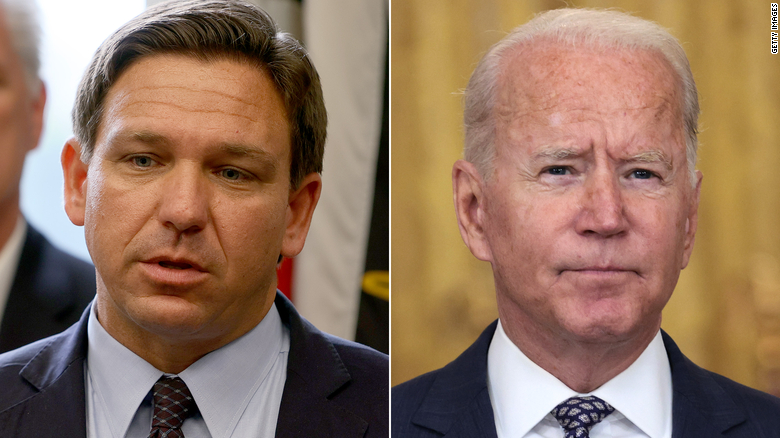
Internal documents show heated back-and-forth between DeSantis and Biden admin over care of migrant children

Internal documents show heated back-and-forth between DeSantis and Biden admin over care of migrant children

(CNN)An ongoing feud over President Joe Biden's immigration policies is escalating in Florida where Gov. Ron DeSantis is threatening to keep long-standing shelters from caring for migrant children, culminating in a heated back and forth unfolding in internal correspondence obtained by CNN. 

The Republican governor's office and the Biden administration are sparring over whether migrant children who arrive at the US-Mexico border alone should be cared for by shelters in Florida, as they have been since 2005. The children, who are in government custody, stay at shelters until they can be reunited with a vetted sponsor, like a parent or relative, in the United States.
DeSantis strategizes for his future while Trump obsesses over his election loss
But in a letter sent to the Health and Human Services Department last week, obtained by CNN, Florida's general counsel, Ryan Newman, alleged the federal government was participating in a "human trafficking scheme." HHS, which is responsible for the care of migrant children, said DeSantis' threat to revoke state licenses from shelters that take these migrants raises "serious legal concerns" and threatened to take the matter to the Justice Department.
    The spat pits DeSantis, a potential 2024 GOP presidential candidate, up against the Biden administration with migrant children in the middle, as evidenced in the leaked documents.
      In December, the DeSantis administration issued an emergency rule that would strip shelters caring for migrant minors in Florida of state licensing, and therefore oversight, if they accept new placements from the border, potentially affecting hundreds of children. 
        Unaccompanied migrant children have become a target for other GOP governors as well, following a surge of minors at the US southern border last year. Texas Gov. Greg Abbott, who's running for reelection and is a vocal critic of Biden, stripped his state shelters of licenses last year, leaving providers to operate without state oversight and largely without sufficient guardrails in the event something happened. And in Pennsylvania, Republican gubernatorial candidate Lou Barletta has cited flights carrying children to the state for care from the border in his criticism of the Biden administration. 
        US begins quietly flying Venezuelan migrants to Colombia under controversial border policy
        For years, minors largely from Central America have journeyed to the US-Mexico border seeking refuge -- often vexing officials in the Obama and Trump administrations. But the issue has taken on new life as Republicans try to elevate immigration and what they describe as poor management of the US-Mexico border ahead of the midterm elections, particularly as Biden's polling numbers sag. 
          "Historically, when we've talked about children, there's been nonpartisan agreement that children deserve protection," said Lisette Burton, chief policy and practice adviser at the Association of Children's Residential & Community services. "I haven't seen before a time where really vulnerable children have been put at the center of political arguments in this way."

          AMERICAN VOICES Voto Latino announces campaign to hold Sen. Sinema 'accountable