What To Do When You're Stopped By Police - The ACLU & Elon James White
What To Do When You're Stopped By Police - The ACLU & Elon James White
Know Anyone Who Thinks Racial Profiling Is Exaggerated? Watch This, And Tell Me When Your Jaw Drops.
This video clearly demonstrates how racist America is as a country and how far we have to go to become a country that is civilized and actually values equal justice. We must not rest until this goal is achieved. I do not want my great grandchildren to live in a country like we have today. I wish for them to live in a country where differences of race and culture are not ignored but valued as a part of what makes America great.
“The mandate requiring vaccines or weekly tests will come into effect on Jan. 4.
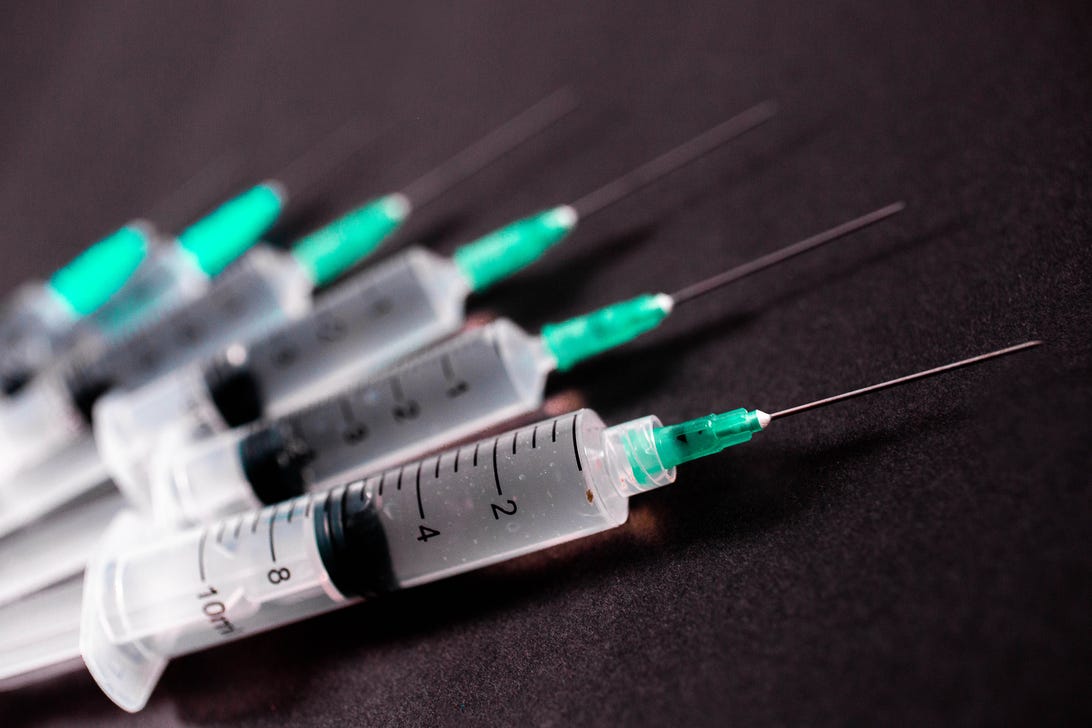
Vaccination or weekly testing has been mandated for employees at large companies.
Sarah Tew/CNET
For the most up-to-date news and information about the coronavirus pandemic, visit the WHO and CDC websites.
President Joe Biden's COVID-19 vaccine and testing mandate has been reinstated after a decision Friday by the US Court of Appeals for the Sixth Circuit in Cincinnati. It follows the mandate being temporarily blocked by a federal appeals panel in Louisiana last month.
The mandate requires employees at large companies of at least 100 workers to be vaccinated against COVID-19 or produce a weekly negative test, with the rules kicking in on Jan. 4, 2022. But the states of Louisiana, Texas, Utah, South Carolina and Mississippi joined with businesses as well as religious and advocacy organizations to file for a permanent injunction against the mandate.
"OSHA [the Occupational Safety and Health Administration] has demonstrated the pervasive danger that COVID-19 poses to workers -- unvaccinated workers in particular -- in their workplaces," the 2-1 ruling Friday said. "OSHA explains why the mechanics of COVID-19 transmission make our traditional workplaces ripe for the spread of the disease, putting workers at heightened risk of contracting it ... transmissibility is possible from those who are symptomatic, asymptomatic or presymptomatic, and variants are likely to be more transmissible."
"The number of deaths in America has now topped 800,000 and healthcare systems across the nation have reached the breaking point. COVID-19 affects individuals of all age groups; but on the whole 'working age Americans (18-64 years old) now have a 1 in 14 chance of hospitalization when infected with COVID-19,'" the ruling Friday added.
The information contained in this article is for educational and informational purposes only and is not intended as health or medical advice. Always consult a physician or other qualified health provider regarding any questions you may have about a medical condition or health objectives.“
Sixty were detained as the president met with the key Democrat who has become a roadblock to his agenda
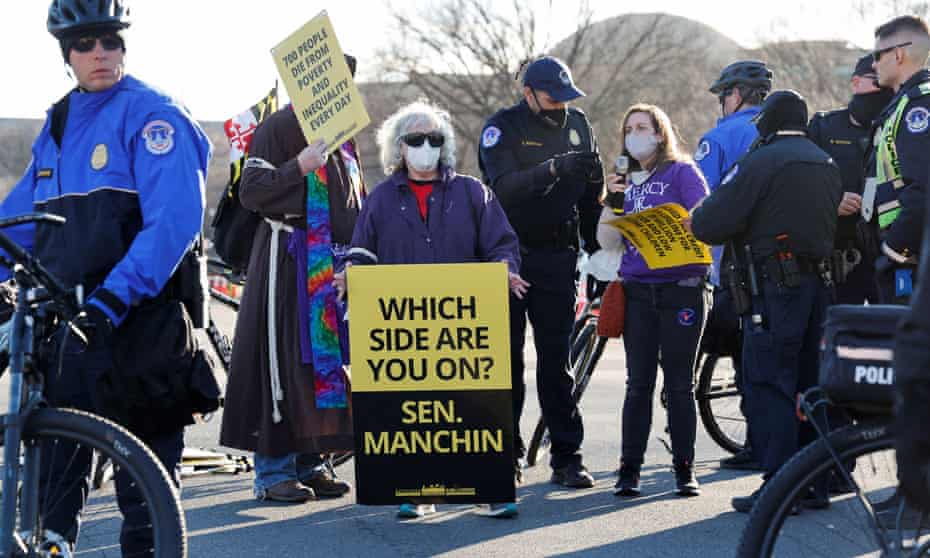
Protesters block traffic during a Poor People’s Campaign march near the Capitol in Washington DC. Photograph: Jonathan Ernst/Reuters
During a crucial week for Joe Biden’s agenda that will likely feature a political showdown on his Build Back Better legislation in the Senate, voting rights activists are turning up the pressure in Washington.
As the US president met with a key centrist Democrat who has acted as a roadblock to his plans – West Virginia Senator Joe Manchin - more than sixty demonstrators were arrested as they protested: singing songs and blocking traffic near the US Capitol.
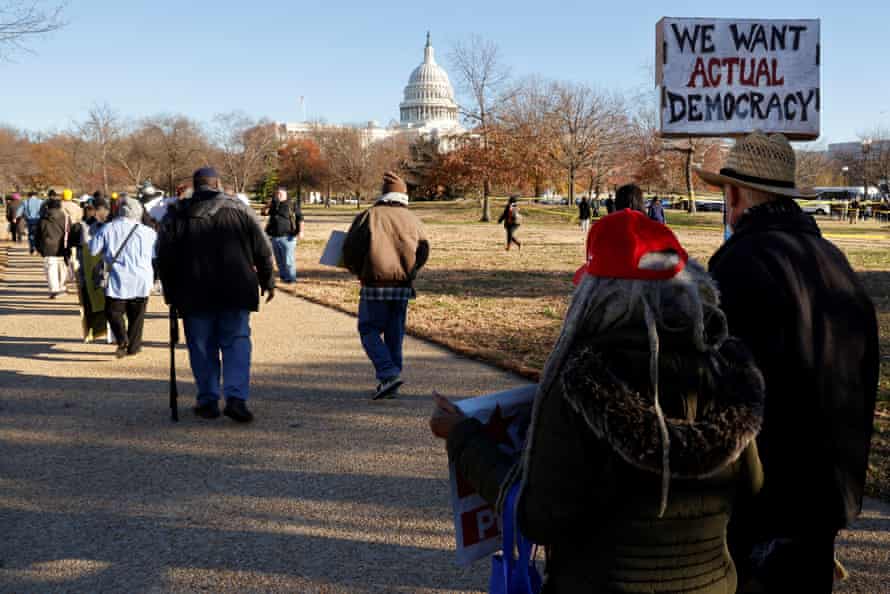
The diverse group of activists came to Washington from around the country and were focused primarily on issues around voting rights and poverty. When the focus turned to voting rights, the talk became more focused on Manchin and the White House’s apparent inability to apply all of its power to pass federal legislation to protect the vote.
“I think we’re moving the ball but we have to get it across the finish line – we’re going to have to keep pushing. They don’t need to be going home for Christmas. We need to get voting rights taken care of,” said Melanie Campbell, president of the National Coalition on Black Civic Participation, as she waited to speak to the assembled crowd of more than 500 people.
As news spread that Manchin was signaling he wants more changes to Biden’s already stripped back Build Back Better legislation because of his concerns over inflation, activists at the rally were not impressed.
“That’s his whole game. Slow it down, block it, get things get done for the billionaires, his corporate donors – then to undermine voting rights let all the voting suppression bills get passed that wouldn’t get passed if we had the Voting Rights Act restored and we had federal protection,” said the Rev William Barber, president of Repairers of the Breach.
“He’s a trickster. The president needs to go to West Virginia. Stop meeting with him in his office. Go to his state,” Barber added shortly before leading activists into a street protest.
Protesters join the march near the Capitol to urge Congress to pass Biden’s Build Back Better bill.Photograph: Jonathan Ernst/Reuters
With talk of direct actions and in-office protests directed at Manchin and others, Barber and other activists promised to apply more pressure on lawmakers this week.
Barber and several other voting rights activists have been frustrated by what they view as a lack of focus and from the Biden administration regarding voting rights.
Many have warned the White House that Biden’s 7m vote victory, buttressed by strong turnout in predominately Black cities such as Atlanta, Detroit, Philadelphia and Milwaukee, will be difficult to repeat without cementing the support of those same voters.
With 2022 midterm elections on the horizon, the urgency about which agenda items Biden will focus is a hot topic in the activists community.
“We go to the streets for non-violent direct action. This is just the precursor,” Barber told the crowd of activists.
“If you think this is an action, you watch how we mobilize when we don’t have to be so Covid safe,” said Barber.
“There is only one answer to nineteen states that have passed voter suppression laws. There’s only one answer to all this election subversion. There’s only one answer to all this work that they’re doing to purge people from election boards. There’s only one answer to gerrymandering. That is, ‘Pass the acts now!’” said Barbara Arwine, who leads the Transformative Justice Coalition to the crowd.
Arnwine was referring to the John Lewis Voting Rights Advancement Act. The bill would restore provisions in the Voting Rights Act of 1965 that were removed by the supreme court’s Shelby v Holder decision in 2013.
… we have a small favour to ask. Tens of millions have placed their trust in the Guardian’s high-impact journalism since we started publishing 200 years ago, turning to us in moments of crisis, uncertainty, solidarity and hope. More than 1.5 million readers, from 180 countries, have recently taken the step to support us financially – keeping us open to all, and fiercely independent.“
Kamala Harris discussed voting rights with Black women leaders in July. Advocates have said they are disappointed in the administration’s lack of leadership on the issue.Photograph: Nicholas Kamm/AFP/Getty Images
Leading voting rights activists came away frustrated and alarmed from what they hoped would be a breakthrough meeting last month at the White House to discuss a strategy to pass federal voting rights legislation.
There were high hopes for the 15 November teleconference between the White House and the leaders of the hundreds of groups that comprise the Declaration for American Democracy (Dfad), many of which have been campaigning hard for federal voting rights legislation.Kamala Harrishad agreed to stop by the meeting.
After Joe Biden gavea strong endorsementin late October of altering the Senate filibuster rulefor voting rights legislation, the activists hoped that the White House would lay out a course for getting thestalled billsthrough the US Senate.
Get the latest updates on voting rights in the Guardian’s Fight to vote newsletter
Instead, multiple people who attended the meeting said they didn’t hear any kind of plan from the White House.
The vice-president, who is leading the White House’s voting rights effort, arrived midway through the meeting and read just over six minutes of prepared remarks and then left without taking any questions, according to people who attended.
White House staffers stayed on the call and answered three questions from participants. “They did not lay out a strategy for getting this done,” said one person who attended, who requested anonymity to discuss a private meeting.
Cliff Albright, a co-founder of Black Voters Matter, also attended the meeting and said it felt like a “check-the-box kind of a call”.
“Nothing substantive came out of it,” he said. “It was very frustrating.”
A third participant was also critical of the way the White House handled the meeting.
“She said her five-minute remarks, which were the ‘same-old, same old’, and then she left”, said the person, who also requested that their name not be disclosed.
“We had hoped going into that meeting that after the president’s comments at the town hall that there would have been some sort of strategic shift, some sort of internal tactical thinking and planning done. It was, from that meeting, clear that no work had been done legislatively,” the person added. “They seemed pretty eager to talk about anything other than legislation.”
There is dismay that the senate could recess before the end of the year without passing voting rights bills, making itharder to implement sweeping voting changes ahead of fast-approaching primaries for the 2022 midterm elections. Alarm has escalated as Republicans in several crucial states have enactednew distorted electoral mapsthat will entrench their majorities for the next decade.
Chuck Schumer, the Democratic leader in the Senate, has said voting rights are a priority and his caucusis trying to finda way around the filibuster. But the plan remains unclear.
Harris has held meetings with voting advocates inSouth Carolina,GeorgiaandMichiganover the last few months to keep a spotlight on the issue. Shehas saidshe has spoken with Republican senators about a path forward on voting rights.
“The vice-president and this administration remain focused on passing the Freedom to Vote Act and the John Lewis Voting Rights Advancement Act. Senate Republicans have voted against even debating these bills, but the president and vice-president know that inaction and obstruction are not options,” deputy White House press secretary Sabrina Singh told the Guardian.
“Nothing comes without a fight, which is why the president and vice-president are working with Speaker Pelosi, leader Schumer, and advocates to protect our democracy and the fundamental right to vote,” she added, referring to the most senior Democrats in the House and Senate.
Albright said he asked staffers how the administration would, for example,halt excessive gerrymandering, but the response “just wasn’t satisfactory”.
“The worst situation to be in is to have responsibility without authority. And right now that is the definition of her [Harris’] voting rights portfolio. She’s got responsibility, but she does not have the authority to deal with the elephant in the room, the filibuster,” he said.
“She cannot go any farther out on the issue than her boss, Potus, is willing to go. And he has not yet demonstrated that he’s willing to go as far as he needs to.”
Lisa Gilbert, executive vice-president of the advocacy group Public Citizen, who helped organize the meeting, said she was encouraged by Harris’ attendance. “The vice-president doesn’t attend many coalition meetings. It’s actually a signifier, or at least we hope it is, of greater engagement from the White House, and the seriousness that the vice-president takes it with.”
Activists have been pressuring Biden for months to use his bully pulpit to more aggressively push for the voting rights bills. Demonstrators have been regularly convening outside the White House andgetting arrested.
“The frustration is not tied to that meeting. There has been a concern all year long that goes to the president and the White House with the failure to treat this existential threat as a top priority for the administration,” said Fred Wertheimer, the founder and president of Democracy 21, who also attended the meeting.
Jana Morgan, the director of Dfad, also said she was happy Harris attended the meeting and anticipated “increased engagement” from the White House.
In July, Biden gavea speechin Philadelphia that called for passing voting rights legislation, but didn’t say anything about the filibuster. Republicans have used the rule to block voting bills four separate times this year, in a chamber split 50-50 with the Democrats.
But then in October, Bidenmore explicitlyendorsed changing the filibuster on voting rights “and maybe more”.
But Biden urged patience, saying that pressuring reluctant Democrats on the filibuster could make it more difficult to pass other important pieces of legislation.
One of the participants in the meeting said staffers conveyed a similar message, saying voting rights legislation would have to wait until after the Senate dealt with theBuild Back Betterbill.
“We know what it’s like when the president treats something as a priority…But we know that we haven’t seen that when it comes to voting rights,” Wertheimer said.
… we have a small favour to ask. Tens of millions have placed their trust in the Guardian’s high-impact journalism since we started publishing 200 years ago, turning to us in moments of crisis, uncertainty, solidarity and hope. More than 1.5 million readers, from 180 countries, have recently taken the step to support us financially – keeping us open to all, and fiercely independent."
In Alabama, a Death Sentence for a Man Who Never Pulled the Trigger
"A New York Times documentary examines the case of Nathaniel Woods, who was sentenced to death for his role in the murders of three Birmingham police officers fatally shot by someone else.
transcript
The New York Times Presents: ‘To Live and Die in Alabama’
[MUSIC PLAYING] “Nathaniel was about to be executed.” “Mr. Woods didn’t shoot anybody. And the state didn’t even contend that he did.” “The fact that three white officers was dead, they were just wanting to put somebody away.” “I don’t forgive. It’s never going to go away.” “Somebody’s life is literally in your hands.” [PHONE LINE RINGING] “(CRYING) No, no, no, no, no, no.” “(WHISPERING) Don’t give up.”
The New York Times Presents
‘To Live and Die in Alabama’
Producer/DirectorMatt Kay Producer/ReporterAbby Ellin ProducersCydney Tucker and Lora Moftah ReporterDan Barry
Watch our new documentary on Friday, Dec. 3, at 10 p.m. on FX orstream it on Hulu.
“I won’t shoot no police officer,” Nathaniel Woods told investigators hours after three Birmingham police officers were killed in a violent shootout at an Alabama drug house. “Ain’t do nothing like that,” he said.
Indeed, Woods didn’t kill anyone on June 17, 2004, and he was unarmed when the officers — Carlos Owen, 58; Harley Chisholm III, 40; and Robert Bennett, 33 — were fatally shot while trying to arrest Woods on an outstanding warrant.
“I know this to be a fact because I’m the man that shot and killed all three of the officers,” the gunman, Kerry Spencer, said in a letter in support of Woods. He added: “Nathaniel Woods doesn’t even deserve to be incarcerated, let alone executed.”
Still, Woods, a Black man, was convicted of capital murder for his role in the deaths of the three white officers.
Alabama is one of 21 states where accomplices are considered just as complicit as the person who pulled the trigger, and prosecutors had successfully argued that Woods lured the officers into the house, where his partner Spencer gunned them down.
In Birmingham, in which a majority of residents are Black, a nearly all-white jury took less than three hours to recommend, on a 10-to-2 vote, that Alabama also execute Woods. The state has more people on death-row per capita than any other.
A new documentary by The New York Times examines the case of Woods, who never touched the gun used in the fatal shootings, but was punished all the same.
In the film, premiering Friday at 10 p.m. Eastern time on FX and Hulu, Woods and Spencer explained how they both wound up on death row, awaiting their fates. Woods’s family, his lawyers and even the sister of one of the officers shot by Spencer tried desperately to win a reprieve for Woods, up to the final minutes before his execution.
Andrea Elders, the daughter of Carlos Owens, one of the other slain police officers, shared the details of her devastating loss and said that she could never forgive Woods for his role in her father’s murder. Members of the jury described the difficult process of deciding whether or not to recommend the death penalty.
“Somebody’s life is literally in your hands,” one juror said.
Supervising ProducerLiz Day Senior ProducerRachel Abrams Directors of PhotographyMatt Kay, Victor Tadashi Suarez Video EditorPierre Takal
“The New York Times Presents” is a series of documentaries representing the unparalleled journalism and insight of The New York Times, bringing viewers close to the essential stories of our time."
A vaccine clinic in Johannesburg yesterday.Joao Silva/The New York Times
Last week, just days before scientists discovered the Omicron variant, South Africa’s government asked Johnson & Johnson and Pfizer not to make some planned deliveries of their Covid-19 vaccines. The country already had more doses in storage than it could use — about 16 million, in a country of 60 million people — and officials were worried that further supplies would spoil before they could be used.
How could that be?
The main answer should be familiar to Americans: vaccine skepticism. “There is a fair amount of apathy and hesitancy,” Dr. Shabir Madhi, a vaccination expert in South Africa,told Reuters. For similar reasons, Namibia, Zimbabwe, Mozambique and Malawi have asked donors to pause vaccine deliveries, my colleague Declan Walsh has reported.
The sources of the skepticism are different in the U.S. and in Africa. In much of Africa, they are related to decades of exploitation and poverty. In the U.S., the biggest cause is political polarization: More than 35 percent of Republican voters are unvaccinated,compared withfewer than 10 percent of Democrats.
But both forms of skepticism stem from distrust — of experts, institutions and government leaders. And that distrust has become a major reason that the world is struggling to defeat Covid. The more people remain unvaccinated, the more the Covid virus spreads and the more people die. Less vaccination also increases the chances that dangerous variants will emerge.
“I think that Covid is not real — they are playing with us, politicians and everyone,” Tidibatso Rakabe, a 20-year-old resident of a township near Pretoria, told The Times. She does not plan to be vaccinated.
After scientists in South Africa announced the discovery of Omicron, some commentators in the U.S. jumped to the conclusion that unequal vaccine distribution between rich and poor countries was the cause. But that’s not quite right, as the stories of Africa’s unused vaccines make clear. (Plus, Omicronmay not have originated in Africa.)
The airport drop
Unequal vaccine access was a major issue earlier this year. High-income countries were faster to order vaccines and could afford more of them initially. They also had the infrastructure to produce and distribute the shots. India and South Africa areamong the few lower-income countriesthat manufacture Covid vaccines.
As a result, even residents of many low-income countries who were eager to receive vaccines often had to wait weeks or months to do so.
Today, though, a simple lack of access is less of a problem in many places. The U.S. and other rich countries are distributing hundreds of millions of doses for free, and pharmaceutical companies are selling others at a discounted price, often less than $10 a dose. In many poor countries, vaccinating the entire adult population would cost significantly less than 1 percent of annual G.D.P.
It still is not close to happening, however. Worldwide, about 56 percent of people have received at least one vaccine dose.Every continentis above 50 percent except for Africa — which is at about 10 percent. In South Africa, the share is 29 percent.
One problem is a lack of public health infrastructure in poorer countries, especially in rural areas, as Lynsey and Max note in their article. There often are not places to store the vaccines or people to administer to them. Governments have also failed to explain the vaccines’ importance to their citizens.
“Almost no investment in vaccine education or promotion has gone into low-income countries,” Dr. Saad Omer, a Yale University epidemiologist, said. “Why do we expect that all we will have to do is drop vaccines at an airport, do the photo op, and people will come running to the airport and grab the vaccine?”
A legacy of mistreatment
The lack of vaccine education plays into an underlying mistrust of many medical treatments, especially those that come from other countries. That mistrust has its roots in a history of horrific experiments under colonialism.
In present-day Namibia during the early 1900s, German officials sterilized some local residents, injected others with arsenic and deliberately infected people with smallpox, typhus and tuberculosis (asthis Times essayby Kavena Hambira and Miriam Gleckman-Krut explains).
Such direct harm became less common in the second half of the 20th century, but mistreatment was still common. Drug companies sometimes conducted research trials without people’s consent. Only a decade ago, Pfizer made financial payments to the parents of dead children in Nigeria aftera research trial went wrong.
Arguably the biggest source of modern distrust in southern Africa is H.I.V. After inventing lifesaving treatments, Western pharmaceutical companies initially kept their prices too high for many Africans to afford, and governments did not fix the situation for years. In South Africa, Zimbabwe and some other countries, life expectancy fellby more than a decadefrom 1990 to 2005 — a decline with little modern equivalent.
Given this history, it’s not exactly surprising that many Africans are skeptical of the Covid vaccines, even though all available evidence suggests they safe and effective. Online misinformation exacerbates the problem, as it does in the U.S.
Ina survey of 15 African countriesdone late last year, 49 percent of respondents said they believed rumors that Covid was planned by a foreign actor and 45 percent said they believed Africans were being used as guinea pigs in vaccine research trials. Those misperceptions are costing people their lives."
Omicron Variant, in at Least 20 Nations, Spread Earlier Than Was Known
"With evidence growing that a worrisome new coronavirus variant is highly contagious, health officials issued warnings that vulnerable people should not travel.
A Covid vaccination in Johannesburg, South Africa, on Tuesday.Joao Silva/The New York Times
The heavily mutated new coronavirus variant was in Europe several days earlier than previously known, health officials said Tuesday, and the number of countries where it has been found increased to at least 20, raising questions about whether the pandemic is about to surge once again.
The Netherlands’ National Institute for Public Health and the Environment said that samples taken on Nov. 19 and Nov. 23 — before the Nov. 24 announcement of Omicron’s existence —tested positive for the variant. Health officials have notified the two infected people and are doing contact tracing to try to limit the spread.
Mutations inthe Omicron variantstrongly suggest that it is more contagious than previous forms of the virus, scientists say. They caution that they cannot be sure without more testing and data, but the evidence so far is sobering.
Late Tuesday night, the U.S. Centers for Disease Control and Prevention said it planned to toughen coronavirus testing and screening of people flying to the United States by requiring all international passengers to provide a negative result from a test taken within 24 hours of departure.
“C.D.C. is working to modify the current global testing order for travel as we learn more about the omicron variant,” said an agency spokesman, Jason McDonald.
The concern is that the current rules, which allow fully vaccinated people to take a test up to three days before departing on a flight to the United States, might not be stringent enough.
Travelers from South Africa being tested for Covid-19 on arrival at Schiphol Airport in Amsterdam.Remko De Waal/ANP, via Agence France-Presse
A day after warning that the risk from Omicron was “very high,” the World Health Organization on Tuesday said that unvaccinated people who are over age 60, are sick or have underlying health risks “should be advised to postpone travel.” In Greece, the prime minister announced that Covid vaccinations would be obligatory for people age 60 and older, and that those who failed to book a first shot by Jan. 16 would face fines.
In South Africa, where the variant was first announced and is already widespread, reported new coronavirus cases have rocketed from about 300 a day in mid-November to about 3,000 a day, the fastest rate of increase in the world. On two flights from South Africa to the Netherlands on Friday, just as a cascade of bans on travel from southern Africa were being announced, 61 passengers tested positive for the virus, at least 14 of them for Omicron.
In addition to the question of Omicron’s transmissibility, scientists still don’t have other answers the world is clamoring for: Are vaccines less effective against it? Are treatments? Does Omicron cause more serious illness?
Experts cautioned not to put too much stock in reports that the variant is causing only mild illness, because the data is still sparse. Early evidence from South Africa indicates that Omicron, more than previous variants, is infecting people who had already had Covid-19, but that, too, requires rigorous testing.
“It’s going to be two to four weeks, possibly a bit sooner,” before preliminary answers are available, Dr. Anthony S. Fauci, the top U.S. infectious disease expert, said Tuesday at a White House briefing.
As of Tuesday evening, no Omicron cases had been reported in the United States, though the variant has been detected in Canada. U.S. officials say that it is just a matter of time, and that the goal should be to slow its spread.
Brazilian media reported Tuesday that the variant had turned up in Brazil, which would mean it is already on every continent but Antarctica.
The U.S. Centers for Disease Control and Prevention is sequencing the genomes of 80,000 coronavirus samples weekly — about one-seventh of all the positive P.C.R. lab tests in the country — and will step up checks on arriving international passengers, the agency’s director, Dr. Rochelle P. Wollensky, said at the White House.
The Temple Underground station in London on Tuesday. British officials say they expect Omicron infections to rise.Matt Dunham/Associated Press
The variant has a very large number of mutations not seen in combination before, about 50, including more than 30 on the “spike” protein it uses to latch onto host cells; the spike is the primary target of the vaccines. That high degree of mutation is behind the fears about Omicron, and the uncertainty over whether those fears are overblown.
Several times before, nations have relaxed their guard, thinking that the worst of the pandemic was behind them, only to be swamped by another wave — most recently the one caused by the highly contagious Delta variant.
Vaccine makers are already looking into reformulating their shots to address Omicron, a step that was not required for fighting Delta.
And Regeneron, maker of an effective, injected monoclonal antibody treatment for Covid, said Tuesday that its therapymight not work as wellagainst Omicron. A U.S. Food and Drug Administration advisory panel on Tuesday recommended approval of an oral treatment to reduce the severity of Covid, made by Merck, and will soon consider another from Pfizer.
In previous waves of the pandemic, by the time the first cases of the virus or a particular variant were detected, in reality there were vastly more and it was already widespread.
But the world’s supply of vaccines has gone primarily to the wealthiest countries, where many people have now received three shots before the vast majority of Africans have had even one. As long as many people are unvaccinated, the pandemic will continue and new variants will emerge.
“Vaccine equity is not charity; it’s in every country’s best interests,” Dr. Tedros Adhanom Ghebreyesus, head of the W.H.O., said Monday at the start of a conference intended to produce an international treaty to coordinate disease response.
“The time has come for countries to agree on a common, binding approach to a common threat that we cannot fully control nor prevent,” he said.
Travelers returning to South Africa at the O.R. Tambo International Airport in Johannesburg on Saturday.Joao Silva/The New York Times
Vaccine doses are in fact becoming more plentiful, but African countries still face challenges in distribution and overcoming vaccine hesitancy. South Africa recentlyturned away a shipment, unsure that it could use the doses in time.
The Coronavirus Pandemic: Key Things to Know
A new type of treatment.An expert panel voted to recommend that the F.D.A. authorize aCovid pill from Merck for high-risk adults, the first in anew class of antiviral drugs that could work against a wide range of variants, including Omicron. The pill could be authorized within days, and available by year’s end.
The new variant was first found in Botswana on Nov. 11 and days later in neighboring South Africa, where its genome was sequenced by scientists who announced its existence two weeks later. Researchers in South Africa have found it in samples from as long ago as Nov. 9, and experts have said it was likely that further testing of old samples would show that it was circulating even earlier.
In Europe, the number of cases confirmed is small so far, under 100, but officials are bracing for more.
“Is there likely to be community transmission?” Sajid Javid, the British health secretary, said at a news conference. “I think we have to be realistic: There is likely to be, as we are seeing in other European countries. We would expect cases to rise as we now actively look for cases.”
The timing is dismal for a continent already gripped by the biggest pandemic wave yet, forcing governments to drastically scale back plans to remain open for the holidays.
European countries are reporting more than two million new coronavirus cases each week, more than half the world’s total, although with vaccinations and improved treatments, deaths have declined compared with a year ago. Germany, the Netherlands, Belgium, Hungary, the Czech Republic, Slovakia, Denmark and Norway all set records for new cases last week; several others hit new highs earlier in November.
Governments in the United States, Europe and elsewhere have barred entry by people — usually with the exception of their own residents — who have recently been in South Africa and several neighboring countries.
But the experience of the two flights that arrived in Amsterdam on Friday night from South Africa shows how late such measures might be.
Closed check-in counters at the O.R. Tambo International Airport in Johannesburg on Tuesday after many flights were canceled.Kim Ludbrook/EPA, via Shutterstock
With the travel ban taking effect, all the passengers were tested, and more than one in 10 had the virus; how many other infected travelers have gone undetected is anyone’s guess.
Not only did 14 of the passengers from South Africa have the Omicron variant — which was not yet known to the world when they took off — but they also had several different versions of it, the Dutch public health institute said.
“This means,” it said, “that the people were very probably infected independently from each other, from different sources and in different locations.”
Reporting was contributed byCora Engelbrecht,Noah Weiland,Rebecca Robbins,Carl Zimmer,Megan Specia,Mark Landler,Michael D. ShearandSheryl Gay Stolberg"