Contact Me By Email


What To Do When You're Stopped By Police - The ACLU & Elon James White

What To Do When You're Stopped By Police - The ACLU & Elon James White

Know Anyone Who Thinks Racial Profiling Is Exaggerated? Watch This, And Tell Me When Your Jaw Drops.


This video clearly demonstrates how racist America is as a country and how far we have to go to become a country that is civilized and actually values equal justice. We must not rest until this goal is achieved. I do not want my great grandchildren to live in a country like we have today. I wish for them to live in a country where differences of race and culture are not ignored but valued as a part of what makes America great.

Sunday, May 02, 2021

G.O.P. Seeks to Empower Poll Watchers, Raising Intimidation Worries - The New York Times

G.O.P. Seeks to Empower Poll Watchers, Raising Intimidation Worries

By
 
NICK CORASANITI 
The New York Times

    Republicans in several states are pushing bills to give poll watchers more autonomy. Alarmed election officials and voting rights activists say it’s a new attempt to target voters of color.

    A man filling out his ballot last year at a voting site in Houston. Republicans in the largely white suburbs of the city have often sought to deploy poll watchers to areas downtown with more voters of color.Credit...David J. Phillip/Associated Press
    A man filling out his ballot last year at a voting site in Houston. Republicans in the largely white suburbs of the city have often sought to deploy poll watchers to areas downtown with more voters of color.Credit...David J. Phillip/Associated Press

    HOUSTON — The red dot of a laser pointer circled downtown Houston on a map during a virtual training of poll watchers by the Harris County Republican Party. It highlighted densely populated, largely Black, Latino and Asian neighborhoods.

    “This is where the fraud is occurring,” a county Republican official said falsely in a leaked video of the training, which was held in March. A precinct chair in the northeastern, largely white suburbs of Houston, he said he was trying to recruit people from his area “to have the confidence and courage” to act as poll watchers in the circled areas in upcoming elections.

    A question at the bottom corner of the slide indicated just how many poll watchers the party wanted to mobilize: “Can we build a 10K Election Integrity Brigade?”

    As Republican lawmakers in major battleground states seek to make voting harder and more confusing through a web of new election laws, they are simultaneously making a concerted legislative push to grant more autonomy and access to partisan poll watchers — citizens trained by a campaign or a party and authorized by local election officials to observe the electoral process.

    This effort has alarmed election officials and voting rights activists alike: There is a long history of poll watchers being used to intimidate voters and harass election workers, often in ways that target Democratic-leaning communities of color and stoke fears that have the overall effect of voter suppression. During the 2020 election, President Donald J. Trump’s campaign repeatedly promoted its “army” of poll watchers as he publicly implored supporters to venture into heavily Black and Latino cities and hunt for voter fraud.

    Republicans have offered little evidence to justify a need for poll watchers to have expanded access and autonomy. As they have done for other election changes — including reduced early voting, stricter absentee ballot requirements and limits on drop boxes — they have grounded their reasoning in arguments that their voters want more secure elections. That desire was born in large part out of Mr. Trump’s repeated lies about last year’s presidential contest, which included complaints about insufficient poll watcher access.

    Now, with disputes over the rules governing voting now at a fever pitch, the rush to empower poll watchers threatens to inject further tension into elections.

    Both partisan and nonpartisan poll watching have been a key component of American elections for years, and Republicans and Democrats alike have routinely sent trained observers to the polls to monitor the process and report back on any worries. In recent decades, laws have often helped keep aggressive behavior at bay, preventing poll watchers from getting too close to voters or election officials, and maintaining a relatively low threshold for expelling anyone who misbehaves.

    But now Republican state lawmakers in 20 states have introduced at least 40 bills that would expand the powers of poll watchers, and 12 of those bills in six states are currently progressing through legislatures, according to the Brennan Center for Justice.

    In Texas, the Republican-controlled Legislature is advancing legislation that would allow them to photograph and video-record voters receiving assistance, as well as make it extremely difficult for election officials to order the removal of poll watchers.

    The video-recording measure has particularly alarmed voting rights groups, which argue that it could result in the unwanted identification of a voter in a video posted on social media, or allow isolated incidents to be used by partisan news outlets to craft a widespread narrative.

    “If you have a situation, for example, where people who are poll workers do not have the ability to throw out anybody at the polls who is being disruptive or anyone at the polls who is intimidating voters, that’s essentially authorizing voter intimidation,” said Jon Greenbaum, chief counsel for the nonpartisan Lawyers’ Committee for Civil Rights Under Law.

    Republicans have been increasingly open in recent years about their intent to line up legions of supporters to monitor the polls. Following the lead of Mr. Trump, they have often framed the observational role in militaristic tones, amplifying their arguments of its necessity with false claims of widespread fraud. Just three years ago, the courts lifted a consent decree that for more than three decades had barred the Republican National Committee from taking an active role in poll watching; in 2020, the committee jumped back into the practice.

    In Florida, Republicans in the State Legislature passed a new election bill on Thursday that includes a provision allowing one partisan poll watcher per candidate on the ballot during the inspection of votes. The measure carries the potential to significantly overcrowd election officials. The bill also does not stipulate any distance that poll watchers must keep from election workers.

    In Michigan, a G.O.P. bill would allow challengers to sit close enough to read poll books, tabulators and other election records, and would let them challenge a voter’s eligibility if they had “a good reason.”

    The Republican drive to empower poll watchers adds to the mounting evidence that much of the party continues to view the 2020 election through the same lens as Mr. Trump, who has repeatedly argued that his losses in key states must have been because of fraud.

    Credit...Doug Mills/The New York Times

    “It seems like the No. 1 goal of these laws is to perpetuate the Big Lie,” said Dale Ho, the director of the Voting Rights Project at the A.C.L.U. “So when you get these unfounded charges that there was fraud or cheating in the election and people say, ‘Well, that’s not detected,’ the purveyors of these lies say, ‘That’s because we weren’t able to observe.’”

    After the election last year, complaints that poll watchers had not been given enough access, or that their accusations of improperly cast ballots had been ignored, fueled numerous lawsuits filed by the Trump campaign and its Republican allies, nearly all of which failed.

    In Texas, the leaked video of the Harris County Republican Party’s training, which was published by the voting rights group Common Cause, recalled a similar episode from the 2010 midterm elections.

    That year, a Tea Party-affiliated group in Houston known as the King Street Patriots sent poll watchers to downtown polling locations. The flood of the mostly white observers into Black neighborhoods caused friction, and resurfaced not-too-distant memories when racial intimidation at the polls was commonplace in the South.

    The King Street Patriots would eventually evolve into True the Vote, one of the major national organizations now seeking more voting restrictions. Last year, True the Vote joined several lawsuits alleging fraud in the election (all failed) and led countrywide drives to try to recruit more poll watchers.

    Access for poll watchers is considered sacred by Texas Republicans; in the Legislature, they cited the difficulty in finding observers for drive-through voting and 24-hour voting as one of their reasons for proposing to ban such balloting methods.

    “Both parties want to have poll watchers, need to have poll watchers present,” State Senator Bryan Hughes, a Republican who sponsored the chamber’s version of the bill, said in an interview last month. “That protects everyone.”

    While the antagonistic language from the Trump campaign about its poll watchers was already a flash point in November, Democrats and voting rights groups are worried that relaxed rules will lead to more reports of aggressive behavior.

    In 2020, there were at least 44 reports of inappropriate behavior by poll watchers in Harris County, according to county records obtained by The New York Times.

    At one polling site on the outskirts of Houston, Cindy Wilson, the nonpartisan election official in charge, reported two aggressive poll watchers who she said had bothered voters and repeatedly challenged the staff.

    “Two Poll watchers stood close to the black voters (less than 3 feet away) and engaged in what I describe as intimidating behavior,” Ms. Wilson wrote in an email to the Harris County clerk that was obtained by The Times through an open records request.

    Ms. Wilson said she was not sure which campaign or party the observers were representing.

    Of course, plenty of interactions with poll workers went smoothly. Merrilee C. Peterson, a poll watcher for a local Republican candidate, worked at a different site, the NRG Arena, and reported no tensions of note.

    “We still had some of the problems of not thinking we were allowed to get close enough to see,” she said. “But once the little kinks were worked out, quite frankly we worked very well with the poll workers.”

    In Florida, crowding was the chief concern of election officials.

    Testifying before state senators, Mark Earley, the vice president of the Florida Supervisors of Elections, said that “as an association, we are very concerned” about the number of poll watchers who would now be allowed to observe the process of duplicating a voter’s damaged or erroneously marked ballot. He said it presented “very grave security risks.”

    Mr. Earley was backed by at least one Republican, State Senator Jeff Brandes, who found the provision for poll watchers unnecessary and dangerous.

    “I don’t think we should have to install risers in the supervisor of elections offices or bars by which they can hang upside down in order to ensure that there is a transparent process,” Mr. Brandes said.

    But perhaps no other state had a conflict involving poll watchers erupt onto cable news as Michigan did. On Election Day and the day after in November, Republican poll watchers grew increasingly obstructive at the TCF Center in Detroit, where absentee ballots were counted as it became clear that Mr. Trump was losing in the state.

    It began with a huddle of Republican observers around midday on Nov. 4, according to affidavits from Democratic poll watchers, nonpartisan observers and election officials.

    Soon after, the Republicans “began to fan out around the room,” wrote Dan McKernan, an election worker.

    Then they ramped up their objections, accusing workers of entering incorrect birth years or backdating ballots. In some cases, the poll watchers lodged blanket claims of wrongdoing.

    “The behavior in the room changed dramatically in the afternoon: The rage in the room from Republican challengers was nothing like I had ever experienced in my life,” wrote Anjanette Davenport Hatter, another election worker.

    Mr. McKernan wrote: “Republicans were challenging everything at the two tables I could see. When the ballot envelope was opened, they would say they couldn’t see it clearly. When the next envelope was opened, they made the same complaint. They were objecting to every single step down the line for no good reason.”

    The chaos provided some of the basis for Michigan officials to debate whether to certify the results, but a state board did so that month.

    Now, the Republican-controlled Legislature in Michigan is proposing to bar nonpartisan observers from acting as poll watchers, allowing only partisan challengers to do so.

    While widespread reports of intimidation never materialized last year, voting rights groups say the atmosphere after the election represents a dangerous shift in American elections.

    “It really hasn’t been like this for decades, generally speaking, even though there’s a long and storied history of it,” said Michael Waldman, a legal expert at the Brennan Center. Aggressive partisan poll watchers, he said, were “a longstanding barrier to voting in the United States, and it was also largely solved. And this risks bringing it back.”

    G.O.P. Seeks to Empower Poll Watchers, Raising Intimidation Worries - The New York Times

    Black Freedmen struggle for recognition as tribal citizens

    Black Freedmen struggle for recognition as tribal citizens

    By
     
    SEAN MURPHY 
    The Associated Press
    4 min

    OKLAHOMA CITY (AP) — As the U.S. faces a reckoning over its history of racism, some Native American tribal nations that once owned slaves also are grappling with their own mistreatment of Black people.

    When Native American tribes were forced from their ancestral homelands in the southeastern United States to what is now Oklahoma in the 1800s — known as the Trail of Tears — thousands of Black slaves owned by tribal members also were removed and forced to provide manual labor along the way. Once in Oklahoma, slaves often toiled on plantation-style farms or were servants in tribal members’ homes.

    Nearly 200 years later, many of the thousands of descendants of those Black slaves, known as Freedmen, are still fighting to be recognized by the tribes that once owned their ancestors. The fight has continued since the killing of George Floyd last year by a Minneapolis police officer spurred a reexamination of the vestiges of slavery in the U.S.

    CHEROKEE NATION FREEDMEN

    The Cherokee, Chickasaw, Choctaw, Muscogee (Creek) and Seminole nations were referred to historically as the Five Civilized Tribes, or Five Tribes, by European settlers because they often assimilated into the settlers’ culture, adopting their style of dress and religion, and even owning slaves. Each tribe also has a unique history with Freedmen, whose rights were ultimately spelled out in separate treaties with the U.S.

    Today, the Cherokee Nation is the only tribe that fully recognizes the Freedmen as full citizens, a decision that came in 2017 following years of legal wrangling.

    “I think that we are a better tribe for having not only embraced the federal court decision but embraced the concept of equality,” said Cherokee Nation Chief Chuck Hoskin Jr., a longtime supporter of citizenship rights for the Freedmen.

    The Cherokee Nation, among the largest Native American tribes, has about 5,800 Freedmen citizens who have traced an ancestor on the tribe’s original Freedmen rolls in the late 19th century.

    When the federal government sought to break up tribal reservations into individual allotments after the Civil War, they created two separate tribal rolls — one for members with American Indian blood and one for Freedmen. In many cases, tribal citizens who appeared Black were placed on the Freedmen rolls, even if they had blood ties to the tribe.

    Of the Five Tribes, only the Chickasaw Nation never agreed to adopt the Freedmen as citizens, according to the Oklahoma Historical Society.

    SEMINOLE NATION CONTROVERSY

    The Wewoka-based Seminole Nation in particular faces fierce criticism after several Black tribal citizens were denied COVID-19 vaccines at a federally operated American Indian health clinic.

    LeEtta Sampson-Osborn, a Seminole Freedman who has a tribal identification card and serves on the tribe’s governing council, said she sought a vaccine in February at a clinic operated by the Indian Health Service, an agency within the U.S. Department of Health and Human Services. She said a worker told her the Seminole Nation doesn’t recognize Freedmen for health services. When she asked for additional explanation, the worker called over a tribal police officer, she said.

    “So, I left,” said Osborne-Sampson. “Even the worst person would try to help when there’s a pandemic all over the world, but they don’t care about the Freedmen. I feel like they want us to die.”

    Three other Seminole Freedmen shared similar experiences with The Associated Press about the same clinic.

    The Seminole Nation says the decision about whether to provide vaccines to Seminole Freedmen rests with the IHS, not the tribe.

    “To be clear, the Seminole Nation does not operate the Wewoka Indian Health Services clinic, has absolutely no policy oversight and was in no way involved with administering COVID-19 vaccines,” Seminole Nation Chief Greg Chilcoat said in a statement.

    The agency said in a statement that it was reviewing eligibility of Seminole Freedmen and will be working with the tribe to determine what services IHS will provide.

    FIGHTING FOR CITIZENSHIP

    Seminole Freedmen say they are unable to receive services other tribal citizens get, including health care, tribal license plates and housing subsidies. The Seminole Freedmen have been fighting for years to be recognized as full tribal citizens in legal battles that underscore the systemic racism that Freedmen from all Oklahoma-based tribes say they have experienced from tribal governments and their members.

    Many Seminole Freedmen are descendants of freed Black slaves who joined the Seminoles in Florida during their wars against the U.S. government.

    “We fought in three wars with them to get where we’re at, and now they’ve turned against us,” said Anthony Conley, who also said he was denied a vaccine at the clinic.

    Conley said he believes racism and an unwillingness of tribal citizens to share tribal funds is at the core of the tribe’s decision to exclude Freedmen from full citizenship, a claim that Chilcoat disputes.

    TRIBAL SOVEREIGNTY

    The Muscogee (Creek) and Choctaw nations have cited tribal sovereignty as reasons for their opposition to citizenship for Freedmen. When Democratic U.S. Rep. Maxine Waters of California last year attempted to force the tribes to reconcile the Freedmen issue by inserting language into a housing bill, Choctaw Nation Chief Gary Batton said the U.S. government is responsible for the Freedmen’s plight, not the Choctaw Nation.

    “There is no more fundamental element of tribal self-governance than the authority of a Tribe like the Choctaw Nation to determine our own citizenship,” Batton wrote in a letter to House Speaker Nancy Pelosi.

    Ultimately, it might be a decision for the federal courts to make. Osborne-Sampson said she and other Freedmen are consulting with an attorney on how to proceed."

    Black Freedmen struggle for recognition as tribal citizens

    Saturday, May 01, 2021

    COVID 'Doesn't Discriminate By Age': Serious Cases On The Rise In Younger Adults

    COVID 'Doesn't Discriminate By Age': Serious Cases On The Rise In Younger Adults

    “After spending much of the past year tending to elderly patients, doctors are seeing a clear demographic shift: young and middle-aged adults make up a growing share of the patients in COVID-19 hospital wards. 

    It's both a sign of the country's success in protecting the elderly through vaccination and an urgent reminder that younger generations will pay a heavy price if the outbreak is allowed to simmer in communities across the country.

    "We're now seeing people in their 30s, 40s and 50s — young people who are really sick," says Dr. Vishnu Chundi, an infectious disease physician and chair of the Chicago Medical Society's COVID-19 task force. "Most of them make it, but some do not. ... I just lost a 32-year-old with two children, so it's heartbreaking." 

    Nationally, adults under 50 now account for the most hospitalized COVID-19 patients in the country — about 35% of all hospital admissions. Those age 50 to 64 account for the second-highest number of hospitalizations, or about 31%. Meanwhile, hospitalizations among adults over 65 have fallen significantly.

    More than 30% of the U.S. population is now fully vaccinated, but the vast majority are people older than 65 – a group that was prioritized in the initial phase of the vaccine rollout.

    While new infections are gradually declining nationwide, some regions have contended with a resurgence of the virus in recent months — what some have called a "fourth wave" — propelled by the B.1.1.7 variant, first identified in the U.K., which is estimated to be somewhere between 40% and 70% more contagious. 

    As many states ditch pandemic precautions, this more virulent strain still has ample room to spread among the younger population, which remains broadly susceptible to the disease. 

    The emergence of more dangerous strains of the virus in the U.S. — the B.1.1.7, as well as other variants first discovered in South Africa and Brazil — has made the vaccination effort all the more urgent. 

    "We are in a whole different ballgame," says Judith Malmgren, an epidemiologist at the University of Washington.

    Rising infections among young adults create a "reservoir of disease" that eventually "spills over into the rest of society" — one that has yet to reach herd immunity — and portends a broader surge in cases, she says. 

    Fortunately, the chance of dying from COVID-19 remains very small for people under the age of 50, but this age group can become seriously ill or suffer from long-term symptoms after the initial infection. People with underlying conditions such as obesity and heart disease are also more likely to become seriously ill. 

    "B.1.1.7 doesn't discriminate by age, and when it comes to young people, our messaging on this is still too soft," says Malmgren. 

    Hospitals filled with younger, sicker people

    Across the country, the influx of younger patients with COVID-19 has startled clinicians who describe hospital beds filled with patients, many of whom appear sicker than what was seen during previous waves of the pandemic. 

    "A lot of them are requiring ICU care," says Dr. Michelle Barron, head of infection prevention and control at UCHealth, one of Colorado's large hospital systems, as compared with earlier in the pandemic.

    The median age of COVID-19 patients at UCHealth hospitals has dropped by more than a decade in the past few weeks, from 59 down to about 48 years old, says Barron. 

    "I think we will continue to see that, especially if there's not a lot of vaccine uptake in these groups," she says. 

    While most hospitals are far from the onslaught of illness seen during the winter, the explosion of cases in Michigan underscores the potential fallout of loosening restrictions when a large share of adults are not yet vaccinated. 

    There's strong evidence that all three vaccines being used in the U.S. provide good protection against the U.K. variant. 

    One recent study suggests that the B.1.1.7 variant doesn't lead to more severe illness, which was previously thought. However, patients infected with the variant appear to be more likely to have more of the virus in their bodies than those with the previously dominant strain, which may help explain why it spreads more easily.

    "We think that this may be causing more of these hospitalizations in younger people," says Dr. Rachael Lee at the University of Alabama-Birmingham hospital.

    Lee's hospital also has observed an uptick in younger patients. Like in other Southern states, Alabama has a low rate of vaccine uptake. 

    But even in Washington state, where much of the population is opting to get the vaccine, hospitalizations have been rising steadily since early March, especially among young people. 

    In the Seattle area, more people in their 20s are now being hospitalized for COVID-19 than people in their 70s, according to Seattle King County Public Health Chief Health Officer Dr. Jeff Duchin. 

    "We don't yet have enough younger adults vaccinated to counteract the increased ease with which the variants spread," said Duchin at a recent press briefing. 

    Nationwide, about 32% of people in their 40s are fully vaccinated, compared with 27% of people in their 30s. That share drops to about 18% for 18- to 29-year-olds.

    "I'm hopeful that the death curve is not going to rise as fast, but it is putting a strain on the health system," says Dr. Nathaniel Schlicher, an emergency physician and president of the Washington State Medical Association. 

    Schlicher, also in his late 30s, recalls with horror two of his recent patients — close to his age and previously healthy — who were admitted with new onset heart failure caused by COVID-19. 

    "I've seen that up close and that's what scares the hell out of me," he says.

    "I understand young people feeling invincible, but what I would just tell them is — don't be afraid of dying, be afraid of heart failure, lung damage and not being able to do the things that you love to do."

    Will younger adults get vaccinated? 

    Doctors and public health experts hope that the troubling spike in hospitalizations among the younger demographic will only be temporary — one that vaccines will soon counteract. 

    It was only April 19 that all adults became eligible for a COVID-19 vaccine, although they were available in some states much sooner.

    But there are some concerning national polls that indicate a sizable portion of teens and adults in their 20s and 30s don't necessarily have plans to get vaccinated. 

    "We just need to make it supereasy — not inconvenient in any way," says Malmgren, the Washington epidemiologist. "We have to put our minds to it and think a little differently." 

    She recommends more outreach through social media platforms or even at bars and other places where younger people hang out. Two bars in New Orleans tried this tactic earlier this month — one even offered a free shot to customers who got vaccinated. 

    When Chicago physician Vishnu Chundi talks to the families of his COVID-19 patients, he generally doesn't hear resistance to getting the vaccine so much as a sense of complacency about getting it done quickly. 

    "You have to be motivated to go to these places, you have to get two vaccines now — it's a process," he says. "If it's available for them, they're going to go pick up coffee somewhere and it's there — yes, they'll get vaccinated." 

    Ignorant "Georgia Man" Gov. Kemp lifts most remaining COVID-19 restrictions effective immediately

    Gov. Kemp lifts most remaining COVID-19 restrictions effective immediately

    ATLANTA — Gov. Brian Kemp has signed an executive order lifting most of the state’s remaining coronavirus restrictions.

    That means safety restrictions on places like restaurants, bars and gyms will be gone starting Saturday.

    Channel 2′s Justin Wilfon talked with one restaurant owner tonight who said the lifting of the restrictions is coming a little too soon for him and that he’ll be keeping the restrictions in place at his restaurant.

    But for so many of these restaurants across the state, they’ve been struggling, and they welcome this news from the governor.

    Leading the Charge Against StrokeSPECIAL SECTION: COVID-19 Vaccine in Georgia]

    Just like at so many other restaurants and bars across the state, it’s been a long year at Manuel’s Tavern in Atlanta.

    “I think that’s great news. I’m very optimistic over it. I’m glad the governor is lifting those restrictions,” said owner Brian Maloof.

    He told Wilfon while he appreciates the governor’s lifting of restrictions on restaurants, it’s too soon for him.

    “The last thing I want or anybody else wants is a resurgence of this virus, so we’re going to continue to play it super safe at Manuel’s,” Maloof said.

    In an executive order, Kemp lifted most of the state’s remaining coronavirus restrictions, including ending requirements that tables at restaurants be spaced out and that restaurant workers wear masks.

    “So your workers are not going to be ripping off their masks tomorrow?” Wilfon asked Maloof.

    “Oh, no,” Maloof said.

    [LINK: Where to find the COVID-19 vaccine in Georgia]

    The governor’s order also lifts safety requirements for gyms, movie theaters and hair salons, as well as eases restrictions for live performance venues.

    Meanwhile, the Centers for Disease Control and Prevention still recommends that people in public spaces stay 6 feet apart, something that seems to conflict with the governor’s order.

    “It just seems a little early. It just seems a little early,” Maloof said.

    There is something else in the governor’s order that could affect a lot of parents — it also eliminates the requirement that child care facilities keep out all unnecessary visitors.

    Earlier this month, Kemp loosened restrictions on bars and restaurants, allowing concert venues and restaurants to be at full capacity. He also ended the ban on gatherings.

    Here are the key provisions of the new executive order:

    1. Modifies the social distancing and sanitation requirements for residents and visitors to “strongly encouraged.”

    2. Eliminates the restaurant and bar table distancing requirements and workers mask requirement.

    3. Eliminates all specific requirements for gyms and fitness centers, movie theaters, body art studios, estheticians, hair stylists, and massage therapists.

    4. Reduces the requirements for conventions.

    5. Eliminates the requirement that childcare facilities prohibit all unnecessary visitors.

    6. Provides that live performance venues, regardless of seating capacity, are only required to follow the guidelines for all organizations, and such venues may implement additional measures in conjunction with the performer or organizer of an event.

    7. Maintains that professional, collegiate, and high school sports organizations and events shall operate pursuant to the rules or guidelines issued by their respective league, conference, or association.

    8. Clarifies that graduation ceremonies are only required to follow the guidelines for all organizations.“

    Manchin opposition weakens DC statehood chances The centrist Senator is the first Democrat to oppose the creation of a 51st state.

    Manchin opposition weakens DC statehood chances

    “The centrist Senator is the first Democrat to oppose the creation of a 51st state.

    Senate Energy and Natural Resources Committee
    Sen. Joe Manchin (D-WV) at a Senate Energy and Natural Resources Committee hearing.
    Tom Williams/CQ-Roll Call, Inc via Getty Images

    The campaign to add Washington, DC as the 51st state always faced low odds in the Senate, but now the bill has its first Democratic detractor — Sen. Joe Manchin of West Virginia.

    In a radio interview with West Virginia’s MetroNews Talkline Friday, Manchin threw cold water on the thus-far unified Democratic effort to approve DC statehood. Legislation to add the District as the 51st state passed the House last week on a strictly party-line vote, sending the bill to the Senate.

    “If Congress wants to make DC a state, it should propose a constitutional amendment,” Manchin said. “Let the people of America vote.”

    In the 50-50 Senate, where any bill would need 60 votes to clear procedural hurdles, the bill was likely on its way to death by filibuster anyway. But the loss of Manchin — who has also vocally stood in the way of Democrats’ plans to reform the filibuster, implement a $15 minimum wage, and President Joe Biden’s federal spending and taxation plans — stings for statehood advocates and progressives alike.

    Thus far, 46 Senate Democrats have come out in favor of the bill, according to The Washington Post, as well as President Biden. Three have yet to take a stance, though one, Sen. Jeanne Shaheen (D-NH) previously cosponsored a DC statehood bill. And Manchin is the only Democrat in the ‘no’ column.

    Republicans appear united in their opposition to the bill. In 2019, then-Senate Majority Leader Mitch McConnell called Democratic efforts to add DC and Puerto Rico as states “full-bore socialism.”

    Manchin argued that reports from the Justice Department under the Reagan and Carter administrations demonstrate that DC must be added as a state by constitutional amendment. He pointed to the 23rd amendment, ratified in 1961, which permitted DC residents the right to vote in presidential elections and granted it three electoral votes in the electoral college, as standing in the way of statehood via congressional action.

    He went on to say he would not support unilateral congressional action on the issue, and said he would “tell his friends” that the matter would end up in the Supreme Court if they pursue a congressional path.

    “Every legal scholar has told us that,” Manchin said. “So why not do it in the right way and let the people see if they want to change?”

    All existing 50 states were added to the union via an act of Congress.

    Proponents of DC statehood, including Del. Eleanor Holmes Norton (D), DC’s only representative — though nonvoting — in Congress, told Politico in a statement that Congress did not need to repeal the 23rd amendment in order to make DC a state.

    Norton also took a shot at Manchin in an interview with The Washington Post, saying she had never counted on him for support, but instead was counting on electing more Democrats in order to diminish his influence.

    Stasha Rhodes, the president of DC statehood advocacy group 51 for 51, framed the issue in a statement as one of racial justice, and pushed back against Manchin’s logic.

    “No member of the Senate should deny voting rights to 700,000 mostly Black and Brown Washingtonians based on a flimsy understanding of the Constitution and American history,” Rhodes said. “A DC statehood law is clearly consistent with the Constitution and the 23rd Amendment.”

    But despite the voting rights and racial justice arguments for statehood, the debate surrounding it has become about partisan power — something that Manchin surely knows. As Vox’s Jerusalem Demsas has reported:

    Democrats’ narrow majority was able to pass statehood legislation when it came to the House floor but now it goes to the Senate — where bills go to die via filibuster.“

    Bush: ‘Anglo-Saxon’ ideals show pro-Trump Republicans ‘want to be extinct’ Former president speaks as lone anti-Trump Republican seeks House seat in Texas special election

    Bush: ‘Anglo-Saxon’ ideals show pro-Trump Republicans ‘want to be extinct’

    “Former president speaks as lone anti-Trump Republican seeks House seat in Texas special election

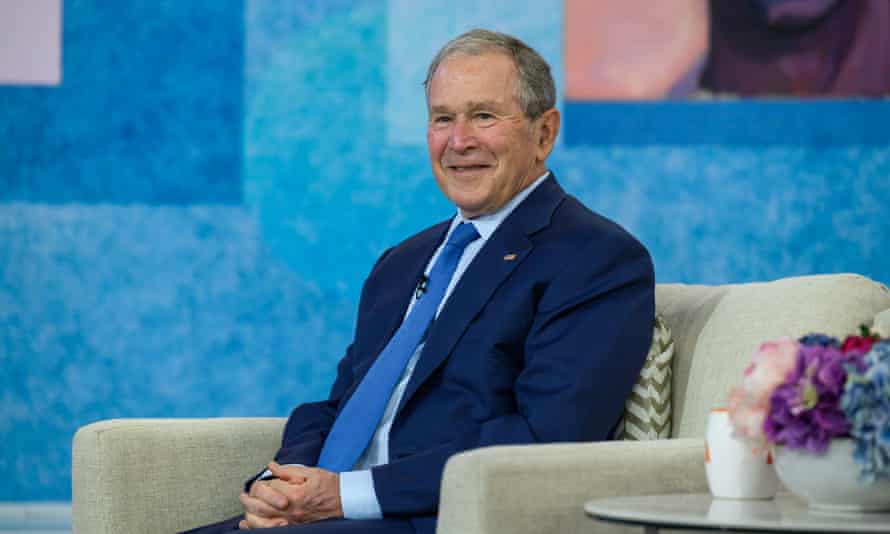
    George W Bush: ‘If the Republican party stands for exclusivity, you know, used to be country clubs, now evidently it’s white Anglo-Saxon Protestantism, then it’s not going to win anything.’
    George W Bush: ‘If the Republican party stands for exclusivity … used to be country clubs, now evidently it’s white Anglo-Saxon Protestantism, then it’s not going to win anything.’ Photograph: NBCU Photo Bank/Getty Images

    Ahead of a special election on Saturday to replace a Texas congressman who died after contracting Covid-19, former president George W Bush said the ascendancy of supporters of Donald Trump suggest Republicans “want to be extinct”.

    The special election is in the sixth district, whose Republican representative, Ron Wright, died in February. Twenty-three candidates will compete: all but one of the 11 Republicans are tied to the apron strings of Trump, the former president who still dominates the party.

    One candidate, the former wrestler Dan Rodimer, promises to “make America Texas again” and has said “commies in DC are ruining America”.

    Trump has endorsed another – Susan Wright, the former congressman’s widow who the former president said on Saturday “will be strong on the border, crime, pro-life, our brave military and vets, and will always protect your second amendment”.

    The one Republican not expressing fealty to Trump, former marine Michael Wood, told CNN he was “afraid for the future of the country”, given his party’s adherence to Trump’s lie that the election was stolen, its reluctance to condemn those who rioted at the Capitol on 6 January in support of that lie, and the prevalence of conspiracy theories such as QAnon.

    “I felt like I had to stand up,” Wood said. “Somebody needed to stand up and say this isn’t what the Republican party should be.”

    Nonetheless, it is. In a CNN poll released on Friday, 70% of Republicans said Biden did not legitimately win enough votes to be named president. Biden won more than 7m more votes than Trump and took the electoral college 306-232, the same score by which Trump beat Hillary Clinton in 2016.

    Bush is promoting a new book, a collection of portraits and stories of immigrants. In an interview released on Friday by the Dispatch, an anti-Trump conservative podcast, he was asked about recent moves by pro-Trump extremists to form a congressional caucus promoting “Anglo-Saxon traditions”.

    “To me that basically says that we want to be extinct,” he said.

    If such trends continued, Bush said, in three to five years “there’s not going to be a party. I mean I read about that and I’m saying to myself, ‘Wow, these people need to read my book.’ And I mean, it’s like saying when I was running for governor of Texas, you’ll never get any Latino votes because you’re Republican. And I said you watch. And I worked hard.

    “And the key thing was to let them know that I could hear their voice. I mean, democracy is great in that sense. And the idea of kind of saying you can only be Republican ‘if’, then the ultimate extension of that is it ends up being a one-person party.”

    Asked if he agreed with “more than 50%” of Republicans who think the election was stolen, Bush said: “No. I guess I’m one of the other 50%.

    “By the way, I’m still a Republican, proud to be Republican. I think Republicans will have a second chance to govern, because I believe that the Biden administration is a uniting factor, and particularly on the fiscal side of things. So, you know, we’ll see. But I know this – that if the Republican party stands for exclusivity, you know, used to be country clubs, now evidently it’s white Anglo-Saxon Protestantism, then it’s not going to win anything.”

    Wood, the anti-Trump Texas Republican, said he voted for Trump in 2020. But he also said he thought “the party is going to get to where I am eventually. I want that to happen without having to lose and lose and lose. Political parties sometimes only get the message they need to try something different after a string of losses. I think we should do that now as opposed to doing it after we lose in the midterms or lose another presidential election.”

    The Texas sixth district has trended towards Democrats in recent elections but remains unlikely to flip.

    Earlier this week, Trump told Fox Business he was “100% thinking about running” in 2024.

    Rodimer, the former wrestler who is among the top money raisers in the field in Texas, told CNN: “President Trump is still the leader of the Republican party. I don’t think he’s going to go anywhere, ever. I hope he doesn’t. If he runs again, I’ll be fired up, I’ll be excited.”

    Global Virus Cases Reach New Peak, Driven by India and South America