What To Do When You're Stopped By Police - The ACLU & Elon James White
What To Do When You're Stopped By Police - The ACLU & Elon James White
Know Anyone Who Thinks Racial Profiling Is Exaggerated? Watch This, And Tell Me When Your Jaw Drops.
This video clearly demonstrates how racist America is as a country and how far we have to go to become a country that is civilized and actually values equal justice. We must not rest until this goal is achieved. I do not want my great grandchildren to live in a country like we have today. I wish for them to live in a country where differences of race and culture are not ignored but valued as a part of what makes America great.
Detective says Chauvin knee on neck a 'totally unnecessary' use of deadly force
Richard Zimmerman gives testimony and tells court ‘if your knee is on someone’s neck – that could kill them’
Richard Zimmerman said: ‘I saw no reason why the officers felt they were in danger, if that’s what they felt. And that is what they have to feel to use that level of force.’ Photograph: AP
"A Minneapolis homicide detective has described Derek Chauvin’s decision to press his knee into George Floyd’s neck for more than nine minutes as a totally unnecessary use of “deadly force”.
Lt Richard Zimmerman, who leads the Minneapolis homicide department, said in testimony on Friday that in four decades as a police officer he had never been trained to place a knee on someone’s neck as a means of restraining them during an arrest.
“If your knee is on a person’s neck, that can kill them,” he said.
In evidence likely to be highly damaging to the defence claim that Chauvin was acting out of concern for his own safety as he arrested Floyd, a 46-year-old Black man, in Minneapolis last May, Zimmerman described the level of force used by officers after Floyd was in handcuffs as “totally unnecessary”.
“Once a person is cuffed, the threat level goes down all the way. They’re cuffed, how can they really hurt you?” he said.
Video shows Floyd was already handcuffed by the time he was forced onto the ground.
“I saw no reason why the officers felt they were in danger, if that’s what they felt. And that is what they have to feel to use that level of force,” said Zimmerman.
Chauvin, 45, has denied charges of second- and third-degree murder, and manslaughter, over Floyd’s death. He faces up to 40 years in prison if convicted of the most serious charge. Three other officers face separate charges.
Zimmerman was one of 14 police officers who published a public letter to the citizens of Minneapolis a month after Floyd’s death, to “wholeheartedly condemn” Chauvin’s actions.
“Like us, Derek Chauvin took an oath to hold the sanctity of life most precious,” they wrote. “Derek Chauvin failed as a human and stripped George Floyd of his dignity and life. This is not who we are.”
Zimmerman told the trial officers are trained in the dangers of keeping a detained person in the prone position on the ground. Floyd was held for more than nine minutes with Chauvin’s knee on his neck and two other officers pinning his torso and legs.
“Once you secure or handcuff a person, you need to get them out of the prone position as soon as possible because it restricts their breathing,” Zimmerman said.
Chauvin’s lawyer, Eric Nelson, put it to Zimmerman “that in a fight for your life, you as an officer are allowed to use whatever force is necessary?”
Nelson challenged the detective’s claim never to have been trained to put a knee to a suspect’s neck, but Zimmerman said the training was to place the knee on a person’s shoulder and only while handcuffing them.
Zimmerman also told the court that police failed to follow critical incident procedures intended to ensure officers are properly interrogated. Zimmerman said that procedure meant the officers involved in Floyd’s death should have been taken in separate squad cars to an interview room for questioning. Yet he found two of the officers, Alexander Kueng and Thomas Lane, still at the scene. He ordered them taken for questioning.
Earlier, a Minneapolis police sergeant, Jon Edwards, who secured the scene after Floyd’s death, told the trial he found Kueng and Lane in their squad car together. He ordered them out and to turn their body cameras on to record their conversations.
Zimmerman’s evidence followed similar testimony from Chauvin’s shift supervisor, Sgt David Pleoger, on Thursday. He said there was no justification for the officer to keep his knee on Floyd’s neck for nine minutes or for the other officers to continue to hold him down once he stopped resisting.
“When Mr Floyd was no longer offering up any resistance to the officers they could have ended their restraint,” said Pleoger, who arrived at the scene shortly after Floyd was taken away by ambulance.
He also said Floyd should not have been kept in the prone position because of the danger of “positional asphyxia”.
“If they are left on chest or stomachs for too long, their breathing can be compromised,” he said.
Pleoger said police officers are trained about the danger that a suspect can suffocate if they are not put on their side in the recovery position.
The police evidence came at the end of a week that began with the prosecution putting witnesses on the stand who gave emotional evidence about Floyd’s struggle for life under Chauvin’s knee.
Some of the most emotional testimony was heard on Thursday as Floyd’s girlfriend, Courteney Ross, spoke about their shared struggle with opioid addiction. Ross, who dated Floyd for about three years, said they both became hooked after being prescribed narcotics to treat chronic pain.
Three other officers involved in Floyd’s death are scheduled to be tried together later this year on charges of aiding and abetting murder and manslaughter.
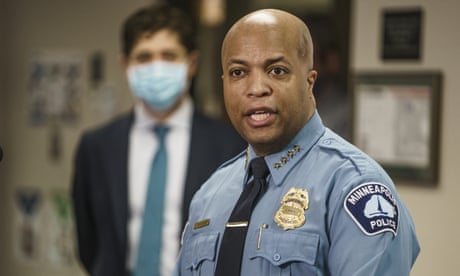
The trial continues. Next week, the chief of the Minneapolis department, Medaria Arradondo, is expected to testify. In a highly unusual move, he will give evidence against his own former officer. Arradondo fired Chauvin shortly after Floyd’s death."
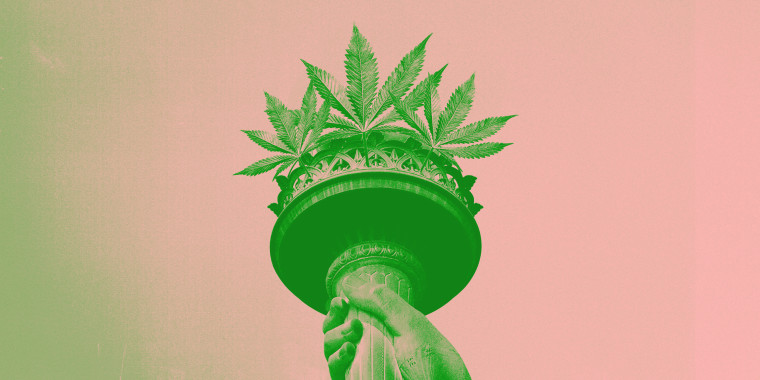
New York City isn't usually so late to trends. It's been 25 years since California first legalized marijuana for medical use. Almost nine years have passed since Colorado and Washington became the first states to make recreational cannabis legal. But residents of the fourth-largest state, home to the biggest city in the country, and one of the most progressive, had to watch as 13 other states and Washington, D.C., followed suit.
That changed Wednesday, when Gov. Andrew Cuomo finally signed a long-awaited bill to create a recreational marketplace for weed in the state. And given how much the Marijuana Regulation and Taxation Act does to erase decades of injustice, it was absolutely worth the wait.”
Kemp admits on tape that law restricting access to voting has "nothing to do with potential fraud"
By
David Edwards
Salon
"Georgia Gov. Brian Kemp (R) admitted on tape that much of the election bill he recently signed into law "has nothing to do with potential fraud."
Kemp made the statement after critics accused white Republican men of gathering behind closed doors to sign a bill that disenfranchises minority voters who predominately cast ballots for Democrats.
In an interview with WABE radio, Kemp insisted that President Donald Trump's charges of voter fraud had nothing to do with the law.
"A lot of this bill is dealing with the mechanics of the election," he insisted. "It has nothing to do with potential fraud or not."
"I've heard a lot of the Democrats say this year the elections have consequences. And they certainly do," the governor added, referring to Republican control of the legislature.
Kemp also lashed out at boycotts of his state over the election law.
"It's unfortunate. And it's not fair to be boycotting businesses because of a so-called voter suppression bill that is not in Georgia," he said.
"After weeks of pressure from activists some major companies and prominent Black executives are taking a somewhat harder line in speaking out against a new law in Georgiato restrict voting access.
Delta Airlines, one of the Georgia-based companies that declined to speak out as the measure moved through the legislature, issued a forceful statement on Wednesday, saying the law was “unacceptable”.
“After having time to now fully understand all that is in the bill, coupled with discussions with leaders and employees in the Black community, it’s evident that the bill includes provisions that will make it harder for many underrepresented voters, particularly Black voters, to exercise their constitutional right to elect their representatives. That is wrong.” Ed Bastian, Delta’s CEO, wrote in a company memo on Wednesday.
“The entire rationale for this bill was based on a lie: that there was widespread voter fraud in Georgia in the 2020 elections. This is simply not true. Unfortunately, that excuse is being used in states across the nation that are attempting to pass similar legislation to restrict voting rights,” he added.
The statement is an abrupt reversal for Delta, which for weeks declined to say it explicitly opposed the Georgia measure. Two weeks ago, when the measure was being crafted in the state legislature, a Delta spokesperson told the Guardian that “ensuring an election system that promotes broad voter participation, equal access to the polls, and fair, secure elections processes are critical to voter confidence and creates an environment that ensures everyone’s vote is counted”.
Delta’s statement came just after some of America’s top Black business leaders and CEOs released a letter condemning widespread efforts across the United States to make it harder to vote. “There is no middle ground here,” Kenneth Chenault, the former CEO of American Express, told The New York Times, which first reported on the letter. “You either are for more people voting, or you want to suppress the vote.”
“Charles McMillian on Wednesday gave one of the most emotional testimonies during the third day of the murder trial of former Minneapolis police officer Derek Chauvin, breaking down in sobs after re-watching video footage of George Floyd’s fatal arrest.
On May 25 last year, McMillian, 61, a resident of Minneapolis, was driving through the area of Chicago Street and 38th Street when he saw a Black man being detained by the police and decided to pull over to figure out what was happening.
“Being nosy” is what made him stop, he admitted in court.
Moments later, he would witness an altercation between George Floyd and police officers that led to Floyd’s death and eventually ignited a nationwide movement against systemic racism and police brutality.
McMillian’s emotional statement was the latest in a string of testimonies that conveyed the trauma suffered by those who witnessed firsthand what occurred to Floyd, and who confessed to struggling with feelings of guilt and helplessness for failing to prevent his death.
In officers’ body camera footage, McMillian is seen pleading with Floyd not to resist the arrest and cooperate with police.
“You can’t win!” McMillian is heard yelling at him in the video. He explained to prosecutors that he was trying to help Floyd based on his own experiences with law enforcement, arguing he knew that once you are placed in a police car and handcuffed, as Floyd was at the moment, “You’re done.”
“I am not trying to win!” responded an increasingly distressed Floyd, who struggled with the police as they tried to get him into a police car, saying repeatedly that he is claustrophobic and has anxiety.
The chilling images also showed Floyd saying over and over again, that he could not breathe and calling for his deceased mother.
“Mama! Mama! Mama,” Floyd cried out several times on the video.
Sitting on the stand, McMillian broke out in tears and hit the desk before him, grabbing tissues to dab away the tears behind his white-framed lenses. “Oh, my God,” he said shaking his head.
“I feel helpless,” McMillian said, explaining his reaction to reliving Floyd’s final moments. “I don’t have a mama either; I understand him.”
As McMillian struggled to hold his emotions and regain his composure, the judge ordered court to take a break.
Later in his testimony, the witness also described how a few days earlier, he had encountered Chauvin and decided to go up and talk to him.
‘Officer, at the end of the day, you go home to your family safe, so let the next person go home to their family safe,’” McMillian recalled telling him.
On Wednesday, prosecutors played never-before-seen body-camera footage from Chauvin’s body camera in which McMillian tells Chauvin he “does not respect” what the officer just did and calls him a “maggot.”
“All right, that’s one person’s opinion,” Chauvin responds in the video.
“But we’ve got to control this guy because he is a sizable guy,” he told McMillian. “Looks like he’s probably on something,” Chauvin said, suggesting Floyd had taken drugs.
Prosecutors asked McMillian why he felt the need to speak to Chauvin.
“Because what I was watching was wrong,” he said.
A few days after Floyd’s death last year, McMillian told a journalist he was also suffering the consequences of seeing a man die.
“Waking up, the first thing I hear is Mr. Floyd saying, ‘Mom, they are killing me in the street,” he said.“
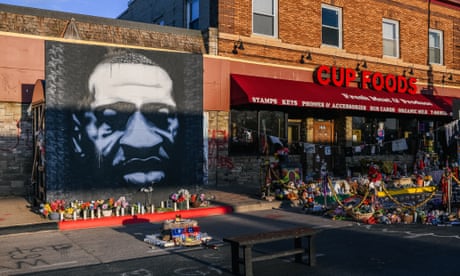
Mementos dedicated to George Floyd are on display at the Chicago Fine Arts Gallery near George Floyd Square. (Octavio Jones/Reuters)
“But Floyd might still be alive had Chauvin listened to the pleas of about a dozen bystanders who happened upon the horrific scene last Memorial Day. It has been clear from their testimony this week, and the videos they recorded on their phones last May, that these citizens were both serving justice and risking retribution when they yelled at the four officers on the scene.
Their righteous anger toward law enforcement and their refusal to stay silent must be celebrated, and emulated, as we try to learn from what happened in Minneapolis a year ago.
Off-duty firefighter Genevieve Hansen, 27, was walking home from a community garden when she saw Floyd pinned on the asphalt. She immediately identified herself as a firefighter and offered to help but was told, not kindly, to step away by one of the officers. The defense attorney tried to portray Hansen as angry and profane as she demanded to know Floyd’s pulse. “I was desperate to help,” she explained in court, grabbing a tissue to wipe back tears while wearing a crisp uniform with a gleaming badge. “I don’t know if you’ve seen anybody be killed, but it’s upsetting.”
Security guard Donald Williams II, 33, had observed the holiday in the most Minnesota way possible: Fishing with his son. They caught three bass. Williams then headed for the neighborhood market to get some air and something to drink. He never made it inside the store after seeing Floyd’s eyes bulging out. “He reminded me of my fish in the bag,” Williams said.
A former wrestler who practices martial arts in his free time, Williams warned Chauvin that he was using a “blood choke” on the handcuffed man. “It’s the only time he looked up,” Williams testified. “We looked each other dead in our eyes. When I said it, he acknowledged it.”
According to his testimony, Chauvin then “shimmied” to shove his knee harder and deeper into Floyd’s neck. Nelson, the defense attorney, pressed Williams on the string of profanities he screamed as that happened. Williams conceded that, yes, he referred to the officers as bums 13 times, but he stepped onto the sidewalk when directed by an officer.
Floyd cried out that he could not breathe. “I’m through” were among the 46-year-old’s last words.
Videos show the crowd’s screams grew louder as Floyd went silent. Darnella Frazier, who was 17 in May, told the jury that she does not normally yell, but she felt like the man she saw on the ground could just as easily have been her father, brother or cousins. “I have social anxiety so it’s really outside my comfort zone . . . but when I see what I saw, I was loud,” Frazier said. “We all knew it wasn’t right.”
Compare the reaction of these Minnesotans to what happened in Manhattan on Monday. Three bystanders inside a luxury condo building’s lobby did not make any effort to intervene as a man viciously assaulted a 65-year-old woman on the sidewalk outside as she made her way to church. As the assailant fled, one of the men — a security guard — closed the door of the building on the victim. The company that manages the condos said staffers had been suspended, and New York police made an arrest early Wednesday. The union that represents the guard says he flagged down a patrol car.
Yelling at officers carries different risks than wading into the middle of violence, but the truth is that many people look the other way when help is needed. Psychologists coined the term “the bystander effect” to describe how, the greater the number of bystanders, the less likely it is one of them will help a person in distress.
Since the 9/11 attacks, government agencies of all kinds have urged Americans who “see something” to “say something.” That is what the Minneapolis bystanders did. Confronted with officers betraying the police department’s motto — “To protect with courage, to serve with compassion” — they spoke out. More of us need to follow their example. Silence in the face of any abuse of power, as King implied, is complicity.
Williams, the wrestler, called 911 that night to report Chauvin. “I did call the police on the police,” he testified. “I believed I witnessed a murder.” Hansen, the firefighter, also called 911 to complain that the four officers did not “do anything to save a man.”
The screams of bystanders did not save Floyd’s life, but their testimony has already indelibly shaped his legacy.