Frisky Business - The Daily Show with Jon Stewart (Video Clip) | Comedy Central
Thursday, February 13, 2020


Tuesday, February 11, 2020
Mike Bloomberg panders to win black vote - New York Daily News. Bloomberg is a racist liar.

"Mike Bloomberg is pandering.
Everybody knows Mike Bloomberg is pandering. Even Mike Bloomberg knows that everybody knows that Mike Bloomberg is pandering. Yet he panders anyway. Why?
Because he’s the Pander Man.
He was pandering last year when he stood in the pulpit of a Brooklyn church and said “I’m sorry” for a racially offensive and unconstitutional policy of stopping and frisking black and brown men in every borough when he was mayor of New York.
He was pandering two weeks ago when he opened a campaign satellite office in the heart of Harlem where his own police officers routinely harassed people of color because his misguided policy told them to.
He was pandering a few days ago when he met with Stacey Abrams, who almost became the nation’s first black woman governor, in Georgia to discuss voting rights, years after he manipulated himself into a third term as mayor.
And he’s pandering now.
After stopping and frisking the black community for more than a decade, Bloomberg suddenly loves black men more than Kim Kardashian.
This summer he will be at your family reunion and every black family reunion in America. He is bringing the potato salad and it will be the best thing you ever tasted.
Mike Bloomberg is Jerry Maguire. He is on the phone behind his desk and he is shouting at the top of his lungs: “I love black people!”
Why? Because the road to the Democratic nomination for president goes through America’s black community, and every Democrat running for the White House knows it.
But no one in the race, no one, is trying harder to win — or buy — the black vote than Mike Bloomberg.
And sadly he has been able to get away with the shameless pandering because black people are on board with his end goal, which is to remove Donald Trump from the White House.
In other words, keep your eyes on the prize.
And to be honest, I was no more interested in what Bloomberg had to say about black people than I was about Bill Cosby on the subject. But I listened anyway, and I like some of what I heard.
“You don’t reverse hundreds of years of theft and exploitation only with modern-day attempts to legislate equal rights, especially when those rights are routinely undermined by racism and inequalities that still exist,” Bloomberg said Sunday during a major speech on race relations and black empowerment ahead of the Martin Luther King Jr. holiday on Monday.
“The 14th Amendment that gave citizenship to black Americans and overturned the Dred Scott decision was a historic milestone for America, but it was also a dead letter for many of the very people it was meant to protect and empower.”
Bloomberg delivered the speech in Tulsa, Okla., where, in 1921, America witnessed the deadliest and most destructive act of racial violence in U.S. history. During the riot that broke out, white mobs destroyed a thriving black Tulsa business district, killing between 100 and 300 people.
Bloomberg, a billionaire many times over, admits that he took advantage of opportunities that have been denied to black people “for hundreds of years.”
To help make amends, the candidate is proposing a $70 billion investment in the country’s “100 most disadvantaged neighborhoods,” along with steps to create 1 million new black homeowners and 100,000 new black-owned businesses.
“I believe that this is a country where anything is possible,” Bloomberg said. “And I believe that we have the power to build a future where color and capital are no longer related.”
Bloomberg, 77, may have just changed the game, even if he is late to the party. He is still the Pander Man, but at least he is pandering with ideas and money."
Mike Bloomberg panders to win black vote - New York Daily News
Barr takes control of legal matters of interest to Trump, including Stone sentencing
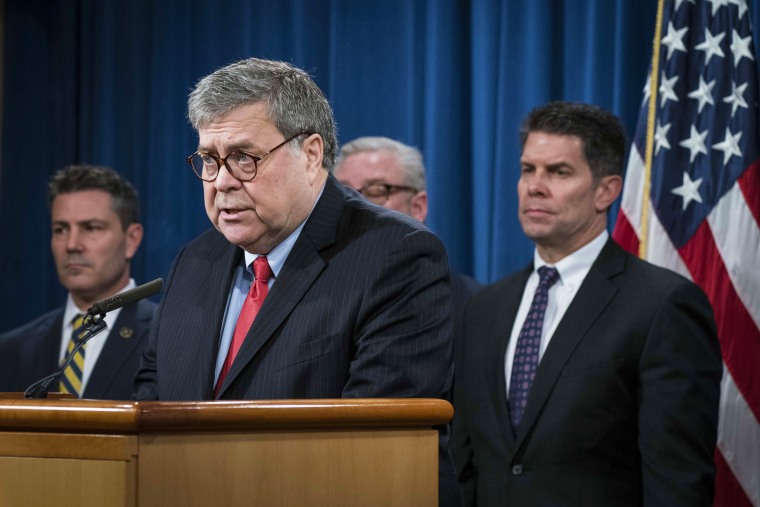
"WASHINGTON — The U.S. attorney who had presided over an inconclusive criminal investigation into former acting FBI director Andrew McCabe was abruptly removed from that job last month in one of several recent moves by Attorney General William Barr to take control of legal matters of personal interest to President Donald Trump, according to multiple people familiar with the matter.
A person familiar with the matter has confirmed to NBC News that President Trump has now rescinded the nomination of the U.S. attorney, Jessie Liu, for a job as an undersecretary at the Treasury Department.
On Tuesday, all four line prosecutors withdrew from the case against Trump associate Roger Stone — and one quit the Justice Department altogether — after Barr and his top aides intervened to reverse a stiff sentencing recommendation of up to nine years in prison that the line prosecutors had filed with the court Monday.
But that wasn't the first time senior political appointees reached into a case involving a former Trump aide, officials told NBC News. Senior officials at the Justice Department also intervened last month to help change the government's sentencing recommendation for Trump's former national security adviser, Michael Flynn, who pled guilty to lying to the FBI. While once the prosecutors in the case had recommended up to six months in jail for Flynn, their latest filing now says they believe probation would be appropriate."
Barr takes control of legal matters of interest to Trump, including Stone sentencing
Sunday, February 09, 2020
Michael Bloomberg is trying to buy the presidency – that should set off alarms | Robert Reich | Opinion | The Guardian
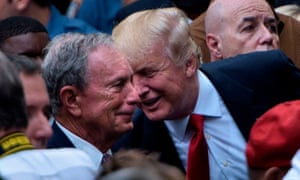
Mr. Stop and Frisk, the Mayor who ordered the NYPD to defy the US Constitution by profiling Blacks and Hispanics by race. Bloomberg is Trump lite.
"We haven’t seen his name on any of the ballots in the first four states, but that’s about to change. I’m talking, of course, about multibillionaire presidential hopeful Michael Bloomberg.
Bloomberg has a chance of winning the presidency because his net worth is more than $60bn.
The yearly return on $60bn is at least $2bn – which is what Bloomberg says he’ll pour into buying the highest office in the land. It’s hardly a sacrifice for him, but it’s a huge sacrifice for American democracy.
Encouraged by the murky outcome from the Iowa caucuses and the notable lack of enthusiasm for Joe Biden, Bloomberg has decided to double his spending on TV commercials in every market where he is currently advertising, and expand his campaign field staff to more than 2,000.
He’s not competing in the first four states with caucuses and primaries but focusing instead on 3 March. So-called “Super Tuesday” will be more super than ever because it now includes California, Texas, Virginia, Minnesota, North Carolina and Massachusetts – a third of all delegates to the Democratic convention.
“It’s much more efficient to go to the big states, to go to the swing states,” Bloomberg told the New York Times. “The others chose to compete in the first four. And nobody makes them do it, they wanted to do it. I think part of it is because the conventional wisdom is, ‘Oh you can’t possibly win without them.’”
Later, he added: “Those are old rules.”
Yes, and the new rules are also to spend billions of your own money, if you have it.
In January alone Bloomberg spent more than $300m on advertising for his campaign. That’s more than Hillary Clinton spent on advertising during her entire presidential run in 2016. It’s multiples of what all other Democratic candidates have spent, leaving even Tom Steyer, another billionaire, in the dust.
The heart of Bloomberg’s campaign message is that he has enough money to blow Trump out of the water. As if to demonstrate this, Bloomberg bought a $10m Super Bowl ad that slammed Trump in the middle of the big game, then bashed Trump again in a national ad just hours before the State of the Union address.
“The Real State of the Union? A nation divided by an angry, out of control president,” a narrator says. “A White House besotted by lies, chaos and corruption.”
If Trump’s tweets are any barometer, Bloomberg’s tactics are getting under the thin-skinned president’s fragile epidermis. According to one Trump adviser, the president “thinks that money goes a long way” and those who believe Bloomberg has no hope are “underestimating him”. Another says Trump “takes money seriously. He’s a businessman.”
The Democratic National Committee is ready to boost Bloomberg into the top tier. Last Friday it abandoned one of its criteria for getting on to the coveted debate stage – the individual-donor threshold, which was used for the first eight debates including this week’s event in New Hampshire – presumably because Bloomberg doesn’t take donations.
To participate in the 19 February debate in Las Vegas, candidates will need to show at least 10% support in four polls released from 15 January to 18 February. Three candidates have met that threshold: Joe Biden, Bernie Sanders and Elizabeth Warren. Bloomberg’s wall-to-wall advertising is giving him a good shot.
Last Monday he tied with Warren for third place in a Morning Consult tracking poll. He’s in the top four in many Super Tuesday states. In Texas and North Carolina, he has overtaken Buttigieg for fourth. He has the third-highest polling average in Florida, ahead of Warren, and fourth-highest in Michigan, Ohio, Georgia, Pennsylvania and New Jersey, whose primaries all fall after Super Tuesday. In the past week, polls have Bloomberg tied for second in New York and trailing only Biden in Missouri. He was also fourth in a Suffolk University poll of Utah, at 13%.
Amazing what money will buy, if there’s enough of it.
Bloomberg has some attractive public policy ideas: he’s for gun control, he wants to reverse climate change and he’s unveiled a plan to raise an estimated $5tn of new tax revenue from high earners and corporations, including a repeal of Trump’s 2017 tax cuts and a new 5% “surcharge” on incomes above $5m a year.
A tour bus passes the Wall Street bull. Photograph: Spencer Platt/Getty Images
A tour bus passes the Wall Street bull. Photograph: Spencer Platt/Getty Images
But he’s also a champion of Wall Street. He fought against the milquetoast reforms following the near-meltdown of 2008. His personal fortune is every bit as opaque as Trump’s. Through his dozen years as mayor of New York he refused to disclose his federal taxes. Even as a candidate for president, he still hasn’t given a date for their release. And, let’s not forget, he’s trying to buy the presidency.
America has had some talented and capable presidents who were enormously wealthy – Franklin D Roosevelt, Teddy Roosevelt, John F Kennedy, for example. The problem lies at the nexus of wealth and power, where those with great wealth use it to gain great power. This is how oligarchy destroys democracy.
The word “oligarchy” comes from the Greek word oligarkhes, meaning “few to rule or command”. It refers to a government of and by a few exceedingly rich people or families who control the major institutions of society. Oligarchs may try to hide their power behind those institutions, or excuse their power through philanthropy and “corporate social responsibility”. But no one should be fooled. An oligarchy is not a democracy.
Even a system that calls itself a democracy can become an oligarchy if power becomes concentrated in the hands of a corporate and financial elite. Their power and wealth increase over time as they make laws that favor themselves, manipulate financial markets to their advantage, and create or exploit economic monopolies that put even more wealth into their pockets.
Since 1980, the share of America’s wealth owned by the richest 400 Americans has quadrupled while the share owned by the entire bottom half of America has declined. The richest 130,000 families in America now own nearly as much as the bottom 90% – 117 million families – combined. The three richest Americans own as much as the entire bottom half of the population. According to Forbes, Michael Bloomberg is the eighth richest.
All this has been accompanied by a dramatic increase in the political power of the super-wealthy and an equally dramatic decline in the political influence of everyone else. Unlike income or wealth, power is a zero-sum game. The more of it at the top, the less of it anywhere else.
In the election cycle of 2016, the richest one-hundredth of 1% of Americans – 24,949 extraordinarily wealthy people – accounted for a record 40% of all campaign contributions. By contrast, in 1980 the top 0.01% accounted for only 15% of all contributions.
Make no mistake: the frustrations and insecurities that fueled Trump’s rise – and are still the basis of his support – have their origin in this power shift, which has left most Americans with a small slice of the nation’s prosperity and almost no voice in its politics.
A half-century ago, when America had a large and growing middle class, those on the left wanted stronger social safety nets and more public investment in schools, roads and research. Those on the right sought greater reliance on the free market.
But as power and wealth have moved to the top, everyone else – whether on the old right or the old left – has become disempowered and less secure. Today the great divide is not between left and right. It’s between democracy and oligarchy.
Bloomberg is indubitably part of that oligarchy. That should not automatically disqualify him but it should set off alarms. If the only way we can get rid of the sociopathic tyrant named Trump is with an oligarch named Bloomberg, we will have to choose the oligarch. Yet I hope it doesn’t come to that. Oligarchy is better than tyranny. But neither is as good as democracy.
Robert Reich, a former US secretary of labor, is professor of public policy at the University of California at Berkeley and the author of Saving Capitalism: For the Many, Not the Few and The Common Good. His next book, The System: Who Rigged It, How We Fix It, will be out in March. He is a columnist for Guardian US."
Michael Bloomberg is trying to buy the presidency – that should set off alarms | Robert Reich | Opinion | The Guardian
Saturday, February 08, 2020
Thursday, February 06, 2020
ArbiLex, A Harvard Law School Legal Tech Startup, Uses AI To Settle Arbitrations
ArbiLex, A Harvard Law School Legal Tech Startup, Uses AI To Settle Arbitrations
“Legal disputes between two entities vary in complexity and scope. With criminal law, the outcome of these cases is seen as discrete (guilty, not guilty, acquittal, mistrial). In civil law, a discrete view of the consequences of a legal ruling is inappropriate. The size of a settlement in a civil case varies. With claims resolved through international arbitration, the outcomes are on the order of millions and billions of dollars. Lawyers arguing these cases rely on intuition, precedent, and incomplete information. Isabel Yang, 30, realized the qualitative nature of law represented an opportunity for technology to resolve legal disputes, creating ArbiLex as a result. ArbiLex is a data analytics startup for international arbitrations, leveraging artificial intelligence (AI) to help parties reach resolutions quickly and efficiently. The Cambridge, Massachusetts-based company was incubated out of the Harvard Innovation Lab.

ArbiLex founder Isabel Yang.
In today’s global economy, business relationships are established and maintained on an international scale. When these relationships breakdown as the parties find themselves in disagreement, international arbitration exists as an option to resolve these disputes. There are many advantages to pursuing international arbitration as a resolution mechanism, such as enforceability, neutrality, confidentiality, and more. However, one of the main difficulties of international arbitration is the length of time a dispute takes to be resolved. Latham & Watkins, a prominent global firm with notable expertise their transactional and regulatory area practices, states, “for a substantial and complex dispute, arbitration typically takes about
12-18 months from commencement to the final hearing.” For the entities with a material stake in this case, the prolonged efforts to reach an outcome have a detrimental effect on all involved (with the exception of the lawyers who bill by the hour). Shortening the length of time needed to resolve international arbitrations is a crucial driver of a potential market in need of a solution.
Estimating the global market arbitration size is difficult due to a lack of data tracking the industry, as the agreements from an arbitration settlement can and usually remain undisclosed. However, understanding the volume and size of these disputes can provide an estimate of the market size. Global Arbitration Review is a leading online publication on law firms that specialize in international arbitration cases. The digital law reporting outlet notes that the “total value” of the pending cases of their top 30 ranked firms is over $2 trillion. Assuming that these firms’ fees are 10% of the total value of the pending cases, the international arbitration market can be roughly estimated to be $200 billion. A product that could help resolve these disputes faster could capture a small portion of the potential market value in fees.
ArbiLex’s product is a predictive data analytics tool that leverages Bayesian machine learning (ML) to help international litigators use data to complement their intuition in resolving arbitration cases. Bayesian ML differs from traditional ML algorithms as probabilities determined in the beginning, intermediate, and final output of a model rely on initial, reasonable guesses of an event happening, called the prior, instead of only building on the observed frequency of an event occurring. A Bayesian approach to machine learning is preferred for this particular problem because one can leverage an expert’s opinion to quantify the prior probability of a given factor in a case. An informed prior is critical to the success of getting a sensible posterior probability, or a probability that coherently adjusts the prior beliefs from limited past data. The confidential nature of international arbitrations reflects how a Bayesian approach has inherent advantages when compared to frequentist probability underpinning many machine learning models. Furthermore, given the need for a prior, which generally comes from an expert, the output from a Bayesian ML model can potentially be explained how the algorithms arrived at a particular conclusion. The key to the success of the startup’s product is access to experts that international litigators and litigation funds need to resolve these disputes in their favor.
The main benefit of ArbiLex’s product is mapping out risk factors associated with an arbitration case. The startup’s algorithms can help benchmark and quantify probabilities, which allows users to think more probabilistically when assessing settlement outcomes as opposed to maintaining a binary mindset. The deep, technical nature of Bayesian ML and the arcane knowledge of the law is necessary for a team to tackle this problem successfully.
Yang, a graduate of Oxford University with a Master’s degree in Economics and a Juris Doctor from Harvard Law School, is well versed in the legalese and economics of international arbitrations. Her economic experience comes from her time at the World Trade Organization and the National Treasury of South Africa. Her understanding of international arbitrations stems from her stints as a summer associate at the law firms Freshfields Bruckhaus Deringer and Shearman & Sterling. AribLex’s AI Lead, Raj Agrawal, is an MIT PhD candidate in Computer Science, specializing in machine learning and predictive inference. The two’s formidable partnership and cross-functional expertise could make ArbiLex an invaluable tool in international arbitrations.”
Wednesday, February 05, 2020
Monday, February 03, 2020
Saturday, February 01, 2020

Subscribe to:
Posts (Atom)