Contact Me By Email


What To Do When You're Stopped By Police - The ACLU & Elon James White

What To Do When You're Stopped By Police - The ACLU & Elon James White

Know Anyone Who Thinks Racial Profiling Is Exaggerated? Watch This, And Tell Me When Your Jaw Drops.


This video clearly demonstrates how racist America is as a country and how far we have to go to become a country that is civilized and actually values equal justice. We must not rest until this goal is achieved. I do not want my great grandchildren to live in a country like we have today. I wish for them to live in a country where differences of race and culture are not ignored but valued as a part of what makes America great.

Tuesday, February 13, 2018

Donald Trump’s Nasty Budget

During his presidential campaign, Donald Trump told the “forgotten men and women of our country” that he would champion them. As evidence that he was a different kind of Republican, he promised not to cut Medicare, Medicaid and other programs that benefit poor and middle-class families.

On Monday, President Trump proposed a budget that would slash spending on Medicare, Medicaid, food stamps, transportation and other essential government services, all while increasing the federal deficit.

Mr. Trump’s 2019 budget, combined with the tax cuts Republicans passed last year, would amount to one of the greatest transfers of wealth from the poor to the rich in generations. It would also charge trillions of dollars in new debt to the account of future Americans. It’s a plan that could please only far-right ideologues who want to dissolve nearly every part of the federal government, save the military.

The proposal would raise military spending by 14.1 percent while cutting funding for the State Department — the agency that has a mandate to resolve problems without going to war — by 26.9 percent. It would cut the Department of Health and Human Services by 20.3 percent and the Department of Education by 10.5 percent. It calls for (yet again) the repeal of the Affordable Care Act and proposes cutting food stamps by $213 billion, or around 30 percent, over 10 years. Medicare and Medicaid, which benefit one-third of Americans, are targeted for cuts of hundreds of billions of dollars.


http://www.armwoodopinion.com/2018/02/donald-trumps-nasty-budget.html

Monday, February 12, 2018

Trump’s budget hits poor Americans the hardest - The Washington Post

"President Trump proposed a budget Monday that hits the poorest Americans the hardest, slashing billions of dollars in food stamps, health insurance and federal housing subsidies while pushing legislation to institute broad work requirements for families receiving housing vouchers, expanding on moves by some states to require recipients of Medicaid and food stamps to work.

The Trump budget proposal would gut the Supplemental Nutrition Assistance Program, better known as food stamps, by $17.2 billion in 2019 — equivalent to 22 percent of the program’s total cost last year. It calls for cuts of more than $213.5 billion over the next decade, a reduction of nearly 30 percent, according to the Center on Budget and Policy Priorities.

In addition, Trump is proposing a full-scale redesign of SNAP, which provides an average of $125 per month to 42.2 million Americans. For the last 40 years, the program has allowed beneficiaries to use SNAP benefits at grocery stores as if they were cash. Under the budget proposal, the Department of Agriculture would use a portion of those benefits to buy and deliver a package of U.S.-grown commodities to SNAP households that receive $90 or more in assistance each month, using the government’s buying power to obtain common foods at lower costs."

(Via.) Trump’s budget hits poor Americans the hardest - The Washington Post

Single Mothers Are Not the Problem - The New York Times


"No group is as linked to poverty in the American mind as single mothers. For decades, politicians, journalists and scholars have scrutinized the reasons poor couples fail to use contraception, have children out of wedlock and do not marry.


When the American Enterprise Institute and the Brookings Institution formed a bipartisan panel of prominent poverty scholars to write a “Consensus Plan for Reducing Poverty” in 2015, its first recommendation was to “promote a new cultural norm surrounding parenthood and marriage.”


The reality, however, is that single motherhood is not the reason we have unusually high poverty in the United States, compared with other rich democracies. In fact, we recently published a study in The American Journal of Sociology, using data from the Luxembourg Income Study, which demonstrates that reducing single motherhood here would not substantially reduce poverty.


Single-mother families are a surprisingly small share of our population. Among households headed by working-age adults, 8.8 percent of people lived in single-mother households in 2013 — the most recent year we were able to analyze. The share of people in single-mother households actually declined from 10.5 percent in 1980 and has increased only modestly since 1970, when it was 7.4 percent. True, compared with other rich democracies, America does have a relatively high portion of families headed by single mothers. Nevertheless, we still fall below Ireland and Britain and are quite similar to Australia and Iceland.


Because fewer people are in single-mother families than you’d think, even large reductions in single motherhood would not substantially reduce poverty. We can illustrate this in two ways. First, what would the poverty rate be if single motherhood in the United States was as common as it is in the typical rich democracy? Second, what would poverty in America be if single motherhood returned to the rate it was in 1970?


If single motherhood in the United States were in the middle of the pack among rich democracies instead of the third highest, poverty among working-age households would be less than 1 percentage point lower — 15.4 percent instead of 16.1 percent. If we returned to the 1970 share of single motherhood, poverty would decline a tiny amount — from 16.1 percent to 15.98. If, magically, there were no single mothers in the United States, the poverty rate would still be 14.8 percent.


What really differentiates rich democracies is the penalty attached to single motherhood. Countries make political choices about how well social policies support single mothers. Our political choices result in families headed by single mothers being 14.3 percent more likely to be poor than other families.


Such a severe penalty is unusual. In a majority of rich democracies, single mothers are not more likely to be poor. Denmark, for example, has chosen to provide universal cash benefits and tax credits for children, publicly subsidized child care and health care, and paid parental leave. Because of these generous social policies, single mothers and their children have a similar level of economic security as other families.


A common knee-jerk reaction against generous social policies for single mothers is that they pose a moral hazard and encourage more single motherhood. The problem with this argument is that it is overwhelmingly contradicted by social science. Did the 1996 welfare reform, which made social policies less generous for single mothers, cause a large reduction in single motherhood? No. Do rich democracies with more generous policies for single mothers have more single mothers? No. Do rich democracies with higher penalties for single motherhood have fewer single mothers? No.


Single motherhood is one of four major risks of poverty, which also include unemployment, low levels of education and forming households at young ages. Our research demonstrates a broader point about the risks of poverty. Poverty in America is not unusually high because more people have more of these risk factors. They are actually less common here than they are in the typical rich democracy, and fewer Americans carry these risks today than they did in 1970 or 1980. Even if one infers that risk factors result from bad choices and behaviors, Americans apparently make fewer such choices and engage in fewer such behaviors than people in other rich democracies or than Americans in the past.


The reality is we have unusually high poverty because we have unusually high penalties for all four of these risk factors. For example, if you lack a high school degree in the United States, it increases the probability of your being in poverty by 16.4 percent. In the 28 other rich democracies, a lack of education increases the probability of poverty by less than 5 percent on average. No other country penalizes the less educated nearly as much as we do.


More generous social policies would reduce the penalty for all four risk factors. In fact, increasing the generosity of American social policies would lower poverty more than increasing high school graduation or employment, and more than decreasing the number of people heading a household at a young age or the number of single mothers. Nor would reducing these penalties encourage people to drop out of high school, be unemployed, form households too young or become single mothers.


Ultimately, there simply aren’t enough single mothers to explain our high poverty. Even if they all married or never had children, poverty would not be substantially lower. We should stop obsessing over how many single mothers there are and stop shaming them.


Instead — even though we all get sick of hearing about how great Scandinavian countries are at handling these issues — we should be following the lead of countries like Denmark. If we did, we could reduce poverty among all American families, including those headed by single mothers. No amount of stigmatization could do the same. Rather than falsely claiming that single motherhood is a major cause of poverty, we should support single mothers in raising America’s children."


Single Mothers Are Not the Problem - The New York Times

Saturday, February 10, 2018

Trump will not release Democrats’ memo on FBI surveillance


"President Trump will not immediately agree to release a Democratic memo rebutting GOP claims that the FBI abused its surveillance authority as it probed Russian meddling in the 2016 election, but he has directed the Justice Department to work with lawmakers so some form of the document could be made public, the White House counsel said Friday night.

In a letter to the House Intelligence Committee, White House counsel Donald McGahn wrote that the Justice Department had identified portions of the Democrats’ memo that it believed “would create especially significant concerns for the national security and law enforcement interests” if disclosed. McGahn included in his note a letter from Deputy Attorney General Rod J. Rosenstein and FBI Director Christopher A. Wray supporting that claim.

The decision stands in contrast to one Trump made last week on a Republican memo alleging the FBI misled the Foreign Intelligence Surveillance Court to obtain a warrant to surveil a former Trump campaign adviser, Carter Page. After the House Intelligence Committee voted on a Monday to make that document public, Trump authorized its release swiftly on a Friday afternoon."

Friday, February 09, 2018

California police worked with neo-Nazis to pursue 'anti-racist' activists, documents show. Officers expressed sympathy with white supremacists and sought their help to target counter-protesters after a violent 2016 rally, according to court documents, | World news | The Guardian

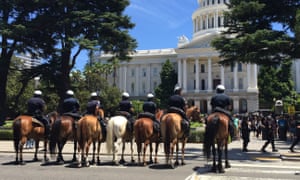
Sacramento mounted police officers at the June 2016 rally, which was organized by a neo-Nazi group.


"California police investigating a violent white nationalist event worked with white supremacists in an effort to identify counter-protesters and sought the prosecution of activists with “anti-racist” beliefs, court documents show.


The records, which also showed officers expressing sympathy with white supremacists and trying to protect a neo-Nazi organizer’s identity, were included in a court briefing from three anti-fascist activists who were charged with felonies after protesting at a Sacramento rally. The defendants were urging a judge to dismiss their case and accused California police and prosecutors of a “cover-up and collusion with the fascists”.


Defense lawyers said the case at the state capital offers the latest example of US law enforcement appearing to align with neo-Nazi and white supremacist groups while targeting anti-fascist activists and Donald Trump protesters after violent clashes...


California police worked with neo-Nazis to pursue 'anti-racist' activists, documents show | World news | The Guardian

California police worked with neo-Nazis to pursue 'anti-racist' activists, documents show. Officers expressed sympathy with white supremacists and sought their help to target counter-protesters after a violent 2016 rally, according to court documents, | World news | The Guardian

Sacramento mounted police officers at the June 2016 rally, which was organized by a neo-Nazi group.


"California police investigating a violent white nationalist event worked with white supremacists in an effort to identify counter-protesters and sought the prosecution of activists with “anti-racist” beliefs, court documents show.


The records, which also showed officers expressing sympathy with white supremacists and trying to protect a neo-Nazi organizer’s identity, were included in a court briefing from three anti-fascist activists who were charged with felonies after protesting at a Sacramento rally. The defendants were urging a judge to dismiss their case and accused California police and prosecutors of a “cover-up and collusion with the fascists”.


Defense lawyers said the case at the state capital offers the latest example of US law enforcement appearing to align with neo-Nazi and white supremacist groups while targeting anti-fascist activists and Donald Trump protesters after violent clashes...


California police worked with neo-Nazis to pursue 'anti-racist' activists, documents show | World news | The Guardian

Lawrence: Why John Kelly is hiding from the American people The White House says the Chief of Staff only just "became fully aware" of abuse allegations against Rob Porter, but the FBI reportedly informed him in November. Lawrence O'Donnell says Kelly is afraid to tell the American people what he knew and when he knew it.


The Last Word with Lawrence O'Donnell on MSNBC

Thursday, February 08, 2018

Gutierrez: Dems working with WH DACA deal ‘collusion with Donald Trump’

"

(Via.)

John Kelly's latest blunder is protecting an accused abuser - CNNPolitics. John Kelly proves a continuing truism that the racist is a misogynist, a homophobe and a bigot. Kelly lied about what he knew and when he knew it. Kelly must go.

NewImage


"But the controversy over how long he knew about domestic abuse allegations by White House staff secretary Porter has revived questions about his attitude and political philosophy. The White House's panicked response to the drama has meanwhile sparked uncertainty about how much Kelly has drained the discord and disorder of Trump's court.It's possible that Trump has changed Kelly more than Kelly has changed Trump, and he is now showing sides of the ex-Marine's character that were for years hidden behind a cloak of military discipline.Furthermore, Kelly's recent remarks on racial and cultural issues and his willingness to embrace Trump's uncompromising rhetoric and policy on immigration show him to be far more in tune with the populist, nationalist Trump philosophy than was initially assumed.

John Kelly's latest blunder is protecting an accused abuser - CNNPolitics: ""

Of Course Trump Wants to Throw Himself a Military Parade: The Daily Show

Tuesday, February 06, 2018

Trump immigration plan would keep America whiter The president says he would love to shut down the government if Democrats don't agree to his immigration plan, which is projected to keep America majority white for five extra years.


All In with Chris Hayes on MSNBC: ""

Trump: 'I'd love to see a shutdown' over immigration - CNNPolitics -This is what Schumer and liberal Democrats refused to see during the first shutdown. This is how they always have been. This refusal to accept reality is what spurred MLK to write his letter from a Birmingham Jail. They took the pressure off of the President and sold out the DACA students out of fear that conservative Democrats might be in jeopardy during the Fall election cycle. This is a clear example of what the late Harvard Law School Professor Derrick Bell called "involuntary sacrifice". Why do they stubbornly keep blinders on their eyes. They refused to listen to the DACA students who wanted to continue the shutdown. These liberals always think they know better when it comes to other people's lives.


Trump: 'I'd love to see a shutdown' over immigration - CNNPolitics: ""

Trump chief of staff: immigrants who didn’t apply for DACA were “too lazy to get off their asses” - Vox - Another racist Trump administration outburst. when will so called "good Americans" say enough is enough and demand this President be removed from office or will they tolerate racism like they almost always have. This is not new. Kelly is a Boston style northern bigot, like Trump is a New York style northern bigot. When if ever will enough is enough? It seems like never. Racism in America is permanent.

NewImage


Trump chief of staff: immigrants who didn’t apply for DACA were “too lazy to get off their asses” - Vox: ""

Constitutional Crisis in Slow Motion - The New York Times

NewImage


"Donald Trump will destroy this entire country — its institutions and its safeguards, the rule of law and the customs of civility, the concept of truth and the inviolable nature of valor — to protect his own skin.

We are not dealing with a normal person here, let alone a normal president.

This is a damaged man, a man who has always lived in his own reality and played by his own rules. When the truth didn’t suit him, he simply, with a devilish ease, invented an alternate reality. There were no hard and fast absolutes in his realm of rubber. Everything was malleable, and he had an abundance of gall and a deficit of integrity to push everything until it bent.

Also, he didn’t start his run for president believing that he could actually win, or even wanting to win. It was just another show, another act in the carnival. He came slowly, I believe, to the realization that he could win, and more important, that he wanted to.

But again, he didn’t want to win to serve the country; he wanted to win to serve his ego. He wanted to win simply because he hates losing, and to come close and lose was far more injurious than to be able to say early on that a party of traditionalists simply wasn’t avant-garde enough for the radical change he represented.

In the process of turning a vanity campaign into an valid campaign, he had to hurry up and ramp up, and he had to take on some of the only people willing to ally themselves with such a ridiculous, tarnished, vile, scandalous, unscrupulous person. The people he got for his team share many of those same characteristics.

Continue reading the main story

Charles M. Blow Politics, public opinion and social justice. Trump Repeats Nixon’s Fateful Panic JAN 28 Soul of a Nation JAN 25 Shutdown, Showdown, Sure Thing JAN 21 John Kelly, Deacon of Deportation JAN 17 Trump Is a Racist. Period. JAN 14 See More »

Hearthkeeper 9 hours ago I have been reading political news and opinion every day since Trump got nominated because I was terrified about the fate of our country and...

Hillary 9 hours ago Sorry, Blow, just don't see the destruction of our country coming from this President. To date, all I've seen is liberal politician...

The president won the election, with Russian assistance and against all odds. The win shocked the world, including Donald Trump himself. He hadn’t had to alter his most negative traits; he won with them on full display.

He was working-class white America’s rebuff to an erudite black man and a supremely experienced woman. Trump’s defects had been validated. He was loved among those who hate.

But Trump had no clue that his greatest victory could open him to his greatest jeopardy. For him, it is a stinging irony that his lifetime high could lay him low.

He is incensed by the threat and is shifting every lever of power to thwart it. His own survival, and that of his family and empire, is all that matters. For him, this is the ultimate game of Machismo Monopoly: The properties are at stake and there’s a ‘Go To Jail’ square in Robert Mueller’s corner.

Another part of all of this that must sting is that much of this legal mess springs from Trump’s own recklessness and impetuousness.

Newsletter Sign UpContinue reading the main story Sign Up for the Opinion Today Newsletter Every weekday, get thought-provoking commentary from Op-Ed columnists, the Times editorial board and contributing writers from around the world.

SEE SAMPLE MANAGE EMAIL PREFERENCES PRIVACY POLICY OPT OUT OR CONTACT US ANYTIME The people he surrounded himself with were shady characters, just like him. For instance, Carter Page is the most weaselly of creatures. And yet the president was touting him as one of his foreign policy advisers.

The dud of a memo by the near-treasonous water boy Devin Nunes was mostly about FISA repeatedly granting the F.B.I. permission to monitor Page’s contacts with Russians. Far from tarnishing the investigation into Russian contacts with the Trump campaign, the memo seemed to bolster the credibility of that investigation.

The investigation was not only born of the Christopher Steele dossier, as Trump and his lackeys had insisted. The memo says this about Trump campaign adviser George Papadopoulos:"

(Via.). Constitutional Crisis in Slow Motion - The New York Times

Sunday, February 04, 2018

China's Surveillance State Should Scare Everyone - The Atlantic


"The country is perfecting a vast network of digital espionage as a means of social control—with implications for democracies worldwide.


Imagine a society in which you are rated by the government on your trustworthiness. Your “citizen score” follows you wherever you go. A high score allows you access to faster internet service or a fast-tracked visa to Europe. If you make political posts online without a permit, or question or contradict the government’s official narrative on current events, however, your score decreases. To calculate the score, private companies working with your government constantly trawl through vast amounts of your social media and online shopping data.


When you step outside your door, your actions in the physical world are also swept into the dragnet: The government gathers an enormous collection of information through the video cameras placed on your street and all over your city. If you commit a crime—or simply jaywalk—facial recognition algorithms will match video footage of your face to your photo in a national ID database. It won’t be long before the police show up at your door.


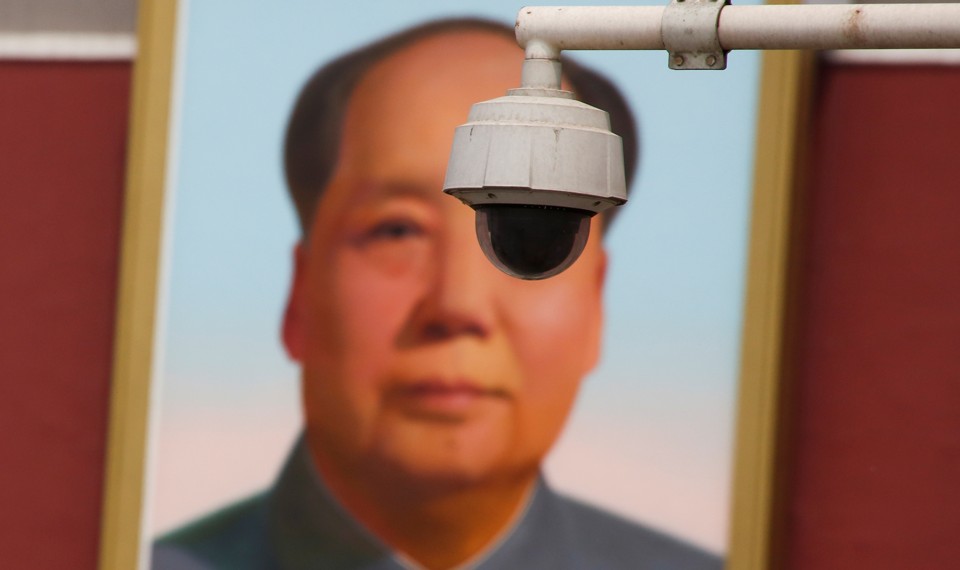
This society may seem dystopian, but it isn’t farfetched: It may be China in a few years. The country is racing to become the first to implement a pervasive system of algorithmic surveillance. Harnessing advances in artificial intelligence and data mining and storage to construct detailed profiles on all citizens, China’s communist party-state is developing a “citizen score” to incentivize “good” behavior. A vast accompanying network of surveillance cameras will constantly monitor citizens’ movements, purportedly to reduce crime and terrorism. While the expanding Orwellian eye may improve “public safety,” it poses a chilling new threat to civil liberties in a country that already has one of the most oppressive and controlling governments in the world.


China’s evolving algorithmic surveillance system will rely on the security organs of the communist party-state to filter, collect, and analyze staggering volumes of data flowing across the internet. Justifying controls in the name of national security and social stability, China originally planned to develop what it called a “Golden Shield” surveillance system allowing easy access to local, national, and regional records on each citizen. This ambitious project has so far been mostly confined to a content-filtering Great Firewall, which prohibits foreign internet sites including Google, Facebook, and The New York Times. According to Freedom House, China’s level of internet freedom is already the worst on the planet. Now, the Communist Party of China is finally building the extensive, multilevel data-gathering system it has dreamed of for decades.


While the Chinese government has long scrutinized individual citizens for evidence of disloyalty to the regime, only now is it beginning to develop comprehensive, constantly updated, and granular records on each citizen’s political persuasions, comments, associations, and even consumer habits. The new social credit system under development will consolidate reams of records from private companies and government bureaucracies into a single “citizen score” for each Chinese citizen. In its comprehensive 2014 planning outline, the CCP explains a goal of “keep[ing] trust and constraints against breaking trust.” While the system is voluntary for now, it will be mandatory by 2020. Already, 100,000 Chinese citizens have posted on social media about high scores on a “Sesame Credit” app operated by Alibaba, in a private-sector precursor to the proposed government system. The massive e-commerce conglomerate claims its app is only tracking users’ financial and credit behavior, but promises to offer a “holistic rating of character.” It is not hard to imagine many Chinese boasting soon about their official scores.


While it isn’t yet clear what data will be considered, commentators are already speculating that the scope of the system will be alarmingly wide. The planned “citizen credit” score will likely weigh far more data than the Western FICO score, which helps lenders make fast and reliable decisions on whether to extend financial credit. While the latter simply tracks whether you’ve paid back your debts and managed your money well, experts on China and internet privacy have speculated—based on the vast amounts of online shopping data mined by the government without regard for consumer privacy—that your Chinese credit score could be higher if you buy items the regime likes—like diapers—and lower if you buy ones it doesn’t, like video games or alcohol. Well beyond the realm of online consumer purchasing, your political involvement could also heavily affect your score: Posting political opinions without prior permission or even posting true news that the Chinese government dislikes could decrease your rank.


Even more worrying is that the government will be technically capable of considering the behavior of a Chinese citizen’s friends and family in determining his or her score. For example, it is possible that your friend’s anti-government political post could lower your own score. Thus, the scoring system would isolate dissidents from their friends and the rest of society, rendering them complete pariahs. Your score might even determine your access to certain privileges taken for granted in the U.S., such as a visa to travel abroad or or even the right to travel by train or plane within the country. One internet privacy expert warns: “What China is doing here is selectively breeding its population to select against the trait of critical, independent thinking.”


While Westerners and especially civil liberties groups like the ACLU are horrified by such a prospect—one commentator called the possibility “authoritarianism, gamified”—others argue that because lack of trust is a serious problem in China, many Chinese welcome this potential system. However, a state-run, party-inspired, data-driven monitoring system poses profound questions for the West about the role of private companies in government surveillance. Is it ethical for private companies to assist in massive surveillance and turn over their data to the government? Alibaba (China’s Amazon) and Tencent (owner of the popular messaging platform WeChat) possess sweeping data on each Chinese citizen that the government would have to mine to calculate scores. Although Chinese companies now are required to assist in government spying while U.S. companies are not, it is possible to imagine Amazon in Alibaba’s position, or Facebook in place of Tencent. While private companies like credit scoring bureaus have always used data to measure consumers’ creditworthiness, in any decent society there must be a clear distinction between private-sector and public-sector scoring mechanisms that could determine access to citizen rights and privileges, without recourse.


This planned data-focused social credit system is only one facet of China’s rapidly expanding system of algorithmic surveillance. Another is a sprawling network of technologies, especially surveillance cameras, to monitor people’s physical movements. In 2015, China’s national police force—the Ministry of Public Safety—called for the creation of an “omnipresent, completely connected, always on and fully controllable” national video surveillance network. MPS and other agencies stated that law enforcement should use facial recognition technology in combination with the video cameras to catch lawbreakers. One IHS Markit estimate puts the number of cameras in China at 176 million today, with a plan to have 450 million installed by 2020. One hundred percent of Beijing is now blanketed by surveillance cameras, according to the Beijing Public Safety Bureau.


The stated goal of this system is to capture and deter criminals. However, it also poses obvious and massive risks to privacy and the modicum of freedom Chinese citizens have managed to gain since the Maoist era. The penalties for small crimes seem unreasonable: Authorities in Fuzhou are publishing the names of jaywalkers in local media and even sending them to their employers. More ominous, though, are the likely punishments that will be inflicted on people who associate with dissidents or critics, who circulate a petition or hold up a protest sign, or who simply wind up in the wrong place at the wrong time. Thus, the installation of an all-seeing-eye for the government alarms civil liberties and privacy advocates worldwide. The government already constantly monitors the cell phones and social media of human-rights activists in the name of “stability maintenance.” A video surveillance system would enable further pervasive and repressive surveillance. Making streams publicly available, too, would threaten every citizen’s privacy: A busybody neighbor could easily spy on the activities of the family next door as they run errands or go on vacation.


China’s experiments with digital surveillance pose a grave new threat to freedom of expression on the internet and other human rights in China. Increasingly, citizens will refrain from any kind of independent or critical expression for fear that their data will be read or their movements recorded—and penalized—by the government. And that is exactly the point of the program. Moreover, what emerges in China will not stay in China. Its repressive technologies have a pattern of diffusing to other authoritarian regimes around the world. For this reason—not to mention concern for the hundreds of millions of people in China whose meager freedom will be further diminished—democracies around the world must monitor and denounce this sinister creep toward an Orwellian world."


China's Surveillance State Should Scare Everyone - The Atlantic

Saturday, February 03, 2018

Fierce DACA Opponents Meet DREAMer Family Face to Face

The Confederate flag resurged. The KKK burned a cross. Racial tensions flared in a Southern town. - The Washington Post


"ASHEBORO, N.C. — The first unpleasant tug of history came before the election, when the yards around Dexter Trogdon Jr.’s house started blooming with Confederate flags. Then last spring, the Ku Klux Klan announced plans to burn a cross in town. A man apparently irked with his black neighbor hung a noose in his yard, and Trogdon started hearing a disturbing new view from some white people: that slavery wasn’t so bad for African Americans.


The 49-year-old bail bondsman knew racial division would be part of the picture when he moved back to this rural, majority-white town where he grew up. But there was one factor he did not expect: the presidential election.


“We were actually getting better,” said Trogdon, picking at his egg whites and fruit at David’s Restaurant, a throwback diner here, noting that the city had been making strides toward improving race relations. Until a year ago, when racism and bigotry seemed to rush out of the woodwork, especially here, in the South. “That stuff came to a halt. ... If you live here, you can feel it. It’s just the way people treat you every day.”


More than a year after President Trump took office, many people of color are coming to terms with what his presidency has exposed, and what it has wrought, on matters of race.


Some white supremacists and white nationalists have seen the administration’s first year as emboldening, leading them to hold rallies like the deadly August gathering of Trump-supporting neo-Nazis in Charlottesville or those in Portland, Ore., that preceded a fatal commuter train attack by a white man who was spouting anti-Muslim hatred at minority passengers."


The Confederate flag resurged. The KKK burned a cross. Racial tensions flared in a Southern town. - The Washington Post