Friday, May 05, 2017


The seven key consequences of the new GOP health care bill

#ResistanceIsNotFutile Call the offices of your Senators and tell them you will organize and vote to defeat them if they vote for any version of the Trumpcare bill. Call your Congressperson, if they voted for this bill and tell them you will organize and vote to unseat them next year, We must punish hour elected officials who cut our health care and give a huge taxbreak to the rich.
Trump’s false claim that 'Dems want billions to go to Insurance Companies to bail out donors' | PolitiFact
"Before the Affordable Care Act, insurance companies could consider a person’s health status when determining premiums, sometimes making coverage unaffordable or even unavailable if a person was already sick with a problem that required expensive treatment. The ACA prohibited that, in part by requiring everyone to purchase insurance.
But that “individual mandate” was unpopular and Republicans would eliminate that requirement in their proposed American Health Care Act. As a replacement, the AHCA initially included a continuous coverage provision that boosted insurance rates by 30 percent for one year if he or she has a lapse in coverage. (We explored this interaction between the provisions earlier.)
As part of an effort to attract more votes, Republicans have added an amendment, crafted by Rep. Tom McArthur (R-N.J.), that instead allows states to seek individual waivers from the law. One possible waiver would replace the continuous coverage provision so that insurance companies for one year could consider a person’s health status when writing policies in the individual and small group plan markets. Another possible waiver would allow the state to replace a federal essential benefits package with a more narrowly tailored package of benefits, again limited to the individual and small-group markets.
The theory is that removing sicker people from the markets and allowing policies with skimpier options would result in lower overall premiums.
Who would be affected?
If the law passed, a person generally would not be affected unless they lived in a state that sought a waiver. Moreover, they would need to have a lapse in health coverage for longer than 63 days and they would need to have a preexisting condition. Finally, they would have to purchase insurance in the individual market, i.e., the health exchanges in Obamacare that currently serve about 18 million Americans.
Someone who got their insurance from an employer – and that’s most Americans (155 million) – presumably would not be affected, though the CBO did project that under the initial version of the AHCA 7 million fewer people would be covered by employers than under current law by 2026.
Then, for a period of one year, a person who fell into this category would face insurance rates that could be based on their individual condition. But states that seek a waiver are required to operate a risk mitigation program or participate in what is called an invisible risk sharing program. Alaska currently has such a program that helps cover the bills for one of 33 conditions (such as HIV/AIDS or metastatic cancer). The individual with the condition still submits bills to the insurance company, which then turns around and bills the state. But then the insurance company does not consider the cost of this care as part of its calculation for premiums to other individuals in the state.
All told, the AHCA would allot $138 billion over 10 years for a variety of funds that would seek to keep premiums lower or to assist with cost-sharing. Just this week, $8 billion over five years was added to the pot to woo wavering lawmakers, with the idea that the additional funds could be used for so-called high-risk pools. Many states had such pools to help people with preexisting conditions before the ACA. But the proposal does not require a state with a waiver to set up such a pool.
What could go wrong then?
There are many uncertainties about this path. The health insurance market has a lot of churn, so many people may experience a gap in coverage of just a few months. One estimate, by the Commonwealth Fund, indicated that 30 million adults would have had such a gap in 2016, potentially exposing them to a surcharge or being placed in a high-risk pool. On top of that, the Kaiser Family Foundation estimated that 27 percent of the people in the individual market have existing conditions that would have been uninsured before the ACA.
The AHCA eliminates cost sharing and offers a stingier tax credit to defray premium costs, likely resulting in higher overall health costs that may make insurance unaffordable for many people. (The CBO projected that 24 million more people would be without health insurance than under current law by 2026.)
Then, if people get sick, they may suddenly find themselves for a year being priced on their illness if they live in a state that sought a waiver. Depending on the approach taken by a state, some people might find it difficult to keep up their coverage for a full year before they qualify for prices at the community rate.
A big question is whether the funding to cover these folks is adequate. High-risk pools were big money losers and underfunded in the pre-Obamacare days, even though many had restrictions, high premiums and waiting lists. A $5 billion federal pool, established by the ACA as a bridge to the creation of the exchanges in 2013, covered about 100,000 people but was suspended when it ran out of money.
The Center for American Progress, a left-leaning group that opposes the AHCA, produced an analysis that indicated that even with the additional $8 billion, the maximum enrollment the AHCA’s funds would cover is about 700,000 people. If just 5 percent of the people currently in the individual market ended up in high-risk pools – and all states sought a waiver – that would overwhelm the proposed funding.
Avalere Health, a consulting firm, said in an analysis that $23 billion is specifically allocated in the bill for helping people with pre-existing conditions. That would cover about 110,000 people. If states allocated all of the other available funding, that would cover 600,00 people. “Approximately 2.2 million enrollees in the individual market today have some form of pre-existing chronic condition,” the analysis said.
When states had high-risk pools, people in those pools represented just 2 percent of the non-group health insurance participants. But given the limitations of those funds, that percentage may not be a good guide for what would happen under the AHCA.
Whenever health-care laws are changed, there are unknown and unintended consequences. The current system does not take into account a person’s health status when assessing premiums. But, as a Brookings Institution analysis suggested, under the AHCA’s provisions, healthy people might have an incentive to join plans based on health status. That would leave sicker people in the community rated plans, which in turn would face higher premiums. Over time, that could make the community rating meaningless. Another possible outcome: If the pool of money is used to pay insurance companies for the difference in costs for patients with preexisting conditions, there may be little incentive for companies to keep their prices low; the difference would be made up by U.S. taxpayers.
The Bottom Line
When it comes to health care, readers should be wary about claims that important changes in health-care coverage are without consequences and that people are “protected” – or that the changes will result in massive dislocation and turmoil. There are always winners and losers in a bill of this size. In this case, if the bill ever became law, much would depend on unknown policy decisions by individual states – and then how those decisions are implemented."
Here’s what you need to know about preexisting conditions in the GOP health plan - The Washington Post
Thursday, May 04, 2017
After announcing retirement, one GOP congresswoman is torching the GOP health care plan

"'Despite amendments and changes, the AHCA still fails to provide for the needs of my constituents. I will not support a bill that has the potential to severely harm the health and lives of people in South Florida and therefore I remain steadfast in my commitment to vote NO on the AHCA. The recent addition of further funds to high risk pools continues to be inadequate and fails to cover those who need it most. If enacted, the older and poorer South Floridians will be worse off and will find it more difficult to obtain quality healthcare. My constituents should not have to take a step backward in their ability to obtain treatment for any illness and thus, I will vote NO.'"
(Via.). After announcing retirement, one GOP congresswoman is torching the GOP health care plan:
Seven Reasons the Left Is Losing - The Atlantic
Call Out Hate, Not Faux Pas
"A related concern was raised by Ezra Klein and Chris Hayes in a podcast conversation where they agreed that while objecting to racism or other bigotries is important—as deBoer would agree—the left must take care, as the universe of things deemed problematic continues to expand, that it doesn’t stray into enforcing elite manners against people who mean no harm and harbor no hate when violating them. What’s more, it must be better at clarifying why some of what may strike observers as mere elite manners is, in fact, a substantive good that deserves to be emphasized.
As they put it:
Hayes: Issues of social justice have been understood by large parts of the populace as essentially elite manners.
Klein: Which, they sometimes have that dimension.
Hayes: Those two things are bound together. So if you watch a farce, the person at the dinner party who doesn’t know which fork to use, that’s who you root for. And in our politics a huge part of the population has understood what I think are––what are––genuine struggles for social justice and equality as essentially elite manners. Michelle Goldberg makes this great point. And it was my experience as well. She was like, ‘When I would go to rallies, a lot of people told me about political correctness and almost no one told me about NAFTA.’ It was the violations of the taboos that people liked, at least the hard core supporters who would go to the rallies, more than trade. Because at some level, their understanding of it, it was the person at the dinner party with everyone with their fine china and their 9 different kinds of forks just drinking the soup out of the bowl. And it was like, that’s my dude.
And precisely for the reasons you identify.
Precisely because there’s been this way in which the cosmopolitan elites, the guardians of culture, the people that cluster in these urban centers, have a set of social values and social taboos that I think are informed by genuine commitments toward justice, but also have this aspect of elite manners and that are understood by huge parts of society as elite manners."
Wednesday, May 03, 2017
James Comey ‘Mildly Nauseous’ Over Idea He Swayed the Election - The New York Times
"Mr. Comey said he went public on Oct. 28 because he believed that the emails found by his agents might provide insight into Mrs. Clinton’s reasons for using a private server as secretary of state and might change the outcome of the investigation. Failing to inform Congress, Mr. Comey said, would have a required an ‘act of concealment.’
‘Concealment, in my view, would have been catastrophic,’ he said, adding later that he knew the decision would be ‘disastrous for me personally.’
What Mr. Comey viewed as concealing, Justice Department officials viewed simply as following the rules. The F.B.I. does not normally confirm ongoing investigations. Senior Justice Department officials urged him not to send a letter to Congress informing them that the bureau was examining the new emails.
Continue reading the main story RELATED COVERAGE
Comey Tried to Shield the F.B.I. From Politics. Then He Shaped an Election. APRIL 22, 2017 RECENT COMMENTS
Phil M 3 minutes ago Comey needs to atone by leaking Trump's tax returns. If that leads to Trump's impeachment, then Comey goes from goat to hero, although he... Oliver Burke 3 minutes ago I've never seen him so energized. FWIW. JA 3 minutes ago dear Mr. Comey,you will want to read this:https://fivethirtyeight.com/features/the-comey-letter-probably-cost-clin... SEE ALL COMMENTS WRITE A COMMENT Mr. Comey’s handling of the Clinton investigation is likely to be as key a moment to his legacy as the 2004 standoff at a hospital bedside over Bush administration wiretapping. Mr. Comey was acting attorney general at the time, and with his ailing boss, John Ashcroft, nearby, he refused the request of White House aides to reauthorize a program for eavesdropping without warrants."
(Via.). James Comey ‘Mildly Nauseous’ Over Idea He Swayed the Election - The New York Times:
Tuesday, May 02, 2017
Trump’s Degradation of the Language - The New York Times
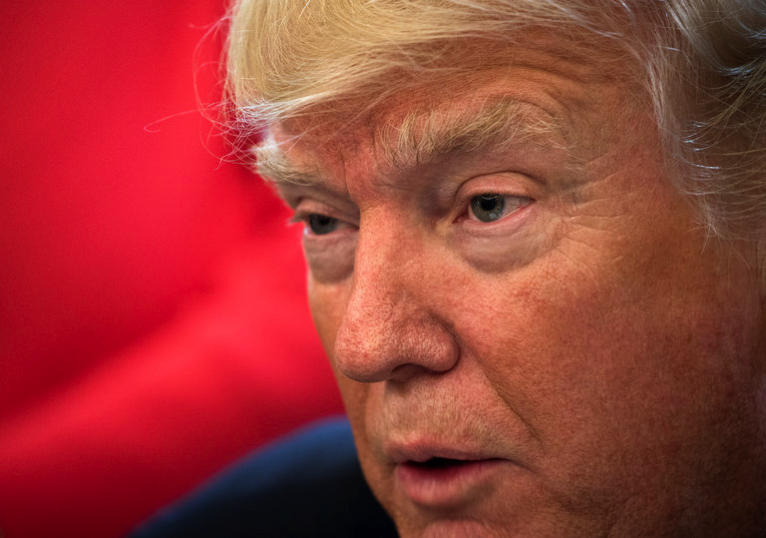
“...One of the more pernicious and insidious effects of the Donald Trump regime may well be the damage he does to language itself.
Trumpian language is a thing unto itself: some manner of sophistry peppered with superlatives. It is a way of speech that defies the Reed-Kellogg sentence diagram. It is a jumble of incomplete thoughts stitched together with arrogance and ignorance.
America is suffering under the tyranny of gibberish spouted by the lord of his faithful 46 percent.
As researchers at Carnegie Mellon pointed out last spring, presidential candidates in general use ‘words and grammar typical of students in grades 6-8, though Donald Trump tends to lag behind the others.’ Indeed, among the presidents in the university’s analysis, Trump’s vocabulary usage was the lowest and his grammatical usage was only better than one president: George W. Bush...
...In Trump world, facts don’t matter, truth doesn’t matter, language doesn’t matter. Passionate performance is the only ideal. A lie forcefully told and often repeated is better than truth — it is accepted as an act of faith, which is better than a point of fact. 1573 COMMENTS This is one of the most heinous acts of this man: the mugging of the meaning, the disassembling of rhetoric until certainty is stripped away from truth like flesh from a carcass. Degradation of the language is one of Trump’s most grievous sins."
(Via.).Trump’s Degradation of the Language - The New York Times: