The Clicker: Was Grokster really the important Supreme Court decision? - Engadget - www.engadget.comThe Clicker: Was Grokster really the important Supreme Court decision?
Posted Jul 7, 2005, 7:26 PM ET by Peter Rojas
Related entries: Displays, Features, HDTV, Home Entertainment
Every Thursday Stephen Speicher contributes The Clicker, a weekly column on television and technology:
The key to all good magic, as it has been explained to me, is misdirection. The magician must engage in some large, eye-catching gesture that, when all is said and done, is rather meaningless. Meanwhile, under the cover of the aforementioned grandeur, the real work is performed.
For instance: in the early nineties, David Copperfield would, with pomp and glory, make large jets, the Grand Canyon, even the Statue of Liberty disappear into thin air. These, of course, were just the WOW-type distractions he needed to accomplish his real goal, attracting supermodel Claudia Schiffer.
As it turns out – Justice Rehnquist and the rest of his Supreme Court posse are also fans of the ancient art of illusion. When the Supreme Court delivered the recent raft of decisions it deftly used the attention-grabbing, yet rather meaningless, Grokster case to grab the attention of the public. Meanwhile, a second, arguably more important, ruling has quietly solidified Comcast et. al.’s legal classification as an “information service” and not as a “telecommunication” service. In doing so, the Supreme Court has set the stage for cable giants such as Comcast to, with impunity, disallow such competitive services as Vonage, Skype, and even perhaps Akimbo, MovieLink, and a host of IPTV services.
A small, Santa Monica-based Internet company, Brand X Internet LLC, brought suit against the cable industry claiming that, under common carrier regulations, Brand X had a right to deliver its Internet services over the cable giants’ broadband networks. Brand X argued that, just like DSL, cable lines were telecommunication instruments. As such, just like the Bells are forced to open DSL lines to third-party providers, so too should third-party companies be afforded access to the cable infrastructure.
Brand X’s argument was not without basis: In 2000, the Ninth Circuit Court of Appeals held in AT&T v. the City of Portland that cable modem services were a mixture of both information services and telecommunication services and should be subject to the regulations of both bodies. However, in response to that ruling, the FCC later (2002) issued an opposing statement that cable modem services were information services and that they were not subject to telecommunications regulations. The Brand X case became the Supreme Court’s chance to set the record straight.
In the 6-3 decision delivered by Clarence Thomas, the court re-affirmed the FCC’s classification of cable modem services as information services.
The ruling has caused a lot of speculation about whether the cable industry will use its newly-reaffirmed status to make life difficult for its competitors in the VoIP industry. Under telecommunication regulations, providers must open their networks on non-discriminatory terms. Information services are not bound by the same regulations. Cable companies could engage in port-blocking and other countermeasures used to stop VoIP services from traversing their networks.
What’s even less clear is how the decision muddies the waters with respect to IPTV services. While not yet as developed as VoIP, the emerging IPTV market has just as much to lose. IPTV is also closer to the cable companies bread and butter services. It’s unclear that, without non-discriminatory terms, cable companies would have the proper incentive to allow third-party video services to traverse their networks. Value-add services such as VOD have been at the backbone of nearly all cable battles, and cable companies have fought hard to maintain their monopoly there. It’s unlikely that they wouldn’t at least consider cutting their competition off at the knees.
The matter is further complicated by the dearth of information-service regulations. The FCC has been in a holding pattern with regards to broadband regulations.
The Supreme Court’s decision, according to FCC Chairman Kevin Martin, allows for that to change. Martin said in a statement: “This decision provides much-needed regulatory clarity and a framework for broadband that can be applied to all providers… We can now move forward quickly to finalize regulations that will spur the development of broadband services for all Americans.”
But, until regulations do change, the Brand X decision leaves the Internet in an unusually precarious position. With a) many regions of the country operating under a broadband-access monopoly and b) with access to broadband services becoming more and more important in both communication and entertainment services, the courts just bestowed upon the cable companies a disturbing amount of power.
It’s time for FCC to take some of that power back from the cable companies. It’s time for Martin to enact neutrality regulations. It’s one thing to allow cable companies sole use of their own networks. It’s an entirely different thing to allow them the power to block the competitive services that travel over those networks, and while we’re in limbo that’s what they’ve done.
Friday, July 08, 2005


Thursday, July 07, 2005
Daily Kos: Rehnquist tomorrow?
Daily Kos: Rehnquist tomorrow?Rehnquist tomorrow?
by kos
Thu Jul 7th, 2005 at 14:59:24 PDT
The big DC rumor is that Rehnquist will announce his retirement tomorrow between 10-11 a.m. ET.
If that happens, would Bush split the difference -- Gonzales and some winger to pacify the Dobson brigades?
by kos
Thu Jul 7th, 2005 at 14:59:24 PDT
The big DC rumor is that Rehnquist will announce his retirement tomorrow between 10-11 a.m. ET.
If that happens, would Bush split the difference -- Gonzales and some winger to pacify the Dobson brigades?
Judith Miller Goes to Jail - New York Times
Judith Miller Goes to Jail - New York TimesJuly 7, 2005
Judith Miller Goes to Jail
This is a proud but awful moment for The New York Times and its employees. One of our reporters, Judith Miller, has decided to accept a jail sentence rather than testify before a grand jury about one of her confidential sources. Ms. Miller has taken a path that will be lonely and painful for her and her family and friends. We wish she did not have to choose it, but we are certain she did the right thing.
She is surrendering her liberty in defense of a greater liberty, granted to a free press by the founding fathers so journalists can work on behalf of the public without fear of regulation or retaliation from any branch of government.
The Press and the Law
Some people - including, sadly, some of our colleagues in the news media - have mistakenly assumed that a reporter and a news organization place themselves above the law by rejecting a court order to testify. Nothing could be further from the truth. When another Times reporter, M. A. Farber, went to jail in 1978 rather than release his confidential notes, he declared, "I have no such right and I seek none."
By accepting her sentence, Ms. Miller bowed to the authority of the court. But she acted in the great tradition of civil disobedience that began with this nation's founding, which holds that the common good is best served in some instances by private citizens who are willing to defy a legal, but unjust or unwise, order.
This tradition stretches from the Boston Tea Party to the Underground Railroad, to the Americans who defied the McCarthy inquisitions and to the civil rights movement. It has called forth ordinary citizens, like Rosa Parks; government officials, like Daniel Ellsberg and Mark Felt; and statesmen, like Martin Luther King. Frequently, it falls to news organizations to uphold this tradition. As Justice William O. Douglas wrote in 1972, "The press has a preferred position in our constitutional scheme, not to enable it to make money, not to set newsmen apart as a favored class, but to bring to fulfillment the public's right to know."
Critics point out that even presidents must bow to the Supreme Court. But presidents are agents of the government, sworn to enforce the law. Journalists are private citizens, and Ms. Miller's actions are faithful to the Constitution. She is defending the right of Americans to get vital information from news organizations that need not fear government retaliation - an imperative defended by the 49 states that recognize a reporter's right to protect sources.
A second reporter facing a possible jail term, Matthew Cooper of Time magazine, agreed yesterday to testify before the grand jury. Last week, Time decided, over Mr. Cooper's protests, to release documents demanded by the judge that revealed his confidential sources. We were deeply disappointed by that decision.
We do not see how a newspaper, magazine or television station can support a reporter's decision to protect confidential sources even if the potential price is lost liberty, and then hand over the notes or documents that make the reporter's sacrifice meaningless. The point of this struggle is to make sure that people with critical information can feel confident that if they speak to a reporter on the condition of anonymity, their identities will be protected. No journalist's promise will be worth much if the employer that stands behind him or her is prepared to undercut such a vow of secrecy.
Protecting a Reporter's Sources
Most readers understand a reporter's need to guarantee confidentiality to a source. Before he went to jail, Mr. Farber told the court that if he gave up documents that revealed the names of the people he had promised anonymity, "I will have given notice that the nation's premier newspaper is no longer available to those men and women who would seek it out - or who would respond to it - to talk freely and without fear."
While The Times has gone to great lengths lately to make sure that the use of anonymous sources is limited, there is no way to eliminate them. The most important articles tend to be the ones that upset people in high places, and many could not be reported if those who risked their jobs or even their liberty to talk to reporters knew that they might be identified the next day. In the larger sense, revealing government wrongdoing advances the rule of law, especially at a time of increased government secrecy.
It is for these reasons that most states have shield laws that protect reporters' rights to conceal their sources. Those laws need to be reviewed and strengthened, even as members of Congress continue to work to pass a federal shield law. But at this moment, there is no statute that protects Judith Miller when she defies a federal trial judge's order to reveal who told her what about Valerie Plame Wilson's identity as an undercover C.I.A. operative.
Ms. Miller understands this perfectly, and she accepts the consequences with full respect for the court. We hope that her sacrifice will alert the nation to the need to protect the basic tools reporters use in doing their most critical work.
To be frank, this is far from an ideal case. We would not have wanted our reporter to give up her liberty over a situation whose details are so complicated and muddy. But history is very seldom kind enough to provide the ideal venue for a principled stand. Ms. Miller is going to jail over an article that she never wrote, yet she has been unwavering in her determination to protect the people with whom she had spoken on the promise of confidentiality.
The Plame Story
The case involves an article by the syndicated columnist Robert Novak, who revealed that Joseph Wilson, a retired career diplomat, was married to an undercover C.I.A. officer Mr. Novak identified by using her maiden name, Valerie Plame. Mr. Wilson had been asked by the C.I.A. to investigate whether Saddam Hussein in Iraq was trying to buy uranium from Niger that could be used for making nuclear weapons. Mr. Wilson found no evidence of that, and he later wrote an Op-Ed article for The Times saying he believed that the Bush administration had misrepresented the facts.
It seemed very possible that someone at the White House had told Mr. Novak about Ms. Plame to undermine Mr. Wilson's credibility and send a chilling signal to other officials who might be inclined to speak out against the administration's Iraq policy. At the time, this page said that if those were indeed the circumstances, the leak had been "an egregious abuse of power." We urged the Justice Department to investigate. But we warned then that the inquiry should not degenerate into an attempt to compel journalists to reveal their sources.
We mainly had Mr. Novak in mind then, but Mr. Novak remains both free and mum about what he has or has not told the grand jury looking into the leak. Like almost everyone, we are baffled by his public posture. All we know now is that Mr. Novak - who early on expressed the opinion that no journalists who bowed to court pressure to betray sources could hold up their heads in Washington - has offered no public support to the colleague who is going to jail while he remains at liberty.
Ms. Miller did not write an article about Ms. Plame, but the prosecutor, Patrick Fitzgerald, wants to know whether anyone in government told her about Mr. Wilson's wife and her secret job. The inquiry has been conducted with such secrecy that it is hard to know exactly what Mr. Fitzgerald thinks Ms. Miller can tell him, or what argument he offered to convince the court that his need to hear her testimony outweighs the First Amendment.
What we do know is that if Ms. Miller testifies, it may be immeasurably harder in the future to persuade a frightened government employee to talk about malfeasance in high places, or a worried worker to reveal corporate crimes. The shroud of secrecy thrown over this case by the prosecutor and the judge, an egregious denial of due process, only makes it more urgent to take a stand.
Mr. Fitzgerald drove that point home chillingly when he said the authorities "can't have 50,000 journalists" making decisions about whether to reveal sources' names and that the government had a right to impose its judgment. But that's not what the founders had in mind in writing the First Amendment. In 1971, our colleague James Reston cited James Madison's admonition about a free press in explaining why The Times had first defied the Nixon administration's demand to stop publishing the Pentagon Papers and then fought a court's order to cease publication. "Among those principles deemed sacred in America," Madison wrote, "among those sacred rights considered as forming the bulwark of their liberty, which the government contemplates with awful reverence and would approach only with the most cautious circumspection, there is no one of which the importance is more deeply impressed on the public mind than the liberty of the press."
Mr. Fitzgerald's attempts to interfere with the rights of a free press while refusing to disclose his reasons for doing so, when he can't even say whether a crime has been committed, have exhibited neither reverence nor cautious circumspection. It would compound the tragedy if his actions emboldened more prosecutors to trample on a free press.
Our Bottom Line
Responsible journalists recognize that press freedoms are not absolute and must be exercised responsibly. This newspaper will not, for example, print the details of American troop movements in advance of a battle, because publication would endanger lives and national security. But these limits cannot be dictated by the whim of a branch of government, especially behind a screen of secrecy.
Indeed, the founders warned against any attempt to have the government set limits on a free press, under any conditions. "However desirable those measures might be which might correct without enslaving the press, they have never yet been devised in America," Madison wrote.
Journalists talk about these issues a great deal, and they can seem abstract. The test comes when a colleague is being marched off to jail for doing nothing more than the job our readers expected of her, and of the rest of us. The Times has been in these fights before, beginning in 1857, when a journalist named J. W. Simonton wrote an editorial about bribery in Congress and was held in contempt by the House of Representatives for 19 days when he refused to reveal his sources. In the end, Mr. Simonton kept faith, and the corrupt congressmen resigned. All of our battles have not had equally happy endings. But each time, whether we win or we lose, we remain convinced that the public wins in the long run and that what is at stake is nothing less than our society's perpetual bottom line: the citizens control the government in a democracy.
We stand with Ms. Miller and thank her for taking on that fight for the rest of us.
Judith Miller Goes to Jail
This is a proud but awful moment for The New York Times and its employees. One of our reporters, Judith Miller, has decided to accept a jail sentence rather than testify before a grand jury about one of her confidential sources. Ms. Miller has taken a path that will be lonely and painful for her and her family and friends. We wish she did not have to choose it, but we are certain she did the right thing.
She is surrendering her liberty in defense of a greater liberty, granted to a free press by the founding fathers so journalists can work on behalf of the public without fear of regulation or retaliation from any branch of government.
The Press and the Law
Some people - including, sadly, some of our colleagues in the news media - have mistakenly assumed that a reporter and a news organization place themselves above the law by rejecting a court order to testify. Nothing could be further from the truth. When another Times reporter, M. A. Farber, went to jail in 1978 rather than release his confidential notes, he declared, "I have no such right and I seek none."
By accepting her sentence, Ms. Miller bowed to the authority of the court. But she acted in the great tradition of civil disobedience that began with this nation's founding, which holds that the common good is best served in some instances by private citizens who are willing to defy a legal, but unjust or unwise, order.
This tradition stretches from the Boston Tea Party to the Underground Railroad, to the Americans who defied the McCarthy inquisitions and to the civil rights movement. It has called forth ordinary citizens, like Rosa Parks; government officials, like Daniel Ellsberg and Mark Felt; and statesmen, like Martin Luther King. Frequently, it falls to news organizations to uphold this tradition. As Justice William O. Douglas wrote in 1972, "The press has a preferred position in our constitutional scheme, not to enable it to make money, not to set newsmen apart as a favored class, but to bring to fulfillment the public's right to know."
Critics point out that even presidents must bow to the Supreme Court. But presidents are agents of the government, sworn to enforce the law. Journalists are private citizens, and Ms. Miller's actions are faithful to the Constitution. She is defending the right of Americans to get vital information from news organizations that need not fear government retaliation - an imperative defended by the 49 states that recognize a reporter's right to protect sources.
A second reporter facing a possible jail term, Matthew Cooper of Time magazine, agreed yesterday to testify before the grand jury. Last week, Time decided, over Mr. Cooper's protests, to release documents demanded by the judge that revealed his confidential sources. We were deeply disappointed by that decision.
We do not see how a newspaper, magazine or television station can support a reporter's decision to protect confidential sources even if the potential price is lost liberty, and then hand over the notes or documents that make the reporter's sacrifice meaningless. The point of this struggle is to make sure that people with critical information can feel confident that if they speak to a reporter on the condition of anonymity, their identities will be protected. No journalist's promise will be worth much if the employer that stands behind him or her is prepared to undercut such a vow of secrecy.
Protecting a Reporter's Sources
Most readers understand a reporter's need to guarantee confidentiality to a source. Before he went to jail, Mr. Farber told the court that if he gave up documents that revealed the names of the people he had promised anonymity, "I will have given notice that the nation's premier newspaper is no longer available to those men and women who would seek it out - or who would respond to it - to talk freely and without fear."
While The Times has gone to great lengths lately to make sure that the use of anonymous sources is limited, there is no way to eliminate them. The most important articles tend to be the ones that upset people in high places, and many could not be reported if those who risked their jobs or even their liberty to talk to reporters knew that they might be identified the next day. In the larger sense, revealing government wrongdoing advances the rule of law, especially at a time of increased government secrecy.
It is for these reasons that most states have shield laws that protect reporters' rights to conceal their sources. Those laws need to be reviewed and strengthened, even as members of Congress continue to work to pass a federal shield law. But at this moment, there is no statute that protects Judith Miller when she defies a federal trial judge's order to reveal who told her what about Valerie Plame Wilson's identity as an undercover C.I.A. operative.
Ms. Miller understands this perfectly, and she accepts the consequences with full respect for the court. We hope that her sacrifice will alert the nation to the need to protect the basic tools reporters use in doing their most critical work.
To be frank, this is far from an ideal case. We would not have wanted our reporter to give up her liberty over a situation whose details are so complicated and muddy. But history is very seldom kind enough to provide the ideal venue for a principled stand. Ms. Miller is going to jail over an article that she never wrote, yet she has been unwavering in her determination to protect the people with whom she had spoken on the promise of confidentiality.
The Plame Story
The case involves an article by the syndicated columnist Robert Novak, who revealed that Joseph Wilson, a retired career diplomat, was married to an undercover C.I.A. officer Mr. Novak identified by using her maiden name, Valerie Plame. Mr. Wilson had been asked by the C.I.A. to investigate whether Saddam Hussein in Iraq was trying to buy uranium from Niger that could be used for making nuclear weapons. Mr. Wilson found no evidence of that, and he later wrote an Op-Ed article for The Times saying he believed that the Bush administration had misrepresented the facts.
It seemed very possible that someone at the White House had told Mr. Novak about Ms. Plame to undermine Mr. Wilson's credibility and send a chilling signal to other officials who might be inclined to speak out against the administration's Iraq policy. At the time, this page said that if those were indeed the circumstances, the leak had been "an egregious abuse of power." We urged the Justice Department to investigate. But we warned then that the inquiry should not degenerate into an attempt to compel journalists to reveal their sources.
We mainly had Mr. Novak in mind then, but Mr. Novak remains both free and mum about what he has or has not told the grand jury looking into the leak. Like almost everyone, we are baffled by his public posture. All we know now is that Mr. Novak - who early on expressed the opinion that no journalists who bowed to court pressure to betray sources could hold up their heads in Washington - has offered no public support to the colleague who is going to jail while he remains at liberty.
Ms. Miller did not write an article about Ms. Plame, but the prosecutor, Patrick Fitzgerald, wants to know whether anyone in government told her about Mr. Wilson's wife and her secret job. The inquiry has been conducted with such secrecy that it is hard to know exactly what Mr. Fitzgerald thinks Ms. Miller can tell him, or what argument he offered to convince the court that his need to hear her testimony outweighs the First Amendment.
What we do know is that if Ms. Miller testifies, it may be immeasurably harder in the future to persuade a frightened government employee to talk about malfeasance in high places, or a worried worker to reveal corporate crimes. The shroud of secrecy thrown over this case by the prosecutor and the judge, an egregious denial of due process, only makes it more urgent to take a stand.
Mr. Fitzgerald drove that point home chillingly when he said the authorities "can't have 50,000 journalists" making decisions about whether to reveal sources' names and that the government had a right to impose its judgment. But that's not what the founders had in mind in writing the First Amendment. In 1971, our colleague James Reston cited James Madison's admonition about a free press in explaining why The Times had first defied the Nixon administration's demand to stop publishing the Pentagon Papers and then fought a court's order to cease publication. "Among those principles deemed sacred in America," Madison wrote, "among those sacred rights considered as forming the bulwark of their liberty, which the government contemplates with awful reverence and would approach only with the most cautious circumspection, there is no one of which the importance is more deeply impressed on the public mind than the liberty of the press."
Mr. Fitzgerald's attempts to interfere with the rights of a free press while refusing to disclose his reasons for doing so, when he can't even say whether a crime has been committed, have exhibited neither reverence nor cautious circumspection. It would compound the tragedy if his actions emboldened more prosecutors to trample on a free press.
Our Bottom Line
Responsible journalists recognize that press freedoms are not absolute and must be exercised responsibly. This newspaper will not, for example, print the details of American troop movements in advance of a battle, because publication would endanger lives and national security. But these limits cannot be dictated by the whim of a branch of government, especially behind a screen of secrecy.
Indeed, the founders warned against any attempt to have the government set limits on a free press, under any conditions. "However desirable those measures might be which might correct without enslaving the press, they have never yet been devised in America," Madison wrote.
Journalists talk about these issues a great deal, and they can seem abstract. The test comes when a colleague is being marched off to jail for doing nothing more than the job our readers expected of her, and of the rest of us. The Times has been in these fights before, beginning in 1857, when a journalist named J. W. Simonton wrote an editorial about bribery in Congress and was held in contempt by the House of Representatives for 19 days when he refused to reveal his sources. In the end, Mr. Simonton kept faith, and the corrupt congressmen resigned. All of our battles have not had equally happy endings. But each time, whether we win or we lose, we remain convinced that the public wins in the long run and that what is at stake is nothing less than our society's perpetual bottom line: the citizens control the government in a democracy.
We stand with Ms. Miller and thank her for taking on that fight for the rest of us.
Ipaq HQ Forums - Watch Who's WiFi You Use -- It Could Be A Felony
Ipaq HQ Forums - Watch Who's WiFi You Use -- It Could Be A FelonyWatch Who's WiFi You Use -- It Could Be A Felony
Richard Dinon of St Petersburg, Florida noticed a guy sitting in an SUV outside his home using a laptop computer. Dinon figured-out that the guy in the SUV, Benjamin Smith, III, was using Dinon's his home's open and unprotected WiFi network -- an unauthorized use no less.
Rather than work it out between them -- like walking up to the door and asking permission or knocking on the SUV window and asking the guy to quit using the network, the Florida Department of Law Enforcement was involved and Smith was arrested. He is facing third-degree felony charges of unauthorized access to a computer network.
Locating and using an open network is a fairly common practice. Sure, some people do so to do bad things, but the vast majority people who access someone else's WiFi network do so to get access to the Internet for relatively harmless reasons such as sending and receiving email, checking movie times or getting updated on the day's news.
It's unclear as to what Mr. Smith was doing with his unauthorized connection -- Florida Prosecutors have declined to comment and Smith hasn't said publicly. What is clear is that whether innocent or nefarious in nature, unauthorized use is against the law in many places.
Staying Out Of Jail With WiFi Access:
1. Ask permission -- getting it in writing is best.
2. No means no -- like in many other areas of life.
3. Yes today doesn't necessarily mean yes tomorrow -- always ask.
4. Look for posted signs advertising FREE WiFi access -- A sign is always a good sign.
5. Pave the way for others -- suggest a sign authorizing FREE open WiFi access to businesses and homes that open their access points to the public.
6. Stay away from Richard Dinon house in St Petersburg, Florida -- he's apparently not open to sharing his open and unprotected WiFi access point with others.
7. When in doubt, don't! -- Asking forgiveness isn't as good as asking permission when someone with handcuffs and a badge is reading you your rights.
8. Pay to play -- just pay for a hotspot subscription and get it over with.
9. Look before you go -- research FREE & legal access points before you hit the road (or with Google Mobile while on the road.) An ounce of prevention, yada, yada, yada...
If you frequently piggy-back on other people's open WiFi access points -- go and sin no more -- or risk fines, fees and felony charges that will FAR outweigh a good T-Mobile Hotspot subscription fee.
Richard Dinon of St Petersburg, Florida noticed a guy sitting in an SUV outside his home using a laptop computer. Dinon figured-out that the guy in the SUV, Benjamin Smith, III, was using Dinon's his home's open and unprotected WiFi network -- an unauthorized use no less.
Rather than work it out between them -- like walking up to the door and asking permission or knocking on the SUV window and asking the guy to quit using the network, the Florida Department of Law Enforcement was involved and Smith was arrested. He is facing third-degree felony charges of unauthorized access to a computer network.
Locating and using an open network is a fairly common practice. Sure, some people do so to do bad things, but the vast majority people who access someone else's WiFi network do so to get access to the Internet for relatively harmless reasons such as sending and receiving email, checking movie times or getting updated on the day's news.
It's unclear as to what Mr. Smith was doing with his unauthorized connection -- Florida Prosecutors have declined to comment and Smith hasn't said publicly. What is clear is that whether innocent or nefarious in nature, unauthorized use is against the law in many places.
Staying Out Of Jail With WiFi Access:
1. Ask permission -- getting it in writing is best.
2. No means no -- like in many other areas of life.
3. Yes today doesn't necessarily mean yes tomorrow -- always ask.
4. Look for posted signs advertising FREE WiFi access -- A sign is always a good sign.
5. Pave the way for others -- suggest a sign authorizing FREE open WiFi access to businesses and homes that open their access points to the public.
6. Stay away from Richard Dinon house in St Petersburg, Florida -- he's apparently not open to sharing his open and unprotected WiFi access point with others.
7. When in doubt, don't! -- Asking forgiveness isn't as good as asking permission when someone with handcuffs and a badge is reading you your rights.
8. Pay to play -- just pay for a hotspot subscription and get it over with.
9. Look before you go -- research FREE & legal access points before you hit the road (or with Google Mobile while on the road.) An ounce of prevention, yada, yada, yada...
If you frequently piggy-back on other people's open WiFi access points -- go and sin no more -- or risk fines, fees and felony charges that will FAR outweigh a good T-Mobile Hotspot subscription fee.
Wednesday, July 06, 2005
Missing college student found in jail | ajc.com
Missing college student found in jail | ajc.comMissing college student found in jail
> By RHONDA COOK
The Atlanta Journal-Constitution
> Published on: 07/06/05
A Clark Atlanta University student was located Tuesday in the city jail, where she had been held since June 26 when she was picked up for disturbing the peace.
Theresa Lewis received a call from a police missing persons detective with the news that Chasity Lewis had been located. He did not tell her, however, that her daughter had been jailed for disturbing the peace.
The missing young woman was being held under the name "Jane Doe," because she refused to tell police her name.
Shortly after learning that her daughter was safe, Theresa Lewis learned from a reporter that she was being held at the city jail. "I am so angry," Lewis said Tuesday night from her home outside San Francisco.
During the 10 days she searched for her only child, Lewis said she had called the city jail, Atlanta Police headquarters and the police zone office near her daughter's home two times each. She was told that police had no one fitting her daughter's description.
Lewis said she is relieved that Chasity was found unharmed but is confused about what prompted her "bizarre" behavior. She said she will fly back to Atlanta to see about her daughter.
"What's happened to her?" Lewis asked. "Did she have a nervous breakdown? Is she sick? I don't know what I'm going to see when I get there [Atlanta]. What happened to her since the last time I saw her?"
A detective put Chasity on the telephone with Lewis on Tuesday, but he didn't explain how she was located. Lewis said the detective promised to "keep her with him" until Lewis can return to Atlanta. The mother was working on travel plans Tuesday evening.
"I almost had a heart attack when I heard her voice," Lewis said just minutes after talking with her daughter. "He put her on the phone and asked me to identify her. It was her. She said, 'Hey, Mom.' She didn't tell me where she had been."
Police spokesman Sgt. John Quigley said "someone recognized" Chasity's picture that was printed in the AJC on Tuesday. She had been arrested for "breach of the peace" on the morning of June 26 on Hopkins Street, about six miles from her home in southwest Atlanta.
According to the police report, neighbors had complained to police that Chasity was walking back and forth along the street, "screaming and yelling out loud in the neighborhood."
Theresa Lewis filed a missing persons report early Saturday — six days after Chasity had been arrested — because she had lost contact with her daughter.
They ordinarily talked on the telephone at least once a day, but the last time they spoke before the disappearance was June 22. Chasity was scheduled to fly to San Francisco to visit her mother on June 28 but never boarded the plane.
Lewis' follow-up calls to check on her daughter were not answered. On June 26, Lewis asked an Atlanta relative to go by Chasity's duplex in southwest Atlanta to check on her. She wasn't there.
Raising the family's concern, the relative found that she had left in the house "all of her things. Her ATM card. Her keys. Her passport. Her cellphone. Her purse," Lewis said. There was an open bottle of wine spritzer, and it looked as if she had taken only one sip from it.
All that was out of character, Theresa Lewis had said, which prompted her to board a flight to Atlanta Friday night.
But the mother had to fly back to California on Monday evening because she was a juror on an ongoing trial. She said Tuesday evening that she would take the next flight to Atlanta she could get.
> By RHONDA COOK
The Atlanta Journal-Constitution
> Published on: 07/06/05
A Clark Atlanta University student was located Tuesday in the city jail, where she had been held since June 26 when she was picked up for disturbing the peace.
Theresa Lewis received a call from a police missing persons detective with the news that Chasity Lewis had been located. He did not tell her, however, that her daughter had been jailed for disturbing the peace.
The missing young woman was being held under the name "Jane Doe," because she refused to tell police her name.
Shortly after learning that her daughter was safe, Theresa Lewis learned from a reporter that she was being held at the city jail. "I am so angry," Lewis said Tuesday night from her home outside San Francisco.
During the 10 days she searched for her only child, Lewis said she had called the city jail, Atlanta Police headquarters and the police zone office near her daughter's home two times each. She was told that police had no one fitting her daughter's description.
Lewis said she is relieved that Chasity was found unharmed but is confused about what prompted her "bizarre" behavior. She said she will fly back to Atlanta to see about her daughter.
"What's happened to her?" Lewis asked. "Did she have a nervous breakdown? Is she sick? I don't know what I'm going to see when I get there [Atlanta]. What happened to her since the last time I saw her?"
A detective put Chasity on the telephone with Lewis on Tuesday, but he didn't explain how she was located. Lewis said the detective promised to "keep her with him" until Lewis can return to Atlanta. The mother was working on travel plans Tuesday evening.
"I almost had a heart attack when I heard her voice," Lewis said just minutes after talking with her daughter. "He put her on the phone and asked me to identify her. It was her. She said, 'Hey, Mom.' She didn't tell me where she had been."
Police spokesman Sgt. John Quigley said "someone recognized" Chasity's picture that was printed in the AJC on Tuesday. She had been arrested for "breach of the peace" on the morning of June 26 on Hopkins Street, about six miles from her home in southwest Atlanta.
According to the police report, neighbors had complained to police that Chasity was walking back and forth along the street, "screaming and yelling out loud in the neighborhood."
Theresa Lewis filed a missing persons report early Saturday — six days after Chasity had been arrested — because she had lost contact with her daughter.
They ordinarily talked on the telephone at least once a day, but the last time they spoke before the disappearance was June 22. Chasity was scheduled to fly to San Francisco to visit her mother on June 28 but never boarded the plane.
Lewis' follow-up calls to check on her daughter were not answered. On June 26, Lewis asked an Atlanta relative to go by Chasity's duplex in southwest Atlanta to check on her. She wasn't there.
Raising the family's concern, the relative found that she had left in the house "all of her things. Her ATM card. Her keys. Her passport. Her cellphone. Her purse," Lewis said. There was an open bottle of wine spritzer, and it looked as if she had taken only one sip from it.
All that was out of character, Theresa Lewis had said, which prompted her to board a flight to Atlanta Friday night.
But the mother had to fly back to California on Monday evening because she was a juror on an ongoing trial. She said Tuesday evening that she would take the next flight to Atlanta she could get.
Tuesday, July 05, 2005


CBS 46 Atlanta - CAU Student Disappears Before Trip Home
CBS 46 Atlanta - CAU Student Disappears Before Trip HomeCAU Student Disappears Before Trip Home
Jul 5, 2005, 5:05 PM
ATLANTA (AP) -- Police are looking into the disappearance of a Clark Atlanta University student who has been missing for about a week.
Chasity Nicole Lewis, 22, was supposed to have flown home to San Francisco for the summer last Tuesday. But she didn't make the flight that day, said her mother, Theresa Lewis.
Theresa Lewis called a friend who lives in the area to go to her daughter's rented house near Hartsfield-Jackson Atlanta International Airport and then to police, who found the house locked. With the landlord out of town, a cousin, David Whatley, was persuaded to climb through a window into the house last Tuesday.
Theresa Lewis said all of Chasity Lewis' things were found inside, including her ATM card, keys, cell phone and her purse. The bed was unmade, the air conditioner was on and a fan was running. Also, her dog was outside the fence.
"It looked like she just vanished," said Whatley, who had had lunch with Chasity Lewis the day before. "I looked the whole house over and nobody was there."
A missing persons report was filed Saturday. Atlanta police spokesman Sgt. John Quigley said that what got their attention is that Chasity Lewis bought a ticket to fly home.
"That's a reason to be concerned," Quigley said.
Theresa Lewis said she last spoke to her daughter June 22 but that she sounded "down, not her bubbly self." After that, calls to her daughter were not answered.
Theresa Lewis said she has also called nearly every number in her daughter's cell phone directory but no one has seen her.
"I don't know if she snapped or lost her mind or where she is," Theresa Lewis said. "Something has happened. It was unlike her not to communicate. We talk every day."
Jul 5, 2005, 5:05 PM
ATLANTA (AP) -- Police are looking into the disappearance of a Clark Atlanta University student who has been missing for about a week.
Chasity Nicole Lewis, 22, was supposed to have flown home to San Francisco for the summer last Tuesday. But she didn't make the flight that day, said her mother, Theresa Lewis.
Theresa Lewis called a friend who lives in the area to go to her daughter's rented house near Hartsfield-Jackson Atlanta International Airport and then to police, who found the house locked. With the landlord out of town, a cousin, David Whatley, was persuaded to climb through a window into the house last Tuesday.
Theresa Lewis said all of Chasity Lewis' things were found inside, including her ATM card, keys, cell phone and her purse. The bed was unmade, the air conditioner was on and a fan was running. Also, her dog was outside the fence.
"It looked like she just vanished," said Whatley, who had had lunch with Chasity Lewis the day before. "I looked the whole house over and nobody was there."
A missing persons report was filed Saturday. Atlanta police spokesman Sgt. John Quigley said that what got their attention is that Chasity Lewis bought a ticket to fly home.
"That's a reason to be concerned," Quigley said.
Theresa Lewis said she last spoke to her daughter June 22 but that she sounded "down, not her bubbly self." After that, calls to her daughter were not answered.
Theresa Lewis said she has also called nearly every number in her daughter's cell phone directory but no one has seen her.
"I don't know if she snapped or lost her mind or where she is," Theresa Lewis said. "Something has happened. It was unlike her not to communicate. We talk every day."
Presidents, Picking Justices, Can Have Backfires - New York Times
Presidents, Picking Justices, Can Have Backfires - New York TimesJuly 5, 2005
Presidents, Picking Justices, Can Have Backfires
By TODD S. PURDUM
WASHINGTON, July 4 - In July 1902, confident that he had found a judge opposed to "big railroad men and other members of large corporations," Theodore Roosevelt named Oliver Wendell Holmes Jr. as his first appointee to the Supreme Court, delighted with a choice that their fellow Republican, Senator Henry Cabot Lodge of Massachusetts, called "our kind right through."
Twenty months (and many convivial dinners at the White House) later, in the middle of an election year, Justice Holmes voted against his progressive president in the biggest railroad trust-busting case of the time, United States v. Northern Securities. "I could carve out of a banana a judge with more backbone than that," an enraged Roosevelt declared.
As President Bush prepares to fill a vacancy that conservatives hope (and liberals fear) could shape the Supreme Court for a generation, he faces a daunting historical reality: presidents don't always get what they bargain for when they grant even seemingly close allies lifetime tenure on a fiercely independent institution, where the hot-button issues of the future are hard to predict.
"The biggest damn fool mistake I ever made," Dwight D. Eisenhower said of his appointment of Chief Justice Earl Warren, who discomfited him with the Brown v. Board of Education ruling ordering desegregation of public schools, and other liberal opinions. Harry S. Truman was even more scathing about Justice Tom C. Clark, a Truman appointee who voted against his 1952 seizure of the steel industry to avert a strike.
"It isn't so much that he's a bad man," Truman later told the oral historian Merle Miller. "It's just that he's such a dumb son of a bitch."
It is precisely to guard against such surprises - and the likes of more recent Republican appointees who have disappointed their party's conservative wing, from the retiring Justice Sandra Day O'Connor to David H. Souter and Anthony M. Kennedy - that many conservatives are now urging Mr. Bush to pick an established jurist or legal scholar with a defined philosophy, clear paper trail and unimpeachable credentials on questions from abortion to property rights.
"He's not guaranteed of getting what he's hoping for, but he can maximize his chances," said Edward Lazarus, a former clerk to Justice Harry A. Blackmun and the author of "Closed Chambers: The Rise, Fall and Future of the Modern Supreme Court." "The way to maximize your chances is to pick someone who is really deeply ideological and has spent a long time thinking about the issues, either a judge or a scholar or someone with a long track record and well-formed ideology."
Justices Antonin Scalia and Clarence Thomas, whom Mr. Bush has cited as his models, have ruled predictably - and often in lockstep. Many of the federal appellate court judges believed to be among the candidates Mr. Bush is now considering would appear to fit the same mold.
But even one of the conservative movement's favorite candidates, Judge J. Michael Luttig of the Court of Appeals for the Fourth Circuit in Richmond, Va., agreed to invalidate a Virginia ban on a form of abortion that the law calls partial birth - a restriction he had previously upheld - after the Supreme Court struck down a similar law in Nebraska. As a member of the Supreme Court, would he feel even more bound by its precedents and traditions?
No less an expert than Chief Justice William H. Rehnquist suggested in a speech more than 20 years ago that any president's ability to pack the court with like-minded justices is inherently limited. While a new justice might feel "strongly loyal to the president who appointed him," Justice Rehnquist told a Minnesota law school audience in 1984, "institutional pressures" within the court itself tend to "weaken and diffuse the outside loyalties of any new appointee."
He added that the court "is an institution far more dominated by centrifugal forces, pushing towards individuality and independence, than it is by centripetal forces pulling for hierarchical ordering and institutional unity."
Presidents as far back as Thomas Jefferson and James Madison have been surprised or disappointed by decisions of their appointees to the court. But perhaps the most famous example was Abraham Lincoln, who named his secretary of the treasury, Salmon P. Chase, as chief justice primarily to ensure that the court would uphold the constitutionality of the legislation by which the federal government had financed the Civil War, and which Mr. Chase had helped draft.
"We cannot ask a man what he will do, and if we should, and he should answer us, we would despise him," Lincoln said, by way of explaining his choice. "Therefore we must take a man whose opinions are known."
Perhaps in one of his perennially unsuccessful efforts to win the Democratic presidential nomination, Justice Chase wrote the court's opinion finding the legislation unconstitutional. But the decision was also, Chief Justice Rehnquist noted, "a textbook example of the proposition that one may look at a legal question differently as a judge than one did as a member of the executive branch."
It is just that reality that so concerns some conservatives about the prospect that Mr. Bush might name Attorney General Alberto R. Gonzales, whose views on issues like abortion are less known. That is why Republican and Democratic senators are already jousting pre-emptively over just how detailed their questioning about any nominee's views on issues should be. To the impassioned advocates on both sides, every detail might be telling.
More than 60 years ago, Zechariah Chafee, a leading legal historian, suggested that the best place to look for signs of a nominee's judicial attitudes was "not in his file of clients or in his safe-deposit box but at the books in his private library at home."
While some legal scholars like Laurence H. Tribe of Harvard have argued that presidents do have enormous power to influence the Supreme Court, others remain skeptical. Richard D. Friedman, of the University of Michigan Law School, said that "the dynamic of the court can be very important, the nine justices speaking to each other and, very importantly, to their clerks."
Harlan Fiske Stone, appointed by Calvin Coolidge, whom he had served as attorney general, eventually came under the influence of Justices Holmes and Louis D. Brandeis "and moved quite steadily left," Professor Friedman said.
The court's slow turnover also all but guarantees that presidents will have limited vacancies to fill. Since 1869, when the number of seats was set at nine, only William Howard Taft and Franklin D. Roosevelt managed to name a majority of justices in a single term, and only Dwight D. Eisenhower did so over the course of two terms. Moreover, Franklin Roosevelt's appointees were nothing like a bloc, and at least one of them, Felix Frankfurter, a prominent liberal law professor, proved surprisingly conservative on the bench.
"I just think what Mr. Justice Frankfurter did when he was a professor and private citizen overlooks the fact that once he got on the court, the job is completely different," said William T. Coleman Jr., who clerked for him in 1948-49 and went on to become Gerald R. Ford's secretary of transportation. He noted that when Mr. Ford appointed Justice John Paul Stevens, who now often votes with the two Democratic appointees on the court, "we read every opinion he'd ever written, but it's really the quality of the person you look for."
"President Ford told me just three weeks ago that one of the decisions he was proudest of was his appointment of Mr. Justice Stevens," Mr. Coleman added. "And that doesn't mean he has decided every case the way President Ford wanted."
Presidents, Picking Justices, Can Have Backfires
By TODD S. PURDUM
WASHINGTON, July 4 - In July 1902, confident that he had found a judge opposed to "big railroad men and other members of large corporations," Theodore Roosevelt named Oliver Wendell Holmes Jr. as his first appointee to the Supreme Court, delighted with a choice that their fellow Republican, Senator Henry Cabot Lodge of Massachusetts, called "our kind right through."
Twenty months (and many convivial dinners at the White House) later, in the middle of an election year, Justice Holmes voted against his progressive president in the biggest railroad trust-busting case of the time, United States v. Northern Securities. "I could carve out of a banana a judge with more backbone than that," an enraged Roosevelt declared.
As President Bush prepares to fill a vacancy that conservatives hope (and liberals fear) could shape the Supreme Court for a generation, he faces a daunting historical reality: presidents don't always get what they bargain for when they grant even seemingly close allies lifetime tenure on a fiercely independent institution, where the hot-button issues of the future are hard to predict.
"The biggest damn fool mistake I ever made," Dwight D. Eisenhower said of his appointment of Chief Justice Earl Warren, who discomfited him with the Brown v. Board of Education ruling ordering desegregation of public schools, and other liberal opinions. Harry S. Truman was even more scathing about Justice Tom C. Clark, a Truman appointee who voted against his 1952 seizure of the steel industry to avert a strike.
"It isn't so much that he's a bad man," Truman later told the oral historian Merle Miller. "It's just that he's such a dumb son of a bitch."
It is precisely to guard against such surprises - and the likes of more recent Republican appointees who have disappointed their party's conservative wing, from the retiring Justice Sandra Day O'Connor to David H. Souter and Anthony M. Kennedy - that many conservatives are now urging Mr. Bush to pick an established jurist or legal scholar with a defined philosophy, clear paper trail and unimpeachable credentials on questions from abortion to property rights.
"He's not guaranteed of getting what he's hoping for, but he can maximize his chances," said Edward Lazarus, a former clerk to Justice Harry A. Blackmun and the author of "Closed Chambers: The Rise, Fall and Future of the Modern Supreme Court." "The way to maximize your chances is to pick someone who is really deeply ideological and has spent a long time thinking about the issues, either a judge or a scholar or someone with a long track record and well-formed ideology."
Justices Antonin Scalia and Clarence Thomas, whom Mr. Bush has cited as his models, have ruled predictably - and often in lockstep. Many of the federal appellate court judges believed to be among the candidates Mr. Bush is now considering would appear to fit the same mold.
But even one of the conservative movement's favorite candidates, Judge J. Michael Luttig of the Court of Appeals for the Fourth Circuit in Richmond, Va., agreed to invalidate a Virginia ban on a form of abortion that the law calls partial birth - a restriction he had previously upheld - after the Supreme Court struck down a similar law in Nebraska. As a member of the Supreme Court, would he feel even more bound by its precedents and traditions?
No less an expert than Chief Justice William H. Rehnquist suggested in a speech more than 20 years ago that any president's ability to pack the court with like-minded justices is inherently limited. While a new justice might feel "strongly loyal to the president who appointed him," Justice Rehnquist told a Minnesota law school audience in 1984, "institutional pressures" within the court itself tend to "weaken and diffuse the outside loyalties of any new appointee."
He added that the court "is an institution far more dominated by centrifugal forces, pushing towards individuality and independence, than it is by centripetal forces pulling for hierarchical ordering and institutional unity."
Presidents as far back as Thomas Jefferson and James Madison have been surprised or disappointed by decisions of their appointees to the court. But perhaps the most famous example was Abraham Lincoln, who named his secretary of the treasury, Salmon P. Chase, as chief justice primarily to ensure that the court would uphold the constitutionality of the legislation by which the federal government had financed the Civil War, and which Mr. Chase had helped draft.
"We cannot ask a man what he will do, and if we should, and he should answer us, we would despise him," Lincoln said, by way of explaining his choice. "Therefore we must take a man whose opinions are known."
Perhaps in one of his perennially unsuccessful efforts to win the Democratic presidential nomination, Justice Chase wrote the court's opinion finding the legislation unconstitutional. But the decision was also, Chief Justice Rehnquist noted, "a textbook example of the proposition that one may look at a legal question differently as a judge than one did as a member of the executive branch."
It is just that reality that so concerns some conservatives about the prospect that Mr. Bush might name Attorney General Alberto R. Gonzales, whose views on issues like abortion are less known. That is why Republican and Democratic senators are already jousting pre-emptively over just how detailed their questioning about any nominee's views on issues should be. To the impassioned advocates on both sides, every detail might be telling.
More than 60 years ago, Zechariah Chafee, a leading legal historian, suggested that the best place to look for signs of a nominee's judicial attitudes was "not in his file of clients or in his safe-deposit box but at the books in his private library at home."
While some legal scholars like Laurence H. Tribe of Harvard have argued that presidents do have enormous power to influence the Supreme Court, others remain skeptical. Richard D. Friedman, of the University of Michigan Law School, said that "the dynamic of the court can be very important, the nine justices speaking to each other and, very importantly, to their clerks."
Harlan Fiske Stone, appointed by Calvin Coolidge, whom he had served as attorney general, eventually came under the influence of Justices Holmes and Louis D. Brandeis "and moved quite steadily left," Professor Friedman said.
The court's slow turnover also all but guarantees that presidents will have limited vacancies to fill. Since 1869, when the number of seats was set at nine, only William Howard Taft and Franklin D. Roosevelt managed to name a majority of justices in a single term, and only Dwight D. Eisenhower did so over the course of two terms. Moreover, Franklin Roosevelt's appointees were nothing like a bloc, and at least one of them, Felix Frankfurter, a prominent liberal law professor, proved surprisingly conservative on the bench.
"I just think what Mr. Justice Frankfurter did when he was a professor and private citizen overlooks the fact that once he got on the court, the job is completely different," said William T. Coleman Jr., who clerked for him in 1948-49 and went on to become Gerald R. Ford's secretary of transportation. He noted that when Mr. Ford appointed Justice John Paul Stevens, who now often votes with the two Democratic appointees on the court, "we read every opinion he'd ever written, but it's really the quality of the person you look for."
"President Ford told me just three weeks ago that one of the decisions he was proudest of was his appointment of Mr. Justice Stevens," Mr. Coleman added. "And that doesn't mean he has decided every case the way President Ford wanted."
Sunday, July 03, 2005
Technology & Marketing Law Blog: Grokster Supreme Court Ruling
Technology & Marketing Law Blog: Grokster Supreme Court Rulingechnology & Marketing Law Blog
« AP Story on Defining Spyware/Adware | Main | Grokster Ruling Commentary »
June 27, 2005
Grokster Supreme Court Ruling
Metro-Goldwyn-Mayer Studios Inc. v. Grokster, Ltd, Case No. 04-480. (US Supreme Court June 27, 2005).
What Happened
The Supreme Court unanimously reversed the Ninth Circuit’s upholding of summary judgment for the defendants, sending the case back to the lower courts to either consider MGM’s motions of summary judgment (which the court signals should be granted) or to conduct a trial.
There are three opinions: (1) the majority opinion, joined by all justices (9-0), finding that summary judgment for the defendants was inappropriate because MGM showed enough facts of “inducement” to defeat summary judgment, (2) a Ginsburg concurrence (representing the opinion of 3 justices), where she says that the defendants should lose under Sony, and (3) a Breyer concurrence (representing the opinion of 3 justices), saying that the defendants should have qualified under Sony.
« AP Story on Defining Spyware/Adware | Main | Grokster Ruling Commentary »
June 27, 2005
Grokster Supreme Court Ruling
Metro-Goldwyn-Mayer Studios Inc. v. Grokster, Ltd, Case No. 04-480. (US Supreme Court June 27, 2005).
What Happened
The Supreme Court unanimously reversed the Ninth Circuit’s upholding of summary judgment for the defendants, sending the case back to the lower courts to either consider MGM’s motions of summary judgment (which the court signals should be granted) or to conduct a trial.
There are three opinions: (1) the majority opinion, joined by all justices (9-0), finding that summary judgment for the defendants was inappropriate because MGM showed enough facts of “inducement” to defeat summary judgment, (2) a Ginsburg concurrence (representing the opinion of 3 justices), where she says that the defendants should lose under Sony, and (3) a Breyer concurrence (representing the opinion of 3 justices), saying that the defendants should have qualified under Sony.
Tech Law Advisor: Concurring Opinions in MGM v. GROKSTER
Tech Law Advisor: Concurring Opinions in MGM v. GROKSTERConcurring Opinions in MGM v. GROKSTER
SUPREME COURT OF THE UNITED STATES No. 04–480
METRO-GOLDWYN-MAYER STUDIOS INC., ET AL.,
PETITIONERS v. GROKSTER, LTD., ET AL.
ON WRIT OF CERTIORARI TO THE UNITED STATES COURT OF
APPEALS FOR THE NINTH CIRCUIT
[June 27, 2005]
Justice Ginsburg, with whom The Chief Justice and Justice Kennedy join, concurring
I concur in the Court's decision, which vacates in full the judgment of the Court of Appeals for the Ninth Circuit, ante, at 24, and write separately to clarify why I conclude that the Court of Appeals misperceived, and hence misapplied, our holding in Sony Corp. of America v. Universal City Studios, Inc., 464 U. S. 417 (1984). There is here at least a "genuine issue as to [a] material fact," Fed. Rule Civ. Proc. 56(c), on the liability of Grokster or StreamCast, not only for actively inducing copyright infringement, but also or alternatively, based on the distribution of their software products, for contributory copyright infringement. On neither score was summary judgment for Grokster and StreamCast warranted.
At bottom, however labeled, the question in this case is whether Grokster and StreamCast are liable for the direct infringing acts of others. Liability under our jurisprudence may be predicated on actively encouraging (or inducing) infringement through specific acts (as the Court's opinion develops) or on distributing a product distributees use to infringe copyrights, if the product is not capable of "substantial" or "commercially significant" noninfringing uses. Sony, 464 U. S., at 442; see also 3 M. Nimmer & D. Nimmer, Nimmer on Copyright §12.04[A][2] (2005). While the two categories overlap, they capture different culpable behavior. Long coexisting, both are now codified in patent law. Compare 35 U. S. C. §271(b) (active inducement liability), with §271(c) (contributory liability for distribution of a product not "suitable for substantial noninfringing use").
SUPREME COURT OF THE UNITED STATES No. 04–480
METRO-GOLDWYN-MAYER STUDIOS INC., ET AL.,
PETITIONERS v. GROKSTER, LTD., ET AL.
ON WRIT OF CERTIORARI TO THE UNITED STATES COURT OF
APPEALS FOR THE NINTH CIRCUIT
[June 27, 2005]
Justice Ginsburg, with whom The Chief Justice and Justice Kennedy join, concurring
I concur in the Court's decision, which vacates in full the judgment of the Court of Appeals for the Ninth Circuit, ante, at 24, and write separately to clarify why I conclude that the Court of Appeals misperceived, and hence misapplied, our holding in Sony Corp. of America v. Universal City Studios, Inc., 464 U. S. 417 (1984). There is here at least a "genuine issue as to [a] material fact," Fed. Rule Civ. Proc. 56(c), on the liability of Grokster or StreamCast, not only for actively inducing copyright infringement, but also or alternatively, based on the distribution of their software products, for contributory copyright infringement. On neither score was summary judgment for Grokster and StreamCast warranted.
At bottom, however labeled, the question in this case is whether Grokster and StreamCast are liable for the direct infringing acts of others. Liability under our jurisprudence may be predicated on actively encouraging (or inducing) infringement through specific acts (as the Court's opinion develops) or on distributing a product distributees use to infringe copyrights, if the product is not capable of "substantial" or "commercially significant" noninfringing uses. Sony, 464 U. S., at 442; see also 3 M. Nimmer & D. Nimmer, Nimmer on Copyright §12.04[A][2] (2005). While the two categories overlap, they capture different culpable behavior. Long coexisting, both are now codified in patent law. Compare 35 U. S. C. §271(b) (active inducement liability), with §271(c) (contributory liability for distribution of a product not "suitable for substantial noninfringing use").
Wednesday, June 29, 2005
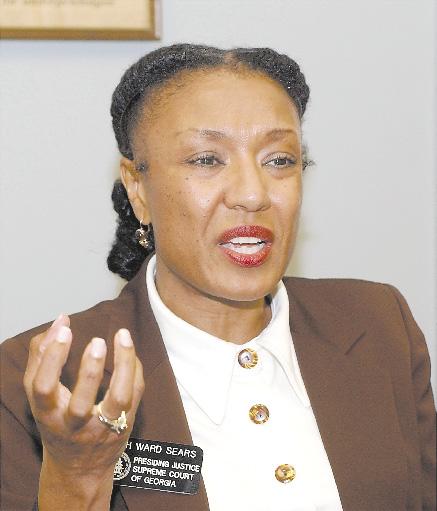

CBS 46 Atlanta - Sears Takes Oath, Makes History
CBS 46 Atlanta - Sears Takes Oath, Makes HistorySears Takes Oath, Makes History
Jun 28, 2005, 5:50 PM
ATLANTA (AP) -- Leah Sears, who survived an attempt by conservatives last year to block her re-election to the state Supreme Court, took the oath of office Tuesday as the court's chief justice, becoming the first woman to hold that position.
With U.S. Supreme Court Justice Clarence Thomas, a longtime friend, looking on, Sears vowed to "strive mightily to uphold the independence and integrity" of the judiciary.
According to the National Center for State Courts based in Williamsburg, Va., Sears is the first black woman ever to head the highest appeals court in any of the 50 states, although there have been women chief judges in the nonfederal appeals courts for the District of Columbia, and a Hispanic woman has been chief justice in New Mexico.
Sears will take office Friday.
She is the second black to head the Georgia Supreme Court.
Absent from the ceremonies, held in the chambers of the state House of Representatives, was Republican Gov. Sonny Perdue, who joined in the GOP effort last year to dump Sears from the court, arguing she did not represent the state's core values. She won the nonpartisan race for a six-year term with 62 percent of the vote.
Perdue's schedule showed he was in north Georgia for an open house at a new GBI crime lab, a visit to a Chamber of Commerce and a visit to a local industry.
Thomas, like Sears a native of the Savannah, Ga., area, called the event "a day when my pride runs deep as a human being, as a member of the judiciary and as a Georgian" and added, "I never thought that in my lifetime I would be able to witness a black woman as the chief justice of the state of Georgia's Supreme Court."
Thomas paid tribute to former ambassador and Atlanta Mayor Andrew Young, who delivered the oath of office to Sears, as a man whose work in the civil rights movement made it "possible for us to be here today in our various capacities and positions to witness this historic event."
He made only a passing reference to the political waiting game over whether there soon will be a vacancy on the nation's highest court.
"As we ended our term at our Supreme Court -- at your Supreme Court -- the winds of controversy swirled about the court's decisions and, unfortunately, about the imagined resignations. As I considered what was happening around our building, I thought about the calm civility of today's events. I thought of the wonderful times that we would have here today," he said.
Thomas also said he was confident Sears will "call them as you see them" and told her, "Those of us who are judges know that it is easy to judge when you already have your mind made up. It is hard to judge when you have to make your mind up."
In her acceptance speech, Sears pledged to continue her the strong push by her predecessor, Norman Fletcher, to implement a statewide indigent defense system to provide lawyers for poor people accused of crimes. She also said she hopes to focus on the plight of the family, noting that two-thirds of court filings now deal with domestic relations issues.
She ended with a call for Georgians to remember their civics lessons about why the judiciary is independent of the executive and legislative branches.
"We must resist all temptations to intimidate judges or to otherwise ask them to answer for the hard decisions that they are being required to make," she said.
"The founders of this great nation of ours intended the judicial branch of government to be a separate, independent, coequal branch of government that answers not to public opinion, polls or politicians, but only to the laws and the Constitutions of the state of Georgia and of the United States of America."
Jun 28, 2005, 5:50 PM
ATLANTA (AP) -- Leah Sears, who survived an attempt by conservatives last year to block her re-election to the state Supreme Court, took the oath of office Tuesday as the court's chief justice, becoming the first woman to hold that position.
With U.S. Supreme Court Justice Clarence Thomas, a longtime friend, looking on, Sears vowed to "strive mightily to uphold the independence and integrity" of the judiciary.
According to the National Center for State Courts based in Williamsburg, Va., Sears is the first black woman ever to head the highest appeals court in any of the 50 states, although there have been women chief judges in the nonfederal appeals courts for the District of Columbia, and a Hispanic woman has been chief justice in New Mexico.
Sears will take office Friday.
She is the second black to head the Georgia Supreme Court.
Absent from the ceremonies, held in the chambers of the state House of Representatives, was Republican Gov. Sonny Perdue, who joined in the GOP effort last year to dump Sears from the court, arguing she did not represent the state's core values. She won the nonpartisan race for a six-year term with 62 percent of the vote.
Perdue's schedule showed he was in north Georgia for an open house at a new GBI crime lab, a visit to a Chamber of Commerce and a visit to a local industry.
Thomas, like Sears a native of the Savannah, Ga., area, called the event "a day when my pride runs deep as a human being, as a member of the judiciary and as a Georgian" and added, "I never thought that in my lifetime I would be able to witness a black woman as the chief justice of the state of Georgia's Supreme Court."
Thomas paid tribute to former ambassador and Atlanta Mayor Andrew Young, who delivered the oath of office to Sears, as a man whose work in the civil rights movement made it "possible for us to be here today in our various capacities and positions to witness this historic event."
He made only a passing reference to the political waiting game over whether there soon will be a vacancy on the nation's highest court.
"As we ended our term at our Supreme Court -- at your Supreme Court -- the winds of controversy swirled about the court's decisions and, unfortunately, about the imagined resignations. As I considered what was happening around our building, I thought about the calm civility of today's events. I thought of the wonderful times that we would have here today," he said.
Thomas also said he was confident Sears will "call them as you see them" and told her, "Those of us who are judges know that it is easy to judge when you already have your mind made up. It is hard to judge when you have to make your mind up."
In her acceptance speech, Sears pledged to continue her the strong push by her predecessor, Norman Fletcher, to implement a statewide indigent defense system to provide lawyers for poor people accused of crimes. She also said she hopes to focus on the plight of the family, noting that two-thirds of court filings now deal with domestic relations issues.
She ended with a call for Georgians to remember their civics lessons about why the judiciary is independent of the executive and legislative branches.
"We must resist all temptations to intimidate judges or to otherwise ask them to answer for the hard decisions that they are being required to make," she said.
"The founders of this great nation of ours intended the judicial branch of government to be a separate, independent, coequal branch of government that answers not to public opinion, polls or politicians, but only to the laws and the Constitutions of the state of Georgia and of the United States of America."
Saturday, June 25, 2005
Test I Review PodCast
CAU MASS COMMUNICATIONS ARTS
Exam I Review PodCasts Summer Semester 2005
Download these mp3 44.1 bps file to your
computer and listen to them in Microsoft
Windows Media Player on your desktop
computer or transfer it to your mp3 player.

        Click On This Link
Sunday, June 05, 2005
ARTHUR ANDERSEN LLP V. UNITED STATES
ARTHUR ANDERSEN LLP V. UNITED STATESSUPREME COURT OF THE UNITED STATES
ARTHUR ANDERSEN LLP v. UNITED STATES
CERTIORARI TO THE UNITED STATES COURT OF APPEALS FOR THE FIFTH CIRCUIT
No. 04—368.Argued April 27, 2005–Decided May 31, 2005
As Enron Corporation’s financial difficulties became public, petitioner, Enron’s auditor, instructed its employees to destroy documents pursuant to its document retention policy. Petitioner was indicted under 18 U.S.C. § 1512(b)(2)(A) and (B), which make it a crime to “knowingly … corruptly persuad[e] another person … with intent to … cause” that person to “withhold” documents from, or “alter” documents for use in, an “official proceeding.” The jury returned a guilty verdict, and the Fifth Circuit affirmed, holding that the District Court’s jury instructions properly conveyed the meaning of “corruptly persuades” and “official proceeding” in §1512(b); that the jury need not find any consciousness of wrongdoing in order to convict; and that there was no reversible error.
Held: The jury instructions failed to convey properly the elements of a “corrup[t] persuas[ion]” conviction under §1512(b). Pp. 6—12.
(a) This Court’s traditional restraint in assessing federal criminal statutes’ reach, see, e.g., United States v. Aguilar, 515 U.S. 593, 600, is particularly appropriate here, where the act underlying the conviction–“persua[sion]”–is by itself innocuous. Even “persuad[ing]” a person “with intent to … cause” that person to “withhold” testimony or documents from the Government is not inherently malign. Under ordinary circumstances, it is not wrongful for a manager to instruct his employees to comply with a valid document retention policy, even though the policy, in part, is created to keep certain information from others, including the Government. Thus, §1512(b)’s “knowingly … corruptly persuades” phrase is key to what may or may not lawfully be done in the situation presented here. The Government suggests that “knowingly” does not modify “corruptly persuades,” but that is not how the statute most naturally reads. “[K]nowledge” and “knowingly” are normally associated with awareness, understanding, or consciousness, and “corrupt” and “corruptly” with wrongful, immoral, depraved, or evil. Joining these meanings together makes sense both linguistically and in the statutory scheme. Only persons conscious of wrongdoing can be said to “knowingly … corruptly persuad[e].” And limiting criminality to persuaders conscious of their wrongdoing sensibly allows §1512(b) to reach only those with the level of culpability usually required to impose criminal liability. See Aguilar, supra, at 602. Pp. 6—9.
(b) The jury instructions failed to convey the requisite consciousness of wrongdoing. Indeed, it is striking how little culpability the instructions required. For example, the jury was told that, even if petitioner honestly and sincerely believed its conduct was lawful, the jury could convict. The instructions also diluted the meaning of “corruptly” such that it covered innocent conduct. The District Court based its instruction on the Fifth Circuit Pattern Jury Instruction for §1503, which defined “corruptly” as “knowingly and dishonestly, with the specific intent to subvert or undermine the integrity” of a proceeding. However, the court agreed with the Government’s insistence on excluding “dishonestly” and adding the term “impede” to the phrase “subvert or undermine,” so the jury was told to convict if it found petitioner intended to “subvert, undermine, or impede” governmental factfinding by suggesting to its employees that they enforce the document retention policy. These changes were significant. “[D]ishonest[y]” was no longer necessary to a finding of guilt, and it was enough for petitioner to have simply “impede[d]” the Government’s factfinding ability. “Impede” has broader connotations than “subvert” or even “undermine,” and many of these connotations do not incorporate any “corrupt[ness]” at all. Under the dictionary definition of “impede,” anyone who innocently persuades another to withhold information from the Government “get[s] in the way of the progress of” the Government. With regard to such innocent conduct, the “corruptly” instructions did no limiting work whatsoever. The instructions also led the jury to believe that it did not have to find any nexus between the “persua[sion]” to destroy documents and any particular proceeding. In resisting any nexus element, the Government relies on §1512(e)(1), which states that an official proceeding “need not be pending or about to be instituted at the time of the offense.” It is, however, quite another thing to say a proceeding need not even be foreseen. A “knowingly … corrup[t] persaude[r]” cannot be someone who persuades others to shred documents under a document retention policy when he does not have in contemplation any particular official proceeding in which those documents might be material. Cf. Aguilar, supra, at 599—600. Pp. 9—12.
374 F.3d 281, reversed and remanded.
Rehnquist, C. J., delivered the opinion for a unanimous Court.
ARTHUR ANDERSEN LLP v. UNITED STATES
CERTIORARI TO THE UNITED STATES COURT OF APPEALS FOR THE FIFTH CIRCUIT
No. 04—368.Argued April 27, 2005–Decided May 31, 2005
As Enron Corporation’s financial difficulties became public, petitioner, Enron’s auditor, instructed its employees to destroy documents pursuant to its document retention policy. Petitioner was indicted under 18 U.S.C. § 1512(b)(2)(A) and (B), which make it a crime to “knowingly … corruptly persuad[e] another person … with intent to … cause” that person to “withhold” documents from, or “alter” documents for use in, an “official proceeding.” The jury returned a guilty verdict, and the Fifth Circuit affirmed, holding that the District Court’s jury instructions properly conveyed the meaning of “corruptly persuades” and “official proceeding” in §1512(b); that the jury need not find any consciousness of wrongdoing in order to convict; and that there was no reversible error.
Held: The jury instructions failed to convey properly the elements of a “corrup[t] persuas[ion]” conviction under §1512(b). Pp. 6—12.
(a) This Court’s traditional restraint in assessing federal criminal statutes’ reach, see, e.g., United States v. Aguilar, 515 U.S. 593, 600, is particularly appropriate here, where the act underlying the conviction–“persua[sion]”–is by itself innocuous. Even “persuad[ing]” a person “with intent to … cause” that person to “withhold” testimony or documents from the Government is not inherently malign. Under ordinary circumstances, it is not wrongful for a manager to instruct his employees to comply with a valid document retention policy, even though the policy, in part, is created to keep certain information from others, including the Government. Thus, §1512(b)’s “knowingly … corruptly persuades” phrase is key to what may or may not lawfully be done in the situation presented here. The Government suggests that “knowingly” does not modify “corruptly persuades,” but that is not how the statute most naturally reads. “[K]nowledge” and “knowingly” are normally associated with awareness, understanding, or consciousness, and “corrupt” and “corruptly” with wrongful, immoral, depraved, or evil. Joining these meanings together makes sense both linguistically and in the statutory scheme. Only persons conscious of wrongdoing can be said to “knowingly … corruptly persuad[e].” And limiting criminality to persuaders conscious of their wrongdoing sensibly allows §1512(b) to reach only those with the level of culpability usually required to impose criminal liability. See Aguilar, supra, at 602. Pp. 6—9.
(b) The jury instructions failed to convey the requisite consciousness of wrongdoing. Indeed, it is striking how little culpability the instructions required. For example, the jury was told that, even if petitioner honestly and sincerely believed its conduct was lawful, the jury could convict. The instructions also diluted the meaning of “corruptly” such that it covered innocent conduct. The District Court based its instruction on the Fifth Circuit Pattern Jury Instruction for §1503, which defined “corruptly” as “knowingly and dishonestly, with the specific intent to subvert or undermine the integrity” of a proceeding. However, the court agreed with the Government’s insistence on excluding “dishonestly” and adding the term “impede” to the phrase “subvert or undermine,” so the jury was told to convict if it found petitioner intended to “subvert, undermine, or impede” governmental factfinding by suggesting to its employees that they enforce the document retention policy. These changes were significant. “[D]ishonest[y]” was no longer necessary to a finding of guilt, and it was enough for petitioner to have simply “impede[d]” the Government’s factfinding ability. “Impede” has broader connotations than “subvert” or even “undermine,” and many of these connotations do not incorporate any “corrupt[ness]” at all. Under the dictionary definition of “impede,” anyone who innocently persuades another to withhold information from the Government “get[s] in the way of the progress of” the Government. With regard to such innocent conduct, the “corruptly” instructions did no limiting work whatsoever. The instructions also led the jury to believe that it did not have to find any nexus between the “persua[sion]” to destroy documents and any particular proceeding. In resisting any nexus element, the Government relies on §1512(e)(1), which states that an official proceeding “need not be pending or about to be instituted at the time of the offense.” It is, however, quite another thing to say a proceeding need not even be foreseen. A “knowingly … corrup[t] persaude[r]” cannot be someone who persuades others to shred documents under a document retention policy when he does not have in contemplation any particular official proceeding in which those documents might be material. Cf. Aguilar, supra, at 599—600. Pp. 9—12.
374 F.3d 281, reversed and remanded.
Rehnquist, C. J., delivered the opinion for a unanimous Court.
Japan Today - News - U.S. Supreme Court overturns Arthur Andersen conviction - Japan's Leading International News Network
Japan Today - News - U.S. Supreme Court overturns Arthur Andersen conviction - Japan's Leading International News NetworkU.S. Supreme Court overturns Arthur Andersen conviction
Send to a friendPrint
Wednesday, June 1, 2005 at 07:50 JST
WASHINGTON — The U.S. Supreme Court on Tuesday dealt a blow to the government's corporate fraud crackdown, overturning the criminal conviction of Arthur Andersen, the accounting giant put out of business for its role in the Enron scandal.
Chief Justice William Rehnquist wrote for a unanimous Supreme Court that the case against the former Big Five accounting firm was "flawed" because of the instructions given to the jury telling them what was needed for a conviction.
The chief justice said the jury instructions "simply failed to convey the requisite consciousness of wrongdoing. Indeed, it is striking how little culpability the instructions required."
The Chicago-based accounting firm was shut down after its 2002 conviction on criminal obstruction of justice charges for the destruction of documents for its client, Enron, as a regulatory probe was underway.
While the court ruling appeared to be based on technical factors, the opinion suggested the government would have to show a stronger finding of criminal intent for a similar conviction.
Andersen was convicted in June 2002 after a jury found that lawyers for the company "corruptly" persuaded employees to destroy documents that could have been relevant to a then looming investigation by the Securities and Exchange Commission.
Enron was Andersen's largest client and relied on the firm for auditing, accounting and consulting advice. Andersen also overlooked some of the accounting schemes that hid the energy firm's massive debts.
But Rehnquist wrote that the interpretation given to the jury for a guilty verdict was too broad and vague.
"Consider, for instance, a mother who suggests to her son that he invoke his right against compelled self-incrimination ... or a wife who persuades her husband not to disclose marital confidences," the justice wrote.
"It is, of course, not wrongful for a manager to instruct his employees to comply with a valid document retention policy under ordinary circumstances."
Prosecutors said they would review the ruling before deciding on whether to seek a new trial.
"The Department of Justice is disappointed in today's decision by the Supreme Court regarding jury instructions given in the case, but of course we respect the Court's decision," said acting Assistant Attorney General John Richter.
"We remain convinced that even the most powerful corporations have the responsibility of adhering to the rule of law."
Andersen, a partnership that still faces civil litigation in a number of cases, said it was "very pleased" with the ruling, "which acknowledges the fundamental injustice that has been done to Arthur Andersen and its former personnel and retirees."
The statement said the former audit firm appealed "not because we believed Arthur Andersen could be restored to its previous position, but because we had an obligation to set the record straight and clear the good name of the 28,000 innocent people who lost their jobs at the time of the indictment and tens of thousands of Andersen alumni, as well as to help secure a fair resolution of the civil litigation facing the firm."
Some experts doubted the government would retry the case, with Andersen out of business.
"It's unfortunate for Andersen, because they are out of business," said Texas lawyer Tom Ajamie, who represents people who lost money in Enron and other corporate fraud cases.
"But let's not forget that Andersen was the auditor for WorldCom, which collapsed, and for Sunbeam, which was found to be fraudulent and for many of the telecom companies that collapsed. And of course they were the auditors for Enron before its collapse ... the auditors are supposed to be the front line of protection" against fraud. (Wire reports)
Send to a friendPrint
Wednesday, June 1, 2005 at 07:50 JST
WASHINGTON — The U.S. Supreme Court on Tuesday dealt a blow to the government's corporate fraud crackdown, overturning the criminal conviction of Arthur Andersen, the accounting giant put out of business for its role in the Enron scandal.
Chief Justice William Rehnquist wrote for a unanimous Supreme Court that the case against the former Big Five accounting firm was "flawed" because of the instructions given to the jury telling them what was needed for a conviction.
The chief justice said the jury instructions "simply failed to convey the requisite consciousness of wrongdoing. Indeed, it is striking how little culpability the instructions required."
The Chicago-based accounting firm was shut down after its 2002 conviction on criminal obstruction of justice charges for the destruction of documents for its client, Enron, as a regulatory probe was underway.
While the court ruling appeared to be based on technical factors, the opinion suggested the government would have to show a stronger finding of criminal intent for a similar conviction.
Andersen was convicted in June 2002 after a jury found that lawyers for the company "corruptly" persuaded employees to destroy documents that could have been relevant to a then looming investigation by the Securities and Exchange Commission.
Enron was Andersen's largest client and relied on the firm for auditing, accounting and consulting advice. Andersen also overlooked some of the accounting schemes that hid the energy firm's massive debts.
But Rehnquist wrote that the interpretation given to the jury for a guilty verdict was too broad and vague.
"Consider, for instance, a mother who suggests to her son that he invoke his right against compelled self-incrimination ... or a wife who persuades her husband not to disclose marital confidences," the justice wrote.
"It is, of course, not wrongful for a manager to instruct his employees to comply with a valid document retention policy under ordinary circumstances."
Prosecutors said they would review the ruling before deciding on whether to seek a new trial.
"The Department of Justice is disappointed in today's decision by the Supreme Court regarding jury instructions given in the case, but of course we respect the Court's decision," said acting Assistant Attorney General John Richter.
"We remain convinced that even the most powerful corporations have the responsibility of adhering to the rule of law."
Andersen, a partnership that still faces civil litigation in a number of cases, said it was "very pleased" with the ruling, "which acknowledges the fundamental injustice that has been done to Arthur Andersen and its former personnel and retirees."
The statement said the former audit firm appealed "not because we believed Arthur Andersen could be restored to its previous position, but because we had an obligation to set the record straight and clear the good name of the 28,000 innocent people who lost their jobs at the time of the indictment and tens of thousands of Andersen alumni, as well as to help secure a fair resolution of the civil litigation facing the firm."
Some experts doubted the government would retry the case, with Andersen out of business.
"It's unfortunate for Andersen, because they are out of business," said Texas lawyer Tom Ajamie, who represents people who lost money in Enron and other corporate fraud cases.
"But let's not forget that Andersen was the auditor for WorldCom, which collapsed, and for Sunbeam, which was found to be fraudulent and for many of the telecom companies that collapsed. And of course they were the auditors for Enron before its collapse ... the auditors are supposed to be the front line of protection" against fraud. (Wire reports)
Thursday, May 19, 2005
SignOnSanDiego.com > News > State -- Republicans see Calif. jurist as model for filibuster fight
SignOnSanDiego.com > News > State -- Republicans see Calif. jurist as model for filibuster fightRepublicans see Calif. jurist as model for filibuster fight
By David Kravets
ASSOCIATED PRESS
12:08 a.m. May 19, 2005
SAN FRANCISCO – Janice Rogers Brown, a sharecropper's daughter who became the first black and most conservative justice on California's Supreme Court, is a model jurist for U.S. Senate Republicans fighting judicial filibusters.
So while another of President Bush's judicial nominees, Texas Supreme Court Justice Priscilla Owen, is likely to be the flashpoint for a showdown over whether Democrats should be able to stop appointments to the nation's highest courts, Brown is being debated just as much on the Senate floor this week.
In many ways, Brown's court rulings and speeches mirror the thinking of Bush and conservatives coast to coast.
An outspoken Christian conservative from the segregated South, she supports limits on abortion rights and corporate liability, routinely upholds the death penalty and opposes affirmative action.
"A lot of judges get to the point they think they were anointed and not appointed," Sen. Jeff Sessions, R-Ala., said Tuesday during floor debate. "I don't think anyone can contend she has performed other than admirably on the bench. She has written beautifully and thoughtfully."
Brown's views are also why Democrats have used a filibuster since 2003 to block her confirmation for a seat on the U.S. Court of Appeals for the District of Columbia Circuit. The Senate's 55 Republicans have a clear majority to confirm but not the 60 votes need to break the filibuster.
"She has criticized the New Deal, which gave us Social Security, the minimum wage, and fair labor laws. She's questioned whether age discrimination laws benefit the public interest," said Sen. Edward Kennedy, D-Mass. "No one with these views should be confirmed to a federal court and certainly not to the federal court most responsible for cases affecting government action."
Brown, 56, caught the attention of conservatives with her majority opinion in 2000 striking down a San Jose city ordinance requiring government contractors to solicit bids from companies owned by women and minorities. Her opinion traced the legal history of race in America, portraying it as ebbing and flowing on whether government should treat all races equally.
Her 40-page conclusion boiled down to this: People should be treated equally, regardless of race.
Even if an ordinance assists minorities, Brown wrote, "benign motivation cannot sanction a requirement that conflicts with the proscription against discrimination and preferential treatment on the basis of race and sex."
California's chief justice, Ronald M. George, concurred with Brown's opinion but attacked her portrayal of affirmative action as "entitlement based on group representation," calling it a "serious distortion of history."
Brown's position, however, meshes well with the philosophy of the Bush administration, which two years ago told the U.S. Supreme Court that it opposed the University of Michigan's race-based admissions policies. In February, she kept up her affirmative action attacks, deciding against safeguards protecting black women from being removed from juries by biased prosecutors.
Her father moved his family from rural Alabama to Sacramento after joining the Air Force. Brown graduated in 1977 from the University of California, Los Angeles School of Law, then worked in state government and for several Republican governors.
Close friend Douglas Kmiec, a Pepperdine School of Law professor, said Brown became a lawyer after her grandmother espoused the virtues of civil rights attorney Fred Gray, who defended Rosa Parks and Martin Luther King Jr.
When Kmiec introduced Brown to the graduating law students at Catholic University in 2003, he said she formulates opinions "in prayer and quiet study of the Bible." Brown then took the podium and criticized philosophers and scientists for trying to mold society "as if God did not exist."
The law, she said, is the "terrain on which Americans are struggling to decide what kind of people they are."
She defended her faith-based approach to the law again last month, telling a gathering of Roman Catholic legal professionals in Darien, Conn., that "these are perilous times for people of faith, not in the sense that we are going to lose our lives, but in the sense that it will cost you something if you are a person of faith who stands up for what you believe in and say those things out loud."
Brown worked 12 years as a state government lawyer before joining a lobbying and legislative law firm led by former Republican Gov. George Deukmejian's chief of staff, Steve Merksamer. Then she became legal affairs secretary to Republican Gov. Pete Wilson, who nominated her to a state appellate court in 1994.
Two years later, Wilson nominated her to the California Supreme Court. She was confirmed in 1996 over the concerns of the state's judicial vetting committee, which rated her "not qualified" because of her limited judicial experience.
Brown has two children and lives in Sacramento with her husband, jazz musician Dewey Parker.
"She's a brilliant African American woman who is able to articulate a conservative judicial philosophy, and the Democrats can't stand it," Merksamer said. "I think it upsets the orthodoxy of the left to have someone who is brilliant and articulate who also happens to be black and female."
Opponents don't see it that way.
"They're hoping that people will feel uncomfortable opposing an African American woman whose father was a sharecropper," said Eva Paterson, president of the Equal Justice Society, a liberal think tank that opposes Brown's nomination.
Regardless, Brown's rulings have shown sympathy at times to the plight of minorities.
In 2002, the California justices upheld the drug conviction of a black man stopped for riding his bicycle the wrong way on a one-way street. Police searched the man, found methamphetamine, and he was convicted and sentenced to nearly three years.
The majority, in upholding the conviction, left it to the "judgment of the arresting officer" on whether to make an arrest under the circumstances. In her lone dissent, Brown said the decision left open the door to racial profiling.
Brown showed less mercy when it comes to the death penalty, writing that "murderers do not deserve a fate better than that inflicted on their victims."
On abortion, Brown wrote a scathing dissent in 1997 to a ruling which struck down a parental consent law, calling her colleagues "philosopher kings."
Editors: David Kravets has been covering state and federal courts for more than a decade.
Profile of a justice
NAME – Janice Rogers Brown.
AGE-BIRTH DATE – 56, Born May 11, 1949, Greenville, Ala.
EDUCATION – B.A. California State University, Sacramento, 1974; J.D. University of California, Los Angeles School of Law, 1977; LL.M. University of Virginia School of Law, 2004.
EXPERIENCE – Associate Justice, California Supreme Court, 1996 to present; Associate justice, Sacramento-based 3rd District Court of Appeals, 1994-1996 (both appointments were by former California Gov. Pete Wilson); Wilson's legal affairs secretary, 1991-1994; Sacramento lobbying law firm of Nielsen, Merksamer, Parrinello & Mueller, 1989-1991; general counsel, California Business, Transportation and Housing Agency, 1987-1989; deputy California attorney general, 1977-1987.
FAMILY – Married to Dewey Parker, a jazz musician. Two children.
QUOTE – "These are perilous times for people of faith, not in the sense that we are going to lose our lives, but in the sense that it will cost you something if you are a person of faith who stands up for what you believe in and say those things out loud."
By David Kravets
ASSOCIATED PRESS
12:08 a.m. May 19, 2005
SAN FRANCISCO – Janice Rogers Brown, a sharecropper's daughter who became the first black and most conservative justice on California's Supreme Court, is a model jurist for U.S. Senate Republicans fighting judicial filibusters.
So while another of President Bush's judicial nominees, Texas Supreme Court Justice Priscilla Owen, is likely to be the flashpoint for a showdown over whether Democrats should be able to stop appointments to the nation's highest courts, Brown is being debated just as much on the Senate floor this week.
In many ways, Brown's court rulings and speeches mirror the thinking of Bush and conservatives coast to coast.
An outspoken Christian conservative from the segregated South, she supports limits on abortion rights and corporate liability, routinely upholds the death penalty and opposes affirmative action.
"A lot of judges get to the point they think they were anointed and not appointed," Sen. Jeff Sessions, R-Ala., said Tuesday during floor debate. "I don't think anyone can contend she has performed other than admirably on the bench. She has written beautifully and thoughtfully."
Brown's views are also why Democrats have used a filibuster since 2003 to block her confirmation for a seat on the U.S. Court of Appeals for the District of Columbia Circuit. The Senate's 55 Republicans have a clear majority to confirm but not the 60 votes need to break the filibuster.
"She has criticized the New Deal, which gave us Social Security, the minimum wage, and fair labor laws. She's questioned whether age discrimination laws benefit the public interest," said Sen. Edward Kennedy, D-Mass. "No one with these views should be confirmed to a federal court and certainly not to the federal court most responsible for cases affecting government action."
Brown, 56, caught the attention of conservatives with her majority opinion in 2000 striking down a San Jose city ordinance requiring government contractors to solicit bids from companies owned by women and minorities. Her opinion traced the legal history of race in America, portraying it as ebbing and flowing on whether government should treat all races equally.
Her 40-page conclusion boiled down to this: People should be treated equally, regardless of race.
Even if an ordinance assists minorities, Brown wrote, "benign motivation cannot sanction a requirement that conflicts with the proscription against discrimination and preferential treatment on the basis of race and sex."
California's chief justice, Ronald M. George, concurred with Brown's opinion but attacked her portrayal of affirmative action as "entitlement based on group representation," calling it a "serious distortion of history."
Brown's position, however, meshes well with the philosophy of the Bush administration, which two years ago told the U.S. Supreme Court that it opposed the University of Michigan's race-based admissions policies. In February, she kept up her affirmative action attacks, deciding against safeguards protecting black women from being removed from juries by biased prosecutors.
Her father moved his family from rural Alabama to Sacramento after joining the Air Force. Brown graduated in 1977 from the University of California, Los Angeles School of Law, then worked in state government and for several Republican governors.
Close friend Douglas Kmiec, a Pepperdine School of Law professor, said Brown became a lawyer after her grandmother espoused the virtues of civil rights attorney Fred Gray, who defended Rosa Parks and Martin Luther King Jr.
When Kmiec introduced Brown to the graduating law students at Catholic University in 2003, he said she formulates opinions "in prayer and quiet study of the Bible." Brown then took the podium and criticized philosophers and scientists for trying to mold society "as if God did not exist."
The law, she said, is the "terrain on which Americans are struggling to decide what kind of people they are."
She defended her faith-based approach to the law again last month, telling a gathering of Roman Catholic legal professionals in Darien, Conn., that "these are perilous times for people of faith, not in the sense that we are going to lose our lives, but in the sense that it will cost you something if you are a person of faith who stands up for what you believe in and say those things out loud."
Brown worked 12 years as a state government lawyer before joining a lobbying and legislative law firm led by former Republican Gov. George Deukmejian's chief of staff, Steve Merksamer. Then she became legal affairs secretary to Republican Gov. Pete Wilson, who nominated her to a state appellate court in 1994.
Two years later, Wilson nominated her to the California Supreme Court. She was confirmed in 1996 over the concerns of the state's judicial vetting committee, which rated her "not qualified" because of her limited judicial experience.
Brown has two children and lives in Sacramento with her husband, jazz musician Dewey Parker.
"She's a brilliant African American woman who is able to articulate a conservative judicial philosophy, and the Democrats can't stand it," Merksamer said. "I think it upsets the orthodoxy of the left to have someone who is brilliant and articulate who also happens to be black and female."
Opponents don't see it that way.
"They're hoping that people will feel uncomfortable opposing an African American woman whose father was a sharecropper," said Eva Paterson, president of the Equal Justice Society, a liberal think tank that opposes Brown's nomination.
Regardless, Brown's rulings have shown sympathy at times to the plight of minorities.
In 2002, the California justices upheld the drug conviction of a black man stopped for riding his bicycle the wrong way on a one-way street. Police searched the man, found methamphetamine, and he was convicted and sentenced to nearly three years.
The majority, in upholding the conviction, left it to the "judgment of the arresting officer" on whether to make an arrest under the circumstances. In her lone dissent, Brown said the decision left open the door to racial profiling.
Brown showed less mercy when it comes to the death penalty, writing that "murderers do not deserve a fate better than that inflicted on their victims."
On abortion, Brown wrote a scathing dissent in 1997 to a ruling which struck down a parental consent law, calling her colleagues "philosopher kings."
Editors: David Kravets has been covering state and federal courts for more than a decade.
Profile of a justice
NAME – Janice Rogers Brown.
AGE-BIRTH DATE – 56, Born May 11, 1949, Greenville, Ala.
EDUCATION – B.A. California State University, Sacramento, 1974; J.D. University of California, Los Angeles School of Law, 1977; LL.M. University of Virginia School of Law, 2004.
EXPERIENCE – Associate Justice, California Supreme Court, 1996 to present; Associate justice, Sacramento-based 3rd District Court of Appeals, 1994-1996 (both appointments were by former California Gov. Pete Wilson); Wilson's legal affairs secretary, 1991-1994; Sacramento lobbying law firm of Nielsen, Merksamer, Parrinello & Mueller, 1989-1991; general counsel, California Business, Transportation and Housing Agency, 1987-1989; deputy California attorney general, 1977-1987.
FAMILY – Married to Dewey Parker, a jazz musician. Two children.
QUOTE – "These are perilous times for people of faith, not in the sense that we are going to lose our lives, but in the sense that it will cost you something if you are a person of faith who stands up for what you believe in and say those things out loud."
Wednesday, May 11, 2005
Students: Please Contact Me by Email Regarding Grades
Clink on the title bar above or email me at armwood@armwood.com. Make sure you respond to the verification email that you will receive from my email server.
Saturday, May 07, 2005
Communications Law Summer Class Schedule (425-01)
Communications Law (425-01)
Classes will meet this summer on Wednesdays beginning at 0800 and end at 1340. Classes begin Wednesday June 8th 2005 at 0800.
CAU Summer Schedule of Classes
The schedule is in the PDF format
Download Acrobat Reader Here To View PDF Files
Classes will meet this summer on Wednesdays beginning at 0800 and end at 1340. Classes begin Wednesday June 8th 2005 at 0800.
CAU Summer Schedule of Classes
The schedule is in the PDF format
Download Acrobat Reader Here To View PDF Files
Subscribe to:
Posts (Atom)